About Maharashtra Police Constable 2027 Exam Series
📖 Table of Contents
- Maharashtra Police Constable 2027 at a glance
- The 17,471 posts, post by post
- A newer drive followed in 2025, and why this guide still starts with 2024
- Who can apply
- How selection works, stage by stage
- The physical standard test
- The physical efficiency test, event by event
- Maharashtra Police Constable exam pattern: the written paper
- What to study in each subject
- Pay, allowances and the first posting
- How to apply when the next advertisement opens
- A plan that respects the 150 mark total
- Where candidates lose marks they already earned
- Sources
Maharashtra Police Constable 2027: Complete Exam Guide
The Maharashtra Police Constable 2027 page on this site follows the last fully run recruitment drive, and that drive is the 2024 cycle. The Maharashtra Police Department advertised 17,471 constable posts in March 2024. Applications ran from 5 March to 15 April 2024. The physical test ran from 19 June to 27 July 2024, and the written examination started on 7 July 2024, unit by unit. No separate 2027 notification has been published as of 22 November 2026, so this guide anchors on the 2024 cycle and says so wherever a 2027 figure would otherwise be guessed.
That honesty about the year matters more here than in most examinations. Maharashtra Police runs this recruitment unit by unit, which means each district, each commissionerate and each State Reserve Police Force group publishes its own advertisement, its own dates and its own merit list under one state wide drive. A candidate in Pune and a candidate in Nagpur can sit the same drive on different dates and read different cut offs. Any guide that quotes a single national style date for the whole state is guessing. This guide gives the state wide figures from the 2024 cycle, names the unit where a figure varies, and flags every number that trackers disagree about.
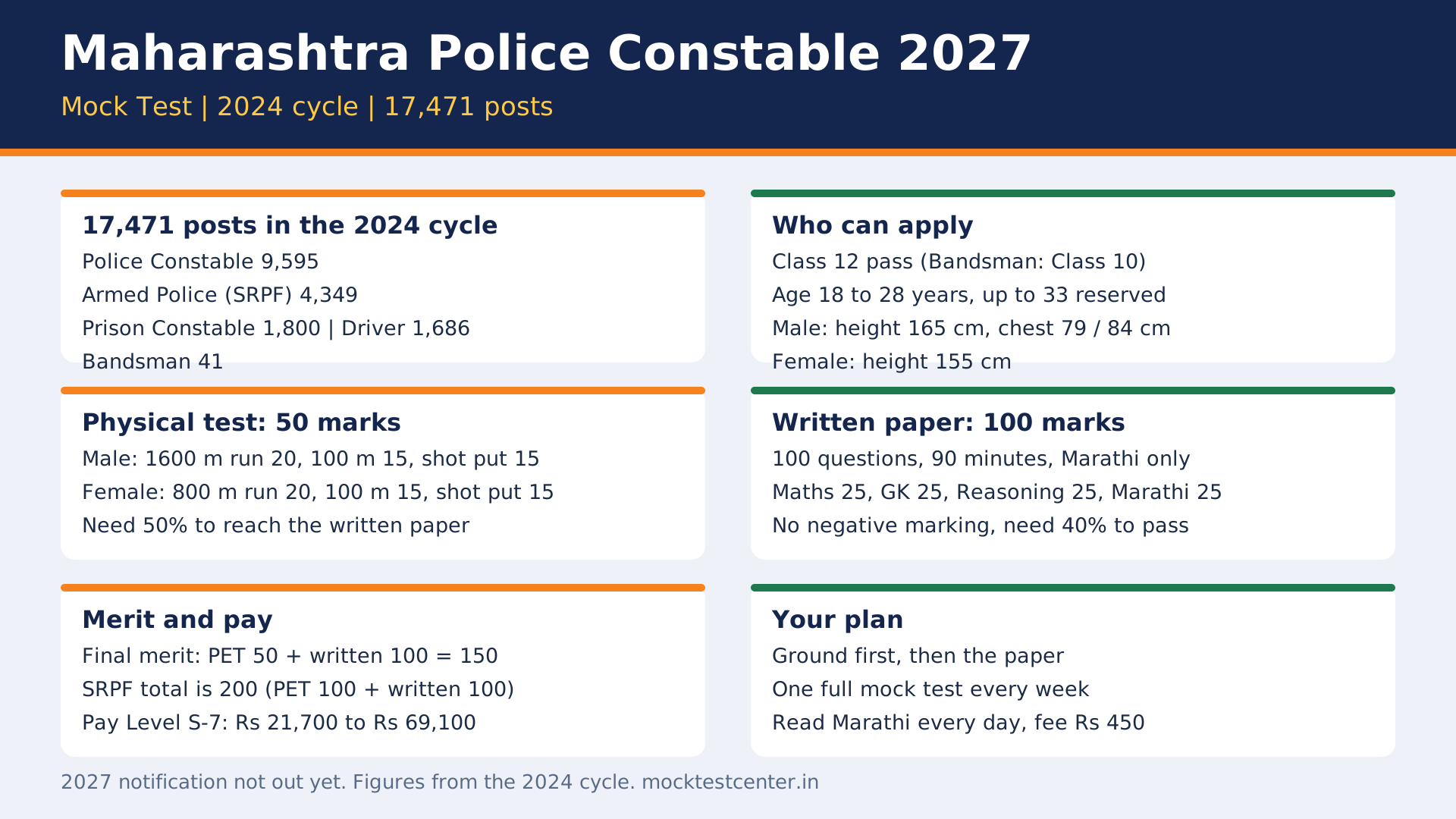
The shape of the selection is simple once you see it whole. The physical test comes first and carries 50 marks. The written paper comes next and carries 100 marks. Final merit adds the two together, 150 marks in all, except for Armed Police Constable posts in the State Reserve Police Force, where the physical test carries 100 marks and the total is 200. There is no interview. There is no negative marking in the written paper. The written paper is set in Marathi only, and a candidate needs 40 percent in it to stay in the race. Those five facts decide how a sensible candidate divides study time, and this guide returns to them throughout.
Maharashtra Police Constable 2027 at a glance
| Detail | Maharashtra Police Constable 2027, as run in the 2024 cycle |
|---|---|
| Conducting body | Maharashtra Police Department, Home Department, Government of Maharashtra |
| Posts in live cycle | 17,471 across five post types |
| Notification | 1 March 2024, advertised unit by unit |
| Applications | 5 March to 15 April 2024, extended from 31 March 2024 |
| Fee | Rs 450 |
| Physical test | 19 June to 27 July 2024, unit by unit |
| Written examination | From 7 July 2024 onwards, unit by unit, OMR based |
| Hall ticket | Released 14 June 2024 on policerecruitment2024.mahait.org |
| Education | Class 12 pass, Bandsman Class 10 pass |
| Age | 18 to 28 years for open category, up to 33 years for reserved categories |
| Physical test | 50 marks, need 50 percent to reach the written paper |
| Written paper | 100 questions, 100 marks, 90 minutes, Marathi only, no negative marking, need 40 percent |
| Final merit | Physical test 50 plus written paper 100, total 150, SRPF total 200 |
| Pay | Level S-7, Rs 21,700 to Rs 69,100 |
| 2027 notification | Not published as of 22 November 2026 |
The 17,471 posts, post by post
The headline number hides five different jobs, and the five jobs do not share the same work, the same physical test or the same number of seats. The largest block is the Police Constable, the district and commissionerate constable most candidates picture when they say police bharti. The 2024 cycle carried 9,595 of these posts. That is more than half the drive, and it is the post where the competition is widest, because every Class 12 pass candidate in the state can apply for it.
The second block is the Armed Police Constable in the State Reserve Police Force, known as SRPF, with 4,349 posts. SRPF constables serve in armed battalions rather than police stations, and their physical test is harder and longer. A candidate who applies for SRPF should know before training starts that the physical test carries 100 marks instead of 50, with a 5 kilometre run worth 50 marks on its own. The written paper is the same 100 mark paper, so the SRPF total is 200 marks.
The third block is the Prison Constable, or Jail Constable, with 1,800 posts. These constables serve in prisons under the prison department. The fourth block is the Police Constable Driver, with 1,686 posts, which adds a driving skill test after the written paper. The fifth and smallest block is the Police Constable Bandsman, with 41 posts, for the police band, which accepts Class 10 pass candidates and adds a music skill test. Add the five blocks together, 9,595 plus 4,349 plus 1,800 plus 1,686 plus 41, and the total is exactly 17,471.
That exact sum matters because tracker sites disagree about the total. Some report 17,641, some report 17,311, and one tracker reports 16,524 for the constable posts alone. The post wise split above comes from the unit wise advertisements as reported by Defence Job Portal, and it is the only split whose parts add to a total that other trackers also report. This guide uses 17,471 throughout and lists the conflicting totals in the sources note at the end so a reader can see the disagreement instead of finding it later on another site.
One more number helps put the drive in scale. The cycle before this one, the 2022-23 cycle, carried 18,331 posts according to the vacancy trend compiled by TaiyarHo. The 2024 cycle is slightly smaller, and the next cycle after it, the 2024-25 drive advertised in October 2025, is smaller still at 15,631 posts. The direction of travel is downward, which means cut offs do not fall just because a new drive is announced. A candidate who waits for a bigger drive may wait a long time.
A newer drive followed in 2025, and why this guide still starts with 2024
Readers who search for this examination today will meet a second set of dates, and they deserve a straight account of it. One tracker, TaiyarHo, reports a Police Bharti 2024-25 drive approved by a Home Department government resolution dated 20 August 2025, with a notification on 29 October 2025, applications from 29 October to 7 December 2025, a fee of Rs 450 for open category and Rs 350 for reserved category candidates, and 15,631 posts split as Police Constable 12,399, Armed Police Constable 2,393, Jail Constable 580, Driver Constable 234 and Bandsman 25. The same tracker reports physical tests from 11 December 2025 to 11 February 2026, written examinations from March 2026, and provisional selection lists published unit by unit from late March 2026.
This guide treats that 2024-25 drive as reported by a single tracker, not as confirmed from an official notification. No second tracker found in this research carries the same dates, and the official site mahapolice.gov.in was checked by the tracker 9curry on 22 November 2026 with no new recruitment notification found. The pattern, the physical standards and the written paper in the 2024-25 account match the 2024 cycle exactly, which is reassuring, but a match in pattern is not proof of a notification. Candidates should check mahapolice.gov.in and their own district unit website before treating any 2025 date as settled.
There is also a claim floating around that a fresh notification for 17,471 posts was issued in November 2026. That claim appears on one low quality blog, Brinto, which gives no advertisement number and no government resolution date. It repeats the 2024 post count word for word, which suggests it is a rewrite of the 2024 drive rather than a new announcement. This guide does not use it. The upload pre-check for this page should confirm the position on mahapolice.gov.in before the page goes live.
The reason this guide still anchors on 2024 is simple. The 2024 cycle is the last drive whose dates, post split, fee and results are reported by several independent trackers and tied to a live application portal, policerecruitment2024.mahait.org. A guide anchored on a single source drive would hand readers dates they cannot verify. The 2024 figures are verifiable, and the examination pattern has stayed the same across the 2022-23, 2024 and 2024-25 accounts, so preparation built on the 2024 pattern stays valid whatever the next notification says.
Who can apply
The education rule is short. A candidate needs a Class 12 pass, known in Maharashtra as HSC, from a recognised board. The subject stream does not matter. Arts, commerce and science candidates sit the same paper. The only exception is the Bandsman post, which accepts a Class 10 pass, known as SSC. A candidate who has finished Class 12 but is waiting for a result should read the unit advertisement before applying, because the advertisement sets the date by which the pass certificate must be in hand, and that date differs between units.
The age rule is 18 to 28 years for open category candidates. Reserved category candidates get five extra years, up to 33 years. Further relaxations apply for ex-servicemen, home guards, sportspersons, police wards and candidates affected by projects or earthquakes, as listed in each unit advertisement. The 2024-25 account also mentions a one time relief for candidates who went over age during the 2022-23 drives, granted by the government resolution of 20 August 2025. That relief is tracker reported, and a candidate who hopes to use it should confirm it in the unit advertisement rather than assume it carries into the next drive.
Domicile shapes the category a candidate can claim. Maharashtra domicile is needed to claim reservation benefits under OBC, SC or ST categories. A candidate from another state can apply, but only in the open or general category. That rule catches outstation candidates every cycle, because the application form accepts the entry and the problem surfaces only at document verification, after the physical and written tests are done. A candidate without a Maharashtra domicile certificate should apply in the open category from the start.
There is no limit on the number of attempts stated in the advertisements, and there is no minimum percentage in Class 12. The barriers are age, education and the physical standards. That makes this examination unusually open. A candidate who missed a graduate level examination for want of a degree can still apply here, and a candidate who is 28 and has never applied before is still inside the age window. The open door is also the reason the applicant count runs into lakhs, and the physical test becomes the first real filter.
How selection works, stage by stage
Selection runs in six stages, and the order matters. The physical standard test comes first, and it is qualifying only. Height and chest are measured, and a candidate who fails a measurement goes home the same day. The physical efficiency test comes second, and it carries marks. A candidate needs at least 50 percent in it, 25 out of 50, to reach the written paper. The written examination comes third, and it carries 100 marks. A candidate needs at least 40 percent in it, 40 out of 100, to stay in the merit list.
After the written paper, the stages turn qualifying again. Driver and Bandsman candidates face a skill test, driving for drivers and music for bandsmen. Then comes the medical examination, and then document verification. The final merit list adds the physical efficiency test marks to the written paper marks. The physical standard test, the skill test, the medical examination and document verification add no marks. They can only remove a candidate.
One detail in that sequence surprises first time candidates. The physical test comes before the written paper, not after it. Some trackers describe the order the other way round, and one tracker, 9curry, states that selection runs through a written examination followed by a physical efficiency test. The 2024 timeline settles the question. The physical test ran from 19 June to 27 July 2024 and the written examination started on 7 July 2024 for units whose physical tests had finished. A candidate prepares for the ground first and the paper second, because the ground decides whether there is a paper at all.
The shortlist between the two marked stages is steep. Candidates who score at least 50 percent in the physical test are called for the written paper in the ratio of one to ten against the vacancies in each category. For a unit with 100 posts, about 1,000 candidates in each category reach the written paper. That ratio is generous compared with most graduate level examinations, and it is the reason the written paper, not the physical test, decides most ranks. A candidate who clears the ground with the minimum marks still has a full chance in the paper.
The physical standard test
The physical standard test measures the body, not fitness, and it is pass or fail. For male candidates the minimum height is 165 centimetres. The chest must measure at least 79 centimetres unexpanded and 84 centimetres expanded, which means an expansion of at least 5 centimetres is mandatory. Weight must be proportionate to height, as the medical board judges it. There is no separate weight number published in the advertisements, which leaves room for argument at the ground, and candidates near a boundary should expect the measurement to be taken more than once.
For female candidates the minimum height is 155 centimetres across categories, as reported by TaiyarHo and by SSC Adda. One tracker, AskFilo, reports 152 centimetres for general, OBC and SC candidates and 147 centimetres for ST candidates. This guide uses 155 centimetres because two trackers agree on it, and it flags the lower figures as a conflict to check in the unit advertisement. There is no chest measurement for female candidates. Weight must be proportionate to height.
Two practical points follow from those numbers. First, height is measured barefoot, and a candidate who is 164 centimetres tall cannot train his way past the standard. Second, chest expansion can be improved with breathing exercise and regular running, and candidates who sit at 79 centimetres unexpanded with only 3 centimetres of expansion have a fixable problem. The expansion gap, not the raw chest size, is what fails most borderline male candidates.
The measurement happens on the ground, in front of the candidate, and the result is recorded the same day. There is no appeal on the spot beyond a re-measurement, so a candidate should arrive knowing his own numbers. A tailor tape and a wall are enough to check height and chest at home a month before the test, and a month is enough time to add a centimetre or two of expansion.
The physical efficiency test, event by event
The physical efficiency test carries 50 marks for constable, jail constable, driver and bandsman posts. Three events make up the 50 marks, and the split is the same for men and women except for the distance of the long run. For male candidates the events are a 1,600 metre run worth 20 marks, a 100 metre sprint worth 15 marks, and shot put worth 15 marks. For female candidates the events are an 800 metre run worth 20 marks, a 100 metre sprint worth 15 marks, and shot put worth 15 marks. The shot is lighter for women, and the distances reflect that, but the marks are identical.
A candidate needs 25 of those 50 marks to qualify for the written paper. That bar is lower than it looks, because a strong run alone can carry a candidate most of the way there. A male candidate who runs 1,600 metres well can score close to the full 20 marks on that event, and then a middling sprint and a middling throw are enough to cross 25. A candidate who cannot run at all will struggle, because the run is the only event worth more than 15 marks, and the sprint and the throw cannot make up for a zero in the run.
One conflict in the event split needs a note. Some trackers, including AskFilo, report a different split for the 2026 cycle, with the 1,600 metre run worth 30 marks, shot put worth 10 marks and long jump worth 10 marks, and no 100 metre sprint at all. The 20, 15 and 15 split above comes from SSC Adda for the 2024 cycle and from TaiyarHo for the 2024-25 cycle, and the two agree event by event. This guide uses the 20, 15 and 15 split and flags the long jump version as unverified. Candidates should confirm the event list in the unit advertisement, because training for long jump when the event is a 100 metre sprint wastes weeks.
The SRPF physical test is a different test. Armed Police Constable candidates face a 100 mark physical test. The events are a 5 kilometre run worth 50 marks, a 100 metre sprint worth 25 marks and shot put worth 25 marks. The qualifying bar is 50 percent, which is 50 out of 100. A 5 kilometre run at pace decides the SRPF list more than any other single event in this whole recruitment, and a candidate who applies for SRPF without distance running in his legs is planning to fail in public.
Training for the physical test follows from the marks. The long run is worth the most and it is the event where training gives the largest return, because a candidate who runs three times a week for eight weeks can cut minutes from a 1,600 metre time. The sprint is worth 15 marks and responds to short interval work. Shot put responds to technique as much as strength, and a candidate who has never thrown a shot should spend one session with a coach rather than ten sessions throwing it wrong. The ground rewards the candidate who trains the scored events in proportion to their marks, not the candidate who trains hardest at the event he already likes.
Maharashtra Police Constable exam pattern: the written paper
The Maharashtra Police Constable exam pattern is a single written paper of 100 objective questions for 100 marks in 90 minutes. Each question carries one mark. There is no negative marking, so a wrong answer costs nothing and a blank answer costs the same as a wrong one. The paper is set in Marathi only. A candidate needs 40 marks out of 100 to pass the paper and stay in the merit list.
The paper has four sections of 25 questions each. Mathematics, called Ankaganit, carries 25 marks. General Knowledge and Current Affairs carries 25 marks. The Intellectual Test, which is reasoning, carries 25 marks. Marathi Grammar, called Marathi Vyakaran, carries 25 marks. The four sections are equal on paper, and that equality is the first thing a preparation plan should respect. A candidate who spends all his time on mathematics and none on Marathi grammar is leaving 25 marks on the table, and 25 marks is a quarter of the paper.
| Section | Questions | Marks |
|---|---|---|
| Mathematics | 25 | 25 |
| General Knowledge and Current Affairs | 25 | 25 |
| Intellectual Test (Reasoning) | 25 | 25 |
| Marathi Grammar | 25 | 25 |
| Total | 100 | 100 |
Ninety minutes for 100 questions allows 54 seconds per question on average. That pace is tight but not brutal, and it rewards the candidate who answers the easy questions first. A candidate who spends four minutes on one hard mathematics question has spent the time of four other questions. The mock test habit that pays off fastest is simple. Mark an answer or move on, and return only if time remains. With no negative marking, there is no reason to leave a question blank. A guess on a question where two options can be eliminated is worth taking every time.
The Marathi only rule is the part of the pattern that outsiders miss. The question paper, the instructions and the OMR sheet are in Marathi. A candidate who studied in an English medium school and reads Marathi slowly will lose time on every question, not just on the grammar section. Reading Marathi newspapers daily for a month before the examination is preparation for the whole paper, not just for one section, because speed in reading is speed in answering.
The 40 percent pass mark is a floor, not a target. Merit is made from the sum of the physical test and the written paper, so a candidate who scores 40 in the paper and 25 in the physical test reaches 65 out of 150. That total will not make a merit list in a district with many applicants. The candidates who get selected score well above the pass mark in the paper, and the paper is where a candidate who is average on the ground can still win, because 100 of the 150 merit marks sit in the paper.
What to study in each subject
Mathematics stays at the level of Class 10. Number system and BODMAS, LCM and HCF, percentages, profit and loss, simple and compound interest, time and work, time speed and distance, and ratio and proportion cover most of the 25 questions. The questions are short and calculation heavy, so speed comes from practice rather than from new concepts. A candidate who solves 20 arithmetic questions a day for two months will answer faster than a candidate who reads theory for two months and solves nothing.
General Knowledge and Current Affairs splits into two halves that need different reading. The static half covers Maharashtra geography and history, the Indian Constitution at a basic level, and science and technology at a school level. The current half covers national and state events, government schemes from the Centre and from Maharashtra, and sports at national and international level. Maharashtra specific questions carry real weight, because the paper is a state paper. A candidate who knows the districts, rivers, forts and administrative divisions of Maharashtra has an edge that a general knowledge book alone will not give.
The Intellectual Test is reasoning. Coding and decoding, blood relations, syllogism, number and alphabet series, Venn diagrams, analogies and odd one out appear every year. These questions have no syllabus to memorise. They have patterns to recognise, and recognition comes from solving past papers. A candidate who works through the previous cycle question papers will meet most of the question types before the examination hall, and the hall will feel familiar rather than strange.
Marathi Grammar is the section candidates from Marathi medium schools score highest in, and it is the section that decides the merit list more than candidates expect. Vocabulary and word meanings, tense, gender, case, idioms and phrases, sentence correction, word order, reading comprehension, sandhi, samas, prefixes and suffixes all appear. The section rewards a candidate who reads Marathi every day. It punishes a candidate who treats grammar as a subject to cram in the last week, because grammar rules learned in a week fade in a day.
Pay, allowances and the first posting
A selected constable joins at Level S-7 of the pay matrix, with a basic pay of Rs 21,700 a month and a pay scale that runs from Rs 21,700 to Rs 69,100. Dearness allowance, house rent allowance, travel allowance, washing and uniform allowance, ration allowance and medical benefits sit on top of the basic pay. TaiyarHo estimates the in hand salary at about Rs 33,000 to Rs 38,000 a month at the start, depending on the city class of the posting, and that estimate is tracker reported rather than official. The dearness allowance rate moves with government orders, so any in hand figure in a guide goes stale within a year. The basic pay and the pay level are the numbers that stay fixed.
Posting is within Maharashtra, assigned to a district or commissionerate after training. New constables serve a probation period before confirmation, and government quarters are available at some postings. The job carries the allowances listed above and also the duties that come with them, which include shift work, bandobast duty during festivals and elections, and night duty. A candidate who joins for the salary alone and discovers the duty roster in the first month has not read the job. The roster is part of the pay.
Promotion runs through the departmental channel. A constable with years of service and departmental examinations can rise to head constable and beyond, and the seniority list is maintained unit by unit. That matters for a candidate choosing a unit, because a unit with fewer constables can mean faster movement in the seniority list, while a unit with many posts can mean a lower cut off. The choice of unit is the one decision in this recruitment that a candidate makes before knowing the cut off, and it deserves a day of thought rather than a minute.
How to apply when the next advertisement opens
Applications run online through the recruitment portal linked from mahapolice.gov.in. In the 2024 cycle the portal was policerecruitment2024.mahait.org, and the 2024-25 account names policesbp.mahiti.org for the later drive. The portal address changes with the cycle, so a candidate should start at mahapolice.gov.in and follow the recruitment link rather than bookmark an old portal. A portal from a past cycle will not accept a fresh application.
The application has one rule that matters more than the rest. A candidate applies to one unit for one post. Applying to two units for the same post invites rejection, and the advertisements state this plainly. The choice of unit should weigh the number of posts in that unit, the expected cut off, the distance from home and the language of daily work. A candidate from Vidarbha who applies to a Konkan unit for a marginally lower cut off will spend his service far from home.
The steps themselves are ordinary. Register with a mobile number and an email address. Fill the form with personal, educational and physical details. Upload a photograph, a signature and the caste or domicile certificate if one is claimed. Pay the fee online. In the 2024 cycle the fee was Rs 450. In the 2024-25 account the fee was Rs 450 for open category and Rs 350 for reserved category candidates. Submit the form and download the acknowledgement slip, and keep it until the final selection list is out, because it carries the registration number needed for the hall ticket.
The most common application error is a wrong photograph or a blurred certificate upload, and it is discovered at document verification, months after the examination. The second most common error is a wrong category entry, where a candidate claims a reservation he cannot prove. Both errors are avoidable in ten minutes at the time of filling the form. A candidate should read the filled form once on screen before paying, because the fee payment locks the form and corrections after payment are limited.
A plan that respects the 150 mark total
The merit total is 150 marks, and the split between the ground and the paper decides where an hour of preparation earns most. The paper carries 100 marks, which is two thirds of the total. The physical test carries 50 marks, which is one third. A candidate who is already fit should spend most of his study hours on the paper, because the paper is where the marks are. A candidate who cannot run 1,600 metres without stopping should spend most of his hours on the ground, because a failure on the ground ends the attempt before the paper begins.
A workable week divides itself. Three mornings a week go to running and to the sprint and shot put, with one of those mornings devoted to timing the run rather than just completing it. Five evenings a week go to the paper, with one subject per evening and a sixth evening for a full mock test of 100 questions in 90 minutes. Marathi reading fits into the gaps, a newspaper over breakfast and a grammar exercise before sleep. That schedule needs no coaching class, and it needs no expensive material. It needs a ground, a stopwatch, past papers and a Marathi newspaper.
Mock tests deserve a word of their own. The mock tests on this site follow the 2024 pattern, 100 questions in 90 minutes, 25 from each section, in Marathi, with no negative marking. A candidate should sit at least one full mock test a week from two months before the examination, and should score it the same day. The score matters less than the pattern of errors. A candidate who loses 12 marks in Marathi grammar every week has found the subject that decides his rank, and the fix is daily grammar work, not more mock tests.
The last two weeks before the examination should change shape. Running should taper so the legs are fresh on the test day, and the paper work should shift from learning new topics to revising the ones already covered. A new topic in the last week costs more in confidence than it gains in marks. The hall ticket, the photograph and the identity proof should be packed the night before, because a candidate who searches for documents in the morning is already late in his head.
Where candidates lose marks they already earned
The first loss is the OMR sheet. A candidate who marks the wrong circle for a question he answered correctly in his head loses a mark he earned. A candidate who marks two circles loses the mark as well. The fix is a habit from mock tests, which is to mark the answer on the OMR sheet the moment it is decided, rather than marking a block of answers at the end. A block marked in a hurry at the end is where the wrong circles happen.
The second loss is the 40 percent floor in the written paper. Candidates who score 38 or 39 in the paper are out of the merit list even if their physical test marks were strong. The paper floor is absolute, and it catches the candidate who treated the paper as a formality after a good physical test. Forty marks is the minimum, and a candidate aiming for selection should treat 60 as the real target, because the merit list is built from totals, not from floors.
The third loss is the physical test qualifying bar. A candidate who scores 24 out of 50 on the ground never sits the paper, no matter how well he would have scored in it. The ground bar is 50 percent, and it is the same for every unit. Candidates who train only in the last fortnight before the physical test fail this bar in numbers every cycle. Eight weeks of running is the minimum that turns a non runner into a 25 mark candidate on the ground.
The fourth loss is the unit choice. A candidate who applies to a unit with a small number of posts and a high cut off, when a neighbouring unit with more posts and a lower cut off was open, loses a place he could have won. The unit wise cut offs from the previous cycle are published on the unit websites and on mahapolice.gov.in, and a day spent reading them before applying is worth more than a month of extra study after applying to the wrong unit.
The fifth loss is the document file. Caste certificates, domicile certificates and education certificates that are expired, unsigned or in the wrong name are rejected at verification, and the rejection comes after the candidate has passed every test. A candidate should check every certificate in the week he applies, not in the week of verification, because a fresh domicile certificate can take weeks to issue.
Sources
Maharashtra Police Department, mahapolice.gov.in, official website and recruitment portal links. Application portal for the 2024 cycle, policerecruitment2024.mahait.org, as reported by SSC Adda and Adda247. SSC Adda, Maharashtra Police Bharti 2024, notification 1 March 2024, applications 5 March to 15 April 2024, physical test 19 June to 27 July 2024, written examination from 7 July 2024, written paper 100 questions 100 marks 90 minutes, four sections of 25 marks, no negative marking, pass 40 percent. SSC Adda, Maharashtra Police Constable Syllabus 2024 and Exam Pattern, physical test male 1,600 metres 20 marks, 100 metres 15 marks, shot put 15 marks, female 800 metres 20 marks, 100 metres 15 marks, shot put 15 marks, 50 percent needed to reach the written paper, shortlist one to ten. Defence Job Portal, Maharashtra Police Online Form 2024, post split Police Constable 9,595, Bandsman 41, Armed Police Constable 4,349, Prison Constable 1,800, Driver 1,686, total 17,471, age 18 to 28 years, fee Rs 450. Government Daily Jobs, Maharashtra Police Recruitment 2024 notification, 17,471 vacancies, applications 5 March to 31 March 2024 before extension, fee Rs 450. Adda247, Maharashtra Police Exam Date 2024, physical test to 27 July 2024, hall ticket 14 June 2024, written examination from 7 July 2024. TaiyarHo, Maharashtra Police Constable 2026, Police Bharti 2024-25 drive, government resolution 20 August 2025, notification 29 October 2025, applications to 7 December 2025, 15,631 posts, physical test 11 December 2025 to 11 February 2026, written examinations from March 2026, salary Level S-7 Rs 21,700 to Rs 69,100, SRPF physical test 100 marks with 5 kilometre run 50 marks, female height 155 centimetres. 9curry, Maharashtra Police Constable, checked mahapolice.gov.in on 22 November 2026 and found no new recruitment notification, last cycle 2024. Brinto, Maharashtra Police Constable Bharti 2026, November 2026 notification claim for 17,471 posts, no advertisement number given, treated as unverified in this guide. AskFilo, Maharashtra Police Constable 2026 Exam Pattern, physical standards male height 165 centimetres, chest 79 centimetres unexpanded and 84 centimetres expanded, female height 152 centimetres for general categories and 147 centimetres for ST, alternative physical split with long jump, flagged as conflicting in this guide.