
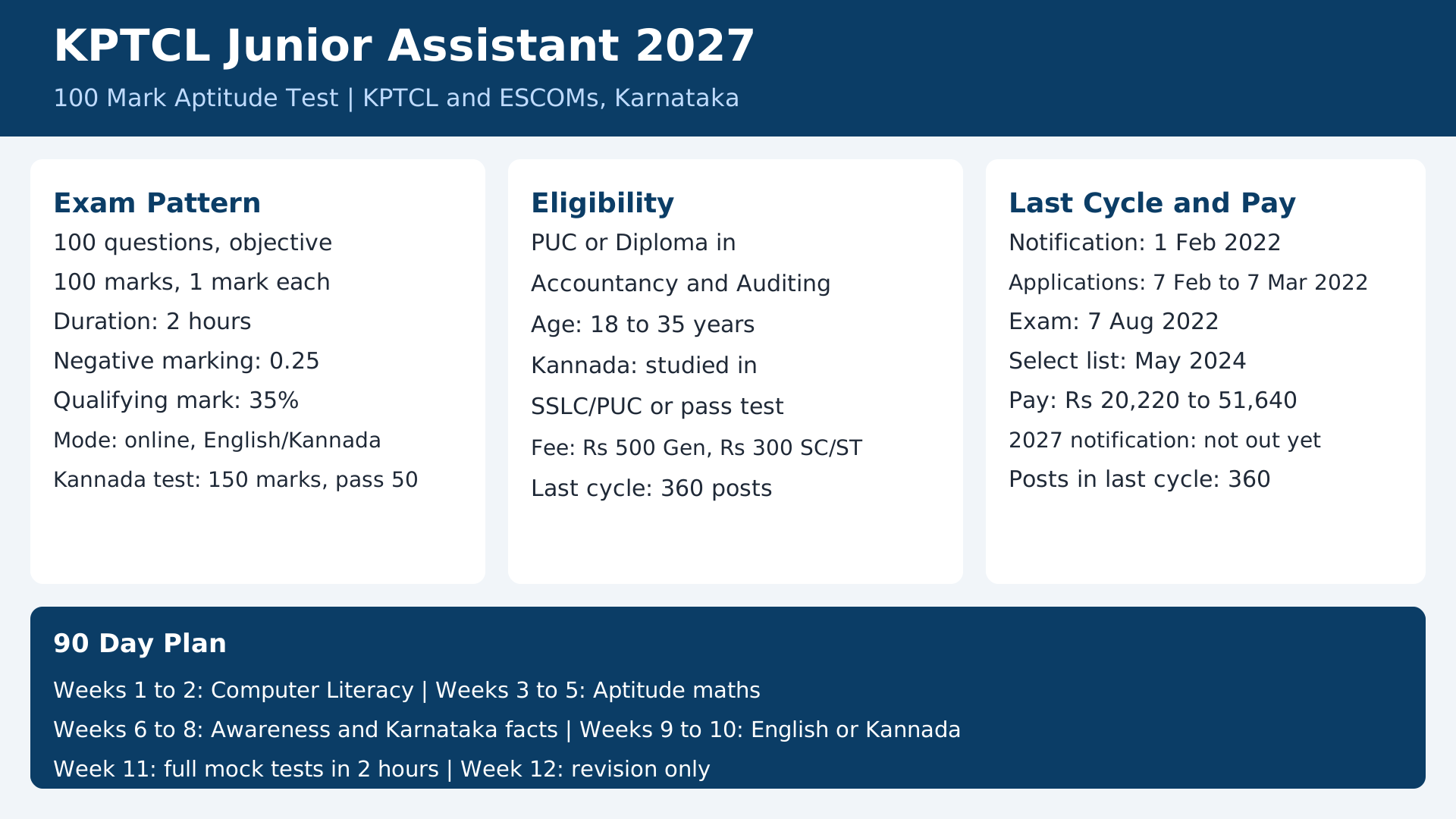
About KPTCL Junior Assistant 2027 Exam Series
📖 Table of Contents
- The 2027 notification is not out yet
- What a Junior Assistant actually does all day
- Who can apply: PUC, Kannada, and the age limits
- The KPTCL Junior Assistant 2027 exam in numbers
- The Kannada language test: 150 marks that many candidates forget
- Computer Literacy: 20 marks that reward daily computer use
- General Awareness and Aptitude: the 40 mark middle
- General English or General Kannada: pick the 40 marks you can actually score
- Pay, allowances, and what the job grows into
- Junior Assistant is not Junior Personal Assistant
- How selection works after the test
- A 90 day plan that fits around a job or college
- Mistakes that cost marks
- Sources
KPTCL Junior Assistant 2027: Complete Guide to the 100 Mark Aptitude Test
The KPTCL Junior Assistant 2027 notification has not appeared yet. That is the first fact to get straight, because several tracker sites write about the 2027 cycle as if the dates were already fixed. They are not.
The last real Junior Assistant cycle ran on a notification dated 1 February 2022, with applications from 7 February to 7 March 2022, an exam on 7 August 2022, and 360 posts. The provisional select list for those posts came out in May 2024. This guide uses that cycle as the facts, and it marks every place where the next notification could change the numbers.
Karnataka Power Transmission Corporation Limited, known as KPTCL, runs the exam with the electricity supply companies of Karnataka. The corporation is a transmission licensee under the Electricity Act, 2003, and the State Transmission Utility of Karnataka. It was incorporated on 28 July 1999 under the Companies Act, 1956, and it started operations on 1 August 1999, after the transmission and distribution work of the old Karnataka Electricity Board was split up.
It is wholly owned by the Government of Karnataka, and its registered office is at Kaveri Bhavan, K.G. Road, Bengaluru. The KPTCL site carries the corporation's company identity number as U40109KA1999SGC025521. A tariff order of the Karnataka Electricity Regulatory Commission from 2024 records that KPTCL and the supply companies serve around 285.97 lakh consumers across about 1.92 lakh square kilometres of the state.
A Junior Assistant is office staff. The post sits in KPTCL offices and in the offices of the five electricity supply companies, BESCOM in Bengaluru, MESCOM in Mangalore, HESCOM in Hubli, GESCOM in Gulbarga, and CESC in Mysore. The work is files and records.
It is data entry and letters, and accounts support. The work stays in an office, and the post needs no engineering degree. That single fact decides whether this exam fits you. If you want a desk job in a government owned power company in Karnataka, and you hold a PUC certificate, this is one of the few direct routes in.
The 2027 notification is not out yet
Prepp states plainly that the official notification for KPTCL Recruitment 2026 has not been released yet, and its date table lists every event as to be notified. Trackers that print 2026 or 2027 dates for this post are guessing. Some of them recycle the dates of other KPTCL drives, and some print a fresh notification as expected in mid 2026.
None of that is an official date. The honest position is simple. No 2027 Junior Assistant notification exists as of 19 November 2026, so no vacancy count, no application date, and no exam date can be stated for 2027.
That does not mean the post is dead. KPTCL kept hiring through 2024 and 2025. A notification numbered KPTCL/B16/86393(HK)/2024-25, dated 25 February 2024, covered 1,450 posts for the Kalyana Karnataka region and 198 for the non Kalyana Karnataka region, across posts that included Assistant Executive Engineer, Assistant Engineer, Junior Engineer, Junior Assistant, Junior Personal Assistant, Sub Station Attendant, Assistant Accounts Officer, and Junior Station Attendant.
A separate drive in October 2024 opened 2,975 posts of Junior Station Attendant and Junior Powerman, with applications from 21 October to 20 November 2024. And in February and March 2025, KPTCL advertised 533 Assistant Engineer posts and 507 Junior Engineer posts, with applications closing on 7 March 2025. Junior Assistant was not part of that 2025 engineering drive, which is why the 2022 cycle stays the latest real Junior Assistant record.
The table below gives the last Junior Assistant cycle in full, from the Testbook record of the 2022 notification.
| Event | Date or figure |
|---|---|
| Notification | 1 February 2022 |
| Applications open | 7 February 2022 |
| Applications close | 7 March 2022 |
| Admit card | 14 July 2022 |
| Exam | 7 August 2022 |
| Junior Assistant posts | 360 (357 non Kalyana Karnataka, 3 Kalyana Karnataka) |
| Provisional select list | May 2024 |
| 2027 notification | Not released as of 19 November 2026 |
One overlap in the records needs a plain note. The figure of 360 Junior Assistant posts appears in the 2022 cycle and again in the company wise table of the February 2024 notification, where the split is 10 posts in KPTCL, 250 in BESCOM, and 100 in CESC. Trackers mix the two cycles, and some pages attach the 2022 dates to the 2024 notification number.
This guide treats the 2022 cycle as the last completed Junior Assistant exam, and it treats the 2024 notification as a wider drive that also carried Junior Assistant posts. The 2027 count is unknown, and any site that prints a 2027 vacancy number today is guessing.
The wider 2022 drive also explains a number that confuses readers. The total across all posts in that drive was 1,492, made up of 505 Assistant Engineer (Electrical), 28 Assistant Engineer (Civil), 570 Junior Engineer (Electrical), 29 Junior Engineer (Civil), and 360 Junior Assistant posts. The 1,492 figure is the whole drive, not the Junior Assistant count. When a page says KPTCL had 1,492 Junior Assistant vacancies, it has read the table wrong.
What a Junior Assistant actually does all day
Picture a KPTCL division office on a working morning. Files move between sections, consumers write in about bills and new connections, engineers ask for records of a line or a substation, and the accounts section closes the month. A Junior Assistant keeps that movement orderly. The daily work is noting on files, drafting routine letters, entering data into the office system, keeping registers, and pulling out a record when an officer asks for it.
Computer work is the centre of the job, which is why the exam gives Computer Literacy its own 20 marks. A Junior Assistant who types slowly, or who fumbles in Word and Excel, slows the whole section down. The office runs on MS Office, email, and databases, and the syllabus names those tools directly. A candidate who already uses a computer every day starts this paper with a real edge.
The post also carries a quiet perk that matters more than it sounds. It is a Karnataka government owned company job, based in Karnataka, with postings in KPTCL and the supply companies across the state. Transfers follow company rules, and the work stays in offices rather than on lines and poles. Candidates from outside Karnataka can apply, but the Kannada requirement described below applies to everyone, and the age relaxation rules treat non Karnataka candidates as general category.
Who can apply: PUC, Kannada, and the age limits
The education bar is low, and that is exactly why the competition is stiff. A candidate must have passed the second year PUC conducted by the Department of Pre University Education, or an equivalent class 12 pass from a state board or CBSE. The other accepted qualification is a diploma in Accountancy and Auditing.
No degree is needed, and no engineering diploma is needed. That is the whole education rule, and it is the same in Testbook and Prepp.
Some tracker pages say any degree, and one page even lists a B.E. or B.Tech for Junior Assistant. Those pages have mixed up the posts. Many graduates apply.
The notification asks for PUC all the same. A graduate who applies should know the post is a PUC level clerical post, with a PUC level pay scale, and not a graduate officer post.
Kannada is mandatory, and this is the rule that catches outstation candidates. A candidate must have studied Kannada in SSLC, or in PUC, or in a higher qualification. A candidate who has not studied Kannada must pass a Kannada language test.
The test carries 150 marks, and a candidate must score at least 50 marks to pass it. The separate section below explains how that test fits into selection, because the trackers disagree on the order.
The age limits are 18 years at the low end and 35 years at the high end for general category candidates. Relaxation takes the upper limit to 38 years for Category IIA, IIB, IIIA and IIIB candidates, and to 40 years for Scheduled Caste, Scheduled Tribe, and Category I candidates. One tracker page prints 28 years as the upper limit, but that figure sits on a page that also mixes up other details, and both Testbook and Prepp agree on 35 years with the relaxations above. Use 35 years, and check the notification for the cut off date that fixes your age.
| Rule | Detail |
|---|---|
| Education | PUC second year pass, or diploma in Accountancy and Auditing |
| Kannada | Studied in SSLC, PUC or higher, or pass the Kannada language test |
| Minimum age | 18 years |
| Maximum age, general | 35 years |
| Maximum age, IIA, IIB, IIIA, IIIB | 38 years |
| Maximum age, SC, ST, Category I | 40 years |
| Application fee, general and other backward categories | Rs 500, including GST and postal charges (see fee note) |
| Application fee, SC and ST | Rs 300, including GST and postal charges (see fee note) |
| Application fee, PWD | No fee |
The fee needs a note because the trackers print two figures. The general KPTCL fee table, carried by Prepp and by the main Testbook KPTCL page, lists Rs 500 for general and other backward category candidates and Rs 300 for SC and ST candidates, including GST and postal service charges. The Junior Assistant page on Testbook lists Rs 600 and Rs 350 for the same categories, and calls those figures expected from the previous year.
Both pages agree that PWD candidates pay no fee, and that the fee is non refundable. This guide uses Rs 500 and Rs 300 as the main figures, because they sit in the general notification table, and it flags the Rs 600 and Rs 350 figures so no reader is surprised at the payment page. Check the fee in the notification itself before you pay.
The KPTCL Junior Assistant 2027 exam in numbers
The exam is an online aptitude test of 100 objective questions for 100 marks, to be finished in 2 hours. Each question carries 1 mark, and each wrong answer costs 0.25 marks. A question left unattempted scores nothing.
That much is consistent across Testbook, Prepp, and Collegedisha, so the 100 mark figure in the task brief checks out against the last real cycle. There is no interview score in the test itself. Selection rests on the aptitude test, with document verification after it, and the Kannada language test for candidates who need it.
The three sections carry different weights, and the split decides how you divide your study time. Computer Literacy carries 20 questions for 20 marks. General Awareness and Aptitude carries 40 questions for 40 marks.
General English or General Kannada carries 40 questions for 40 marks. The total is 100 questions for 100 marks in 120 minutes, which gives 72 seconds per question. That pace is the real test. A candidate who knows the answers but reads slowly will still run out of time.
| Section | Questions | Marks | Language |
|---|---|---|---|
| Computer Literacy | 20 | 20 | English only |
| General Awareness and Aptitude | 40 | 40 | English and Kannada |
| General English or General Kannada | 40 | 40 | As chosen |
| Total | 100 | 100 | 2 hours |
Two conflicts sit inside that table, and both are worth knowing before you plan. First, the Testbook Junior Assistant page and Toppersexam print a different split for the same 100 marks: Computer Literacy 20, General Awareness and Aptitude 50, and General English 30. That version has no General Kannada option in the third section, and it moves 10 marks from language to awareness and aptitude.
Prepp, Collegedisha, and the Testbook syllabus page print the 20, 40 and 40 split used above, with a General English or General Kannada choice. This guide follows the 20, 40 and 40 split because three sources print it against two, and because it matches the notification pattern that names General English or General Kannada as a section. If the 2027 notification prints the 50 mark middle section, the plan still holds, because the topics are the same and only the counts move.
Second, one Collegedisha page says there will be no negative marking, in the same page that prints 0.25 marks deducted per wrong answer in its pattern table. The 0.25 deduction is printed by Testbook, Prepp, and Toppersexam as well, so treat negative marking as real. A wrong answer costs a quarter mark, and four wrong answers wipe out one right answer. That arithmetic shapes the whole attempt strategy, which the mistakes section covers near the end.
The qualifying mark for the aptitude test is 35 percent, as printed by Testbook. That is the floor to stay in the merit list, not a safe score. With 360 posts and a PUC level bar, the merit list closes far above the floor in practice, but no official cut off marks were available in the sources retrieved for this guide, so no cut off figure is printed here. Any site that prints a Junior Assistant cut off for the last cycle without naming the KPTCL list it came from is inventing it.
The Kannada language test: 150 marks that many candidates forget
The Kannada language test is the part of this recruitment that surprises candidates the most, because it sits outside the 100 mark aptitude test. It carries 150 marks, and a candidate must score at least 50 marks to pass it. It applies only to candidates who have not studied Kannada in SSLC, or in PUC, or in a higher qualification. If you studied Kannada at any of those stages, the test does not apply to you.
The order of the two tests is disputed in the trackers, and the dispute matters for planning. Prepp states that a candidate must secure at least 50 marks in the Kannada language test to be eligible to appear in the general aptitude test, which puts the language test first. Testbook lists the selection as merit in the aptitude test, then personal interview or document verification, then the Kannada language test for candidates who have not studied Kannada, which puts the language test after the main test.
Both cannot be the sequence, and the notification is the only paper that settles it. A candidate who needs the language test should prepare for it from day one either way, because passing it is a hard gate in both versions. A strong aptitude score means nothing if the language gate stops you.
The Kannada syllabus in the trackers covers Kannada literature, the history of the Kannada language, grammar, antonyms, adjectives, tenses, prepositions, modal auxiliaries, vocabulary, active and passive voice, error correction, conjunctions, and articles. That list looks like a school level language paper, and it is. A candidate who grew up speaking Kannada but never studied it in school still needs to learn the grammar terms, because the test asks about them by name. A candidate who studied Kannada in school can treat this as revision, not as a new subject.
There is one more practical point. The computer questions come in English only, while the awareness and aptitude questions come in English and Kannada. A candidate who picks General Kannada as the third section still answers the computer section in English.
Plan your language choice around the third section alone, and pick the language in which you read faster. Speed decides more marks here than knowledge does.
Computer Literacy: 20 marks that reward daily computer use
Computer Literacy is the smallest section, and it is the easiest place to bank marks. Twenty questions, twenty marks, and a syllabus that describes ordinary office computing. The Testbook syllabus lists basic computer skills, MS Office in Word, Excel and PowerPoint, MS Access or database concepts, Outlook Express and email handling, operating systems, and application packages.
Nothing on that list needs a computer science degree. It needs a person who has actually used a computer to do office work.
Each topic maps to a small set of facts that the exam can ask as direct questions. In Word, learn to save and format documents, and to build tables and use mail merge. In Excel, learn cells and formulas first, then charts.
In PowerPoint, learn slides and layouts, plus presentation views. In Access, learn tables, records and fields, and about queries. In email, learn the inbox, the compose button and the attachment option.
In operating systems, learn files and folders, and the basic commands. A candidate who opens each program once a week and clicks through its menus will recognise most of the questions. A candidate who only reads about the programs from a book will guess at half of them.
Give this section two short sittings a week, on a real computer, and treat it as a break from the heavier sections. Open Word and make a table. Open Excel and write a sum formula, an average formula, and a count formula.
Open PowerPoint and build a five slide deck. Open your email and find the attachment, reply, and forward buttons by their exact names. That hour of clicking is worth more than a week of reading definitions, because the questions test names of things you can see on a screen.
One trap sits in this section. Candidates who are strong in computers rush it and make silly errors, because the questions look too easy to deserve care. Twenty marks is a fifth of the paper.
A single careless error here costs the same as a careless error in the hardest aptitude question. Read each option, and do not let the easy look of the section fool you into speed.
General Awareness and Aptitude: the 40 mark middle
This section carries the most marks, and it mixes two very different skills. Half of it is awareness of the world, and half of it is aptitude with numbers and logic. The awareness half rewards a daily newspaper habit.
The aptitude half rewards practice with a timer. Neither half rewards last minute reading.
The awareness syllabus in the trackers is broad. It names current affairs at national and international level, Indian history, Indian culture, Indian politics, Indian Parliament, Indian economy, the Indian financial system, recent credit and monetary policies, geography, environment, physics, chemistry, botany, zoology, sports, important days and dates, famous books and authors, and inventions in the world. That list is long, and no candidate covers all of it fully.
The smart move is to cover Karnataka and India first, then the world. KPTCL is a Karnataka company, and state level exams lean on state facts. Learn the Karnataka districts, the major dams and rivers, the state symbols, the recent state budget announcements, and the power sector of the state, because those questions recur in Karnataka exams.
Current affairs need a fixed daily slot, not a monthly scramble. Read one newspaper every morning, and note five facts a day in a small book. Cover Karnataka and the nation, the economy and science, and one sports fact.
In ninety days that book holds 450 facts, and the awareness section will feel familiar instead of random. Skip the habit, and the same section will feel like a lottery.
The aptitude half is a standard list. It names numbers and ages, percentages, ratio and proportion, averages, simple interest, compound interest, profit and loss, time and work, time and distance, problems on trains, boats and streams, pipes and cisterns, LCM and HCF, partnership, mixture and allegations, simple equations, quadratic equations, indices and surds, decimals and fractions, square roots, mensuration, areas and volumes, permutations and combinations, probability, odd man out, races and games, simplification and approximation, and data interpretation through bar graphs, line graphs, and tables. That is a lot of topics, but each one has a small set of formulas, and the questions stay at school level.
Do not study aptitude by reading solutions. Work each question with a pen, on paper, against a clock. Ten questions a day, timed at twelve minutes, builds the speed this paper needs.
Mark the topics where you take more than ninety seconds per question, and drill those topics alone for a week. Speed in aptitude comes from recognising the type of question in the first five seconds, and that recognition only comes from solving, not from reading.
General English or General Kannada: pick the 40 marks you can actually score
The third section gives you a choice, and the choice is worth 40 marks, so make it on evidence, not on pride. Pick the language in which you read faster and make fewer errors. A candidate who speaks Kannada at home but reads English faster should pick English.
A candidate who studied in Kannada medium and reads Kannada without effort should pick Kannada. The higher score is what counts, so pick the language that gives it to you.
The English syllabus is a long list of familiar school topics. It names spelling tests, synonyms, antonyms, homonyms, word formation, error correction, sentence improvement, sentence arrangement, transformation, passage completion, para completion, theme detection, topic rearrangement of a passage, fill in the blanks, sentence completion, prepositions, direct and indirect speech, active and passive voice, idioms and phrases, substitution, joining sentences, and data interpretation. The list looks huge, but the questions repeat a small set of patterns. Spotting errors, sentence improvement, and fill in the blanks make up most of the section in practice, and each of those improves fast with daily practice of ten questions.
English preparation has one rule that matters more than any book. Read English every day, even if it is only one page. A candidate who reads a newspaper page daily will spot errors by ear, because wrong sentences start to sound wrong.
A candidate who only memorises grammar rules will keep pausing over every option. Read first, then practise questions, then read the grammar rule only for the questions you got wrong. That order saves weeks.
The Kannada option follows the same shape in Kannada, with literature, language history, grammar, vocabulary, and voice. A Kannada medium candidate should treat this section as the safest 40 marks in the paper, and should still practise with a timer, because easy sections punish carelessness the most. The one decision to make early is which language you will pick, because switching late wastes the practice you did in the other language. Decide in week one, and do not revisit the decision.
Pay, allowances, and what the job grows into
The pay scale printed by Testbook for Junior Assistant is Rs 20,220 to Rs 51,640 per month, and the same page prints Rs 20,220 to Rs 51,460 in its salary section, a small difference that looks like a typing slip in one of the two places. This guide uses Rs 20,220 to Rs 51,640, because it appears in the page summary and in the vacancy table of other trackers. Other pages print very different figures, and a reader should know about them.
One tracker prints Rs 19,900 to Rs 63,200 as a Level 4 scale, another prints Rs 25,500 to Rs 81,100 as Pay Level 4, and a third prints a revised scale of Rs 27,650 to Rs 52,650. Those figures cannot all be the same post at the same time, and they come from different pay revisions and different assumptions. The notification is the only paper that fixes the scale for a given cycle, so treat every pay figure here as a tracker figure to confirm, not as a promise.
Gross monthly pay runs higher than the basic scale, because dearness allowance, house rent allowance, and other allowances sit on top of basic pay. One tracker estimates gross monthly pay at about Rs 35,000 to Rs 45,000, including allowances. That estimate is a tracker figure, not a KPTCL figure, and it moves with dearness allowance revisions.
The safe way to read it is this. A Junior Assistant starts on a modest clerical basic, and the allowances lift the take home pay well above the basic. It is a stable state company salary, not a high private sector salary, and candidates who join for quick money will be disappointed.
The job grows through the company, not through the exam. A Junior Assistant who works well moves up the clerical line in KPTCL and the supply companies, and the experience counts in later departmental exams. The post also suits a candidate who wants to prepare for other exams while working, because the hours are office hours and the work stays in the office. Many clerks in state power companies do exactly that, and the steady income makes the next attempt easier to fund.
One honest note belongs here. The pay is the weakest part of this post when set beside a bank clerk or a central government clerk, and the competition is still heavy because the education bar is PUC and the job is in Karnataka. Candidates should join with open eyes. The value of the post is stability, a Karnataka posting, and a foot inside a government owned company, not a high starting salary.
Junior Assistant is not Junior Personal Assistant
Three posts with similar names sit in the same KPTCL notifications, and candidates mix them up every cycle. Junior Assistant, Junior Personal Assistant, and Junior Station Attendant are separate posts, with separate qualifications, separate work, and separate selection. This package covers Junior Assistant only, and this section draws the lines so no reader applies for the wrong post.
Junior Assistant needs PUC or a diploma in Accountancy and Auditing, and the work is general office and accounts support. Junior Personal Assistant needs only the 10th standard from the state of Karnataka, and the work is secretarial support to senior officers, including shorthand and typing. The February 2024 notification carried 56 Junior Personal Assistant posts against 360 Junior Assistant posts, and one tracker prints a Junior Personal Assistant pay scale of Rs 22,920 to Rs 56,320, a tracker figure to confirm in the notification. A candidate who holds only a 10th pass cannot apply for Junior Assistant, and a PUC holder who wants secretarial work should look at the Personal Assistant post on its own terms.
Junior Station Attendant and Junior Powerman are field posts, and they sit even further from this package. The October 2024 drive opened 2,975 of those posts, 2,760 in the non Kalyana Karnataka region and 215 in the Kalyana Karnataka region, for candidates who had passed the 10th standard. Selection for those posts rests on an endurance test and a merit list, not on the 100 mark aptitude test in this guide. A candidate who applies for Junior Station Attendant expecting a desk job will be in for a hard surprise, because the post works on stations and lines.
The same warning applies to the Assistant post, which appears in some KPTCL tables as a separate line from Junior Assistant. Assistant and Junior Assistant are different grades in the same clerical line, and the notification fixes the count and the scale for each. Read the post name in the notification letter by letter before you apply, and apply only for the post whose qualification you hold.
How selection works after the test
Selection rests on the aptitude test, and the merit list decides who moves ahead. Testbook puts the minimum qualifying mark at 35 percent in the aptitude test, and lists personal interview or document verification as the next step, with the Kannada language test for candidates who have not studied Kannada. Other trackers describe the process as aptitude test, then document verification, with no interview at all. The notification is the paper that settles whether an interview exists in a given cycle, and the safest reading is that the aptitude test decides the merit, and document verification follows for the shortlisted candidates.
Document verification is not a formality. Shortlisted candidates must produce the original PUC certificate or diploma, the SSLC certificate that shows Kannada study or the lack of it, the caste certificate where relaxation is claimed, and the identity proof used in the application. The provisional select list for the 360 posts came out in May 2024, and objections were invited before the final list. A candidate whose certificate has a spelling error in the name, or whose caste certificate is out of date, should fix it now, while there is time, because a mismatch at verification can cost a post that the exam had already won.
The medical test and the joining formalities follow verification in the wider KPTCL process, and the appointment order comes after the final list. The May 2024 reporting on the wider KPTCL hiring shows how the end of the process looks: counselling sessions were held, appointment orders were issued for Assistant Engineer and Junior Engineer candidates in March 2024, and the Junior Assistant provisional list moved through objections in May 2024. That is the shape of the finish line. It is slow, paper heavy, and it rewards candidates who keep every original certificate ready.
A 90 day plan that fits around a job or college
Ninety days is enough for the KPTCL Junior Assistant 2027 paper, because the syllabus is school level and the sections are only three. The plan below assumes two to three hours a day, and it puts the heaviest weight on aptitude and awareness, because those two decide the merit list. It also keeps the Kannada language test in view from the first week, so no candidate discovers it in the last month.
| Weeks | Focus | Daily time |
|---|---|---|
| 1 to 2 | Computer Literacy on a real computer, plus the language choice for section three | 2 hours |
| 3 to 5 | Aptitude maths, ten timed questions a day, and the formula book | 2 to 3 hours |
| 6 to 8 | General Awareness, daily newspaper notes, Karnataka facts, and current affairs revision | 2 hours |
| 9 to 10 | General English or General Kannada, ten questions a day, and error spotting drills | 2 hours |
| 11 | Full 100 question mock tests in 2 hours, with same evening review | 2 to 3 hours |
| 12 | Revision only, Kannada language test practice for those who need it, and no new topics | 2 hours |
| Last 3 days | Formulas, computer shortcuts, Karnataka facts, and one light mock test | 1 hour |
Mock tests deserve a fixed slot, not leftover time. Take one full 100 question mock test every Sunday from week 3 onward, in 2 hours, without pausing, and review every wrong answer the same evening. Track your score by section, not just in total, because a total of 60 that hides a Computer Literacy score of 8 out of 20 is a warning.
The last three days are for formulas, shortcuts, and facts only. New topics in the last three days cost more marks than they gain, because they displace revision of material you already know.
Keep a single small book for the whole plan. One page per aptitude topic with its formulas, one page for computer shortcuts, one page a week for current affairs, and one page for the Kannada grammar terms if the language test applies to you. Rewrite the formula pages from memory once a week.
That rewrite is the revision. Reading the same page five times only builds recognition, and recognition fails in the exam hall when the options look alike.
Candidates who work a job or attend college should protect the morning hour. One hour before work, spent on aptitude questions, beats three tired hours at night. The evening hour can carry the newspaper and the computer practice, which need less fresh energy. Ninety days of two real hours beats thirty days of five exhausted hours, and the mock test scores will show it by week six.
Mistakes that cost marks
The first mistake is forgetting the Kannada language test. Candidates who did not study Kannada in school spend ninety days on the aptitude test and learn about the language test only when the admit card arrives. By then the 150 mark paper, with its 50 mark pass bar, is a wall in front of a merit list they had already earned. If the test applies to you, start it in week one.
The second mistake is skipping Computer Literacy because it looks easy. Twenty marks is a fifth of the paper, and those marks are the most predictable in the whole exam. A candidate who gives the section two sittings a week on a real computer will score near full marks. A candidate who skips it drops marks that no amount of aptitude practice can buy back.
The third mistake is guessing without counting the cost. Each wrong answer takes away 0.25 marks, so four wrong answers erase one right answer. Attempt the questions you can narrow to two options, and leave the pure guesses alone. The qualifying mark is 35 percent, but the merit list closes far above it, so every quarter mark matters.
The fourth mistake is trusting tracker dates. Pages that print a 2025 or 2026 Junior Assistant exam date, or a 2027 vacancy count, are guessing, because no 2027 notification exists as of 19 November 2026. A candidate who plans around a printed date will either rush for an exam that is not coming, or relax for one that arrives without warning. Plan on ninety days from today, and watch the KPTCL site for the notification.
The fifth mistake is studying aptitude by reading solutions instead of solving questions. Aptitude speed comes from solving, and the paper gives 72 seconds per question. Ten timed questions a day, every day, builds that speed. Reading a solved example builds only the feeling of knowing, and the feeling does not survive the exam hall.
The sixth mistake is picking the wrong language section. Candidates pick General Kannada because they speak it at home, then find they read English faster and score higher in English. Or they pick English because it sounds safer, then find their Kannada reading is quicker and cleaner. Decide in week one, on the evidence of two timed practice sets, one in each language, and then stop switching.
The seventh mistake is poor time use in the hall. One hundred questions in 120 minutes gives 72 seconds per question in the KPTCL Junior Assistant 2027 paper, and a candidate who spends five minutes on one hard aptitude question loses four easy marks elsewhere. Mark the hard question, move on, and return only after the rest of the paper is done. Use the last ten minutes for the marked questions, and do not leave the easy computer questions for the end, because they are the quickest marks in the paper.
Clerk level exams share the same skills, so the preparation here transfers directly. The SBI Clerk 2027, IBPS Clerk 2027, IBPS RRB PO 2027, RBI Assistant 2027, FSSAI Assistant 2027, LIC ADO 2027, SBI PO 2027, IBPS PO 2027, SSC GD 2027 and UGC NET Paper 1 2027 pages on this site carry the same style of mock test guide, and the computer, awareness and language practice you build for KPTCL carries into every one of them.
Sources
Karnataka Power Transmission Corporation Limited, the official KPTCL site, for the corporation, its registered office at Kaveri Bhavan, K.G. Road, Bengaluru, its company identity number U40109KA1999SGC025521, and the recruitment pages. Testbook KPTCL Junior Assistant page, for the 2022 cycle dates of 1 February 2022 notification, 7 February to 7 March 2022 applications, 14 July 2022 admit card, 7 August 2022 exam, 360 posts with 357 non Kalyana Karnataka and 3 Kalyana Karnataka, the May 2024 provisional select list, the PUC and diploma in Accountancy and Auditing qualification, the Kannada study rule, the age limits of 18 to 35 years with relaxation to 38 and 40 years, the fee of Rs 600 and Rs 350, the 35 percent qualifying mark, the 20, 50 and 30 section split, the negative marking of 0.25, and the pay scale of Rs 20,220 to Rs 51,640. Testbook KPTCL syllabus and exam pattern page, for the online aptitude test of 100 marks, the 20, 40 and 40 section split, the Kannada language test of 150 marks with a 50 mark pass, and the English only computer questions.
Prepp KPTCL Recruitment 2026 page, for the statement that the 2026 notification has not been released, the 1,492 total of the 2022 drive, the PUC and diploma qualification, the age limits, the fee of Rs 500 and Rs 300 including GST and postal charges, the 20, 40 and 40 split, the Kannada test order, and the Kannada syllabus. Collegedisha KPTCL exam pattern page, for the 20, 40 and 40 split and the internal note that contradicts itself on negative marking. Toppersexam KPTCL Junior Assistant syllabus page, for the 20, 50 and 30 split and the 0.25 negative marking.
Jobsandhan KPTCL hall ticket page, for the February 2024 notification number KPTCL/B16/86393(HK)/2024-25, the 1,450 Kalyana Karnataka and 198 non Kalyana Karnataka posts, and the company wise Junior Assistant split of 10 in KPTCL, 250 in BESCOM and 100 in CESC. Vartha Bharati, 24 May 2024, for the recruitment order for 902 posts and the Junior Assistant provisional list of 360 posts. Dailyrecruitment KPTCL Recruitment 2024 page, for the Junior Station Attendant and Junior Powerman drive of 2,975 posts, notification 14 October 2024, applications 21 October to 20 November 2024, and the endurance test and merit list selection.
Karnataka Electricity Regulatory Commission tariff order 2024, for KPTCL as transmission licensee and State Transmission Utility, incorporation on 28 July 1999, operations from 1 August 1999, and around 285.97 lakh consumers across about 1.92 lakh square kilometres. AskFilo KPTCL Recruitment 2026 guide, for the gross monthly pay estimate of about Rs 35,000 to Rs 45,000 including allowances.
Open the KPTCL site today, find the recruitment section, and check whether a Junior Assistant notification has appeared. If it has, note the last date, the fee, and the section split in the notification itself, then start the 90 day plan in this KPTCL Junior Assistant 2027 guide from week one tomorrow morning.







