About KPSC LDC 2027 Exam Series
📖 Table of Contents
- KPSC LDC 2027 at a glance
- The notification that is actually live
- What a Lower Division Clerk does, and where the post sits
- Who can apply: SSLC, age, and the district choice
- No fee, and how the application works
- The KPSC LDC exam pattern in full
- The syllabus, section by section
- The district ranked list, and how posting works
- Pay, and what the job looks like day to day
- The last cycle, date by date
- A 90 day plan that fits a 100 mark paper
- Mistakes that cost marks in this paper
- What to watch before the next notification
- Sources
KPSC LDC 2027: Complete Exam Guide
KPSC LDC 2027 on this page follows the last verified cycle of the Kerala Public Service Commission Lower Division Clerk examination, and that cycle is Category Number 503/2023. The Kerala Public Service Commission, known as Kerala PSC, published the notification in its gazette on 30 November 2023. Applications ran from 30 November 2023 to 3 January 2024, up to midnight. The written test ran district by district from July to October 2024, and the district ranked lists came into force on 1 August 2025.
Kerala PSC has published no new notification for Clerk in Various Departments as of 23 November 2026. The gazettes of 31 August, 30 September, 30 October and 16 November 2026 contain no new notification for this post. The next notification is widely expected around the end of 2026 or early 2027, but Kerala PSC has not announced a date. This guide anchors on Category Number 503/2023 and on the official January 2024 syllabus, and it says so wherever a 2027 figure would otherwise be guessed. The page carries 2027 in its title because the site groups examination pages by that year.
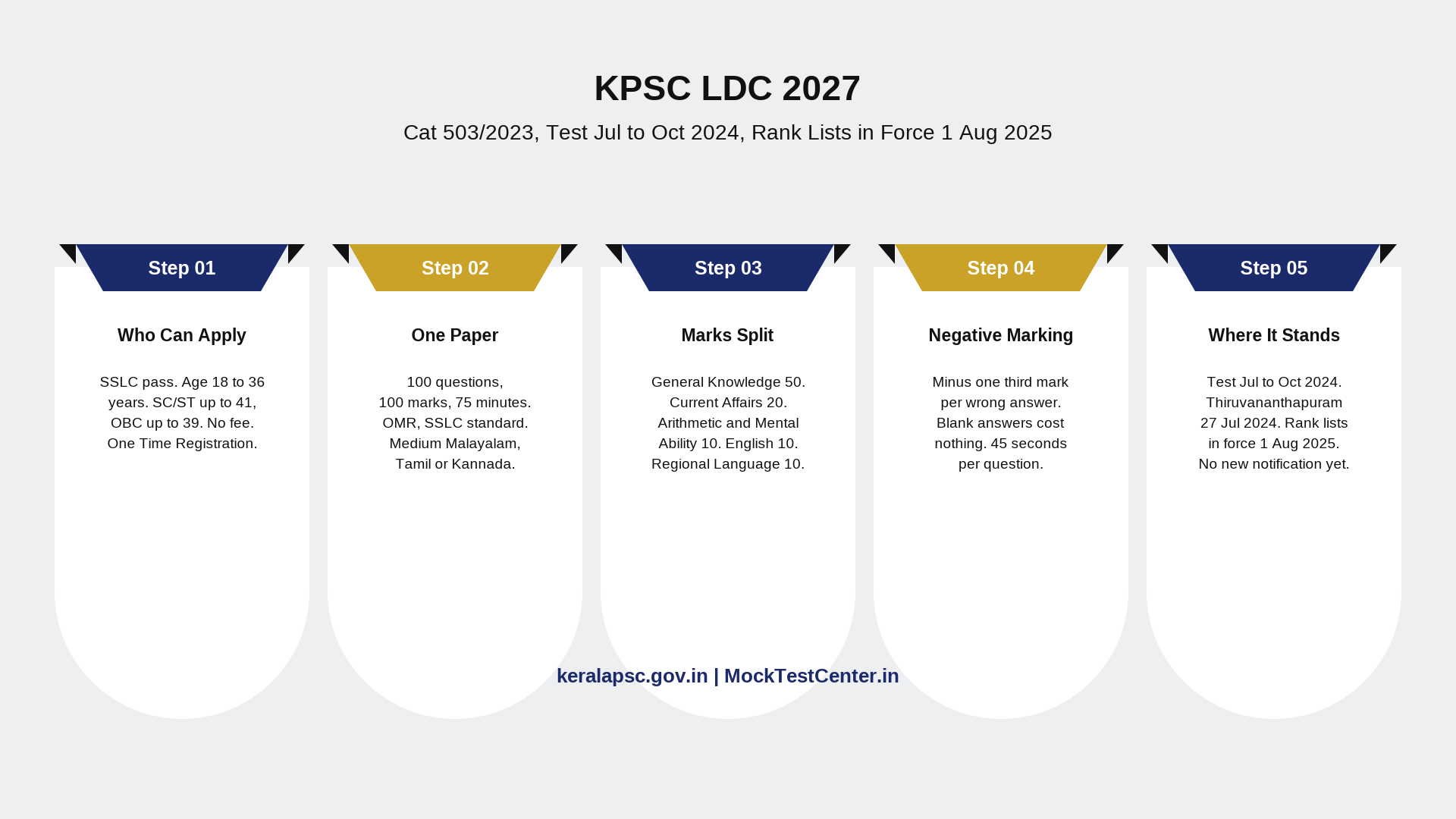
The Lower Division Clerk post is the biggest single entry gate in Kerala PSC recruitment. It asks for a pass in the SSLC examination, which is the Class 10 level, and nothing more. The post asks for no degree. The post asks for no typing certificate at the application stage. The age window runs from 18 to 36 years, with the usual relaxations for Scheduled Caste, Scheduled Tribe and Other Backward Community candidates. The application carries no fee. One written paper of 100 questions decides the ranked list, and there is no interview.
That simplicity is the reason the examination draws lakhs of candidates every cycle. It is also the reason the paper is hard to clear. A single paper of 100 marks leaves no room for a weak section, and the negative marking of one third of a mark per wrong answer punishes guessing. The candidates who clear it are the ones who treat the 100 marks as a race run in 75 minutes, with General Knowledge carrying half the paper.
KPSC LDC 2027 at a glance
| Detail | KPSC LDC 2027, as run in the 503/2023 cycle |
|---|---|
| Conducting body | Kerala Public Service Commission (Kerala PSC), Thiruvananthapuram, website keralapsc.gov.in |
| Post | Lower Division Clerk (LD Clerk) in Various Departments, including Clerk and Village Assistant in the Revenue Department |
| Live cycle | Category Number 503/2023, Part I Direct Recruitment, gazette dated 30 November 2023 |
| By transfer stream | Category Number 504/2023, Part II Recruitment by Transfer, same gazette date |
| Applications | 30 November 2023 to 3 January 2024, up to midnight, closed |
| Fee | No application fee |
| Education | Pass in SSLC Examination or equivalent qualification |
| Age limit | 18 to 36 years, SC and ST up to 41 years, OBC up to 39 years |
| Written test | 100 questions, 100 marks, 1 hour 15 minutes, OMR, negative marking one third of a mark per wrong answer |
| Pattern | General Knowledge 50, Current Affairs 20, Simple Arithmetic and Mental Ability 10, General English 10, Regional Language 10 |
| Exam dates | District by district, July to October 2024, Thiruvananthapuram on 27 July 2024 |
| Ranked lists | District wise ranked lists in force since 1 August 2025 |
| Pay scale | Rs 26,500 to Rs 60,700 per month |
| Selection | Single written test, then document verification and district wise ranked list, no interview |
| 2027 notification | Not published as of 23 November 2026 |
The notification that is actually live
Search results for this examination are a mess of years, and the mess has a cause. Trackers label the same cycle as LDC 2023, LDC 2024, LDC 2026 and LDC 2027 in the same week. The notification came out in November 2023, the applications closed in January 2024, the test ran in 2024, and the ranked lists came into force in August 2025. Each tracker picks a different year from that chain. The category number settles it. Category Number 503/2023 is the direct recruitment notification for Clerk in Various Departments, and Category Number 504/2023 is the by transfer stream from the same gazette.
A second confusion is sharper, and it can cost a candidate an application. In late 2025 Kerala PSC published Category Number 619/2025 for Lower Division Clerk in the Kerala State Beverages (Manufacturing and Marketing) Corporation Limited. That is a corporation post, not the district LDC post in Various Departments. Its applications ran from 30 December 2025 to 4 February 2026. Some tracker pages headline it as the Kerala PSC LDC Notification 2026, with no mention of the corporation in the headline. A candidate who reads only the headline will think the main LDC notification is out. It is not. The main district LDC post, the one this guide covers, has had no new notification as of 23 November 2026.
A third confusion comes from the exam date. CareerPower puts the Thiruvananthapuram test on 26 July 2024. Adda247 and Competitive Cracker put it on 27 July 2024, and Competitive Cracker prints the district wise schedule with Thiruvananthapuram in July 2024 and the other 13 districts spread across August, September and October. This guide uses 27 July 2024, the date two trackers carry, and records 26 July 2024 as a conflict. The district wise spread itself is not in dispute. Kannur tested on 17 August 2024, Thrissur on 31 August 2024 and Wayanad on 5 October 2024, according to the ranked lists.
The confirmation step is part of the cycle that first time candidates miss. Kerala PSC asks candidates to confirm through their One Time Registration profile that they will write the test, district by district, before the commission issues the hall ticket. The confirmation window for Thiruvananthapuram ran from 22 April to 11 May 2024. A candidate who applied and never confirmed got no hall ticket. The hall ticket for Thiruvananthapuram came out around 12 to 22 July 2024, with the two trackers disagreeing on the exact day. The lesson survives the date dispute. Apply, then watch the profile for the confirmation window, then download the hall ticket.
What a Lower Division Clerk does, and where the post sits
The post covers clerical work across the departments of the Government of Kerala. The notification covers Lower Division Clerk in Various Departments, and it expressly includes the integrated post of Lower Division Clerk and Village Assistant in the Revenue Department. This examination also fills vacancies in the Kerala Municipal Common Service, according to the tracker pages that describe the post. The clerk handles files, registers, correspondence and records at the lowest rung of the secretariat and district office ladder, and the Village Assistant works in the revenue village offices.
Kerala PSC does not publish a vacancy total for this post. The notification lists anticipated vacancies district by district across all 14 districts, and the number in each district moves as departments report vacancies. Entri states plainly that the vacancy details were not revealed, and Adda247 lists the vacancy figure as Various. Any page that prints a firm vacancy total for the 503/2023 cycle is guessing. This guide prints no total. The task brief for this package mentioned a figure of more than 200 posts per cycle, and that figure could not be verified in any source read, so it is not used here.
The district is the unit of the whole recruitment. A candidate applies for one district, writes the test for that district, and finds a place on that district ranked list. The ranked lists are district wise, and the commission fills advice to candidates from the list of the district where the vacancy arises. A candidate cannot apply for all 14 districts in one notification. The choice of district matters, because the competition and the pace of advice differ from district to district, and the candidate cannot change the choice after the application closes.
The post is the first step on a ladder, not a dead end. A Lower Division Clerk who completes probation and the departmental tests moves up to Upper Division Clerk, and from there to further supervisory posts in the department. The pay scale at entry is Rs 26,500 to Rs 60,700. The official ranked list for the Lower Division Typist post in the same pay band prints that scale, and the tracker pages for LDC print it too. Adda247 prints an older figure of Rs 19,000 to Rs 43,600, which belongs to the pre revision scale. This guide uses Rs 26,500 to Rs 60,700 and records the older figure as a conflict. Dearness allowance and other allowances sit on top of the scale, and the in hand pay varies with posting and deductions.
Who can apply: SSLC, age, and the district choice
The education rule is one line. A candidate must have passed the SSLC Examination or an equivalent qualification. The SSLC is the Class 10 examination in Kerala. A candidate with a degree is eligible, and a candidate with a higher qualification is eligible, but neither earns extra marks. The test itself is set at SSLC standard, so a degree holder and an SSLC holder sit the same paper.
The age window runs from 18 to 36 years. The relaxation rules are the standard Kerala PSC rules. Scheduled Caste and Scheduled Tribe candidates can apply up to 41 years, and Other Backward Community candidates up to 39 years, according to Adda247. The 503/2023 notification fixes the birth date window in its text, and candidates should read that window rather than the round figure, because the exact dates decide borderline cases. The by transfer stream under Category Number 504/2023 carries its own conditions for serving employees, and it is a separate application.
The district choice deserves a paragraph of its own, because it is the one decision in the application that cannot be undone. The candidate picks one of the 14 districts of Kerala and applies for that district alone. The test date, the hall ticket and the ranked list all follow the district. A candidate from a district with a long ranked list may wait longer for advice than a candidate from a district with a short list, and the reverse can also be true in the next cycle. No source read for this guide publishes a district wise applicant count for the 503/2023 cycle, so this guide does not rank districts by competition. The honest advice is to apply for the home district unless there is a concrete reason to do otherwise, because the rules restrict transfer between districts after appointment.
Kerala PSC runs its recruitment through One Time Registration. A candidate registers once on keralapsc.gov.in, uploads a photograph taken within six months with the name and the date of the photograph printed legibly at the bottom, and the photograph stays valid for ten years from the date of upload. After registration the candidate logs in with the user ID and password, clicks Apply Now on the notification, and submits the application. The profile is the place where the confirmation, the hall ticket and the result all appear, so the password and the registered mobile number must stay in the candidate hands through the whole cycle.
No fee, and how the application works
There is no application fee for this examination. The Kerala PSC tips page states it plainly, and the notification PDFs repeat it: no application fee is required. Testbook and Competitive Cracker both confirm it. The application is free for every category, which is one more reason the applicant count runs high. A page that asks for a fee to apply for Kerala PSC LDC is not the official site.
Applications run online only, through the One Time Registration system on keralapsc.gov.in. There is no offline form and no fee payment step. The 503/2023 window opened on 30 November 2023 and closed on 3 January 2024 at midnight. The corporation LDC notification under Category Number 619/2025 closed on 4 February 2026, and that date belongs to the corporation post, not to this one.
Keep the submitted application until Kerala PSC publishes the ranked list, because the commission asks for documents at the verification stage. The commission publishes the ranked list district by district, and advises candidates from the list as vacancies are reported. The ranked list from the 503/2023 cycle came into force on 1 August 2025, and it stays in force for the period the commission fixes, usually until it is exhausted or replaced by the next cycle list.
The KPSC LDC exam pattern in full
The KPSC LDC exam pattern is a single OMR paper. One hundred questions, 100 marks, 1 hour 15 minutes. Each correct answer carries 1 mark. Each wrong answer loses one third of a mark, which is 0.33. A question left unanswered loses nothing. The paper is set at SSLC standard, and the medium is Malayalam, Tamil or Kannada, except for the General English section, which is in English.
The five parts of the paper carry very unequal weight, and the weight is the whole strategy. General Knowledge carries 50 marks, half the paper. Current Affairs carries 20 marks. Simple Arithmetic and Mental Ability together carry 10 marks. General English carries 10 marks. Regional Language carries 10 marks. A candidate who scores 40 in General Knowledge and 15 in Current Affairs has 55 marks before touching the other three sections, and a candidate who scores 25 in General Knowledge has to be near perfect everywhere else to catch up.
| Part | Subject | Marks |
|---|---|---|
| I | General Knowledge | 50 |
| II | Current Affairs | 20 |
| III | Simple Arithmetic and Mental Ability | 10 |
| IV | General English | 10 |
| V | Regional Language (Malayalam, Tamil or Kannada) | 10 |
| Total | 100 questions | 100 |
The time arithmetic is tight. One hundred questions in 75 minutes allow 45 seconds per question. The arithmetic and mental ability questions take longer than 45 seconds each, and the General Knowledge questions take less, so the candidate who answers the fast questions first and returns to the slow ones finishes the paper, while the candidate who works in order can run out of time with ten questions unread. The negative marking makes the last ten minutes a decision, not a scramble. Three wrong guesses cancel one correct answer, so a blind guess on a question where two options can be ruled out is a fair bet, and a blind guess on a question where nothing can be ruled out is a loss on average.
One tracker page contradicts the negative marking, and the contradiction is worth recording. Testbook answer key page prints a formula that says there is no negative marking, in a section about calculating the score. The same tracker family, and Entri, Competitive Cracker and the syllabus pages, all print one third negative marking. The official January 2024 syllabus and the pattern tables agree on one third. This guide uses one third of a mark per wrong answer and records the Testbook formula as an error on that page.
The syllabus, section by section
Kerala PSC published the official syllabus for this post in January 2024, and Entri reproduces it in full. The 2027 syllabus has not been announced, and Entri states that plainly, so the January 2024 syllabus is the one to study until the commission publishes a new one. The General Knowledge section of 50 marks breaks into eleven topics, and the split shows where the marks sit.
| General Knowledge topic | Marks |
|---|---|
| History | 5 |
| Geography | 5 |
| Economics | 5 |
| Indian Constitution | 5 |
| Kerala, Governance and System of Administration | 5 |
| Life Science and Public Health | 6 |
| Physics | 3 |
| Chemistry | 3 |
| Arts, Sports, Literature and Culture | 5 |
| Computer basics | 3 |
| Important Laws | 5 |
| Total | 50 |
Kerala carries more weight than the table shows at first glance. The Kerala governance topic is 5 marks, but Kerala facts also appear in the History, Geography, Arts and Culture topics, and in Current Affairs. A candidate who knows the Kerala Renaissance, the districts and rivers, the state symbols, the local self government structure and the welfare schemes will pick up marks in three sections at once. The Constitution topic covers the parts of the Constitution a Class 10 candidate is expected to know, and the Important Laws topic covers the laws that touch daily administration, which is why it sits in a clerk examination at all.
Current Affairs carries 20 marks, the second largest block. The questions cover national and international events, and the Kerala angle again matters, because state government decisions, schemes and appointments appear in the paper. A daily habit of reading a Malayalam newspaper and noting one national, one international and one Kerala item a day covers the section better than a monthly compilation read in the last week, because the paper asks for facts that were news over months, not over days.
Simple Arithmetic and Mental Ability carry 5 marks each. The arithmetic stays at SSLC level: percentages, profit and loss, simple interest, averages, ratio, time and work, speed and distance. The mental ability questions cover series, coding, analogy, blood relations, direction sense and odd one out. Five marks each is small, but the section is the most scoring part of the paper for a candidate who practises, because every question has one right answer and no ambiguity.
General English carries 10 marks, split into grammar and vocabulary, 5 marks each. The grammar covers tenses, articles, prepositions, subject verb agreement, voice and speech, and the vocabulary covers synonyms, antonyms, one word substitution and spelling. The Regional Language section carries 10 marks in Malayalam, Tamil or Kannada, chosen by the candidate, and it tests the same kind of grammar and vocabulary in the regional language. A candidate who grew up speaking Malayalam at home but never studied its grammar formally should not assume the 10 marks are free.
The district ranked list, and how posting works
Kerala PSC does not declare a single state merit list for this post. It publishes a ranked list for each district, and the lists come into force on different dates as the tests and the verifications finish. The 503/2023 lists came into force on 1 August 2025, according to the status page that tracks the cycle. The commission advises a candidate on a district list for appointment when a department reports a vacancy in that district, and the advice follows the rank order on that list.
The list stays alive until departments exhaust it or the next cycle list replaces it. That is why the 503/2023 cycle still matters in 2026 even though its test ran in 2024. Candidates on the list keep getting advised through 2025 and 2026 as departments report vacancies, and the next notification will start a fresh cycle only when the commission decides the lists need replacement. A candidate who missed the 503/2023 application cannot join that list, and a candidate on the list cannot transfer it to another district.
There is no interview in this selection. The written test decides the rank, document verification confirms the eligibility, and the ranked list decides the advice. That is the whole process. The absence of an interview is one more reason the written paper carries everything, and one more reason the negative marking matters, because there is no later stage where a candidate can make up lost marks.
Pay, and what the job looks like day to day
The pay scale for Lower Division Clerk is Rs 26,500 to Rs 60,700 per month. The official ranked list for the Lower Division Typist post, which sits in the same pay band, prints the scale, and the tracker pages for LDC print it too. Dearness allowance, house rent allowance and other allowances are paid on top of the scale under Kerala government rules, so the monthly amount a clerk takes home is higher than the basic scale, and it varies with the posting and with deductions.
The work is office work. A Lower Division Clerk in a department office drafts notes, maintains registers, types correspondence, files papers and answers the public at the counter. A Village Assistant in a revenue village office keeps the village records, issues certificates, collects the land revenue records and assists the Village Officer. The hours follow government office hours, and the posting is in the district the candidate applied for, usually in the district headquarters or in a taluk or village office.
Promotion runs through departmental tests and seniority. A Lower Division Clerk becomes an Upper Division Clerk after the prescribed service and the departmental test, and further promotion follows the rules of the department. The post is a starting point, and the candidates who treat it as one plan their departmental tests from the first year of service rather than after a decade in the same chair.
The last cycle, date by date
The 503/2023 cycle is the only anchor this guide has, so its dates are worth printing in one place. The gazette notification came out on 30 November 2023. Applications opened the same day and closed on 3 January 2024 at midnight. The confirmation window for Thiruvananthapuram ran from 22 April to 11 May 2024. The hall ticket came out in July 2024. The Thiruvananthapuram test ran on 27 July 2024. The other districts tested through August, September and October 2024, with Kannur on 17 August, Thrissur on 31 August and Wayanad on 5 October. The district ranked lists came into force on 1 August 2025.
The by transfer stream under Category Number 504/2023 ran alongside the direct stream, for serving employees seeking transfer to the clerk cadre. The two streams produce separate lists, and a serving employee applies under the stream that matches the service rules, not under both.
One more date matters, and it belongs to a different post. The Kerala State Beverages Corporation LDC notification under Category Number 619/2025 closed on 4 February 2026. This guide prints it here only so that a reader who saw that date elsewhere does not mistake it for the main district LDC cycle. The two recruitments share a post name and nothing else.
A 90 day plan that fits a 100 mark paper
Ninety days is enough for this paper if the candidate starts with the weight of the sections. The first 30 days belong to General Knowledge, because it is half the paper. History, Geography, Constitution, Economics and Kerala governance each take a few days, with one day a week for Life Science and Public Health, which is the single largest topic at 6 marks. A Class 10 level book for each subject is enough, and the Kerala facts come from the state board books and the state government yearbook rather than from a national compilation.
The next 30 days belong to Current Affairs and to the three 10 mark sections. Current Affairs needs a daily habit, not a weekend binge, so the candidate reads the newspaper every morning and writes down three facts: one national, one international, one Kerala. Arithmetic and Mental Ability need one hour of practice a day, with the questions timed, because the section is easy to learn and easy to lose on time. English and Regional Language grammar need a rule a day, practised with ten questions, because the rules are few and the paper repeats them.
The last 30 days belong to the paper itself. Two full mock tests a week, 100 questions in 75 minutes, with the OMR discipline of marking answers as the candidate goes. The score to watch is not the total but the section split. A candidate scoring 40 in General Knowledge, 15 in Current Affairs and 8 in each of the three small sections sits at 79, which is a strong score. A candidate scoring 30 in General Knowledge and 9 in each small section sits at 57, and no amount of arithmetic practice closes a 10 mark gap in General Knowledge in the last week.
Previous question papers are the best mock tests for this examination, because Kerala PSC repeats the pattern and the topics even when it changes the questions. The 503/2023 cycle papers, and the papers of the earlier LDC cycles, show the same split: 50 marks of General Knowledge with the same eleven topics, 20 marks of Current Affairs, and the same small sections. A candidate who works through three previous papers under time will know the paper better than a candidate who reads three new books.
Mistakes that cost marks in this paper
The first mistake is applying for the wrong notification. The corporation LDC post and the district LDC post share a name, and the tracker headlines hide the difference. A candidate who applies for the corporation post thinking it is the district post has applied for a different employer, a different scale and a different list. Read the department line in the notification before applying, every time.
The second mistake is skipping the confirmation step. Kerala PSC asks for confirmation through the profile before the commission issues the hall ticket, and the window is district wise. A candidate who applied in December 2023 and never opened the profile again in April 2024 got no hall ticket for Thiruvananthapuram. The application alone does not put a candidate in the hall.
The third mistake is studying the paper backwards. Candidates spend weeks on arithmetic because it feels productive, and they leave General Knowledge to the last month because it feels endless. The arithmetic section is 10 marks. General Knowledge is 50 marks. The paper rewards the candidate who studies in proportion to the marks, not in proportion to comfort.
The fourth mistake is guessing through the negative marking. One third of a mark per wrong answer means three blind guesses cancel one correct answer, and a candidate who guesses on twenty questions with no elimination loses nearly seven marks, which is often the gap between a rank and no rank. The rule is simple. If two options can be ruled out, guess. If nothing can be ruled out, leave it blank.
The fifth mistake is treating the regional language section as free marks. Malayalam grammar, Tamil grammar and Kannada grammar each have rules that a native speaker may never have studied, and the paper asks for the rule, not for fluency. Ten marks is a tenth of the paper, and a candidate who scores 3 there while a rival scores 9 starts the race six marks behind.
The sixth mistake is trusting a tracker date without checking the gazette. One tracker page prints the Thiruvananthapuram test date as 26 July 2024, and two others print 27 July 2024. The hall ticket is the only document that settles it, and the hall ticket comes from the profile, not from a tracker. Check keralapsc.gov.in and the profile, and treat every other date as a report.
What to watch before the next notification
Kerala PSC has published no next notification for Clerk in Various Departments as of 23 November 2026. Entri expects it around the end of 2026 or early 2027, and Competitive Cracker expects the notification by the end of 2026 with the test in 2027. Both are expectations, not announcements. Kerala PSC publishes its notifications in the extraordinary gazette on keralapsc.gov.in, and the gazette is the place to watch. A candidate who keeps the One Time Registration profile ready, with a photograph taken within six months and the details correct, can apply the day the notification appears, instead of spending the first week of the window fixing the profile.
When the notification comes, three things in it matter more than anything else. The district list, because the candidate applies for one district only. The birth date window, because it decides the age eligibility for borderline candidates. And the syllabus, because the commission can change the topic split. The January 2024 syllabus is the best guide until then, and this page will need updating the day the new syllabus appears.
One caution belongs here. Pages that promise a 2027 notification date, a vacancy total, or a cut off for the next cycle are guessing. Kerala PSC published no vacancy total for the 503/2023 cycle, no source read published a cut off with the ranked lists, and the commission has announced no date for the next cycle. A candidate who plans on a guessed date will be caught out when the real notification lands on a different one. Plan on the pattern, not on the rumour.
Sources
Entri, LDC Syllabus 2027 page, for the 100 question and 100 mark pattern with 1 hour 15 minutes and one third negative marking, the marks table of General Knowledge 50, Current Affairs 20, Simple Arithmetic and Mental Ability 10, General English 10 and Regional Language 10, the General Knowledge topic split, the statement that the 2027 syllabus has not been announced and the official January 2024 syllabus applies, the last notification date of 30 November 2023, and the expectation of the next notification around the end of 2026 or early 2027.
ExamDetail, Kerala PSC LDC 2026 page, for the current status that Kerala PSC has not issued a new notification for Clerk in Various Departments in 2026, the district ranked lists from Category Number 503/2023 in force since 1 August 2025, the gazette date of 30 November 2023 for Category Number 503/2023 Part I and Category Number 504/2023 Part II, the last date to apply of 3 January 2024, and the district test dates of 17 August 2024 in Kannur, 31 August 2024 in Thrissur and 5 October 2024 in Wayanad.
CareerPower, Kerala PSC LDC Exam Date 2024 page, for the application window of 30 November 2023 to 3 January 2024, the hall ticket date of 22 July 2024, and the exam date of 26 July 2024, which conflicts with the 27 July 2024 date carried by Adda247 and Competitive Cracker.
Adda247, Kerala PSC LDC Recruitment 2023-24 page, for the notification date of 30 November 2023, the age limit of 18 to 36 years with SC and ST up to 41 years and OBC up to 39 years, the SSLC qualification, the salary figure of Rs 19,000 to Rs 43,600, which conflicts with the revised scale, the exam date of 27 July 2024 for Thiruvananthapuram district, and the confirmation window of 22 April to 11 May 2024.
Competitive Cracker, LDC 2024 Exam Date page, for the district wise schedule with Thiruvananthapuram on 27 July 2024 and the other districts across August, September and October 2024, the last date to apply of 3 January 2024, the pay scale of Rs 26,500 to Rs 60,700, and the selection through OMR test, document verification and district wise ranked list with no interview.
Competitive Cracker, Kerala PSC LD Clerk Exam Pattern page, for the 100 question and 100 mark OMR test in 1 hour 15 minutes with one third negative marking, the SSLC qualification, the 18 to 36 year age limit, and the pay scale of Rs 26,500 to Rs 60,700.
Competitive Cracker, Kerala PSC LD Clerk Application Process 2026-2027 page, for the One Time Registration system, the statement that there is no application fee, and the expectation of the notification by the end of 2026 with the test likely in 2027.
GovtJobsLive, Kerala LDC Exam page, for the integrated post of Lower Division Clerk and Village Assistant in the Revenue Department, the Kerala Municipal Common Service vacancies filled through the examination, the SSLC qualification, the 100 mark paper in four parts with 75 minutes, and the medium of Malayalam, Tamil and Kannada except General English.
Kerala Public Service Commission, Tips to Applicants page on keralapsc.gov.in, for the One Time Registration requirement and the statement that no application fee is required.
Testbook, Kerala PSC LDC Recruitment 2026 page, for the statement that there is no application fee, and for the Kerala State Beverages Corporation LDC notification under Category Number 619/2025 with applications from 30 December 2025 to 4 January 2026, which is a different post from the district LDC post.
Kerala Public Service Commission, Category Number 619/2025 notification PDF, for the Lower Division Clerk post in the Kerala State Beverages (Manufacturing and Marketing) Corporation Limited, the One Time Registration requirement, the photograph rules, the statement that no application fee is required, and the last date of 4 February 2026.
The official portal named in this guide is the Kerala Public Service Commission at keralapsc.gov.in.