
About Kerala PSC Secretariat Assistant 2027 Exam Series
📖 Table of Contents
- Kerala PSC Secretariat Assistant 2027 at a glance
- No 2027 notification yet, and what the live cycle is
- Where the Assistant works, and what the Auditor does
- The 576/2024 cycle, date by date
- Who can apply: degree, age, and the by transfer route
- How the application works through One Time Registration
- Three stages, and which marks count
- The Preliminary paper in full
- Main Paper I, subject by subject
- Main Paper II, the paper that separates the field
- The interview, and how the ranked list is built
- Pay, posting, and the career after selection
- The previous cycle, 57/2021, and what it shows
- A preparation plan that fits the marks
- Mistakes that cost candidates a place on the list
- What to watch next
- Mock tests for Kerala PSC Secretariat Assistant 2027: Full Tests, PYQ, Chapter Tests, Sectional Tests, NCERT based Tests, Current Affairs and PYQ PDF Downloads
- Sources
Kerala PSC Secretariat Assistant 2027: Complete Exam Guide
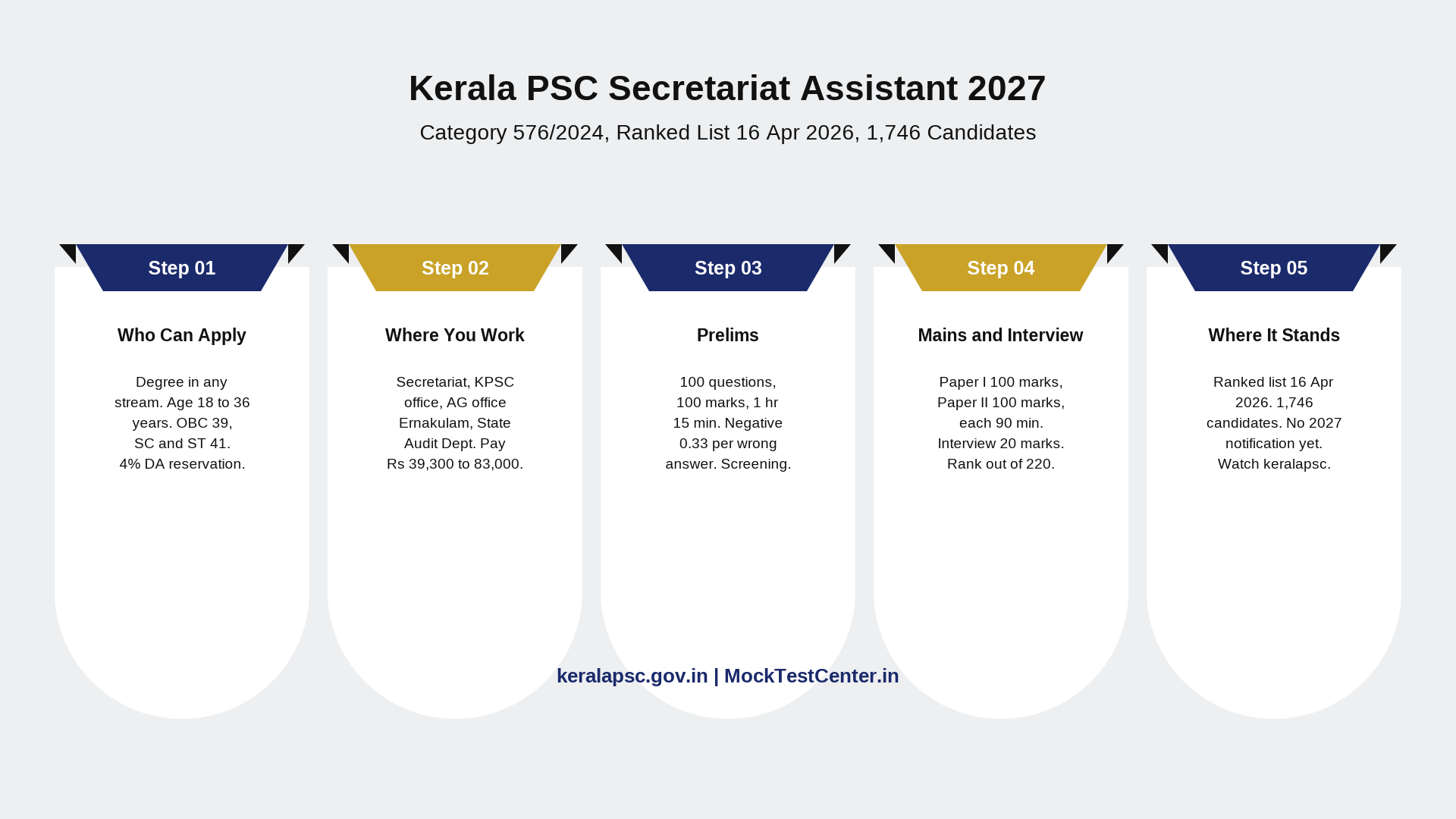
Kerala PSC Secretariat Assistant 2027 on this page follows the live cycle of the Kerala Public Service Commission recruitment for the post of Assistant and Auditor, and the live cycle is Category Number 576/2024. The Kerala Public Service Commission, known as Kerala PSC, published the notification in the extraordinary gazette dated 31 December 2024. Applications ran from 31 December 2024 to 29 January 2025, and the ranked list came into force on 16 April 2026.
No separate 2027 notification has been published as of 23 November 2026, so this guide anchors on the 576/2024 cycle and on the cycle before it, and says so wherever a 2027 figure would otherwise be guessed. The page carries 2027 in its title because the site groups examination pages by that year. The examination itself carries the category number 576/2024, and that number is the identifier a candidate should use when checking the Kerala PSC website.
The post draws graduates from every stream into the heart of the Kerala government. An Assistant works in the Government Secretariat in Thiruvananthapuram, in the Kerala PSC office, in the Advocate General office at Ernakulam, or in the State Audit Department and the offices of the Vigilance Tribunal and the Enquiry Commissioner and Special Judge. An Auditor works in the State Audit Department, checking the accounts of local bodies and government offices. The two titles sit in one recruitment, one examination, and one ranked list.
That shared recruitment is the first thing a new candidate should grasp. The notification calls the post Assistant and Auditor, and it fills both kinds of chair through the same three stages. A candidate does not choose between Assistant and Auditor at the application stage in the way a candidate chooses between two separate examinations. The commission allots departments after the ranked list, and the preparation is the same either way.
The second thing to grasp is the shape of the competition. Kerala PSC published a ranked list of 1,746 candidates for the 576/2024 cycle, and that list covers appointments across all the departments named above. The list stays in force for a fixed period, and appointments come from it as vacancies are reported. A candidate who misses the next notification by a few months may wait years for the one after it, because the gap between the 2021 notification and the 2024 notification ran to more than three years.
Kerala PSC Secretariat Assistant 2027 at a glance
| Detail | Kerala PSC Secretariat Assistant 2027, as run in the 576/2024 cycle |
|---|---|
| Conducting body | Kerala Public Service Commission (Kerala PSC), Thiruvananthapuram, website keralapsc.gov.in |
| Exam | Assistant and Auditor, direct recruitment, Category Number 576/2024 |
| Departments | Government Secretariat, Kerala PSC office, Advocate General office Ernakulam, State Audit Department, Office of the Vigilance Tribunal, Office of the Enquiry Commissioner and Special Judge |
| Gazette date | 31 December 2024 |
| Applications | 31 December 2024 to 29 January 2025, up to 12 midnight, closed, through One Time Registration |
| Vacancies | Anticipated vacancies, no number published in the notification |
| Education | Degree in any discipline from a recognised university, or an equivalent qualification |
| Age limit | 18 to 36 years, OBC up to 39 years, SC and ST up to 41 years |
| Pay scale | Rs 39,300 to Rs 83,000, plus dearness allowance and house rent allowance |
| Preliminary exam | Degree Level Common Preliminary Examination Stage I, 24 May 2025, 100 questions, 100 marks, 1 hour 15 minutes, negative marking 0.33 per wrong answer |
| Main exam | Paper I 100 marks in 1 hour 30 minutes, Paper II 100 marks in 1 hour 30 minutes, both objective multiple choice |
| Interview | 20 marks, added to the Main examination marks for the ranked list |
| Ranked list | Ranked List Number 302/2026/SS IV, in force from 16 April 2026, 1,746 candidates |
| 2027 notification | Not published as of 23 November 2026 |
No 2027 notification yet, and what the live cycle is
Search results for this examination carry three different years in the same week, and the confusion is easy to explain. Tracker pages label the recruitment by the year they write about it, so the same cycle appears as 2024, 2025, and 2026 on different pages. The notification came out on 31 December 2024, so some pages call it the 2024 recruitment. The Preliminary Examination took place in May 2025, so other pages call it the 2025 examination. The ranked list came out in April 2026, so still other pages call it the 2026 result.
The category number settles the confusion. Category Number 576/2024 is the direct recruitment for Assistant and Auditor, and Category Number 577/2024 is the parallel by transfer recruitment for the same post. A page that leaves out the category number may describe a different cycle, and a page that prints a 2027 notification date without a category number is guessing. No notification for a fresh direct recruitment had been published as of 23 November 2026.
The live cycle matters because it is the only cycle with verifiable dates, a verifiable pattern, and a verifiable ranked list. Everything in this guide that carries a date comes from the 576/2024 notification, from the Kerala PSC ranked list page, or from the detailed syllabus the commission published for the Main examination. Where a tracker page disagrees with those sources, this guide records the disagreement rather than picking the friendlier number.
The gap between notifications is part of the story. The previous direct recruitment carried Category Number 57/2021, with its gazette dated 3 April 2021, and its ranked list came into force on 12 April 2023. The cycle before that carried Category Numbers 638/2014 and 639/2014, with its written examination held on 16 May 2015. The pattern is a long wait, a short application window, and then a cycle that runs for more than a year from gazette to ranked list. A graduate who wants this post should prepare during the wait, because the window gives no time to start from zero.
Where the Assistant works, and what the Auditor does
The Government Secretariat in Thiruvananthapuram is the main posting, and it is the posting most candidates picture when they apply. An Assistant in the Secretariat handles files, drafts notes, puts up cases for decision, and keeps the record of a section moving. The work is desk work, and it rewards a candidate who writes clearly, files carefully, and learns the rules of the department. The Secretariat runs the state, and the Assistant is the grade that keeps its paper moving.
The Kerala PSC office takes Assistants of its own, and the work there is close to the recruitment process itself. The Advocate General office at Ernakulam takes Assistants who support the legal work of the state, and the State Audit Department takes Auditors who examine the accounts of local bodies and government offices. The Vigilance Tribunal office and the Enquiry Commissioner and Special Judge office take Assistants for their quasi judicial work. The departments differ, and the grade is the same.
An Auditor in the State Audit Department audits the accounts of panchayats, municipalities, and other local bodies, and reports on how public money was spent. The work needs arithmetic, attention to detail, and a working knowledge of accounts and audit rules. The Main examination reflects that need in its own way, because Paper I gives 15 marks to Simple Arithmetic, Mental Ability and Reasoning, the single largest block in that paper, and Paper II gives 30 marks to the Kerala economy and the Kerala model of development.
Promotion runs through the Secretariat service, and an Assistant moves up the grades with service and departmental examinations. The pay scale of Rs 39,300 to Rs 83,000 is the starting scale for the post, and it carries dearness allowance and house rent allowance on top of the basic pay. The exact in hand figure varies with the posting and with the allowances in force at the time, so this guide prints the scale and does not print a monthly in hand figure. Tracker pages that print a single in hand number are estimating, and the estimate changes every time the dearness allowance changes.
The 576/2024 cycle, date by date
The cycle opened with the extraordinary gazette dated 31 December 2024. Applications ran through the Kerala PSC One Time Registration system, and the last date for receipt of applications was 29 January 2025, up to 12 midnight. The notification stated the number of vacancies as anticipated vacancies, which is the Kerala PSC form of words for a recruitment where departments report vacancies as they arise, and no fixed number is published at the notification stage.
The Preliminary Examination was the Degree Level Common Preliminary Examination Stage I, held on 24 May 2025. The admit card was released on 9 May 2025 on the Thulasi portal. The Preliminary Examination is a common paper shared with other degree level posts, and the Secretariat Assistant candidates sat it with candidates for other graduate posts in the same stage. The commission published the standardisation procedure for the Degree Level Common Preliminary Examinations of 2025, and the Secretariat Assistant category numbers 576/2024 and 577/2024 appear in the commission examination updates for that stage.
The Main examination followed the Preliminary Examination, and the commission published a detailed syllabus for Main Paper I and Main Paper II. The Main examination dates do not appear in the sources read for this guide, so this guide states no Main examination date. The interview carried 20 marks, and the ranked list was published as Ranked List Number 302/2026/SS IV, with effect from 16 April 2026. The list carries 1,746 candidates in all, with 910 candidates on the main list, 805 candidates on the supplementary lists, and 31 candidates on the differently abled list, according to the Entri breakdown of the list. The Kerala PSC ranked list page confirms the list number, the category number, and the date of 16 April 2026.
Appointments from the list had begun by the time the coaching portals reported on it, and the list remains the source from which the departments draw. A candidate on the list watches the advice memos, and a candidate off the list watches for the next notification. The two groups need different things from this guide, and the sections below serve both: the pattern and syllabus for the next notification, and the calendar of the cycle that just finished for the candidate who wants to know how long the road runs.
Who can apply: degree, age, and the by transfer route
The education rule is short. A candidate needs a degree in any discipline from a university recognised by law in India, or an equivalent qualification prescribed by the Kerala PSC. Science, Commerce, and Arts graduates stand on the same footing, and no subject restriction applies. No minimum percentage applies either. The rule numbered KS and SSR Part II Rule 10(a)(ii) is noted as applicable in the notification, and it covers the recognition of qualifications.
Age runs from 18 to 36 years for the direct recruitment, with the upper limit rising to 39 years for OBC candidates and to 41 years for SC and ST candidates. The exact birth window for the 576/2024 cycle does not appear in the sources read for this guide, so this guide states the limits and does not print birth dates. The next notification will fix its own cut off date, and the candidate should read it in that notification rather than carry the last cycle dates forward.
Four percent of the vacancies are reserved for differently abled candidates, under Government Order (P) Number 05/2023/SJD dated 1 October 2023. The notification carries that reservation expressly, and it is one of the few vacancy related figures the notification states in plain numbers. The reservation applies to the vacancies as they are reported, and the ranked list carries a separate differently abled list of 31 candidates.
Category Number 577/2024 runs beside the direct recruitment, and it fills the same post by transfer from low paid employees already in government service. Its eligibility list carried Number 36/2025/ERXV and was dated 29 July 2025. A serving employee who wants the by transfer route should read the 577/2024 notification, because its conditions differ from the direct recruitment, and the two lists are prepared separately. This guide covers the direct recruitment, and it notes the by transfer route so that a candidate does not confuse the two lists.
How the application works through One Time Registration
Applications run online only, through the Kerala PSC One Time Registration system on keralapsc.gov.in and the Thulasi portal. A candidate registers once, with a valid mobile number and email ID, and then applies for each post from the same profile. The photograph and signature go up in the format the notification fixes, and the application for the post is submitted from the profile before the last date. The 576/2024 last date was 29 January 2025, up to 12 midnight, and the portal closes at that hour.
The notification carries no application fee figure in the material read for this guide, and this guide states none. Kerala PSC applications run through the One Time Registration profile, and the candidate should read the fee position, if any, in the notification for the cycle they apply under. A page that prints a fee for this post without citing the notification is guessing, and the fee is the kind of detail that changes between cycles.
Confirmation is a separate step that catches candidates every cycle. After the application, the commission opens a confirmation window for the examination, and only candidates who confirm through their Thulasi profile receive an admission ticket. The confirmation window for the Staff Nurse examination in the same period ran from 22 April to 11 May 2025, and the Secretariat Assistant cycle used the same system. A candidate who applies and forgets to confirm does not sit the examination, and no late confirmation is accepted. The admission ticket for the Preliminary Examination was released on 9 May 2025, and the candidate downloads it from the Thulasi portal.
The submitted application should be kept until the final result, because the commission asks for it at the document verification stage. The profile also carries the messages about shortlists, eligibility lists, and interview calls, and the candidate who checks the profile regularly misses nothing. The commission publishes its notices on keralapsc.gov.in, and the candidate who relies on a coaching portal alone learns the dates late.
Three stages, and which marks count
The Kerala PSC Secretariat Assistant exam pattern runs in three stages, and each stage decides a different thing. The Preliminary Examination screens the field. The Main examination decides the written merit. The interview adds a small but real weight at the end. The notification states the scheme plainly: the Main examination carries two papers, the interview carries 20 marks, and the marks of the Main examination and the interview will be considered for ranking.
The Preliminary Examination marks do not count in the final merit. That single sentence changes how a candidate should spend the preparation. The Preliminary paper is a gate, and the Main papers are the examination. A candidate who tops the Preliminary paper and scores poorly in the Main papers still fails, and a candidate who scrapes through the Preliminary paper and scores well in the Main papers still ranks. The preparation should follow the marks, not the calendar order.
The funnel is narrow at every stage. The ranked list carries 1,746 candidates, and the main list carries 910 of them. The number who sat the Preliminary Examination is not published in the sources read for this guide, so this guide prints no applicant total and no ratio. A page that prints a firm applicant count for the 576/2024 cycle is guessing, because the commission does not publish it in the notification or in the ranked list notice.
Shortlists and eligibility lists come between the stages, and the commission publishes them on its website with an eligibility list number and a date. The by transfer list carried Number 36/2025/ERXV dated 29 July 2025, and the direct recruitment list followed the interview stage. A candidate should check the shortlist pages for the category number, because a list for 577/2024 is not a list for 576/2024, and the two recruitments move on different dates.
The Preliminary paper in full
The Preliminary Examination is the Degree Level Common Preliminary Examination, and for the 576/2024 cycle it was Stage I, held on 24 May 2025. The paper is an objective type test, valued by OMR, with 100 questions and 100 marks, run in 1 hour 15 minutes. Every question carries 1 mark, and the commission deducts 0.33 marks for each wrong answer. A question left unanswered carries no penalty.
The arithmetic of the paper is tight. One hundred questions in 75 minutes allow 45 seconds per question, and the paper rewards the candidate who moves on from a stuck question instead of burning two minutes on it. Three wrong guesses cancel one correct answer, so a candidate who guesses blindly loses marks fast, and a candidate who leaves a question blank loses nothing. The discipline is to attempt a question only when at least two options can be eliminated, and to leave the rest.
The medium of the questions is English and Malayalam, Tamil, or Kannada, as the notification states. The paper is common to degree level posts, so it tests graduate level general knowledge rather than Secretariat work. The ten topics in the notification are Quantitative Aptitude, Mental Ability and Test of Reasoning, General Science, Current Affairs, Facts about India, Renaissance of Kerala, Constitution of India and Civil Rights, General English, Social Welfare Schemes and Measures, and Information Technology and Cyber Laws.
Two topics in that list deserve more weight than the rest, because they are the ones a general graduate has not studied. Renaissance of Kerala covers the social reform movements, the leaders, and the changes that shaped modern Kerala, and it is the topic where a candidate from outside the state syllabus loses marks. Facts about India covers the same ground at the national level, and Current Affairs covers the year before the examination. The three together reward a candidate who reads the news daily and keeps a notebook of Kerala facts.
The marks per topic for the Preliminary paper do not appear in the sources read for this guide, so this guide prints no topic wise split for the Preliminary paper. The detailed syllabus for the Main examination carries a full mark distribution, and that distribution is printed in the sections below. A page that prints a Preliminary topic wise split with exact marks is filling a gap the commission left open, and the candidate should treat it as an estimate.
| Stage | Papers | Questions and marks | Time | Counts for rank |
|---|---|---|---|---|
| Preliminary | One objective paper, common Degree Level Prelims | 100 questions, 100 marks, 1 mark each, minus 0.33 per wrong answer | 1 hour 15 minutes | No, screening only |
| Main Paper I | One objective paper | 100 marks | 1 hour 30 minutes | Yes |
| Main Paper II | One objective paper | 100 marks | 1 hour 30 minutes | Yes |
| Interview | Personal interview | 20 marks | As scheduled | Yes |
| Total for rank | Main papers plus interview | 220 marks | 3 hours of written papers plus interview | Yes |
Main Paper I, subject by subject
Main Paper I carries 100 marks in 1 hour 30 minutes, and it is an objective multiple choice paper. The official detailed syllabus gives a subject wise mark distribution, and that distribution is the most useful page in the whole recruitment for planning the preparation. The candidate who studies in proportion to the marks spends the time where the marks are, and the candidate who studies every subject equally spends too long on the small ones.
Simple Arithmetic, Mental Ability and Reasoning carries the largest single block in Paper I, at 15 marks. English carries 13 marks, and the Regional Language carries 13 marks. Those three blocks together carry 41 marks, which is more than a third of the paper. A candidate who is strong in arithmetic and reasoning and in the two languages starts the paper with a real advantage, and a candidate who is weak in all three starts it with a hole that no other subject can fill.
History carries 7 marks, Geography carries 7 marks, Economics carries 7 marks, Life Science and Public Health carries 7 marks, Physics carries 7 marks, and Chemistry carries 7 marks. Arts, Literature and Culture carries 8 marks. Sports carries 3 marks, and Basics of Computer carries 6 marks. The science blocks together carry 21 marks, and they stay at the level of a graduate who kept up with school science, not at the level of a specialist. The history and geography blocks reward Kerala facts alongside national facts, and the economics block rewards the same ground the Preliminary paper tests.
| Main Paper I subject | Marks |
|---|---|
| History | 7 |
| Geography | 7 |
| Economics | 7 |
| Life Science and Public Health | 7 |
| Physics | 7 |
| Chemistry | 7 |
| Arts, Literature and Culture | 8 |
| Sports | 3 |
| Basics of Computer | 6 |
| Simple Arithmetic, Mental Ability and Reasoning | 15 |
| English | 13 |
| Regional Language | 13 |
| Total | 100 |
The note at the end of the official syllabus matters, and most tracker pages leave it out. The commission says that questions from other topics prescribed for the educational qualification of the post may also appear in the question paper, and that there is no undertaking that all the topics above may be covered in the question paper. The syllabus guides the paper. It does not promise that every listed topic appears in it. A candidate who studies only the listed topics and skips the general graduate ground risks a question from outside the list, and a candidate who expects every listed topic to appear risks disappointment.
English in Paper I tests comprehension, grammar, and vocabulary at the graduate level, and the Regional Language paper tests the same skills in Malayalam, Tamil, or Kannada. The two language blocks together carry 26 marks, and they are the blocks where daily practice pays fastest. A passage a day, a set of grammar questions a day, and a vocabulary notebook kept through the preparation cover both blocks without a separate book for each.
Main Paper II, the paper that separates the field
Main Paper II carries 100 marks in 1 hour 30 minutes, and it is the paper that separates the field. Paper I tests what a graduate knows. Paper II tests what an Assistant needs to know: administration, management, the Constitution, the Kerala economy, the environment, and electronic governance. A candidate who treats Paper II as general knowledge wastes the paper, and a candidate who studies it as a professional syllabus gains the marks that decide the rank.
Principles of Administration carries 10 marks, and Principles of Management carries 10 marks. The two modules cover the definition and scope of administration, the types of organisations, the theories of administration from the classical school through the behavioural school to the contingency school, organisational structure and functions, organisational culture and change management, ethical principles, leadership and leadership styles, communication in administration, and accountability and transparency. The management module adds the management functions of planning, organising, staffing, directing, and controlling, the contemporary approaches of the system approach, the contingency approach, total quality management, lean management, and agile management, and the questions of corporate social responsibility and globalisation.
Constitutional Structure carries 12 marks, the largest single module in Paper II, and Centre State Relations carries 8 marks. The two together carry 20 marks, and they cover the salient features of the Indian Constitution, the Preamble, fundamental rights with their meaning and limitations, the directive principles of state policy and the fundamental duties, the Union Executive and the Union Legislature, the Union Judiciary with judicial review and public interest litigation, the State Executive and the State Legislature, the State Judiciary, and the legislative, administrative, and financial relations between the Union and the States. A candidate who knows the Constitution from the Preliminary paper still needs to study it again for Paper II, because the questions here go deeper into structure and relations.
Kerala Economy carries 15 marks, and Kerala Model of Development carries 15 marks. The two together carry 30 marks, which is nearly a third of the paper, and they are the reason Paper II decides the rank. The economy module covers the Kerala economy since the formation of the state, the State Gross Domestic Product, economic growth, per capita income, resource mobilisation through tax and non tax revenue, public expenditure, decentralised planning, policies and development programmes, agriculture crops, land use pattern, land reforms, food security, industry, micro small and medium enterprises, energy, infrastructure, the service sector, health, the care economy, migration, tourism, education, and information and communication technology.
The Kerala model module covers the evolution of the model, its significance, and its features, which are adult literacy, life expectancy, infant mortality, and birth rate. It covers the reasons behind the model, and the challenges that sit beside it, which are unemployment, poverty, inequality, the gender gap, ageing, and the position of women, and it covers the women empowerment programmes, the knowledge economy, startups, and brain gain. A candidate who can write a paragraph on each of those features, with one fact for each, is ready for the module. A candidate who knows only the slogan of the Kerala model is not.
| Main Paper II module | Marks |
|---|---|
| Principles of Administration | 10 |
| Principles of Management | 10 |
| Constitutional Structure | 12 |
| Centre State Relations under the Constitution | 8 |
| Kerala Economy | 15 |
| Kerala Model of Development | 15 |
| Environment and Climate | 10 |
| Disaster Management | 10 |
| E Governance | 10 |
| Total | 100 |
Environment and Climate carries 10 marks, and Disaster Management carries 10 marks. The environment module covers the basic concepts of ecosystem and biodiversity, forests, deserts, and aquatic ecosystems, the rivers of Kerala, environmental pollution of water, air, and soil, contaminants such as pesticides, metals, and gaseous pollutants, and the environmental movements. The disaster management module covers the hazards Kerala faces, and the management of them. The two modules together carry 20 marks, and they reward a candidate who follows the news on floods, landslides, and the monsoon, because Kerala lives with those hazards every year.
E Governance carries 10 marks, and it closes the paper. The module covers the basic objectives of electronic governance, and the way the government delivers services through digital channels. A candidate who has used the Kerala PSC Thulasi portal, the state service delivery portals, and the common service centres has already seen the subject in practice. The module asks for the principles behind those services, not for a list of website names.
The interview, and how the ranked list is built
The interview carries 20 marks, and it is the last stage before the ranked list. The commission calls the candidates who clear the Main examination, verifies their original documents, and interviews them. The interview tests the candidate in person, and it covers the background, the motivation for the post, and the general awareness the written papers cannot test. Twenty marks is a small weight beside the 200 marks of the Main papers, and it is large enough to move a candidate several places on the list.
The ranked list is prepared from the Main examination marks plus the interview marks, out of 220. The Preliminary Examination marks do not enter the list. The list carries a main list, supplementary lists, and a differently abled list, and the 576/2024 list carries 910 candidates on the main list, 805 on the supplementary lists, and 31 on the differently abled list. Appointments come from the main list first, and the supplementary lists supply candidates as the main list is exhausted and as reserved vacancies arise.
The list stays in force for a fixed period, and the commission publishes addenda and errata to it when a correction is needed. The ranked list page on keralapsc.gov.in carries the list with its number, its date, and its addendum and erratum links, and the candidate should read that page rather than a coaching portal summary. The results of some candidates may be withheld, and the Entri report on the 576/2024 list notes withheld results for five interview serial numbers. A withheld result means the commission has held the result back for verification, and the commission publishes the position when the verification is done.
Document verification is the step that ends the most candidacies after the interview, and it ends them for avoidable reasons. The candidate must carry the original degree certificate, the proof of age, the community certificate where claimed, and the registration details that match the application. A certificate that does not match the application, or a document that is missing on the day, costs the candidate the appointment even after a place on the list. The candidate should assemble the file before the interview call, not after it.
Pay, posting, and the career after selection
The pay scale for the post is Rs 39,300 to Rs 83,000. The scale carries dearness allowance and house rent allowance, and the in hand figure depends on the posting, the allowances in force, and the deductions. The Secretariat posting is in Thiruvananthapuram, and the other departments post across the state, with the Advocate General office at Ernakulam as the main posting outside the capital. A candidate who joins should expect a desk, a section, and a file load from the first week, and should expect the first year to be a course in the rules of the department.
The career runs through the Secretariat service, and an Assistant moves to higher grades with service, seniority, and departmental examinations. The grade is a starting point. Officers rise from it with service and departmental examinations, and the officers who rise fastest are the ones who learn the rules early and write well. The Main examination already tests the ground the career needs, because Paper II covers administration, management, the Constitution, and the Kerala economy, and those are the subjects an Assistant uses every day in the Secretariat.
The Auditor in the State Audit Department follows a parallel path, with audit work in the districts and with the accounts of local bodies. The audit path rewards arithmetic and attention to detail, and it takes the Auditor into panchayats and municipalities across the state. The two titles share a ranked list and a starting scale, and they diverge after the posting, so the candidate should be ready for either.
One fact about the posting deserves a plain statement. The Secretariat Assistant is a Thiruvananthapuram centred post for most of its holders, and a candidate who wants to stay in a home district should think about that before applying. The departments outside the capital take a smaller share of each list, and the posting follows the vacancy, not the preference of the candidate alone. The transfer rules of the department govern the later moves, and the candidate should read them after selection, not before applying.
The previous cycle, 57/2021, and what it shows
The previous direct recruitment carried Category Number 57/2021, with its gazette dated 3 April 2021, and its by transfer companion carried Category Number 58/2021. The ranked list for the direct recruitment carried Number 224/23/ERVI, and it came into force on 12 April 2023. The cycle ran for two years from gazette to ranked list, and the 576/2024 cycle ran for about sixteen months from gazette to ranked list. The commission has shortened the cycle, and the candidate who applies under the next notification should still plan for a year or more from application to appointment.
The 2021 cycle also shows how the cut off behaves. The Entri page on the Secretariat Assistant cut off carries the 2018 cycle figures as a reference, with the general main list cut off at 75.33 marks and the supplementary list at 74 marks, and it carries expected figures for the later cycle that run higher. Those figures are estimates from a coaching portal, and the commission does not publish a single cut off for the Preliminary Examination in the way the portals present it. This guide prints no cut off for the 576/2024 cycle, because no verified cut off for that cycle appears in the sources read, and a candidate who plans around an estimated cut off plans around a number that may be wrong by several marks.
The 2018 cycle is worth a line for its own sake. The written examination for that cycle was held on 13 October 2018, the shortlist was published on 14 February 2019, and the ranked list came into force on 9 April 2019. The cycle before the 2021 one, in other words, ran on the same shape: a gazette, a common Preliminary Examination, a Main examination, an interview, and a ranked list that stayed in force while appointments were made. The shape has not changed in a decade. The syllabus has grown more detailed, and the Main examination now carries a published mark distribution that the earlier cycles did not carry in the same form.
The lesson of the previous cycles is that the examination rewards the candidate who prepares through the gap between notifications, not the candidate who starts at the gazette. The 2021 gazette came three years after the 2018 examination, and the 2024 gazette came more than three years after the 2021 gazette. The next gazette will come when the ranked list nears exhaustion and the departments report fresh vacancies, and no tracker page can predict that date. The candidate who keeps the base subjects warm during the gap is ready when the window opens.
A preparation plan that fits the marks
The plan starts with the weight of the marks, because the marks are the only honest guide to where the time should go. The Preliminary Examination carries 100 marks and screens the field, and the Main examination carries 200 marks and decides the rank, with the interview adding 20 marks. The candidate should spend the largest share of the preparation on the Main papers, and should treat the Preliminary paper as a gate to clear with a margin, not as the examination itself.
For the Preliminary paper, the daily work is current affairs, Kerala facts, and arithmetic. A newspaper a day, with a notebook for the facts that recur, covers Current Affairs and Facts about India. A book on the Renaissance of Kerala, read slowly and revised twice, covers the topic that most candidates neglect. Arithmetic and reasoning need daily sets, because the Preliminary paper allows 45 seconds per question, and speed comes only from practice. General English needs a passage a day, and the science blocks need the school level ground revised from the start.
For Main Paper I, the plan follows the mark distribution. Simple Arithmetic, Mental Ability and Reasoning at 15 marks gets a daily set. English at 13 marks and the Regional Language at 13 marks get a daily passage and a daily grammar set. The six blocks at 7 marks each get a weekly rotation, with History and Geography sharing a week and the sciences sharing a week. Arts, Literature and Culture at 8 marks gets a reading list of Kerala art, literature, and culture, and Basics of Computer at 6 marks gets a short revision of computer fundamentals. Sports at 3 marks gets a notebook of the year sporting facts, and no more.
For Main Paper II, the plan rests on reading. Principles of Administration and Principles of Management need a standard text on public administration, read with notes, and the Constitution needs the text of the Constitution with a commentary, read module by module. Kerala Economy and the Kerala Model of Development need the Economic Review of Kerala and a book on the Kerala economy, read for the facts that recur: the State Gross Domestic Product, the per capita income, the revenue figures, the land reforms, the migration story, and the health and education indicators. Environment and Disaster Management need the news of the monsoon and the floods, and E Governance needs the portals the candidate already uses.
Mock tests close the plan. A mock test every week for the Preliminary paper, taken in 75 minutes with the negative marking applied, teaches the timing that the paper demands. A mock test every week for each Main paper, taken in 90 minutes, teaches the same timing for the Main papers. The score on a mock test matters less than the review after it, and the review should list the questions lost to guessing, the questions lost to a gap in the syllabus, and the questions lost to time. The candidate who fixes the guessing first gains marks fastest, because three wrong guesses cancel one correct answer.
The interview needs a different kind of preparation, and it starts after the Main examination. The candidate should be able to speak about the home district, the degree subject, the reason for choosing the Secretariat, and the work of an Assistant, in plain sentences and without rehearsed speeches. The interview carries 20 marks, and it rewards a candidate who is clear and honest over a candidate who is polished and vague. A mock interview with a teacher or a senior who has faced the commission is worth more than a book on interviews.
Mistakes that cost candidates a place on the list
The first mistake is preparing for the wrong cycle. Tracker pages mix the 2018, 2021, and 2024 cycles, and a candidate who studies the pattern of an older cycle may prepare for a paper that no longer exists in that form. The Main examination now carries two papers of 100 marks each with a published mark distribution, and the Preliminary Examination is the common Degree Level paper. Read the category number, and prepare from the notification and the detailed syllabus for that category number.
The second mistake is treating the Preliminary paper as the examination. The Preliminary marks do not count in the final merit, and the Main papers carry 200 marks against the interview 20 marks. A candidate who spends the whole preparation on the Preliminary paper arrives at the Main examination unready, because Paper II asks for administration, management, and the Kerala economy at a depth the Preliminary paper never tests. Spend the preparation in proportion to the marks, and the Main papers will carry the rank.
The third mistake is guessing blindly in the objective papers, where the Kerala PSC Secretariat Assistant exam pattern punishes it. The penalty is 0.33 marks per wrong answer in the Preliminary paper, and the same penalty structure applies in the Main papers. A candidate who guesses on twenty questions and gets five right loses five marks net, and a candidate who leaves those twenty blank loses nothing. Attempt a question only when two options can be eliminated, and leave the rest.
The fourth mistake is skipping the confirmation step. The commission opens a confirmation window for the examination, and only candidates who confirm through their Thulasi profile receive an admission ticket. The candidate who applies in January and forgets to confirm in the window does not sit the paper in May, and no late confirmation is accepted. Set a reminder for the confirmation window as soon as the application is submitted, and check the profile every week from the application to the examination.
The fifth mistake is trusting a vacancy total from a tracker page. Kerala PSC states the vacancies for this post as anticipated vacancies, and no fixed number is published at the notification stage. A page that prints a firm number for the 576/2024 cycle is guessing, and the Testbook figure of around 2,500 vacancies for a previous year is an estimate from that page, not a commission figure. The hard number for the 576/2024 cycle is the ranked list of 1,746 candidates, and that number is the only vacancy related figure a candidate can plan around.
The sixth mistake is neglecting Paper II, and it is the costliest of all. Paper II carries 100 marks, and 30 of them sit in the Kerala Economy and the Kerala Model of Development, with 20 more in the Constitution and 20 more in administration and management. A candidate who knows the Preliminary syllabus and skips Paper II loses the paper that decides the rank. Read a book on the Kerala economy, read the Constitution with a commentary, and read a text on public administration, and the paper will repay the reading.
The seventh mistake is leaving the documents to the last day. The interview stage verifies the original degree certificate, the proof of age, and the community certificate where claimed, and a missing or mismatched document costs the appointment even after a place on the list. Assemble the file before the interview call, check every certificate against the application, and carry the originals with a set of copies.
What to watch next
The 576/2024 ranked list is in force from 16 April 2026, and appointments from it continue as the departments report vacancies. A candidate on the list should watch the advice memos on the Thulasi profile and the Kerala PSC website, and should keep the documents ready for the day the call comes. A candidate off the list should watch for the next notification, which will carry its own category number, its own dates, and its own fee position, and should prepare the base subjects in the meantime.
The next notification will come when the ranked list nears exhaustion, and no date for it has been announced as of 23 November 2026. The Degree Level Common Preliminary Examinations for the next round of graduate posts ran in stages on 2 May, 16 May, and 6 June 2026, and the Secretariat Assistant will join a future stage when its notification comes. The candidate who prepares now will sit that stage with the syllabus already covered, and the candidate who waits for the gazette will start from zero with a short window.
Check keralapsc.gov.in for the notification, the examination programme, the shortlists, and the ranked lists. Check the Thulasi profile for the confirmation window and the admission ticket. Keep the preparation in proportion to the marks, keep the guessing under control, and keep Paper II at the centre of the plan. The post rewards the candidate who does the steady work through the long gap between notifications, and the ranked list of 1,746 candidates shows that the road, though long, is open.
Mock tests for Kerala PSC Secretariat Assistant 2027: Full Tests, PYQ, Chapter Tests, Sectional Tests, NCERT based Tests, Current Affairs and PYQ PDF Downloads
The mock tests on this page follow the pattern this guide records for the 576/2024 cycle. A full test for the Preliminary paper carries 100 questions and 100 marks in 1 hour 15 minutes, and the commission deducts 0.33 marks for each wrong answer. A full test for Main Paper I and a full test for Main Paper II each carry 100 marks in 1 hour 30 minutes. The interview carries 20 marks, and the rank comes from the Main papers plus the interview, out of 220. Take each full test in one sitting with the clock running.
The previous year papers tab draws on the papers this guide records by date. The commission held the written examination of the earlier cycle on 13 October 2018. The commission held the Preliminary Examination of the 576/2024 cycle on 24 May 2025. Those two papers show the real shape of the examination. This guide names no separate published set of previous year papers for this post. The tab will carry papers as Kerala PSC publishes them on keralapsc.gov.in.
Chapter tests follow the real syllabus, chapter by chapter. The Preliminary paper topics are Quantitative Aptitude, Mental Ability and Test of Reasoning, General Science, Current Affairs, Facts about India, Renaissance of Kerala, Constitution of India and Civil Rights, General English, Social Welfare Schemes and Measures, and Information Technology and Cyber Laws. Main Paper I marks run 15 for arithmetic and reasoning, 13 each for English and the Regional Language, 7 each for History, Geography, Economics, Life Science and Public Health, Physics, and Chemistry, 8 for Arts, Literature and Culture, 3 for Sports, and 6 for Basics of Computer. Main Paper II marks run 10 each for Principles of Administration, Principles of Management, Environment and Climate, Disaster Management, and E Governance, 12 for Constitutional Structure, 8 for Centre State Relations, and 15 each for Kerala Economy and Kerala Model of Development.
Sectional tests take one section of the real pattern and test it alone. A Preliminary sectional test can cover Current Affairs, Renaissance of Kerala, or Quantitative Aptitude. A Main Paper I sectional test can cover the arithmetic and reasoning block at 15 marks, or the two language blocks at 13 marks each. A Main Paper II sectional test can cover Kerala Economy and Kerala Model of Development at 30 marks, or Constitutional Structure at 12 marks.
NCERT based tests cover the school level ground behind the science and general knowledge parts of this examination. The Preliminary paper tests General Science, and Main Paper I tests Physics, Chemistry, and Life Science and Public Health at 7 marks each. NCERT books from Class 6 to Class 12 cover that ground, and only that ground. Paper II needs its own books, because administration, management, the Kerala economy, and the Kerala model sit outside the school books.
Current Affairs tests cover the year before the examination, which is the window this guide records for the Preliminary paper. The scope runs across Kerala and the nation, with Kerala government schemes, appointments, awards, sports results, and science news beside national events.
PYQ PDF downloads live on keralapsc.gov.in, where Kerala PSC publishes its notifications, its detailed syllabuses, its shortlists, and its ranked lists. This guide names no official PYQ PDF for a named paper of this post, so this page prints no download link for a previous year paper. The tab will carry papers as the commission publishes them.
Sources
Adda247, Category Number 576/2024 notification, gazette date 31 December 2024, last date 29 January 2025, post Assistant and Auditor, departments Government Secretariat, Kerala Public Service Commission, Advocate General office Ernakulam, State Audit Department, Office of the Vigilance Tribunal, Office of the Enquiry Commissioner and Special Judge, scale of pay Rs 39,300 to Rs 83,000, number of vacancies anticipated vacancies, method of appointment direct recruitment, 4 percent reservation for differently abled candidates under Government Order (P) Number 05/2023/SJD dated 1 October 2023, KS and SSR Part II Rule 10(a)(ii) applicable, applications through keralapsc.gov.in after One Time Registration, Preliminary Examination one objective paper 1 hour 15 minutes, medium English and Malayalam, Tamil, Kannada, Main Examination Paper I objective 1 hour 30 minutes, Paper II objective 1 hour 30 minutes, interview 20 marks, marks of Main examination and interview considered for ranking, last date for receipt of applications 29 January 2025 up to 12 midnight. Entri, Secretariat Assistant Coaching page, last recruitment Category Number 576/2024, ranked list published 16 April 2026 with 1,746 candidates, appointments begun, selection through preliminary exam, main exam and interview, pay scale Rs 39,300 to Rs 83,000, degree in any field from a recognised university, age 18 to 36 years, OBC 39 years, SC and ST 41 years, Preliminary Examination 100 questions, 100 marks, 1 hour 15 minutes, 1 mark per correct answer, 0.33 marks deducted per wrong answer, topics Quantitative Aptitude, Mental Ability and Test of Reasoning, General Science, Current Affairs, Facts about India, Renaissance of Kerala, Constitution of India and Civil Rights, General English, Social Welfare Schemes and Measures, Information Technology and Cyber Laws. Entri, Secretariat Assistant Rank List 2026 page, Category Number 576/2024, ranked list release date 16 April 2026, total candidates 1,746, main list 910, supplementary list 805, differently abled list 31, withheld results for interview serial numbers 7, 10, 16, 609, 1853.
Kerala Public Service Commission, Ranked List page, Assistant and Auditor direct recruitment Category Number 576/2024, Ranked List Number 302/2026/SS IV with effect from 16 April 2026, scale Rs 39,300 to Rs 83,000, departments Government Secretariat, Kerala Public Service Commission, Advocate General office Ernakulam, State Audit Department, Office of the Vigilance Tribunal, Office of the Enquiry Commissioner and Special Judge, uploaded 16 April 2026. Kerala Public Service Commission, Short Lists page, Assistant and Auditor statewide by transfer Category Number 577/2024, eligibility list Number 36/2025/ERXV dated 29 July 2025, scale Rs 39,300 to Rs 83,000. Kerala Public Service Commission, examination updates page, standardisation procedure for Degree Level Common Preliminary Examinations 2026 conducted on 2 May, 16 May and 6 June 2026, Assistant and Auditor Category Numbers 576 and 577/2024 in the examination updates. PSC Mastery, Secretariat Assistant Main Exam Syllabus page, Main examination 200 marks, Paper I 100 marks, Paper II 100 marks, Paper I distribution History 7, Geography 7, Economics 7, Life Science and Public Health 7, Physics 7, Chemistry 7, Arts Literature Culture 8, Sports 3, Basics of Computer 6, Simple Arithmetic Mental Ability and Reasoning 15, English 13, Regional Language 13, Paper II distribution Principles of Administration 10, Principles of Management 10, Constitutional Structure 12, Centre State Relations 8, Kerala Economy 15, Kerala Model of Development 15, Module 7 10, Module 8 10, E Governance 10, verified against the official Kerala PSC detailed syllabus on 25 August 2026. Kerala Public Service Commission, detailed syllabus for Secretariat and KPSC Assistant Main Examination Paper II, total 100 marks, Principles of Administration and Management, Constitution of India, Kerala Model Economy and Development, Environment, Climate and Disaster Management, E Governance. Entri, Secretariat Assistant Exam Date 2025 page, Preliminary Examination scheduled 24 May 2025, admit card released 9 May 2025. Entri, Secretariat Assistant Cut Off page, Category Number 57/2021 gazette 3 April 2021, Category Number 58/2021 by transfer, previous cycle written examination 13 October 2018, shortlist 14 February 2019, ranked list 9 April 2019, 2018 cut off general main list 75.33 marks. Kerala Public Service Commission, ranked list page for Assistant and Auditor direct Category Number 057/2021, Ranked List Number 224/23/ERVI with effect from 12 April 2023. Testbook, Kerala PSC Secretariat Assistant Recruitment 2025 page, age 18 to 36 years, degree in any stream, pay Rs 39,300 to Rs 83,000, application start 31 December 2024, last date 29 January 2025, around 2,500 vacancies in the previous year as an estimate from that page, selection through written exam and interview, last updated 3 November 2026.







