
About Kerala PSC LGS 2027 Exam Series
📖 Table of Contents
- Kerala PSC LGS 2027 at a glance
- Two recruitments share one name, and mixing them up costs marks
- Who can apply: the Standard VII rule that surprises graduates
- LGS exam pattern: one paper, 100 questions, and a timing question nobody flags
- What the job actually involves
- Pay: Rs 23,000 to Rs 50,200, and what lands in hand
- District rank lists: your district picks your cut off
- Cut off marks, district by district
- How to apply on keralapsc.gov.in
- How to prepare when the paper is mostly general knowledge
- What to watch before the next notification
- Mock tests for Kerala PSC LGS 2027: Full Tests, PYQ, Chapter Tests, Sectional Tests, NCERT based Tests, Current Affairs and PYQ PDF Downloads
- Sources
Kerala PSC LGS 2027: Complete Exam Guide
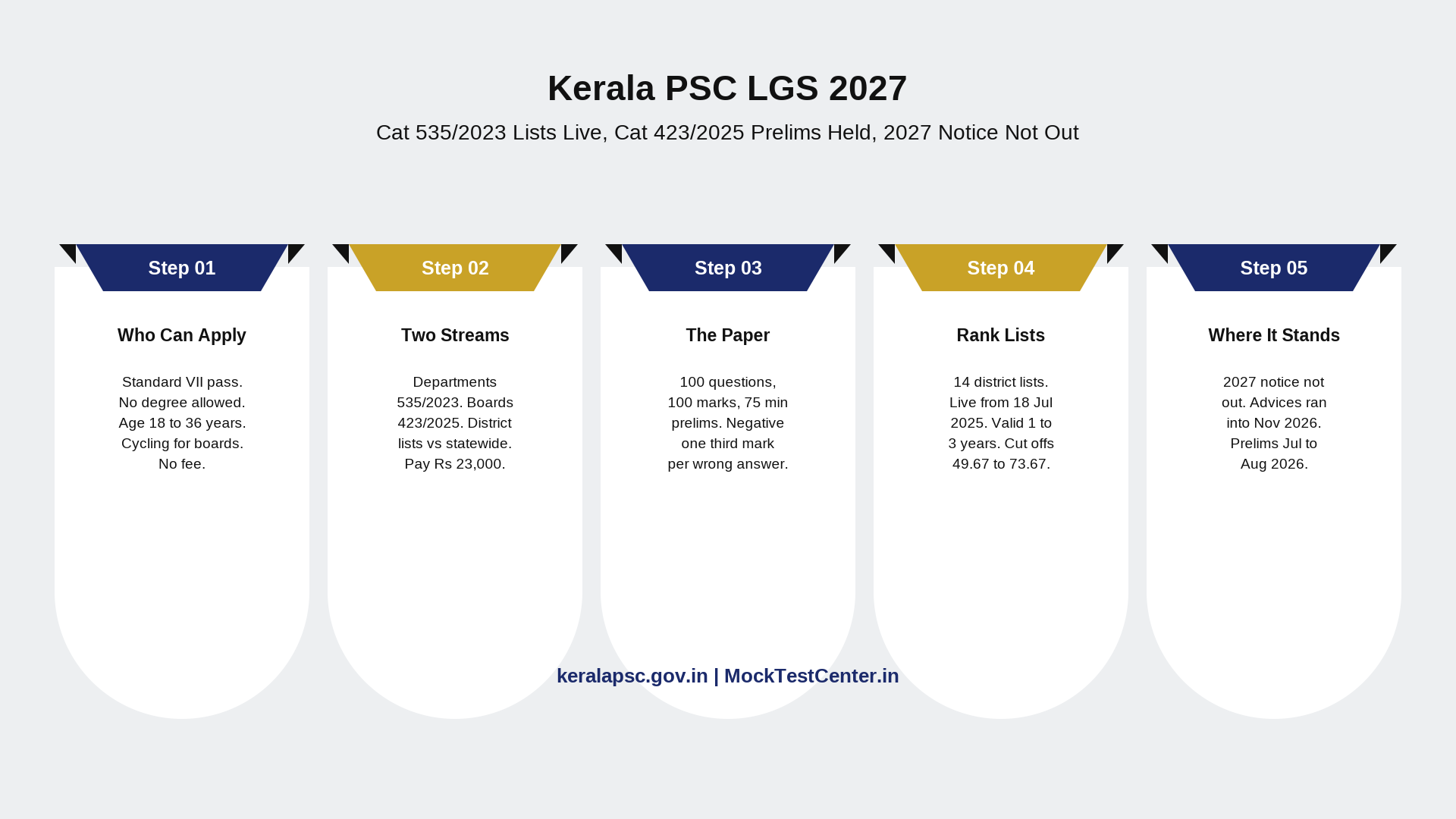
Kerala PSC LGS 2027 has no notification yet. As of 23 November 2026 the Kerala Public Service Commission has published no advertisement number, no application dates and no exam date for a fresh Last Grade Servants cycle under the 2027 label. This guide anchors on the two verified cycles that candidates actually face: the department recruitment under Category Number 535/2023, whose ranked lists came into force on 18 July 2025 and whose advices still ran in November 2026, and the company and board recruitment under Category Number 423/2025, notified on 30 October 2025 with applications closing on 3 December 2025.
The Kerala PSC LGS 2027 page on this site carries the 2027 year because the site groups examination pages by that year. The facts below carry the category numbers they belong to, so a reader can check each one against the notification it came from. Where tracker pages disagree with the official notification, this guide says so and names the disagreement instead of picking the friendlier number.
One fact decides whether a candidate should apply at all, and most pages about this exam bury it. LGS asks for a pass in Standard VII, and it bars anyone who holds a degree. The official notification for Category Number 535/2023 states the rule in plain words: should have passed Standard VII and should not have acquired graduation. A graduate who applies wastes the application, because the commission checks the qualification at verification and the degree itself disqualifies. That single rule shapes the whole applicant pool, and it explains why the cut off marks sit where they do.
Kerala PSC LGS 2027 at a glance
| Detail | Kerala PSC LGS 2027, as run in the verified cycles |
|---|---|
| Conducting body | Kerala Public Service Commission, Thiruvananthapuram, website keralapsc.gov.in |
| Post | Last Grade Servants in various departments, and in government owned companies, corporations and boards |
| Live cycles | Category Number 535/2023 for departments, ranked lists from 18 July 2025; Category Number 423/2025 for companies and boards, notified 30 October 2025 |
| 2027 notification | Not published as of 23 November 2026 |
| Qualification | Pass in Standard VII or equivalent, and no degree |
| Age | 18 to 36 years, with the usual relaxation for SC, ST and Other Backward Communities |
| Pay scale | Rs 23,000 to Rs 50,200 |
| Vacancies | District wise for departments, anticipated for companies and boards, no published total |
| Application fee | None, Kerala PSC charges no fee for this post |
| Exam | One OMR paper, 100 questions, 100 marks, one third mark lost per wrong answer |
| Selection | Written test, document verification, district wise ranked list, advice for appointment |
Two recruitments share one name, and mixing them up costs marks
Search results for LGS read like one exam. They describe one pattern, one syllabus and one set of dates. The commission runs more than one LGS recruitment, and the streams differ in the qualification, the paper, the rank list and the posting. A candidate who prepares from the wrong stream studies the wrong paper.
The department stream covers Last Grade Servants in various departments of the Government of Kerala. Category Number 535/2023 notified this stream, with applications from 15 December 2023 to 17 January 2024. The commission held the written examination in November and December 2024, published district wise probability lists in April 2025, and brought the district ranked lists into force on 18 July 2025. Advices from those lists continued into November 2026. The department stream makes a separate ranked list for each of the 14 districts, and a candidate applies for one district only. The district a candidate picks decides the cut off, the waiting time and the posting.
The company and board stream covers Last Grade Servants in government owned companies, corporations and boards. Category Number 423/2025 notified this stream on 30 October 2025, with applications closing on 3 December 2025. The commission runs this stream through the 10th level common preliminary examination, shared with posts such as Lower Division Clerk and Storeman, and it prepares one statewide ranked list instead of 14 district lists. A candidate on this list can receive a posting anywhere in Kerala, in entities such as the Kerala State Electricity Board, the Kerala State Road Transport Corporation, the Kerala Water Authority, the Kerala State Financial Enterprises and the Kerala State Beverages Corporation. The pay for a company or board post follows the scale that the company or board concerned prescribes, generally aligned with the state scale of Rs 23,000 to Rs 50,200, with allowance and bonus structures that differ by corporation.
A third stream, University LGS, recruits Last Grade Servants for universities in Kerala. It follows the same minimum qualification, a pass in Standard VII, with degree holders barred, and the same pay scale of Rs 23,000 to Rs 50,200. Coaching pages present it as a separate preparation track because university postings and work differ from department postings, but the entry rule stays the same.
The streams share the entry rule and the pay scale, and they part company after that. The table below sets the split out so a reader can see which row applies to the notification in hand.
| Point | Departments, Category 535/2023 | Companies and boards, Category 423/2025 |
|---|---|---|
| Notification | 15 December 2023, last date 17 January 2024 | 30 October 2025, last date 3 December 2025 |
| Vacancies | District wise, no total published | Anticipated, no total published |
| Qualification | Standard VII pass, no degree | Standard VII pass, no degree, plus knowledge of cycling |
| Age | 18 to 36, born 2 January 1987 to 1 January 2005 | 18 to 36, born 2 January 1989 to 1 January 2007 |
| Written test | One OMR paper, 100 questions, 100 marks | 10th level common preliminary examination, then post wise main examination |
| Rank list | Separate list per district, 14 lists | One statewide list |
| Posting | Within the district applied for | Anywhere in Kerala, by corporation vacancy |
| Current stage | Ranked lists live from 18 July 2025, advices running into November 2026 | Common preliminary examination held July to August 2026 |
Tracker pages blur this split in two ways. Some print the company and board pattern, General Knowledge 40, Current Affairs 20, Arithmetic 20, English 10 and Regional Language 10, as the only LGS pattern. Others print the common preliminary pattern, General Knowledge with Current Affairs and Renaissance in Kerala 60, General Science 20 and Arithmetic with Mental Ability 20, as the only pattern. Both patterns exist. They belong to different stages of different streams, and the section later in this guide on the LGS exam pattern sets out which paper each pattern describes.
The department stream also carries exclusions that surprise candidates who read only the headline. Vacancies in the subordinate services of the Government Secretariat, the Legislative Secretariat, the State Audit Department, the Kerala Public Service Commission itself and the Advocate General's Office do not come from the 535/2023 ranked lists. Vacancies in the Kerala Municipal Common Service do come from those lists. A candidate who wants a Secretariat posting needs a different notification, and no LGS list will carry that candidate there.
Who can apply: the Standard VII rule that surprises graduates
The qualification rule for LGS runs against the grain of most government recruitment, where a higher qualification usually helps. Here a higher qualification disqualifies. The official notification for Category Number 535/2023 requires a pass in Standard VII or an equivalent qualification, and it adds that candidates possessing any degree are ineligible. Rule 10 (a)(ii) of Part II of the Kerala State and Subordinate Services Rules applies to the selection. A candidate who finished Standard VII and stopped there qualifies. A candidate who went on to a degree does not, even when the degree came from a recognised university and even when the candidate would happily take a last grade post.
One exception softens the degree bar. Ex servicemen who hold the Indian Army Special Certificate of Education, or an equivalent certificate from the Navy or the Air Force, stay eligible under Government Order (P) Number 05/2018/P and ARD dated 19 April 2018. The exception covers that certificate only. It gives no opening to a civilian graduate.
Age runs from 18 to 36 years in both verified cycles, with the birth windows printed in each notification. For Category Number 535/2023 the window ran from 2 January 1987 to 1 January 2005, both dates included. For Category Number 423/2025 the window ran from 2 January 1989 to 1 January 2007. The commission grants the usual relaxation to Scheduled Caste, Scheduled Tribe and Other Backward Community candidates, and the notification caps the relaxed upper age at 50 years in all cases. Tracker pages put the relaxed limits at 39 years for Other Backward Communities and 41 years for Scheduled Castes and Scheduled Tribes, which matches the usual three year and five year relaxations. Family planning voluntary workers carry a maximum age of 45 years, and part time contingent employees receive relaxation to the extent of their part time contingent service, subject to the superannuation limit.
The company and board stream adds a condition the department stream does not carry: knowledge of cycling. Category Number 423/2025 requires it, and it exempts women and differently abled candidates from the requirement. A male candidate for a company or board LGS post needs to know cycling, and the commission can test that knowledge. The department notification for 535/2023 carries no cycling condition.
Some department posts add a physique condition. Candidates for Gate Keeper Grade II and Lascar Grade II in the Printing Department need good physique besides the general qualification, and the commission advises them only after receiving a medical certificate from a medical officer in government service not below the rank of Assistant Surgeon. The medical certificate rule applies to those posts only, and a candidate for an ordinary office attendant post faces no medical test.
Kerala PSC asks candidates to apply through One Time Registration on keralapsc.gov.in, and the photograph rules deserve a read before the last date rush. The notification for 535/2023 requires a photograph taken after 31 December 2013, with the name of the candidate and the date of taking the photograph printed at the bottom in white background. Candidates who created a profile on or after 1 January 2022 must upload a photograph taken within six months. A photograph once uploaded and meeting the requirements stays valid for 10 years from the date of taking. Candidates who ignore the photo rule find the application rejected for a reason that has nothing to do with study.
The application carries no fee. The notification states it directly: no application fee is required. That sets Kerala PSC apart from commissions that charge Rs 200 or more per application, and it removes the payment step that trips candidates on other portals. The candidate still needs a working One Time Registration profile, a valid photograph, and the documents that prove qualification, age and community, produced when the commission calls for them.
LGS exam pattern: one paper, 100 questions, and a timing question nobody flags
The LGS exam pattern looks simple on a coaching poster: 100 questions, 100 marks, one paper. The detail sits in which 100 questions, how long the candidate gets, and which stage the paper belongs to. Three different patterns circulate under the LGS name, and each one belongs somewhere specific.
The department stream under Category Number 535/2023 ran a single written examination. The commission quashed the earlier two phase structure for this cycle, so candidates attended one examination of 100 questions in place of a preliminary and a main paper. The paper followed the company and board style split that tracker pages print for the latest LGS rounds: General Knowledge 40 marks, Current Affairs 20 marks, Simple Arithmetic and Mental Ability 20 marks, General English 10 marks and Regional Language, Malayalam, Tamil or Kannada, 10 marks, for a total of 100 marks. The commission held the examination on 23 November 2024 in some districts and on 7 December 2024 in others, with 14 districts covered.
The company and board stream under Category Number 423/2025 runs through the 10th level common preliminary examination, which the commission shares with Lower Division Clerk and Storeman posts. The official Kerala PSC notice for the 10th preliminary examination sets that paper at 100 questions for 100 marks in 1 hour 15 minutes: General Knowledge, Current Affairs and Renaissance in Kerala 60 marks, General Science 20 marks and Simple Arithmetic and Mental Ability 20 marks. The commission held that common preliminary examination in July and August 2026. Candidates who clear it move to a post wise main examination of 100 marks: General Knowledge 40, Current Affairs 20, Science 10, Public Health 10 and Simple Arithmetic, Mental Ability and Test of Observation Skills 20. The main examination adds the Public Health section and a separate Current Affairs section, and it tests deeper than the preliminary paper.
That leaves the timing question. The official notice for the 10th preliminary examination gives 75 minutes. Tracker pages reporting the 535/2023 single examination give 1 hour 30 minutes. Both figures appear in sources this guide read, and they describe different papers, so this guide prints both with the paper each belongs to. A candidate should take the duration from the hall ticket for the examination actually attended, because the hall ticket overrules every coaching page.
Negative marking follows the Kerala PSC standard for objective papers. Each right answer earns 1 mark. Each wrong answer loses one third of a mark. Marking more than one answer, or altering an answer, also brings negative marks under the Kerala PSC notice. The arithmetic matters more here than in most exams, because the district cut offs cluster between 50 and 74 marks out of 100. A candidate who guesses on 12 questions and gets 3 right loses 3 marks on the 9 wrong answers and gains 3 on the right ones, which nets to zero and burns time. A candidate who leaves the same 12 blank keeps the score untouched. The candidates who top a district list usually attempt fewer questions than the candidates who finish the paper, and they attempt them with more care.
The question paper comes in Malayalam, Tamil or Kannada. The candidate picks the regional language, and the English section stays in English. The commission sets the paper at the 10th level in difficulty, which means the arithmetic stays at simple interest, averages, percentages, ratio and time and work, the science stays at school level physics, chemistry and biology, and the general knowledge leans hard on Kerala: its rivers, districts, history, renaissance leaders, art forms, festivals, wildlife sanctuaries and local self government structure. Renaissance in Kerala carries real weight in the preliminary paper, with 10 marks inside the 60 mark General Knowledge block in some splits, and candidates who skip it hand away marks that their competitors collect.
| Paper | Sections and marks | Total | Time |
|---|---|---|---|
| Department single examination, 535/2023 | General Knowledge 40, Current Affairs 20, Simple Arithmetic and Mental Ability 20, General English 10, Regional Language 10 | 100 | 1 hour 30 minutes as reported for this paper |
| 10th level common preliminary, 423/2025 stream | General Knowledge, Current Affairs and Renaissance in Kerala 60, General Science 20, Simple Arithmetic and Mental Ability 20 | 100 | 1 hour 15 minutes, official notice |
| Post wise main examination, 423/2025 stream | General Knowledge 40, Current Affairs 20, Science 10, Public Health 10, Simple Arithmetic, Mental Ability and Test of Observation Skills 20 | 100 | As printed on the hall ticket |
No interview follows the written test in either stream. Selection runs through the written examination, document verification for candidates on the shortlist, the ranked list, and advice for appointment as vacancies reach the commission. Some tracker pages list an interview stage for the company and board stream, and the official pattern carries no interview. The notification governs, and the notification for each verified cycle prescribes the written test and verification only.
The LGS exam pattern rewards a particular kind of preparation. General Knowledge carries 40 to 60 percent of the paper depending on the stage, so a candidate who knows Kerala well starts with a lead that arithmetic practice alone cannot match. Current Affairs carries 20 marks in every version of the paper, so a candidate who reads the last 12 months of state, national and international events collects a fifth of the paper from one habit. Arithmetic and mental ability carry 20 marks, and those marks come cheaper than any others, because the questions test method rather than memory. English and the regional language carry 10 marks each in the single paper, which makes them tiebreakers rather than the main event.
What the job actually involves
Last Grade Servant is the entry rung of the Kerala government service, and the work is physical, visible and close to the public. The appointment charts that the commission publishes show the post names that actually fill from the LGS lists: Office Attendant, Office Attendant Grade II, Van Cleaner, Gate Keeper Grade II and Lascar Grade II, across departments such as Health Services, Social Justice, Co-operation, Local Self Government and Land Revenue. The daily work runs from carrying files and records between sections, to keeping offices and records rooms in order, to watch and ward duty, to attending on officers and visitors, to driving and cleaning department vehicles where the post requires it.
The job carries the security that draws lakhs of applicants to a Standard VII qualification post. The appointment is permanent government service with the state pay scale, dearness allowance, house rent allowance, medical benefits and pension under the rules that apply to Kerala government employees. Promotion runs through the departmental channel: a Last Grade Servant with the required service can move up to higher last grade posts and, with further qualification and departmental examinations, to clerical posts. The promotion ladder is slow, and a candidate who joins for the salary alone should know that the first years pay the least and demand the most physical work.
The department a candidate lands in depends on the district list and on the vacancies that reach the commission while the list stays alive. Health Services, Social Justice, Co-operation, Local Self Government and Land Revenue all draw from the same district list, and the appointment chart for a district shows the mix changing advice by advice. A candidate cannot pick a department at the application stage. The candidate picks a district, the commission advises by rotation, and the department follows the vacancy.
Company and board postings work differently. The statewide list feeds corporations and boards, and the posting follows the vacancy in the corporation. A candidate advised to the Kerala State Road Transport Corporation works in a transport undertaking. A candidate advised to the Kerala Water Authority works in a water utility. The allowance and bonus structures differ by corporation, so two LGS appointees on the same basic scale can take home different amounts. Premium corporations such as the Kerala State Financial Enterprises and the Kerala State Beverages Corporation carry distinct allowance and bonus structures, and tracker pages put the gross starting salary in those corporations higher than in a plain department posting.
Pay: Rs 23,000 to Rs 50,200, and what lands in hand
The official notification for Category Number 535/2023 prints the scale of pay as Rs 23,000 to Rs 50,200. That is the scale for the department stream, and it is the scale that most pages quote. The scale comes from the state pay revision, and it moves up by increments across the span. A new appointee starts at Rs 23,000 as basic pay, and the monthly take home adds dearness allowance, house rent allowance and other allowances that apply to the posting, after deductions for provident fund, insurance and tax.
Tracker pages put the gross starting salary at roughly Rs 28,000 to Rs 34,000 per month depending on the board, and that figure is an estimate, not an official figure. In hand pay varies with the posting, the allowances of the corporation or department, and the deductions, so no page can print an exact take home that holds for every appointee. The official figure is the scale, and any gross figure a reader sees elsewhere is an estimate built on the allowances in force at the time of writing.
For a company or board post the scale itself follows the organisation. The notification for Category Number 423/2025 states the scale of pay as prescribed for the post by the company, corporation or board concerned. In practice the scales align with the state scale of Rs 23,000 to Rs 50,200, but the commission does not guarantee that alignment in the notification, and a candidate should read the scale printed in the notification for the cycle applied under.
The pay looks modest next to a graduate level post, and the comparison misses the point of this recruitment. LGS is the only Kerala government recruitment that opens a permanent post to a candidate whose formal education stopped at Standard VII. The applicant pool is enormous, the qualification bar is low, and the pay is a full government salary with allowances and pension. That combination is what makes the cut off marks sit above 65 in most districts, and it is what makes a single wrong guess cost a rank.
District rank lists: your district picks your cut off
The department stream runs on district lists, and the district choice is the most strategic decision in the whole process. The commission publishes a separate ranked list for each of the 14 districts, and each list has its own cut off, its own length and its own pace of advice. A score of 60 marks can top the list in one district and miss the shortlist in another. The candidate applies for one district, and the commission does not let a candidate switch districts after applying.
The 535/2023 cycle shows how the calendar runs. The commission held the examination in November and December 2024, published the district wise probability lists in April 2025, and brought the ranked lists into force on 18 July 2025. The Kottayam ranked list, Number 553/2025/DOK, and the Kannur ranked list, Number 561/2025/DOC, both carry the 18 July 2025 date. Advices from those lists continued for more than a year: the Idukki appointment chart shows 155 total advices with the last advice on 7 November 2026, and the Kannur chart shows advices running into March 2026 with the rotation standing at Main Rotation LXVI. A list stays alive for at least one year and at most three years from the date it comes into force, or until a new list replaces it, under Rule 13 of the Kerala Public Service Commission Rules of Procedure. The 535/2023 lists therefore stay valid until at least 18 July 2026 and at most 18 July 2028, unless a new list replaces them earlier.
The probability list deserves a word, because candidates misread it every cycle. The probability list, also called the shortlist, names the register numbers of candidates provisionally eligible for the next stage. It is not the ranked list, and a place on it guarantees no appointment. The ranked list follows after verification, and the commission advises from the ranked list in rotation order, following the community rotation rules. Candidates who treat the probability list as a selection letter set themselves up for a disappointment that the commission never promised.
The commission also publishes shortlists for special recruitment categories, and those lists move on their own calendars. In October 2026 the commission published shortlists for Category Number 792/2025, Last Grade Servants under special recruitment for Scheduled Castes and Scheduled Tribes in various departments, for districts including Kollam, Ernakulam, Alappuzha and Palakkad, and for Category Number 785/2025, Last Grade Servants for ex servicemen only in the NCC and Sainik Welfare Department, for Thiruvananthapuram, Alappuzha and Kannur, and for Category Number 870/2025, Last Grade Servants for ex servicemen under the first non creamy layer turn for Latin Catholic and Anglo Indian candidates, for Kannur. A candidate in one of those categories follows the shortlist for that category number and district, not the general 535/2023 list.
Checking a list is straightforward. The commission publishes ranked lists and shortlists on keralapsc.gov.in, district by district and category by category, and a candidate searches by register number or through the One Time Registration profile. The lists carry the register numbers, not the names, in the shortlist stage, and the candidate needs the register number from the hall ticket to check.
Cut off marks, district by district
Kerala PSC does not publish cut off marks alongside most ranked lists. The district cut offs below come from the marks printed in the ranked list PDFs for Category Number 535/2023, as reported by tracker pages that read the last candidate on each main list. They are reported figures, not a table the commission itself published, and they should be read as the mark the last main list candidate carried in each district.
| District | Reported cut off, Category 535/2023 |
|---|---|
| Kasaragod | 68.00 |
| Kannur | 59.33 |
| Wayanad | 68.00 |
| Kozhikode | 73.00 |
| Malappuram | 61.33 |
| Palakkad | 73.67 |
| Thrissur | 64.00 |
| Ernakulam | 68.33 |
| Idukki | 49.67 |
| Kottayam | 57.33 |
| Alappuzha | 67.67 |
| Pathanamthitta | 52.67 |
| Kollam | 70.00 |
| Thiruvananthapuram | 65.33 |
The spread tells the story. Palakkad closed at 73.67 and Kozhikode at 73.00, while Idukki closed at 49.67 and Pathanamthitta at 52.67. The gap between the highest and the lowest district is 24 marks on a 100 mark paper, which is the difference between a comfortable selection and a miss. The gap comes from the number of applicants per vacancy in each district, the number of vacancies the district reports, and the strength of the applicant pool there, and it changes every cycle. A candidate who picks a district by home address alone, without looking at the last cycle cut offs, gives away marks that the district choice could have saved.
Two warnings belong with this table. First, the cut off for a district is the mark of the last candidate on the main list, and supplementary lists for reserved categories carry their own lower marks, so a candidate from a reserved category faces a different threshold from the main list figure. Second, the 2021 cycle cut offs that some pages print beside the 2025 figures come from a different paper and a different applicant pool, and they mislead more than they help. This guide prints the 535/2023 figures only, with the caveat above, and no older figures.
How to apply on keralapsc.gov.in
Applications go online only, through One Time Registration on keralapsc.gov.in. A candidate who has no profile creates one with the basic details, a photograph and a signature, and then clicks Apply Now on the notification link for the post. A candidate who already holds a profile logs in, checks that the photograph and the details are current, and applies from the notification link. The commission accepts no paper application, and it accepts no application after the last date and time printed in the notification. For Category Number 535/2023 the last date was 17 January 2024, Wednesday, up to 12 midnight. For Category Number 423/2025 the last date was 3 December 2025.
The documents a candidate needs at verification are the ones that prove the three things the notification asks for: qualification, age and community. The qualification proof is the Standard VII pass certificate or its equivalent, and the candidate must also be ready to show that no degree was acquired, because the degree bar is checked at verification and a degree certificate produced by mistake can end a candidature. The age proof is the birth certificate or the school leaving certificate that carries the date of birth. Community candidates carry the community certificate in the form the commission prescribes. Ex servicemen carry the discharge certificate and, where the exception applies, the Special Certificate of Education.
The hall ticket comes through the profile as well. The commission publishes the admission ticket download link on keralapsc.gov.in before the examination, and the candidate downloads it from the profile and prints it. The hall ticket carries the examination centre, the date, the time and the instructions, including the duration that governs on the day. A candidate should download it as soon as it appears, because centres fill by district and a late download leaves no time to fix a wrong photograph or a wrong centre.
After the examination the commission publishes the answer key, invites objections within the window it announces, and then publishes the final answer key. The probability list follows, then verification, then the ranked list. The whole sequence for the 535/2023 cycle took about 19 months from notification to ranked list, and advices continue for years after. A candidate who expects a result in weeks will wait longer than planned, and a candidate who plans for the long calendar will not lose heart at the first quiet month.
How to prepare when the paper is mostly general knowledge
Preparation for LGS starts with the weight of the paper. General Knowledge carries the largest share in every version, and Kerala carries the largest share inside General Knowledge. A candidate who can name the rivers of Kerala in order, the districts and their headquarters, the renaissance leaders and what each one founded or fought, the art forms and the districts they belong to, the wildlife sanctuaries and the national parks, and the structure of local self government, walks into the hall with 30 or more marks already in reach. The renaissance section alone rewards a candidate who reads Sree Narayana Guru, Ayyankali, Chattampi Swamikal, Vakkom Moulavi and the movements they led, with the dates and the organisations attached.
Current Affairs carries 20 marks, and the habit that collects them is a daily one. A candidate should read state, national and international events from the 12 months before the examination, with a notebook for Kerala government schemes, appointments, awards, sports results and science news. The questions test recall of facts rather than opinion, so the notebook matters more than the editorial page. A candidate who revises the last 12 months twice in the final month keeps those 20 marks, and a candidate who starts current affairs a week before the examination loses most of them.
Simple Arithmetic and Mental Ability carry 20 marks, and those marks come from method rather than memory. Percentages, averages, ratio and proportion, simple interest, time and work, speed and distance, number series, coding, odd one out and observation tests make up the section. A candidate who practices 20 questions a day for three months answers this section faster than the candidate who memorises formulas the night before, because the questions test speed of method. The observation test deserves separate practice: it asks the candidate to spot the different figure, the embedded figure or the mirror image, and it punishes a candidate who has never seen the format.
General English carries 10 marks in the single paper, and the questions stay at school level: synonyms, antonyms, one word substitution, correction of sentences, active and passive voice, and simple comprehension. The regional language section carries 10 marks in Malayalam, Tamil or Kannada, testing grammar, vocabulary and comprehension in the language the candidate chose. A candidate who grew up speaking the language still needs to practice the grammar, because the questions test the written standard rather than everyday speech.
General Science carries 20 marks in the preliminary paper and 10 marks plus Public Health 10 marks in the main paper. The science stays at school level: human anatomy, vitamins and deficiency diseases, commercial crops of Kerala, forest resources, basic physics and chemistry, and everyday science. Public Health covers nutrition, communicable diseases, sanitation, immunisation and the health programmes of the state and the centre. A candidate who reads the school science textbook and the health section of a Kerala yearbook covers most of it.
Mock tests decide the final 10 marks more than any book does. A candidate should take full 100 question mock tests in the same time the paper allows, with negative marking applied, and should score each test the way the commission scores it. The mock test habit teaches the two skills the paper rewards: skipping a question that is not known, and finishing the known questions with time to spare. A candidate who scores 70 in a mock test with 90 attempts and 20 wrong answers learns more from the 20 wrong answers than from the 70 right ones, because the wrong answers show the guessing habit that the negative marking punishes. The mock tests on this page follow the pattern of the verified cycles, with the same mark split and the same negative marking, so a candidate can practice the exact decisions the real paper demands.
Three mistakes end more LGS candidatures than any gap in study. The first is the degree mistake: a graduate applies, clears the paper, and fails verification because the degree itself disqualifies. The second is the district mistake: a candidate applies for the home district without checking the last cycle cut off, and misses a list that a neighbouring district would have cleared. The third is the photograph mistake: a candidate uploads a photograph that breaks the notification rules, and the application dies before the examination. Each of these mistakes is avoidable, and each one costs a candidate who studied well.
What to watch before the next notification
No 2027 notification exists as of 23 November 2026, and the next notification will appear on keralapsc.gov.in before it appears anywhere else. A candidate waiting for the next cycle should watch the notifications page of the commission, the district office pages for the district applied for, and the ranked list pages for the 535/2023 lists, because the commission publishes the shortlists and the advices there first. The next notification will carry the category number, the last date, the age window with the birth dates, the qualification, the district wise vacancy position and the syllabus for the paper. Until that notification appears, every date and every vacancy figure printed under a 2027 label on a coaching page is a guess.
Two signals will show that a fresh cycle is near. The first is the expiry of the current lists: the 535/2023 lists stay valid for at most three years from 18 July 2025, and the commission usually notifies afresh as a list nears its end. The second is the progress of the 423/2025 company and board cycle, whose common preliminary examination ran in July and August 2026. The main examination and the ranked list for that stream will show how the commission runs the new two stage structure, and the next department notification may follow the same structure.
Candidates who are already on a live ranked list should watch the appointment charts for their district, because the charts show the rotation position, the vacancies reported and the date of the last advice. A candidate whose rank is near the rotation position should keep the documents ready, because the commission calls for verification with short notice and an unready candidate loses the turn to the next rank. A candidate far from the rotation position should keep preparing for the next cycle instead of waiting, because a list that moves slowly can still expire before the rank comes up.
Mock tests for Kerala PSC LGS 2027: Full Tests, PYQ, Chapter Tests, Sectional Tests, NCERT based Tests, Current Affairs and PYQ PDF Downloads
The mock tests on this page follow the papers this guide records. A full test for the department single examination carries 100 questions and 100 marks in 1 hour 30 minutes: General Knowledge 40, Current Affairs 20, Simple Arithmetic and Mental Ability 20, General English 10, and the Regional Language 10. A full test for the 10th level common preliminary examination carries 100 questions and 100 marks in 1 hour 15 minutes: General Knowledge, Current Affairs and Renaissance in Kerala 60, General Science 20, and Simple Arithmetic and Mental Ability 20. A full test for the post wise main examination carries 100 marks: General Knowledge 40, Current Affairs 20, Science 10, Public Health 10, and Simple Arithmetic, Mental Ability and Test of Observation Skills 20. Each wrong answer loses one third of a mark.
The previous year papers tab draws on the papers this guide records by date. The commission held the department single examination on 23 November 2024 in some districts and on 7 December 2024 in others. The commission held the 10th level common preliminary examination in July and August 2026. This guide names no separate published set of previous year papers for this post. The tab will carry papers as Kerala PSC publishes them.
Chapter tests follow the subjects of the real papers. General Knowledge chapters cover the rivers of Kerala, the districts and their headquarters, the renaissance leaders, and the structure of local self government. General Science chapters cover school level physics, chemistry, and biology, with human anatomy and everyday science. Arithmetic chapters cover simple interest, averages, percentages, ratio, and time and work, with number series, coding, and observation tests. English chapters stay at school level, with synonyms, antonyms, one word substitution, correction of sentences, and comprehension, and the Regional Language chapters test grammar, vocabulary, and comprehension. Public Health chapters cover nutrition, communicable diseases, sanitation, immunisation, and the health programmes of the state and the centre.
Sectional tests take one section of the real pattern and test it alone. A preliminary sectional test can cover the 60 mark General Knowledge, Current Affairs and Renaissance block, or the 20 mark General Science block. A main examination sectional test can cover General Knowledge at 40 marks, or Current Affairs at 20 marks, or Science and Public Health together at 20 marks.
NCERT based tests cover the school level ground behind the general knowledge and science parts of this examination. NCERT books from Class 6 to Class 12 cover the science behind the General Science block and the social science behind the general knowledge block. NCERT tests cover only that base. The Kerala specific ground needs Kerala books, and arithmetic, English, and the Regional Language reward practice rather than reading.
Current Affairs tests cover the 12 months before the examination, which is the window this guide records for every version of the paper. Current Affairs carries 20 marks in every version. The scope runs across state, national, and international events, with a notebook for Kerala government schemes, appointments, awards, and science news.
PYQ PDF downloads live on keralapsc.gov.in, where Kerala PSC publishes its notifications, its answer keys, its shortlists, and its ranked lists. After each examination the commission publishes the answer key and then the final answer key. This guide names no official PYQ PDF for a named paper of this post, so this page prints no download link for a previous year paper. The tab will carry papers as the commission publishes them.
Sources
Kerala Public Service Commission, Category Number 535/2023 notification, keralapsc.gov.in, Last Grade Servants in various departments, scale of pay Rs 23,000 to 50,200, vacancies district wise, direct recruitment, age 18 to 36 with candidates born between 2 January 1987 and 1 January 2005, qualification pass in Standard VII and should not have acquired graduation, degree holders ineligible, ex servicemen with Indian Army Special Certificate of Education eligible under Government Order (P) Number 05/2018/P and ARD dated 19 April 2018, medical certificate for Gate Keeper Grade II and Lascar Grade II in the Printing Department, One Time Registration, photograph taken after 31 December 2013 with name and date printed at the bottom, photograph valid 10 years, no application fee, last date 17 January 2024 up to 12 midnight. Kerala Public Service Commission, ranked list pages, keralapsc.gov.in, Last Grade Servants Various, Category Number 535/2023, Idukki ranked list with 155 total advices and last advice 7 November 2026, Kottayam ranked list Number 553/2025/DOK with effect from 18 July 2025, Kannur ranked list Number 561/2025/DOC with effect from 18 July 2025 and date of examination 23 November 2024, Kottayam ranked list Number 406/2022/DOK for Category Number 548/2019 with effect from 18 July 2022. Kerala Public Service Commission, appointment chart, Kannur district, Last Grade Servants Various, Category Number 535/2023, vacancies reported and advices including Health Services Van Cleaner, Social Justice Office Attendant, Co-operation Office Attendant, Local Self Government Office Attendant Grade II and Land Revenue Office Attendant. Shishya, Kerala PSC LGS tracker, 10th level common preliminary examination OMR 100 questions 100 marks 75 minutes, General Knowledge Current Affairs and Renaissance in Kerala 60, General Science 20, Simple Arithmetic and Mental Ability 20, one third mark lost per wrong answer, Category Number 423/2025 gazette 30 October 2025 last date 3 December 2025, 10th level common preliminary examination held July to August 2026, official Kerala PSC 10th Preliminary notice. Entri, Kerala PSC LGS Selection Process 2027, no confirmed LGS notification for 2027 yet, OMR written examination, document verification, rank list and advice, total marks 100, medium Malayalam Tamil and Kannada, negative marking one third mark, pattern General Knowledge 40, Current Affairs 20, Simple Arithmetic and Mental Ability 20, General English 10, Regional Language 10. Entri, LGS Syllabus 2027, two stage process with preliminary and main examinations, both objective OMR tests of 100 marks each, preliminary pattern General Knowledge Current Affairs and Renaissance in Kerala 60, General Science 20, Simple Arithmetic Mental Ability and Test of Observation Skills 20, main pattern General Knowledge 40, Current Affairs 20, Science 10, Public Health 10, Simple Arithmetic Mental Ability and Test of Observation Skills 20, syllabus not officially released yet. Entri, Kerala PSC University LGS Exam Preparation, minimum qualification pass in Standard VII, degree holders not eligible, pay scale Rs 23,000 to Rs 50,200, age 18 to 36, written objective examination and ranked list, application through Kerala PSC Thulasi profile. Entri, Kerala PSC LGS Shortlist 2026, shortlists published in phases for Category Numbers 792/2025, 785/2025 and 870/2025, district wise probability lists. Entri, Kerala PSC LGS Rank List 2025, district wise reported cut off marks for Category Number 535/2023, Kasaragod 68.00, Kannur 59.33, Wayanad 68.00, Kozhikode 73.00, Malappuram 61.33, Palakkad 73.67, Thrissur 64.00, Ernakulam 68.33, Idukki 49.67, Kottayam 57.33, Alappuzha 67.67, Pathanamthitta 52.67, Kollam 70.00, Thiruvananthapuram 65.33, ranked list valid for at least one year and at most three years. CompetitiveCracker, Kerala PSC Company Board LGS Notification 2025 Category Number 423/2025, notification 30 October 2025, last date 3 December 2025, vacancies anticipated, qualification pass in Standard VII and knowledge of cycling with women and differently abled candidates exempt, age 18 to 36 born between 2 January 1989 and 1 January 2007, pay as prescribed by the company corporation or board concerned, pattern General Knowledge 40, Current Affairs 20, Simple Arithmetic and Mental Ability 20, General English 10, Regional Language 10, total 100 marks, duration 1 hour 15 minutes. CompetitiveCracker, Kerala PSC LGS 2023 notification Category Number 535/2023, two phase structure quashed, one examination with 100 questions and 1 hour 30 minutes, pay scale Rs 23,000 to 50,200, qualification Standard VII pass and no degree, age 18 to 36 with Other Backward Communities to 39 years and Scheduled Castes and Scheduled Tribes to 41 years, Secretariat and Legislative Secretariat and State Audit Department and Kerala Public Service Commission and Advocate General Office vacancies excluded, Kerala Municipal Common Service vacancies included. ExamSyllabusHub, Company Board LGS Syllabus, one objective OMR test of 100 marks, 1 hour 15 minutes, negative marking one third mark, minimum qualification pass in Standard VII, age 18 to 36, knowledge of cycling with women and differently abled candidates exempt, no separate main examination in the latest round, pattern General Knowledge 40, Current Affairs 20, Simple Arithmetic Mental Ability and Observation 20, Science 10, Public Health 10. KAS Mentor, LGS Exam Profile, 10th level recruitment statewide Company Board stream, minimum Standard VII with no upper educational ceiling in the Company Board stream, postings in Kerala State Electricity Board, Kerala State Road Transport Corporation, Kerala Water Authority, Kerala State Financial Enterprises, Kerala State Beverages Corporation, Keltron and agro industrial boards, pay generally aligned with Rs 23,000 to Rs 50,200, gross starting salary typically Rs 28,000 to Rs 34,000 per month depending on the board, statewide centralised rank list, common 10th level preliminary examination 100 marks screening, Company Board LGS main examination 100 marks final ranking merit, negative marking 0.33 per wrong answer, physical efficiency and endurance test stage noted without exact standards. Testkart, Kerala PSC 10th Level Eligibility, Category Number 423/2025 Last Grade Servants Standard VII or equivalent and knowledge of cycling, Category Number 618/2025 Storeman SSLC or equivalent, Category Number 619/2025 Lower Division Clerk SSLC or equivalent, age 18 to 36 for each. Kerala PSC Study Material and Exam, Last Grade Servant, eligibility Class 7 pass with some posts requiring SSLC, age 18 to 36, 100 questions 75 minutes, salary band Rs 23,000 to 50,200. Testbook, Kerala PSC LGS Cut Off 2025, district wise cut offs for 2021 and 2018 cycles, minimum qualifying marks, negative marking one third mark per wrong answer. Indian Kanoon, Mayakrishnan R and others versus State of Kerala and others, 16 April 1998, Rule 13 of the Kerala Public Service Commission Rules of Procedure, ranked list in force for one year and continuing till publication of a new list after the minimum period of one year or till expiry of three years whichever is earlier. PSCBuddy, Kerala PSC Rank List 2026, ranked list usually in force for at least one year and at most three years from the date it comes into force, Kerala PSC does not publish cut off marks with most lists.







