
About JKSSB Junior Statistical Assistant 2027 Exam Series
📖 Table of Contents
- JKSSB Junior Statistical Assistant 2027 and the 2020 cycle in numbers
- What a Junior Statistical Assistant actually does
- Who can apply for JKSSB Junior Statistical Assistant 2027
- The written exam, section by section
- The syllabus, subject by subject
- How the 2020 cycle actually ran
- How hard is it to get in
- Mistakes that cost marks
- A 90 day plan that fits around a job
- Books and papers that actually help
- How to apply, and the documents to keep ready
- Previous papers and mock tests: how to use them
- Statistics: how to handle the two heavy sections
- Sources
JKSSB Junior Statistical Assistant 2027: Complete Guide
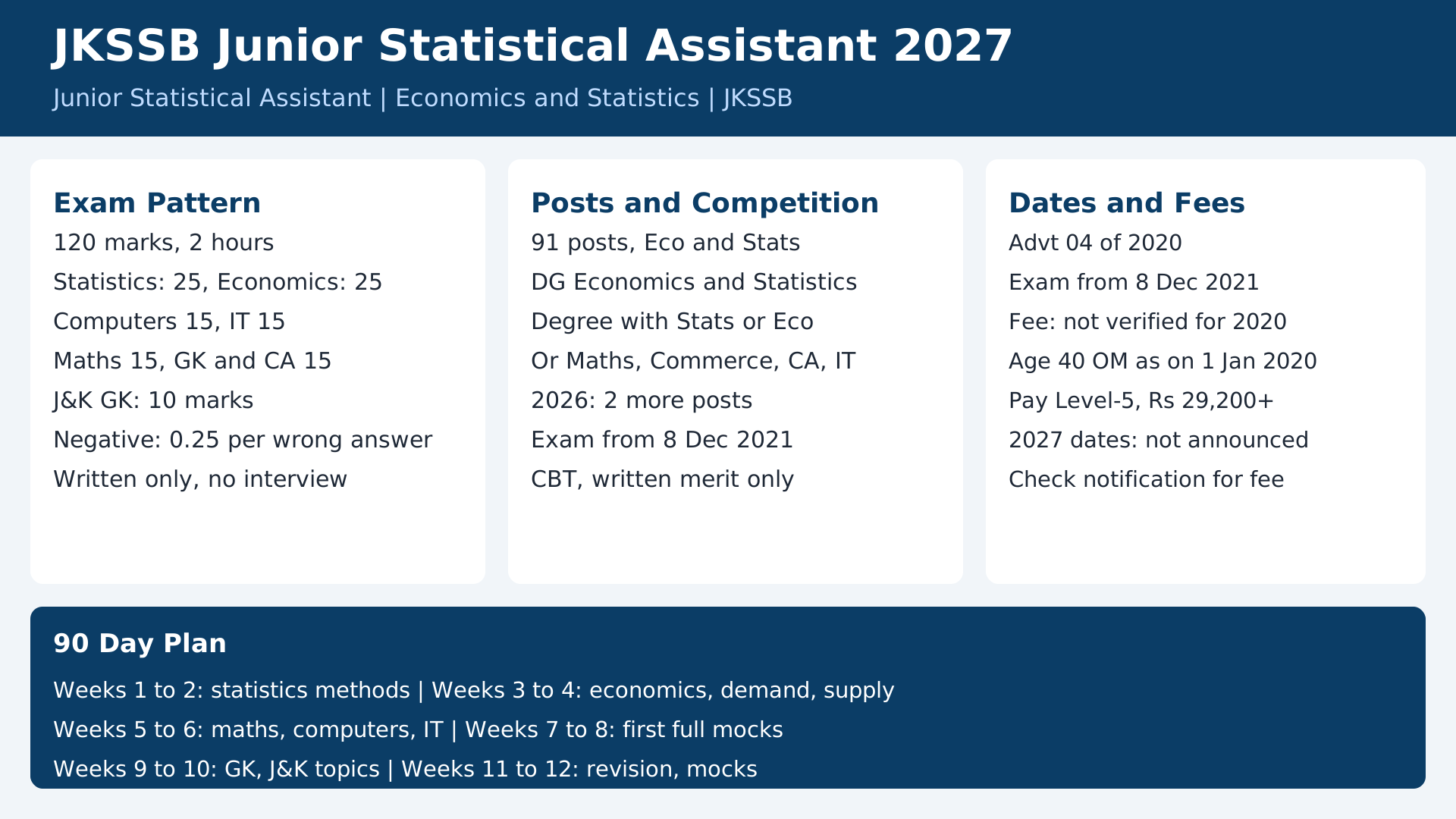
JKSSB advertised 91 Junior Statistical Assistant posts under Advertisement No. 04 of 2020, and the computer based test began on 8 December 2021. The Jammu and Kashmir Services Selection Board drew the merit from a single written exam of 120 marks in 2 hours, with no interview and no skill test. JKSSB Junior Statistical Assistant 2027 has no fresh notification yet, so every fact in this guide comes from the 2020 advertisement and the exam that followed it. If you hold a degree with Economics, Statistics, Mathematics, Commerce, Computer Applications or Information Technology as one of the subjects, this is the paper to prepare for.
The post is often confused with two others, and the confusion costs candidates months. The Statistical Assistant post in the Planning, Development and Monitoring Department is a different post with a 150 mark paper of its own, and the Junior Assistant post is a different post with an 80 mark paper and a typing test. The Junior Statistical Assistant paper is 120 marks across seven sections, with Statistics at 25 marks and Economics at 25 marks, and the selection rests on the written merit alone. Get the post right first, and the preparation follows.
JKSSB Junior Statistical Assistant 2027 and the 2020 cycle in numbers
| Item | Detail |
|---|---|
| Conducting body | Jammu and Kashmir Services Selection Board (JKSSB) |
| Advertisement | No. 04 of 2020 |
| Department | Directorate of Economics and Statistics |
| Posts | 91 |
| Pay scale | Level-5, Rs 29,200 to Rs 92,300 |
| Written exam | From 8 December 2021, computer based test |
| Exam duration | 2 hours, 120 marks |
| Application fee | Not verified for the 2020 cycle |
| 2026 posts | 2 posts in a multi-post notification, applications closed 8 September 2026 |
| 2027 notification | Not issued as of 20 November 2026 |
Ninety one posts is a small recruitment, and the eligibility is narrower than most JKSSB graduate posts, because the degree must carry one of six named subjects. That narrow eligibility is the reason the competition is more manageable than the post count suggests. A general graduate cannot apply, and the pool is limited to candidates with a quantitative or commerce background.
The 2026 development is small but worth noting. A multi-post notification in 2026, carrying 72 posts in total, included 2 Junior Statistical Assistant posts, with applications closing on 8 September 2026. The advertisement number for that notification was not verified in prep, so this guide states the 2 posts as a tracker report. A candidate who applied in that window should prepare on the 120 mark pattern below, because the post and the syllabus are the same.
What a Junior Statistical Assistant actually does
A Junior Statistical Assistant works in the Directorate of Economics and Statistics, the office that collects, compiles and publishes the statistics of the Union Territory. The day involves collecting data from departments, checking it for errors, entering it into the statistical systems, preparing tables and summaries, and helping with the reports the directorate publishes. The work needs a person who is comfortable with numbers, with tables, and with the patience to check a figure twice before it goes into a report.
The directorate is the source of the economic survey, the district statistical handbooks and the price and production data that the government uses for planning. A Junior Statistical Assistant who learns the data well becomes the person the office turns to when a figure is needed in a hurry, and the post is a good foundation for the higher statistical posts in the department. The work is office based, with field visits for data collection when a survey is running.
The pay is Level-5, from Rs 29,200 to Rs 92,300, with the allowances that apply to Union Territory employees. For a graduate with a quantitative subject, it is a solid starting pay, and the post carries the advantage of a defined career line inside a single directorate, where the work and the promotion path are both clear.
The post sits under the Planning, Development and Monitoring Department, and the appointing authority is the Director General of Economics and Statistics. Candidates should not confuse it with the Statistical Assistant post in the same department, which is a different post with a different pattern and a different pay. The Junior Statistical Assistant is the junior post, and its paper is the 120 mark paper described below.
Who can apply for JKSSB Junior Statistical Assistant 2027
The educational qualification is a bachelor's degree with Economics, Statistics, Mathematics, Commerce, Computer Applications or Information Technology as one of the elective subjects. The subject must appear as an elective in the degree, and the degree must be from a recognised university. A graduate with none of these subjects cannot apply, even with a high percentage, and a graduate with one of them is eligible even if the degree is in another main subject.
Domicile of the Union Territory of Jammu and Kashmir is compulsory, with a valid domicile certificate. The age limit for Open Merit was 40 years as on 1 January 2020, which is the standard JKSSB figure, and the reserved category relaxations follow the standard JKSSB table. The exact age table for the 2020 cycle should be checked in the notification, because the tracker summaries give the Open Merit figure clearly and the reserved figures less consistently.
| Category | Maximum age |
|---|---|
| Open Merit | 40 years |
| Reserved categories | As per the standard JKSSB table |
The application fee for the 2020 cycle was not verified in prep, and no fee figure is stated anywhere in this package. The Rs 600 and Rs 500 figures that appear on other JKSSB pages belong to later cycles, and they must not be pasted into this guide. The upload pre-check should read the fee from the official notification before any figure is published.
The selection is made on the basis of merit in the written examination only. There is no interview, no viva and no skill test for this post, despite one tracker page that describes an 80 mark paper plus a skill test. That description belongs to the Junior Assistant post, not to this one, and this guide does not repeat it.
The written exam, section by section
The written test is a single objective paper of 120 marks in 2 hours, with multiple choice questions set in English only. Negative marking is 0.25 marks for each wrong answer, and the selection is made on the merit of this paper alone.
| Section | Marks |
|---|---|
| General Knowledge and Current Affairs | 15 |
| General Knowledge with special reference to UT of Jammu and Kashmir | 10 |
| Statistical Methods and Applied Statistics | 25 |
| General Economics | 25 |
| Computer Applications | 15 |
| Information Technology | 15 |
| Mathematics | 15 |
| Total | 120 |
Statistics and Economics together carry 50 marks, which is more than forty percent of the paper, and they are the sections that decide the merit list. A candidate with a statistics or economics background starts with a real advantage here, because the two sections test degree level material rather than general knowledge. The other five sections carry 70 marks between them, and they are the sections where a prepared candidate can pick up steady marks.
Two warnings belong here. The first is that the Statistical Assistant post in the same department has a 150 mark paper with a different section split, including Principles of Business Management and a 2 hour 30 minute duration. Its figures are not used in this guide. The second is that one tracker page describes an 80 mark written exam plus a skill test for this post, which is the Junior Assistant pattern, not this one. The Junior Statistical Assistant paper is 120 marks, written only, and that is the pattern to prepare for.
The syllabus, subject by subject
General Knowledge and Current Affairs carries 15 marks and covers Indian history with special reference to the Freedom Movement, languages and culture, the Constitution, Indian economy, geography, science and technology, environment and ecology, and current events of national and international importance. The section is standard graduate level general knowledge, and a daily newspaper plus a general knowledge manual covers it.
General Knowledge with special reference to the Union Territory of Jammu and Kashmir carries 10 marks and covers history, economy, geography with weather, climate, crops, rivers, lakes, flora and fauna, heritage and culture, important tourist destinations, and the Jammu and Kashmir Reorganisation Act, 2019. Ten marks is the smallest share in the paper, but the section is also the most predictable, because the topics are named and the questions are direct.
Statistical Methods and Applied Statistics carries 25 marks, the joint highest share, and covers measures of central tendency and dispersion, probability and probability distributions, sampling and sampling distributions, correlation and regression, index numbers, time series analysis, vital statistics, and applied statistics with data collection and presentation. The level is degree level, and a candidate with statistics as a subject will find the section familiar, while a candidate with economics or commerce will need to revise the methods properly.
General Economics carries 25 marks, the joint highest share, and covers microeconomics and macroeconomics, demand and supply, production and cost, market structures, national income, money and banking, public finance, Indian economy, economic planning, and the role of mathematics in economics. The section rewards a candidate who has studied economics as a subject, and it punishes a candidate who tries to cover it from a general knowledge book alone.
Computer Applications carries 15 marks and covers basic applications and components, fundamentals of computer science, hardware and software, input and output devices, MS Word, MS Excel, MS PowerPoint, internet and email, and computer viruses and anti-virus. Information Technology carries 15 marks and covers information technology fundamentals, data communication, networking, databases, and the role of information technology in governance. The two sections together carry 30 marks, and they are the most learnable in the paper, because the topics are memory based.
Mathematics carries 15 marks and covers set theory with basic concepts and applications, matrices and determinants, simultaneous linear equations with Cramer's rule, coordinate geometry, calculus with limits, differentiability, integration and differential equations, and the role of mathematics in economics. The level is degree level, and the section needs problem practice rather than reading alone.
How the 2020 cycle actually ran
Advertisement No. 04 of 2020 carried the 91 Junior Statistical Assistant posts along with other posts, and the computer based test for this post began on 8 December 2021. The exam was a single stage written test, and the merit was drawn from the written marks alone, with document verification following for shortlisted candidates. The cycle was completed on written merit, with no interview at any stage.
The gap between the advertisement in 2020 and the exam in December 2021 is a year, which is shorter than the gaps in some other JKSSB recruitments of the period. Candidates who apply for the next cycle should still expect a wait between the application and the exam, and should use it to prepare the two heavy sections, Statistics and Economics, which need months rather than weeks.
The 2026 multi-post notification is the most recent development, with 2 Junior Statistical Assistant posts among 72 posts in total, and applications closing on 8 September 2026. The advertisement number was not verified in prep, and the post count is small, but the post is the same and the syllabus is the same, so the preparation described here applies to that cycle as well.
How hard is it to get in
Ninety one posts with a narrow eligibility is a different competition from a general graduate paper. The pool is limited to graduates with one of six named subjects, and inside that pool the candidates with statistics or economics as a main subject start ahead, because the two heavy sections test degree level material. A commerce graduate with a working knowledge of statistics can compete, but will need to put in the hours on the methods section to match a statistics graduate.
The 120 mark paper with 0.25 negative marking compresses the merit list, and the two 25 mark sections decide it. A candidate who scores 40 out of 50 in Statistics and Economics and picks up steady marks in the other five sections will beat a candidate who is even across all seven sections but weak in the two heavy ones. The preparation should follow the marks, with the largest share of time going to the two sections that carry the largest share of the paper.
No official cut-off for the 2020 cycle was retrieved in prep, so no cut-off number is stated here. The useful target is a standard rather than a number: aim for 40 out of 50 in the two heavy sections, 20 out of 30 in the two computer sections, and steady marks elsewhere, with the blind guesses kept to zero.
Mistakes that cost marks
The first mistake is preparing for the wrong post. The Statistical Assistant paper is 150 marks with a different split, and the Junior Assistant paper is 80 marks plus a typing test. Both are different posts, and a candidate who prepares either of them for this exam will practise the wrong paper. Check the post name on the application, and prepare the 120 mark paper with seven sections.
The second mistake is treating Statistics and Economics as general knowledge sections. They carry 50 marks between them at degree level, and they need textbooks and problem practice, not a general knowledge manual. A candidate who reads a summary will score poorly in both, while a candidate who works through the methods will score well.
The third mistake is ignoring the two computer sections. Computer Applications and Information Technology together carry 30 marks, and they are the most learnable sections in the paper. A candidate who gives them two hours a day for three weeks will outscore a candidate who gives them the last three days, and the gap will be larger than the gap in any other section except the two heavy ones.
The fourth mistake is guessing blindly under negative marking. Four wrong answers wipe out one right answer, and in a 120 mark paper with a thin merit list, that arithmetic decides ranks. Attempt what you can narrow down to two options, and leave the rest blank.
The fifth mistake is waiting for the next notification before starting. The syllabus is fixed by the 2020 notification, the pattern is fixed, and the paper is 120 marks in 2 hours. A candidate who starts now gets three months of steady preparation, while a candidate who waits for the notification gets a notice period of a few weeks and a panic.
JKSSB Junior Statistical Assistant aspirants often prepare for other state and national exams alongside this one. The UGC NET Economics 2027, UGC NET Commerce 2027, UGC NET Management 2027, RBI Grade B DEPR 2027, IBPS SO 2027, NABARD Grade A 2027, SBI PO 2027, IBPS PO 2027, SSC GD 2027, UGC NET Paper 1 2027 pages on this site carry the same style of mock test guide, and the pattern habit you build here transfers directly to them.
A 90 day plan that fits around a job
Weeks 1 to 2 belong to Statistics. Measures of central tendency and dispersion, probability, correlation and regression, and index numbers, with numericals every day. Keep a formula notebook from day one, because the methods section is formula heavy and the formulas need revision.
Weeks 3 to 4 belong to Economics. Demand and supply, production and cost, market structures, national income, money and banking, and public finance, with the Indian economy topics in the second week. Read the theory and solve the numericals together, because the section tests both.
Weeks 5 to 6 belong to Mathematics and the two computer sections. Set theory, matrices, Cramer's rule and calculus in mathematics, and hardware, software, MS Office, networking and databases in computers and information technology. The computer sections are memory based, so they give quick marks for the hours spent.
Weeks 7 to 8 are for the first full mocks. Two full 120 mark papers in 2 hours each week, with the whole paper reviewed the same day. Sort every wrong answer into three piles: did not know, knew but rushed, and guessed badly. Shrink the third pile first, because it is the only one you can fix by behaviour alone.
Weeks 9 to 10 are for General Knowledge and Jammu and Kashmir general knowledge, plus the weak spots the mocks exposed. History, geography, economy, heritage, tourist destinations and the Reorganisation Act need reading, and the current affairs note needs a daily ten lines. Re-do the Statistics numericals that went wrong in the mocks.
Weeks 11 to 12 are for revision and mocks only. No new theory and no new book. Re-read the formula notebook, re-do the Economics numericals, re-read the computer notes, and sit for three more full mocks in exam conditions. In the last week, cut the study hours and protect your sleep, because a fresh mind on the exam day is worth more than one more chapter.
Books and papers that actually help
For Statistics, a degree level statistics textbook is the right book, and the JKSSB syllabus topics map directly onto its chapters. Work through the numericals rather than reading the theory alone, because the section tests methods, not definitions.
For Economics, a degree level microeconomics and macroeconomics textbook covers the section, and the Indian economy topics need a standard Indian economy book. The role of mathematics in economics is a named topic, so keep the basic calculus and matrix work fresh alongside the theory.
For Mathematics, a degree level textbook covering set theory, matrices, coordinate geometry and calculus is enough. For computers and information technology, a basic computer awareness book plus the MS Office programs on your own computer covers the two sections.
For General Knowledge, a standard general knowledge manual plus a Jammu and Kashmir general knowledge book covers the syllabus, and a daily newspaper covers current affairs. The single best practice material is the set of previous JKSSB graduate level papers, solved in 2 hours with the 0.25 negative marking applied.
How to apply, and the documents to keep ready
The application for Advertisement No. 04 of 2020 ran online on the JKSSB portal, and the window has now closed, so this section is for candidates who will apply when the next cycle opens. The steps are the same in every JKSSB recruitment, with one point that is specific to this post and easy to get wrong.
First, read the advertisement in full, including the eligibility clause, before touching the form. The degree must carry Economics, Statistics, Mathematics, Commerce, Computer Applications or Information Technology as one of the elective subjects, and the form asks for the subject, so check the degree marks sheet and confirm the subject appears as an elective. A graduate with none of these subjects cannot apply, and the board checks it at document verification.
Second, complete the one time registration on the portal if you have not done so already, and keep the login details safe, because the same login carries the admit card and the result later. Third, fill the form with the details as they appear on the matriculation certificate, because the board matches the name, the date of birth and the parents names against that certificate. Fourth, upload the photograph and signature in the size and format the notification prescribes, and check the preview before submitting.
Fifth, upload the domicile certificate and the category certificate in the prescribed format, with the dates on or before the last date of application. Sixth, pay the fee online and download the confirmation page, because the payment receipt is the proof that the application went through. Keep a folder ready with the matriculation certificate, the domicile certificate, the category certificate if you claim reservation, the degree certificate and marks sheets showing the elective subject, a valid photo identity proof, and two recent passport size colour photographs.
Previous papers and mock tests: how to use them
The best practice material for this post is the set of previous JKSSB graduate level papers, plus the statistics and economics papers from other graduate recruitments at the same level. The two heavy sections test degree level material, so the practice must be numerical rather than reading alone. Solve the papers in 2 hours with the 0.25 negative marking applied, and score yourself strictly, because a mock without negative marking teaches you nothing about this exam.
Use the mocks in three stages. In the first stage, solve section-wise papers to build depth in Statistics and Economics, with numericals every day, because the two sections carry 50 marks between them. In the second stage, solve full 120 mark papers in 2 hours, with the whole paper reviewed the same day. In the third stage, in the last month, solve two full papers a week in exam conditions, at the same time of day as the real exam, with no breaks and no phone.
The review matters more than the score. Write down every question you got wrong and why, and sort the reasons into three piles: did not know, knew but rushed, and guessed badly. The third pile is the one to shrink first, because it is the only one you can fix by behaviour alone. For numericals, re-solve the ones that went wrong after a week, and check whether the steps stick. A mock that is solved and forgotten is a wasted mock, and a mock that is reviewed properly is worth more than a chapter of theory.
Statistics: how to handle the two heavy sections
Statistics and Economics carry 50 marks between them, and they need a different method from the other five sections. The method is simple to state and hard to follow: work through a degree level textbook chapter by chapter, solve the numericals at the end of each chapter, and keep a formula notebook that you revise every Sunday. Reading the chapter without solving the numericals does not work, because the paper tests methods, not definitions.
In Statistics, start with measures of central tendency and dispersion, then move to probability and probability distributions, then to correlation and regression, then to index numbers and time series, and finish with vital statistics and applied statistics. The order matters, because each topic builds on the one before it. Correlation needs the mean and the standard deviation, regression needs correlation, and index numbers need the averages. A candidate who jumps to regression without the basics will struggle with every question in the section.
In Economics, start with demand and supply, then production and cost, then market structures, then national income, then money and banking, then public finance, and finish with the Indian economy. The numericals in this section are fewer than in Statistics, but they are just as important, because the paper asks for calculations of national income, elasticity and cost alongside the theory. Keep the diagrams in the notebook as well, because a demand and supply diagram drawn from memory is faster than a paragraph of text in revision.
The formula notebook is the tool that ties the two sections together. Every formula, every standard value and every definition goes in with the topic it belongs to, and the notebook is revised every Sunday without fail. In the last two weeks, that notebook is your revision, and it is worth more than any new book. A candidate who has solved two hundred numericals in these two sections will find the paper familiar, and a candidate who has only read the theory will find it hard from the first question.
Sources
Oliveboard JKSSB Junior Statistical Assistant notification and syllabus pages, for Advertisement No. 04 of 2020, the 91 posts, the Level-5 pay scale of Rs 29,200 to Rs 92,300, the degree with Economics, Statistics, Mathematics, Commerce, Computer Applications or Information Technology as one elective subject, the age limit of 40 for Open Merit as on 1 January 2020, the 120 mark pattern and the CBT from 8 December 2021.
Jobs in Jammu Kashmir Junior Statistical Assistant syllabus page, for the same 91 posts, the 120 mark and 2 hour paper, the 0.25 negative marking and the section split with Statistics 25, Economics 25 and Mathematics 15.
MyJobUpdates JKSSB multiple posts recruitment 2026 page, for the 2026 multi-post notification carrying 2 Junior Statistical Assistant posts with applications closing on 8 September 2026.







