About HPSC HCS 2027 Exam Series
📖 Table of Contents
- HPSC HCS 2027 at a glance
- The 102 posts, and the services behind them
- What changed in 2025, and why the old books mislead
- The HPSC HCS exam pattern in the prelims
- The mains: six papers, and the 475 versus 675 argument
- The interview, and how the final merit is made
- Who can apply, what it costs, and the age rule
- The DSP post, and its physical standards
- Pay, and what the career looks like after selection
- The 2024 cycle, on the old pattern
- A preparation plan that fits the numbers
- The mistakes that cost candidates a year
- Sources
HPSC HCS 2027: Complete Exam Guide
The HPSC HCS 2027 page on this site follows the live cycle of the Haryana Civil Services examination, and the live cycle is the 2025 examination. The Haryana Public Service Commission, known as HPSC, published the notification for 102 posts on 30 January 2026 under Advertisement Number 22/2026. Applications ran from 6 to 26 February 2026. HPSC held the preliminary examination on 26 April 2026, ran the mains from 27 to 29 June 2026, held interviews from 3 to 8 October 2026, and declared the final result with service allocation on 17 October 2026. No separate 2027 notification has been published as of 22 November 2026, so this guide anchors on the 2025 cycle and says so wherever a 2027 figure would otherwise be guessed.
That anchoring matters more for this examination than for most, because the 2025 cycle ran on a brand new pattern. The Haryana government revised the HCS syllabi through an extraordinary gazette notification shortly before the advertisement, and the revision changed the mains completely. Optional subjects went out. Four General Studies papers came in. The mains grew to six descriptive papers of 100 marks each. A candidate who prepares from the old pattern, the one used in the 2024 cycle, will prepare for an examination that no longer exists. This guide keeps the 2025 cycle as the anchor, uses the 2024 cycle as history, and labels each figure with the cycle it belongs to.
The examination has three stages. An objective prelims screens candidates. A descriptive mains of six papers tests written expression and General Studies. A personality test of 75 marks closes the selection. The prelims marks count for nothing beyond the shortlist. The mains and the interview decide the merit, though tracker pages disagree on whether the two language papers in the mains count toward that merit, and this guide flags that disagreement rather than hiding it. The whole cycle, from notification on 30 January 2026 to final result on 17 October 2026, took under nine months, which is fast for a state civil service examination, and the 2024 cycle before it took about seven months from notification to final result.
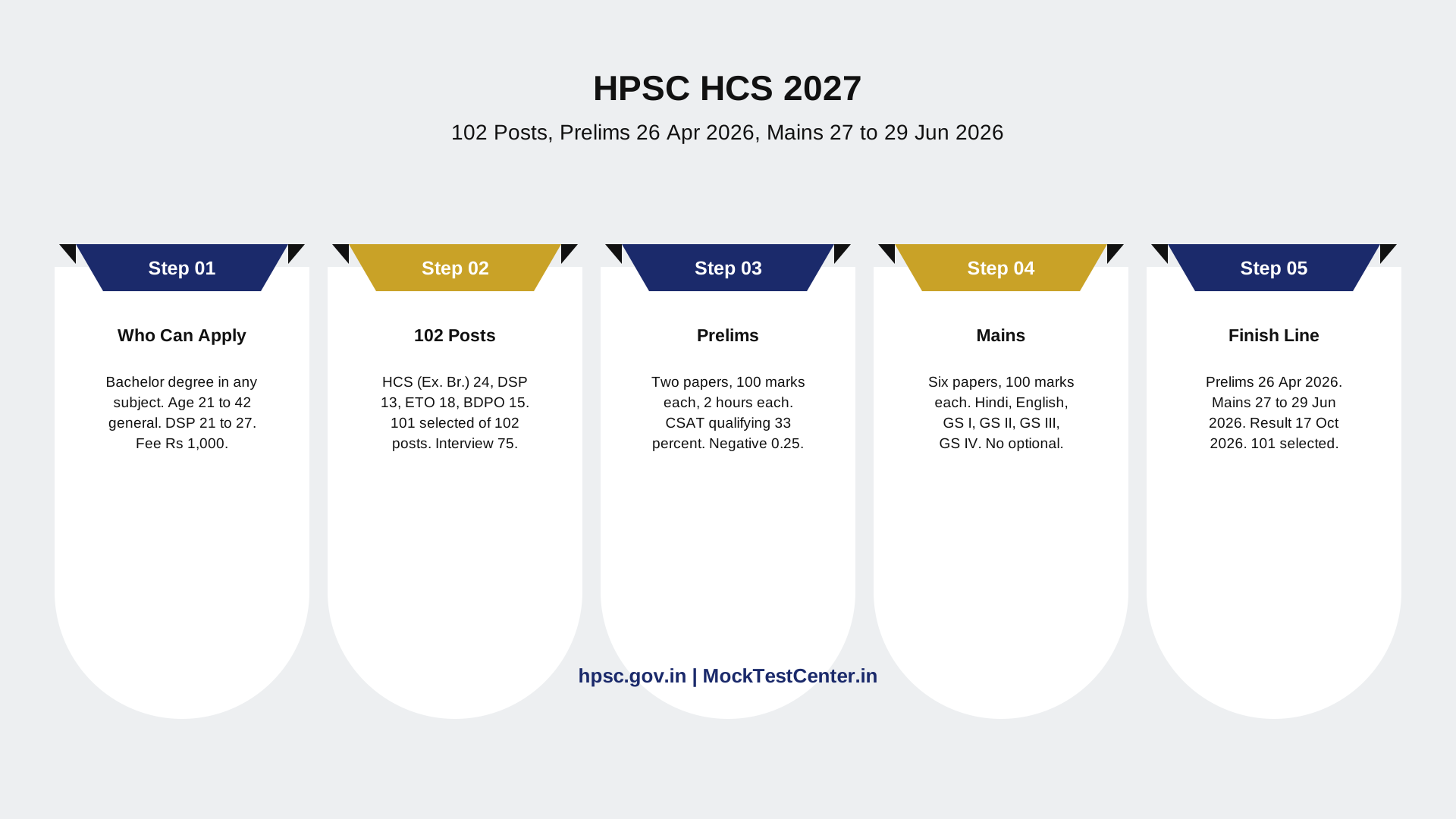
HPSC HCS 2027 at a glance
| Detail | HPSC HCS 2027, as run in the 2025 cycle |
|---|---|
| Conducting body | Haryana Public Service Commission (HPSC), Panchkula |
| Exam | Haryana Civil Services (Executive Branch) and Other Allied Services Examination, commonly called HPSC HCS |
| Live cycle | 2025, notification dated 30 January 2026, Advertisement Number 22/2026 |
| Posts in live cycle | 102 in all, HCS (Executive Branch) 24, DSP 13, ETO 18, Assistant Employment Officer Group A 10, DFSC 7, BDPO 15, ARCS 7, Assistant Employment Officer Group B 4, Traffic Manager 3, Labour cum Conciliation Officer 1 |
| Applications | 6 to 26 February 2026, closed |
| Fee | Rs 1,000 for general category, Rs 250 for Haryana reserved categories and women, PwBD exempt |
| Prelims | 26 April 2026, two papers of 100 marks each, 2 hours each, CSAT qualifying at 33 percent, negative marking 0.25 per wrong answer |
| Prelims result | 4 May 2026, with further results to 1 June 2026 |
| Mains | 27 to 29 June 2026, six descriptive papers of 100 marks each, 3 hours each |
| Mains result | 17 September 2026 |
| Interview | 3 to 8 October 2026, 75 marks, 316 candidates interviewed |
| Final result | 17 October 2026, 101 candidates recommended for 102 posts, one PwBD post kept vacant |
| Education | Bachelor degree from a recognised university, in any discipline |
| Age limit | 21 to 42 years for most posts as on 1 January 2026, 21 to 27 years for DSP |
| 2027 notification | Not published as of 22 November 2026 |
The 102 posts, and the services behind them
The notification of 30 January 2026 opened with 102 posts, and the split across services is the first thing a candidate should read, because one application covers ten different services and the candidate lists preferences in order. Haryana Civil Service (Executive Branch) carries 24 posts. Deputy Superintendent of Police carries 13 posts. Excise and Taxation Officer carries 18 posts. Assistant Employment Officer in Group A carries 10 posts. District Food and Supplies Controller carries 7 posts. Block Development and Panchayat Officer carries 15 posts. Assistant Registrar Co-operative Societies carries 7 posts. Assistant Employment Officer in Group B carries 4 posts. Traffic Manager carries 3 posts. Labour cum Conciliation Officer carries 1 post. Those ten numbers add to 102.
The HCS (Executive Branch) cadre itself carries 24 of the 102 posts, the largest single share, and it is the service most candidates aim for. An HCS (Executive Branch) officer starts as a Sub Divisional Magistrate, the officer who runs a sub division, and rises through the district administration toward the Haryana Civil Service senior scale. The cadre is Group A, in Pay Level 10, Rs 56,100 to Rs 1,77,500. The Deputy Superintendent of Police is also Group A in the same pay level, and it carries the uniformed police career in the state, with physical standards of its own. The Excise and Taxation Officer is Group A as well, and it carries the revenue work of the excise and taxation department.
The Group B services carry the rest of the posts, and they are not consolation prizes. A Block Development and Panchayat Officer runs development work at the block level and carries 15 posts, the second largest share after the HCS cadre. A District Food and Supplies Controller runs the public distribution system in a district. An Assistant Registrar of Co-operative Societies regulates co-operative societies. A Traffic Manager runs transport operations. The final result of 17 October 2026 allotted services by rank and by the preference list each candidate filed, so the preference order a candidate files at the application stage decides which of these services a rank can actually fetch. A candidate who files preferences carelessly can lose a better service to a lower ranked candidate who filed them carefully.
One post stayed empty at the end of the cycle. The final result recommended 101 candidates for the 102 advertised posts, and one post reserved for a person with benchmark disability in the hard of hearing category was kept vacant while the Commission waits for clarification from the Haryana government. The Commission announced no waiting list and no fresh round for that post. The result is also subject to writ petitions and a letters patent appeal pending before the Punjab and Haryana High Court, and the Commission says any inadvertent error can be rectified later. A candidate reading the allocation list should read those two caveats with it.
The earlier cycle shows how the post count moves. The 2024 cycle under Advertisement Number 58/2023 carried 121 posts, with 87,092 candidates applying. The 2025 cycle carries 102 posts. Two cycles, two totals, and no steady trend. A candidate who assumes the next cycle will carry about 100 posts is guessing. The notified number is the only number that counts, and it arrives with the advertisement.
What changed in 2025, and why the old books mislead
The gazette revision that arrived just before the 2025 advertisement is the single biggest fact in this guide, because it changed the mains from an optional subject examination into a General Studies examination. Under the old pattern, the one used in the 2024 cycle, the mains had four papers: English for 100 marks, Hindi for 100 marks, General Studies for 200 marks, and one optional subject for 200 marks, with the interview at 75 marks. Under the new pattern the optional subject is gone. The mains now has six papers: Hindi, English, and General Studies I, II, III and IV, each of 100 marks and each of 3 hours. The interview stays at 75 marks.
The prelims changed less, but it changed. The prelims still has two objective papers of 100 marks each and 2 hours each, General Studies and the Civil Services Aptitude Test, with negative marking of 0.25 marks per wrong answer. The CSAT paper is qualifying, with 33 percent needed to pass it, and only the General Studies marks decide the prelims merit. One newspaper report of the gazette says the two prelims papers total 400 marks, which conflicts with the two tracker pages that describe the actual 2025 cycle as 100 marks per paper. This guide uses 100 marks per paper, because that is the figure the tracker pages report for the cycle that actually ran, and it records the 400 mark figure as a conflict. A candidate should read the prelims marks from the advertisement PDF of the next cycle before trusting either figure.
The new mains syllabus reads like the UPSC pattern with a Haryana spine. General Studies I covers Indian heritage and culture, modern Indian history, Indian society, and the geography of India and the world, with Haryana linkages. General Studies II covers the Constitution, governance, polity, social justice and international relations. General Studies III covers economic development, technology, environment, biodiversity and internal security. General Studies IV covers ethics, integrity and aptitude, with case studies. Hindi and English carry essay, precis, comprehension, translation and grammar. The Haryana element runs through the whole syllabus: Haryana history, Haryana geography, Haryana culture, Haryana economy and Haryana current affairs appear as topics in the prelims General Studies paper and across the mains General Studies papers.
The change also changed the preparation maths. Under the old pattern a candidate could carry the mains on a strong optional subject worth 200 of the 600 mains marks. Under the new pattern there is no optional subject to hide behind, and four General Studies papers worth 400 marks decide the written merit together with the two language papers. A candidate who buys old HCS books built around an optional subject will study for a paper that no longer exists. The books that matter now are the General Studies books, the Haryana books, and the language practice books.
The HPSC HCS exam pattern in the prelims
The HPSC HCS exam pattern starts with a screening test, and the screening test is the prelims. Paper I is General Studies, 100 questions for 100 marks in 2 hours. Paper II is the Civil Services Aptitude Test, 100 questions for 100 marks in 2 hours. Both papers are objective, bilingual in English and Hindi, and held on the same day, one in the morning and one in the afternoon. In the 2025 cycle the prelims was held on 26 April 2026, from 10 am to noon and from 3 pm to 5 pm.
The marking rule is negative marking of 0.25 marks for each wrong answer in both papers. Each question carries 1 mark, so four wrong answers cost one correct answer. The CSAT paper is qualifying in nature. A candidate must score at least 33 percent in it, and the CSAT marks do not count toward the prelims merit. Only the General Studies marks decide who goes to the mains. A candidate who scores brilliantly in General Studies and fails the CSAT qualifying mark does not go to the mains at all, which is a trap that catches strong candidates every year in examinations with this design.
The shortlist rule matters because it decides how many candidates the prelims lets through. Tracker pages report that HPSC shortlists about 12 times the advertised vacancies for the mains, which would be about 1,224 candidates for 102 posts. One tracker page reports that about 1,899 candidates qualified for the mains in the 2025 cycle, which is more than 12 times the vacancies. The two figures do not sit together, and the gap probably comes from the four prelims results HPSC published, the first on 4 May 2026 and further results on 13 May, 20 May and 1 June 2026, which added candidates in stages. This guide records both figures and flags the gap. About 48,000 candidates appeared for the prelims in the 2025 cycle, according to one tracker report, so the prelims let through roughly one candidate in 25.
The prelims syllabus rewards Haryana specific preparation more than national material alone. History of India with special emphasis on Haryana, Indian and world geography with emphasis on Haryana geography, Indian polity and governance, economic and social development in India and Haryana, environment, general science and current events of national and international importance all appear in Paper I. The CSAT paper tests comprehension, interpersonal and communication skills, logical reasoning, decision making, problem solving, general mental ability, basic numeracy at Class 10 level, and data interpretation from charts, graphs and tables. Speed matters in both papers. A hundred questions in 120 minutes allows 72 seconds per question on average, and a candidate who spends three minutes on a single hard question has already borrowed time from two other questions.
The mains: six papers, and the 475 versus 675 argument
The mains is a descriptive examination of six papers, each of 100 marks and each of 3 hours, held across three days. In the 2025 cycle HPSC held it from 27 to 29 June 2026. The six papers are Hindi in Devanagari script, English, General Studies I, General Studies II, General Studies III and General Studies IV. The mains result came out on 17 September 2026, about eleven weeks after the examination, and 316 candidates went on to the interview.
| Paper | Subject | Marks | Time | Type |
|---|---|---|---|---|
| I | Hindi (Devanagari script) | 100 | 3 hours | Descriptive |
| II | English | 100 | 3 hours | Descriptive |
| III | General Studies I | 100 | 3 hours | Descriptive |
| IV | General Studies II | 100 | 3 hours | Descriptive |
| V | General Studies III | 100 | 3 hours | Descriptive |
| VI | General Studies IV (Ethics) | 100 | 3 hours | Descriptive |
| Total | Written examination | 600 | 18 hours | Descriptive |
Here is the disagreement this guide refuses to smooth over. Some tracker pages report that the Hindi and English papers are qualifying only, needing 33 percent each, with their marks left out of the merit, so the merit total is the four General Studies papers at 400 marks plus the interview at 75 marks, a total of 475 marks. Other tracker pages report that the mains carries 600 marks plus the interview at 75 marks, a total of 675 marks, with all six papers counted. Both versions appear in pages describing the same cycle. The Indian Express report of the gazette says the mains totals 600 marks, which supports the 675 figure, but it does not say whether the language papers count toward merit. This guide states the six paper structure as verified, states both merit totals as reported, and flags the question as unresolved. A candidate should read the merit rule from the advertisement PDF of the next cycle, because the difference between 475 and 675 decides how much the language papers are worth.
Whichever total is right, the language papers deserve a weekly slot in the timetable from the first month. Hindi and English together carry 200 of the 600 written marks, a third of the mains. The Hindi paper tests essay writing in Devanagari script, English to Hindi translation, letter and precis writing, prose and poetry explanations, idioms and corrections. The English paper tests reading serious prose, precis writing, passage comprehension, usage, vocabulary, grammar, composition and an essay. A candidate who prepares only General Studies prepares for two thirds of the mains at most, and a candidate who fails the 33 percent qualifying mark in either language paper, if that rule applies, loses the whole attempt.
General Studies IV, the ethics paper, is new to this examination and it deserves a note of its own. It tests ethics and aptitude through case studies, covering the essence of ethics in action, human values from leaders, attitude and its influences, foundational civil service values like integrity and empathy, emotional intelligence, moral thinkers, public service ethics, dilemmas, accountability, governance probity including the Right to Information, codes, citizen charters and corruption challenges. It is the paper where a candidate who has only memorised facts will struggle, because it asks for judgement in a situation, not recall of a date. Answer writing practice for this paper should start with real situations from Haryana administration, not with definitions copied from a book.
The interview, and how the final merit is made
The personality test carries 75 marks and it closes the selection. In the 2025 cycle HPSC interviewed 316 candidates from 3 to 8 October 2026, published the interview marks on 8 October 2026, published the withheld marks of 21 interviewed candidates on 15 October 2026, and declared the final result with service allocation on 17 October 2026. The interview lasts about 30 to 45 minutes. It tests mental alertness, critical thinking, clarity of exposition, balance of judgement, variety and depth of interest, ability for social cohesion and leadership, intellectual and moral integrity, and knowledge of Haryana and current affairs.
The final merit is the mains written examination plus the interview. On the 675 reading that is 600 plus 75. On the 475 reading that is 400 plus 75. Either way the interview is worth about a tenth of the total, which is enough to move a candidate several ranks in either direction but not enough to rescue a weak mains score. The final result of 17 October 2026 recommended 101 candidates, and HPSC published roll number wise marks of every candidate who appeared in the mains on 18 October 2026, so a candidate can read exactly where the cut fell and how far each paper carried the selected candidates.
The 2024 cycle shows the same shape on the old pattern. That cycle drew 87,092 applications for 121 posts. The prelims on 11 February 2024 let 1,706 candidates through. The mains on 30 and 31 March 2024 let 275 candidates through to the interview. Interviews ran from 10 to 14 June 2024, and the final result came out on 15 June 2024. The ratio at each stage is the story: about one in 51 applicants reached the mains, about one in six of those reached the interview, and about one in 2.3 of those was finally selected. The prelims is the gate where most attempts end.
Who can apply, what it costs, and the age rule
The education rule is a bachelor degree in Arts, Science, Commerce or an equivalent degree from a recognised university, in any discipline. Professional degrees like B.Tech, B.E., BBA and BCA from UGC recognised universities count as equivalent. Final year students could apply in the 2025 cycle if their results were declared before the closing date of 26 February 2026. All certificates and documents had to be issued on or before the closing date. The post is open to fresh graduates, and no experience is required.
The age rule is 21 to 42 years for most posts, counted as on 1 January 2026. That covers the HCS (Executive Branch), the Excise and Taxation Officer, the Block Development and Panchayat Officer and the other allied services. The Deputy Superintendent of Police is the exception, with an age limit of 21 to 27 years, because of the physical fitness the post demands. Relaxation applies for Haryana domicile candidates: 5 years for SC, BC-A, BC-B and EWS candidates, taking the upper age to 47 years, and 10 years for persons with benchmark disabilities, taking it to 52 years, with 15 years where disability combines with a reserved category. For the DSP post the relaxation is capped lower, with the upper age reaching 32 years for SC and BC candidates. Haryana government regular employees get relaxation up to 45 years with conditions, and ex servicemen get relaxation under Haryana government rules.
The fee in the 2025 cycle was Rs 1,000 for general category candidates, Rs 250 for Haryana reserved categories and women candidates, and nil for persons with benchmark disabilities, with candidates from other states paying Rs 1,000 with no concession. Payment was online only, through net banking, credit or debit card, or UPI, and the fee was non refundable. The application itself ran online only on hpsc.gov.in, with registration by mobile number and Aadhaar number, and candidates filed their service preferences in order at the application stage. After final submission the candidate had to download the form, sign it by hand, scan it and upload it back, a step the Commission requires and one that candidates should not leave to the last hour.
There is no rule that bars candidates from outside Haryana from applying, but Haryana domicile decides who gets the state reservations. A candidate from another state can apply and compete, but the Commission assesses such a candidate as general category for reservation purposes and charges the full fee. Knowledge of Hindi is required in practice. The mains Paper I tests Hindi for 100 marks as a full paper, and the prelims papers are bilingual in English and Hindi. A candidate who cannot write Hindi at all will lose a sixth of the mains in Paper I alone, which is a practical barrier even though no Hindi certificate is demanded at the application stage.
There is no fixed number of attempts for this examination. The age limit restricts attempts in practice, 21 to 42 years for most posts and 21 to 27 years for the DSP post. A candidate can appear as many times as the age limit allows, subject to clearing the prelims each time. The wide age window is one reason the applicant pool is so large: a graduate of 21 and a working professional of 40 can sit the same papers, and the 2024 cycle drew 87,092 applications for 121 posts.
The DSP post, and its physical standards
The Deputy Superintendent of Police post carries its own rules inside the common examination, and a candidate who wants it should read them before applying, because they cannot be fixed after the result. The age limit is 21 to 27 years, the tightest in the whole recruitment. The physical standards follow the Haryana Police Service Rules, 2002. For male candidates the minimum height is 170.18 cm, or 5 feet 7 inches, with a chest of 83.82 cm, or 33 inches, with an expansion of 4.5 cm. For female candidates the minimum height is 157.50 cm, or 5 feet 2 inches. One tracker page reports different figures, 167.5 cm height and 81 cm chest for general and BC male candidates, with 165 cm and 79 cm for SC male candidates, and 152 cm height with 47.5 kg weight for female candidates. The two sets do not agree, and this guide records both and flags the conflict, because the advertisement PDF is the only source that settles it.
Vision standards apply as per the Haryana Police Service Rules, 2002, and the Commission assesses them at the medical examination after selection. A candidate who clears the written examination and the interview but fails the physical or medical standards for the DSP post can still be allotted another service from the preference list, provided the rank and the preferences allow it. That is another reason the preference list matters: a candidate who lists only the DSP post and fails its physical standards has nowhere to go, while a candidate who lists the other services in order keeps every option the rank earns.
Pay, and what the career looks like after selection
The HCS (Executive Branch) and the Deputy Superintendent of Police sit in Pay Level 10, Rs 56,100 to Rs 1,77,500, under the Seventh Central Pay Commission scales adopted by Haryana. That is the figure tracker pages report for the two top services, and it is the only pay figure this guide quotes, because the pay levels of the other eight services were not verified from the sources read for this guide. A candidate should read the pay level of each service from the advertisement PDF, because the services differ and the difference compounds over a career.
The career itself is the reason the examination draws close to ninety thousand applications for about a hundred posts. An HCS (Executive Branch) officer starts as a Sub Divisional Magistrate, the officer who runs a sub division, handling revenue, law and order, elections and development work in the sub division. From there the officer rises through Additional Deputy Commissioner and Deputy Commissioner posts, and into the secretariat as a senior officer of the state government. A Deputy Superintendent of Police starts as a sub divisional police officer and rises through the police hierarchy of the state. An Excise and Taxation Officer runs the tax administration of a district or a circle. A Block Development and Panchayat Officer runs development work at the block level. The work is public, the postings move across the state, and the first posting is rarely the posting a candidate imagined. That is the nature of the service, and a candidate who wants a single city for a whole career should think twice before applying.
The 2024 cycle, on the old pattern
The 2024 cycle is worth reading in full because it is the last cycle on the old pattern, and because it shows how fast HPSC moves once the prelims is over. The notification came out on 17 November 2023 under Advertisement Number 58/2023 for 121 posts. Applications ran from 1 to 21 December 2023. The prelims was held on 11 February 2024. The prelims result came out on 27 February 2024, with a category wise list on 15 March 2024, and 1,706 candidates qualified for the mains. The mains was held on 30 and 31 March 2024, only seven weeks after the prelims. The mains result came out on 27 May 2024, and 275 candidates were called for interview. Interviews ran from 10 to 14 June 2024, and the final result came out on 15 June 2024.
The whole cycle took about seven months from notification to final result, and the gap between the prelims and the mains was seven weeks. A candidate who waited for the prelims result before starting mains preparation lost most of that gap. The sensible habit, and the one the 2025 cycle rewarded even more, is to start mains answer writing the week after the prelims, while the result is still weeks away. The 2025 cycle gave candidates about nine weeks between the prelims on 26 April 2026 and the mains on 27 June 2026, which is more than the 2024 cycle gave, but it is still not enough time to learn descriptive answer writing from zero.
The old pattern itself is now history, but its shape explains why the new pattern looks the way it does. The old mains had English for 100 marks, Hindi for 100 marks, General Studies for 200 marks, and one optional subject for 200 marks, with the interview at 75 marks. The optional subject carried a third of the written marks, and candidates chose it from a list of 23 subjects, from Agriculture to Zoology. The new pattern removes that choice and replaces it with four General Studies papers. The Commission has not published a reason for the change in the sources read for this guide, but the effect is plain: every candidate now faces the same six papers, and the examination no longer rewards a candidate for picking a high scoring optional subject.
A preparation plan that fits the numbers
The plan starts from the marks. The prelims carries 200 marks and decides nothing beyond the shortlist. The mains carries 600 marks and the interview 75, and they decide everything. A candidate who spends 70 percent of the year on prelims and 30 percent on mains has the ratio backwards. The working split that fits the numbers is about 40 percent of study time on prelims material in the first months, moving to 80 percent on mains writing once the prelims syllabus is covered. The prelims material and the mains material overlap heavily in General Studies, so the split is about the form of practice, not the subject. Prelims practice is multiple choice questions under time. Mains practice is written answers under time.
Answer writing should start early and stay small. One answer a day, 150 words, in 11 minutes, is enough in the first month. The point is the habit, not the volume. By the third month the candidate should be writing two answers a day and one essay a fortnight. By the sixth month the candidate should be writing a full three hour paper every week, with the language papers getting a weekly slot of their own. The language papers carry a third of the mains, so the weekly slot is not a luxury. A candidate who writes Hindi and English every week from the start will arrive at the mains with two papers already practised, while a candidate who starts the language papers in the last month will arrive with a third of the examination unpractised.
Haryana is the section where a well prepared candidate pulls away from the rest, because national level material is common to every state examination and every serious candidate covers it. The history of Haryana, the geography of the state, the culture of Haryana, the economy of Haryana, the polity of the state and current events from Haryana all recur in the prelims and across the mains General Studies papers. The formation of Haryana in 1966, the districts and their headquarters, the rivers and the canals, the agricultural economy, the industrial corridors, the sports culture, the folk traditions and the administrative structure of the state are the topics where local preparation pays. A daily note of one Haryana fact, one national fact and one international fact, kept in a single notebook and revised weekly, builds more than 500 facts in six months, and the revision of it takes an hour.
Mock tests have a specific job in this examination, and it is not to predict the rank. Their job is to expose the habits that cost marks. In the prelims, the habits are blind guessing, slow reading, and spending three minutes on a question worth 1 mark, with a 0.25 deduction waiting for every wrong answer. In the mains, the habits are writing too much on the first answer and too little on the last, skipping the language papers in practice, and never finishing a paper in 3 hours. A candidate should take a mock test, spend an hour on the mistakes, and change one habit before the next test. A candidate who takes twenty mock tests and changes nothing has bought twenty confirmations of the same errors.
The mistakes that cost candidates a year
The first mistake is preparing for the prelims as if it were the examination. The prelims is a gate. Candidates who clear it by a wide margin and then discover they have never written a mains answer lose the weeks between the prelims and the mains to learning a skill they should have built a year earlier. The mains is the examination. The prelims is the ticket to sit it. In this examination the gap is sharper than in most, because the mains carries six papers across three days and there is no optional subject to carry a weak candidate through.
The second mistake is ignoring the CSAT qualifying mark. The CSAT paper needs only 33 percent, and strong candidates treat it as a formality. It is not a formality. A candidate who scores brilliantly in General Studies and misses 33 percent in CSAT does not go to the mains at all. The CSAT paper deserves a weekly slot of its own, with comprehension, reasoning and Class 10 numeracy practised under time, because the qualifying mark is a floor and the floor has no mercy.
The third mistake is filing the service preferences carelessly. One application covers ten services, and the final result allots services by rank and by the preference list. A candidate who files preferences without thinking can lose a better service to a lower ranked candidate who filed them carefully. The preference list deserves an evening of thought before the application closes, with the pay level, the nature of the work, the posting pattern and the physical standards of each service read before the order is set.
The fourth mistake is trusting a single tracker site for dates and post counts. The 2025 cycle alone produced a prelims total of 400 marks on one page against 100 marks per paper on two others, a merit total of 675 marks on some pages against 475 on others, a mains qualified count of 1,899 against a shortlist rule that gives 1,224, and two different sets of DSP physical standards. A candidate who plans from one site will plan from one error. The official site, hpsc.gov.in, is the only source for dates, and the advertisement PDF is the only source for post counts, patterns and standards. Tracker sites are useful for explanation, and they are not a source for facts that decide an attempt.
The fifth mistake is waiting for the result before starting the next stage. The 2024 cycle took seven weeks from prelims to mains and seven weeks from mains result to final result. The 2025 cycle took nine weeks from prelims to mains and about eleven weeks from mains to mains result. The candidates who keep moving during those gaps are the ones who arrive at the next stage ready. The candidates who wait arrive at the next stage and start from zero. The examination rewards the candidate who treats waiting time as study time, because in this examination waiting time is most of the calendar.
Check hpsc.gov.in for the next advertisement before you change anything in this plan, and read the advertisement PDF line by line when it appears. The pattern, the post count and the dates in the next cycle will be the ones that decide your attempt, not the figures in any guide. The 2025 cycle changed the mains completely, and the next cycle could change something else. The advertisement is the only document that counts.
Sources
Indian Express, Haryana revises HCS exam syllabi, introduces four General Studies papers for Mains, gazette notification by Chief Secretary Anurag Rastogi, prelims two objective papers totalling 400 marks, mains six descriptive papers of 100 marks each totalling 600 marks, optional subjects removed, four General Studies papers introduced, Paper I English and Essay, Paper II Hindi and Hindi Essay in Devanagari script, General Studies I Indian art, history and geography, General Studies II Constitution, governance and international relations, General Studies III economy, technology, environment and security, General Studies IV ethics, integrity and aptitude. Times of India, HPSC HCS final result 2026 declared for 102 posts, final result 17 October 2026, 101 candidates recommended, one PwBD post vacant, prelims 26 April 2026, mains 27 to 29 June 2026, mains result 17 September 2026, interviews 3 to 8 October 2026, Advertisement Number 22/2026. SarkariPoint, HPSC HCS Executive Branch and Allied Services Recruitment 2026 Advertisement Number 22/2026, 102 posts, final result 17 October 2026, 101 recommended, one PwBD-HH post vacant, interview marks 8 October 2026, withheld marks 15 October 2026, marks of all mains candidates 18 October 2026, prelims result 4 May 2026 with further results 13 May, 20 May and 1 June 2026, HCS Executive Branch 24 posts, category split General 11, DSC 2, OSC 2, BC(A) 4, BC(B) 2, EWS 3, total 102. JobCareerUpdates, HPSC HCS Final Result 2026, 101 recommended for 102 posts, advertisement 30 January 2026, applications 6 to 26 February 2026, fee Rs 1,000 or Rs 250 for Haryana reserved categories and women, PwBD exempt, prelims 26 April 2026, mains 27 to 29 June 2026, mains result 17 September 2026, interviews 3 to 8 October 2026, 316 interviewed candidates, selection on mains 600 marks plus interview 75 marks, total 675. FindGovtJobAlert, HPSC HCS Final Result 2026, prelims about 48,000 appeared, 1,899 reported as qualifying for mains, revised prelims result 1 June 2026, mains 600 marks, Hindi, English and General Studies Papers I to IV, interview 75, combined 675. Tajajobs, Haryana Civil Service Online Form 2026, Advertisement Number 22/2026, 102 posts, post wise split HCS Executive Branch 24, DSP 13, ETO 18, Assistant Employment Officer Group A 10, DFSC 7, BDPO 15, ARCS 7, Assistant Employment Officer Group B 4, Traffic Manager 3, Labour cum Conciliation Officer 1, applications 6 to 26 February 2026, age 21 to 42 years as on 1 January 2026, DSP 21 to 27 years, relaxation SC and BC 5 years to 47, PwBD 10 years to 52, prelims Paper I General Studies 100 marks, Paper II CSAT 100 marks, CSAT qualifying at 33 percent, negative marking 0.25 per wrong answer, mains six papers of 100 marks each, Hindi and English qualifying at 33 percent, merit on General Studies I to IV 400 marks plus interview 75 marks, total 475, DSP physical standards male height 167.5 cm, chest 81 cm, SC 165 cm and 79 cm, female height 152 cm and weight 47.5 kg. ExamWithArihant, Haryana PSC Exam 2024, age 21 to 42 years for most posts, DSP 21 to 27 years. TheIASHub, HCS Application Form 2026, age 21 to 42 years, DSP 21 to 27 years, SC and BC relaxation 5 years to 47 years, DSP upper age capped at 32 years, DSP physical standards male height 170.18 cm, chest 83.82 cm with 4.5 cm expansion, female height 157.50 cm. SarkariPaper, HPSC 2026, HCS Executive Branch and DSP Pay Level 10 Rs 56,100 to Rs 1,77,500. Sangam Rojgar, HPSC HCS Recruitment 2024, 121 posts, notification 17 November 2023, applications 1 to 21 December 2023, prelims 11 February 2024, mains 30 to 31 March 2024, fee Rs 1,000 general, Rs 250 SC, BC, ESM and all female candidates, bachelor degree in any stream. Times of India, HPSC declares HCS results, 121 posts, 87,092 applied, prelims 11 February 2024, prelims result 15 March 2024, 1,706 qualified, mains 30 and 31 March 2024, mains result 27 May 2024, 275 called for interview, interviews 10 to 14 June 2024. Adda247, HPSC HCS Final Result 2024, final result 15 June 2024. SSCAdda, HPSC HCS Result 2024, prelims result 27 February 2024, category wise PDF 15 March 2024, final result 15 June 2024, Advertisement Number 58/2023. StudyIQ, HPSC HCS Mains Result 2024, mains result 27 May 2024.