About FCI Manager 2027 Exam Series
📖 Table of Contents
- What FCI Manager 2027 is
- The eight Manager posts, and the 113 seats
- Who can apply, post by post
- The pay, the stipend, and the six month training
- Phase I: the 100 mark screen
- Phase II Paper I: 120 questions for every Manager post
- Phase II Paper II: the post specific paper
- Papers III and IV: the Hindi Manager route
- The interview, and how the final list is made
- Dates from the last cycle
- The five zones, and where the 113 seats sat
- What a Manager actually does in FCI
- A 90 day plan, and where this exam sits beside the rest
FCI Manager 2027: Pattern, Salary, Syllabus, Dates
What FCI Manager 2027 is
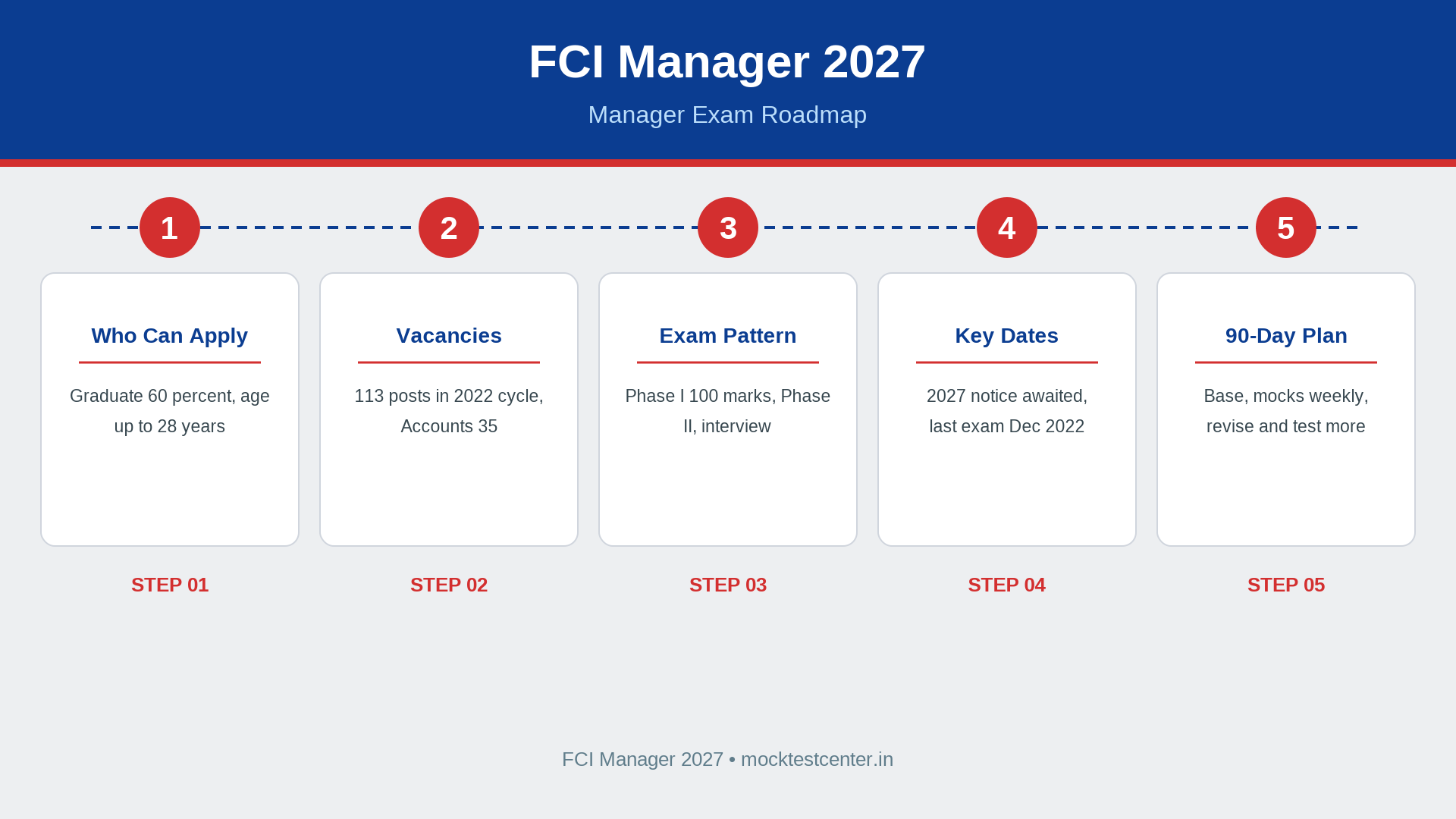
FCI Manager 2027 is the next recruitment of Managers by the Food Corporation of India. The post is a Category II, graduate level management post in the organisation that buys, stores and moves food grain across India. The last full cycle ran in 2022, under Advertisement Number 02/2022-FCI Category-II, for 113 posts. Candidates selected for most Manager posts join first as Management Trainees, train for six months on a stipend, and are then absorbed as Managers. The Hindi post is the exception: it carries no training, and the selected candidate is appointed directly as Manager.
No 2027 notification has been released as of 20 November 2026. That is the first fact on this page, and it shapes everything else here. Any site that prints 2027 dates, a 2027 vacancy count or a 2027 fee is guessing. This article works from the 2022 advertisement and the exams that followed it, because that is the only complete record that exists. The pattern, the eligibility rules and the shape of the job have stayed the same across recent cycles, so they are the safest things to plan around while the new notice is awaited.
The Food Corporation of India was set up under the Food Corporations Act 1964 and started work in 1965. It works under the Ministry of Consumer Affairs, Food and Public Distribution, with its head office in New Delhi. Its job is to buy wheat and paddy from farmers at support prices, store the grain in depots, keep buffer stocks, and move grain to the states for the public distribution system. It runs around 2,000 depots across the country. A Manager in FCI runs that work at the district and regional level, supervising depots, procurement operations, movement of stocks and the accounts that go with them.
Check the official site fci.gov.in for every notice, because only the official notice is final. The recruitment portal used in the last cycle was recruitmentfci.in, and the notices also appear on fci.gov.in. Dates, vacancy counts and pay figures in this article come from the 2022 advertisement. They will change for the next cycle. The pattern and the eligibility rules are the parts that usually carry over.
The gap since 2022 is itself a fact worth sitting with. FCI does not recruit Managers on a fixed calendar, and the gap between the 2022 notice and today is already more than four years. That gap has built up a large pool of waiting graduates. When the next notice comes, the number of applicants per seat is likely to be high, because 113 seats is a small number for an all India exam. Candidates who start now, while there is no notice, get the one thing late starters never get: time.
The eight Manager posts, and the 113 seats
There is no single Manager post. There are eight, and you apply to one of them. The 2022 advertisement split the 113 seats as follows: Accounts 35, Technical 28, General 19, Depot 15, Movement 6, Civil Engineering 6, Hindi 3 and Electrical Mechanical Engineering 1. Accounts alone held nearly a third of all seats. Electrical Mechanical held a single seat. That split decides where the competition sits, and it should decide where you apply.
| Post | Seats in 2022 | Share of all seats |
|---|---|---|
| Manager (Accounts) | 35 | About 31 percent |
| Manager (Technical) | 28 | About 25 percent |
| Manager (General) | 19 | About 17 percent |
| Manager (Depot) | 15 | About 13 percent |
| Manager (Movement) | 6 | About 5 percent |
| Manager (Civil Engineering) | 6 | About 5 percent |
| Manager (Hindi) | 3 | About 3 percent |
| Manager (Electrical Mechanical Engineering) | 1 | About 1 percent |
| Total | 113 | 100 percent |
Accounts is the biggest door, and it is the most specialised one. It needs a professional accountancy qualification or a commerce degree with an MBA in Finance, and it carries a post specific paper on accounting and finance. The 35 seats look generous, but the eligible pool is narrow: chartered accountants, cost accountants, company secretaries and finance MBAs. A candidate who holds one of those qualifications faces far less competition per seat than a general graduate faces anywhere else in this recruitment.
Technical is the second biggest door, with 28 seats. It needs a B.Sc. in Agriculture or a B.Tech or BE in Food Science or a related subject, and it carries a post specific paper. The eligible pool is agriculture and food technology graduates. A B.Sc. Agriculture graduate who is also ready for the general papers has a better seat to applicant ratio here than in almost any other central recruitment. That is the quiet fact of this exam, and it is easy to miss if you only look at the headline total.
General, Depot and Movement are the three generalist posts, with 19, 15 and 6 seats. All three need a graduate degree with at least 60 percent marks, or a CA, ICWA or CS qualification. The work differs: General is office and administration, Depot is depot operations, Movement is the movement of stocks by rail and road. The exam for General is Paper I only. The papers for Depot and Movement were not separately verified in this pass, and the article says so plainly in the pattern section rather than guessing.
Civil Engineering has 6 seats and needs a degree in Civil Engineering. Electrical Mechanical Engineering has a single seat and needs a degree in Electrical or Mechanical Engineering. Both carry a post specific paper. A single seat exam is a lottery in one sense and a fair test in another: the paper decides everything, and the candidate who scores highest takes the seat. There is no room for a bad day.
Hindi has 3 seats and the strictest entry rule. It needs a master degree in Hindi with English as a subject at the degree level, plus five years of translation or terminological work in Hindi, or five years of teaching, research, writing or journalism in Hindi. It carries two papers of its own, Paper III and Paper IV, and it carries no training. Few candidates meet the five year experience rule, so the field is thin, but the seats are thin too.
One rule covers all eight posts. A candidate can apply in any one zone only: North, South, East, West or North East. You pick one zone, and you compete inside that zone. Your cut off, your merit list and your posting all sit inside the zone you picked. Pick the zone with care, because you cannot change it after you apply.
Who can apply, post by post
The age limit in the 2022 cycle was counted as on 1 August 2022. For every post except Hindi, the upper age limit was 28 years. For Hindi, it was 35 years. Age relaxation applied as per the government rules: five years for SC and ST candidates, three years for OBC candidates, ten years for persons with benchmark disabilities, and up to 50 years for departmental FCI candidates in some cases. The next notice will set its own cut off date, so check your age against the date printed in the new notice, not against the date in this article.
Education is post specific, and it is worth reading slowly, because the wrong qualification means a rejected form. For General, Depot and Movement, the rule was a graduate degree or equivalent from a recognised university with at least 60 percent marks, or a CA, ICWA or CS qualification. For SC, ST and PwBD candidates, the marks bar was 55 percent. For Accounts, the rule was associate membership of the Institute of Chartered Accountants of India, the Institute of Cost Accountants of India or the Institute of Company Secretaries of India, or a B.Com degree with a full time MBA in Finance of two years, or a part time MBA of three years, or a distance mode MBA recognised by the UGC, AICTE and DEC Joint Committee.
For Technical, the rule was a B.Sc. in Agriculture, or a B.Tech or BE in Food Science, Food Science and Technology, Food Technology, Food Processing Technology, Food Process Engineering, Food Processing, Food Preservation Technology, Agricultural Engineering, Bio-Technology, Industrial Bio-Technology, Bio-Chemical Engineering or Agricultural Bio-Technology. For Civil Engineering, it was a degree in Civil Engineering. For Electrical Mechanical Engineering, it was a degree in Electrical or Mechanical Engineering. For Hindi, it was a master degree in Hindi with English as a subject at the degree level, plus five years of experience as described above.
The 60 percent rule for the generalist posts is the filter that most candidates miss. A graduate with 58 percent cannot apply for Manager General, Depot or Movement, however strong the rest of the profile is. The CA, ICWA and CS route is the alternative written into the notice: a professional qualification stands in place of the marks bar. Candidates near the line should check their final year aggregate exactly as the university prints it, because the notice counts the aggregate, not the best four subjects or the honours paper alone.
There is no limit on attempts written into the notice. You can apply in every cycle as long as you meet the age limit. That matters here, because the cycles are not annual. A candidate who was 25 in the 2022 cycle will be 29 or older when the next notice comes, and may find the age door closed. The gap between cycles is not just a wait. For some candidates, it is the whole ball game. If you are inside the age limit now, treat this cycle as the one that counts.
The pay, the stipend, and the six month training
The pay scale for a Manager in the 2022 cycle was 40,000 to 1,40,000 rupees, on the IDA pattern. The same scale applied to all eight posts, including Hindi. Candidates selected for General, Depot, Movement, Accounts, Technical, Civil Engineering and Electrical Mechanical Engineering join first as Management Trainees. They train for six months on a consolidated stipend of 40,000 rupees a month. On successful completion of the training, they are considered for absorption as Managers in the scale of 40,000 to 1,40,000 rupees. The Hindi post carries no training, and the selected candidate is appointed directly as Manager in that scale.
Put the money in order. Six months at 40,000 rupees a month as a trainee. Then absorption as Manager, with basic pay starting at 40,000 rupees a month, plus dearness allowance, house rent allowance and the other allowances that apply to FCI officers. The take home pay depends on the city of posting, because house rent allowance changes with the city class. A posting in a small town pays less in allowances than a posting in a big city, and it also costs less to live in.
The training is not a formality. A Management Trainee in FCI learns the depot, the procurement operation, the movement of stocks and the accounts, by working in them. The six months decide whether the trainee is absorbed, and the assessment at the end of training is part of the selection. Candidates who treat the training as a paid holiday will find that out the hard way. Candidates who treat it as the first six months of the job will find that the job starts well.
The pay looks modest beside a bank PO scale at first glance, and it is worth saying plainly. The SBI PO 2027 exam starts at a basic pay of 48,480 rupees, and the IBPS PO 2027 exam starts at the same figure. FCI Manager starts at 40,000 rupees as a trainee and then as a Manager. What FCI offers instead is a management post in a food organisation with around 2,000 depots, a clear training path, and a recruitment where the written test and the interview decide everything. Candidates who want the highest starting pay should look at the officer exams in banking and insurance. Candidates who want a management post in the food system should look here.
The fee in the 2022 cycle was 800 rupees for General, OBC and EWS candidates, paid online, excluding bank charges but including GST. SC, ST and PwBD candidates paid no fee, and women candidates paid no fee. The fee is small, and it is not the barrier in this exam. The barrier is the competition: 113 seats for an all India exam, with a 60 percent graduation bar on the generalist posts.
Phase I: the 100 mark screen
The FCI Manager selection has two online phases, then an interview, then training for most posts. Phase I is common to all posts. It is a screen, not a ranking test. Its marks do not count in the final merit list. Its only job is to cut the field down to fifteen times the number of vacancies for Phase II. That changes how you should treat it. You do not need a top score in Phase I. You need a score above the cut off, with no section failed.
| Section | Questions | Marks | Minutes |
|---|---|---|---|
| English Language | 25 | 25 | 15 |
| Reasoning Ability | 25 | 25 | 15 |
| Numerical Aptitude | 25 | 25 | 15 |
| General Studies | 25 | 25 | 15 |
| Total | 100 | 100 | 60 |
The paper is 100 questions for 100 marks in 60 minutes, with separate timing of 15 minutes per section. You cannot carry time from one section to the next. Each question carries one mark, and each wrong answer costs 0.25 marks. A blank answer costs nothing. The paper is bilingual in English and Hindi, except the English Language section, which is in English only.
General Studies is the section that surprises first timers. Twenty of its 25 questions come from History, Geography, Economy and General Science up to Class 8 level, and five come from current affairs. The Class 8 ceiling is good news and bad news. The questions stay at school level. They reward school level facts that most graduates have forgotten: rivers and their tributaries, the layers of the atmosphere, the chapters of the Constitution, the crops of each season. A month with a Class 6 to 8 NCERT set covers more of this section than a year of reading big general knowledge books.
English gives 25 questions in 15 minutes. That is 36 seconds per question. Reading comprehension takes the most time here, so answer the direct questions first and leave inference questions for the end if time is left. Grammar, vocabulary and error spotting reward daily reading more than last minute rules. Fifteen minutes a day with a newspaper, read properly, does more than a grammar book read once.
Reasoning gives 25 questions in 15 minutes, at the same pace. Puzzles and seating arrangements eat time, so learn to judge a question in five seconds. A skipped question costs nothing. A wrong guess costs 0.25 marks, and in a 100 mark paper with a cut off, four wrong guesses wipe out one right answer. That is the arithmetic that decides Phase I for most candidates.
Numerical Aptitude gives 25 questions in 15 minutes. Simplification, number series and arithmetic are the fastest marks here. Data interpretation does not appear in Phase I in the way it does in bank exams, so the section is a test of speed on small sums, not of reading big tables. Practice with a timer, not without one. The difference between knowing a method and finishing a sum inside 36 seconds is the whole section.
Sectional timing is the trap in Phase I. Fifteen minutes per section means a strong section cannot rescue a weak one, because the clock stops you. Candidates who spend their preparation on their best subject arrive at the exam and watch the timer cut them off in their worst one. The fix is dull and it works: give each section its own timed slot every day, and track the score per section, not the total.
Phase II Paper I: 120 questions for every Manager post
Phase II is where the merit list starts to take shape. Paper I is common to the Manager posts other than Hindi. It has 120 questions for 120 marks in 90 minutes. It covers Reasoning, Data Analysis, Computer Awareness, General Awareness, Management and Current Affairs. There is no negative marking in Phase II. That single fact changes the tactics completely: a question left blank in Phase II costs the same as a question answered wrong, which is nothing extra. You should answer every question in Phase II, because a guess has a chance and a blank has none.
The subjects in Paper I are broader than Phase I, and Management is the new one. The Management part covers the basics of management thought, planning, organising, staffing, directing and control, and the functions of a manager in a public sector organisation. Candidates with an MBA will know this ground. Candidates without one will need a month with a basic management text. The section is basic, but it is unfamiliar, and unfamiliar sections cost marks when they are skipped in preparation.
Data Analysis is the other part that deserves attention. It covers data interpretation from tables, charts and graphs, with questions that need two or three steps of arithmetic. The pace is 45 seconds a question on average across the paper, so a data set that gives five questions is worth more per minute than five separate questions. Learn to read a table once and answer all its questions before moving on. Candidates who jump between sets lose time on every switch.
Computer Awareness in Paper I covers the basics: hardware and software, operating systems, memory, number systems, data communication and networks, databases, MS Office, computer security and new trends in technology. General Awareness covers the economy, the food sector, government schemes and current affairs, with an emphasis on the subjects that touch FCI work: procurement, buffer stocks, the public distribution system and food prices. Read the commerce and agriculture pages, not just the front page.
One practical point about the two papers. Paper I and Paper II run in a single sitting for candidates who take both. That is a long sitting, and stamina is part of the test. Candidates who have never sat for two and a half hours of timed questions will feel it in the second paper. Take at least five full length combined sittings before the exam, with the same gap between papers that the admit card will show. The body needs to learn the sitting as much as the mind needs to learn the syllabus.
Phase II Paper II: the post specific paper
Paper II is the post specific paper. It has 60 questions, each carrying 2 marks, for a total of 120 marks, in 60 minutes. There is no negative marking in Phase II. The paper is post specific, so its content changes with the post, and it is worth half of the 240 mark Phase II total for the candidates who take it.
For Accounts, Paper II covers general accounting and finance. The 60 questions at 2 marks each make this paper worth exactly half of the Phase II total for Accounts candidates. A chartered accountant or finance MBA who is strong here can make up for an average Paper I. A candidate who is weak here cannot, because the paper is half the score. The syllabus is the professional syllabus, and the best preparation is the qualification itself, revised with a question bank, not a new book.
For Technical, Paper II covers the agriculture and food science subjects of the degree. The same logic applies: the degree is the syllabus, and the paper rewards candidates who revised it properly. For Civil Engineering, Paper II covers civil engineering subjects. For Electrical Mechanical Engineering, it covers electrical and mechanical engineering subjects. The paper is the reason the eligibility rules are strict. FCI wants managers who know their subject, not managers who cleared a general test.
Which posts take Paper II is stated carefully here, because the notification text is precise. The notice says that candidates applying for the posts with codes D, E, F and G will appear in Paper I followed by Paper II. Manager General appears for Paper I only. The paper combination for Depot and Movement was not separately verified in this pass, and this article does not guess it. Candidates for Depot and Movement should check the paper table in the new notice before they plan their preparation, because the difference between one paper and two is 120 marks.
The final merit for the Manager posts is built on the Phase II marks plus the interview, as the next sections explain. Paper II is therefore not a side paper. For the posts that take it, it is half the written score, and it is the half where the competition is thinnest, because only candidates with the right qualification sit for it. A strong Paper II score is the best route into the interview list.
Papers III and IV: the Hindi Manager route
Manager Hindi is a different exam inside the same recruitment. Hindi candidates take Paper III and Paper IV instead of Paper I and Paper II, in a single sitting. Paper III is an objective paper of 120 questions for 120 marks in 90 minutes. It covers Hindi, English, Computer Application and General Awareness. Paper IV is a subjective paper of 120 marks in 90 minutes, and it is the only subjective paper in the whole FCI Manager recruitment.
| Paper IV task | Marks |
|---|---|
| Passage for translation from Hindi to English | 30 |
| Passage for translation from English to Hindi | 30 |
| Essay in Hindi | 30 |
| Precis writing in English | 30 |
| Total | 120 |
Paper IV is a writing test, and it rewards practice, not reading. Translation in both directions is half the paper, at 60 marks. A translator who works slowly will not finish. The essay in Hindi is 30 marks, and the precis in English is 30 marks. Ninety minutes for four written answers is tight, and the typing or writing speed decides the score as much as the language knowledge does. Candidates who practise one translation in each direction every day for two months will feel the difference on exam day. Candidates who only read about translation will not.
The Hindi post carries no training, and the selected candidate is appointed directly as Manager. That is a real advantage: no six month trainee period, no stipend stage, and no absorption assessment. The price of that advantage is the five year experience rule and the subjective paper. Few candidates can pay it. The three seats in 2022 went to candidates who could, and the next cycle will be the same.
A Hindi candidate should also note the age limit. It was 35 years as on 1 August 2022, against 28 years for the other posts. The extra seven years follow from the experience rule: a candidate who finished a master degree at 23 and worked five years in translation is 28 at the earliest, so the higher limit is the arithmetic of the rule.
The interview, and how the final list is made
Candidates who clear Phase II are called for an interview. The shortlisting rule in the 2022 advertisement was a minimum of 50 percent marks in the Phase II online test for unreserved category candidates, and 45 percent for SC, ST, OBC and PwBD candidates. The number of candidates called for interview is normally three times the number of advertised vacancies. With 113 vacancies, that means about 339 candidates reach the interview stage, across all posts and zones.
The interview carries a weight of 10 percent in the final selection, according to the trackers that quoted the advertisement. That makes the final weight 90 percent for the Phase II online test and 10 percent for the interview. A strong written score can survive an average interview. A weak written score cannot be rescued by a great interview. Put your energy where the marks are, and treat the interview as the last tenth, not the first.
The interview panel asks about the degree, the post applied for, basic economics, the food sector and why the candidate wants this job. Read about FCI before the interview. Know what the Food Corporation does, how procurement works, what buffer stocks are, and why a government corporation buys grain. Panels ask that question in some form every year, and candidates who answer it well stand out at once. A candidate for Accounts should know the FCI accounts cycle. A candidate for Technical should know grain quality testing. A candidate for Civil should know godown construction. The panel expects the degree to show.
Prepare for the interview from the day you clear Phase II, not a week before it. Know your degree subject and one project or paper from it. Know one food sector story from the news, with a number. And know one plain reason you want this job, stated in your own words. Panels hear the same rehearsed lines all day. A plain answer in your own words stands out more than a polished speech.
After the interview, the selected candidates for General, Depot, Movement, Accounts, Technical, Civil Engineering and Electrical Mechanical Engineering join as Management Trainees for six months. The training carries a stipend of 40,000 rupees a month, and absorption as Manager follows successful completion. The Hindi post goes straight to appointment. There is no interview for FCI Assistant Grade III 2027 at all, which is one reason the Manager exam feels heavier: the same organisation, the same food system, but a written test, an interview and a training period instead of a written test alone.
Dates from the last cycle
The 2027 notice has not been released. No dates for 2027 exist yet, and any site that prints them is guessing. What exists is the last cycle, and it is worth reading closely, because it shows the shape of the wait.
| Event | Date |
|---|---|
| Advertisement 02/2022-FCI Category-II released | 24 August 2022 |
| Applications open | 27 August 2022 |
| Applications close | 26 September 2022 |
| Phase I examination | 10 and 17 December 2022 |
The apply window lasted thirty days. The gap between the last date and Phase I was about two and a half months. Phase I ran on two dates, 10 and 17 December 2022, with two sittings on each date. The Phase II dates for the 2022 Manager cycle were not verified in this pass, and this article leaves them out. That gap in the record is stated here rather than filled with a guess, because a wrong date is worse than a missing one.
Since the 2022 cycle, no new Manager advertisement has come. As of November 2026, trackers report that a large FCI recruitment is expected, with figures of 33,566 posts and even 42,790 posts circulating online. None of those figures comes from an official FCI notice, and this article does not repeat them as facts. A recruitment drive is possible, and the long gap makes one likely, but until FCI publishes the advertisement on fci.gov.in, no vacancy number or date is official. The same trackers report an FCI order dated 17 November 2026 that abolishes 7,361 Category IV posts. That is an administrative order about watch and ward and other Category IV posts, not a recruitment notice for Category II, and it does not change the Manager position.
The 113 seats of 2022 are small beside the 5,043 seats of the Category III cycle of the same year, and that contrast is the point. The Manager exam is a small, sharp recruitment. The Assistant Grade III exam is a large, broad one. A candidate who is eligible for both should prepare for both, because the Phase I paper is the same and the general parts of Phase II overlap. One preparation, two chances, and the Manager paper is the one with the higher pay at the end of it.
The five zones, and where the 113 seats sat
FCI recruits zone wise. The five zones are North, South, East, West and North East. In the 2022 Manager cycle, the zone totals were North 38, South 16, West 20, East 21 and North East 18. The North Zone held the most seats, with 38 of 113. The South Zone held the fewest, with 16. The spread is far more even than in the Category III cycle, where the North Zone held nearly half of all seats.
The post wise split by zone shows where each post sat. Manager General had 1 seat in the North, 5 in the South, 3 in the West, 1 in the East and 9 in the North East. Manager Accounts had 14 in the North, 2 in the South, 5 in the West, 10 in the East and 4 in the North East. Manager Technical had 9 in the North, 4 in the South, 6 in the West, 7 in the East and 2 in the North East. Manager Depot had 4 in the North, 2 in the South, 6 in the West, 2 in the East and 1 in the North East. Manager Movement had 5 in the North and 1 in the East. Manager Civil had 3 in the North, 2 in the South and 1 in the North East. The single Electrical Mechanical seat sat in the North Zone. Manager Hindi had 1 seat each in the North, South and North East zones.
Read that table twice before you pick a zone, because the best zone for an Accounts candidate is not the best zone for a General candidate. A General candidate in the North East competes for 9 seats, while a General candidate in the North competes for 1. An Accounts candidate in the North competes for 14 seats, while an Accounts candidate in the South competes for 2. The zone totals hide these differences, and the post wise table is the one that matters.
The cut offs are zone wise and post wise, so the same score can clear the cut off in one zone and fail it in another. The merit lists are built zone by zone. There is no all India merit list to fall back on. Your zone is your whole competition, and your post is the other half of it. Pick both with the table in front of you, not from memory.
What a Manager actually does in FCI
A Manager in FCI runs the work that the Assistant Grade III staff carry out. In a depot, the Manager supervises receipt, weighment, stacking, preservation and dispatch of grain, and signs the records that the assistants write. In a district office, the Manager supervises procurement from the mandis, the movement of stocks, and the settlement of bills. In a regional office, the Manager works on planning, accounts, administration or technical matters, according to the post.
The Accounts Manager works on the money side at a higher level: budgets, payments, advances, recoveries, and the accounts of the region. The Technical Manager works on quality at a higher level: sampling, testing, grading, and the preservation of stocks. The Civil Manager works on godown construction and maintenance. The Electrical Mechanical Manager works on the machinery of the depot: weighbridges, conveyors and handling equipment. The Movement Manager works on the movement of stocks by rail and road, which is the largest single operation in the food system. The Hindi Manager works on official language work for the region.
The posting is usually in the zone you applied in, and often in a district town rather than a state capital. The work is a management job in the food system of the country, with depots, mandis, railway sidings and trucks. Candidates who want a capital city posting should know that now, not after the result. Candidates who like work they can see and touch, and who want to run an operation rather than sit in a branch, will find this job suits them better than a bank posting does.
The career path runs upward through the officer grades, and the training period is the start of it. A Management Trainee who learns the depot in six months becomes a Manager who can run one. A Manager who runs a depot well becomes a candidate for the next grade. The organisation is large, the zones are large, and seniority builds inside the zone. The first promotion is the one that matters most, and it comes to the officers who learn the field work first.
A 90 day plan, and where this exam sits beside the rest
Ninety days is enough to cover this syllabus if the days are used on the pattern, not on the books. The plan below assumes the candidate starts from zero on the FCI pattern but knows school level maths and English. It splits the work into three blocks of thirty days, and it keeps Phase II in view from day one.
Days 1 to 30 are for the base. English for thirty minutes a day: reading, vocabulary and error spotting, with one comprehension passage a day. Reasoning for thirty minutes: series, coding, blood relations, directions and syllogisms, with puzzles kept short. Numerical Aptitude and Data Analysis for forty five minutes: simplification, number series, percentages, ratio, averages, time and work, and one data set a day, all with a timer. General Studies for forty five minutes: Class 6 to 8 NCERT History, Geography and Science, one chapter a day, with notes in your own words. Current affairs for fifteen minutes: one newspaper, with two lines of notes on each big story, and the agriculture and commerce pages read first. Management basics for thirty minutes: one topic a day from planning, organising, staffing, directing and control. Computer basics for fifteen minutes: one topic a day from hardware, software, operating systems and MS Office.
Days 31 to 60 are for mocks and repair. Take one Phase I mock every three days, timed at 60 minutes, and one Paper I mock every week, timed at 90 minutes. After each mock, spend as long on the analysis as on the test. List every question you got wrong by topic, and list every question you skipped. The skipped list is as useful as the wrong list, because it shows the topics you avoid. Give the weakest section thirty minutes a day extra, and take it from the strongest section, not from sleep. In this block, add the post specific paper if you take Paper II: one hour a day on accounting, agriculture, engineering or translation, from the degree books. If you are a Hindi candidate, add one translation in each direction every day, timed.
Days 61 to 90 are for speed and revision. Take two full mocks a week, one Phase I and one Paper I, and one combined sitting with Paper II if you take it. Cut the revision notes to one page per subject, and read those pages, not the books. Stop learning new topics in the last ten days. New topics in the last ten days cost marks in the topics you already know, because they take revision time and add worry. The last week is for the notes, the mock scores, and the admit card. Sleep properly the night before. The exam rewards a rested candidate more than a candidate who read one more chapter at 2 AM.
Put FCI Manager beside the big exams and the trade off becomes clear. The IBPS PO 2027 exam and the SBI PO 2027 exam lead to bank officer posts with thousands of seats and a higher starting pay. The IBPS SO 2027 exam needs a specialist degree and pays more. The LIC AAO 2027 exam and the NIACL AO 2027 exam offer officer posts in insurance with more seats. The RBI Grade B 2027 exam and the NABARD Grade A 2027 exam are the top of the regulatory ladder, and they draw the heaviest competition in the country.
FCI Manager asks for a graduate degree with 60 percent marks, or a professional qualification, and it offers 113 seats. That is a small number, and it is honest to say so. What it offers instead is a management post in the food system, a six month training with a stipend, and a selection where the written test carries 90 percent of the weight. The IBPS RRB PO 2027 exam places you in a rural bank near home. The IDBI Executive 2027 exam is a contract post. FCI Manager is a permanent management post, and that difference is worth the harder preparation.
The honest place for this exam in a plan is as a second target beside the bank and insurance officer exams, not the only one. The cycles are not annual, and no one can say when the next notice will come. A candidate who prepares only for FCI will wait years between attempts. A candidate who prepares for the bank PO exams, and keeps the FCI syllabus warm beside them, will find that most of the preparation overlaps: English, reasoning, numerical aptitude, data analysis and general awareness are the same subjects with different weights. The FCI specific work is the Class 8 science, the management basics, the computer awareness, and the post specific paper. Keep those warm, take the bank exams in between, and when the FCI notice comes, you will be ready in weeks rather than months.
Start with one FCI Manager mock this week, Phase I first and Paper I second. Score it, list your weak section, and give that section thirty minutes a day. That single habit, repeated for ninety days, is what turns a graduate into a Manager.