
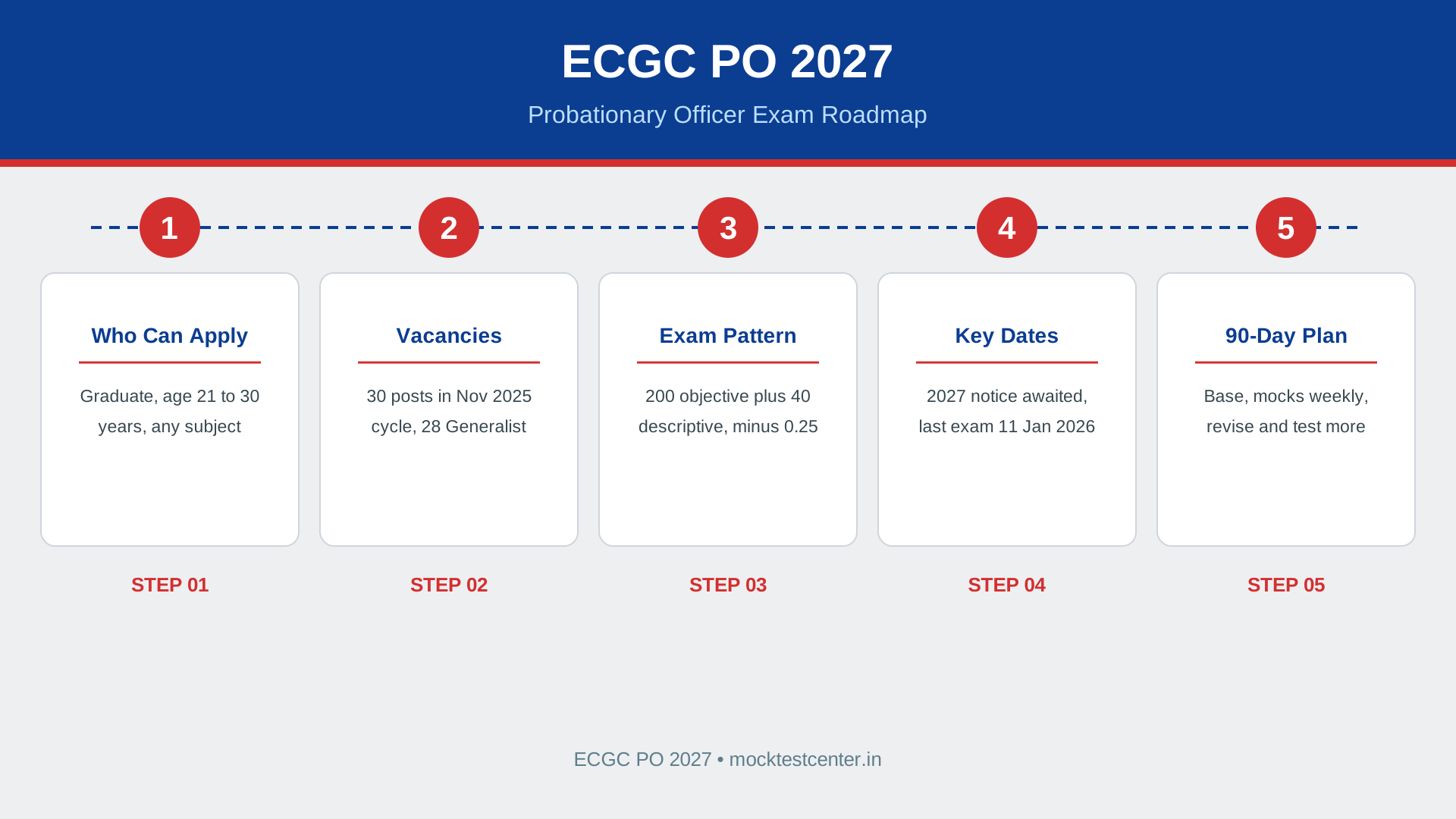
About ECGC PO 2027 Exam Series
📖 Table of Contents
- What ECGC PO 2027 is
- Who can apply for ECGC PO
- The pay, and why 30 posts draw 79,000 applications
- The online examination, part by part
- The descriptive paper: essay and precis
- How the interview works, and how the final list is made
- Dates from the last cycle, and what they tell you
- How to apply on ecgc.in
- What to study for each section of ECGC PO 2027
- A 90 day plan that fits around a job or college
- Mistakes that cost candidates a year
- ECGC PO next to other bank exams
- What to check before the 2027 notice comes out
ECGC PO 2027: Probationary Officer Pattern, Salary, Dates
What ECGC PO 2027 is
ECGC PO 2027 is the next recruitment of Probationary Officers by ECGC Limited, the Export Credit Guarantee Corporation of India. The post sits in the cadre of Executive Officer, and it covers Generalist officers and a small number of Rajbhasha specialists. The selection has two stages: an online examination with an objective paper and a descriptive paper, followed by an interview. The 2027 notice has not come out yet, so this page works from the last full cycle, which ran in late 2025 for the year 2025-26.
The last cycle is worth studying because it shows how small and how sharp this exam is. ECGC released Advertisement Number ECGC/OP/FY/2025-26 on 10 November 2025 for 30 Probationary Officer posts. Applications ran from 11 November to 2 December 2025. The online examination took place on 11 January 2026, in a single shift from 2 PM to 5 PM. The result came on 3 February 2026. About 79,000 candidates applied for those 30 posts. That ratio, more than 2,600 applicants per seat, is the first thing a candidate for the next cycle should learn.
Check the official site ecgc.in for every notice, because only the official notice is final. Dates, vacancy counts, and pay figures in this article come from the 2025 advertisement and the reports that followed it. They will change for 2027. The pattern, the eligibility rules, and the shape of the job have stayed the same across recent cycles, so they are the safest things to plan around.
ECGC itself is worth a sentence. It was set up in 1957 as the Export Risks Insurance Corporation, and it is now a company wholly owned by the Government of India, under the Ministry of Commerce and Industry, with its head office in Mumbai. It gives export credit insurance to Indian exporters, covering the risk that a foreign buyer does not pay. A Probationary Officer here works in export credit, insurance, and trade finance, not in branch banking. That difference shapes the whole job.
Who can apply for ECGC PO
There are two doors into this exam. The Generalist door is open to any graduate. A bachelor degree in any discipline from a university recognised by the Government of India is enough. The Specialist door, for Rajbhasha or Hindi officers, needs a master degree in Hindi or Hindi Translation with English as a core, elective, or major subject at graduation, with 60 percent marks, or a master degree in English with Hindi as a core, elective, or major subject, with the same marks. For SC and ST candidates, the marks bar is 55 percent.
The age limit in the 2025 cycle was 21 to 30 years as on 1 November 2025. That meant candidates born between 2 November 1995 and 1 November 2004. Age relaxation applied as per government rules: five years for SC and ST, three years for OBC, ten years for persons with benchmark disabilities, and five years for ex-servicemen. Expect the 2027 notice to set its own cut off date. Check your age against the date printed in the new notice, not against the date in this article.
Two posts were for Rajbhasha specialists in the last cycle, and 28 were for Generalists. Candidates for the Specialist post should read the language qualification with care, because the master degree subject rule is strict. A degree in Hindi literature without English at graduation does not meet the first option, and a degree in English without Hindi at graduation does not meet the second. Keep the mark sheets that prove both subjects.
There is no limit on attempts in the notice. You can apply in every cycle as long as you meet the age limit. That matters for this exam, because the vacancy count is small and the competition is heavy. Many candidates take two or three cycles to get in.
The pay, and why 30 posts draw 79,000 applications
The pay scale for an Executive Officer, Probationary Officer, in the 2025 cycle was 88,635 to 1,69,025 rupees. The starting basic pay is 88,635 rupees a month. The approximate cost to company for a Probationary Officer posted in Mumbai is 20,00,000 rupees a year. That figure counts the allowances: dearness allowance, house rent allowance, transport allowance, meal coupons, medical benefits, mobile allowance, and furniture and briefcase allowance.
That pay explains the crowd. Twenty lakh a year for a graduate post with 30 seats is one of the best pay to effort ratios in government recruitment. The SBI PO 2027 exam pays less at the start and draws lakhs of candidates for more seats. ECGC pays more and offers fewer seats, so the cut offs run high. Candidates should enter with open eyes. This is a high reward exam and a high risk one.
Put the money in order. Basic pay 88,635 rupees a month at the start. Cost to company about 20 lakh a year in Mumbai. Postings outside Mumbai pay less in allowances but cost less to live in. The pay grows with increments: the scale moves by 4,385 rupees fourteen times, then by 4,750 rupees four times, up to 1,69,025 rupees. That is a long ladder, and it is the reason officers stay.
One more point about the job. ECGC has a small workforce and a specialist mandate. A Probationary Officer here learns export credit insurance, trade finance, and risk assessment. Those skills are rare in the banking market. An officer who leaves after a few years carries knowledge that few bankers have. That is a career asset, not just a salary.
The online examination, part by part
The ECGC PO 2027 online examination has two papers. The first is an objective test of 200 questions for 200 marks. The second is a descriptive paper of 40 marks. Both run in the same sitting, in one shift of three hours. The objective paper takes 140 minutes and the descriptive paper takes 40 minutes. Every wrong answer in the objective paper costs 0.25 marks. The descriptive paper has no negative marking.
| Section, Generalist objective test | Questions | Marks | Minutes |
|---|---|---|---|
| Reasoning Ability | 50 | 50 | 40 |
| English Language | 40 | 40 | 30 |
| Computer Knowledge | 20 | 20 | 10 |
| General Awareness | 40 | 40 | 20 |
| Quantitative Aptitude | 50 | 50 | 50 |
| Total | 200 | 200 | 140 |
Reasoning takes fifty questions in forty minutes. That is forty eight seconds per question. Puzzles and seating arrangements eat time, so learn to judge a question in five seconds. A skipped question costs nothing. A wrong guess costs 0.25 marks.
English gives forty questions in thirty minutes. That is forty five seconds per question. Reading comprehension takes the most time here. Read the passage once, answer the direct questions first, and leave inference questions for the end if time is left. Cloze tests and error spotting reward daily reading more than last minute grammar rules.
Computer knowledge gives twenty questions in ten minutes. That is thirty seconds per question, the fastest pace in the objective paper. The questions cover basic hardware, software, operating systems, and the internet. Ten questions a day from a computer basics book covers this section in two weeks.
General awareness gives forty questions in twenty minutes. That is thirty seconds per question. You either know the answer or you do not. Banking awareness, economy news, and current affairs from the last six months carry the most weight. Export and trade news matters more here than in other bank exams, because ECGC works in exports. Read the commerce pages, not just the front page.
Quantitative aptitude gives fifty questions in fifty minutes. That is one minute per question, the most generous pace in the paper. Data interpretation sets give several questions from one table, so they pay better per minute than a single puzzle. Simplification and number series are the fastest marks in this section.
Sectional cut offs apply, along with an overall cut off. A high total with a failed section does not save you. Every section needs a minimum score. The exact cut offs change with each cycle and ECGC does not publish them in advance. The safe target is simple. Aim for at least 60 percent in your weakest section in mocks, and never let one section fall below half marks while another soars.
The descriptive paper: essay and precis
The descriptive paper is what makes ECGC PO different from every other bank PO exam. It carries 40 marks and takes 40 minutes. It has two questions. The first is an essay, one topic out of two options, for 20 marks. The second is a precis, one passage out of two options, for 20 marks. Both are in English. You type your answers on the computer.
Forty minutes for two written answers is tight. That is twenty minutes per answer, and the typing itself takes time. Candidates who type slowly lose marks here without knowing it. Practice typing your essays on a keyboard with a timer. If you write 250 words in twenty minutes with clean grammar, you are ready. If you write 120 words, you need practice, not more vocabulary.
What should the essay say? The topics in past cycles have covered economy, exports, banking, and current affairs. A good essay has a clear opening line, two or three points with one fact each, and a closing line that says what should happen next. Do not memorise essays. Memorised essays read stiff and miss the topic. Instead, read the news every day and keep one line of opinion on each big story. That line becomes your essay.
The precis is a different skill. You read a passage of about 400 words and rewrite it in about 130 words, keeping every important point and dropping every example. The title matters. Give the precis a short title that captures the main idea. Practice with one editorial a week. Read it, close the paper, and write the precis from memory. Then compare. The gaps show you what you missed.
Most bank exams have no descriptive paper at all, which is why most candidates ignore it. That is a mistake here. Forty marks out of 240 is one sixth of the written score. In a 30 seat exam, one sixth of the score decides the merit list. Give the descriptive paper one hour a week from the start of your preparation, not one day at the end.
One more point about marking. The descriptive paper is read by a human evaluator, so handwriting does not matter and typing speed does. Candidates who type with two fingers will spend half their time hunting for keys. Learn touch typing before the exam if you can, because every minute spent looking at the keyboard is a minute taken from thinking about the essay. A candidate who types 40 words a minute finishes the essay with time to read it back, while a candidate who types 15 words a minute submits a half finished answer, and the difference shows in the marks even when both candidates know the same facts.
Keep a small file of essay material. Every week, write one page on a live topic: exports, the rupee, inflation, digital payments, or a government scheme. Note two facts and one opinion for each topic. After two months you will have eight pages, and those eight pages cover most topics the paper can ask. On exam day you will not be writing from memory. You will be writing from a file you built yourself, and that is a different feeling entirely.
How the interview works, and how the final list is made
Candidates who clear the online examination are called for an interview. The interview carries 60 marks. The minimum qualifying marks are 40 percent, or 24 marks, for General candidates, and 35 percent, or 21 marks, for SC, ST, OBC, and PwBD candidates. Candidates who score below that line are out, whatever their written score.
The final merit list uses both scores. The weight is 80 percent for the online examination and 20 percent for the interview. That means the written test carries four times the weight of the interview. A strong written score can survive an average interview. A weak written score cannot be rescued by a great interview. Put your energy where the marks are.
The interview panel asks about your degree, your hometown, basic economics, exports, and why you want this job. Read about ECGC before the interview. Know what export credit insurance is, who buys it, and why a government company does it. Panels ask that question in some form every year, and candidates who answer it well stand out at once.
Prepare for the interview from the day you clear the test, not a week before it. Know your degree subject and one project or paper from it. Know one export story from the news, with a number. And know one plain reason you want this job, stated in your own words. Panels hear the same rehearsed lines all day. A plain answer in your own words stands out more than a polished speech.
Dates from the last cycle, and what they tell you
The ECGC PO 2027 notice has not been released. No dates for 2027 exist yet, and any site that prints them is guessing. What exists is the last cycle, and it is worth reading closely.
| Event | Date |
|---|---|
| Advertisement ECGC/OP/FY/2025-26 released | 10 November 2025 |
| Applications open | 11 November 2025 |
| Applications close | 2 December 2025 |
| Online examination | 11 January 2026, 2 PM to 5 PM |
| Result declared | 3 February 2026 |
The apply window lasted twenty two days. The gap between the last date and the test was forty days. The gap between the test and the result was twenty three days. That is a kinder timeline than the IDBI exams, where the test follows within three weeks. Use the forty days well. They are enough to finish the syllabus and take ten mocks.
The category split for the 30 posts was 5 for SC, 0 for ST, 10 for OBC, 3 for EWS, and 12 for General. Out of those, 28 posts were for Generalist officers and 2 for Rajbhasha specialists. The bank hires in small numbers every cycle, so expect the 2027 cycle to sit near 30 again. That is a guess about size, not a fact about the notice. The notice will give the real number.
Watch ecgc.in from October 2027 onward. The last notice came in November, so late autumn is the season to watch. Check the careers section twice a week. The window is longer than the IDBI window, but the test follows fast enough that late starters still lose.
How to apply on ecgc.in
Go to the careers section of ecgc.in and open the link for Recruitment of Probationary Officers. Read the full advertisement before you touch the form. Then register with a working email and mobile number. You will get a registration number and password. Keep them safe. You need them for the admit card later.
Fill the form in one sitting if you can. Keep your degree details, your date of birth as on your Class 10 certificate, and your category certificate number ready. For the Rajbhasha post, keep the master degree mark sheets that prove both Hindi and English subjects. Upload a photo and signature in the size the notice asks for. A photo that is too large or a signature that is too small gets the form rejected, and ECGC does not chase you to fix it.
Pay the fee online and save the receipt. In the 2025 cycle, the fee was 950 rupees for General, OBC, and EWS candidates, and 175 rupees for SC, ST, and PwBD candidates. Take a print of the final form. Then wait for the admit card, which ECGC releases on its site before the test. The admit card tells you the centre and the reporting time. Reach the centre early. Late entry is refused.
Candidates who also track the IBPS PO 2027 exam will find the application steps nearly the same. Government recruitment forms follow one pattern, and once you have filled one carefully, the rest feel familiar.
What to study for each section of ECGC PO 2027
Reasoning first. The fifty questions cover puzzles; seating arrangements; syllogisms; coding decoding; blood relations; direction sense; and data interpretation. Puzzles carry the most marks, so give them the most practice time. Start with linear seating and box puzzles. Move to floor puzzles only after the easy types feel fast. Data interpretation sets look long but give several questions from one table, so they pay better per minute than a single puzzle.
English next. The forty questions cover reading comprehension; cloze test; error spotting; sentence improvement; and vocabulary. Read one English editorial every day and note ten new words a week. That habit alone covers vocabulary and comprehension together, and it also feeds the descriptive paper, which needs the same reading habit. Grammar rules help with error spotting, but only if you apply them on questions.
Computer knowledge needs two evenings, not two months. Cover input and output devices; memory units; operating systems; MS Office shortcuts; internet terms; and cyber security basics. Twenty questions, ten minutes, thirty seconds each. Candidates who skip this section lose easy marks to candidates who spent two evenings on it.
General awareness needs two notebooks. One for banking and economy, one for current affairs, with a third page for exports and trade. In the banking notebook, write the repo rate, reverse repo rate, CRR, SLR, bank rate, and the names of the RBI governor and the ECGC chairman, and update them every month. Add the full forms of NPA, CBS, KYC, NEFT, RTGS, IMPS, and UPI. In the exports notebook, write the top export items of India, the top export destinations, and the export figures for the last quarter. ECGC works in exports, so trade questions show up more here than in other bank exams.
Quantitative aptitude needs a topic list you can tick off. Simplification and approximation; number series; quadratic equations; data interpretation; time and work; time speed and distance; profit and loss; simple and compound interest; ratio and proportion; averages; and mensuration. That list looks long. It is the same list as every bank exam, so the books and mocks you already own cover it. The difference is speed. Fifty questions in fifty minutes means one minute per question, so accuracy matters more than speed here. A candidate who gets forty right and ten wrong scores 37.5. A candidate who gets forty five right and skips five scores 45.
The descriptive paper needs its own practice. Write one essay a week on an economy or export topic, in twenty minutes, on a keyboard. Write one precis a week from an editorial, in twenty minutes. After a month you will have four essays and four precis to compare. The improvement shows in the word count and in the grammar. Do not practise the descriptive paper by reading about it. Write it.
A 90 day plan that fits around a job or college
Days 1 to 30 are for the base. Study two hours a day if you work or attend college, four hours if you are free. Cover one reasoning topic and one quant topic each day. Read the news every morning and write five lines in your current affairs notebook, plus two lines on exports. Write one essay and one precis each week. Take one mock at the end of week two and one at the end of week four. Do not worry about the score. The first mocks only show you where you stand.
Days 31 to 60 are for speed. Your ECGC PO 2027 score will move most in this phase, because speed under sectional timers is what the paper actually tests. Take two mocks a week now, with the descriptive paper included. After each mock, spend as much time on analysis as you spent on the test. Write down every question you got wrong and why. Was it a concept gap, a silly mistake, or a time problem? Concept gaps go back into your study list. Silly mistakes need a checklist before you submit each section. Time problems need easier questions first and hard ones last.
Days 61 to 90 are for the real thing. Take three mocks a week. Revise your error notebook every second day. Stop learning new topics in the last ten days. New topics in the last week add stress and no marks. In the last three days, take one full mock at the same time as your real test slot, then rest. Sleep matters more than one more chapter in the final week.
If you have less than ninety days, cut the base phase, not the mocks. Ten mocks with full analysis beat thirty days of reading without a single test. The paper rewards candidates who have sat through the three hour sitting many times. It punishes candidates who know the syllabus and have never felt the sectional timer run out.
Mistakes that cost candidates a year
The first mistake ECGC PO 2027 candidates make is ignoring the descriptive paper. Forty marks out of 240 is one sixth of the written score. In a 30 seat exam, that sixth decides the merit list. Give it one hour a week from the start.
The second mistake is ignoring one section. Sectional cut offs end runs every year. A candidate with 180 marks and a failed computer section goes home, while a candidate with 150 marks and balanced sections goes to the interview. Give your weakest section thirty minutes a day, every day, even when it feels slow.
The third mistake is guessing too much. Four wrong answers erase one right answer. In a section where you know thirty answers for sure, ten wild guesses can pull your score down by two and a half marks. That is often the gap between selection and rejection in a 30 seat exam. Guess only when you can rule out two options.
The fourth mistake is skipping mocks. Reading feels like preparation, but the test measures speed under a timer. Candidates who take fewer than ten mocks before the real test are gambling. Take twenty if you can. Analyse every one.
The fifth mistake is applying for the wrong post. Generalist and Rajbhasha have different qualifications. A candidate who applies for Rajbhasha without the master degree subject rule gets rejected at document verification, after clearing the test. Read the language rule twice before you choose.
ECGC PO next to other bank exams
Put ECGC PO beside the big exams and the trade off becomes clear. The SBI Clerk 2027 exam and the IBPS Clerk 2027 exam lead to clerk posts with many more seats, but the pay is far lower than the ECGC scale. The IBPS RRB PO 2027 exam places you in rural banks, which suits candidates who want to work near home. The IBPS SO 2027 exam needs a specialist degree, so it suits a smaller group. The RBI Assistant 2027 exam pays well and draws heavy competition of its own.
Against officer exams, the comparison is about seats. The LIC AAO 2027 exam and the NIACL AO 2027 exam offer officer posts in insurance with more seats than ECGC. The IDBI JAM 2027 exam leads to a Grade O post through a paid course, with many more seats and a lower starting pay. ECGC offers the highest starting pay of the group and the fewest seats. That is the deal.
The way to choose is to ask one question. Do you want the highest pay and a specialist career in exports, and can you accept that 30 seats mean a hard cut off? If yes, ECGC PO deserves your main effort. If no, the PO and clerk exams with more seats fit better. Many candidates apply for both kinds and decide when the offers come. That is a sound plan, because the syllabus overlaps so much that one preparation serves all of them, and the descriptive paper is the only extra work.
What to check before the 2027 notice comes out
Keep three things ready. First, your degree certificate and the age calculation as on 1 November 2025 for the last cycle, so you can redo it at once when the new cut off date comes out. Second, a mock test routine with sectional timers plus the descriptive paper, so the three hour sitting feels normal by the time the notice comes out. Third, a habit of checking ecgc.in twice a week from October 2027.
Start with one ECGC PO 2027 mock this week, essay and precis included. Score it, list your weak section, and give that section thirty minutes a day. That single habit, repeated for ninety days, is what turns a graduate into a Probationary Officer.







