
About CAIIB Risk Management 2027 Exam Series
📖 Table of Contents
- One elective out of five, and what that choice really means
- The paper in numbers
- Why this paper pays, in plain salary terms
- Module A: risk and the risk management framework
- Module B: credit risk, the biggest module
- Module C: market risk and the maths of prices
- Module D: operational risk, the risk of everything going wrong inside
- Module E: Basel norms and the RBI rulebook
- Module F: derivatives, the tools that hedge and the tools that hurt
- Appendix: statistics, the quiet marks
- Who should pick Risk Management, and who should not
- A 90 day plan that fits around a bank job
- Mistakes that cost marks
- Sources
CAIIB Risk Management 2027: Elective Paper Guide
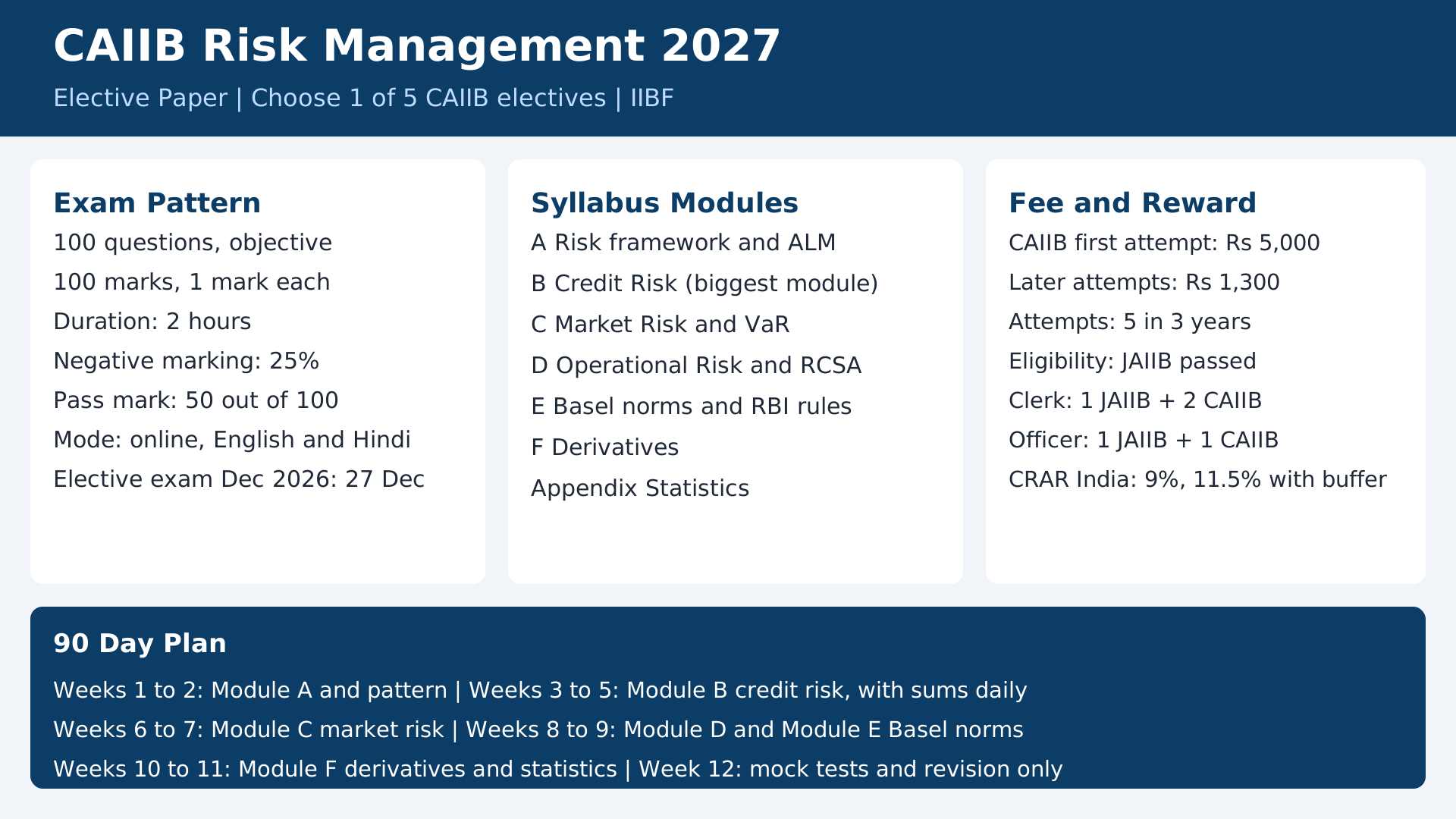
Risk Management is one of five electives in CAIIB, and you pick only one of them. The paper carries 100 questions for 100 marks, runs for 2 hours, and has negative marking of 25 percent of the marks of the question. You need 50 marks out of 100 to pass it, with one narrow exception explained below. The elective exam in the December 2026 cycle was held on 27 December 2026, after the four compulsory papers on 6, 12, 13 and 20 December 2026. No 2027 schedule had been announced by the Indian Institute of Banking and Finance as of 19 November 2026, so treat every 2027 date in this guide as unannounced until IIBF publishes it.
That short paragraph is the whole paper in brief. The rest of this guide earns its keep by going into the parts that decide marks. Credit risk takes the biggest share of your time. Market risk needs numbers. Operational risk needs memory of frameworks and real bank failures. Basel norms tie all three together, and the statistics appendix quietly supplies the maths that appears inside the other modules. Read the guide in order once, then use the 90 day plan near the end to turn it into a timetable.
One elective out of five, and what that choice really means
CAIIB has four compulsory papers. They are Advanced Bank Management, Bank Financial Management, Advanced Business and Financial Management, and Banking Regulations and Business Laws. Every CAIIB candidate clears those four. Then the candidate picks one elective. The five choices are Rural Banking, Human Resources Management, Information Technology and Digital Banking, Risk Management, and Central Banking. You register for one elective only. You cannot carry two electives through the same CAIIB attempt, and the elective you pick does not change the compulsory papers.
Risk Management suits a particular kind of banker. If you work in credit, treasury, inspection, audit, or compliance, the paper reads like your working day with names attached to things you already do. If you work at a branch counter and rarely touch a rating sheet, the paper still works, but you will need more time on Module B and Module E, because those two modules carry the heaviest concepts. The paper is often described as the most chosen elective, and Oliveboard calls it one of the most chosen electives in CAIIB. That popularity is a weak reason to pick it. Pick it because your job touches risk, or because you want a risk role next, or because numbers and frameworks suit you better than the memory load of the other electives.
One honest warning belongs here. Risk Management looks friendly because every question carries only one mark, but a wrong guess costs a quarter mark under the negative marking rule of 25 percent. That comfort hides a trap. Candidates who guess freely on 30 questions they never studied still fail, because a blind guess is worth almost nothing once the quarter mark penalty is counted, and a candidate who knows 40 marks of material lands near 42. The pass mark is 50. Guessing helps only at the margin. It never replaces study.
The paper in numbers
| Item | Detail |
|---|---|
| Conducting body | Indian Institute of Banking and Finance (IIBF) |
| Paper type | CAIIB elective, choose one of five |
| Questions | 100 objective questions |
| Marks | 100 marks, one mark per question |
| Duration | 2 hours |
| Negative marking | 25 percent of the marks of the question |
| Pass mark | 50 out of 100 in the paper |
| Mode | Online only |
| Medium | English and Hindi |
| Elective exam, December 2026 cycle | 27 December 2026 |
| 2027 schedule | Not announced as of 19 November 2026 |
Two details in that table deserve a closer look. First, the pass rule has a second route. IIBF trackers report that a candidate can also pass with at least 45 marks in every paper and an aggregate of at least 50 percent across all subjects, and Adda247 notes this aggregate route applies in a single attempt. The standard route is simpler to plan around. Aim for 50 in this paper on its own, and treat the aggregate route as a safety net you never plan to use. Second, the fee for CAIIB in the December 2026 cycle was Rs 5,000 for the first attempt, excluding taxes and charges, and Rs 1,300 for the second to fifth attempts. That fee covers the CAIIB registration, and IIBF adds late fees in later registration windows, so registering early saves money as well as stress.
Eligibility is strict and simple. You must have passed JAIIB or Part I of the Associate Examination, and you must hold active IIBF membership with your subscription not in arrears. There is no age limit. JAIIB itself has four papers, Indian Economy and Indian Financial System, Principles and Practices of Banking, Accounting and Financial Management for Bankers, and Retail Banking and Wealth Management, each 100 questions for 100 marks in 2 hours with negative marking of 25 percent of the marks of the question. In the November 2026 cycle those four papers were held on 1, 22, 28 and 29 November 2026. JAIIB first attempt fee was Rs 4,000, with Rs 1,300 for later attempts.
The attempt rule is one place where old blogs mislead readers. The old rule allowed four attempts in two years. The current rule reported by IIBF trackers for both JAIIB and CAIIB is five attempts within three years from the date of first registration, whichever limit is reached first, and the five attempts need not be consecutive. If you fail to clear CAIIB within five attempts or three years, you must re-register and previous credits are forfeited. Check the current IIBF notification before you register, because IIBF has changed this rule before and can change it again.
Why this paper pays, in plain salary terms
Clearing CAIIB adds permanent increments to basic pay, and the increment is governed by the bipartite settlement between banks and unions, so the exact rupee figure varies by bank and pay scale. The widely reported framework is clear. A clerk gets one increment for JAIIB and two increments for CAIIB, a total of three. An officer gets one increment for JAIIB and one increment for CAIIB, a total of two. Guidely reports the JAIIB increment at about Rs 1,340 for a clerk and about Rs 2,000 for a Scale I officer under the 12th bipartite settlement, with a clerk basic of Rs 24,050 rising to Rs 25,390 after one increment. Treat those rupee figures as examples from one settlement, and confirm your own figure with your HR department.
An increment stays in your basic pay for the rest of your service, and it lifts dearness allowance, house rent allowance, provident fund and pension base along with it. Over a long career that compounding is worth far more than the fee and the study hours. CAIIB also carries weight in internal promotion exams, and some banks make JAIIB and CAIIB a condition for fast track promotion. The elective paper itself does not change the increment. Risk Management pays the same as any other elective. Pick it for fit, because the money is identical either way.
Module A: risk and the risk management framework
Module A opens with a question the exam loves to ask in different words. Why are banks special? A bank borrows short and lends long, it runs the payment system, and its failure spreads to depositors and other banks in a way a factory failure never does. That is why banks carry more kinds of risk than most businesses, and why regulators watch them so closely. The module lists the main risks: credit risk, market risk, operational risk, liquidity risk, legal risk, interest rate risk and currency risk. Learn to separate them cleanly, because the exam tests the boundary between them. A borrower who cannot repay is credit risk. A bond price that falls when rates rise is market risk. A clerk who keys a wrong amount is operational risk. A bank that cannot meet withdrawals today is liquidity risk, even if its loans are sound.
The risk management framework has a fixed sequence, and the exam asks about the order. Risk identification comes first, then measurement, then mitigation, then monitoring and control. Around that sequence sit risk appetite, risk limits, risk culture, the risk management policy, and the management information system that reports risk to the board. Enterprise risk management pulls the separate risks into one view, and its components include the internal environment, objective setting, event identification, risk assessment, risk response, control activities, information and communication, and monitoring. Learn the list well enough to recognise each piece when a question describes it.
Asset liability management, usually shortened to ALM, is the heart of Module A. A bank balance sheet is a bet on timing. Deposits can leave quickly, loans return slowly, and interest rates move in between. ALM is the discipline of matching those timings. The Asset Liability Committee, called ALCO, runs it. The tools are gap analysis, duration analysis, simulation, and stress testing. Gap analysis lines up assets and liabilities by maturity bucket and shows where a rate rise helps or hurts. Duration measures how sensitive a bond or a portfolio is to a change in rates. A longer duration means a bigger price fall when rates rise. Stress testing asks what happens in a bad scenario, and back testing checks whether the risk model was right last time. Learn the difference between a rate sensitive asset and a rate sensitive liability, because a single question on that distinction appears in almost every cycle.
Liquidity risk gets its own corner of Module A. Liquidity is the ability to meet obligations as they fall due. Solvency is having assets worth more than liabilities. A bank can be solvent and still fail from illiquidity, and that sentence is worth remembering because the exam tests it directly. Liquidity risk takes forms that include funding liquidity risk, market liquidity risk, and intraday liquidity risk. The module also introduces the mid office, the unit that sits between the front office that trades and the back office that settles, and checks limits and valuations. Forwards, futures and options appear here as instruments, and Module F returns to them in full.
Module B: credit risk, the biggest module
Module B is the longest module, and most toppers treat it as the paper. Credit risk is the risk that a borrower fails to meet obligations on time or in full. The module builds the idea in layers. First comes the framework: credit culture, loan policy, due diligence, the approval process, limits on aggregate exposure, underwriting criteria, and the organisation that enforces them. Then comes borrower risk, split into business risk and financial risk, with industry analysis sitting above both. A strong company in a weak industry can still fail, and a weak company in a strong industry can survive longer than its numbers suggest. The exam likes that tension.
Credit rating is the module's most tested tool. A rating compresses a borrower's risk into a grade, and banks use internal ratings and external agency ratings together. The internal rating system needs a rating exercise, assignment of grades, and periodic review. Rating is a ranking of relative risk, and the exam asks that distinction in several forms. It never predicts the date a borrower will fail. Rating feeds pricing. A riskier borrower pays a higher rate, and risk based pricing is the bridge between the rating and the loan contract.
Three letters carry the measurement section: PD, EAD and LGD. Probability of Default is the chance the borrower defaults over a horizon, usually one year. Exposure at Default is how much the bank stands to lose at the moment of default, including undrawn limits the borrower may draw before failing. Loss Given Default is the share of the exposure the bank actually loses after recovery from security and guarantees. Expected loss is PD multiplied by EAD multiplied by LGD, and the exam expects you to compute it from simple numbers. Work five such sums by hand before the exam, because the question is easy marks if you have practised and a trap if you have not. Risk Adjusted Return on Capital, shortened to RAROC, divides the risk adjusted return of a loan by the economic capital it consumes, and it lets a bank compare a safe low margin loan with a risky high margin loan on equal terms.
Portfolio credit risk adds ideas that single borrower analysis misses. Systematic risk hits all borrowers together, like a recession, and cannot be diversified away inside one loan book. Unsystematic risk belongs to one borrower or sector and can be reduced by spreading loans. Concentration risk is the danger of too much exposure to one borrower, one group, one sector or one region. Correlation risk is the danger that borrowers who looked independent fail together. Credit models try to capture these effects, and the module asks about their uses and their types without demanding deep maths.
Credit derivatives close the module. A credit default swap lets a protection buyer pay a regular premium to a protection seller, who pays out if a defined credit event occurs, such as default or restructuring. A total return swap passes the full return of an asset to another party. Credit linked notes package credit exposure into a security. Learn who is the buyer and who is the seller in each case, and what triggers payment. Confusing buyer and seller is the most common error in this section.
Module C: market risk and the maths of prices
Market risk is the risk of loss from movements in market prices. The module names four of them: interest rate risk, equity price risk, foreign exchange risk and commodity price risk, plus liquidity risk, credit risk and counterparty risk inside the trading book. A trading portfolio is marked to market daily, so a price move shows up in profit the same day. That immediacy is what separates market risk from credit risk, where losses emerge slowly as borrowers weaken.
Fixed income securities take a large share of the module. A bond is a promise to pay interest and repay principal, and its price moves opposite to interest rates. When rates rise, existing bonds with lower coupons fall in value. The module teaches bond valuation, then measurement tools. Price Value of a Basis Point, or PVBP, is the change in a bond price when yield moves by one basis point, which is one hundredth of a percent. Duration measures sensitivity in years, modified duration adjusts it for yield, and convexity corrects duration when rate moves are large, because the price yield curve bends. Do not memorise formulas without working numbers. Take one bond, change its yield by 50 basis points, and compute the price change with duration and then with convexity. That one exercise fixes the concepts better than ten readings.
Value at Risk, or VaR, is the module's signature measure. VaR answers one question: over a given horizon and at a given confidence level, what is the maximum loss we expect, in normal markets? A one day VaR of Rs 10 lakh at 99 percent confidence means the bank expects to lose more than Rs 10 lakh on only one day in a hundred. The methods are historical simulation, variance covariance, and Monte Carlo simulation. Historical simulation replays past price moves. Variance covariance assumes a normal distribution and uses volatility and correlation. Monte Carlo generates thousands of random scenarios. The exam tests their assumptions and their limits, and the limits matter more than the formulas. VaR says nothing about how bad the loss is beyond the threshold, it assumes normal markets, and it failed visibly in the 2008 crisis. Stress testing and backtesting sit beside VaR for exactly that reason. Stress testing asks what happens in a named bad scenario. Backtesting counts how often actual losses exceeded VaR, and too many exceptions mean the model is wrong.
Module D: operational risk, the risk of everything going wrong inside
Operational risk is the risk of loss from failed internal processes, people, systems, or external events, and the definition deliberately excludes strategic risk and reputational risk. That exclusion is a favourite exam question. A failed system, a fraud, a wrong process, a flood that closes a data centre, all count. A bad business strategy does not count as operational risk, even though it can destroy a bank.
The module follows the Basel sound principles for operational risk management. The board sets the framework, senior management implements it, and every business unit owns its own operational risk. Risk and Control Self Assessment, called RCSA, is the working tool. A unit lists its risks, rates inherent risk before controls, tests how well controls work, and arrives at residual risk. Key Risk Indicators, or KRIs, are early warning numbers, such as the count of failed transactions or the number of unreconciled entries, and the exam asks how a KRI is chosen and used. Scenario analysis asks what a rare but severe event would cost, and loss data collection, both internal and external, feeds the whole system. External loss data matters because a bank cannot learn about rare events from its own history alone.
Technology risk fills a large part of Module D. The topics include information security principles, governance and roles, malware, patch management, change management, audit trails, network security, remote access, denial of service attacks, ISO 27001, wireless security, business continuity, electronic banking frauds and cyber frauds. Read this section with your own bank in mind. Every control you have seen at work, dual authorisation, maker checker, password rotation, patch windows, appears here with a formal name. Climate risk is the newest addition, covering the Basel Committee guidance on climate related financial risks, the difference between physical risk and transition risk, and green finance. Do not skip it because it is new. New topics attract questions precisely because candidates skip them.
Corporate governance closes the module. The Basel Committee guidance on governance, the role of the board, the independence of the risk function, and benchmarking of risk governance all appear. The link to risk management is direct. Most large operational losses in banking history trace back to governance failure before they trace back to a system failure. A trader who hides losses for years is a governance failure first and a control failure second.
Module E: Basel norms and the RBI rulebook
Module E is where the paper turns regulatory. The Basel Committee on Banking Supervision, based at the Bank for International Settlements in Basel, Switzerland, writes the global capital rules. India is a member, and the Reserve Bank of India applies those rules with Indian adjustments. Basel I arrived in 1988 and set a simple 8 percent capital floor against risk weighted assets. Basel II, in 2004, added the three pillar structure and risk sensitive methods. Basel III, published in 2010 after the 2008 crisis, raised the quality and quantity of capital and added liquidity standards and a cap on borrowed funding relative to capital. The exam asks the years and the reason for each accord, so learn them as a timeline, not as isolated facts.
The three pillars are the frame for the whole module. Pillar 1 sets minimum capital requirements for credit, market and operational risk. Pillar 2 is supervisory review, where the bank runs its own Internal Capital Adequacy Assessment Process, called ICAAP, and the RBI reviews it through its supervisory process. Pillar 3 is market discipline through disclosure, so that markets can judge a bank's risk. A question that asks which pillar covers ICAAP is a free mark if you know this frame, and a lost mark if you mix Pillar 2 with Pillar 1.
The capital numbers for India are precise and heavily tested. The global Basel III minimum total capital is 8 percent of risk weighted assets. The RBI requires 9 percent. The capital conservation buffer adds 2.5 percent, so the effective minimum total CRAR, the capital to risk weighted assets ratio, is 11.5 percent. Common Equity Tier 1, the highest quality capital, must be at least 5.5 percent in India against a global 4.5 percent, and 8 percent once the buffer is added. Tier 1 capital must be at least 7 percent in India against a global 6 percent. CRAR equals Tier 1 capital plus Tier 2 capital, divided by risk weighted assets, multiplied by 100. Work that formula with simple numbers until it is automatic. Domestic systemically important banks, currently SBI, HDFC Bank and ICICI Bank, must hold extra CET1 above these floors because their failure would hurt the whole system.
Capital charge methods differ by risk. For credit risk the standardised approach uses external ratings and fixed risk weights, while the internal ratings based approach lets a bank use its own PD, LGD and EAD estimates with RBI approval. For market risk the standardised duration method and the internal models approach, built on VaR, are the two routes. For operational risk the older methods were the basic indicator approach, the standardised approach and the advanced measurement approach, and the module asks about the business indicator and the qualifying criteria for each. The revised Basel III framework applies in India from 1 April 2027 for credit and operational risk rules, with the RBI having issued final directions in April 2026, so expect questions on the transition as well as the old methods. State the date carefully in the exam: the new rules apply from 1 April 2027, they do not rewrite the ratios you already know.
Stress testing and the prompt corrective action framework sit in this module too. ICAAP stress testing covers sensitivity tests, scenario tests, reverse stress tests that ask what would break the bank, and single factor tests. The PCA framework lets the RBI restrict a weak bank's lending, dividend and expansion until its capital, asset quality and profitability recover. Risk based supervision is the RBI approach of focusing inspection effort where risk is highest, and risk based internal audit applies the same idea inside the bank. Learn the difference between the two: one is the regulator looking in, the other is the bank looking at itself.
Module F: derivatives, the tools that hedge and the tools that hurt
A derivative is a contract whose value comes from an underlying asset, rate or index. The module covers forwards, futures, options and swaps, and the exam tests the difference between each pair. A forward is a private contract between two parties to buy or sell at a future date at a price fixed today. It carries counterparty risk because no clearing house stands between the parties. A future is the same idea traded on an exchange, standardised, margined daily, and cleared, so counterparty risk is far lower. Contango is when futures prices sit above spot prices, backwardation is the reverse, and the exam asks both words.
An option gives the buyer the right, but not the obligation, to buy or sell. A call option is the right to buy, a put option is the right to sell. The buyer pays a premium and the seller receives it, and the buyer can walk away if the market moves against the option. That asymmetry is the whole point of an option, and it is also why options cost money while forwards cost nothing at inception. Interest rate swaps exchange fixed rate payments for floating rate payments, or the reverse, and a swaption is an option to enter a swap. Banks use swaps to change the interest rate character of their assets and liabilities without selling the underlying loans or bonds.
Derivatives appear twice in the exam's logic. As hedges they reduce risk, which is why ALM uses them. As speculative positions they create risk, which is why the 2008 crisis made regulators wary of them. The module asks about uses and misuse, OTC versus exchange traded markets, long and short positions, payoffs, pricing and valuation. Draw the payoff of a long call and a short call on paper once, and the difference will stay with you. A long call has limited loss, the premium, and unlimited gain. A short call has limited gain, the premium, and unlimited loss. That one picture answers several exam questions.
Appendix: statistics, the quiet marks
The appendix covers statistical concepts, and candidates who skip it lose easy marks. The topics are frequency distribution, measures of central tendency and dispersion, skewness and kurtosis, correlation and regression, expected return and average ratios, risk and portfolio diversification, beta and performance evaluation, probability and conditional probability, random variables and distribution functions, expectation and standard deviation, and the binomial, Poisson and normal distributions. The normal distribution matters most, because VaR and many credit models assume it. Learn the 68, 95 and 99.7 percent rule for one, two and three standard deviations, and learn what skewness and kurtosis say about the shape of returns. A positively skewed distribution has a long right tail, a leptokurtic distribution has fat tails, and fat tails are exactly what VaR misses. That link between the appendix and Module C is a favourite exam angle.
One caution about the syllabus itself. Sources disagree on how many modules this paper has. The older IIBF syllabus lists five modules, A to E, with risk organisation and policy as Module E. The current 2026 courseware described by Oliveboard lists six modules, A to F, plus an appendix on statistical concepts, with Basel and RBI guidelines as Module E and derivatives as Module F. This guide follows the six module structure, because it matches the current courseware and the detailed topic lists, but the five module version still circulates in older trackers. Before your exam, confirm the module list in the IIBF courseware for your cycle. The topics are the same either way, and only the module letters move.
Who should pick Risk Management, and who should not
Pick Risk Management if you work in credit, treasury, risk, inspection or audit, or if you want to move into one of those functions. The paper rewards working knowledge, and a credit officer who has read rating sheets will find Module B far easier than a candidate meeting PD and LGD for the first time. Pick it if you are comfortable with numbers. The paper asks for calculations on expected loss, CRAR, duration, PVBP and VaR, and comfort with those sums is worth real marks. Pick it if you want the knowledge for your job, because risk language is now part of every credit committee and treasury discussion, and this paper teaches the vocabulary.
Do not pick it only because a friend cleared it, or because a coaching page calls it scoring. Every elective is scoring for the candidate whose background fits it. A branch officer who deals with rural customers daily may score higher in Rural Banking than in Risk Management, and a human resources officer may score higher in HRM. Do not pick it if you dislike numbers and frameworks together, because the paper offers no escape from either. And do not pick it late. Changing electives after registration is a scramble, so decide before you register, and decide on fit.
Compare the electives on three questions only. Which one matches your daily work. Which one matches the books you already own or can borrow. Which one can you finish in the time you actually have, not the time you wish you had. Answer those three plainly and the choice makes itself.
A 90 day plan that fits around a bank job
| Weeks | Focus | Daily time |
|---|---|---|
| 1 to 2 | Module A and the paper pattern, plus one mock test to find your weak spots | 2 hours |
| 3 to 5 | Module B credit risk, with expected loss and RAROC sums every day | 2 to 3 hours |
| 6 to 7 | Module C market risk, with duration, PVBP and VaR sums | 2 to 3 hours |
| 8 to 9 | Module D operational risk and Module E Basel norms, with CRAR sums | 2 hours |
| 10 to 11 | Module F derivatives and the statistics appendix | 2 hours |
| 12 | Full mock tests, revision of notes, and no new topics | 2 hours |
| Last 3 days | Formulas, ratios, module definitions, and one light mock test | 1 hour |
The plan assumes two hours a day, which is realistic for a working banker, and it puts the biggest module first in effort if not first in order. Module B gets three weeks because it is the longest and the most numerical. Module C gets two weeks because its sums need practice, not just reading. Module E gets paired with Module D because Basel norms make more sense once you know the three risks they capitalise. Keep a single notebook for formulas and ratios, and rewrite it from memory once a week. That rewrite is the revision. Reading the same page five times only builds recognition, and recognition fails in the exam hall when the options look alike.
Mock tests deserve a fixed slot, not leftover time. Take one full 100 question mock test every Sunday from week 3 onward, in 2 hours, without pausing, and review every wrong answer the same evening. Track your score by module, not just in total, because a total of 52 that hides a Module B score of 12 out of 30 is a warning. The last three days are for formulas and definitions only. New topics in the last three days cost more marks than they gain, because they displace revision of material you already know.
Mistakes that cost marks
The first mistake is reading without solving. Risk Management is a paper of worked numbers, and a candidate who has read about duration but never computed one will hesitate on the easiest question in the paper. Solve five sums per module, by hand, before you move on. The second mistake is memorising ratios without the formula. Knowing CRAR is 11.5 percent is useless if you cannot compute it from capital and risk weighted assets. The exam gives numbers and asks for the ratio, not the other way round.
The third mistake is confusing similar terms. PD is not LGD. VaR is not expected shortfall. A forward is not a future. Pillar 1 is not Pillar 2. Liquidity is not solvency. Each pair appears as a question with all four options drawn from the confusion, and the only defence is to write the definitions side by side in your notebook and test yourself on the difference. The fourth mistake is skipping the appendix and Module F because they look small. Small modules carry questions too, and their questions are often the easiest in the paper, because the topics are narrow and the answers are definitions.
The fifth mistake is poor time use in the hall. One hundred questions in 120 minutes gives 72 seconds per question, and a candidate who spends five minutes on one hard sum loses four easy marks elsewhere. Mark the hard question, move on, and return only after the rest of the paper is done. With negative marking of 25 percent, attempt the questions you can narrow to two options, and use the last ten minutes for the ones you marked. The sixth mistake is studying from a single old source. The syllabus has changed, the attempt rule has changed, and the revised Basel III rules apply from 1 April 2027. Check the current IIBF notification and courseware for your cycle, and treat any blog that cites the four attempts in two years rule as out of date.
Bankers who clear CAIIB often prepare for other banking exams alongside it. The SBI PO 2027, IBPS PO 2027, RBI Grade B 2027, NABARD Grade A 2027, SEBI Grade A 2027, UGC NET Paper 1 2027, UPPSC PCS 2027, UP Police Sub Inspector 2027, Agniveer Vayu 2027 and SSC GD 2027 pages on this site carry the same style of mock test guide, and the pattern habit you build here transfers directly to them.
Sources
IIBF official site, iibf.org.in, for the conducting body, the CAIIB structure, and the 2027 schedule status. Oliveboard CAIIB Risk Management syllabus page, for the six module structure, the 100 question pattern, and the December 2026 dates. Oliveboard CAIIB December 2026 exam date and notification pages, for the paper dates of 6, 12, 13, 20 and 27 December 2026, the fee of Rs 5,000 for the first attempt and Rs 1,300 for later attempts, the five attempts in three years rule, and the 50 mark pass rule with the 45 mark aggregate route. MyOnlinePrep CAIIB notification page, for eligibility, the elective date of 27 December 2026, and the same fee and attempt rules. CareerPower CAIIB syllabus page, for the older five module structure, the online mode, and the bilingual medium. Guidely JAIIB salary increment page, for the clerk and officer increment figures under the 12th bipartite settlement. LotusArise capital adequacy page and the Indian Bank Basel III disclosure, for the Indian CRAR of 9 percent, CET1 of 5.5 percent, and the effective 11.5 percent with the buffer. Pareto Academy Basel III page, for the revised Basel III rules applying from 1 April 2027.