
About CAIIB Central Banking 2027 Exam Series
📖 Table of Contents
- One elective out of five, and what that choice really means
- The paper in numbers
- Why this paper pays, in plain salary terms
- Module A: why a central bank exists at all
- Module B: the Reserve Bank of India, up close
- Module C: monetary policy and credit policy, the heart of the paper
- Module D: foreign exchange reserves and the Indian financial market
- Module E: regulation, supervision and financial stability
- Module F: non banking finance companies and primary dealers
- Who should pick Central Banking, and who should not
- A 90 day plan that fits around a bank job
- Mistakes that cost marks
- Sources
CAIIB Central Banking 2027: Elective Paper Guide
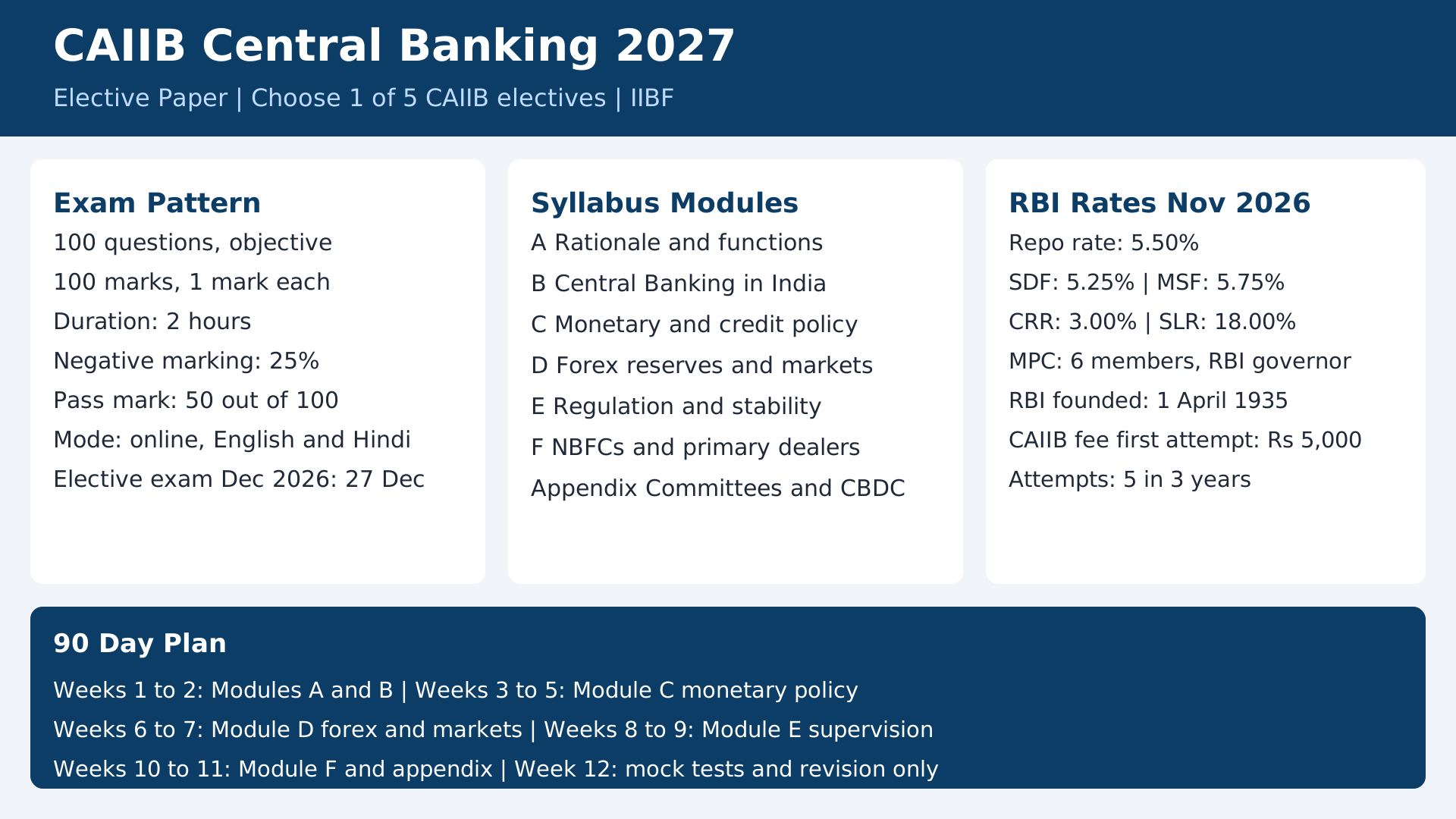
Central Banking is one of five electives in CAIIB, and you pick only one of them. The paper carries 100 questions for 100 marks, runs for 2 hours, and has negative marking of 25 percent of the marks of the question. You need 50 marks out of 100 to pass it, with one narrow exception explained below. The elective exam in the December 2026 cycle was held on 27 December 2026, after the four compulsory papers on 6, 12, 13 and 20 December 2026. No 2027 schedule had been announced by the Indian Institute of Banking and Finance as of 19 November 2026, so treat every 2027 date in this guide as unannounced until IIBF publishes it.
This paper is about the institution that sits above every bank you work in. It explains why a central bank exists, how the Reserve Bank of India is organised, how monetary policy moves interest rates, how the RBI supervises banks, and how non banking finance companies and primary dealers fit into the system. It is a concept paper with very little calculation. A candidate who reads the financial news will recognise half the syllabus already. A candidate who never reads it will need to learn the vocabulary from scratch, and this guide supplies it in plain words.
One elective out of five, and what that choice really means
CAIIB has four compulsory papers. They are Advanced Bank Management, Bank Financial Management, Advanced Business and Financial Management, and Banking Regulations and Business Laws. Every CAIIB candidate clears those four. Then the candidate picks one elective. The five choices are Rural Banking, Human Resources Management, Information Technology and Digital Banking, Risk Management, and Central Banking. You register for one elective only. You cannot carry two electives through the same CAIIB attempt, and the elective you pick does not change the compulsory papers.
Central Banking suits a candidate who likes ideas more than sums. There is almost no calculation in this paper. The work is definitions, functions, tools, Acts, committees and the logic that connects them. If you read the RBI monetary policy statement when it comes out, if you know what the repo rate did last quarter, if you can explain to a colleague why the RBI raised rates, this paper will feel natural. If numbers are your strength and you enjoy working out expected loss or duration, Risk Management will reward you more. Neither paper is easier in any absolute sense. Each is easier for the candidate whose habits fit it.
One fact about the paper often surprises candidates. It is low on numbers and high on memory, so it rewards steady revision more than cleverness. A candidate who reads the syllabus once and never revisits it will forget the difference between the Bank Rate and the Marginal Standing Facility rate, or between a primary dealer and a non banking finance company, and those small confusions cost marks. A candidate who revises short notes every week will hold them. The plan near the end of this guide is built around that single insight.
The paper in numbers
| Item | Detail |
|---|---|
| Conducting body | Indian Institute of Banking and Finance (IIBF) |
| Paper type | CAIIB elective, choose one of five |
| Questions | 100 objective questions |
| Marks | 100 marks, one mark per question |
| Duration | 2 hours |
| Negative marking | 25 percent of the marks of the question |
| Pass mark | 50 out of 100 in the paper |
| Mode | Online only |
| Medium | English and Hindi |
| Elective exam, December 2026 cycle | 27 December 2026 |
| 2027 schedule | Not announced as of 19 November 2026 |
Two details in that table deserve a closer look. First, the pass rule has a second route. IIBF trackers report that a candidate can also pass with at least 45 marks in every paper and an aggregate of at least 50 percent across all subjects, and Adda247 notes this aggregate route applies in a single attempt. The standard route is simpler to plan around. Aim for 50 in this paper on its own, and treat the aggregate route as a safety net you never plan to use. Second, the fee for CAIIB in the December 2026 cycle was Rs 5,000 for the first attempt, excluding taxes and charges, and Rs 1,300 for the second to fifth attempts. IIBF adds late fees in later registration windows, so registering early saves money as well as stress.
Eligibility is strict and simple. You must have passed JAIIB or Part I of the Associate Examination, and you must hold active IIBF membership with your subscription not in arrears. There is no age limit. JAIIB itself has four papers, Indian Economy and Indian Financial System, Principles and Practices of Banking, Accounting and Financial Management for Bankers, and Retail Banking and Wealth Management, each 100 questions for 100 marks in 2 hours with negative marking of 25 percent of the marks of the question. In the November 2026 cycle those four papers were held on 1, 22, 28 and 29 November 2026. JAIIB first attempt fee was Rs 4,000, with Rs 1,300 for later attempts.
The attempt rule is one place where old blogs mislead readers. The old rule allowed four attempts in two years. The current rule reported by IIBF trackers for both JAIIB and CAIIB is five attempts within three years from the date of first registration, whichever limit is reached first, and the five attempts need not be consecutive. If you fail to clear CAIIB within five attempts or three years, you must re-register and previous credits are forfeited. Check the current IIBF notification before you register, because IIBF has changed this rule before and can change it again.
Why this paper pays, in plain salary terms
Clearing CAIIB adds permanent increments to basic pay, and the increment is governed by the bipartite settlement between banks and unions, so the exact rupee figure varies by bank and pay scale. The widely reported framework is clear. A clerk gets one increment for JAIIB and two increments for CAIIB, a total of three. An officer gets one increment for JAIIB and one increment for CAIIB, a total of two. Guidely reports the JAIIB increment at about Rs 1,340 for a clerk and about Rs 2,000 for a Scale I officer under the 12th bipartite settlement, with a clerk basic of Rs 24,050 rising to Rs 25,390 after one increment. Treat those rupee figures as examples from one settlement, and confirm your own figure with your HR department.
An increment stays in your basic pay for the rest of your service, and it lifts dearness allowance, house rent allowance, provident fund and pension base along with it. Over a long career that compounding is worth far more than the fee and the study hours. CAIIB also carries weight in internal promotion exams, and some banks make JAIIB and CAIIB a condition for fast track promotion. The elective paper itself does not change the increment. Central Banking pays the same as any other elective. Pick it for fit, because the money is identical either way.
Module A: why a central bank exists at all
Module A starts with history. Central banks grew out of the need for a single issuer of currency, a lender of last resort, and a banker to the government. Before central banks, private banks issued their own notes, and a note was worth only as much as the bank behind it. A central bank replaced that confusion with one currency that every bank and every citizen accepts. The module traces that evolution in developed and developing countries, and the exam asks about the stages, so learn the sequence: private note issue, then a single issuer, then a full central bank with monetary policy and supervision added over time.
The functions of a central bank form the core of the module, and CareerPower lists them in the form the exam uses. A central bank is banker to the government, banker to banks, the authority for monetary policy, the issuer and manager of currency, the operator of the payment system, the keeper of the internal and external value of currency, the regulator and supervisor of the financial system, and a promoter of growth and other national objectives. It also develops financial markets and institutions, and it communicates its policies to the public. Learn that list as one set, because the exam often gives four functions and asks which one is missing, or gives a description and asks which function it belongs to.
Banker to the government means the central bank keeps the government's accounts, manages its borrowing, and advises on debt. Banker to banks means commercial banks keep accounts with the central bank, settle payments through it, and borrow from it when they run short. The lender of last resort role is the emergency version of banker to banks: when a solvent bank faces a sudden run, the central bank lends against good security so the bank survives the panic. That role is what separates a central bank from an ordinary bank, and the exam tests it directly. Currency issue means the central bank alone issues notes, except for one rupee notes and coins, which the Government of India issues and the RBI puts into circulation. That small exception is a favourite exam question, so remember it.
Contemporary issues close the module. They include the desirability of central bank autonomy and independence, credibility, accountability and transparency, and the conflict with fiscal policy. Autonomy means the central bank can set interest rates without daily instruction from the government. It is never absolute, and the tension is permanent. A government that wants growth will press for lower rates, while a central bank that fears inflation will press for higher ones. The Monetary Policy Committee, described in Module C, is India's answer to that tension: a committee of six that votes, with the RBI governor holding a casting vote.
Module B: the Reserve Bank of India, up close
Module B is about the RBI itself. The Reserve Bank of India was established on 1 April 1935 under the Reserve Bank of India Act, 1934, and it was nationalised in 1949. Its central office is in Mumbai. The governor is Sanjay Malhotra, who took over in December 2024 for a three year term, and he chairs the Monetary Policy Committee. The module covers the organisational evolution of the RBI, its constitution and governance, major organisational and functional developments over time, and recent developments. Learn the dates 1935 and 1949 as a pair, because the exam asks both, and learn that the RBI Act is 1934 while the Banking Regulation Act is 1949.
The Banking Regulation Act, 1949 gives the RBI its powers over banks, including licensing, inspection, and directions on lending. The Foreign Exchange Management Act, known as FEMA, governs foreign exchange, and the RBI administers it. The Banking Ombudsman scheme gives customers a route to complain when a bank fails to resolve a grievance, and the exam asks about its purpose and its place in customer protection. Financial sector reforms in India, starting in the early 1990s, reduced the statutory preemptions on banks, opened entry, and moved supervision toward risk based methods. The module also covers other financial regulators and the division of functions between them, so learn which regulator covers which market: the RBI covers banks and payment systems, SEBI covers securities markets, IRDAI covers insurance, and PFRDA covers pensions. Confusing those four is a common error.
Institutions set up by the RBI appear in this module too. They include NABARD, set up to refinance agriculture and rural development, and the older institutions named in the syllabus, IDBI, DFHI, IRBI and UTI, which show how the RBI built the financial system piece by piece. NABARD matters most for the exam, because it still operates and its functions appear in other CAIIB papers as well. Learn what NABARD does, refinance, development, and supervision of cooperative banks and regional rural banks, and do not confuse it with a commercial bank. The module ends with a glossary of central banking terms, and that is a hint: this paper rewards a candidate who knows the words. Build your own glossary as you study, one line per term, and revise it weekly.
Module C: monetary policy and credit policy, the heart of the paper
Module C is the heart of the paper, and it is also the part that maps most directly to the daily news. Monetary policy is the use of interest rates and liquidity tools to keep inflation low and growth steady. The RBI Act sets the inflation target at 4 percent, with a tolerance band of 2 percent to 6 percent, and the Monetary Policy Committee is the body that sets the repo rate to meet it. The committee has six members, three from the RBI and three appointed by the government, and it meets at least four times a year. Since September 2016 the repo rate has been set by the committee by vote, not by the governor alone, and the governor holds only a casting vote.
The rates in force as of November 2026 give the module a live example, and you should learn them as a set. The policy repo rate was 5.50 percent after the committee raised it by 25 basis points on 7 October 2026, in a unanimous six to nothing vote, and changed its stance from neutral to calibrated tightening. The Standing Deposit Facility rate was 5.25 percent and the Marginal Standing Facility rate and the Bank Rate were 5.75 percent. The cash reserve ratio was 3.00 percent and the statutory liquidity ratio was 18.00 percent. The next committee meeting was scheduled for 2 to 4 December 2026. Those rates will change, and the exam will use the rates in force at the time of your cycle, so always check the current figures on the RBI site before the exam. The definitions do not change, and they are what the exam really tests.
Learn each tool by what it does. The repo rate is the rate at which the RBI lends short term funds to banks against government securities. The reverse repo rate is the rate at which the RBI borrows from banks, though the Standing Deposit Facility has largely replaced it as the floor of the corridor. The Standing Deposit Facility lets banks park surplus funds with the RBI without collateral. The Marginal Standing Facility lets banks borrow overnight against securities in an emergency, above the repo rate. The Bank Rate is the long term rate at which the RBI lends, and it now sits with the Marginal Standing Facility rate. Open market operations are the RBI buying or selling government securities to add or absorb liquidity. The cash reserve ratio is the share of deposits banks must keep with the RBI, and the statutory liquidity ratio is the share they must keep in liquid assets such as government securities. Raising the repo rate makes borrowing dearer and slows demand, which cools inflation. Cutting it does the reverse.
The transmission mechanism is how a rate change reaches the real economy, and the module asks about its channels and its lags. A repo rate cut lowers banks' funding cost, which should lower lending rates, which should raise borrowing and spending, which should raise growth, and with a lag, prices. The chain breaks at several points. Banks may not pass the cut on, borrowers may not want to borrow, and the effect arrives months after the decision. That lag is why the committee looks ahead and acts on forecasts, not only on today's inflation. The Taylor rule, named in the syllabus, is a formula that links the policy rate to inflation and output, and the exam asks about its idea rather than its arithmetic: raise rates when inflation runs above target or output runs above trend, cut them when the reverse holds.
Credit policy is the RBI's direction of credit toward priority needs, and fiscal policy is the government's side of the same problem. The syllabus asks for an overview of fiscal policy, including the Union Budget, state budgets, finances of the Union and state governments, and the Finance Commission, and it asks how monetary and fiscal policy strike a balance between inflation and growth. The tension is simple to state and hard to resolve. A government that spends heavily and borrows heavily pushes up demand and interest rates, which fights the central bank's effort to cool inflation. Coordination is the answer the syllabus wants, and the exam asks about it in the form of the conflict between the two policies.
Module D: foreign exchange reserves and the Indian financial market
The newer six module version of the syllabus gives foreign exchange reserves and the Indian financial market their own module, and this guide follows that structure. The RBI manages India's foreign exchange reserves, which it holds in foreign currency assets, gold, special drawing rights and the reserve tranche position with the International Monetary Fund. The reserves serve three purposes: they let the RBI steady the rupee when markets turn volatile, they give the country a buffer to pay for imports and service external debt, and they signal confidence to foreign investors. The RBI intervenes in the foreign exchange market by buying dollars when the rupee strengthens too fast and selling dollars when it weakens too fast, and it sterilises the intervention when it wants to keep domestic liquidity unchanged. Learn the direction of each move, because the exam asks it: selling dollars supports the rupee, buying dollars weakens it.
The Indian financial market has four parts that the exam asks about as a set: the money market, the capital market, the foreign exchange market and the government securities market. The money market deals in short term funds, with instruments such as call money, treasury bills, commercial paper and certificates of deposit. The capital market deals in long term funds, with shares and bonds. The government securities market is where the government borrows, and the RBI manages it as the government's debt manager. The foreign exchange market is where rupees are exchanged for other currencies, and the RBI regulates it under FEMA. Each market has its own participants, its own instruments and its own regulator, and the exam likes questions that mix them up to test whether you know which instrument belongs where. Treasury bills belong to the money market. A ten year government bond belongs to the government securities market. Commercial paper is a money market instrument issued by companies, not by the government.
Module E: regulation, supervision and financial stability
Module E explains how the RBI watches banks and keeps the system stable. Bank regulation is the setting of rules, and supervision is the checking that banks follow them. The RBI's supervision has moved over time from compliance based inspection, which checked whether a bank followed each rule, to risk based supervision, which focuses inspection effort where the risk is highest. The exam asks about that shift, and about the tools that support it: off site surveillance through returns, on site inspection, and the supervisory review that sits inside the Basel framework as Pillar 2.
Financial stability is the condition in which the financial system can absorb shocks and keep serving the economy. The module contrasts financial development with financial stability, because a system can grow fast and still be fragile. Risks to stability include credit booms, asset price bubbles, heavy borrowing, maturity mismatches, and contagion from one bank to another. Early warning signals include rapid credit growth, rising non performing assets, falling capital ratios, and funding stress in the money market. Remedial action runs from moral suasion, through directions and restrictions, to prompt corrective action, where the RBI restricts a weak bank's lending, dividend and expansion until its capital, asset quality and profitability recover.
Basel norms and prudential norms sit in this module, and they connect directly to the Risk Management elective. The global Basel III minimum total capital is 8 percent of risk weighted assets. The RBI requires 9 percent. The capital conservation buffer adds 2.5 percent, so the effective minimum total CRAR, the capital to risk weighted assets ratio, is 11.5 percent. Common Equity Tier 1 must be at least 5.5 percent in India against a global 4.5 percent, and 8 percent once the buffer is added. Tier 1 capital must be at least 7 percent in India against a global 6 percent. CRAR equals Tier 1 capital plus Tier 2 capital, divided by risk weighted assets, multiplied by 100. The Basel framework has three pillars: minimum capital requirements, supervisory review including the bank's own Internal Capital Adequacy Assessment Process, and market discipline through disclosure. Liberalisation and globalisation increased the links between the Indian system and the rest of the world, so the module also covers linkage to international financial stability, international standards and codes, and the role of the supervisor under Basel norms. The revised Basel III framework applies in India from 1 April 2027 for credit and operational risk rules, with the RBI having issued final directions in April 2026.
Liquidity management is part of stability too. A bank that cannot meet withdrawals today fails, even if its loans are sound. The RBI's liquidity tools, the liquidity adjustment facility, the marginal standing facility, open market operations and the cash reserve ratio, are the day to day instruments of stability. The liquidity coverage ratio and the net stable funding ratio, both Basel III additions, force banks to hold enough high quality liquid assets and stable funding to survive a stress period. Learn what each ratio measures in one line: the liquidity coverage ratio covers 30 days of stress, and the net stable funding ratio covers one year. That single distinction answers several exam questions.
Module F: non banking finance companies and primary dealers
Module F covers two kinds of institution that sit beside banks. A non banking finance company, or NBFC, lends and invests like a bank but cannot accept demand deposits, cannot issue cheques drawn on itself, and is not part of the payment and settlement system. That three part exclusion is the definition the exam uses, so learn it exactly. The RBI regulates NBFCs under a scale based framework, with layers called base, middle, upper and top, and the regulatory intensity rises with size and risk. The compliance function and the chief compliance officer have a formal role in upper and middle layer NBFCs, and the exam asks about that framework. NBFCs matter because they reach borrowers that banks serve poorly, especially in vehicle finance, gold loans, microfinance and housing, and their failure can spread to banks that fund them.
Primary dealers are the other institution in the module. A primary dealer buys government securities directly from the RBI in auctions, underwrites new issues, and makes a market in them by quoting buying and selling prices. They are the link between the RBI as debt manager and the market as buyer, and they keep the government securities market liquid. Learn the difference between the two institutions cleanly: an NBFC lends to the public, a primary dealer deals in government securities. The exam asks that distinction, and it also asks about the registration and obligations of primary dealers, including their underwriting commitments in auctions.
The appendix to the newer syllabus covers committees, international institutions, cryptocurrencies, central bank digital currency, and sustainable finance. The committees are the expert groups whose reports shaped Indian banking, and the exam asks about their recommendations in outline, not in detail. International institutions include the Bank for International Settlements, the International Monetary Fund and the World Bank, and the exam asks what each does: the BIS hosts the Basel Committee, the IMF lends to countries in balance of payments trouble, and the World Bank lends for development. Central bank digital currency is the RBI's digital rupee, a liability of the central bank in digital form, and the exam asks how it differs from a cryptocurrency, which is privately issued and not a liability of any central bank. Sustainable finance is the channelling of funds toward green and climate friendly activity, and it links back to the climate risk topics in the Risk Management elective.
One caution about the syllabus itself. Sources disagree on how many modules this paper has. The older IIBF syllabus lists four modules, A to D, with supervision and financial stability as Module D. The current 2026 courseware described by Oliveboard lists six modules, A to F, plus an appendix, with foreign exchange reserves and the financial market as Module D, regulation and supervision as Module E, and NBFCs and primary dealers as Module F. This guide follows the six module structure, because it matches the current courseware and the detailed topic lists, but the four module version still circulates in older trackers. Before your exam, confirm the module list in the IIBF courseware for your cycle. The topics are the same either way, and only the module letters move.
Who should pick Central Banking, and who should not
Pick Central Banking if you read the news, if you can follow a monetary policy statement, or if you work in a role where the repo rate and the RBI's directions shape your day. Treasury staff, credit officers who price loans off the repo rate, and branch managers who explain rate changes to customers all fit this paper. Pick it if you prefer memory and logic to calculation, because the paper asks for almost no sums, and its marks come from knowing definitions, functions, tools and Acts cold.
Do not pick it only because it looks light. A light paper with 100 questions across six modules is still 100 questions, and the breadth is the difficulty. A candidate who knows monetary policy well and knows nothing about NBFCs will drop marks in Module F. Do not pick it if you dislike memorising lists of functions, Acts and institutions, because the paper is full of them. And do not pick it late. Changing electives after registration is a scramble, so decide before you register, and decide on fit.
Compare the electives on three questions only. Which one matches your daily work. Which one matches the books you already own or can borrow. Which one can you finish in the time you actually have, not the time you wish you had. Answer those three plainly and the choice makes itself.
A 90 day plan that fits around a bank job
| Weeks | Focus | Daily time |
|---|---|---|
| 1 to 2 | Module A and Module B, plus a glossary notebook and one mock test | 2 hours |
| 3 to 5 | Module C monetary and credit policy, with the current rates learned as a set | 2 to 3 hours |
| 6 to 7 | Module D forex reserves and financial market | 2 hours |
| 8 to 9 | Module E regulation, supervision and financial stability, with Basel ratios | 2 hours |
| 10 to 11 | Module F NBFCs and primary dealers, plus the appendix | 2 hours |
| 12 | Full mock tests, revision of notes, and no new topics | 2 hours |
| Last 3 days | Rates, ratios, Acts, dates, and one light mock test | 1 hour |
The plan assumes two hours a day, which is realistic for a working banker, and it gives Module C the longest stretch because it is the heart of the paper and the part most linked to current affairs. Read the RBI monetary policy statement on the day it comes out, and add its numbers to your notes the same evening. That habit turns the news into revision. Keep a single glossary notebook, one line per term, and rewrite it from memory once a week. That rewrite is the revision. Reading the same page five times only builds recognition, and recognition fails in the exam hall when the options look alike.
Mock tests deserve a fixed slot, not leftover time. Take one full 100 question mock test every Sunday from week 3 onward, in 2 hours, without pausing, and review every wrong answer the same evening. Track your score by module, not just in total, because a total of 52 that hides a Module C score of 12 out of 30 is a warning. The last three days are for rates, ratios, Acts and dates only. New topics in the last three days cost more marks than they gain, because they displace revision of material you already know.
Mistakes that cost marks
The first mistake is learning the tools without learning the direction. Knowing the repo rate exists is useless if you cannot say what happens when it rises. Every tool has a direction, and the exam asks it: a repo hike cools demand, a CRR hike absorbs liquidity, an OMO sale absorbs liquidity, a dollar sale by the RBI supports the rupee. Write each tool with its direction in your notebook, and test yourself on the direction, not the definition. The second mistake is confusing the rates. Repo, reverse repo, Standing Deposit Facility, Marginal Standing Facility, Bank Rate, cash reserve ratio and statutory liquidity ratio are seven different things, and the exam sets them side by side. Learn each one as a sentence that starts with what it is and ends with its current rate.
The third mistake is confusing the regulators. The RBI, SEBI, IRDAI and PFRDA each cover a different market, and the exam asks which regulator covers a given institution or product. Write the four regulators with their markets in one table and revise it weekly. The fourth mistake is skipping Module F and the appendix because they look small. Small modules carry questions too, and their questions are often the easiest in the paper, because the topics are narrow and the answers are definitions. The fifth mistake is studying old rates. The repo rate in November 2026 was 5.50 percent, and it will change. Learn the current rates from the RBI site in the week before your exam, and never quote a rate from a blog that is a year old.
The sixth mistake is poor time use in the hall. One hundred questions in 120 minutes gives 72 seconds per question, and a candidate who spends five minutes on one hard question loses four easy marks elsewhere. Mark the hard question, move on, and return only after the rest of the paper is done. With negative marking of 25 percent, attempt the questions you can narrow to two options, and use the last ten minutes for the ones you marked. The seventh mistake is studying from a single old source. The syllabus has changed, the attempt rule has changed, and the revised Basel III rules apply from 1 April 2027. Check the current IIBF notification and courseware for your cycle, and treat any blog that cites the four attempts in two years rule as out of date.
Bankers who clear CAIIB often prepare for other banking exams alongside it. The SBI Clerk 2027, IBPS Clerk 2027, IBPS RRB PO 2027, RBI Assistant 2027, LIC AAO 2027, NIACL AO 2027, RBI Grade B DEPR 2027, UGC NET Commerce 2027, UPPSC RO ARO 2027 and AFCAT 2027 pages on this site carry the same style of mock test guide, and the pattern habit you build here transfers directly to them.
Sources
IIBF official site, iibf.org.in, for the conducting body, the CAIIB structure, and the 2027 schedule status. Oliveboard CAIIB Central Banking syllabus pages, for the five and six module structures, the concept heavy nature of the paper, and the December 2026 cycle. Oliveboard CAIIB December 2026 exam date and notification pages, for the paper dates of 6, 12, 13, 20 and 27 December 2026, the fee of Rs 5,000 for the first attempt and Rs 1,300 for later attempts, the five attempts in three years rule, and the 50 mark pass rule with the 45 mark aggregate route. MyOnlinePrep CAIIB notification page, for eligibility, the elective date of 27 December 2026, and the same fee and attempt rules. CareerPower CAIIB syllabus page, for the older four module structure, the functions of a central bank, the online mode, and the bilingual medium. Guidely JAIIB salary increment page, for the clerk and officer increment figures under the 12th bipartite settlement. RBI policy coverage as reported in November 2026, for the repo rate of 5.50 percent after the 7 October 2026 hike, the Standing Deposit Facility rate of 5.25 percent, the Marginal Standing Facility and Bank Rate of 5.75 percent, the cash reserve ratio of 3.00 percent, the statutory liquidity ratio of 18.00 percent, and the next committee meeting on 2 to 4 December 2026. LotusArise capital adequacy page and the Indian Bank Basel III disclosure, for the Indian CRAR of 9 percent, CET1 of 5.5 percent, and the effective 11.5 percent with the buffer. Pareto Academy Basel III page, for the revised Basel III rules applying from 1 April 2027.