About CAIIB BRBL 2027 Exam Series
📖 Table of Contents
- The paper in one page
- Why BRBL feels different from the other CAIIB papers
- Module A: regulations and compliance
- The regulator and the regulated
- Compliance is a job, not a department name
- NPA management and Basel norms
- Module B: the big Acts, part A
- Banking Regulation Act, 1949
- Reserve Bank of India Act, 1934
- Negotiable Instruments Act, 1881
- Prevention of Money Laundering Act, 2002
- Module C: the big Acts, part B
- The ombudsman and the unhappy customer
- SARFAESI and the DRT route
- IBC and FEMA in short
- Module D: commercial laws that show up at the branch
- Contract law is the base of all lending
- Companies, partnerships and LLPs
- Property, goods, trusts and the digital layer
- SARFAESI, DRT and IBC: three tools, three jobs
- The CAIIB BRBL 2027 90 day plan
- Mistakes that cost marks in BRBL
- Before you register, check these things on the IIBF site
- Where CAIIB fits in a banking career
- Sources
CAIIB Banking Regulations and Business Laws 2027: BRBL Paper Guide
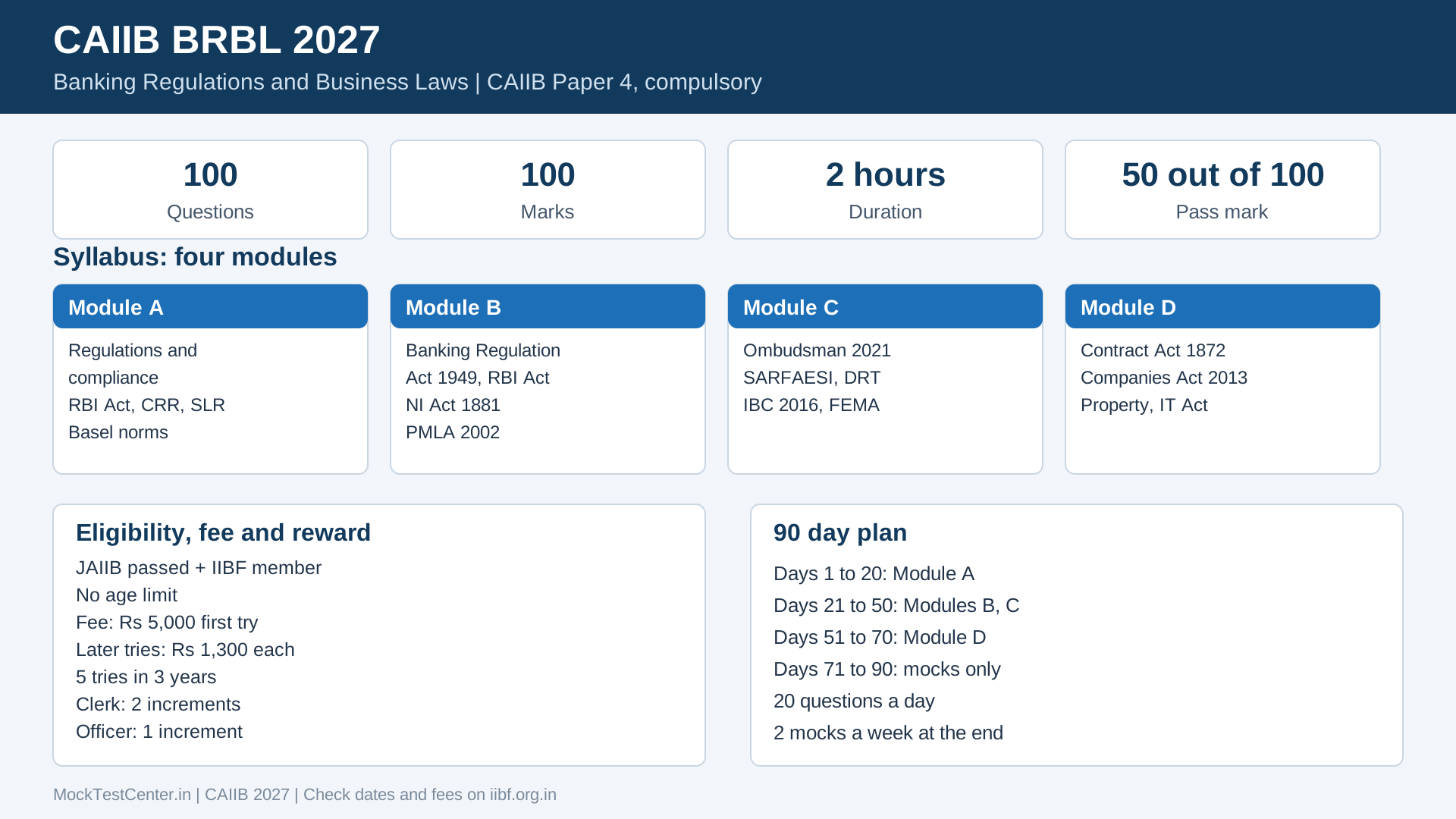
Banking Regulations and Business Laws, known as BRBL, is paper 4 of CAIIB and it is compulsory for every candidate. The Indian Institute of Banking and Finance, IIBF, runs the exam twice a year and the December 2026 paper was held on 20 December 2026. The CAIIB BRBL 2027 cycle has no announced dates yet as of 19 November 2026, so this guide uses the latest real cycle and the current syllabus. That is the honest starting point for any plan.
BRBL carries 100 objective questions for 100 marks and the paper runs for 2 hours. There is negative marking of 25 percent of the marks allotted to the question, so a wrong answer costs a quarter mark and a blank answer scores nothing. You pass with 50 marks out of 100 in the paper.
IIBF also allows a second route to pass, which is 45 marks in each paper with an aggregate of 50 percent across all papers in a single attempt. The second route only helps if you clear every paper in that one sitting, so plan for 50 in BRBL and treat the aggregate route as a safety net.
This guide walks through the full syllabus module by module, then through the Acts that carry the most marks, then through a 90 day plan that fits around a full time bank job. Every date and fee in this guide comes from the IIBF notification as reported by trackers, and the sources sit at the end of the page. Check the IIBF official website before you pay any fee, because IIBF can change a date or a fee between cycles.
The paper in one page
| Item | Detail |
|---|---|
| Paper | Banking Regulations and Business Laws, BRBL, CAIIB paper 4, compulsory |
| Questions | 100 objective questions |
| Marks | 100 marks, 1 mark per question |
| Duration | 2 hours |
| Negative marking | 25 percent of the marks of the question |
| Pass mark | 50 out of 100, or 45 in each paper with 50 percent aggregate in one attempt |
| Mode | Online, objective type, including case based questions |
| Medium | English and Hindi |
| Last paper date | 20 December 2026 |
| Next cycle | 2027 dates not announced as of 19 November 2026 |
BRBL is the only CAIIB paper that tests law in depth. The other compulsory papers test management and finance, with accounting in the mix. That difference shapes how you study. In finance papers you practise sums.
In BRBL you learn what a section says, when it applies, and what happens when a bank ignores it. Memory matters here, but memory without meaning fails fast. A question rarely asks you to recite a section number on its own. It gives you a branch situation and asks which law applies.
The syllabus has four modules: A, B, C, D. Module A covers regulation and compliance. Module B covers the big banking Acts in part A. Module C covers the big banking Acts in part B.
Module D covers commercial laws with reference to banking operations. The paper has about 34 chapters across these four modules, which makes it the largest CAIIB paper by reading load. That size scares candidates, yet the questions stay close to the courseware. Read the IIBF course book first and use other books only to clear doubts.
Why BRBL feels different from the other CAIIB papers
Most bankers meet law only when something goes wrong at the branch. A cheque bounces, a borrower stops paying, a customer files a complaint, or an auditor flags a gap in KYC. BRBL takes those branch moments and turns them into exam questions.
That is why the paper rewards working bankers who pay attention at work. You have already seen half the syllabus in real life, even if you never learned the section numbers.
The paper also punishes a common habit. Many candidates read the Acts like story books, from the first section to the last, and remember nothing on exam day. Law sticks when you tie each rule to a job you do.
Section 13 of SARFAESI sticks when you picture a secured loan that turned into an NPA. The Negotiable Instruments Act sticks when you picture a cheque that came back unpaid. Study each topic with one branch example in mind and the section numbers will follow.
Another difference is the cut off date for current developments. IIBF exams from September to February generally cover regulatory and banking developments up to 30 June of that year. For the December 2026 paper, that meant developments up to 30 June 2026.
The same rule will apply in spirit to the 2027 cycles, with the exact cut off set by IIBF for each cycle. Keep a short note of RBI circulars and new rules from the months before your exam, and revise that note in the last week.
Case based questions deserve a special mention. BRBL uses caselets, which are short case studies with a set of questions. A caselet may describe a loan account, a guarantee, or a disputed cheque, and then ask four or five questions on it.
One caselet can swing five marks. Practise caselets under time pressure, because they eat minutes fast. Read the case once, note the facts that matter, and answer the questions in order without going back to reread the whole case.
Module A: regulations and compliance
Module A explains who regulates banks in India and how that regulation works in practice. It starts with the legal framework for regulation, then moves to control over the organisation of banks, then to the regulation of banking business, and then to compliance. This module gives you the frame for the whole paper. If you understand Module A, the Acts in Modules B and C make more sense, because you already know why each Act exists.
The regulator and the regulated
The Reserve Bank of India regulates banks under the Reserve Bank of India Act, 1934 and the Banking Regulation Act, 1949. The government also plays a role as a regulator, and other authorities regulate parts of the system, such as cooperative banks and non banking financial companies. The syllabus asks you to know the legal framework, not just the names. Know what the RBI can do, what it cannot do, and where the government steps in.
Control over the organisation of banks covers licensing, the constitution of banks, minimum capital, control over management. A banking company needs a licence from the RBI to do banking business. The RBI can cancel a licence when a bank breaks the conditions.
The Act also sets rules on shareholding and on who can sit on the board. These rules exist because a bank holds public money, and public money needs stronger checks than an ordinary company.
Regulation of banking business covers the business of banking companies, cash reserves, branch licensing, mergers and amalgamations, restrictions on loans and advances. Cash reserve ratio and statutory liquidity ratio sit in this part of the syllabus. Learn what each ratio is, who sets it, and what happens to a bank that falls short. Questions on CRR and SLR appear in almost every cycle, and they are easy marks if you learn the definitions cleanly.
Compliance is a job, not a department name
The second half of Module A deals with the compliance function in banks. It covers the need for compliance, its scope and structure, and the role of the Chief Compliance Officer. It also covers compliance with laws and regulations, risk management, fraud risk management, corporate governance and the whistleblower policy.
Compliance sounds dull until you see what it prevents. A bank that misses a KYC rule or a fraud signal pays for it in penalties and in reputation.
The Chief Compliance Officer, or CCO, is a key figure in this module. Learn the role in plain terms. The CCO watches whether the bank follows the law and the RBI directions, reports gaps to the top management and the board, and keeps the compliance culture alive across branches.
Exam questions often test the difference between the compliance function and the audit function. Audit checks after the event. Compliance works before and during the event to stop the breach.
Corporate governance and the whistleblower policy also appear here. Governance means the board and the senior management take charge of how the bank is run, with clear roles and clear accountability. A whistleblower policy gives staff a safe way to report wrongdoing inside the bank.
Both topics connect to fraud risk management, because most bank frauds grow in places where governance is weak and staff stay silent. Learn these links, because the exam tests links more than isolated facts.
NPA management and Basel norms
Module A also covers NPA management and the Basel norms. An NPA is a loan account where interest or principal stays overdue beyond the period RBI prescribes, which is 90 days for most term loans. The syllabus expects you to know the asset classification norms and the provisioning that follows.
A standard asset needs little provision. A substandard, doubtful or loss asset needs more. These numbers change with RBI directions, so revise them from the latest courseware rather than from old notes.
Basel norms set the global rules for bank capital. Basel I came in 1988 and focused on credit risk. Basel II added market risk and operational risk with three pillars: minimum capital, supervisory review, market discipline.
Basel III raised the quality of capital, added buffers, set a minimum ratio of capital to total exposure, and brought in liquidity standards such as the liquidity coverage ratio and the net stable funding ratio. You do not need the full history in detail. You need the pillars, the buffers, the ratios, and the reason each one exists.
Module B: the big Acts, part A
Module B takes up the Acts that shape daily banking. It covers the Banking Regulation Act, 1949; the Reserve Bank of India Act, 1934; the Negotiable Instruments Act, 1881; the Bankers Books Evidence Act, 1891; and the Prevention of Money Laundering Act, 2002. This module carries heavy marks, and it is the module where section numbers matter most. Learn the Act and the year, plus the one line that says what the Act does.
Banking Regulation Act, 1949
The Banking Regulation Act, 1949 is the main law for banking companies in India. It defines banking, sets the rules for licensing, controls branch expansion, and gives the RBI powers of inspection and control over management. Section 35A gives the RBI power to issue directions to banking companies in the public interest or in the interest of banking policy. That single section sits behind a large share of RBI directions, including the recovery agent rules that banks must follow.
Learn the Act in clusters rather than section by section. One cluster is licensing and business, which covers what a bank may do and what it may not do. Another cluster is management control, which covers the board, the chief executive and the RBI power to remove managerial persons.
A third cluster is inspection and winding up, which covers what happens when a bank fails. Questions often ask which section gives a particular power, so keep a short list of the most tested sections and revise it weekly.
Reserve Bank of India Act, 1934
The Reserve Bank of India Act, 1934 created the RBI and set out its functions. The RBI issues currency, acts as banker to the government, acts as banker to banks, manages foreign exchange reserves, and runs monetary policy. The Act also gives the RBI power to regulate the banking system and to inspect banks. Monetary policy works through tools such as the repo rate, the reverse repo rate, the cash reserve ratio and the statutory liquidity ratio.
Candidates often mix up the two Acts. A simple way to keep them apart is to ask who the Act is about. The RBI Act is about the central bank itself, its constitution and its powers.
The Banking Regulation Act is about the banking companies that the RBI regulates. When a question asks about licensing a new bank, the answer sits in the Banking Regulation Act. When a question asks about issuing currency, the answer sits in the RBI Act.
Negotiable Instruments Act, 1881
The Negotiable Instruments Act, 1881 governs cheques, bills of exchange and promissory notes. It defines the parties to each instrument and the rules of endorsement. It also covers the rights of a holder and a holder in due course, crossing of cheques, dishonour and noting, and the penalties for bouncing of cheques. Section 138 deals with dishonour of a cheque for insufficiency of funds, and it is one of the most tested sections in the whole paper.
Holder in due course is a phrase you must learn exactly. A holder in due course takes the instrument for value, in good faith, and before it becomes overdue, without notice of any defect in the title of the person who transferred it. Such a holder gets a better title than the transferor had. That rule is what makes cheques and bills work as payment tools, because a person who accepts them in good faith does not have to check the full history of every earlier holder.
Crossing of cheques is another favourite of the exam. A general crossing, two parallel lines across the face of the cheque, means the cheque must go through a banker. A special crossing names a particular banker.
An account payee crossing tells the collecting banker to credit the payee account only. Learn what each crossing does and what duty it puts on the paying banker and the collecting banker. A banker who pays against the crossing can lose the protection the Act gives.
Prevention of Money Laundering Act, 2002
The Prevention of Money Laundering Act, 2002, known as PMLA, deals with the offence of money laundering and the duties of banks and financial institutions. Banks must keep records, report suspicious transactions, and follow the KYC and anti money laundering norms that the RBI issues. The Act defines money laundering as the process of making illegally earned money look legal, and it sets punishments for the offence.
KYC sits at the heart of this topic. Know your customer means the bank must identify the customer, verify the identity, and understand the nature of the business before opening an account or starting a relationship. Enhanced due diligence applies to high risk customers.
The exam tests the obligations of banking companies under PMLA, the records to be maintained, and the information that must go into those records. Learn the duties as a list of actions, not as a paragraph, so you can recall them under pressure.
Module C: the big Acts, part B
Module C continues the legal aspects of banking operations. It covers the Reserve Bank Integrated Ombudsman Scheme, 2021; the Micro, Small and Medium Enterprises Development Act, 2006; securitisation and the SARFAESI Act, 2002; the Recovery of Debts and Bankruptcy Act, 1993; the Insolvency and Bankruptcy Code, 2016; and the Foreign Exchange Management Act, 1999. This module is about what happens when things go wrong, and how the system fixes them.
The ombudsman and the unhappy customer
The Reserve Bank Integrated Ombudsman Scheme, 2021 brought the earlier separate ombudsman schemes for banks, non banking financial companies and digital transactions under one scheme. A customer who has a complaint against a bank can first complain to the bank, and if the bank does not resolve it in 30 days, the customer can approach the ombudsman. The scheme covers deficiency in service, and the ombudsman can award compensation within the limits the scheme sets.
Exam questions on the ombudsman usually test the process, not the philosophy. Learn the sequence, which is complaint to the bank first, then to the ombudsman, then the award and the appeal route. Learn the grounds on which a complaint can be rejected, such as a complaint that is already before a court or another authority. The ombudsman is a strong topic for caselets, because a caselet can describe a customer grievance and ask which forum should hear it.
SARFAESI and the DRT route
The Securitisation and Reconstruction of Financial Assets and Enforcement of Security Interest Act, 2002, known as SARFAESI, lets a secured creditor enforce its security without going to court. The process starts with a 60 day demand notice under section 13(2) once the account is classified as an NPA. If the borrower does not pay within 60 days, the bank can take possession of the secured asset and sell it under section 13(4). The borrower can appeal to the Debt Recovery Tribunal under section 17.
SARFAESI has clear limits. It does not apply to agricultural land, and it does not apply where the amount due is below the threshold the Act sets. The bank must follow the procedure in order, and a slip in the notice or the sale process can undo the whole enforcement.
The Recovery of Debts and Bankruptcy Act, 1993 set up Debt Recovery Tribunals for bank debts of Rs 20 lakh and above, with appeal to the Debt Recovery Appellate Tribunal. DRT is a money decree route, while SARFAESI is a security enforcement route, and the exam loves to test that difference.
IBC and FEMA in short
The Insolvency and Bankruptcy Code, 2016, known as IBC, gives a time bound process for resolving insolvency before the National Company Law Tribunal. A financial creditor can trigger the Corporate Insolvency Resolution Process on default, a resolution professional takes over the management, and the committee of creditors votes on a resolution plan. The original timeline was 180 days, extendable to 330 days including litigation time.
If no plan is approved, the company goes into liquidation. IBC works at the level of the whole borrower, while SARFAESI works at the level of one secured asset.
The Foreign Exchange Management Act, 1999, known as FEMA, replaced the earlier Foreign Exchange Regulation Act and governs foreign exchange transactions. It separates current account transactions from capital account transactions and sets the rules for remittances, external commercial borrowings and foreign investment. BRBL tests FEMA at a basic level, so learn the definitions, the two kinds of transactions, and the role of the RBI and the authorised dealers. Do not go deep into FEMA case law, because the paper does not ask for it.
Module D: commercial laws that show up at the branch
Module D covers the commercial laws that a banker meets when lending to businesses and individuals. It includes the Indian Contract Act, 1872; the Indian Partnership Act, 1932; the Limited Liability Partnership Act, 2008; the Companies Act, 2013; the Transfer of Property Act, 1882; the Sale of Goods Act, 1930; the Indian Trusts Act, 1882; the Information Technology Act, 2000; and the Consumer Protection Act, 2019. This module is wide, so study it by the lending decision each law affects.
Contract law is the base of all lending
Every loan is a contract, so the Indian Contract Act, 1872 sits under everything in this module. A valid contract needs an offer and an acceptance, consideration, capacity to contract, free consent, and a lawful object. A contract made by a minor is void.
A contract made under coercion or undue influence can be set aside. Learn the essentials as a checklist, and then learn the special contracts that banks use: indemnity, guarantee, bailment, pledge, agency.
Guarantee matters most for bankers. In a contract of guarantee, the surety promises to pay if the principal debtor fails to pay. The liability of the surety is co extensive with the liability of the principal debtor unless the contract says otherwise.
That one line answers many exam questions. A continuing guarantee covers a series of transactions until it is revoked. Learn the rights of the surety, including the right to be discharged when the creditor changes the terms without the surety consent.
Companies, partnerships and LLPs
The Companies Act, 2013 governs how companies are formed, run and wound up. For bankers, the key parts are the types of companies, incorporation, the memorandum and articles of association, share capital, directors, meetings, dividends, audit, winding up. When a bank lends to a company, it must check the borrowing powers in the memorandum, the board resolution that authorises the borrowing, and the charges that the company has created on its assets. A charge that is not registered can lose priority, and that is a question the exam asks in different forms.
The Indian Partnership Act, 1932 and the Limited Liability Partnership Act, 2008 cover the other common forms of business. A partnership firm is not a separate legal person from its partners, and partners carry unlimited liability. An LLP is a separate legal person, and the liability of a partner is limited to the agreed contribution, except in cases of fraud.
When a bank lends to a partnership firm, it must know who can bind the firm and what happens when a partner retires or dies. Learn the differences in a small table of your own, because the exam tests them side by side.
Property, goods, trusts and the digital layer
The Transfer of Property Act, 1882 covers mortgage, charge, sale, lease, gift, actionable claims. Mortgage is the topic that matters most to bankers, because most secured loans rest on a mortgage. Learn the types of mortgage: simple, usufructuary, English, mortgage by conditional sale, mortgage by deposit of title deeds, anomalous mortgage. Mortgage by deposit of title deeds, also called equitable mortgage, is the most common in branch lending, and the exam tests its essentials again and again.
The Sale of Goods Act, 1930 covers the formation of a sale contract, conditions and warranties, transfer of ownership, and the rights of an unpaid seller. The Indian Trusts Act, 1882 covers the duties and liabilities of trustees. The Information Technology Act, 2000 gives legal recognition to electronic records and digital signatures and defines cyber offences.
The Consumer Protection Act, 2019 gives customers rights and a forum for grievances, and it applies to banking services as well. These topics are smaller in marks, but they are easy marks because the questions stay close to definitions.
SARFAESI, DRT and IBC: three tools, three jobs
Candidates mix up the three recovery routes, so learn them as three tools with three different jobs. SARFAESI enforces a security interest without court help. DRT gives a tribunal decree for a debt of Rs 20 lakh or more. IBC resolves the insolvency of the whole borrower before the NCLT.
A secured loan with a clear asset points to SARFAESI. A large debt with no clear security points to DRT. A company that owes many lenders and cannot pay any of them points to IBC.
The sequence matters in each route. Under SARFAESI, the account must first be an NPA, then the bank serves the 60 day notice under section 13(2), then the borrower may make a representation under section 13(3A), and only then can the bank act under section 13(4). Under IBC, the default triggers the application, the NCLT admits it, the moratorium starts, the resolution professional takes charge, and the committee of creditors votes.
Under DRT, the bank files an application, the tribunal hears it, and the recovery officer executes the certificate. Learn each sequence as a short chain of steps.
One more distinction helps in caselets. SARFAESI and DRT both end with recovery of money, but IBC can end with the company surviving under a new plan. That is why IBC is called a resolution process rather than a recovery process.
A question that asks about saving the business points to IBC. A question that asks about selling a mortgaged house points to SARFAESI. Keep that test in mind and the caselets get easier.
The CAIIB BRBL 2027 90 day plan
Ninety days is enough for the CAIIB BRBL 2027 paper if you study every day and keep the plan simple. The plan below assumes one hour on working days and three hours on holidays, which adds up to about 90 hours. If you have more time, add mock tests rather than more reading.
Reading the same chapter twice rarely adds marks. Answering questions on it does.
Days 1 to 20 cover Module A and the two big Acts in Module B. Read the courseware, make a one page note per chapter, and write the section numbers on that page. Do 20 questions per day from a question bank, and mark every wrong answer with the reason you got it wrong. Most wrong answers in this phase come from reading too fast, not from missing knowledge, and the note will show that.
Days 21 to 50 cover Modules B and C in full, with Module D started in parallel. This is the heaviest phase, so split it by Act rather than by chapter. Give three days to the Banking Regulation Act, three days to the RBI Act, four days to the Negotiable Instruments Act, three days to PMLA, and the rest to SARFAESI, DRT, IBC, the ombudsman scheme. End each Act with 30 questions on that Act alone before moving on.
Days 51 to 70 cover Module D and the first full revision. Contract law and company law need the most time here, because they carry the most questions in the module. Property law and the Sale of Goods Act need less time, because the questions stay close to definitions. Start one full mock test per week in this phase, and use the result to decide what to revise, not to judge yourself.
Days 71 to 90 are for revision and mock tests only. No new book, no new chapter. Revise the one page notes, redo the questions you got wrong, and take two mock tests per week under exam conditions, which means 100 questions in 2 hours with no break.
In the last week, revise the section numbers, the ratios, the time limits and the thresholds, because those are the facts that fade first. Sleep well the night before the exam. A tired mind confuses section numbers that a fresh mind gets right.
Mistakes that cost marks in BRBL
The first mistake is reading only summaries and skipping the IIBF courseware. Summaries help for revision, but the exam follows the courseware. A summary that drops one line from a section can cost you the exact question that line answers. Read the course book once in full, then use summaries for the second pass.
The second mistake is learning section numbers without learning what the section does. A question that asks for a section number is rare. A question that describes a situation and asks which section applies is common. Learn each important section with a one line job description, and test yourself by reading the description and recalling the number.
The third mistake is ignoring the caselets. Candidates who score well on single questions often lose marks on caselets because they run out of time. Practise caselets from the start, not in the last week.
Read the case once, answer the questions, and check how long it took. If a caselet takes more than 10 minutes, you need a faster method, which is to read the questions first and then hunt for the facts in the case.
The fourth mistake is treating BRBL as a theory paper with no link to the branch. The paper rewards the banker who connects the law to the work. When you learn about crossing of cheques, check how your branch handles an account payee cheque.
When you learn about KYC, check what your branch asks a new customer. These small checks turn abstract rules into facts you remember without effort.
Before you register, check these things on the IIBF site
First, confirm the exam dates for your cycle on the IIBF official website. The 2027 schedule was not announced as of 19 November 2026. Do not plan leave or book travel on the basis of a tracker page alone. Second, confirm the fee for your attempt.
The first attempt fee for CAIIB is Rs 5,000 plus taxes, and the second to fifth attempts cost Rs 1,300 each plus taxes, as per the IIBF rules. Third, confirm your membership status, because your subscription must not be in arrears. Fourth, confirm the time limit rule, which is 5 attempts within 3 years from the date of first registration, whichever ends first, with passed paper credits kept until the limit ends. Fifth, confirm the medium and the exam centre rules for your cycle.
CAIIB needs JAIIB first. You must have passed JAIIB or Part I of the Associate Examination to register for CAIIB. There is no age limit for CAIIB.
The exam runs online, and you register online through the IIBF site. Keep your registration receipt and your admit card safe, and check the admit card details as soon as it is available, because a wrong centre or a wrong paper on the card is easier to fix early.
The reward for clearing CAIIB is real and it lasts. A clerk who clears CAIIB gets two increments in basic pay, and an officer gets one increment, under the bipartite settlement rules that banks follow. JAIIB gives one increment to both clerks and officers.
So a clerk who clears both exams gains three increments in total, and an officer gains two. The exact amount of each increment depends on the pay scale in force, so confirm the figure with your own bank HR. The increments are permanent, which is why bankers call JAIIB and CAIIB the cheapest pay rise in banking.
Where CAIIB fits in a banking career
CAIIB is a mid career qualification, and it helps to see where it sits next to the entry exams that brought bankers into the system. A probationary officer who joined through SBI PO 2027 usually starts JAIIB in the first year of service and moves to CAIIB soon after. An officer who joined through IBPS PO 2027 follows the same path, and the increments from the two exams arrive on top of the regular annual increment. A clerk who joined through a clerical exam gains the most in money terms, because the clerk total is three increments against two for an officer.
BRBL also helps bankers who aim higher. The law in this paper overlaps with the syllabus of RBI Grade B 2027 and with the legal parts of NABARD Grade A 2027, so a banker who prepares for those exams finds BRBL familiar. The compliance and securities law in BRBL also touches the work of SEBI Grade A 2027, and the contract and company law in Module D matches the core of UGC NET Law 2027. A banker who later aims for UPPSC PCS 2027 will meet the same Acts again in the general studies papers, though at a different depth.
Not every banker stays in banking, and BRBL still pays off outside it. The paper teaches how banks recover loans, how cheques work, and how a customer complaint moves through the ombudsman, and that knowledge helps in any job that deals with money and contracts. A candidate who came from SSC GD 2027 or from Agniveer Vayu 2027 and later joined a bank will find the discipline of BRBL familiar, because both services teach rules and procedure, with accountability at every step. An officer in an insurance company who cleared LIC AAO 2027 will also find the contract and consumer protection law familiar, because insurance rests on the same base.
Sources
IIBF official website, iibf.org.in, checked 19 November 2026. Oliveboard CAIIB syllabus 2026, module wise syllabus for BRBL and Rural Banking, exam pattern, pass rule, December 2026 dates. Oliveboard CAIIB BRBL study material, BRBL exam date 20 December 2026 and 25 percent negative marking. Oliveboard CAIIB December 2026 exam dates, registration 13 September to 8 October 2026 and paper wise dates.
MyOnlinePrep CAIIB notification 2026, fee Rs 5,000 first attempt and Rs 1,300 later attempts, 5 attempts in 3 years, pass rule. Guidely CAIIB BRBL syllabus 2026, module wise topics for all four modules. AskBanker recovery of dues, SARFAESI section 13(2) 60 day notice, section 13(4) enforcement, DRT threshold Rs 20 lakh, IBC CIRP timeline.
CareerPower JAIIB CAIIB 2026, JAIIB November 2026 dates and CAIIB December 2026 dates. IIBF Store increment guide, clerk 1 increment for JAIIB and 2 for CAIIB, officer 1 each.