
About Bihar Junior Engineer 2027 Exam Series
📖 Table of Contents
- Bihar Junior Engineer 2027 at a glance
- BTSC JE exam pattern: the paper in full
- The 2,809 posts, trade by trade
- Who can apply
- How selection actually works
- The syllabus, trade by trade
- Why the 80 and 20 split decides ranks
- What a Junior Engineer does in a Bihar department
- The money: Level 7 and what it means
- A 90 day plan that fits the real paper
- Mistakes that cost candidates marks
- Where to check next
- Sources
Bihar Junior Engineer 2027: Complete Exam Guide
The Bihar Junior Engineer 2027 cycle is already a real recruitment, not a rumour. The Bihar Technical Service Commission, BTSC, advertised 2,809 Junior Engineer posts in December 2025 under three advertisements: No. 28/2025 for Civil, No. 29/2025 for Mechanical and No. 30/2025 for Electrical. Applications ran from 12 December 2025 to 12 January 2026. The exam date had not been announced as of 21 November 2026, and this guide works from the notification as published, with every figure tied to it or to the reporting that reproduced it.
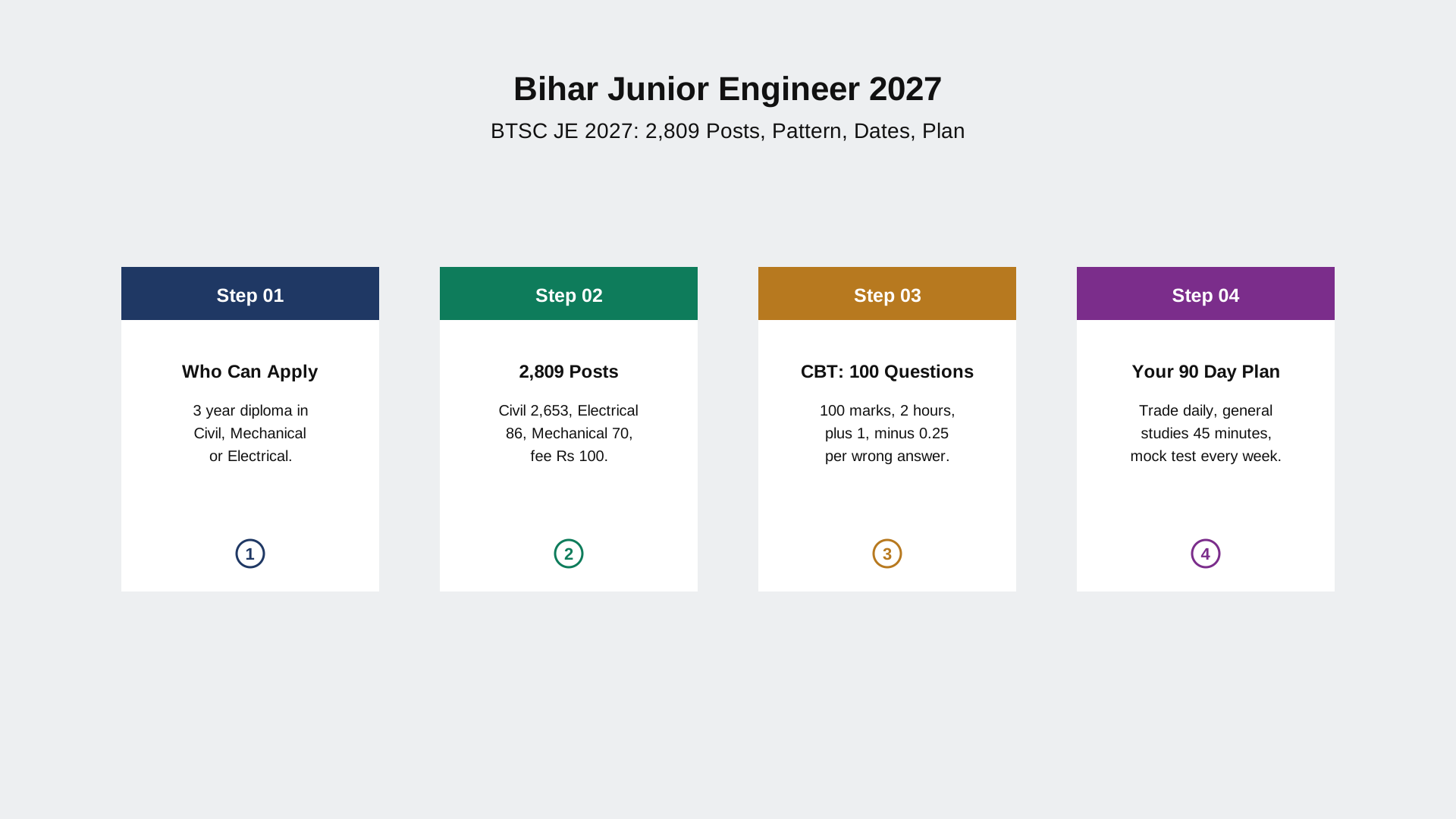
The test is a computer based test of 100 questions for 100 marks, to be finished in 2 hours. Each right answer earns 1 mark and each wrong answer loses 0.25 marks. Twenty questions come from general studies and 80 from the candidate's own engineering trade. The entry ticket is a three year diploma in the relevant discipline. The fee is Rs 100 for every candidate. The pay is Level 7, Rs 44,900 to Rs 1,42,400 a month.
Civil engineering takes almost the whole drive. Of the 2,809 posts, 2,653 are Civil, 86 are Electrical and 70 are Mechanical. A civil diploma holder faces the largest number of seats and also the largest crowd. A mechanical or electrical diploma holder faces far fewer seats and a smaller field, which changes the arithmetic of the cut off in ways this guide works through below.
Bihar Junior Engineer 2027 at a glance
| Detail | Bihar Junior Engineer, BTSC 2025 cycle |
|---|---|
| Conducting body | Bihar Technical Service Commission (BTSC) |
| Post | Junior Engineer, Civil, Mechanical and Electrical |
| Advertisements | No. 28/2025 Civil, No. 29/2025 Mechanical, No. 30/2025 Electrical |
| Total posts | 2,809 (Civil 2,653, Electrical 86, Mechanical 70) |
| Application window | 12 December 2025 to 12 January 2026, online |
| Exam date | Not announced as of 21 November 2026 |
| Education | Three year diploma in the relevant engineering discipline; B.E. and B.Tech holders also eligible |
| Age limit | 18 to 37 years as on 1 August 2025, with relaxation for reserved categories |
| Fee | Rs 100 for all candidates |
| Pay | Level 7, Rs 44,900 to Rs 1,42,400, grade pay Rs 4,600 |
| Exam | Computer based test, 100 questions, 100 marks, 2 hours |
| Marking | 1 mark for a right answer, 0.25 marks cut for a wrong answer |
| Selection | Written exam, then document verification and medical examination |
| Official website | btsc.bihar.gov.in |
BTSC JE exam pattern: the paper in full
The BTSC JE exam pattern is a single computer based test. It has 100 objective questions, all multiple choice, and the candidate gets 2 hours. The paper is bilingual, in Hindi and English, and the questions follow the AICTE syllabus for a three year diploma in the relevant trade. That last point matters more than it looks. The paper tests diploma level knowledge, not degree level knowledge, so a degree holder who revises from degree textbooks is studying above the paper, and a diploma holder who revises from diploma notes is studying exactly at it.
The split is 20 questions of general studies for 20 marks and 80 questions of domain knowledge for 80 marks. Two sources reproduce a different split, and this guide flags both. One tracker page prints 25 general studies questions and 75 of engineering. Another prints all 100 questions from the trade, with no general studies at all. The 20 and 80 split appears on Jagran Josh and Testbook, the two most detailed trackers of this cycle, and it matches the notification summary that most reporting reproduced, so this guide follows it and the mock tests on this site use it. If the admit card or the BTSC notice shows a different split, the tests will be rebuilt.
The marking is 1 mark for a right answer and 0.25 cut for a wrong one. A blind guess across four options breaks even on average, and it loses once the questions you would have skipped are counted. The working rule is the same as in every test with a quarter mark penalty. Answer what you know, attempt what you can cut to two options, and leave the rest blank. In a 100 mark paper with a 40 percent qualifying mark for general candidates, a handful of careless guesses can move a candidate from above the line to below it.
The written exam carries a weight of 75 marks in the final selection, and work experience carries 25 marks. That is the part many short summaries leave out, and it changes how a candidate should think about the test. The 100 mark paper is scaled to 75, so each mark in the test is worth 0.75 marks in the final score. A candidate with contract experience as a Junior Engineer or in an equivalent post under the Bihar government, the central government or a government undertaking can claim experience marks. A candidate without that experience scores zero out of 25 and has to make it up in the written test. Fresh diploma holders should know this before they apply, because it sets the real target. A fresher needs a written score high enough to beat experienced candidates who start with a head start.
| Section | Questions | Marks | Time |
|---|---|---|---|
| General Studies | 20 | 20 | 2 hours total |
| Domain Knowledge, Civil, Mechanical or Electrical | 80 | 80 | |
| Total | 100 | 100 | 2 hours |
The 2,809 posts, trade by trade
Civil engineering is the drive. Of the 2,809 posts, 2,653 are Civil, which is more than 94 in every 100. The posts sit across various Bihar government departments, and the notification places them in the departments that build and maintain the state: public works, water resources, public health engineering and the other engineering departments that run on Junior Engineers. The exact department wise break up is in the notification PDFs, and candidates should read the PDF for their trade rather than rely on a summary.
Mechanical engineering has 70 posts and Electrical has 86. Those numbers look small next to Civil, and they are, but the applicant pool for each trade is smaller too. A mechanical diploma holder competes only with other mechanical diploma holders, and the same goes for electrical. The cut off for a 70 post trade can still be high, because the number of applicants per post is what sets the cut off, and small trades often have intense competition for their few seats. Nobody can quote a cut off for this cycle yet, because the exam has not been held, and any site that prints one is guessing.
The scale of the drive is worth a comparison. BTSC has run Junior Engineer recruitments before, and the 2,809 figure puts this cycle among the larger ones. The December 2025 application window was reopened on 12 December 2025, which is why some pages call it the 2025 recruitment and others call it the 2026 recruitment. The branding on this page is 2027, because the exam and the appointments fall in 2027, and the mock tests are built for the exam as it will be held.
Who can apply
The education rule is a three year diploma in the relevant engineering discipline from a recognised institute or university. Civil posts need a diploma in civil engineering, mechanical posts need a diploma in mechanical engineering, and electrical posts need a diploma in electrical engineering. Candidates with a B.E. or B.Tech in the relevant trade are also eligible, and the notification treats the degree as covering the diploma requirement. The diploma must be complete before the last date of application, so a final year student whose result comes after the window closes cannot apply in this cycle.
The age rule is 18 to 37 years as on 1 August 2025. The category wise ceilings reported from the notification are 37 years for general male candidates, 40 years for general female candidates and for OBC and EBC candidates of either sex, and 42 years for SC and ST candidates of either sex. Relaxation follows Bihar government rules, and the notice is the final word on the exact ceilings for each category. A candidate should check the age cut off first, before the fee, because the cut off date of 1 August 2025 is fixed and no appeal moves it.
The fee is Rs 100 for all candidates, and it is non refundable. That is unusually low for a state recruitment of this size, and it is one reason the applicant count will be high. A low fee removes the last reason to delay, and the application window of one month, 12 December 2025 to 12 January 2026, was the only real barrier to entry.
Indian citizenship is required, and the recruitment is for Bihar government departments, so the work is in Bihar. Candidates from other states can apply, and reservation benefits follow Bihar domicile rules as in other Bihar recruitments. The notice carries the reservation details, and candidates should read the roster for their trade, because the category wise seat counts decide how many candidates from each category move forward.
How selection actually works
Selection has three stages: the written examination, document verification and a medical examination. Only candidates who clear each stage move to the next, and the final appointment rests on the merit list. The written test is the stage that decides almost everything, because the merit list is built from the written score plus experience marks.
The minimum qualifying marks reported from the notification are 40 percent for general candidates, 34 percent for OBC candidates, 36.5 percent for SC and ST candidates, and 32 percent for women, SC and ST, and disabled candidates. Those last two lines overlap in the reporting, and this guide prints them as reported rather than smoothing them into a single table. A candidate should read the qualifying marks clause in the notification PDF for their own category, because the qualifying mark is a floor, not a target. Clearing 40 percent gets a general candidate past the floor. It rarely gets them a post, because the merit list fills from the top.
Work experience is the part that surprises fresh candidates. The selection gives 25 marks for work experience as a Junior Engineer or in an equivalent post on contract under the Bihar government, the central government, or a government undertaking, corporation, body, authority or autonomous body. The experience must be genuine and documented, and the document verification stage will test it. A candidate who claims experience marks without the papers to prove them loses the marks and risks the candidacy.
The written paper scales to 75 marks, so the final score is the written score out of 75 plus experience out of 25. A fresher who scores 65 out of 100 in the written test carries 48.75 into the final list. An experienced candidate who scores 55 in the written test carries 41.25, plus up to 25 for experience, which can lift them past the fresher. The lesson for fresh candidates is plain. You need a written score high enough that no experience bonus can catch you, and that means aiming well above the qualifying floor, not just above it.
Document verification checks the diploma, the age proof, the category certificate and the experience papers. The medical examination follows for selected candidates. Both stages are pass or fail, and neither adds marks. They exist to confirm that the person on the merit list is the person who sat the test and holds the qualifications claimed.
The syllabus, trade by trade
General studies is common to all three trades. It covers current affairs, national and international, Indian history, Indian geography, Indian polity, science and technology, static general knowledge, sports and the economic scene. Twenty questions is a small section, and it tempts candidates to skip it. That is a mistake, because the section is worth 20 marks in a paper where the qualifying mark for a general candidate is 40. A candidate who scores 15 out of 20 in general studies has already covered more than a third of the qualifying mark before touching the trade paper.
The civil engineering syllabus follows the three year diploma course. Building materials covers properties, tests, uses, asbestos products, timber and wood based products, laminates, paints and varnishes. Estimating, costing and valuation is its own block, and it is the numerical heart of the civil paper. Environmental engineering covers water purification, sewerage, sewage treatment, drainage, solid waste and pollution. Theory of structures covers elasticity, bending moment, shear force, slope deflection and torsion. The rest runs through transportation engineering, basic surveying, water resources engineering, construction materials, hydraulics, concrete technology, and design of steel and reinforced concrete structures. A civil candidate who is strong in surveying, estimating and concrete has covered the ground where the most marks live.
The mechanical syllabus covers thermodynamics, strength of materials, theory of machines, manufacturing, fluid mechanics and engineering mechanics. It is a compact list, and it rewards the candidate who works numericals rather than reading theory. Thermodynamics and strength of materials carry the most weight in most diploma papers, and the mock tests on this site weight them the same way.
The electrical syllabus covers basic electrical engineering, with Ohm law, AC and DC circuits, series and parallel circuits and network theorems, then the trade topics of the diploma course: machines, power systems, measurement and control. Electrical candidates should treat network theorems and machines as the core, because those topics produce the most questions per hour of study in past diploma papers.
One thread runs through all three trades. The syllabus is the AICTE diploma syllabus, and the paper is set at that level. Candidates who revise from the diploma notes they already own are revising the right material. Candidates who buy degree level books are paying to study above the paper.
Why the 80 and 20 split decides ranks
Four out of five questions come from the trade, so the trade section decides the merit list. That sounds obvious, and it still changes how study time should be split. A candidate who gives general studies half the timetable is giving 50 percent of the time to 20 percent of the marks. The right split is closer to the paper itself: most of the time on the trade, a fixed daily slot on general studies, and no day without both.
The trade section also decides who survives the negative marking. Trade questions are where a prepared candidate is sure, and general studies questions are where the same candidate guesses. A candidate who guesses across general studies loses 0.25 marks per wrong answer, and five wrong guesses cost 1.25 marks, which is more than a whole right answer in the trade section. The discipline that matters is to leave a general studies question blank when none of the options rings a bell, and to spend the saved time on a trade numerical where the marks are bigger and the confidence is higher.
The experience marks add a second layer to the same point. A fresher competes on the written paper alone, so the trade section is the whole game. An experienced candidate has a cushion, and the cushion is worth up to 25 marks, which is a quarter of the final score. Fresh candidates sometimes read that and give up. The right response is the opposite. The experience cushion is fixed, and the written paper is open. A fresher who scores 70 in the written test beats an experienced candidate who scores 50 and claims the full 25. The gap is closable, and it closes in the trade section.
What a Junior Engineer does in a Bihar department
A Junior Engineer is the person who turns a sanctioned estimate into a road, a building or a water supply line. The day starts with the site: measuring work done, checking material quality, recording measurements in the measurement book, and certifying bills for payment. The measurement book is the document that matters most, because every payment to a contractor rests on the measurements recorded in it. A wrong entry pays for work that never happened, and a missing entry delays payment for work that did.
The Junior Engineer also prepares estimates, draws up bills of quantities, checks drawings against the work on the ground, and reports progress to the Assistant Engineer. In water resources, the work is canals and embankments. In public health engineering, it is water supply and sanitation. In public works, it is roads and buildings. The trade changes the site, and the job stays the same: measure with care, record carefully, and keep the work moving.
It is a field post with a desk attached, not a desk post with occasional field visits. A Junior Engineer who likes site work will be happy. A Junior Engineer who expected a chair and a file will be surprised for the first year and then used to it. The pay, Level 7, reflects a post that carries real responsibility for public money, and the measurement book is where that responsibility sits.
The money: Level 7 and what it means
The pay scale is Level 7, Rs 44,900 to Rs 1,42,400 a month, with a grade pay of Rs 4,600. That is a regular government pay scale, with annual increments, dearness allowance and the other allowances that come with a Bihar government post. A new Junior Engineer starts near the bottom of the scale, and the in hand pay after deductions is lower than the top line figure that websites quote. Candidates should read the starting basic pay, Rs 44,900, as the number that matters, and treat the top of the scale as a figure for much later in the career.
The post is a regular government job, which is the main reason the applicant count will be large. A diploma holder in Bihar has few routes to a regular Level 7 post, and this drive offers 2,809 of them at once. The fee of Rs 100 and the diploma level paper make it accessible, and the combination of accessible and regular is what draws the crowd. The crowd is the reason the cut off will be high, and the cut off is the reason preparation has to be serious.
A 90 day plan that fits the real paper
Ninety days is enough if the days follow the paper. The paper is 80 percent trade, so the plan gives the trade 80 percent of the time. General studies gets a daily slot of 45 minutes, and it never gets a whole day, because a whole day on general studies is a day the trade section loses.
Days 1 to 30 build the trade base. Civil candidates start with surveying, building materials and concrete technology, two hours a day, working numericals with a notebook. Mechanical candidates start with thermodynamics and strength of materials. Electrical candidates start with network theorems and machines. General studies gets 45 minutes a day, split between a news summary and one set of static facts. One full mock test every Sunday, 100 questions in 2 hours, with the result reviewed the same evening. Every wrong answer gets a one line note with the right answer and the reason for the miss.
Days 31 to 60 add the rest of the trade syllabus. Civil candidates take estimating and costing, theory of structures and design of steel and reinforced concrete structures. Mechanical candidates add theory of machines, manufacturing and fluid mechanics. Electrical candidates add machines, power systems and measurement. General studies keeps its 45 minutes, and the news notes become a revision file. Mock tests move to twice a week, and the review notes start to repeat, which is how you know the weak spots are shrinking.
Days 61 to 90 are for revision and speed. No new topic starts after day 65. The trade formulas get written out from memory once a week until they come out clean. General studies revision comes from the notes file, not from new books. Mock tests run every other day in the last two weeks, always in one sitting, always timed, always with the same order as the real paper: general studies first, trade second, guesses only when two options survive. The last three days are light. Short revision, early sleep, and no new material. A tired candidate makes the mistakes that a fresh one avoids, and the negative marking charges 0.25 marks for each one.
Two habits run through all ninety days. First, solve numericals by hand, with the working shown. The trade paper is a numerical paper, and the hand remembers what the eye forgets. Second, keep a mistakes book. One page per mock test, one line per error. By day 90 that book holds every trap you have already fallen into once, and the exam cannot use them against you a second time.
Mistakes that cost candidates marks
The most expensive mistake is studying above the paper. Degree level books, coaching notes written for degree exams, and advanced reference material all feel like serious preparation, and all of them miss the diploma level paper. The BTSC paper follows the AICTE diploma syllabus. Revise from diploma notes and diploma previous papers, and the paper will feel familiar.
The second mistake is skipping general studies. Twenty marks is a fifth of the paper, and the qualifying mark for a general candidate is 40. A candidate who scores 12 out of 20 in general studies has covered nearly a third of the qualifying mark before the trade section starts. A candidate who scores 4 out of 20 has to find those 8 marks in the trade section, against a crowd that is also strong there.
The third mistake is guessing under the quarter mark penalty. Four wrong guesses cost 1 mark, which cancels a right answer. In a paper where the merit list is decided by fractions of a mark after scaling, a handful of guesses can cost a rank, and a rank can cost a post. Leave a question blank when you cannot cut it to two options.
The fourth mistake is forgetting the experience marks. Fresh candidates who do not know about the 25 marks for experience aim at the qualifying floor and stop. Experienced candidates who do know about them aim higher. A fresher needs a written score that beats an experienced candidate's written score plus the experience bonus, and that target is higher than the floor. Set the target from the merit list, not from the qualifying mark.
The fifth mistake is waiting for the exam date before starting. The applications closed on 12 January 2026, and the exam date had not been announced as of 21 November 2026. That gap is preparation time, not rest time. The candidate who uses the gap arrives at the exam with months of work done. The candidate who waits for the date arrives with a month, and a month is not enough for an 80 question trade paper.
Where to check next
The one place that matters is the BTSC site at btsc.bihar.gov.in. The exam date, the admit card, the answer key and the result will all appear there first. Everything else is a copy, and copies get dates wrong. When the exam date lands, check three things on the notice: the date and shift, the exam centre instructions, and any change to the pattern. If the pattern differs from the one in this guide, this page will be updated and the mock tests will be rebuilt to match.
Until then, the work is the same. Trade every day, general studies in a daily 45 minutes, numericals by hand, and a mock test every week. The 2,809 posts are real, the notification is real, and the exam will reward the candidate who treated the waiting time as study time.
Sources
Adda247, BTSC JE Exam Date 2026, Advertisement No. 28/2025, 29/2025 and 30/2025, 2,809 posts, applications 12 December 2025 to 12 January 2026. Testbook, BTSC JE Online Form 2025, reopened 12 December 2025, 2,809 vacancies, fee and selection process. Times of India, BTSC JE recruitment 2025, registration begins for 2,809 vacancies at btsc.bihar.gov.in, 12 December 2025, fee Rs 100, age 18 to 37 years as on 1 August 2025. Times of India, BTSC JE Recruitment 2025-26 notification out, 2,809 posts, Civil 2,653, Electrical 86, Mechanical 70. JobRasta, BTSC Bihar JE Recruitment 2025 Notification for 2809 Post, age limits and vacancy details. Jagran Josh, Bihar BTSC JE Syllabus 2025 and Exam Pattern, 100 questions, General Studies 20 and Domain Knowledge 80, negative marking 1/4. CareerPower, BTSC JE Syllabus 2026, Exam Pattern and Subject-wise Topics, written exam 75 marks and work experience 25 marks, qualifying marks. Testbook, BTSC JE Syllabus and Exam Pattern 2026, 100 questions for 100 marks, 2 hours, 1/4 negative marking. Made Easy, BTSC JE Recruitment 2026, notification, vacancy and exam pattern.







