About Bank of Baroda LBO 2027 Exam Series
📖 Table of Contents
- What Bank of Baroda LBO 2027 is
- The 2026 notice in full: 2,482 posts
- Who can apply: the 2026 rules
- The 2025 cycle and what changed in 2026
- The exam pattern, section by section
- English is qualifying only: the detail most candidates miss
- The local language test: the heart of this post
- Selection stages: test, psychometric test, interview
- Pay: what a Local Bank Officer actually takes home
- Bank of Baroda LBO next to PO, Clerk and the other LBOs
- What to study for each section
- A 90 day plan that fits around a bank job
- Mistakes that cost LBO candidates a year
- What to check before the next Bank of Baroda notice
Bank of Baroda LBO 2027: Pattern, Salary, Dates
What Bank of Baroda LBO 2027 is
Bank of Baroda LBO 2027 is the Local Bank Officer recruitment of Bank of Baroda, one of India's largest public sector banks. A Local Bank Officer is a Junior Management Grade Scale I officer who works in one state, serves customers in the local language of that state, and handles branch banking in the area he or she knows best. The post sits at the same grade as a Probationary Officer, with the same starting basic pay of 48,480 rupees. The difference is the route in and the place of work. A Probationary Officer can be posted anywhere in India. A Local Bank Officer applies for one state, proves skill in that state's language, and works in that state.
Bank of Baroda has now run this recruitment twice in two years. The 2025 cycle offered 2,500 posts under Advertisement Number BOB/HRM/REC/ADVT/2025/05. The 2026 cycle, the latest notice, offered 2,482 posts under Advertisement Number BOB/HRM/REC/ADVT/2026/16, dated 18 August 2026. Applications for the 2026 cycle ran from 18 August to 7 September 2026, and the bank fixed the online test tentatively for 3 October 2026. This page builds its guide from that 2026 notice, which is the latest real notice for this post, plus the completed 2025 cycle. No 2027 notice exists yet. When the next notice comes out, read it first and treat this page as a starting point, not as the final word.
Check the official careers page at bankofbaroda.in for every notice, because only the official notice is final. The pattern, eligibility rules and pay figures in this article come from the Bank of Baroda notices themselves. They are not guesses from coaching sites. Where a fact comes from a tracker rather than the notice, this page says so, and the package notes mark it as unverified.
The LBO idea is simple. A bank with branches in every district needs officers who speak the local language, know the local crops and trades, and stay in one area long enough to build trust. Bank of Baroda was founded in 1908 in Baroda, in Gujarat, and Gujarat still holds its thickest branch network. That history shows in the vacancy table. Gujarat took 1,185 of the 2,482 posts in the 2026 cycle, almost half the total. An officer who grew up speaking Gujarati and knows the trading towns of Gujarat serves that network better than an officer posted there from another state. That is the whole deal, and it is why the local language test sits at the centre of this exam.
The 2026 notice in full: 2,482 posts
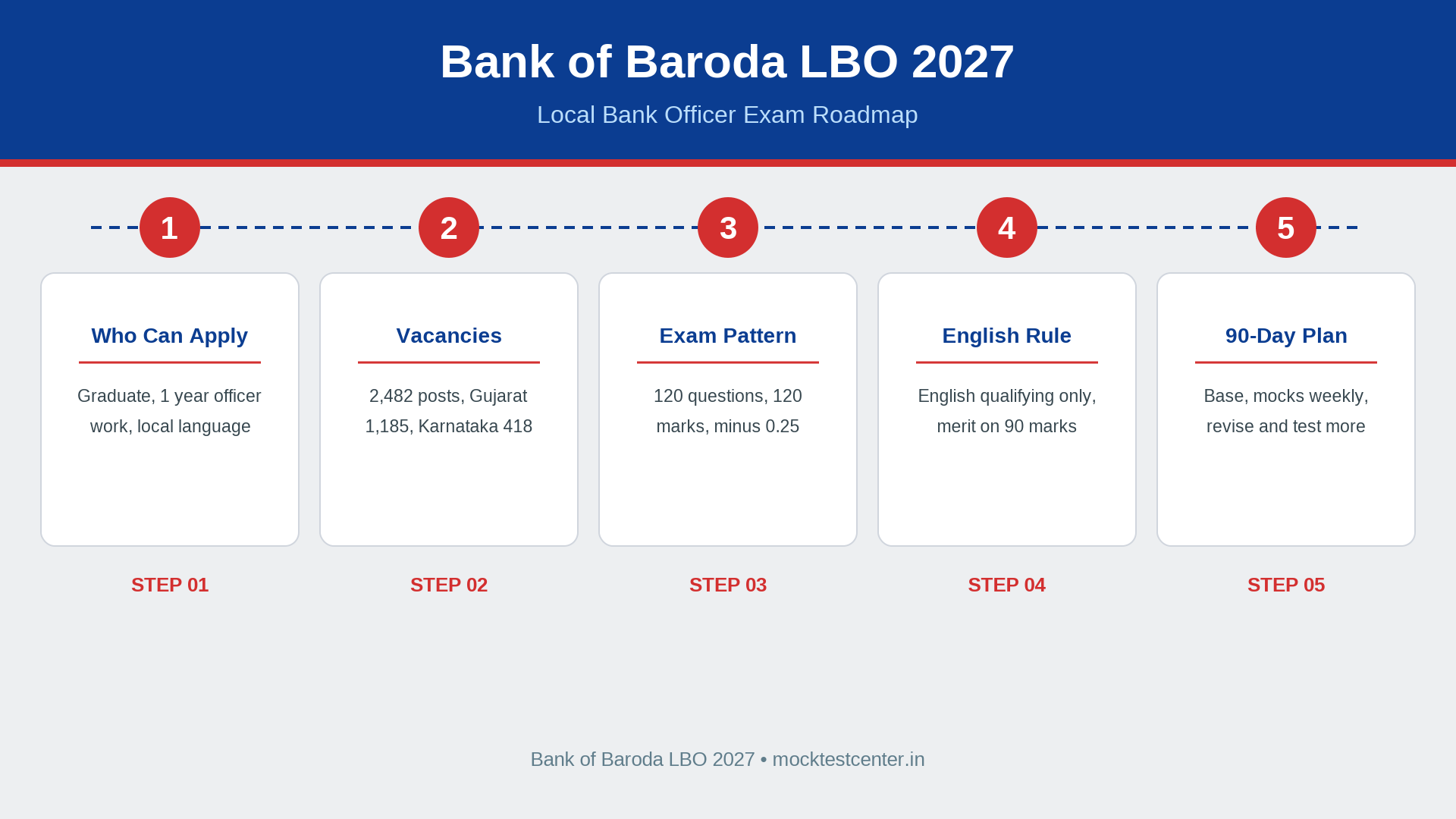
Advertisement Number BOB/HRM/REC/ADVT/2026/16 came out on 18 August 2026 for 2,482 Local Bank Officer posts in Junior Management Grade Scale I. Online registration opened the same day and closed on 7 September 2026. The bank said the online test would be held tentatively on 3 October 2026, and it ran pre examination training online for SC, ST, ex-servicemen, minority community and PwBD candidates in the weeks before the test. The fee was 850 rupees for General, EWS and OBC candidates, and 175 rupees for SC, ST, PwBD, ex-servicemen and women candidates, the same fee as the 2025 cycle.
One detail of the 2026 vacancy table needs care, because it confuses candidates every year. The 2,482 posts mix new vacancies with unfilled vacancies carried over from the earlier LBO exercises. Gujarat shows 400 new vacancies and 785 unfilled vacancies, a total of 1,185. Karnataka shows 130 new and 288 unfilled, a total of 418. Maharashtra shows 180 new and 38 unfilled, a total of 218. The bank said plainly in the notice that the unfilled vacancies came from the previous LBO recruitment exercises. A carried over vacancy is still a real vacancy, and the merit list is still drawn state wise and category wise, but the split tells you something useful. Gujarat and Karnataka filled fewer of their 2025 posts than the other states, which is why so many seats came back. Candidates who read only the total miss that signal.
The state table runs to 20 states. After Gujarat, Karnataka and Maharashtra come Tamil Nadu with 132 posts, Odisha with 100, Andhra Pradesh with 80, Telangana with 50, Kerala with 49, West Bengal with 42, Assam with 40, Punjab with 34, Goa with 21, Arunachal Pradesh with 20, and Jammu and Kashmir, Manipur, Mizoram, Meghalaya and Nagaland with 15 each, Sikkim with 10 and Tripura with 8. The category split is 981 General, 600 OBC, 358 SC, 303 EWS and 240 ST. The bank kept the right to change the vacancy count as the process moved, as every notice does. Apply for one state only. The notice is firm on that. A candidate who sends two applications keeps only the latest valid one, and the fee paid for the other is lost.
The 2026 notice also names who cannot apply, and the list is longer than most candidates expect. Employees working in Bank of Baroda in the officer cadre cannot apply. Employees on contract with the bank cannot apply. Officers who resigned from Bank of Baroda within the last three years cannot apply. The bank is hiring outsiders into its officer cadre, not running an internal promotion. If you already work in Bank of Baroda as an officer, this door is not yours. If you work as an officer in another Scheduled Commercial Bank, it is.
Who can apply: the 2026 rules
The 2026 notice sets the age at 21 to 30 years as on 1 August 2026. Relaxation follows government rules: five years for SC and ST, three years for OBC non creamy layer, ten years for persons with benchmark disabilities, with higher limits for ex-servicemen and other protected groups. The bank says there is no reservation for ex-servicemen in the officer cadre, which is a standard line in officer notices, so ex-servicemen apply under the age relaxation rules rather than a reserved quota.
Graduation in any discipline from a recognised university is the education rule. The notice also lists preferred certifications, such as the NISM Mutual Fund Distributors examination and the Insurance Institute of India IC 38, but those are preferences, not conditions. A plain graduation degree is enough to apply. Final year students should not count on applying, because the notice also asks for experience, and experience needs a completed degree and a job already held.
Experience is the rule that will decide most applications, and the 2026 notice tightens it in two ways that the 2025 notice did not spell out as clearly. First, the candidate needs a minimum of one year of post qualification experience as an officer in a Scheduled Commercial Bank listed in the Second Schedule of the Reserve Bank of India. Experience in the clerical cadre does not count. Second, experience of less than six months in any organisation does not count, except when it is part of the current employment. A candidate who worked as a clerk for three years and as an officer for eight months has eight months of countable experience, not three years and eight months. A candidate who worked as a sales executive or a teacher has no countable experience at all. Keep your appointment letter and experience certificate ready, because the bank will check them after the test, and a candidate who wrote one year on the form and can prove only ten months is out, whatever the test score.
Local language skill is a hard condition. The candidate must be able to read, write, speak and understand the local language of the state applied for. The notice names the language against each state in the vacancy table: Gujarati for Gujarat, Kannada for Karnataka, Marathi for Maharashtra, Tamil for Tamil Nadu, Odia for Odisha, Telugu for Andhra Pradesh and Telangana, Malayalam for Kerala, Bengali for West Bengal, Assamese and Bodo for Assam, Punjabi for Punjab, Konkani for Goa, Urdu, Kashmiri and Dogri for Jammu and Kashmir, and so on. Two states take English as the local language: Arunachal Pradesh and Nagaland, but only for candidates who studied and passed English as a subject in a school located in that state. That is a narrow rule, not a free pass for every English speaker. Candidates who studied the local language in Class 10 or 12 and can show a mark sheet or certificate are exempt from the language test in most LBO cycles. Keep your Class 10 mark sheet safe. It is the paper that saves you a test.
The 2025 cycle and what changed in 2026
The 2025 cycle is the completed run that shows how this recruitment actually moves. Advertisement Number BOB/HRM/REC/ADVT/2025/05 came out on 4 July 2025 for 2,500 Local Bank Officer posts across 18 states. Applications ran from 4 July to 24 July 2025, and the bank extended the last date to 3 August 2025. The online test took place on 6 September 2025. The result came out on 25 November 2025, according to tracker reports. Gujarat took the largest share, with 1,160 posts, followed by Maharashtra with 485 and Karnataka with 450. Kerala took 50 posts. Probation was 12 months.
Compare the two cycles and four changes stand out. First, the count fell slightly, from 2,500 to 2,482, but the 2026 figure carries 1,000 plus unfilled seats from the earlier exercise, so the real new hiring is smaller than the headline. Second, the state map grew from 18 states to 20, with Arunachal Pradesh, Telangana and others added or split out. Third, the age cut off moved from 1 July 2025 to 1 August 2026, which shifts the birth date window by a year. Fourth, the 2026 notice spells out the experience rule in sharper words, with the six month floor and the clerical exclusion written in plain text. The pattern did not change. The fee did not change. The pay scale did not change. A candidate who prepared for the 2025 cycle and missed it can walk into the next cycle with the same books and the same mocks.
The 2026 cycle also shows why the apply window matters. Twenty one days, from 18 August to 7 September, is the whole window. The test followed about four weeks after the last date. A banker who starts preparing on the day of the notice has about two months. A banker who starts now has the whole year. The syllabus overlaps with the PO and Clerk exams so much that every hour you spend now counts for those exams too, even if the next LBO notice comes late.
The exam pattern, section by section
The online test in the 2026 notice has 120 questions for 120 marks in two hours, with four sections of 30 marks each and a separate timer for each section. The table below is the tentative structure printed in the notice itself.
| Section, Bank of Baroda LBO 2026 | Questions | Marks | Minutes |
|---|---|---|---|
| English Language | 30 | 30 | 30 |
| Banking Knowledge | 30 | 30 | 30 |
| General and Economic Awareness | 30 | 30 | 30 |
| Reasoning Ability and Quantitative Aptitude | 30 | 30 | 30 |
| Total | 120 | 120 | 120 |
English gives thirty questions in thirty minutes. That is one minute per question. Reading comprehension, cloze tests, error spotting and vocabulary carry this section. The 2026 notice adds a twist that changes how you should treat this section, and the next section of this page covers it in full. For now, know that the other three sections are bilingual, in English and Hindi, while the English section is in English only.
Banking Knowledge gives thirty questions in thirty minutes, and it is where your job helps most. The questions cover the Reserve Bank of India and its functions, repo rate and reverse repo rate, CRR and SLR, types of accounts and deposits, priority sector lending, KYC norms, digital payment systems such as UPI, NEFT and RTGS, and the basics of loans and NPAs. A candidate who has worked in a branch for a year has seen most of these in real files. The gap is usually the numbers. Repo rate, CRR and SLR change through the year, so note the current figures a week before the test and revise them the night before.
General and Economic Awareness gives thirty questions in thirty minutes. Half of it is current affairs from the last six months, and half is static economy and banking awareness. Government schemes, the Union Budget, RBI monetary policy, major appointments and sports events all appear. Read the business page every morning and keep a notebook of one line per story. Six months of one line a day is about 180 lines, and that notebook covers most of the section. Add the economy of your own state, because the LBO paper can ask about local crops, local industries and state schemes.
Reasoning Ability and Quantitative Aptitude gives thirty questions in thirty minutes, which is the tightest pace in the paper. Puzzles, seating arrangements, simplification, number series and data interpretation share the section, so no single topic can carry it. Learn to judge a question in five seconds. A skipped question costs nothing. A wrong guess costs 0.25 marks, because the notice applies a penalty of one fourth of the marks assigned to the question for every wrong answer. That penalty runs in all four sections. The bank also says it may change the structure of the test, including adding a descriptive test or a case study, and it will tell candidates on its website if it does. Read the call letter handout when it comes, because the paper you sit may not be the paper in the notice.
English is qualifying only: the detail most candidates miss
The 2026 notice prints one line about the English section that changes the whole strategy of the paper. The test of English Language is only qualifying in nature, and marks secured in the English section will not be considered for the final merit list. The other three sections carry the merit. English can still fail you, because the bank sets minimum qualifying marks per section at its sole discretion and can waive the criteria if it chooses, but a high English score adds nothing to your rank. A candidate who scores 28 in English and 70 in the other three sections ranks above a candidate who scores 30 in English and 68 elsewhere. The maths is plain. Put your best hours into Banking Knowledge, General Awareness and Reasoning with Quantitative Aptitude, and treat English as a paper you must pass, not a paper you must top.
This is also the sharpest difference from the 2025 cycle as it was reported, where qualifying marks of 40 percent per section for General and EWS candidates and 35 percent for reserved categories were printed in tracker summaries of the notice. The 2026 notice does not print a fixed percentage. It keeps the qualifying marks in the bank's hands. Do not plan around a fixed 12 out of 30. Plan around passing every section with room to spare, and scoring as high as you can in the three sections that count.
The practical fix is simple. In your mocks, score yourself on 90 marks, not 120. Take the English score out of the total and check it only against a pass line. If your English is weak, give it thirty minutes a day until it clears the line, then stop feeding it hours that should go to the sections that rank you. If your English is strong, bank the pass and move on. Many working bankers read official letters and mails all day, which helps with comprehension, but the grammar questions still need practice. Read one editorial a day and mark the sentence structures you would have written differently. That habit alone lifts the score enough to clear a qualifying line.
The local language test: the heart of this post
The local language test is what makes a Local Bank Officer different from a Probationary Officer, and it is the stage that ends the most runs. The test checks reading, writing and speaking in the local language of the state you applied for. It is qualifying in nature. You do not need a high score. You need to pass, and a fail here ends the selection, whatever your written test score.
Candidates who studied the local language in Class 10 or 12 and can show a mark sheet or certificate are exempt from the test in most LBO cycles. The Bank of Baroda notice makes language proficiency a condition of applying, and the exemption is the standard way the bank checks it. If you studied your state language in school, find that mark sheet now and keep a scanned copy ready. If you did not study it in school, you will take the test, and you should start preparing for it the day you apply.
Two special cases appear in the 2026 notice and are worth knowing. Arunachal Pradesh and Nagaland take English as the local language, but only for candidates who studied and passed English as a subject in a school located in that state. The notice also says the candidate can apply for one state only, and the merit list is drawn state wise and category wise. Rules like this change with each notice, so read the language column of the state table in the new notice before you choose your state.
Start the language work early if you need the test. Read one page of a local newspaper a day, in the local language. Write five lines a day in that language. Speak it with family and colleagues. A month of daily practice is enough to pass a qualifying test if you already speak the language at home. If you do not speak it at all, no amount of last minute study will save you, so do not apply for that state. Pick the state whose language is yours.
Selection stages: test, psychometric test, interview
The 2026 notice describes the selection as an online test, with a psychometric test or any other test the bank finds suitable, followed by interviews of candidates who qualify in the online test. The bank keeps the right to change the method, and it names group discussion, multiple rounds of interview, descriptive tests and screening as options it may use. Treat the interview as certain, the psychometric test as likely, and the group discussion as possible. The 2025 cycle was reported with a group discussion or personal interview after the test, and the exact final stage differs from cycle to cycle, so prepare for all three and be surprised by none.
The psychometric test deserves a note, because it is new in the 2026 notice language and candidates ask about it most. It tests personality, communication, clarity, problem solving, efficiency and willingness to work in any part of the country. It is not a knowledge paper. You cannot revise for it the night before. The honest preparation is to know your own work history well enough to answer plainly about it, and to answer consistently across questions that ask the same thing in different words. Do not try to game it with a rehearsed persona. Panels and psychometric tools are both built to catch that.
The interview panel asks about your banking experience, your home state, the local economy, basic banking and why you want to join Bank of Baroda. A banker who has worked for a year should find this easy, but the panel can tell at once whether your answers come from real work or from a guidebook. Prepare with your own stories. One loan file you handled, one difficult customer you managed, one audit finding you fixed. Those stories carry more weight than any rehearsed definition.
Document verification runs alongside these stages, and it is where the experience rule bites. The bank will read your appointment letter, your experience certificate and your salary slips, and check them against the experience rule in the notice. The bank also captures biometric data and photographs on the day of the online test and verifies them again at the interview and at joining. Get the papers right before you apply. If your bank gives experience certificates only after a written request, make that request now, not after the test. HR departments in banks take weeks, and the bank gives a short window for document upload.
Pay: what a Local Bank Officer actually takes home
A Local Bank Officer starts in Junior Management Grade Scale I with a basic pay of 48,480 rupees a month. The pay scale runs from 48,480 to 85,920 rupees: 48,480 with annual increments of 2,000 rupees seven times to 62,480, then 2,340 rupees twice to 67,160, then 2,680 rupees seven times to 85,920. On top of the basic pay come dearness allowance, house rent allowance, city compensatory allowance, provident fund, pension under NPS, leave fare concession and medical benefits. This scale is the same across Bank of Baroda, Union Bank and Indian Overseas Bank, because it comes from the industry wide settlement for Scale I officers.
The gross monthly pay at the start is reported in the range of 52,000 to 58,000 rupees, depending on the place of posting. A posting in a metro city pays more in house rent allowance and costs more to live in. A posting in a small town pays less and costs less. That range is a reported figure, not a number printed in any LBO notification, so treat it as a guide only. The basic pay of 48,480 rupees is the fixed fact. Probation in the 2025 cycle was 12 months. The 2026 notice does not print a probation figure in the pages fetched here, so check the appointment terms when they come out rather than assuming the same figure.
Put that pay beside the other bank exams and the picture is fair. The SBI Clerk 2027 exam leads to a clerk post with a starting basic pay of 26,730 rupees, so LBO pays almost twice as much at the start. The IBPS PO 2027 exam and the IBPS RRB PO 2027 exam offer the same Scale I basic pay of 48,480 rupees, so the money is the same and the difference is the route in and the place of work. The RBI Assistant 2027 exam pays a lower basic pay but sits in the central bank.
Two things about the job are worth more than the pay slip. First, an LBO stays in one state, which means a stable posting near home for most of a career. A Probationary Officer can be posted anywhere in India. Second, the local knowledge you bring is a real asset in the branch. You know the crops, the trades, the festivals and the language of the area, and that knowledge turns into business faster than any training can. That head start shows in the first promotion cycle, where performance counts.
Bank of Baroda LBO next to PO, Clerk and the other LBOs
Bank of Baroda runs its LBO drive beside the exams every banking candidate already knows. The Probationary Officer door is for fresh graduates with no experience. The Clerk door is for graduates who want a safe entry with many seats and no interview. The LBO door is for bankers who already hold an officer post elsewhere and want to move into Bank of Baroda at the same grade, in their home state. The experience rule is what sets it apart. No other large bank exam asks for a year of officer experience as a condition of applying.
The SBI PO 2027 exam is the hardest of the group to crack, because it has three stages, a mains paper with a descriptive section, a psychometric test, and a group exercise with an interview. It also has the widest career path, because a PO can rise to the top of the bank. The Clerk exams are the easiest to enter, with a prelims and a mains and no interview, but the pay is lower and the promotion path is longer. The LBO exam is the shortest written test of the group, at 120 marks in two hours, with a language test that the other exams do not have in the same form and a psychometric test that the 2026 notice adds.
The other LBO drives use different papers, and the difference matters if you apply to more than one bank. Union Bank of India ran its LBO drive for 1,500 posts with a much longer paper: 157 questions for 225 marks in three and a half hours, including a descriptive letter and essay. Indian Overseas Bank ran its LBO drive for 400 posts in 2025 and 250 posts in 2026 with a 140 question paper for 200 marks in three hours. Bank of Baroda gives you the shortest paper and the fewest questions, but it also asks for the one thing the others do not: a year of officer experience. The Union Bank LBO 2027 exam suits a fresh graduate with strong writing skills. The IOB LBO 2027 exam suits a graduate who wants a smaller, tighter state list. The Bank of Baroda exam suits a working officer who wants to move banks without moving states.
A banker with a year of officer experience should take the Bank of Baroda LBO exam as the main target when the notice comes, and the PO exam as a second shot. The syllabus overlaps so much that one preparation serves both. The IBPS Clerk 2027 exam and the IBPS RRB Clerk 2027 exam offer clerk posts with many more seats, and the same preparation covers most of their syllabus too. The IBPS SO 2027 exam is a different case, because it needs a specialist degree in IT, law, agriculture, HR or marketing, so it suits a smaller group. The LIC AAO 2027 exam offers another route into banking and insurance, and the same preparation covers most of its syllabus as well. Apply for every exam you are eligible for, and decide when the offers come.
The way to choose is to ask one question. Do you want to work in your home state, in your own language, as a Scale I officer? If yes, LBO is your post, and it deserves your main effort when the notice comes. If no, the PO and Clerk exams are your doors, and they post you where the bank needs you. That is the whole decision. Do not spend a year preparing for a posting you do not want.
What to study for each section
English needs a topic list you can tick off. Reading comprehension; cloze tests; error spotting; sentence improvement; para jumbles; fill in the blanks; vocabulary, including synonyms and antonyms. Read one editorial a day and mark the sentence structures you would have written differently. That habit alone lifts the score, because the paper tests the same structures again and again. Remember the section is qualifying only, so the aim is a safe pass, not a top score.
Banking Knowledge needs the current numbers first and the concepts second. Repo rate, reverse repo rate, bank rate, CRR and SLR as they stand today; the functions of the Reserve Bank of India; types of accounts and deposits; priority sector lending; KYC norms; digital payment systems such as UPI, NEFT, RTGS and IMPS; the basics of loans, NPAs and the SARFAESI Act. A banker who has worked in a branch for a year has seen most of these in real files. The gap is usually the numbers, so note the current figures a week before the test and revise them the night before.
General and Economic Awareness needs a notebook, not a book. Read the business page every morning and write one line per story. Government schemes, the Union Budget, RBI monetary policy, major appointments and sports events all appear. Six months of one line a day is about 180 lines, and that notebook covers most of the section. Add the economy of your own state, because the LBO paper can ask about local crops, local industries and state schemes. Gujarat candidates should know the diamond and textile trades, the ports and the cooperative banking network of their state. Karnataka candidates should know the coffee and silk economy and the IT industry of Bengaluru.
Reasoning Ability and Quantitative Aptitude needs speed more than depth. Simplification and approximation; number series; quadratic equations; data interpretation; time and work; time speed and distance; profit and loss; simple and compound interest; ratio and proportion; averages; puzzles and seating arrangements. That list looks long. It is the same list as every bank exam, so the books and mocks you already own cover it. The difference is the pace. Thirty questions in thirty minutes means one minute per question, and the negative marking of 0.25 means a wild guess costs you. Guess only when you can rule out two options.
A 90 day plan that fits around a bank job
A working banker cannot study eight hours a day. Two hours a day is realistic, and two hours a day for ninety days is 180 hours, which is enough. The plan below fits around branch hours, and it treats the local language as a real subject, not an afterthought. Start it now, before the notice comes out, because the apply window will be about three weeks and the test will follow about four to six weeks later.
Days 1 to 30 are for the base. Study two hours a day, one hour before the branch opens or after it closes. Cover one Banking Knowledge topic and one English topic each day. Read the news every morning and write five lines in your current affairs notebook, plus two lines on your own state. Read one page of a local newspaper a day, in the local language. Take one mock at the end of week two and one at the end of week four. Do not worry about the score. The first mocks only show you where you stand.
Days 31 to 60 are for speed. Your BOB LBO 2027 score will move most in this phase, because the paper gives one minute per question and a wrong answer costs 0.25 marks, so speed with accuracy is the whole game. Take two mocks a week now. After each mock, spend as much time on analysis as you spent on the test. Write down every question you got wrong and why. Was it a concept gap, a silly mistake, or a time problem? Concept gaps go back into your study list. Silly mistakes need a checklist before you submit each section. Time problems need easier questions first and hard ones last.
Days 61 to 90 are for the real thing. Take three mocks a week. Revise your error notebook every second day. Stop learning new topics in the last ten days. New topics in the last week add stress and no marks. In the last three days, take one full mock at the same time as your real test slot, then rest. Sleep matters more than one more chapter in the final week. A banker who walks into the test hall tired will make the same mistakes a fresh candidate makes, and the year of experience will not save the score.
If you have less than ninety days, cut the base phase, not the mocks. Ten mocks with full analysis beat thirty days of reading without a single test. The paper rewards candidates who have sat through the two hour sitting many times. It punishes candidates who know the syllabus and have never felt the sectional timer run out. Score your mocks on 90 marks, leaving English out, so the number you track is the number that ranks you.
Mistakes that cost LBO candidates a year
The first mistake BOB LBO candidates will make is waiting for the notice to start. The apply window in the 2026 cycle was twenty one days, and the test followed about four weeks after the last date. A banker who starts on the day of the notice has about two months. A banker who starts now has the whole year. The syllabus overlaps with the PO and Clerk exams so much that every hour you spend now counts for those exams too, even if the next LBO notice comes late.
The second mistake is picking the wrong state. A state with more posts looks tempting, but the local language test at the end is real. Gujarat has 1,185 posts, but a candidate who cannot read and write Gujarati will fail at the last stage. Apply for the state whose language you can read, write and speak. Keep your Class 10 mark sheet ready, because it exempts you from the language test in most cycles.
The third mistake is counting the wrong experience. The 2026 notice counts officer experience in a Scheduled Commercial Bank, with a six month floor and no credit for clerical service. A candidate who counts years in a shop, a school, a private company or a clerical post clears the test and fails document verification. Count only the years the notice names, and get the certificate before you apply.
The fourth mistake is feeding English too many hours. English is qualifying only in the 2026 notice, and its marks do not count in the final merit list. An hour spent pushing English from 26 to 29 buys nothing. An hour spent pushing Banking Knowledge from 20 to 24 buys rank. Pass English safely, then spend your hours where the marks count.
The fifth mistake is guessing too much. Four wrong answers erase one right answer. In a section where you know twenty answers for sure, ten wild guesses can pull your score down by two and a half marks. That is often the gap between selection and rejection in a state with few posts. Guess only when you can rule out two options.
What to check before the next Bank of Baroda notice
Keep four things ready. First, your degree certificate and your experience certificate, with the dates matching the appointment letter, so you can prove the one year officer rule the day the notice comes out. Second, your Class 10 mark sheet, because it proves your local language skill and can exempt you from the language test. Third, a mock test routine with sectional timers, scored on 90 marks, so the two hour sitting feels normal by the time the notice comes out. Fourth, a habit of checking bankofbaroda.in twice a week, because the LBO notice will appear there first and the apply window will be short.
Start with one BOB LBO 2027 mock this week, built on the 2026 pattern: 120 questions, 120 marks, two hours, four sections of thirty, with English scored separately as a qualifying paper. Score it on 90, list your weak section, and give that section thirty minutes a day. That single habit, repeated for ninety days, is what turns a working banker into a Local Bank Officer.