
About Assam PSC Junior Engineer 2027 Exam Series
📖 Table of Contents
- Assam PSC Junior Engineer 2027 at a glance
- The 187 posts, discipline by discipline
- Who can apply
- The screening test, paper by paper
- Interview marks, negative marking, and the numbers nobody agrees on
- The cycle is already over, here is the timeline
- The earlier cycles, and what they show
- Do not confuse this with Arunachal
- How to prepare for the next cycle
- Where to check next
- Mock tests for Assam PSC Junior Engineer 2027: Full Tests, PYQ, Chapter Tests, Sectional Tests, NCERT-based Tests, Current Affairs and PYQ PDF Downloads
- Sources
Assam PSC Junior Engineer 2027: Complete Exam Guide
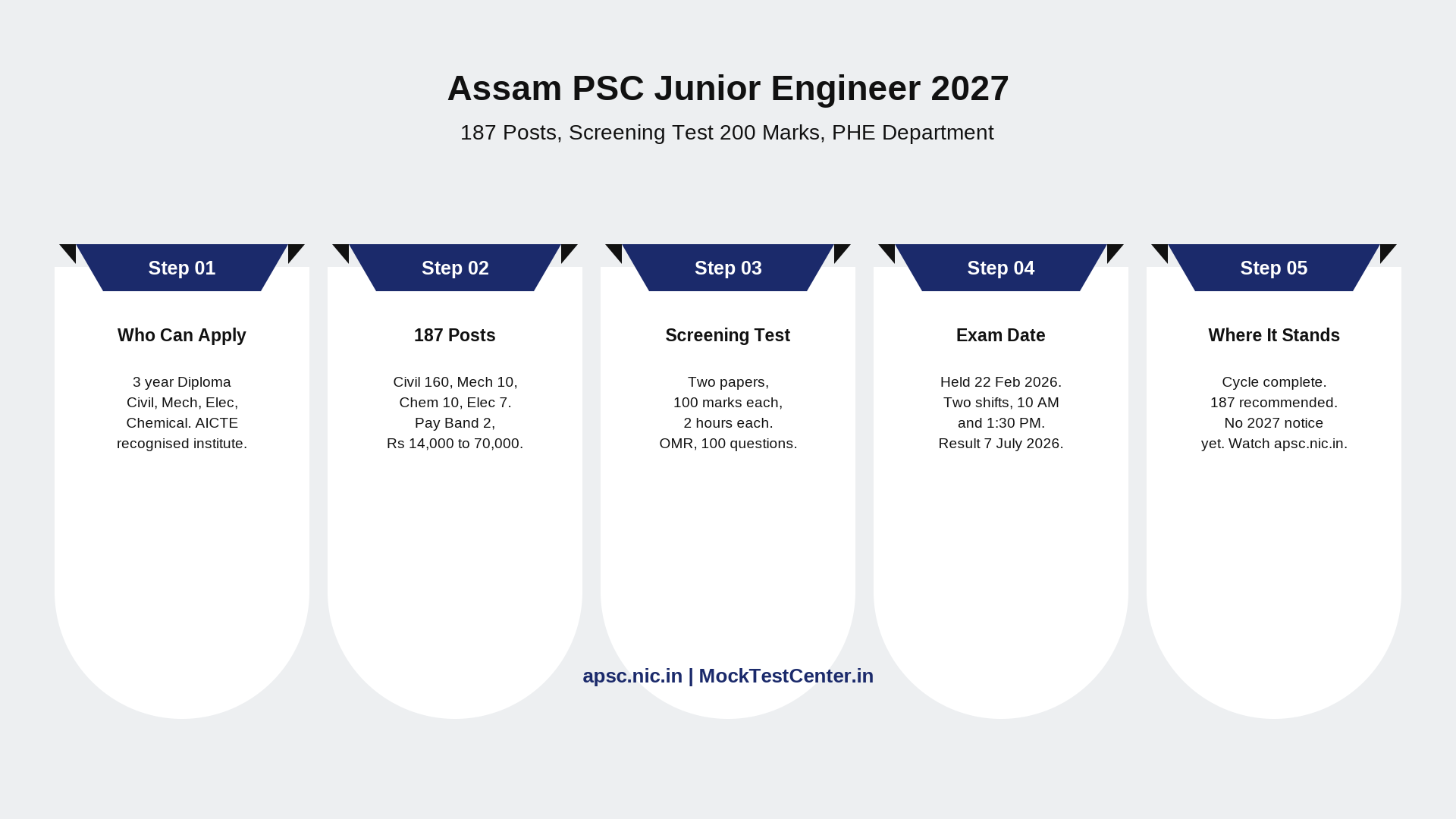
The Assam PSC Junior Engineer 2027 page on this site follows the last verified cycle of the recruitment, and that cycle is the 2025 cycle run by the Assam Public Service Commission for the Public Health Engineering Department. The Commission advertised 187 Junior Engineer posts under Advertisement Number 27/2025, dated 11 August 2025, took applications from 14 August to 13 September 2025, held the screening test on 22 February 2026, and declared the result on 7 July 2026 with 187 candidates recommended. The cycle is over. No 2027 notification exists as of 23 November 2026, so this guide anchors on the completed 27/2025 cycle and says so wherever a 2027 figure would otherwise be guessed.
That finished status is the first thing a reader should know, because most pages about this recruitment still read as if applications were open. They are not. The 187 posts are filled, the document verification ran on 22, 23 and 24 June 2026, and the Commission published the cut off marks and the marks secured by candidates on 26 August 2026. A candidate who finds this page in late 2026 needs the pattern, the syllabus and the standard of the last cycle, because the next advertisement will reuse them with new dates and a new vacancy count. This guide gives exactly that, and it flags every figure that the sources disagree on instead of picking one quietly.
The second thing a reader should know is that the search results for this exam are polluted by a different commission with a similar name. Arunachal Pradesh Public Service Commission, shortened to APPSC, advertised 413 Junior Engineer posts in 2025 with a written test of 450 marks and a 50 mark interview, and its pages dominate the results for Junior Engineer exam pattern. Assam Public Service Commission, shortened to APSC, runs a different exam: two papers of 100 marks each and an interview whose marks the sources cannot agree on. This guide covers Assam only, and it calls out the Arunachal figures wherever a reader might mistake them for Assam figures.
Assam PSC Junior Engineer 2027 at a glance
| Detail | Assam PSC Junior Engineer 2027, as run in the 2025 cycle |
|---|---|
| Conducting body | Assam Public Service Commission (APSC), Guwahati |
| Department | Public Health Engineering Department, Government of Assam |
| Post | Junior Engineer (Civil, Mechanical, Chemical, Electrical) |
| Advertisement | Advt No. 27/2025, dated 11 August 2025 |
| Posts | 187 in all: Civil 160, Mechanical 10, Chemical 10, Electrical 7 |
| Applications | 14 August to 13 September 2025, online at apscrecruitment.in; fee payment till 15 September 2025 |
| Fee | General Rs 297.20, OBC/MOBC Rs 197.20, SC/ST/BPL/PwBD Rs 47.20, including processing fee and tax |
| Education | Three year Diploma in Civil, Mechanical, Electrical or Chemical Engineering from an AICTE recognised institute |
| Age limit | 18 to 40 years as on 1 January 2025, with relaxation for reserved categories |
| Pay | Pay Band 2, Rs 14,000 to Rs 70,000, plus Grade Pay Rs 8,700, with allowances as admissible under the rules |
| Screening test | OMR based, 22 February 2026, two shifts: 10:00 AM to 12 Noon and 1:30 PM to 3:30 PM |
| Written pattern | Two papers of 100 marks each, 100 questions each, 2 hours each, objective type |
| Result | Declared 7 July 2026, 187 candidates recommended; document verification 22 to 24 June 2026 |
| 2027 notification | None as of 23 November 2026 |
The 187 posts, discipline by discipline
Civil engineering dominates this recruitment. Of the 187 posts, 160 belong to Junior Engineer (Civil). Mechanical takes 10, Chemical takes 10 and Electrical takes 7. A civil diploma holder competes for 160 posts. A mechanical diploma holder competes for 10. That gap shapes the whole preparation. The civil cut off moves with a large pool of candidates and a large pool of posts. The mechanical, chemical and electrical cut offs move with small pools on both sides, and a handful of marks can swing the result by dozens of ranks.
| Discipline | Posts |
|---|---|
| Junior Engineer (Civil) | 160 |
| Junior Engineer (Mechanical) | 10 |
| Junior Engineer (Chemical) | 10 |
| Junior Engineer (Electrical) | 7 |
| Total | 187 |
The reservation split shows the same care with numbers. Unreserved takes 95 posts, with 27 of them reserved for women. OBC and MOBC take 39 posts, with 11 reserved for women. Scheduled Tribe (Plains) takes 24 posts, with 6 reserved for women. Scheduled Caste takes 13 posts, with 3 reserved for women. Scheduled Tribe (Hills) takes 9 posts, with 3 reserved for women. Tea Tribes and Adivasi communities take 7 posts, with 1 reserved for women. The category rows add to 187, and the women column adds to 51. Fifty one of the 187 posts carry a women reservation, which is more than a quarter of the total. A woman candidate competes in the open list and in the women list, and the advertisement counts her in both places until the final selection.
| Category | Posts | Reserved for women |
|---|---|---|
| Unreserved | 95 | 27 |
| OBC/MOBC | 39 | 11 |
| Scheduled Tribe (Plains) | 24 | 6 |
| Scheduled Caste | 13 | 3 |
| Scheduled Tribe (Hills) | 9 | 3 |
| Tea Tribes and Adivasi | 7 | 1 |
| Total | 187 | 51 |
The result notice adds a detail that the advertisement could not. The Commission recommended exactly 187 candidates, one for each post, across Civil 160, Mechanical 10, Chemical 10 and Electrical 7. But the notice also records that no candidate was found or recommended in some PwBD sub categories and in the ex servicemen category for some posts. A post that carries a reservation for a category with no qualified candidate does not stay vacant in the tables. The Commission fills it under the rules that govern unfilled reserved posts, and the result notice carries those notes post by post. A candidate who reads only the advertisement will miss that the final selection is a little messier than the vacancy table.
Who can apply
The education rule is narrow, and it excludes more candidates than any other condition. A candidate needs a three year Diploma specifically in Civil, Mechanical, Electrical or Chemical Engineering from an institute recognised by AICTE. A degree in the same branch qualifies too, since the Commission accepts a diploma or an equivalent qualification, but a diploma in another branch does not. A civil diploma holder cannot apply for the mechanical posts, and a mechanical diploma holder cannot apply for the civil posts. Each candidate applies against the discipline printed on the diploma. Candidates with a diploma in electronics, computer science, instrumentation or any other branch fall outside this advertisement entirely, however strong their general preparation.
Age runs from 18 to 40 years as on 1 January 2025. The upper limit carries relaxation for reserved categories under the government rules, but the sources read for this guide give no exact relaxation years for this advertisement. This guide records that gap rather than borrowing the relaxation table from another APSC advertisement. A candidate who needs relaxation should read the relaxation clause in Advt No. 27/2025 itself, because the years differ between advertisements and the wrong figure can end an application.
The fee table is exact, and it includes the processing charge. General candidates paid Rs 297.20. OBC and MOBC candidates paid Rs 197.20. SC, ST, BPL and PwBD candidates paid Rs 47.20. Those totals include the processing fee charged by the Common Service Centre SPV and the tax on it, which is why the figures end in paise instead of round rupees. The last date for fee payment was 15 September 2025, two days after the application window closed. A candidate who submitted the form on 13 September and missed the fee deadline on 15 September lost the application. The Commission runs the whole process online through apscrecruitment.in, and a candidate who has not registered there must complete the One Time Registration first and then apply against the advertisement.
One eligibility point comes from tracker summaries rather than from the advertisement text read for this guide. MadeEasy states that residents of Assam qualify for this recruitment. The Commission recruits for a state government department, and state recruitments in Assam commonly require permanent residence, but this guide records the residence condition as tracker reported and asks candidates to confirm it in the advertisement before they rely on it. The diploma, the age and the fee are verified. The residence rule is not, and this guide does not hide that.
The screening test, paper by paper
The APSC JE exam pattern for this cycle is a screening test in two papers, both objective, both on OMR sheets, both worth 100 marks. Each paper carries 100 questions of one mark each and runs for two hours. The two papers ran on the same day, 22 February 2026, in two shifts: the morning shift from 10:00 AM to 12 Noon and the afternoon shift from 1:30 PM to 3:30 PM. The hall ticket download opened on 16 February 2026 on apsc.nic.in, and the Commission sent no hall ticket by post.
The paper order is where the sources start to disagree, and the disagreement is worth a paragraph because it confuses every new candidate. Some sources put General Studies in Paper I and the engineering discipline in Paper II. Other sources put General English and General Awareness in Paper I and the engineering discipline in Paper II. The 2026 Electrical cycle under Advt No. 03/2026 puts the technical paper first in its own table and General Studies second. The previous year papers listed by Adda247 label the General Studies paper as Paper I and the discipline paper as Paper II for the 22 February 2026 test, and the same site labels the papers the other way round for the 2023 cycle. The marks do not change either way. Two papers, 100 marks each, 200 in all. But a candidate who buys a book titled Paper I Civil Engineering for one cycle and Paper I General Studies for the next will waste a week. Check the paper order in the syllabus notice for the cycle being attempted, not in a book.
The General Studies paper covers the ground a diploma engineer is expected to know outside the discipline. General Studies and current affairs take the largest share, with Indian history and the national movement, the history of Assam, Indian and Assam geography, Indian polity and the Constitution, the economy of India and Assam, and general mental ability and reasoning. English language takes a smaller share, with grammar, vocabulary and comprehension. The exact split varies by source. Xarothi gives the General Studies paper for Junior Engineer as 50 marks of General Studies and current affairs, 25 marks of general mental ability and reasoning, and 25 marks of English language. Other sources describe the paper without a split. This guide uses the Xarothi split as the working figure and flags it as a coaching site figure, not a Commission figure, because the Commission publishes the syllabus topic by topic without fixing the marks per topic in the sources read.
The technical paper follows the diploma syllabus of the discipline. Civil engineering covers surveying, building materials and concrete technology, theory of structures, RCC and steel structure design, soil mechanics, fluid mechanics and hydraulics, water supply and waste water, irrigation, highway and transportation, estimation and costing, and environmental engineering. Mechanical engineering covers thermodynamics, theory of machines, strength of materials, fluid mechanics, manufacturing and workshop technology, and refrigeration and air conditioning. Electrical engineering covers circuits, machines, measurements, power systems and estimation and costing. Chemical engineering covers the core diploma subjects of the branch. The technical paper carries half the written marks, and it decides the merit order between two candidates with similar General Studies scores, because the technical paper separates diploma holders from each other while the General Studies paper does not.
Interview marks, negative marking, and the numbers nobody agrees on
The interview is the messiest part of this recruitment, because three credible looking sources give three different answers. Xarothi, a coaching site that tracks APSC engineering exams closely, puts the Junior Engineer interview at 40 marks, for a total of 240 marks with the written 200. Jijnas, reporting on the Junior Engineer (Electrical) cycle under Advt No. 03/2026, puts the interview at 37 marks. Testbook, in its general APSC JE pages, describes an interview round without giving a figure for the 27/2025 cycle. The advertisement itself, as reported by GyaanJob, said the final selection method, meaning the exam and the interview, would be announced later. So the 27/2025 cycle went to the screening test without a published interview figure, and the interview figures in circulation come from other cycles and other departments.
Negative marking is just as unsettled. Xarothi states that the APSC engineering written papers carry no negative marking. Jijnas states that the Electrical 03/2026 screening test deducts 0.25 marks for each wrong answer. A Testbook table for the APSC JE exam pattern states a penalty of one mark for each wrong answer, which would wipe out the mark for a correct answer and then some, and no other source supports that figure. The 22 February 2026 screening test for the 27/2025 cycle ran on OMR sheets with 100 questions of one mark each in each paper, and the negative marking rule that applied on that day stays unrecorded in the sources read for this guide. This guide does not pick a figure. A candidate preparing for the next cycle should read the negative marking clause in the new advertisement and in the exam day instructions, because the rule changes between cycles and a wrong assumption costs marks on every guess.
Qualifying marks carry the same warning. Testbook puts the qualifying line at 40 percent for General category candidates and 35 percent for reserved category candidates in the written exam. No other source read for this guide states a qualifying line for the 27/2025 cycle, and the Commission publishes cut off marks after the test rather than a qualifying line before it. The cut off marks for the 27/2025 screening test went up on the Commission site on 26 August 2026, along with the marks secured by candidates, and candidates could access their own marks for 60 days from the upload date. That is the only qualifying standard that matters in practice: the cut off for the discipline and the category in the cycle being attempted.
The honest summary of the pattern is this. Two papers, 100 marks each, 2 hours each, OMR, objective, one mark per question: verified, from the test that actually ran on 22 February 2026. Interview after the written test: verified as a stage, unverified as a figure, with 40 and 37 both in circulation for different cycles. Negative marking: unverified for the 27/2025 cycle, with zero, 0.25 and one mark all claimed somewhere. Qualifying marks: tracker reported at 40 percent and 35 percent, unverified from the Commission. A guide that printed one clean pattern table without these warnings would look tidy and would mislead every reader who trusted it.
The cycle is already over, here is the timeline
The dates of the 27/2025 cycle run in a straight line, and the line is complete. The Commission issued Advt No. 27/2025 on 11 August 2025. Applications opened on 14 August 2025 and closed on 13 September 2025. Fee payment closed on 15 September 2025. The Commission published the list of shortlisted candidates for the screening test in February 2026, opened hall ticket downloads on 16 February 2026, and held the OMR screening test on 22 February 2026 in two shifts. Document verification for the shortlisted candidates ran on 22, 23 and 24 June 2026. The Commission declared the result on 7 July 2026 and recommended 187 candidates. The cut off marks and the marks secured went up on 26 August 2026.
Two dates in that line need a note, because two sources give the result date differently. Testbook and FreeJobAlert date the result declaration to 7 July 2026, with the recommendation of 187 candidates after the screening test and the document verification. SafalYuva dates its result page to 26 August 2026, which is the date the Commission uploaded the cut off marks and the marks secured. Both dates describe real notices. The recommendation list came on 7 July 2026. The marks and cut off notice came on 26 August 2026. A reader who sees only one of the two dates will think the other is wrong. Neither is wrong. They are two notices about the same recruitment, seven weeks apart.
The timeline also shows how fast the Commission moved once the test was held. Five months passed between the advertisement and the test, from August 2025 to February 2026. Then the result came within five months of the test, and the marks followed within seven weeks of the result. Compare that with the 2023 cycle, where the screening test ran on 13 August 2023 and the result came on 13 December 2024, sixteen months later. The 27/2025 cycle ran quicker than the 2023 cycle by a wide margin. A candidate waiting for the next cycle should not assume either pace. The Commission sets its own calendar for each advertisement.
The earlier cycles, and what they show
The 2023 cycle is the closest comparison. Advt No. 29/2023, dated 31 October 2023, with a corrigendum dated 1 November 2023, advertised Junior Engineer posts under the Public Health Engineering Department in the same four disciplines. The screening test ran on 13 August 2023. The Commission declared the result on 13 December 2024 and recommended candidates on merit, with Junior Engineer (Civil) alone taking 212 posts, 66 of them reserved for women. PlacementStore puts the total for the 2023 cycle at 264 posts, and this guide records that total as tracker reported, since the result notice excerpt read for this guide shows only the Civil figure of 212. The 2023 cycle therefore offered more posts than the 2025 cycle, 264 against 187, and Civil again took the largest share.
The 2024 cycle shows how narrow an APSC Junior Engineer advertisement can be. Advt No. 10/2024 advertised 80 Junior Engineer (Mechanical) posts under the joint cadre of the Public Works Roads Department and the Public Works (Building and National Highway) Department. The Commission issued the advertisement on 3 May 2024, took applications from 6 May to 5 June 2024, and took fee payment till 7 June 2024. One discipline, one cadre, 80 posts. A mechanical diploma holder who missed the 2024 window had to wait for the 2025 PHE cycle, where mechanical took only 10 posts. The lesson is that APSC Junior Engineer advertisements do not repeat on a fixed calendar, and a discipline can go from 80 posts to 10 posts in a year.
The 2026 Electrical cycle is already running while this guide is written. Advt No. 03/2026, issued on 5 May 2026, advertises Junior Engineer (Electrical) posts under the Public Works (Building and National Highway) Department. Testbook dates the screening test to 1 November 2026, with Paper I from 10:00 AM to 12 Noon and Paper II from 1:30 PM to 3:30 PM, the same two shift shape as the 27/2025 test. The Commission issued a corrigendum on 27 August 2026 that renames Paper II as General Studies instead of General Knowledge, and states that all other contents of the syllabus remain unchanged. Jijnas reports that the 03/2026 notification does not specify the total vacancy count or the category wise seat allotment, which is unusual for an APSC advertisement. This guide records that as reported, and it does not state a vacancy figure for the 03/2026 cycle.
The pay figure moved between cycles, and the move is worth recording. The 2024 Mechanical cycle reports a pay scale of Rs 14,000 to Rs 60,500 with Grade Pay Rs 8,700. The 2025 PHE cycle reports Rs 14,000 to Rs 70,000 with the same Grade Pay of Rs 8,700. The starting pay did not change. The ceiling rose by Rs 9,500, which matches the pay revision Assam applied to state government posts. A candidate who joins at the bottom of the band starts at Rs 14,000 plus Grade Pay Rs 8,700 plus allowances, and the band ceiling matters only over a career.
Do not confuse this with Arunachal
The Arunachal Pradesh Public Service Commission exam is the single biggest source of wrong numbers about the Assam exam. Arunachal advertised 413 Junior Engineer posts in 2025 across Civil, Electrical, Mechanical, IT and other disciplines. Its written test carries 450 marks: a General paper of 150 marks and a Technical paper of 300 marks. Its interview carries 50 marks, for a total of 500. Its negative marking is one sixth of a mark per wrong answer. Its qualifying line is 33 percent aggregate with 20 percent in each paper. Its exam ran on 24 January 2026. Every one of those figures is real, and none of them belongs to Assam.
The confusion is easy to understand. Both commissions shorten to similar letters, both recruit Junior Engineers, both ran exams in early 2026, and search engines mix their pages freely. A candidate who searches for Junior Engineer exam pattern without the word Assam will meet the Arunachal pattern first, because the Arunachal advertisement carries 413 posts and a 500 mark test, and pages about it rank high. The Assam pattern is smaller and quieter: 187 posts, two papers of 100 marks, and an interview figure the sources cannot agree on. This guide states the Arunachal figures here so that a reader who has seen them elsewhere can recognise them as Arunachal figures and set them aside.
GovernmentDailyJobs adds one more wrong figure to the pile. Its page on the 2024 Mechanical cycle states that the written exam carries 100 questions from General Knowledge, Aptitude and Mechanical Engineering, runs for 120 minutes, awards 2 marks for each correct answer and deducts 1 mark for each incorrect answer. That describes a 200 mark single paper, which matches neither the two paper 100 mark pattern of the 27/2025 cycle nor the pattern of any APSC Junior Engineer cycle in the sources read for this guide. This guide records that claim as unverified and does not use it. A candidate who prepares for a 2 mark per question paper with one mark negative will misjudge the value of every question.
How to prepare for the next cycle
Start with the technical paper, because it carries half the written marks and it separates candidates who hold the same diploma. A civil diploma holder should work through surveying, strength of materials, theory of structures, RCC design, steel design, soil mechanics, fluid mechanics, hydraulics, irrigation, water supply, highway engineering and estimation and costing, in that order of weight. A mechanical diploma holder should work through thermodynamics, theory of machines, strength of materials, fluid mechanics, manufacturing and heat transfer. An electrical diploma holder should work through circuits, machines, measurements, power systems and estimation. A chemical diploma holder should work through the core diploma subjects of the branch. The previous year papers show the level. The Commission has held this test in 2020, 2023, 2024, 2025 and 2026, and the papers from those years are listed by Adda247 and Testbook with dates: 16 July 2023, 13 August 2023, 24 July 2024, 14 July 2024, 28 December 2025 and 22 February 2026. Work the papers from the last two cycles first, because the pattern held steady across them.
General Studies needs a different kind of work. It rewards a candidate who reads the news every day and a candidate who knows Assam. Current affairs from India and Assam, Indian history and the national movement, the history of Assam, Indian and Assam geography, Indian polity and the Constitution, and the economy of India and Assam make up the paper, with English grammar and reasoning alongside. A candidate who lives in Assam absorbs the state part from the news. A candidate who does not should read an Assam yearbook and a state general knowledge book, because the Assam questions carry the same one mark each as the technical questions, and they are the cheapest marks in the paper for a candidate who knows the state.
Documents deserve a check before the next advertisement, not during it. The Commission asks for the diploma certificate and mark sheets, the HSLC certificate for age proof, a photograph and a signature, and the caste, PwBD, BPL or ex servicemen certificate where a candidate claims a relaxation or a reservation. The One Time Registration on apscrecruitment.in takes time, and a candidate who starts it on the last day of the application window risks missing the window. Register early, keep the login safe, and keep the mobile number and email active, because the Commission sends the hall ticket link and the result notices through the portal and by email, and it sends nothing by post.
Where to check next
Two sites carry this recruitment. The Assam Public Service Commission publishes every notice, syllabus, corrigendum, selection list, result and cut off list at apsc.nic.in. The online application portal lives at apscrecruitment.in, where the One Time Registration and the application form run. No other site can confirm a date. Tracker pages copy the advertisement, and they copy it with errors, as this guide shows in four places: the interview marks, the negative marking, the qualifying line and the vacancy count of the Electrical cycle. When a tracker page announces a new advertisement, treat it as a rumour until apsc.nic.in carries the same notice.
Assam PSC Junior Engineer 2027 is a page about a cycle that has already finished. The 187 posts of Advt No. 27/2025 are filled, the screening test ran on 22 February 2026, and the result came on 7 July 2026. The next advertisement will carry new dates, a new vacancy count and possibly a new department, and it will reuse the pattern this guide describes: two papers of 100 marks each, a diploma in one of four branches, and an interview after the written test. Prepare against that pattern, watch apsc.nic.in for the next notice, and do not trust a pattern table that cannot name its advertisement.
Mock tests for Assam PSC Junior Engineer 2027: Full Tests, PYQ, Chapter Tests, Sectional Tests, NCERT-based Tests, Current Affairs and PYQ PDF Downloads
The full test on this page follows the screening test of 22 February 2026. It runs in two papers of 100 marks each, with 100 questions of one mark each in each paper, and 2 hours for each paper, on OMR sheets. Sources disagree on the paper order, so the tab labels each paper by its content rather than by its number. Negative marking for the 27/2025 cycle stays unverified, with zero, 0.25 and one mark all claimed somewhere, so the tab assumes no figure and the new advertisement governs. The interview figure stays unverified too, with 40 and 37 marks both in circulation.
The previous year papers on this tab carry the dates Adda247 and Testbook list for this test: 16 July 2023, 13 August 2023, 24 July 2024, 14 July 2024, 28 December 2025 and 22 February 2026. The Commission publishes its notices on apsc.nic.in, and applications run on apscrecruitment.in. The tab carries the dated papers as Adda247 and Testbook list them, and official PDFs live on apsc.nic.in when the Commission publishes them. No download link appears here for a paper the Commission has not published.
Chapter tests follow the discipline on the diploma, because the technical paper carries half the written marks. Civil covers surveying, building materials and concrete technology, theory of structures, RCC and steel design, soil mechanics, fluid mechanics and hydraulics, water supply and waste water, irrigation, highway and transportation, estimation and costing, and environmental engineering. Mechanical covers thermodynamics, theory of machines, strength of materials, fluid mechanics, manufacturing and workshop technology, and refrigeration and air conditioning. Electrical covers circuits, machines, measurements, power systems and estimation and costing. Chemical engineering covers the core diploma subjects of the branch. Each chapter test follows the discipline printed on the diploma, because a civil diploma holder cannot apply for the mechanical posts.
Sectional tests split the two papers the way the test splits them. The General Studies paper covers current affairs, Indian history and the national movement, Assam history, Indian and Assam geography, polity and the Constitution, the economy of India and Assam, and mental ability and reasoning, plus English grammar, vocabulary and comprehension. Xarothi gives that paper as 50 marks of General Studies and current affairs, 25 of reasoning and 25 of English, and the tab marks that split as a coaching site figure, not a Commission figure. The technical paper forms one section per discipline, and it decides the merit order between two candidates with similar General Studies scores.
NCERT school books feed the general paper base, and the tab uses them for that base only. NCERT Class 9 to 12 mathematics and science cover the school level base under the diploma syllabus, and NCERT history, geography, polity and economics cover the General Studies ground. NCERT is a base for the general paper, not a substitute for the diploma technical syllabus, and the tab states that limit plainly.
Current affairs tests cover Assam and national events from the last 12 months, inside the General Studies paper. They sit beside Indian history, Assam history, geography, polity and the economy, so the tab keeps them inside the General Studies section rather than building a separate current affairs paper.
Sources
Assam Public Service Commission, Advt No. 27/2025 dated 11 August 2025, 187 Junior Engineer posts under the Public Health Engineering Department, Civil 160, Mechanical 10, Chemical 10, Electrical 7, applications 14 August to 13 September 2025, fee payment till 15 September 2025, as reported by MadeEasy, Scroll, Times of India and JagranJosh.
MadeEasy, APSC JE Recruitment 2025 for 187 Junior Engineer Vacancies, Advertisement Number 27/2025, reservation split, pay Rs 14,000 to Rs 70,000 with Grade Pay Rs 8,700, age 18 to 40 years as on 1 January 2025, three year Diploma from an AICTE recognised institute, applications 14 August to 13 September 2025.
Scroll, APSC JE recruitment 2025, Advt No. 27/2025, 187 posts, applications till 13 September 2025, fee payment till 15 September 2025, fee General Rs 297.20, OBC and MOBC Rs 197.20, SC, ST, BPL and PwBD Rs 47.20.
Times of India, APSC JE recruitment 2025, 187 Junior Engineer positions under the Public Health Engineering Department, Civil 160, Mechanical 10, Chemical 10, Electrical 7, age 18 to 40 years as on 1 January 2025, applications till 13 September 2025.
Testbook, APSC JE Result 2026 Out, Advertisement Number 27/2025 dated 11 August 2025, screening test 22 February 2026, document verification 22, 23 and 24 June 2026, final result 7 July 2026, 187 candidates recommended.
FreeJobAlert, APSC Junior Engineer Result 2026 (PHED), result declared 7 July 2026, screening test 22 February 2026, document verification 22 to 24 June 2026, 187 recommended across Civil 160, Mechanical 10, Chemical 10 and Electrical 7, memo number 390PSC/CON/Exam-17/2025-2026.
JagranJosh, APSC JE Selection List 2026 Out, screening test 22 February 2026 in two shifts from 10:00 AM to 12 Noon and 1:30 PM to 3:30 PM, hall ticket download from 16 February 2026, Advt No. 27/2025.
SafalYuva, APSC Junior Engineer (Advt. 27/2025) Cut off Marks and Marks Secured, marks and cut offs uploaded 26 August 2026, access for 60 days, screening test 22 February 2026.
Xarothi, APSC AES Assam Competitive Exam Preparation, Junior Engineer Paper I 100 marks and Paper II 100 marks, 2 hours each, interview 40 marks, total 240 marks, no negative marking, pay Rs 14,000 to Rs 70,000 with Grade Pay Rs 8,700.
Jijnas, APSC JE Electrical Recruitment 2026, Advertisement Number 03/2026, Public Works (Building and National Highway) Department, notification 5 May 2026, screening test two papers of 100 marks each, negative marking 0.25 marks, interview 37 marks, vacancy count not specified in the notification.
Testbook, APSC JE Recruitment 2026 and APSC JE Syllabus and Exam Pattern 2026, Junior Engineer (Electrical) screening test 1 November 2026, Paper I 10:00 AM to 12 Noon and Paper II 1:30 PM to 3:30 PM, syllabus corrigendum 27 August 2026 renaming Paper II as General Studies, qualifying marks 40 percent General and 35 percent reserved as tracker reported.
Assam Public Service Commission, result notice No. 47PSC/CON/Exam-26/2023-2024 dated 13 December 2024, Junior Engineer under Public Health Engineering Department, Advt No. 29/2023 dated 31 October 2023, screening test 13 August 2023, Junior Engineer (Civil) 212 posts, as mirrored at Scribd and FreeJobAlert.
GovernmentDailyJobs, APSC JE Recruitment 2024 for 80 Vacancies, Advt No. 10/2024, Junior Engineer (Mechanical) under Public Works Roads and Public Works (Building and National Highway), advertisement 3 May 2024, applications 6 May to 5 June 2024, fee payment till 7 June 2024, pay Rs 14,000 to Rs 60,500 with Grade Pay Rs 8,700.
Adda247, APSC JE Previous Year Question Paper, papers held 16 July 2023, 13 August 2023, 14 July 2024, 24 July 2024, 28 December 2025 and 22 February 2026, two paper pattern with General Studies and discipline papers.







