
About Assam Grade III 2027 Exam Series
📖 Table of Contents
- Assam Grade III 2027 at a glance
- Three papers, one grade, and the qualification that picks yours
- The vacancy number that keeps changing
- Who can apply, and the two conditions that catch people out
- No fee, and why that still confuses people
- The quarter mark that decides merit lists
- What ADRE 1.0 looked like, and why its numbers disagree too
- The two year wait, stage by stage
- The syllabus, and where the marks actually sit
- Pay, and the two figures that circulate for it
- How to prepare when there is no notification yet
- Mock tests for Assam Grade III 2027: Full Tests, PYQ, Chapter Tests, Sectional Tests, NCERT-based Tests, Current Affairs and PYQ PDF Downloads
- Sources
Assam Grade III 2027: Complete Exam Guide
The last Assam Grade III recruitment took 26 months from application to appointment letter. Candidates applied between 10 November and 29 December 2023. They sat the written examination in September 2024. The written result came out on 7 March 2025. Skill tests and interviews ran from June 2025. The final result was declared on 10 October 2025. Appointment letters were handed over on 10 January 2026. That is the real shape of this examination, and any preparation plan that ignores the waiting time between stages is planning for a different test.
Assam Grade III 2027 is the State Level Recruitment Commission (SLRC) examination for Class III posts across Government of Assam departments. The posts are the clerical and technical backbone of the state government. Junior Assistant, Lower Division Assistant, Junior Clerk, Accountant, Cashier, Stenographer, Field Assistant, Agriculture Extension Assistant, Foreman, Section Assistant and Driver are the familiar names. The recruitment runs under the Assam Direct Recruitment Examination, known as ADRE. Grade III and Grade IV are the two halves of ADRE, run on separate portals, with separate papers and separate merit lists. This guide covers Grade III only.
No 2027 notification has been published as of 23 November 2026. No advertisement number, no application dates, no vacancy figure and no examination date exist for a fresh Grade III cycle. The SLRC portals at slrcg3.sebaonline.org and the Government of Assam portal at assam.gov.in carry no signed notification for ADRE 3.0. Tracker sites have circulated expected figures in the 12,000 to 15,000 range for Grade III and Grade IV combined, and some have guessed at a notification in January or February 2027. Those are guesses. This guide anchors on ADRE 2.0, the last completed cycle, and marks every figure that comes from a tracker rather than a notification.
Assam Grade III 2027 at a glance
| Detail | Assam Grade III 2027, as run in the ADRE 2.0 cycle |
|---|---|
| Conducting body | State Level Recruitment Commission (SLRC), Assam, with examination infrastructure from the Board of Secondary Education, Assam (SEBA) |
| Exam | Assam Direct Recruitment Examination (ADRE) for Grade III posts |
| Live cycle | ADRE 2.0, advertisements issued October 2023, applications 10 November to 29 December 2023 |
| Posts in live cycle | 7,650 Grade III posts (revised figure; the original advertisements said 7,600) |
| Application fee | Nil for every category |
| Age limit | 18 to 40 years as on 1 January 2023, with 5 years relaxation for SC and ST candidates |
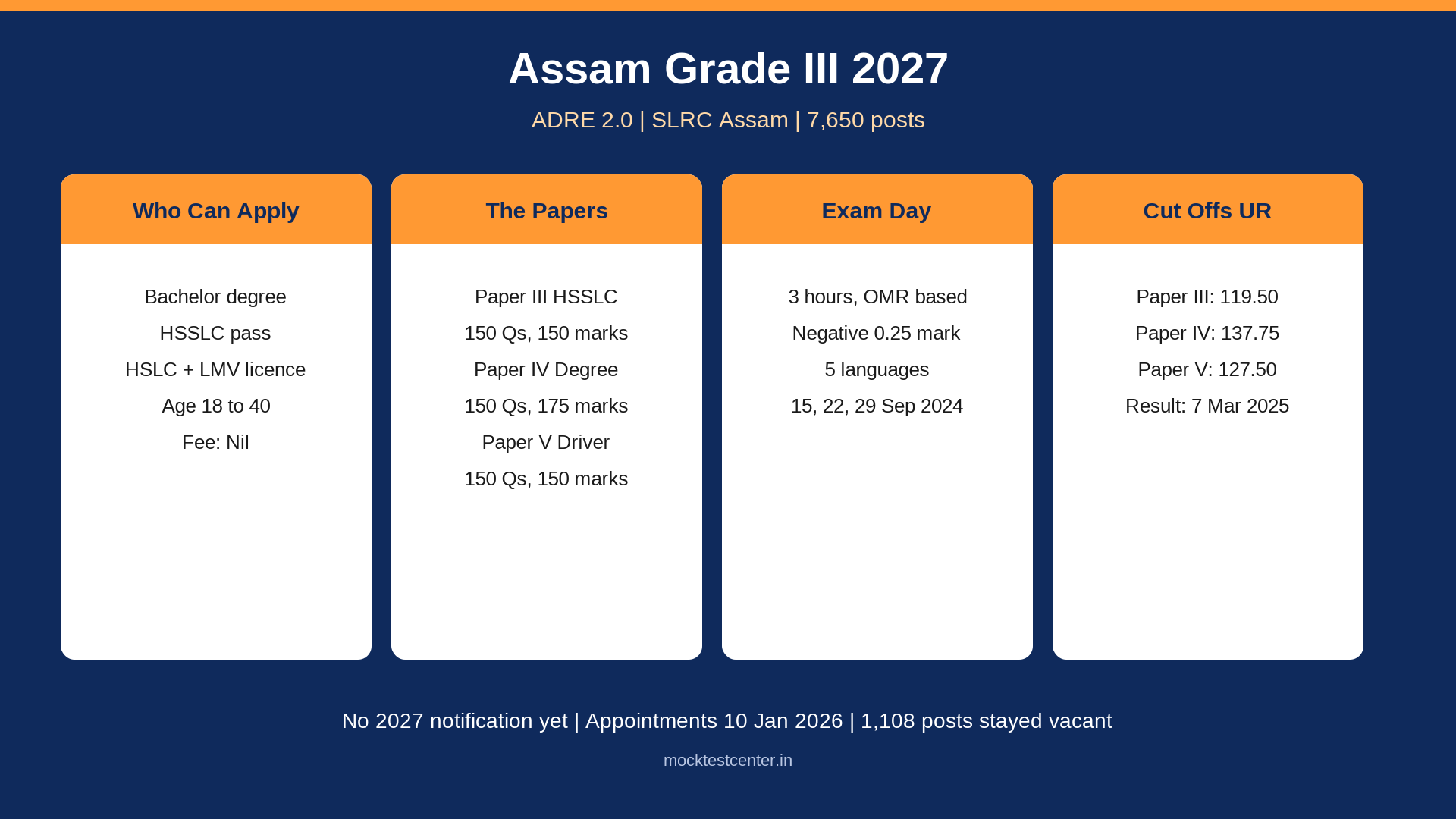
| Written examination | 15, 22 and 29 September 2024, OMR based, 150 questions, 3 hours, in Assamese, Bengali, Bodo, English and Hindi |
| Written result | 7 March 2025, with cut off marks published the same day |
| Final result | 10 October 2025 |
| Appointment letters | 10 January 2026, with a further round for Tea Tribe candidates on 12 January 2026 |
| 2027 notification | Not published as of 23 November 2026 |
Three papers, one grade, and the qualification that picks yours
Grade III runs as three papers, and the candidate's qualification decides which paper is sat. Category I is the Bachelor's degree level, for posts such as Accountant, Cashier, Junior Assistant and Stenographer. Category II is the HSSLC or Class 12 level, for posts such as Field Assistant, Fieldman, Foreman, Section Assistant and Agriculture Extension Assistant. Category III is the HSLC or Class 10 level, for Driver posts only, and it needs a valid LMV driving licence in addition to the HSLC pass.
Paper IV, the Bachelor's degree paper, carries 150 questions for 175 marks. Paper III, the HSSLC paper, carries 150 questions for 150 marks. Paper V, the Driver paper, also carries 150 questions for 150 marks. Every paper runs for 3 hours. Every paper is OMR based, with multiple choice questions and one correct option. The papers are set in Assamese, Bengali, Bodo, English and Hindi. A candidate applies for the category that matches the qualification held, and sits only that paper. The Assam Grade III exam pattern is the same across all three papers in duration and question count, and only the marks and the subject split change.
The difference between Paper IV and the other two papers is one section. Paper IV has 125 questions of 1 mark each and 25 questions of 2 marks each, and the 2 mark questions all sit in Reading Comprehension and English Language. That section alone is worth 50 marks out of 175, which is more than a quarter of the paper. Paper III and Paper V give 1 mark to every question. The subject split for Paper IV is Social Studies 30, General Knowledge 35, Logical Reasoning and Mental Ability 20, General Mathematics 30, General English 10, and Reading Comprehension and English Language 25 questions for 50 marks. The split for Paper III is Social Studies 30, General Knowledge 30, Logical Reasoning and Mental Ability 20, General Mathematics 35, and General English 35. The split for Paper V is Social Studies 20, General Knowledge 30, Logical Reasoning and Mental Ability 20, General Mathematics 30, General English 30, and Road Transport 20. The notification calls the subject wise counts approximate. The totals are fixed.
That 50 mark English section is the part of ADRE that most preparation advice gets wrong. Trackers that list the syllabus treat all six sections as equal weight. They are not equal. A graduate who scores well in Social Studies, General Knowledge and Mathematics but reads slowly will lose the paper in the last section. Reading comprehension at 2 marks a question punishes slow reading twice, once in marks and once in time, because the same 3 hours must cover 150 questions. The mock tests on this site follow the same split, so a candidate can find out now whether the English section is a strength or a leak.
The vacancy number that keeps changing
Ask five websites how many Grade III posts ADRE 2.0 advertised and you will get two answers. The original advertisements, issued in October 2023 and hosted on assam.gov.in, said 7,600 posts: Category I 4,055, Category II 3,127, and Category III Driver 418. Later pages, including the SLRC result coverage and several Assam job portals, say 7,650 posts: Category I 4,092, Category II 3,248, and Category III Driver 310. The total moved up by 50. Category I moved up by 37. Category II moved up by 121. The Driver figure moved down by 108.
Neither set of numbers is invented. The 7,600 figure is what the advertisements said when applications opened. The 7,650 figure is what the later record says, and the appointment arithmetic supports it. DY365 reported from the appointment ceremony figures that 6,347 Grade III candidates were appointed, plus 195 Tea Tribe candidates, leaving 1,108 posts vacant. Add those three numbers and the total is exactly 7,650. That is a strong check, and it is why this guide uses 7,650 as the headline figure and records the 7,600 advertisement figure alongside it, rather than picking one and hiding the other.
The combined ADRE 2.0 total has the same split. The advertisements said 12,600 posts across both grades. The later record says 12,673, which is 7,650 Grade III plus 5,023 Grade IV. The Grade IV side moved from 5,000 to 5,023 in the same revision. A candidate who quotes 12,600 is quoting the advertisement. A candidate who quotes 12,673 is quoting the revised record. Both need the sentence that explains which one they mean, and most pages on the internet skip that sentence entirely.
There is a second number worth knowing. More than 1,100 Grade III posts stayed vacant after the appointment ceremonies in January 2026, and candidates left out of the appointments appealed to the Chief Minister to fill them. A recruitment that advertises 7,650 posts and appoints about 6,540 has not finished its work when the ceremony photographs are taken. The vacant posts are a real fact about ADRE 2.0, and they are also the reason some candidates expect the next cycle to move sooner rather than later. Expectation is not a notification, and this guide does not turn it into one.
Who can apply, and the two conditions that catch people out
The age limit in ADRE 2.0 was 18 to 40 years as on 1 January 2023. The upper age limit was relaxed by 5 years for SC and ST candidates. The notification also carried relaxations for other categories, and the exact list should be read from the signed advertisement when the next cycle opens, because this guide could not verify the OBC, MOBC, PwD and ex serviceman figures from a source it trusts. Age is counted on the cut off date the notification states, not on the date of the examination, and a candidate who turns 41 between the cut off date and the examination date is still inside the limit if the cut off date is met.
Two conditions catch applicants out every cycle. The first is the Employment Exchange registration number in Assam. The application form asks for it, and a candidate without one has to register first. The second is the qualification ceiling, which works differently in the two grades. Grade IV has a maximum qualification of HSSLC, and a candidate holding a higher qualification on the date of application is not eligible for Grade IV at all. Grade III has no such ceiling. A graduate can apply for a Category II HSSLC level post in Grade III, but the same graduate cannot apply for a Grade IV post. Candidates who hold a degree and apply for both grades in the same cycle need to know that the Grade IV application will fail on qualification, and the form will not always explain why.
Indian citizenship is required. The qualification for each post is set post by post in the advertisement, and some posts add their own condition. Stenographer posts need stenography. Some Category I posts need a computer certificate or diploma of at least six months. Library posts need a library science degree. Driver posts need the LMV licence. The advertisement is the only document that lists these post wise conditions in full, and a candidate who applies on the basis of a tracker summary is applying blind.
No fee, and why that still confuses people
ADRE 2.0 charged no application fee at all. The advertisement said there will be no application fee for all categories of candidates, and the fee table in the notification shows Nil for UR, OBC, MOBC, SC and ST alike. ADRE 1.0 charged a fee, with different amounts by category, and that is where the confusion comes from. Tracker pages that still list a fee for ADRE are usually carrying the ADRE 1.0 table forward without checking whether it survived into ADRE 2.0. It did not.
The practical point is simple. A payment page that asks for money during an ADRE application is not the official form. The official application ran through the SLRC portals on the SEBA domain, and the only money a candidate should expect to spend is on documents, photographs and travel. The helpline number published with the ADRE 2.0 advertisements was 9582390056, open Monday to Saturday from 10 in the morning to 5 in the evening, for queries about the online application process.
The quarter mark that decides merit lists
Negative marking in ADRE 2.0 was a quarter of the question's marks for every wrong answer. A wrong 1 mark question cost 0.25 marks. A wrong 2 mark question in Paper IV cost 0.50 marks. There was no deduction for a question left blank. The rule is small on paper and large in practice, because the cut offs show how tight the merit lists run.
The written result of 7 March 2025 came with cut off marks for every paper and category. For Paper IV, the Bachelor's degree paper, the unreserved cut off was 137.75 out of 175. For Paper III, the HSSLC paper, the unreserved cut off was 119.50 out of 150, and 126.25 for HSSLC Science posts. For Paper V, the Driver paper, the unreserved cut off was 127.50 out of 150. Those are the marks needed to be called to the next stage, not the marks needed for a final appointment. The final merit came after skill tests, driving tests and interviews, and the final result was declared separately in October 2025.
Read the Paper IV number again. 137.75 out of 175 is close to 79 percent. A candidate who attempts all 150 questions and gets 12 wrong at 1 mark each loses 3 marks to negative marking, and that alone can move a candidate from above the cut off to below it. The candidates who clear ADRE are not the ones who attempt everything. They are the ones who know which questions to leave alone. The mock tests on this site carry the same negative marking, so the habit of skipping an unsure question can be built before the real paper, not during it.
The cut offs also show the gap between categories. In Paper III, the SC cut off was 110 against 119.50 for unreserved, and the ST Plains cut off was 107.25. In Paper IV, the SC cut off was 127.25 against 137.75 for unreserved. In Paper V, the figures follow the same shape. These are written examination cut offs for provisional shortlisting, published by the Commission in March 2025, and they are the best available guide to the standard the next cycle will demand. They are not a promise. A different vacancy count or a different paper will move them.
What ADRE 1.0 looked like, and why its numbers disagree too
ADRE 1.0 ran in 2022, under the Act that created the commission structure. The Act, the Assam Direct Recruitment Commissions for Analogous Posts in Class III and Class IV Act 2021, received the Governor's assent on 24 January 2022 and was published in the Assam Gazette on 27 January 2022. The Rules followed on 7 March 2022. Applications ran from 11 April to 7 June 2022, and 11,15,460 applications came in: 6,71,805 for Class III and 4,43,655 for Class IV. The written examinations were held on 21 and 28 August 2022, with the Driver paper on 11 September 2022. The written results came out in November 2022. Interviews and skill tests ran from December 2022 to February 2023. The final results were declared on 3 May 2023 for Class III and 4 May 2023 for Class IV.
The vacancy total for ADRE 1.0 is reported two ways, and the disagreement is bigger than the ADRE 2.0 one. Some trackers say 25,807 posts, split as 10,406 Class III, 1,105 Driver and 14,281 Class IV, which adds to 25,792, not 25,807. Others say 26,441 posts, split as 13,141 Grade III and 13,300 Grade IV. The 26,441 figure appears in the admit card coverage from August 2022, when the process was still running. The 25,807 figure appears in the result coverage from May 2023. The likeliest reading is that the advertised figure and the figure at result stage differed, as they did in ADRE 2.0, but no source read for this guide states the reason for the change in ADRE 1.0. This guide records both figures and the 15 post gap inside the 25,807 split, because a guide that quietly picks one number is doing its readers a disservice.
One thing ADRE 1.0 proves is the scale of the examination. More than 11 lakh applications for about 26,000 posts is a ratio of roughly 43 applicants per post. ADRE 2.0 drew applications in the tens of lakhs for 12,673 posts, a steeper ratio still. The written examination is the filter that does almost all of the work, because only a fraction of applicants reach the skill test stage. Preparation that starts with the skill test is preparation in the wrong order.
The two year wait, stage by stage
The ADRE 2.0 timeline is worth setting out in full, because it is the best predictor of what the next cycle will feel like. The advertisements were issued in October 2023. Applications opened on 10 November 2023 and closed on 29 December 2023. A correction window ran from 5 January to 18 January 2024. Admit cards for Grade III were released on 2 September 2024. The Grade III examinations were held on 15, 22 and 29 September 2024. The Grade IV examinations followed on 20 and 27 October 2024. The written results and cut off marks were published on 7 March 2025. Skill tests, driving tests and oral tests began on 16 June 2025. Document verification and committee hearings for shortlisted candidates were notified on 2 September 2025. The final results were declared on 10 October 2025 for Grade III and 15 October 2025 for Grade IV. Appointment letters were distributed on 9 January 2026 for Grade IV and 10 January 2026 for Grade III, with Tea Tribe candidates on 12 January 2026.
Two dates in that list carry a warning. The Driver paper date of 22 September 2024 is reported by Pratidin Time, while other trackers list only 15 and 29 September for Grade III. The Grade IV date of 20 October 2024 is reported by some trackers, while others list only 27 October, when both Grade IV papers were held in two shifts. This guide uses the fuller dates and flags the single source behind each one, because a candidate planning around a date should know how firm it is.
The long gap between the written examination and the final result is not an accident of one cycle. ADRE 1.0 took a similar shape, with written examinations in August 2022 and final results in May 2023, and ADRE 2.0 stretched further. The written paper is only the first stage. For most Grade III posts there is a skill test or computer test after it, and for Driver posts a driving test. Then comes document verification, then the merit list, then department allotment, then the appointment letter. A candidate who clears the written paper in the next cycle should expect months of waiting before the next call, and should keep every certificate ready in the meantime. The certificates that cause trouble are the caste certificate, the EWS certificate and the Employment Exchange registration, because the verification behind each one can take weeks, and the notification window is often shorter than that.
The syllabus, and where the marks actually sit
The syllabus for Grade III follows the five subjects in the paper, plus Road Transport for Driver posts. Social Studies covers Assam history, the literature of Assam, the geography of Assam, Indian history from ancient to modern times, the freedom struggle, the Indian Constitution, political systems, governance, Panchayati Raj, public administration, and basic economics. General Knowledge covers inventions, sports, basic computers, famous days and dates, famous books and authors, Indian Parliament, botany, chemistry, physics, zoology, Indian politics, geography, the Indian economy, environment and Indian culture, with current affairs running through all of it. General Mathematics is set at the Class 10 standard, and covers LCM and HCF, ratio and proportion, percentages, profit and loss, square roots, triangles, circles and quadrilaterals, trigonometric ratios, mixture and allegation, regular polygons, partnership, time and work, time and distance, simple and compound interest, and mensuration. Mental Ability and Logical Reasoning covers number series, coding and decoding, statement and argument, statement and assumption, logical deduction, cause and effect, and verbal reasoning. General English covers synonyms, antonyms, prepositions, sentence completion, active and passive voice, spelling, spotting errors, passage completion, substitution, sentence arrangement, transformation, idioms and phrases, sentence improvement, para completion, joining sentences, error correction, fill in the blanks, one word substitution, cloze tests and precis writing.
The weight of each subject is visible in the paper split, and the split rewards a particular kind of preparation. In Paper III, General English is 35 questions, the joint largest section with General Mathematics. In Paper IV, General Knowledge is 35 questions, the largest single mark section before the English comprehension block. Social Studies is 30 questions in both papers. Logical Reasoning is 20 questions in every Grade III paper. A candidate who spends equal time on all five subjects is spending too much time on reasoning and too little on the two sections that carry the most marks. The mock tests on this site follow the same section weights, so the score report shows the gap in the same shape the real paper will.
For Driver posts, Road Transport is 20 questions out of 150. It is the only section in any Grade III paper that tests job knowledge rather than general ability, and it is the section a Driver candidate can prepare fastest, because the Motor Vehicles Act, road signs, traffic rules and basic vehicle maintenance form a closed set of topics. A Driver candidate who ignores it is giving away more than 13 percent of the paper.
Pay, and the two figures that circulate for it
The ADRE 2.0 advertisements did not print a salary table. They said the scale of pay would be the pay band and grade pay of the post as per the Assam Services (Revision of Pay) Rules 2017, as amended. The post wise pay depends on the post, and it varies inside Grade III. The common figure for a Junior Assistant is Pay Band 2, Rs 14,000 to Rs 70,000, with grade pay of Rs 6,200. Other Grade III posts carry grade pay of Rs 5,600 or Rs 8,700, with the same pay band. Some tracker pages still quote Rs 14,000 to Rs 60,500, which was the pre revision pay band ceiling. The 70,000 figure is the one used in current Government of Assam advertisements, and this guide uses it, while recording the 60,500 figure as the older ceiling that still circulates.
Gross monthly salary for a Grade III post is commonly reported in the region of Rs 30,000 to Rs 40,000, depending on posting location, dearness allowance and house rent allowance, with in hand pay after NPS and professional tax deductions commonly reported between Rs 26,000 and Rs 35,000. Those are tracker estimates, not notified figures, and they move with dearness allowance revisions. The starting basic for a Junior Assistant is Rs 20,200, which is the pay band minimum of Rs 14,000 plus grade pay of Rs 6,200, before allowances. That is the only salary number in this guide that can be worked out from the notified pay structure itself.
How to prepare when there is no notification yet
The honest position for a Grade III aspirant in November 2026 is that the examination to prepare for is the ADRE 2.0 paper, because it is the only paper that exists. The pattern, the syllabus and the cut offs are all known for that cycle, and the next notification can change any of them, but it is unlikely to change the shape of the examination. Three papers by qualification level, 150 questions, 3 hours, OMR based, negative marking of a quarter mark, five subjects plus Road Transport for drivers: that shape has held across both cycles, and the ADRE 3.0 notification, when it comes, will most likely confirm it with new dates and new vacancy numbers.
Preparation should start with the previous year papers. ADRE 1.0 and ADRE 2.0 papers are available with answer keys, and the 2024 papers are the closest model of the next examination. Work them under the real conditions: 3 hours, OMR sheet if possible, negative marking applied, and the English comprehension section timed separately, because it is the section where time runs out first. Then take mock tests in the same pattern and read the section wise score, not the total. A total of 120 out of 150 in Paper III looks safe until the section split shows 15 out of 35 in English. The cut off for Paper III was 119.50 for unreserved candidates, so a candidate scoring 120 overall with a weak section is standing on the edge, not safely past it.
Assam specific preparation deserves a separate note. Social Studies and General Knowledge together are 60 questions in Paper III and 65 in Paper IV, and a large share of those questions is about Assam: its history, its geography, its literature, its writers and heroes, and its current affairs. A candidate who prepares from a national level book alone will miss the Assam share of the paper. The state level material is the difference between a candidate from Assam and a candidate who happens to live in Assam, and the paper rewards the first one.
Keep the documents ready while waiting. Employment Exchange registration, caste certificate, EWS certificate, qualification certificates, and for Driver posts the LMV licence. Check the SLRC Grade III portal directly, at slrcg3.sebaonline.org, and the Government of Assam portal at assam.gov.in, rather than waiting for a tracker to report the notification. The notification will appear on those two domains first, and every day spent waiting for a third party to report it is a day lost from the application window, which ran for 50 days in ADRE 2.0 and may run shorter next time.
Take the mock tests on this page in the ADRE 2.0 pattern, with the same 150 questions, the same 3 hours and the same negative marking. The first test will show where the marks are leaking. Fix the leak, take the next test, and keep going until the section scores clear the 2025 cut offs with room to spare. That is the whole plan, and it works whether the notification comes in January or in June.
Mock tests for Assam Grade III 2027: Full Tests, PYQ, Chapter Tests, Sectional Tests, NCERT-based Tests, Current Affairs and PYQ PDF Downloads
The full test on this page follows the paper the candidate's qualification picks. Paper IV, the Bachelor's degree paper, carries 150 questions for 175 marks. Paper III, the HSSLC paper, carries 150 questions for 150 marks. Paper V, the Driver paper, also carries 150 questions for 150 marks. Every paper runs for 3 hours on OMR, in Assamese, Bengali, Bodo, English and Hindi. Negative marking costs a quarter of the question marks for every wrong answer, 0.25 marks on a 1 mark question and 0.50 marks on a 2 mark question, with no deduction for a question left blank. The unreserved cut offs from the March 2025 result show the standard: Paper IV 137.75 out of 175, Paper III 119.50 out of 150 and Paper V 127.50 out of 150.
The previous year papers on this tab come from the two ADRE cycles. ADRE 1.0 ran its papers on 21 and 28 August 2022, with the Driver paper on 11 September 2022. ADRE 2.0 ran the HSSLC paper on 15 September 2024 and the Bachelor paper on 29 September 2024, with the Driver paper on 22 September 2024 as reported by Pratidin Time. The papers are available with answer keys. The SLRC Grade III portal at slrcg3.sebaonline.org and the Government of Assam portal at assam.gov.in carry the notification first, and the tab carries the ADRE 1.0 and ADRE 2.0 papers with answer keys as they are available. No download link appears here for a paper the Commission has not published.
Chapter tests follow the subject split of each paper. Paper IV carries Social Studies 30, General Knowledge 35, Logical Reasoning and Mental Ability 20, General Mathematics 30, General English 10, and Reading Comprehension and English Language 25 questions worth 50 marks. Paper III carries Social Studies 30, General Knowledge 30, Logical Reasoning and Mental Ability 20, General Mathematics 35 and General English 35. Paper V carries Social Studies 20, General Knowledge 30, Logical Reasoning and Mental Ability 20, General Mathematics 30, General English 30 and Road Transport 20. The notification calls the subject counts approximate, and the totals are fixed.
Sectional tests group the chapters the way each paper groups them, with one section per subject. The English comprehension section in Paper IV gets its own timed practice, because it carries 50 marks out of 175, more than a quarter of the paper, and time runs out there first. A graduate who scores well in Social Studies, General Knowledge and Mathematics but reads slowly will lose the paper in that last section.
NCERT school books form the base for the school level subjects in these papers. NCERT Class 6 to 10 mathematics covers the Class 10 standard of the General Mathematics section. NCERT science and social science cover the General Knowledge base. The Assam share needs state material beyond NCERT: Assam history, Assam geography, Assam literature, Assam writers and heroes, and Assam current affairs. A candidate who prepares from a national level book alone will miss the Assam share of the paper.
Current affairs tests cover Assam and national events from the last 12 months, running through General Knowledge and Social Studies in all three papers. Social Studies and General Knowledge together carry 60 questions in Paper III and 65 in Paper IV, and a large share of those questions is about Assam.
Sources
AssamJobDesk, ADRE Assam Direct Recruitment Complete Guide, ADRE 2.0 notified 12,673 posts, 7,650 Grade III and 5,023 Grade IV, results Grade III 10 October 2025 and Grade IV 15 October 2025, appointment letters Grade IV 9 January 2026 and Grade III 10 January 2026 with a further round 12 January 2026, ADRE 3.0 not notified, Act 2021 assent 24 January 2022 and Gazette 27 January 2022, Rules 2022 Gazette 7 March 2022, portals slrcg3.sebaonline.org and slrcg4.sebaonline.org. AssamJobOnline, Assam Direct Recruitment 2025, 12,673 posts, Grade III 7,650 with Category I 4,092, Category II 3,248 and Category III Driver 310, Grade IV 5,023 with Class VIII 2,102, HSLC 1,088 and HSLC with ITI 1,833, age 18 to 40 years as on 1 January 2023, applications 10 November to 29 December 2023, written result 7 March 2025, skill tests from 16 June 2025, final results 10 and 15 October 2025. AssamCareer, Assam Direct Recruitment 2023, 12,600 posts, Grade III 7,600 and Grade IV 5,000, no application fee for any category, applications 10 November to 29 December 2023, correction window 5 to 18 January 2024, pay as per Assam Services (Revision of Pay) Rules 2017, helpline 9582390056. NENow, Assam Direct Recruitment, 12,600 Grade III and Grade IV posts, Grade III Category I 4,055, Category II 3,127, Category III 418, Grade IV HSLC 1,060, HSLC with ITI 1,990, Class VIII 1,950, age 18 to 40 years as on 1 January 2023 with 5 years relaxation for SC and ST candidates, maximum qualification for Class IV HSSLC, advertisements hosted on assam.gov.in. CareerPower, ADRE Syllabus and Exam Pattern 2026, Paper III 150 questions and 150 marks, Paper IV 150 questions and 175 marks, Paper V 150 questions and 150 marks, 3 hours, OMR based, negative marking 0.25 for 1 mark questions and 0.50 for 2 mark questions, subject splits for all three Grade III papers, languages Assamese, Bodo, Bengali, English and Hindi. Ankuron ACS Academy, ADRE Grade 3 Coaching, ADRE 3.0 not notified as of 21 September 2026, Grade III vacancies Category I 4,055, Category II 3,127 and Driver 418, Bachelor paper held 29 September 2024, unreserved cut offs Paper IV 137.75 out of 175, Paper III 119.50 out of 150, Paper V Driver 127.50 out of 150, no application fee, negative marking 0.25. ExamNotify, ADRE Grade 3 and Grade 4 Cut Off Marks, written result 7 March 2025, Paper III unreserved 119.50 and HSSLC Science 126.25, Paper IV unreserved 137.75 and Bachelor with Computer 117, Grade IV Paper I unreserved 91.50 and Paper II 99.75. TestBook, ADRE Result 2025, result 7 March 2025, Grade III examinations 15 and 29 September 2024, Grade IV examination 27 October 2024. Pratidin Time, ADRE Admit Card 2024, Grade III examinations 15, 22 and 29 September 2024, Grade IV examinations 20 and 27 October 2024, admit cards from 2 September 2024. DY365, Over 1,000 ADRE 2.0 Posts Remain Vacant, 7,650 Grade III and 5,000 Grade IV advertised, 6,347 Grade III and 4,378 Grade IV appointed, 1,108 Grade III and 628 Grade IV posts vacant, 292 Tea Tribe candidates selected. AssamCareer, Assam Direct Recruitment Result, ADRE 1.0 25,807 posts, written examinations August and September 2022, interviews and skill tests December 2022 to February 2023, final results 3 May 2023 for Class III and 4 May 2023 for Class IV, 11,15,460 applications. Jiwika, ADRE Previous Year Question Papers, ADRE 1.0 Grade III papers 21 and 28 August 2022, ADRE 2.0 HSSLC 15 September 2024, Bachelor 29 September 2024, Grade IV 27 October 2024 in two shifts. AlertAssam, Assam Prepares for ADRE 3.0, ADRE 2.0 12,673 posts across 50 departments, applications 10 November to 29 December 2023, results 10 and 15 October 2025, appointments 9 and 10 January 2026, ADRE 3.0 expected 12,000 to 15,000 posts with no official notification. AssamJobAlerts, ADRE 3.0 Recruitment News, Grade III pay scale Rs 14,000 to Rs 60,500 with grade pay Rs 6,200, gross salary commonly Rs 30,000 to Rs 40,000, in hand commonly Rs 26,000 to Rs 35,000. TheJobinAssam, KAAC Handloom and Textiles Recruitment 2026, Grade III Pay Band 2 Rs 14,000 to Rs 70,000 with grade pay Rs 6,200 to Rs 8,700, Grade IV Pay Band 1 Rs 12,000 to Rs 52,000 with grade pay Rs 3,900.







