
About APSC CCE 2027 Exam Series
📖 Table of Contents
- The year on the notice never matches the year of the exam
- CCE 2025 post by post: 78 posts, 11 services
- Who can apply, and who cannot
- The paper itself: prelims, mains, interview
- The fee, and the second date most people miss
- 78 posts after 289: what the drop means
- Assam specific studies: the part that decides Paper I
- How CCE compares with the other Assam exams
- A 90 day plan built around the real papers
- What to watch before the next notice
- Mock tests for APSC CCE 2027: Full Tests, PYQ, Chapter Tests, Sectional Tests, NCERT-based Tests, Current Affairs and PYQ PDF Downloads
- Sources
APSC CCE 2027 Mock Test: Complete Guide to the Assam Combined Competitive Examination
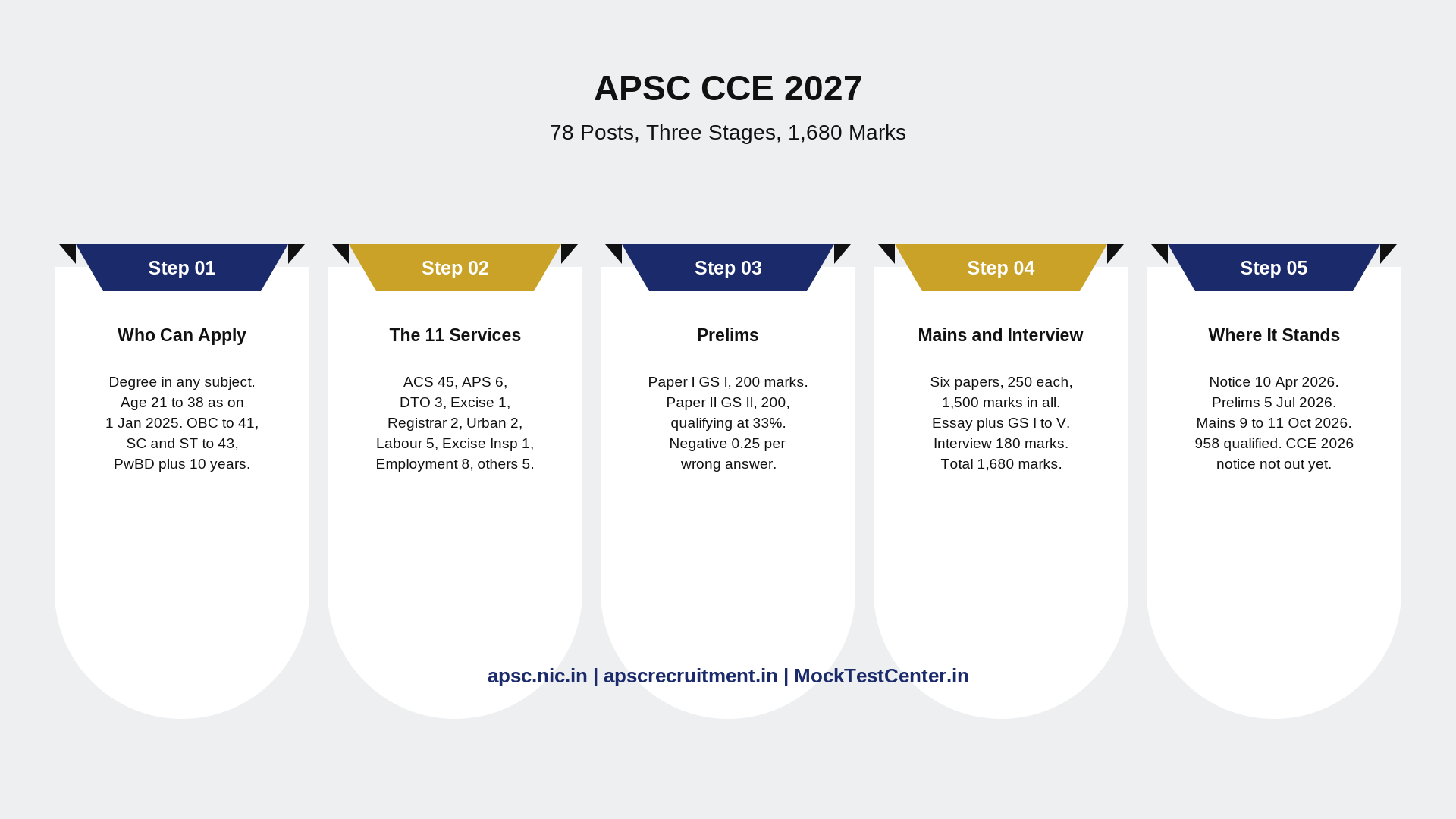
APSC CCE 2027 is the page candidates look for when they want the next Assam Combined Competitive Examination, and the short version is this: the latest cycle, CCE 2025, offered 78 posts, ran its prelims on 5 July 2026 and its mains on 9, 10 and 11 October 2026, and the next notice, CCE 2026, had not appeared as of 23 November 2026. This APSC CCE mock test guide works from that cycle, because it carries the only full paper trail available right now, and it clears up the year confusion that makes half the pages on Google wrong about which exam they describe.
The Assam Public Service Commission runs this exam to fill the state civil services in one stroke. One notice covers the Assam Civil Service, the Assam Police Service and nine smaller services. A graduate in any subject can apply. The selection runs in three stages, prelims, mains and interview, and the prelims only screens candidates. Marks from the prelims never enter the final merit list. That single fact shapes how a serious candidate should spend time, and this guide returns to it more than once.
Read the dates in this guide as the dates of the CCE 2025 cycle, not as promises about the next one. APSC has published one CCE notice every 12 to 15 months, in December 2022, January 2024, March 2025 and April 2026. The next notice should follow the same rhythm, and one careful tracker puts the expected window at April to June 2027. That window is an estimate, not an official date. APSC has announced no date for CCE 2026.
The year on the notice never matches the year of the exam
APSC names each exam after the year its vacancies belong to, and it publishes the notice in the next year. The mismatch confuses almost everyone the first time. CCE 2025 came out in April 2026. CCE 2024 came out in March 2025. CCE 2023 came out in January 2024. So a candidate who searches for APSC CCE 2027 today will find pages about four different exams, and most of them carry the wrong year in the title. The table below pins each cycle to its notice, so you can check any page against it in seconds.
| Cycle | Advertisement | Notice date | Applications | Prelims | Posts |
|---|---|---|---|---|---|
| CCE 2025 | Advt. 01/2026 | 10 Apr 2026 | 13 Apr to 3 May 2026 | 5 Jul 2026 | 78 |
| CCE 2024 | Advt. 12/2025 | 23 Mar 2025 | 28 Mar to 29 Apr 2025 | 8 Jun 2025 | 289 |
| CCE 2023 | Advt. 02/2024 | 12 Jan 2024 | 17 Jan to 6 Feb 2024 | 18 Mar 2024 | 235 |
| CCE 2022 | Advt. 26/2022 | 22 Dec 2022 | 26 Dec 2022 to 26 Jan 2023 | 26 Mar 2023 | 793 |
The CCE 2024 row needs a note, because two numbers circulate for it and both look official. The advertisement listed 262 posts. APSC then added 27 Assam Finance Service posts on 29 March 2025, which took the cycle to 289. Pages that print 262 stopped reading at the advertisement. Pages that print 289 counted the addition. The final result for CCE 2024 came out on 17 February 2026, and it covered 289 posts. Use 289 when you compare cycles, and treat 262 as the advertisement figure only.
CCE 2025 moved fast once the prelims ended. APSC declared the prelims result and opened mains applications from 4 to 24 August 2026, with fee payment to 26 August 2026. A total of 958 candidates qualified in the prelims. The mains ran in Guwahati on 9, 10 and 11 October 2026, two papers each day. The interview stage follows, and the final result comes after that. The 958 figure matters for anyone judging the odds: 958 candidates chased 78 posts at the mains stage, about 12 for each post.
One more naming trap deserves a line. Several job sites label the March 2025 notice as CCE 2025, because the notice came out in 2025. That notice is CCE 2024, Advt. 12/2025, and its prelims ran on 8 June 2025. If a page tells you CCE 2025 had 262 posts, or that its last date was 29 April 2025, you are reading about CCE 2024 under the wrong name. The real CCE 2025 has 78 posts and a last date of 3 May 2026.
CCE 2025 post by post: 78 posts, 11 services
The 78 posts split across 11 services, and the split explains where the competition sits. Assam Civil Service (Junior Grade) took 45 of the 78, more than half the cycle. Assam Police Service (Junior Grade) took 6. The other nine services shared the remaining 27. A candidate who only wants ACS faces the largest pool of seats and the largest pool of applicants. A candidate open to the smaller services faces fewer seats but also fewer rivals who list them first.
| Service | Posts | Pay scale | Grade pay |
|---|---|---|---|
| Assam Civil Service (Jr. Grade) | 45 | Rs 30,000 to Rs 1,10,000 | Rs 13,300 |
| Assam Police Service (Jr. Grade) | 6 | Rs 30,000 to Rs 1,10,000 | Rs 13,300 |
| District Transport Officer | 3 | Rs 30,000 to Rs 1,10,000 | Rs 13,300 |
| Superintendent of Excise | 1 | Rs 30,000 to Rs 1,10,000 | Rs 13,300 |
| Assistant Registrar of Cooperative Societies | 2 | Rs 30,000 to Rs 1,10,000 | Rs 12,700 |
| Assam Urban Administrative Service (EO, Jr. Gr. II) | 2 | Rs 30,000 to Rs 1,10,000 | Rs 12,700 |
| Inspector of Labour | 5 | Rs 22,000 to Rs 97,000 | Rs 9,400 |
| Inspector of Excise | 1 | Rs 22,000 to Rs 97,000 | Rs 9,400 |
| Assistant Employment Officer | 8 | Rs 22,000 to Rs 97,000 | Rs 9,400 |
| Sub-Registrar | 4 | Rs 22,000 to Rs 97,000 | Rs 9,400 |
| Research Assistant (Border Protection and Development) | 1 | Rs 22,000 to Rs 97,000 | Rs 9,400 |
The pay bands split the 11 services into two groups. ACS, APS, the District Transport Officer, the Superintendent of Excise, the Assistant Registrar and the Urban Administrative Service sit in the higher band, Rs 30,000 to Rs 1,10,000 with grade pay of Rs 12,700 or Rs 13,300. The five inspector level services sit in the lower band, Rs 22,000 to Rs 97,000 with grade pay of Rs 9,400. The advertisement also reserves 14 of the 78 posts for women and 3 for persons with benchmark disabilities, and the category split runs to 42 unreserved, 14 OBC or MOBC, 8 SC, 7 ST (Plains), 7 ST (Hills) and 3 PwBD.
Compare this with CCE 2024 and the shape of the exam changes. CCE 2024 offered 20 Assam Police Service posts against 6 in CCE 2025, 51 Inspector of Taxes posts against none, 26 Assam Finance Service posts against none, and 23 Assistant Manager or Assistant Industries Officer posts against none. The 2025 cycle dropped the tax, finance and industries posts entirely. A candidate who prepared for the 2024 vacancy mix and assumed the same mix would return has already made a planning error. Read the next advertisement post by post before choosing a service preference.
Who can apply, and who cannot
The degree rule is simple and it is also the rule that ends the most applications. A candidate must hold a degree from a university recognised by the UGC or set up by an Act of a Central or State Legislature, or a qualification the Government declares equivalent, and must hold it on the date of submission of the application. A final year student who expects the degree later cannot apply. The advertisement states the condition in those words, and APSC checks it at the mains stage when candidates submit documents.
Age runs from 21 to 38 years as on 1 January 2025 for CCE 2025. The upper limit relaxes by 3 years for OBC and MOBC candidates, to 41, by 5 years for SC, ST (Plains) and ST (Hills) candidates, to 43, and by 10 years for PwBD candidates. The age counts on 1 January of the vacancy year, not on the date of the notice or the exam, which catches out candidates who turn 39 between the notice and the prelims. Check the age against 1 January 2025 for this cycle, and against 1 January of the vacancy year for the next one.
APSC accepts applications only online, through apscrecruitment.in, and the portal is the only place the form exists. The commission publishes the advertisement on apsc.nic.in and opens the link on the recruitment portal. Candidates who apply through any other site hand their fee to a stranger. The application window for CCE 2025 ran for 21 days, 13 April to 3 May 2026, and APSC gave no extension. Short windows are the pattern now: CCE 2024 allowed 32 days, CCE 2023 allowed 21 days. Keep documents ready before the notice lands, because the window will not wait for a degree certificate to arrive by post.
The paper itself: prelims, mains, interview
The prelims has two objective papers, and only one of them counts for ranking at that stage. Paper I, General Studies I, carries 200 marks in 2 hours. Paper II, General Studies II, also carries 200 marks in 2 hours, but it works as a qualifying paper: a candidate must score at least 33 percent in it, and its marks do not count for ranking. The two papers together total 400 marks. Each wrong answer loses one fourth of a mark, and marking more than one option counts as wrong. The prelims works as a screen. APSC calls about 12 candidates per post for the mains, and the prelims marks die at that point.
That qualifying paper changes how to divide revision time. Paper II decides whether a candidate survives, and nothing more. A candidate who scores 90 percent in Paper II and 40 percent in Paper I still fails, because Paper I ranks candidates. A candidate who scores exactly 33 percent in Paper II and tops Paper I still advances. Spend enough time on Paper II to clear 33 percent with room to spare, then put the bulk of the hours into Paper I, because Paper I alone picks the mains list.
The mains has six descriptive papers of 250 marks each, 1,500 marks in all, and every paper runs 3 hours. Paper 1 is the Essay. Papers 2 to 6 are General Studies I to V. APSC runs no optional subject in this pattern, which separates Assam from several other state services that still keep one. Candidates may write answers in English or Assamese. The mains ran over three days in October 2026, 9, 10 and 11 October, with two papers each day: Essay and GS I on day one, GS II and GS III on day two, GS IV and GS V on day three.
The interview carries 180 marks, and the final merit adds the mains and the interview together for 1,680 marks. APSC calls candidates for interview in a 1 to 3 ratio against vacancies. The interview tests personality and judgment rather than recall, and at 180 marks it can move a candidate several ranks either way. A candidate who treats the interview as a formality gives away the one stage where preparation time is short and the return is high.
Mock tests should mirror this shape, not some other state's shape. A good APSC CCE mock test set gives two 200 mark prelims papers with a 33 percent qualifying line on the second, then six 250 mark descriptive papers with 3 hour sittings. Most free mock tests online only cover the prelims. The prelims is the easy half to imitate and the smaller half of the marks. A candidate who never sits a full 3 hour descriptive paper before October discovers the problem in the hall, where it costs the most.
The fee, and the second date most people miss
APSC charges the fee by category, and the processing fee sits inside every figure. General candidates pay Rs 297.20, which breaks down as a Rs 250 application fee plus a Rs 47.20 processing fee. OBC and MOBC candidates pay Rs 197.20, which is Rs 150 plus Rs 47.20. SC, ST, BPL, PwBD and women candidates of all categories pay only the processing fee of Rs 47.20. The same fee table applied to the Junior Engineer advertisement of 2025, so APSC holds this structure across its recruitments.
The date that trips people up is the fee date. For CCE 2025 the form closed on 3 May 2026 at 5 PM, and the fee payment closed on 5 May 2026. The two extra days help candidates whose payment fails on the last day, and they also create a trap: a candidate who submits the form on 3 May and assumes the fee can wait a week loses the application. Pay on the same day as the form, and treat the extra two days as a rescue window, not as part of the plan.
The mains application carried its own fee and its own window, 4 to 24 August 2026, with fee payment to 26 August 2026. Only the 958 prelims qualifiers could apply, and the mains form asked for documents the prelims form never did. Candidates who qualified in July and waited for a reminder lost days. APSC publishes the mains notice on apsc.nic.in and expects qualifiers to watch for it. No email or SMS carries the responsibility.
78 posts after 289: what the drop means
The fall from 289 posts in CCE 2024 to 78 in CCE 2025 is the largest single year drop in the four cycles on record, and it changes the arithmetic of the whole exam. CCE 2022 offered 793 posts, though 415 of those were Assistant Accounts Officer posts in one service. CCE 2023 offered 235. CCE 2024 offered 289. CCE 2025 offered 78. The vacancy count has fallen in three of the four steps, and the 2025 cycle is the smallest CCE since the current pattern began.
The drop does not mean the exam got harder in content. It means the same paper now filters far more candidates per seat. CCE 2024 drew 57,222 submitted applications for 262 advertised posts, and CCE 2025 called 958 candidates to the mains for 78 posts. A smaller cycle also means a narrower service mix: no Inspector of Taxes, no Assam Finance Service, no Assistant Manager or Industries Officer posts in 2025. Candidates who aimed at those services in 2024 found no equivalent door in 2025, and the next notice may or may not bring them back.
One reading of the numbers helps more than the rest. The Assam Civil Service kept 45 posts in both 2024 and 2025, while almost every other service shrank or vanished. ACS is the stable core of this exam. A candidate who prepares for ACS specifically, rather than for the CCE in general, faces the same 45 seats in either cycle. A candidate who aimed at the smaller services faces a lottery that changes every year. Pick the service first, then read the vacancy table, not the other way round.
Assam specific studies: the part that decides Paper I
Paper I rewards candidates who know Assam, and it punishes candidates who revise only national material. The state specific share of the paper covers the history of Assam from the Ahom period to the present, the geography of the Brahmaputra valley and the Barak valley, the economy of tea, oil, agriculture and handloom, and the polity of the Sixth Schedule areas. A candidate who can name the districts, the rivers and the major towns has a base. A candidate who can also explain why the Brahmaputra floods every year and what the embankments do has an edge. The difference between those two candidates is about ten questions, and ten questions decide the mains list.
Current affairs need the same Assam focus. Follow the state budget, the major state schemes, the recruitment drives themselves and the decisions of the Gauhati High Court for the 12 months before the prelims. National current affairs still matter, but they matter less than most coaching material suggests. APSC sets this paper for Assam, and the paper shows it. Read one Assam daily, in English or Assamese, every morning, and keep a notebook of one line per story with the date. The notebook becomes the revision material in the last fortnight, when no new reading helps.
History deserves a separate note, because it is where candidates waste the most time. The Ahom period, the colonial period and the language movement all appear, but the questions test facts rather than interpretation. Dates of treaties, names of kings, the sequence of events in the Assam movement: these are the questions. Read a standard Assam history text once, make a timeline of 40 dates, and revise the timeline weekly. A timeline of 40 dates beats a second reading of a 300 page book, because the paper asks for the dates.
Geography works the same way. Learn the tributaries of the Brahmaputra in order, the national parks and wildlife sanctuaries with their districts, the major industries with their locations, and the census figures for Assam that the state economic survey publishes. Kaziranga, Manas, Nameri, Orang and Dibru Saikhowa appear so often that a candidate who cannot place all five on a map is giving away marks. Draw the map by hand once a week until the districts sit in the right places without thinking.
The English and Assamese option in the mains changes the preparation for candidates who write in Assamese. The essay paper allows either language, and the General Studies papers allow either language too. A candidate who writes better in Assamese should write in Assamese, because the marks reward clarity rather than language choice. The risk runs the other way: candidates who write in English because it looks more serious, while their English is weaker than their Assamese, lose marks on every paper. Choose the language you think in, not the language you admire.
How CCE compares with the other Assam exams
CCE sits at the top of the Assam ladder, and the comparison with the other exams on this site shows why. The Assam Direct Recruitment Examination fills Grade III and Grade IV posts with a single objective paper and no interview, and its age window runs to 40 years. The Assam Police Constable and Sub Inspector recruitments add physical tests and run through the State Level Police Recruitment Board. The Assam Teacher Eligibility Test only certifies eligibility and fills no post by itself. CCE alone among the ten asks for six descriptive papers and an interview, and CCE alone leads to the state civil services.
The pay gap matches the paper gap. An ACS officer starts in the band of Rs 30,000 to Rs 1,10,000 with grade pay of Rs 13,300. A constable starts at Rs 14,000 to Rs 70,000 with grade pay of Rs 5,600. A Grade III clerk starts lower still. The CCE paper is longer and harder because the job carries more authority, and the authority is the reason the competition is fiercer. A candidate who wants the CCE should want the job, not only the salary, because the interview board will ask which service and why, and a salary answer ends the conversation.
One practical overlap helps candidates who sit more than one Assam exam. The general studies base for CCE Paper I covers most of the ADRE Grade III Bachelor level paper, most of the Assam Police SI written paper and a large part of the Assam TET Paper II social studies section. The same Assam history, geography, polity and current affairs appear in all four. A candidate who prepares for CCE first can sit the ADRE and police papers with a few weeks of extra work on their specific patterns. The reverse does not hold: ADRE preparation alone leaves a candidate far short of the CCE mains.
A 90 day plan built around the real papers
Start with the prelims, because it comes first and it kills the most candidates. Give Paper I six days a week and Paper II one day a week for the first month. Paper I needs Assam specific general studies: the history of Assam, its geography, its economy, its polity and its current affairs, plus national general studies and mental ability. Paper II needs comprehension, reasoning and basic numeracy at a level that clears 33 percent with room to spare. Test Paper I weekly under 2 hour conditions from week two. Test Paper II once a fortnight, because overinvesting in a qualifying paper is the most common waste of hours in this exam.
Move to the mains in the second month, while the prelims is still fresh. The mains rewards writing speed more than reading volume, and writing speed only grows by writing. Draft one essay a week and one General Studies answer set a week, each inside 3 hours, on paper, by hand. The jump from reading notes to writing 250 mark papers in 3 hours surprises candidates who prepare only with objective tests. Six papers mean six sittings of 3 hours, and the hand that has never written for 3 hours at a stretch will slow down in the third paper of the day.
Use the last month for full length rehearsal. Sit two prelims papers back to back on Saturdays, exactly as the real day runs, with negative marking applied and the 33 percent line checked on Paper II. Sit one mains paper each weekday morning, and spend the afternoon marking it against the syllabus rather than against a model answer. Keep one day a week for Assam current affairs, because the state specific questions reward candidates who followed the last 12 months of Assam news and punish candidates who revised only national material.
The interview needs a different kind of work, and it needs it early. Read the services you listed, know what a District Transport Officer actually does, and know what an Inspector of Labour actually inspects. Interview boards in Assam ask about the state, about the service, and about the candidate's own degree subject. A graduate in history who cannot connect the Ahom administration to the present district system has wasted a degree. Prepare three honest answers about why you want the service, and drop any answer that could apply to any state in India.
What to watch before the next notice
Watch two sites and ignore the rest until the notice lands. The advertisement appears on apsc.nic.in, and the application opens on apscrecruitment.in. Job sites will report the notice within hours, and most of them will get the year wrong in the title, as they did with CCE 2024. Check the advertisement number before trusting any summary. CCE 2026 will carry its own number, and the vacancy year in the title will read 2026.
The expected window of April to June 2027 comes from the gap between the last four notices, not from any APSC announcement. APSC took 13 months between the CCE 2024 and CCE 2025 notices, and 15 months between CCE 2023 and CCE 2024. The CCE 2025 mains finished in October 2026, and the interview and final result still lie ahead. A notice before the final result would break the recent pattern. Keep documents ready from February 2027, and check apsc.nic.in weekly from April.
One last check before you apply. Confirm the degree rule against your own certificate, confirm the age against 1 January of the vacancy year, and confirm the fee category before you pay. The APSC CCE 2027 page on this site will update when the CCE 2026 notice appears, with the new advertisement number, the new vacancy table and the new dates. Until then, the CCE 2025 cycle in this guide is the closest picture of the exam you will face.
Mock tests for APSC CCE 2027: Full Tests, PYQ, Chapter Tests, Sectional Tests, NCERT-based Tests, Current Affairs and PYQ PDF Downloads
The mock test page for APSC CCE 2027 carries seven tabs, each with a different job. The tabs below follow the real pattern of the exam.
The Full Tests tab copies the CCE 2025 pattern. A full prelims test gives General Studies I and General Studies II, 200 marks each in 2 hours, with Paper II qualifying at 33 percent, its marks not counted for ranking. Each wrong answer loses one fourth of a mark. A full mains test gives six descriptive papers of 250 marks each, 1,500 in all, each 3 hours: the Essay and General Studies I to V, with no optional subject. The interview carries 180 marks, and the final merit totals 1,680.
The Previous Year Papers tab works from the four cycles named in this guide: CCE 2025, prelims 5 July 2026 and mains 9, 10 and 11 October 2026; CCE 2024, prelims 8 June 2025; CCE 2023, prelims 18 March 2024; and CCE 2022, prelims 26 March 2023. APSC publishes the papers for these cycles, and the tab carries the prelims and mains papers from them. The mains papers are descriptive, so treat each one as a writing task.
The Chapter Tests tab breaks the syllabus into chapters, so a weak chapter can be fixed without a full retake. The chapters come from the syllabus in this guide: the history of Assam, the geography of the Brahmaputra valley and the Barak valley, the tributaries of the Brahmaputra, the national parks Kaziranga, Manas, Nameri, Orang and Dibru Saikhowa, the economy of tea, oil, agriculture and handloom, the polity of the Sixth Schedule areas and the Constitution, and Paper II skills: mental ability, comprehension, reasoning and basic numeracy.
The Sectional Tests tab sits between chapter tests and full tests. Each section matches one paper: Prelims Paper I and Prelims Paper II, and the Essay and General Studies I to V. A sectional test for Paper II checks one thing, whether the candidate clears 33 percent with room to spare. A sectional test for a mains paper checks whether the candidate can write a 250 mark paper in 3 hours.
The NCERT-based Tests tab builds the general studies base from NCERT books of Classes 6 to 12, in history, geography, political science, economics and science, which feed Paper I and the mains General Studies papers. NCERT alone does not finish the preparation. The mains papers are descriptive and the Assam share of Paper I needs state material beyond these books: the history and geography of Assam, the state economic survey and the current affairs of the last 12 months. Treat them as the first layer.
The Current Affairs tab covers the 12 months before the prelims, with Assam first and national and international affairs after it. The Assam share follows the state budget, the major state schemes, the recruitment drives themselves and the decisions of the Gauhati High Court. Read one Assam daily, in English or Assamese, every morning, and keep a notebook of one line per story with the date.
The PYQ PDF Downloads tab carries the previous year papers for download, and it follows one rule: a paper appears here only when APSC has published it, and the official source for APSC notices and papers is apsc.nic.in. No download link is given here, and no paper is promised for a cycle APSC has not published. Papers from the four cycles above appear as they are published, so check the tab again after each APSC notice.
Sources
Assam Public Service Commission advertisement for the Combined Competitive Examination 2025, Advt. 01/2026, dated 10 April 2026, on apsc.nic.in. APSC notice for the Combined Competitive (Main) Examination 2025, dated 31 July 2026, and the mains schedule for 9, 10 and 11 October 2026, on apsc.nic.in. APSC CCE cycle table and CCE 2026 status check of 20 November 2026 on suchitraacs.com, which records the 262 plus 27 reconciliation for CCE 2024 and the 958 prelims qualifiers for CCE 2025. CCE 2025 notification, vacancy table, fee table, age limit and pattern on gyaanjob.com and govtjobsalert.in, cross checked against each other. CCE 2024 advertisement figures and the 17 February 2026 final result on assamjobonline.in and assamgovernmentjob.com. Application portal apscrecruitment.in. Figures were read on 23 November 2026.







