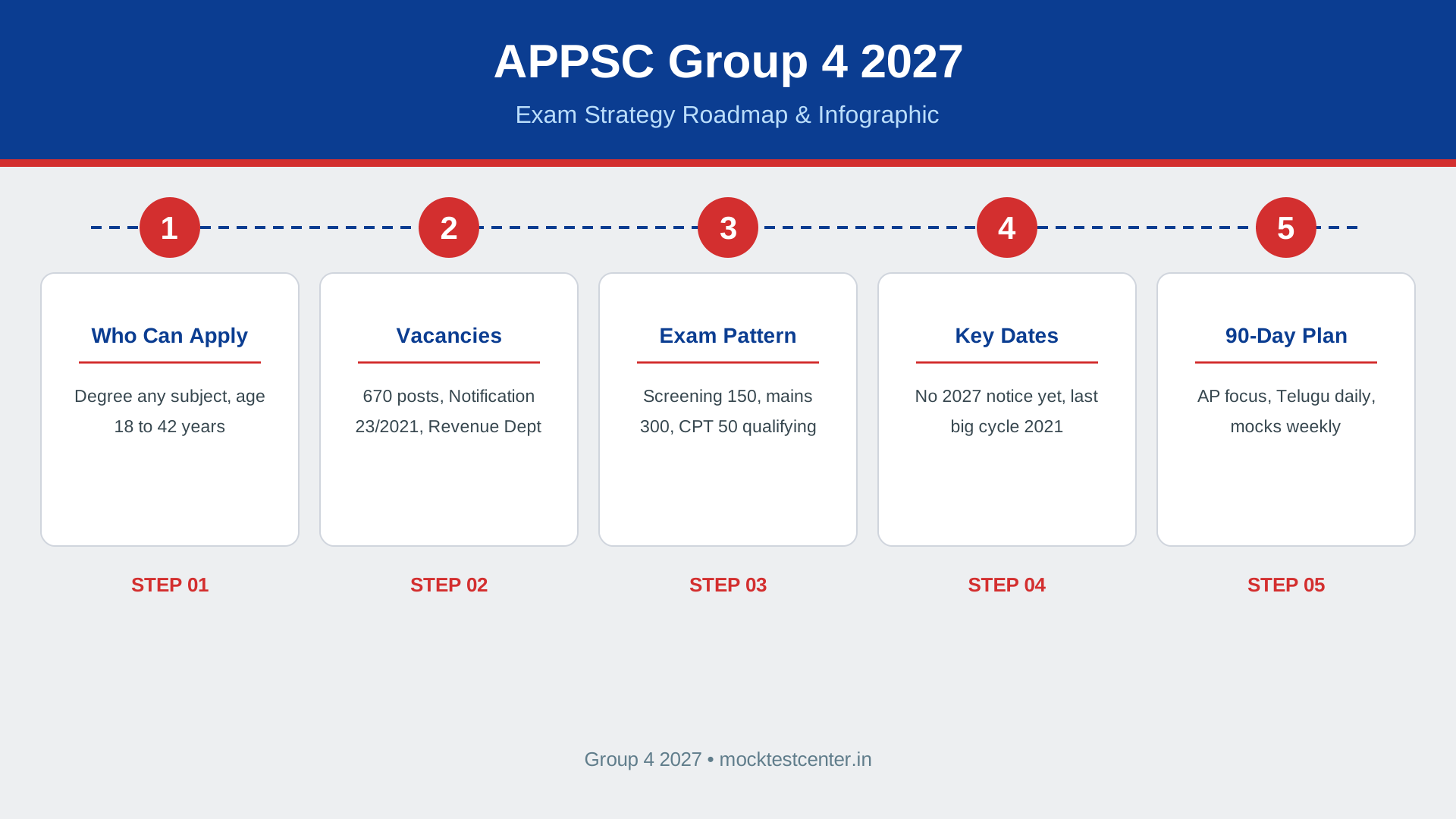
About APPSC Group 4 2027 Exam Series
📖 Table of Contents
- APPSC Group 4 2027 and the last big cycle in numbers
- What the posts actually are
- Three notifications tell the recent story
- Who can apply for APPSC Group 4 2027
- How selection works
- Screening test, paper by paper
- Mains: 300 marks decide your rank
- The computer test that ends runs
- Syllabus: Paper 1, general studies and mental ability
- Syllabus: Paper 2 and the Telugu question
- Group 4 is not Group 3, and neither is the village secretariat
- What to study first
- A 90 day plan that fits around a job
- Mistakes that cost marks
- Sources
APPSC Group 4 2027: Junior Assistant Exam Guide
On 31 July 2022, 2,11,341 candidates sat for one screening test. They were chasing 670 posts of Junior Assistant cum Computer Assistant in the Revenue Department. APPSC Group 4 2027 has no notification yet as of 20 November 2026, and no large Group 4 recruitment is scheduled in the state job calendar for 2026, so every fact in this guide comes from the last real cycles, above all Notification 23/2021. If you plan to sit for the 2027 cycle, that cycle is the closest picture you have of the posts, the pattern, the age limits and the fees. The Andhra Pradesh Public Service Commission runs this exam, and its site is the only place a new notification will appear first.
Group 4 fills the junior ministerial posts of the state government. Junior Assistant, Junior Assistant cum Computer Assistant, Typist, Junior Stenographer and Junior Office Assistant work in departments, district collectorates and directorates across Andhra Pradesh. The work is files, correspondence, records and data, in English and in Telugu. That is why the exam tests both languages at school standard while it tests general studies at degree standard. A degree in any subject makes you eligible. Selection runs through a screening test, a main examination and a computer proficiency test. There is no interview.
APPSC Group 4 2027 and the last big cycle in numbers
| Item | Detail |
|---|---|
| Conducting body | Andhra Pradesh Public Service Commission (APPSC) |
| Exam name | Group IV Services Examination, known as Group 4 |
| Latest large notification | 23/2021, dated 28 December 2021, 670 posts |
| Post in the latest large cycle | Junior Assistant cum Computer Assistant, Revenue Department |
| Application window | 30 December 2021, last date extended to 6 February 2022 |
| Screening test | 31 July 2022, morning session |
| Appeared for screening | 2,11,341 |
| Shortlisted for mains | 11,574 |
| Screening result | 12 October 2022 |
| Mains examination | 4 April 2023, computer based test |
| Mains marks list | 12 May 2023 |
| Computer proficiency test | 20 August 2023, in the districts |
| 2027 notification | Not issued as of 20 November 2026 |
Those numbers tell you how steep the climb is. Divide 2,11,341 candidates who appeared by 670 posts and you get about 315 candidates for each post. Only 11,574 moved to mains, which is about one in 18 of those who appeared. The computer test then called candidates at twice the number of vacancies, about 1,340 people, and the final selection came from the mains merit list district by district. Your first job is to land inside that 11,574. Everything else comes after.
The screening cut off marks show how district changes everything. In Srikakulam the general standard cut off was 81.67 marks out of 150. In Visakhapatnam it was 79 marks out of 150. The same candidate with the same score can qualify in one district and miss in another, because each district has its own list, its own vacancies and its own cut off. That is the single most practical fact about this exam, and it is the reason the district you choose at the time of application matters as much as the marks you score. More on that choice below.
One more number deserves attention. The screening test was held because the field was far past the point where the commission screens. APPSC adds a screening stage when applications exceed 200 times the number of vacancies, and 2,11,341 applicants against 670 posts is about 315 times. A small post specific notification with six posts or one post does not draw that kind of field, and those cycles run straight to the written examination. So the pattern you face depends on the size of the notification, and a large 2027 notification would almost certainly bring the screening test back.
What the posts actually are
Group 4 covers a family of junior ministerial posts that sit at the bottom of the state secretariat and district office hierarchy, and each notification fills the posts that happen to be vacant in the departments named in it. The 23/2021 cycle filled only one post, Junior Assistant cum Computer Assistant in the Revenue Department, in 670 vacancies spread across the 13 districts as they stood then. The 06/2022 cycle filled six posts across six departments, one vacancy each. The 22/2025 cycle filled one post, Junior Office Assistant in the Prisons and Correctional Services Department. A candidate who waits for a notification that lists every Group 4 post at once will wait a long time, because that has not happened since 2021.
The Junior Assistant cum Computer Assistant works in the Revenue Department, in the district collectorate and in the mandal and divisional offices under it. The daily work is revenue records, correspondence, files and data entry, and the computer part of the post name is real. You must pass a practical computer test in office automation before appointment, and the typing speed it demands is 30 words per minute in MS Word. A Junior Assistant in other departments does the same kind of desk work without the computer assistant tag, though the computer test applies to those posts too in most cycles. A Typist types. A Junior Stenographer takes shorthand and types it out. A Junior Office Assistant does general office work in the department named in the notification.
Pay is the detail candidates ask about first, and it changed between the two recent cycles because the state revised its pay scales. The 23/2021 notification gave the scale of pay as Rs 16,400 to Rs 49,870. The 06/2022 notification gave the scale as Rs 25,220 to Rs 80,910 under the Revised Pay Scales of 2022. The second figure is the current scale for the posts, and the first figure belongs to the older pay revision. Any guide that still quotes Rs 16,400 to Rs 49,870 as the current pay is quoting the 2021 notification, not the pay you would draw today. The exact in hand salary depends on allowances and the place of posting, and no notification prints a single take home figure, so treat any single salary number in a tracker guide as an estimate.
These are district posts, and that shapes the whole job. A Junior Assistant cum Computer Assistant in the Revenue Department belongs to a district cadre. You are posted inside the district you were selected for, and transfers outside it are not part of the normal career path. The notification divides the vacancies district by district, and the commission builds a separate ranking list for each district. The District Selection Committee then makes the selection from that district list. So the exam is really 13 small exams run on the same day with the same paper, one per district, and the cut off in your district is the only cut off that matters to you.
Three notifications tell the recent story
The honest way to read Group 4 is through its last three notifications, because they show a recruitment that has shrunk from a large statewide drive to single post fillings. Each one is worth knowing in full, because the 2027 cycle, whenever it comes, will look like one of these three shapes.
Notification 23/2021, dated 28 December 2021, is the big one. It invited applications for 670 Junior Assistant cum Computer Assistant posts in the Revenue Department, in the scale of pay of Rs 16,400 to Rs 49,870, from candidates aged 18 to 42 years as on 1 July 2021. Applications opened on 30 December 2021. The last date for payment of fee was 18 January 2022, and the last date to apply was later extended to 6 February 2022. The screening test was held on 31 July 2022, and 2,11,341 candidates appeared. The result came on 12 October 2022, with 11,574 candidates shortlisted for mains. The mains examination, a computer based test, was held on 4 April 2023, and the marks list came on 12 May 2023. The computer proficiency test followed in the districts, with Srikakulam district holding it on 20 August 2023 for candidates shortlisted at twice the vacancies. The whole cycle took about 20 months from notification to the proficiency test, and that slow pace is normal for this exam.
Notification 06/2022, dated 26 September 2022, is the small one. It was a limited recruitment for six carried forward vacancies in the scale of pay of Rs 25,220 to Rs 80,910 under the Revised Pay Scales of 2022, for candidates aged 18 to 42 years as on 1 July 2022. The six posts were Junior Assistant in Prisons and Correctional Services, Junior Assistant cum Typist in Prisons and Correctional Services, Typist in Women Development and Child Welfare, Typist in Sericulture Service, Steno cum Typist in Tribal Welfare, and Junior Stenographer in Labour Department, one vacancy each. Applications ran from 29 September to 19 October 2022. The computer based test was held on 3 and 4 October 2023, and the selection notification came on 5 February 2024. Two of the six posts were district cadre posts, and only candidates of the Scheduled Caste community local to the respective districts could apply for those two. The other four were state cadre posts. This notification shows how narrow a Group 4 cycle can be: one post in one department, open only to one community in one district.
Notification 22/2025, dated 24 September 2025, is the smallest one possible. It notified a single carried forward Junior Office Assistant post in the Prisons and Correctional Services Department, in Guntur district, local to that district, and reserved for a woman with blindness or low vision. Applications ran from 25 September to 15 October 2025. The written examination was held on 27 and 30 January 2026, and the final key and ranking list came on 7 May 2026. One post, one district, one category of candidate. If you read only the headlines about Group 4, you would think the exam had vanished. It has not vanished. It has become post specific, and each cycle now carries its own cadre and local rules.
The state job calendar for 2026 confirms that no large Group 4 recruitment is on the way in the near term. G.O.Ms.No.81 of the Finance Department, dated 22 August 2026, permits the filling of 10,060 direct recruitment posts in four phases. Phase 1, 1,523 posts, was already notified by the Higher Education Department on 15 May 2026. Phase 2, 3,231 posts, was due on 15 September 2026 and covers Group 1 services with 149 posts, police posts and other departmental posts. Phase 3, 2,311 posts, was due on 15 October 2026 and covers Group 2 services with 673 posts, power utility engineering posts and excise constables. Phase 4, 2,995 posts, was due on 15 October 2026 and covers 2,991 teaching posts under the Directorate of School Education and 4 adult education posts. No phase lists Group 4, Junior Assistant or Typist posts. That does not mean a Group 4 notification can never appear outside the calendar, since carried forward vacancies have been notified outside it before, but it does mean you should not plan your year around a large Group 4 notification in 2026. The sensible plan is to prepare on the 23/2021 pattern and watch psc.ap.gov.in, so that a surprise notification finds you ready instead of starting from zero.
Who can apply for APPSC Group 4 2027
Eligibility rests on three things: a degree, an age inside the limit, and the technical skill the post demands. A bachelor's degree from a university in India established under a Central, State or Provincial Act, or an institution recognised by the University Grants Commission, qualifies you. The degree subject plays no part in selection. Every Group 4 post code in the 2021, 2022 and 2025 notifications required a degree, and Paper 2 is set at school standard, but eligibility is not. A candidate with a degree in any subject, BA, BCom, BSc or BTech, stands on the same footing.
Typist and stenographer posts add a technical condition. They need a pass in the prescribed Government Technical Examination in typewriting or shorthand, at the grade the notification specifies, in addition to the degree. The 06/2022 posts show this in practice: the Typist and Junior Stenographer posts carried technical requirements that the plain Junior Assistant posts did not. Check the post code table in the notification before you apply, because the technical condition differs by post and a degree alone will not cover it.
The age limit has held steady across all three recent cycles. The minimum age is 18 years and the maximum age is 42 years, reckoned as on 1 July of the notification year. That date was 1 July 2021 for the 23/2021 cycle, 1 July 2022 for the 06/2022 cycle and 1 July 2025 for the 22/2025 cycle. The relaxation table below comes from the notifications, and the figures have been identical across the cycles.
| Category | Relaxation in upper age limit |
|---|---|
| SC, ST, BC and EWS | 5 years |
| Persons with benchmark disabilities | 10 years |
| Ex-servicemen and NCC instructors | 3 years plus length of service |
| Regular Andhra Pradesh state government employees | Up to 5 years based on regular service |
| Widowed, divorced or judicially separated women not remarried, for Junior Assistant posts | Up to 48 years for SC and ST, up to 43 years for others |
One tracker reports that the upper age limit was raised from 42 to 44 years for non uniformed services up to 30 September 2027 under G.O.Ms.No.187. That claim could not be checked against the official notification in this preparation, because the commission site did not respond, and another tracker guide states that the 42 year ceiling has held throughout the recent cycles. This guide therefore uses 18 to 42 years as the verified figure and flags the 44 year claim as unconfirmed. If the 2027 notification carries a higher ceiling, it will be printed in the notification itself, and that is the document to trust.
Local status is the part of eligibility that first time candidates get wrong. Group 4 posts are organised into local cadres under the Presidential Order, and the notification splits vacancies into local and non local seats for each district. You choose the district in which you want to be considered at the time of application, on a local or non local basis, and that choice fixes your ranking list. Local status turns on where you studied, with the rules counting the years of study in the local area, and the notification carries the full rule. A candidate who applies in a district where they hold no local status competes for the small non local share of seats only, and in a single post notification like 22/2025 the post may be open to local candidates of one district alone. Read the vacancy table and the local status rule first, before you read the syllabus, because a wrong district choice cannot be fixed after the application closes.
The fee is small, and it is the same across the recent cycles. Every applicant pays Rs 250 as the application processing fee, and general category applicants pay Rs 80 more as the examination fee, a total of Rs 330. The Rs 80 examination fee is exempt for SC, ST, BC, disabled and ex-servicemen candidates, for white card holder families of Andhra Pradesh, and for unemployed youth who submit the declaration under G.O.Ms.No.439. Candidates from other states get no exemption other than for disability or ex-service status. The fee is paid online, and the application is submitted only after the payment reference number is generated, so keep that number safe.
How selection works
| Stage | Type | Marks | Counts in final merit |
|---|---|---|---|
| Screening test | Objective, OMR, 150 questions | 150 | No, shortlist only |
| Main examination | Objective, computer based, 2 papers | 300 | Yes, the whole merit |
| Computer proficiency test | Practical, 30 minutes | 50 | No, qualifying only |
| Certificate verification | Documents and local status | Nil | No |
| Final merit | Mains marks, district list | 300 | Yes |
Three facts in that table decide how you prepare. The screening test marks stay out of the final merit, so a high screening score earns you nothing beyond a mains seat. The mains carries all 300 merit marks, so the two mains papers decide your rank entirely. The computer test is qualifying only, but failing it ends the run whatever your mains score is. There is no interview at any stage, and no personality test, so the whole selection is written work plus a practical computer test plus document checks.
The screening test appears only when the field is very large. The rule is that the commission holds a screening test when applications exceed 200 times the number of vacancies notified. For 670 posts that threshold is 1,34,000 applications, and the 23/2021 cycle drew far more than that, so the screening test was held on OMR sheets on 31 July 2022. For the six post cycle of 2022 and the single post cycle of 2025, no screening test was needed, and candidates went straight to the computer based written examination. If a 2027 notification is large, expect the screening test. If it is small, expect a direct written examination on the mains pattern.
The mains shortlist in the big cycle ran at about 17 times the vacancies: 11,574 candidates from 2,11,341 who appeared. The commission fixes the shortlist ratio in the notification, and it works district by district, so the number called from your district depends on the vacancies in your district. The computer test then calls candidates at twice the number of vacancies, 1 to 2, from the mains merit list, and only those who qualify in it go forward to certificate verification. The final selection comes from the district merit list prepared on mains marks, subject to qualifying the computer test and clearing verification of certificates, local status and community claims.
Negative marking applies at every written stage. Each wrong answer costs one third of a mark, under G.O.Ms.No.235 of the Finance Department dated 6 December 2016. A question carries one mark in both the screening test and the mains, so a wrong answer costs 0.33 marks. Blank answers carry no penalty. With 150 questions in 150 minutes, you have 60 seconds per question, and the penalty means a guess between two options still pays over a full paper while a blind guess does not. The cut offs show how much the penalty matters: the Srikakulam general cut off of 81.67 out of 150 is barely above half marks, and a candidate who guessed blindly across the paper would lose roughly a third of a mark on every wrong answer and sink below it.
Screening test, paper by paper
| Section | Subject | Questions | Marks | Duration |
|---|---|---|---|---|
| Section A | General Studies and Mental Ability | 100 | 100 | 100 minutes |
| Section B | General English and General Telugu, 25 marks each | 50 | 50 | 50 minutes |
| Total | 150 | 150 | 150 minutes |
Section A is the general studies and mental ability section, set at degree standard, and it carries 100 of the 150 marks. Section B is the language section, set at SSC standard, with 25 marks of English and 25 marks of Telugu. The two sections run as one paper of 150 minutes in the screening test, and the medium of the question paper is English and Telugu. The screening syllabus is the same syllabus as the mains, in shorter form: Section A covers the general studies topics, and Section B covers the language topics. That overlap is good news for preparation, because the same study serves both stages, and a candidate who prepares for mains is already prepared for screening.
The screening test is an OMR test, answered on paper with a pencil or pen on a bubble sheet, while the mains is a computer based test. That difference matters for practice. Screening practice should be on OMR sheets under time, with the habit of marking answers cleanly and checking the question number before each bubble. Mains practice should be on screen, with the habit of reading on a monitor and using the on screen tools for marking questions for review. Candidates who practise only on paper walk into a computer test slower than they need to be, and candidates who practise only on screen fumble the OMR sheet on the screening day.
Mains: 300 marks decide your rank
| Paper | Subject | Questions | Marks | Duration |
|---|---|---|---|---|
| Paper 1 | General Studies and Mental Ability, degree standard | 150 | 150 | 150 minutes |
| Paper 2 | General English and General Telugu, 75 marks each, SSC standard | 150 | 150 | 150 minutes |
| Total | 300 | 300 | 300 minutes |
Paper 1 is the general studies and mental ability paper, set at degree standard, with 150 questions in 150 minutes. Paper 2 is the language paper, set at SSC standard, with 75 questions of English and 75 questions of Telugu in 150 minutes. The two papers carry equal weight, and that equality is the trap in this exam. Candidates pour months into general studies and treat the language paper as a formality, then discover that half their merit marks came from a paper they never practised. A candidate who scores 110 in Paper 1 and 80 in Paper 2 totals 190. A candidate who scores 100 in Paper 1 and 105 in Paper 2 totals 205 and ranks ahead. Paper 2 carries half the merit marks, so it deserves half the preparation time.
Paper 1 gives you 60 seconds per question, and Paper 2 does the same. That pace rewards recognition over working out, which means the preparation must build instant recall of facts, formulas and grammar rules rather than deep reading alone. Mock tests under the same timing are the only way to build that pace, and a mock score without negative marking applied is a score that lies to you. Apply the one third penalty to every wrong answer in practice, and track your score by section, because a total of 190 that hides a Telugu section of 30 out of 75 is a warning that your language preparation is thin.
The computer test that ends runs
| Part | Task | Marks |
|---|---|---|
| Part A | MS Word, typing a passage of 100 to 150 words, formatting, spell check | 15 |
| Part B | MS Excel, worksheet, formulas, functions, charts | 10 |
| Part C | MS PowerPoint, two slides with layout, pictures and transitions | 10 |
| Part D | MS Access, creation and manipulation of databases | 10 |
| Part E | Internet and email, inbox display, browsing, search | 5 |
| Total | 30 minutes, practical | 50 |
The computer proficiency test is a practical test, not a theory paper. You sit at a computer for 30 minutes and do the tasks: type a passage in MS Word at 30 words per minute or faster, format it, run a spell check, build a table or graph in Excel, make two slides in PowerPoint, work a small database in Access, and show an email inbox and a web search. The qualifying marks are 20 out of 50 for open category candidates, 17.5 for BC candidates and 15 for SC, ST and PH candidates. Those bars look low, and they are low, but candidates still fail this test, because they never practised the tasks under time. Typing speed is the usual failure point: 30 words per minute sounds slow until you must type a passage you have never seen, with correct spelling and formatting, while the clock runs.
Start computer practice early, not after mains. Fifteen minutes a day on a keyboard builds the speed in a few months, and a candidate who types daily will clear the Word part without thinking about it. The Excel and PowerPoint parts need a different habit: learn the five or six operations the test actually asks for, formulas and charts in Excel, slide layout and transitions in PowerPoint, and practise them as tasks rather than reading about them. The Access part surprises candidates who have never opened the program, so open it once, build one small table, and the mystery goes away. The district collectorate conducts this test for the district cadre posts, and the commission calls candidates for it at twice the vacancies, so about 1,340 candidates in a cycle the size of 23/2021.
Syllabus: Paper 1, general studies and mental ability
Paper 1 covers 12 units, and the notification lists them in the same order for the screening test and the mains. The mains paper goes deeper into the same units, so the list below serves both stages, and the difference between the stages is depth rather than topics.
The first units are current affairs and science. Events of national and international importance, current affairs at international, national and regional level, general science and its applications to day to day life, and contemporary developments in science and technology and information technology. These units reward a daily newspaper habit and a monthly current affairs revision, and the regional part means Andhra Pradesh news, not only national news. Read the state pages of a Telugu or English daily, and keep a separate notebook for Andhra Pradesh developments, because the paper asks about the state directly.
The middle units are history, polity, economy and geography. Social, economic and political history of modern India with emphasis on Andhra Pradesh, Indian polity and governance with constitutional issues, public policy, reforms and e-governance initiatives with specific reference to Andhra Pradesh, economic development in India since independence with emphasis on Andhra Pradesh, and physical geography of the Indian subcontinent and Andhra Pradesh. The phrase with emphasis on Andhra Pradesh appears again and again in this syllabus, and it is the clearest instruction the commission gives. National books cover the national part. State specific books and the state textbooks cover the Andhra Pradesh part, and a candidate who studies only national material leaves a large share of the paper unprepared.
The later units are the ones other state exams do not carry. Disaster management, with the vulnerability profile of the state, prevention and mitigation strategies, and the application of remote sensing and GIS in disaster assessment. Sustainable development and environmental protection. Logical reasoning, analytical ability and data interpretation, with data analysis through tabulation of data, visual representation of data, and basic data analysis using summary statistics such as mean, median, mode, variance and coefficient of variation. And finally, the bifurcation of Andhra Pradesh and its administrative, economic, social, cultural, political and legal implications and problems. That last unit is unique to this exam. The division of the state in 2014, the loss of Hyderabad, the building of Amaravati, the division of assets and liabilities, the special category status debate, and the river water disputes all sit inside it, and the paper asks about them directly. Study the bifurcation as a topic in its own right, with dates, figures and the main issues, because no national book covers it.
Data interpretation deserves a line of its own. The syllabus names tabulation, visual representation and summary statistics, which means tables, bar diagrams and pie charts, and mean, median, mode, variance and coefficient of variation. These are school level statistics, but they appear as calculation questions under time pressure, and a candidate who has not practised them will spend three minutes on a question worth one mark. Learn the formulas, practise 20 questions of each type, and the section becomes free marks.
Syllabus: Paper 2 and the Telugu question
Paper 2 is set at SSC standard, which is Class 10 level, and it splits into 75 marks of English and 75 marks of Telugu. The English part covers comprehension of a passage, usage and idioms, vocabulary and punctuation, logical rearrangement of sentences, grammar, synonyms and vocabulary, and spotting errors. The Telugu part covers the same skills in Telugu: comprehension, synonyms and vocabulary, grammar including sandhi and samasa, Telugu to English meanings, English to Telugu meanings, and usage and idiom of Telugu. Both halves test whether you can read carefully and write correctly in the two languages the job is done in.
Telugu is the section that decides this paper for many candidates. English graduates often score well in the English half and poorly in the Telugu half, because they have not read or written Telugu since school. The reverse happens too: candidates strong in Telugu lose marks in English grammar and vocabulary. The fix is simple and it takes time, which is why it belongs at the start of preparation rather than at the end. Read one Telugu newspaper page a day, and work through a Class 10 Telugu grammar book, sandhi and samasa first, then the vocabulary lists. For English, a standard grammar book with daily error spotting practice and a weekly comprehension passage will cover the syllabus. Both halves are school level, and school level material rewards steady revision more than last minute study.
A practical note on medium: the question paper comes in English and Telugu, and the general studies questions can be read in either language. Candidates who are stronger in Telugu should read the Telugu version of the general studies questions, because a misread question costs the same as an unanswered one. Practise mocks in the medium you will use on the day, and do not switch mediums in the last week.
Group 4 is not Group 3, and neither is the village secretariat
Three recruitments get mixed up in the minds of Andhra Pradesh aspirants, and the mix up wastes months of preparation, because each one has a different syllabus and a different job at the end of it. Group 4, Group 3 and the village secretariat posts are three separate things, and this section draws the lines between them.
Group 3 is the Panchayat Secretary recruitment. Both cycles the commission ran under the Group 3 heading, in 2016 and in 2018, were for Panchayat Secretary Grade 4 in the Panchayat Raj Subordinate Service. The last notification was 13/2018, dated 21 December 2018, for 1,051 posts. There has been no Group 3 or Panchayat Secretary notification since 2018, and under the service rules as amended in 2019, Grade 4 vacancies are now filled by promotion from Grade 5 rather than by direct recruitment. The exam differs from Group 4 in its second paper: where Group 4 tests English and Telugu, Group 3 tested rural development and the problems of rural areas with special reference to Andhra Pradesh, covering panchayat raj, rural schemes, the village economy and the duties of the post. A Panchayat Secretary is the executive officer of a gram panchayat, keeping its records and accounts, convening its meetings and carrying rural schemes to the village. A Junior Assistant sits in a department office and handles files. Same degree requirement, same age limit of 18 to 42, different job, different second paper, and no Group 3 notification in eight years.
The village secretariat posts are different again. The Grama and Ward Sachivalayam system, created in 2019, staffs every village and urban ward secretariat with functionaries who deliver government services at the doorstep: Panchayat Secretary Grade 5, Digital Assistant, Welfare and Education Assistant, Village Revenue Officer, survey assistant, engineering assistant and others. These posts are filled by the Panchayat Raj department through its own recruitment, not by APPSC under the Group 4 heading, and the 2025 rationalisation order of the Grama Sachivalayams and Ward Sachivalayams Department reorganised them into general purpose and specific purpose functionaries across secretariat categories. A candidate preparing for Group 4 who drifts into secretariat preparation is preparing for a different recruitment with different posts, and a candidate preparing for secretariat posts who drifts into Group 4 is doing the same in reverse. Pick one recruitment, learn its syllabus, and ignore the other until you hold a post.
Group 1 and Group 2 sit above Group 4 in the same commission, and they confuse candidates in a different way. Group 1 fills gazetted posts such as Deputy Collector and Deputy Superintendent of Police, and Group 2 fills executive posts such as Deputy Tahsildar. Group 4 fills junior ministerial posts. The papers look alike, general studies plus a second paper, but the standard, the competition and the job are all different, and a Group 4 plan copied from a Group 1 guide will over prepare the wrong topics and under prepare the language paper that carries half the Group 4 marks.
What to study first
Start with the books that cover the most marks per page. For polity, use Indian Polity by M. Laxmikanth. For modern Indian history, use Spectrum. For the base of history, geography, science and economy, use the NCERT textbooks from classes 6 to 12. For the economy, use Indian Economy by Ramesh Singh with the NCERT economics books. For geography, use Certificate Physical and Human Geography by G.C. Leong with NCERT geography. For environment, use the Shankar IAS material. For mental ability and data interpretation, use Quantitative Aptitude by R.S. Aggarwal and a modern reasoning book, and practise the statistics formulas from a school level book. For English grammar and vocabulary, use Wren and Martin with a daily error spotting habit. For Telugu, use the Class 10 Telugu grammar and language textbooks, and a Telugu to English dictionary for the translation part. For Andhra Pradesh specific history, geography and economy, use the state textbooks and the Telugu Academy books, because the state part of the paper comes from that material more than from any national book.
Books alone will not clear the screening test. Previous papers will tell you how APPSC asks what it asks, and that matters more than how much you have read. The commission publishes question papers and answer keys for its examinations, and the 23/2021 screening and mains papers are the most useful documents you can own, because they show the exact level of the general studies questions and the exact shape of the Telugu questions. Solve the screening paper of 31 July 2022 under time, 150 questions in 150 minutes, with the one third negative marking applied to your score. Then solve the mains papers of 4 April 2023 the same way. Track your score by section, not just in total, because a total of 190 that hides a Telugu section of 30 out of 75 is a warning that your language preparation is thin.
Current affairs need two separate notebooks, one for national and international events and one for Andhra Pradesh. The paper splits them that way, so your notes should split them that way too. The Andhra Pradesh notebook holds state government programmes, the state budget, welfare schemes, infrastructure projects, the Amaravati capital works, Polavaram, river water issues, and developments in agriculture, water and industry in the state. Update it weekly. A monthly current affairs magazine gives you national coverage, but no national magazine covers Andhra Pradesh schemes in the depth the paper demands. Read the state government releases and the budget speech itself for that part.
A 90 day plan that fits around a job
| Weeks | Focus | Daily time |
|---|---|---|
| 1 to 2 | Paper 1 history and polity, Andhra Pradesh focus, plus one screening mock | 2 hours |
| 3 to 4 | Paper 1 economy and geography, bifurcation unit, plus Telugu grammar daily | 2 hours |
| 5 to 6 | Paper 1 science, disaster management and environment, plus English grammar daily | 2 to 3 hours |
| 7 to 8 | Reasoning and data interpretation, statistics formulas, plus two full mocks | 2 to 3 hours |
| 9 to 10 | Paper 2 full practice, Telugu and English sets, plus computer test practice | 2 to 3 hours |
| 11 | Previous papers under time, weak section repair, typing speed daily | 3 hours |
| 12 | Full mock tests, revision of notes, and no new topics | 2 hours |
| Last 3 days | Andhra Pradesh facts, dates, schemes, formulas, one light mock | 1 hour |
The plan assumes two hours a day, which is realistic for a working candidate, and it puts Andhra Pradesh first because Andhra Pradesh carries the marks other candidates skip. Weeks 1 to 4 build the Paper 1 base, with history, polity, economy and geography taking the largest share, and the bifurcation unit studied as its own topic. Weeks 5 to 6 add science, disaster management and environment, with English grammar running alongside. Weeks 7 to 8 cover reasoning and data interpretation, the sections where steady practice adds marks fastest, because the formulas are fixed and the question types repeat. Weeks 9 to 10 shift to Paper 2, because the language paper is half the merit and it needs its own weeks, and computer practice starts here too, fifteen minutes a day on the keyboard. Week 11 tests the whole plan under exam conditions with previous papers. Week 12 is revision only. New topics in the last week cost more marks than they gain, because they displace revision of material you already know.
Mock tests deserve a fixed slot, not leftover time. Take one full 150 question mock every Sunday from week 3 onward, in one sitting of 150 minutes, without pausing, and review every wrong answer the same evening. Apply the one third negative marking to your score, and track it by section. From week 9, add one Paper 2 set a week, 150 questions in 150 minutes, in the medium you will use on the day. The last three days are for Andhra Pradesh facts, dates, schemes, statistics formulas, and one light mock test. Sleep matters more than one more chapter in those three days, and the candidates who reach the hall rested answer better than the ones who studied through the night.
Mistakes that cost marks
The first mistake is choosing the district carelessly. The cut off differs by district, the vacancies differ by district, and the ranking list is district by district, so the district you pick at application time is a decision about your competition, not a formality. Study the vacancy table, check your local status with care, and pick the district where your position is strongest. The second mistake is treating Paper 2 as a side paper. It carries 150 of the 300 merit marks, and the Telugu half of it ends more runs than any other section. The third mistake is ignoring the computer test until after mains. Typing at 30 words per minute and the Excel and PowerPoint tasks need months of short daily practice, and a candidate who starts after mains has weeks, not months.
The fourth mistake is guessing blindly. A wrong answer costs one third of a mark, so a guess with no elimination loses marks across a full paper, while a guess between two options still pays. Learn the difference and apply it in every mock. The fifth mistake is reading only national current affairs. The syllabus repeats the words with emphasis on Andhra Pradesh for a reason, and the bifurcation unit appears in no national book. The sixth mistake is preparing for the wrong exam: Group 3 has had no notification since 2018 and its Grade 4 posts are now filled by promotion, and the village secretariat posts belong to a different recruitment altogether, so months spent on the rural development paper or on secretariat syllabuses do not transfer to Group 4. The seventh mistake is waiting for the notification before starting. The last large cycle took 20 months from notification to the computer test, and the candidates who cleared it had started before the notification appeared. The state job calendar lists no large Group 4 recruitment for 2026, so the next notification may be small, sudden and post specific, and the candidates it favours will be the ones who were already ready.
Candidates for this exam often prepare for other state and national exams alongside it. The UPPSC PCS 2027, UPPSC RO ARO 2027, SSC GD 2027, SSC CGL 2027, IBPS Clerk 2027, SBI Clerk 2027, RBI Assistant 2027, JKSSB Junior Assistant 2027, KPTCL Junior Assistant 2027 and UPSC CSE Prelims 2027 pages on this site carry the same style of mock test guide, and the habit of timed practice with negative marking that you build here transfers directly to them. Start with the 23/2021 screening paper this week, score it with the penalty applied, and let that score set your plan for the next 90 days.
Sources
Notification 23/2021 as reproduced on the notification mirror sites, for the 28 December 2021 date, the 670 Junior Assistant cum Computer Assistant posts in the Revenue Department, the pay scale of Rs 16,400 to Rs 49,870, the age of 18 to 42 years as on 1 July 2021, the application window from 30 December 2021, the screening and mains scheme with question counts, durations and marks, the one third negative marking rule under G.O.Ms.No.235 dated 6 December 2016, the computer proficiency test scheme with its five parts and qualifying marks, and the district cadre rule.
Notification 06/2022 as reproduced on the notification mirror sites and reported by Jagran Josh and Scroll, for the 26 September 2022 date, the six carried forward vacancies, the pay scale of Rs 25,220 to Rs 80,910 under the Revised Pay Scales of 2022, the post wise list across six departments, the district cadre posts open only to Scheduled Caste local candidates, the application window from 29 September to 19 October 2022, the computer based test on 3 and 4 October 2023, and the selection notification of 5 February 2024.
Notification 22/2025 as reported by the tracker guides, for the 24 September 2025 date, the single Junior Office Assistant post in Prisons in Guntur district reserved for a woman with blindness or low vision, the application window from 25 September to 15 October 2025, the written examination on 27 and 30 January 2026, and the ranking list of 7 May 2026. The APPSC screening result notice of 12 October 2022 as reproduced by the result trackers, for the 2,11,341 candidates who appeared, the 11,574 shortlisted for mains, the screening test date of 31 July 2022, and the district cut off marks of 81.67 for Srikakulam and 79 for Visakhapatnam. G.O.Ms.No.81 of the Finance Department dated 22 August 2026 as reproduced by the job calendar trackers, for the 10,060 posts in four phases and the absence of Group 4 posts from every phase. The Group 3 and Panchayat Secretary tracker guides, for the last notification 13/2018 of 21 December 2018 with 1,051 posts, the absence of any Group 3 notification since 2018, and the 2019 rule amendment under which Grade 4 is filled by promotion from Grade 5. The Andhra Pradesh Public Service Commission site at psc.ap.gov.in, the official source for all of these notifications, which did not respond to direct requests during preparation on 20 November 2026, so the facts above rest on the notification texts as reproduced by the mirror and tracker pages listed here and should be checked against the official notification before you apply.