
About APPSC ASO 2027 Exam Series
📖 Table of Contents
- APPSC ASO 2027 and the 20/2026 cycle in numbers
- What an Assistant Statistical Officer actually does
- The pattern: one written exam, then a computer test
- The Computer Proficiency Test is a second exam, not a formality
- Who can apply: the degree rule is strict
- Local candidature: 189 of the 196 posts are zone-local
- Paper I syllabus: general studies and mental ability
- Paper II syllabus: ten topics, and they are the whole exam
- The Computer Proficiency Test syllabus in full
- Fee, pay, centres and how to apply
- How this cycle differs from the older ASO cycles
- Cut-offs: the only official number is the qualifying mark
- A 90 day plan that fits the real pattern
- Books that cover the syllabus without waste
- Mistakes that cost candidates this exam
- Sources
APPSC ASO 2027: Assistant Statistical Officer Exam Guide
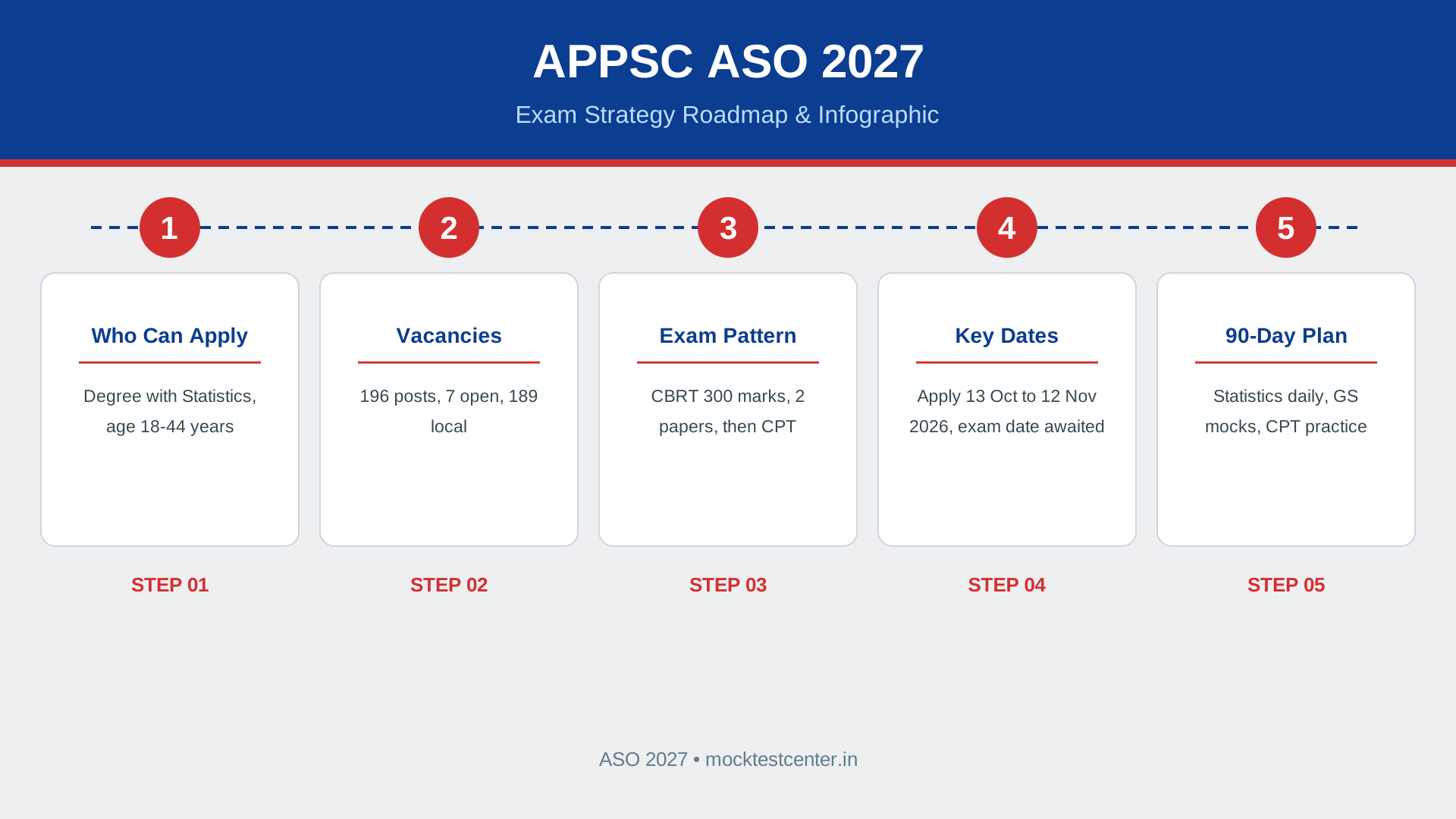
Notification No. 20/2026 offers 196 Assistant Statistical Officer posts in the A.P. Economics and Statistical Subordinate Service, and the whole selection runs on one written exam of 300 marks plus a practical computer test. The Andhra Pradesh Public Service Commission opened applications on 13 October 2026, first set the last date at 2 November 2026, then extended it to 12 November 2026 by a web note dated 2 November 2026 that said there would be no further extension. Applications are now closed. The written exam date has not been announced as of 20 November 2026. APPSC ASO 2027 is the name this guide uses for the cycle, because the 2027 exam is the one these 196 posts will be filled through, even though the notification itself carries a 2026 number.
Three facts decide whether this exam is for you. First, Statistics is not optional. You need a degree with Statistics as a main subject, or a degree in Mathematics, Economics, Commerce or Computer Science with Statistics as a paper in at least one year. A plain B.A. or B.Com without Statistics does not qualify. Second, only 7 of the 196 posts are open competition. The other 189 are reserved for local candidates of one of six zones, so the zone your schooling puts you in matters as much as your marks. Third, there is no screening test this time. The brief notification says so in plain words: a single-level examination only, no screening test, irrespective of the number of applications received. Older guides that describe a prelims plus mains structure are describing the 2019 cycle, not this one.
APPSC ASO 2027 and the 20/2026 cycle in numbers
| Item | Detail |
|---|---|
| Conducting body | Andhra Pradesh Public Service Commission (APPSC), Vijayawada |
| Post | Assistant Statistical Officer, A.P. Economics and Statistical Subordinate Service |
| Brief notification | No. 20/2026, dated 15 September 2026 |
| Detailed notification | No. 20/2026, dated 13 October 2026 |
| Posts | 196, provisional and subject to variation on confirmation from the department |
| Application window | 13 October 2026 to 12 November 2026, 11:59 PM, online only |
| Last date as first notified | 2 November 2026, extended to 12 November 2026 by web note dated 2 November 2026 |
| Age as on | 1 July 2026, 18 to 44 years |
| Qualification reckoned as on | 13 October 2026, the date of the detailed notification |
| Pay scale | Rs 37,640 to Rs 1,15,500 per month, A.P. Revised Pay Scales 2022 |
| Written exam | Online Computer Based Recruitment Test, 300 marks, date not announced |
| Exam centres | Visakhapatnam, Vijayawada, Tirupati, Ananthapuramu |
| Fee | Rs 330 general, Rs 250 for exempted categories |
Read that table once more before you read anything else in this guide. Almost every argument about this exam starts from one of those rows. The 196 posts are provisional, which means the department can still change the number before the exam. The age is counted on 1 July 2026 while the qualification is counted on 13 October 2026, and mixing those two dates up is one of the easiest ways to get a form rejected. And the pay scale is the one number in the notification that needs no interpretation at all: Rs 37,640 at the bottom of the scale, Rs 1,15,500 at the top, plus the allowances that go with the service.
What an Assistant Statistical Officer actually does
An Assistant Statistical Officer works in the Directorate of Economics and Statistics, under the Planning Department of the Government of Andhra Pradesh. The job is what the name says: collect data, check it, tabulate it, analyse it, and turn it into tables and reports that departments and planners can use. The directorate runs socio-economic surveys, compiles price statistics, prepares crop estimates, and publishes district statistical handbooks. The ASO is the field and desk level officer who makes that work happen, at the district and mandal level as much as in the head office.
That matters for your preparation in a practical way. Paper II tests the exact tools this job uses every day: averages and dispersion, correlation, time series, index numbers, sampling, probability. You are learning the working kit of the post, so the statistics you study here stays useful after the exam. A candidate who has actually handled a data table, cleaned a dirty dataset, or built an index number by hand will find Paper II familiar in a way that a candidate who only memorised formulas will not.
It also matters for the Computer Proficiency Test. The directorate works in spreadsheets, word processors and presentations all day. The CPT tests Word, Excel and PowerPoint because the post needs them, not because the Commission wanted a second hurdle. Treat the CPT as part of the job test and it stops feeling like an afterthought.
One confusion to clear up at the start: this ASO is not the Assistant Section Officer in the Secretariat. APPSC Group 2 recruits Assistant Section Officers for the Secretariat, 80 posts in the cycle that opened alongside this one, and the two posts share initials and nothing else. The Section Officer post takes any degree and has a different pattern. If a guide, a coaching ad, or a friend talks about ASO without saying Statistical, ask which one they mean.
The pattern: one written exam, then a computer test
The selection has three steps and no interview. First comes the written examination, an online Computer Based Recruitment Test of 300 marks. Second comes the Computer Proficiency Test, a practical test of 100 marks that you must pass. Third comes certificate verification. There is no interview at any stage in this notification, which is a change from the older ASO cycles that had a 30-mark interview.
| Paper | Subject | Questions | Minutes | Marks |
|---|---|---|---|---|
| Paper I | General Studies and Mental Ability | 150 | 150 | 150 |
| Paper II | Subject: Statistics, Economics and allied topics | 150 | 150 | 150 |
| Total | Written examination | 300 | 300 | 300 |
Both papers are objective, degree standard, and carry one mark per question. You get one minute per question on average, which sounds generous until you meet a Paper II question that needs a calculation. The scheme comes from Annexure V of G.O.Ms.No.201, Finance (HR-I, Plg and Policy) Department, dated 21 December 2017, and the notification annexes the full scheme and syllabus so candidates can plan from the official text.
Negative marking is one third of the marks prescribed for a question, under G.O.Ms.No.235, Finance (HR-I, Plg and Policy) Department, dated 06 December 2016. On a 1-mark question that is 0.33 marks off for every wrong answer. Three wrong guesses wipe out one correct answer. That rate is steeper than the one fourth used in most central recruitments, and it changes how you should play the paper. A guess between two options is still worth taking when you have real reason to favour one of them. A blind guess across four options is not, because the maths works against you over a full paper. Work this out for yourself with a mock test: score one attempt with every guess included and one with only confident answers, and the difference will tell you your own guessing line.
The written exam has minimum qualifying marks, and they are the only official floor in this cycle. Open Category, EWS, sportspersons and ex-servicemen need 40 percent, which is 120 marks out of 300. Backward Classes need 35 percent, which is 105 marks. SC, ST and Persons with Benchmark Disabilities need 30 percent, which is 90 marks. The notification adds, in plain words, that merely securing the minimum does not confer any right to selection. The qualifying mark gets you past the gate. The merit list is made from the marks above it, so the real target is far higher than 120.
If the written exam runs in multiple sessions, the Commission will normalise the scores and declare results on a percentile basis. The notification says the details of the normalisation method will be published in due course if it applies. That is a reason to ignore raw score talk from other sessions and to focus on your percentile position in mocks that mix candidates together.
The Computer Proficiency Test is a second exam, not a formality
Candidates provisionally shortlisted after the written examination must take the Computer Proficiency Test. It is a practical test in office automation with computers and associated software, 60 minutes, 100 marks, run under G.O.Ms.No.26, G.A. (Ser.B) Department, dated 24 February 2023. The qualifying marks are 40 for Open Category, 35 for Backward Classes, and 30 for SC, ST and Persons with Benchmark Disabilities.
The assessment split is published in the syllabus annexure, and it tells you where the marks sit. Part A is a set of multiple choice questions on computer basics, worth 20 percent. Part B is the practical work, worth 80 percent: typing speed counts for 25 percent, organising a document and inserting objects counts for 15 percent, preparing and formatting an Excel sheet with formulas and graphs counts for 20 percent, and preparing a PowerPoint presentation counts for 20 percent. The typing speed part may be made mandatory for qualifying under the norms in force, so a candidate who types slowly can fail the CPT even with good Excel skills.
Most candidates will lose marks here through neglect rather than inability. They spend six months on Paper II and six days on the CPT. That is the wrong split. Two hours a week on real documents, spreadsheets and slides from the start of preparation is enough to clear the CPT bar, and it is far cheaper than trying to learn Excel formulas in the week between the written result and the CPT date. Practise with LibreOffice as well as MS Office, since the syllabus names both, and practise on the kind of tasks the syllabus lists: mail merge, tables, WordArt, charts, conditional formatting, slide transitions.
Who can apply: the degree rule is strict
The educational qualification has five routes, and you need exactly one of them. A bachelor degree with Statistics as one of the main subjects qualifies. So does a bachelor degree with Mathematics as a main subject, provided Statistics was a paper in one year, two years or all three years. The same proviso applies to Economics, Commerce and Computer Science degrees: the main subject must be one of those four, and Statistics must have been a paper in at least one year of the degree. The degree must come from a university set up under a Central or State Act, a deemed university under Section 3 of the UGC Act 1956, or a foreign university approved by the Central Government.
Two traps sit inside that rule. The first is the Statistics paper condition. A B.Sc. in Mathematics where Statistics was never a paper does not qualify, even though the degree is mathematical. Check your marks memos year by year before you assume you are eligible. The second trap is the date. The qualification is reckoned as on 13 October 2026, the date of the detailed notification. If your final year result came after that date, you do not meet the condition for this cycle, however close the result was.
If you hold a qualification you believe is equivalent to one of the five routes, the notification gives you a narrow path: produce the relevant Government Order to the Commission within 10 days of the last date for applications. Miss that window and the application is rejected. Do not leave an equivalence claim to the verification stage. The Commission will not go looking for your order.
The age limit is 18 to 44 years as on 1 July 2026, under Rule 12 of the A.P. State and Subordinate Service Rules 1996, read with G.O.Ms.No.187, G.A. (Ser-A) Department, dated 14 September 2026. That upper limit of 44 is higher than the 42 years in the 2016 cycle, which is why some tracker pages still show 42. The 2026 notification says 44, and the notification wins. Relaxations sit on top of the 44. SC, ST, Backward Classes and EWS candidates get 5 years, taking the ceiling to 49. Persons with Benchmark Disabilities get 10 years, taking it to 54. Ex-servicemen can deduct 3 years plus the length of service in the armed forces, and the same concession applies to those who served as instructors in the N.C.C. Regular A.P. State Government employees can deduct the length of regular service, up to 5 years, but employees of corporations, municipalities and similar bodies do not get this concession. Retrenched temporary employees of the State Census Department with at least six months of service get 3 years.
Local candidature: 189 of the 196 posts are zone-local
This is a zonal post. Under the Presidential Order 2025, 95 percent of the posts in each zone are reserved for local candidates of that zone, and only 7 posts across the whole state are open competition. Your zone is decided by where you studied or lived in the years up to Class VII. A local candidate is one who studied in an educational institution in that zone for at least four consecutive academic years ending with the year in which they appeared for Class VII or its equivalent. Failing that, the rule looks at seven years of study up to and including the Class VII year, and the zone where the maximum part of those seven years was spent decides candidature. If the candidate did not study at all during that period, residence over the same period is used instead.
Claims based on study need a certificate from the institution. Claims based on residence need a certificate from a Revenue Department officer not below the rank of Mandal Revenue Officer, and if you lived in more than one mandal during the relevant period you need separate certificates from each. Candidates who migrated from Telangana to Andhra Pradesh between 2 June 2014 and 1 June 2024 must obtain a Local Status Certificate from the competent authority and produce it at verification. Get these certificates in order before the exam, not after the result. Verification is the last stage, and a missing certificate at that point ends a selection that the written exam had already won.
| Zone | Districts | Open | Local | Total |
|---|---|---|---|---|
| Zone I | Srikakulam, Vizianagaram, Parvathipuram Manyam, Visakhapatnam, Anakapalli | 1 | 30 | 31 |
| Zone II | Alluri Sitharama Raju, East Godavari, Kakinada, Dr. B.R. Ambedkar Konaseema | 1 | 20 | 21 |
| Zone III | West Godavari, Eluru, NTR, Krishna | 1 | 27 | 28 |
| Zone IV | Guntur, Palnadu, Bapatla, Prakasam, Sri Potti Sriramulu Nellore | 2 | 39 | 41 |
| Zone V | Tirupati, Chittoor, Annamayya, YSR Kadapa | 1 | 38 | 39 |
| Zone VI | Nandyal, Ananthapuramu, Kurnool, Sri Sathya Sai | 1 | 35 | 36 |
| Total | Six zones | 7 | 189 | 196 |
Zone IV has the most posts at 41, and Zone II the fewest at 21. That gap matters, but only within your own zone. You compete for the posts in your zone, not for the state total, so a zone with 41 posts is not automatically easier than a zone with 21. What matters is how many candidates from your zone apply and how well they score. Still, the zone table is the first thing to check after eligibility, because it tells you the size of the field you are actually in.
The category split runs across the zones. Open Category has 83 posts, EWS has 18, SC-I has 2, SC-II has 12, SC-III has 13, ST has 13, BC-A has 17, BC-B has 16, BC-C has 3, BC-D has 12 and BC-E has 7. The three SC sub-categories are shown separately rather than as one SC block, which is how the notification presents them. Together the three come to 27 SC posts in all. Horizontal reservation for women, Persons with Benchmark Disabilities and meritorious sportspersons applies on top of these figures, under Rules 22, 22(A) and 22(B) of the A.P. State and Subordinate Service Rules 1996.
Paper I syllabus: general studies and mental ability
Paper I has ten topics in the official syllabus, and they split into two halves that need different preparation. The first half is knowledge: current events, history, geography, polity, economy, environment, disaster management. The second half is skill: logical reasoning and data analysis. The skill half is the part candidates underprepare, and it is the part where a statistics graduate should be strongest.
Current events cover international, national and Andhra Pradesh issues, and the AP share is heavy. Read the state budget, the state economic survey, and the schemes the Andhra Pradesh government runs, because Paper I asks about the state the way other state exams ask about their own state. General science covers applications to daily life and current developments in science, technology and information technology. History of India is asked with a broad general understanding in its social, economic, cultural and political aspects, with a focus on Andhra Pradesh and the Indian National Movement. Geography of India is asked with a focus on Andhra Pradesh, which means the rivers, the coastline, the districts, the crops and the ports of the state deserve more of your time than the geography of distant states.
Indian polity and governance covers constitutional issues, public policy, reforms and e-governance initiatives. Indian economy and planning is a short topic in Paper I, but it overlaps heavily with Paper II, so study it once and use it twice. Sustainable development and environmental protection is a compact topic that rewards a few days of focused reading on climate, forests, and the environmental law that actually gets asked. Disaster management covers the vulnerability profile, prevention and mitigation strategies, and the application of remote sensing and GIS in disaster assessment. Andhra Pradesh has a long coastline and a real cyclone record, so the disaster topic connects directly to the state you live in.
Logical reasoning, analytical ability and logical interpretation is the ninth topic, and it is pure practice. Series, coding, blood relations, direction sense, puzzles, syllogisms, and the standard reasoning set. Do these daily in short sets rather than in long weekend blocks, because reasoning speed is built by frequency. Data analysis is the tenth topic: tabulation of data, visual representation, and basic data analysis with summary statistics such as mean, median, mode and variance, plus interpretation. If you are preparing for Paper II as well, this topic should feel like revision. Treat it as free marks and bank them.
A word on weight. The notification does not publish a topic-wise question split for Paper I, so no guide can tell you with confidence that current affairs carries 25 questions and history carries 20. Any page that prints such a split is guessing. The sound way to plan is to give every topic a fair share of time, give the AP-focused topics a little more, and let mock tests show you where your own weak spots are.
Paper II syllabus: ten topics, and they are the whole exam
Paper II carries half the written marks, and for most candidates it decides the merit list. The official syllabus has ten topics, and they fall into three groups: economics, accounting and computers, and statistics. The statistics group is the largest, with five topics out of ten, which is why a Statistics graduate has a real edge here and why a Commerce or Economics graduate must spend the most time on it.
The first topic is economic concepts. Production, consumption and demand, elasticity, market structures and equilibrium, price determination. National income, its concepts and determinants, employment, consumption, savings and investment. Rate of interest and profit. Money, measures of money supply, velocity. Banks and credit creation, banks and portfolio management, the central bank and control over the money supply. Price level determination, inflation, its meaning, measurement and control. Public finance: budgets, taxes and non-tax revenues, budget deficits. This is degree-level economics, and it rewards a candidate who understands the ideas rather than one who memorised definitions. Work through the logic of each concept with a diagram or a number example before you move on.
The second topic is international economics. Free trade and protection, balance of payments accounts and adjustment, exchange rates under the exchange markets, the international monetary system and the world trading order, the Bretton Woods system, the IMF and the World Bank and their associates. Sources of growth: capital, human capital, productivity, trade and aid, non-economic factors. The third topic is Indian economics. Population: size, composition, quality and growth trend, occupational distribution, effects of births and deaths. Mass poverty, unemployment and its types, inequality and its types, rural-urban disparities. Foreign trade, balance of payments and external debt. Inflation and the parallel economy and its effects. Fiscal deficit. Sectoral trends and regional disparities. Economic planning in India, major controversies on planning, NITI Aayog, and broad fiscal, monetary, industry, trade and agricultural policies. Read the Indian economy topics against the Andhra Pradesh economy wherever you can, because the examiners write from the state they serve.
The fourth topic is financial accounting. Introduction to accounting, concepts and conventions, the accounting process, journalising, posting to ledger accounts, subsidiary books including the cash book, bank reconciliation statement, preparation of trial balance and final accounts, errors and rectification, depreciation and reserves, single entry and non-trading concerns. This topic is the one Economics and Statistics graduates most often neglect, and it is also the one where a Commerce graduate picks up easy marks. If accounting is new to you, give it a full week and work problems by hand. Preparing a trial balance yourself is the way to learn it.
The fifth topic is basics of computers. Binary, octal and hexadecimal systems, conversion to and from decimal, codes, bits, bytes and words. Memory of a computer, arithmetic and logical operations on numbers. Algorithms and flow charts. Using a spreadsheet: basics, manipulation of cells, formulas and functions, editing, printing. This topic overlaps with the CPT syllabus, so the hours you spend here pay twice.
The sixth topic is introduction to statistics. Collection of data, primary and secondary data, methods of sampling, random and non-random, definition of probability, census, schedule and questionnaire, frequency distribution, tabulation, diagrammatic and graphic presentation of data. The seventh topic is measures of central tendency: meaning, objectives and characteristics, types of averages, arithmetic mean, geometric mean, harmonic mean, median, mode, quartiles, deciles, percentiles, properties of averages and their applications. The eighth topic is measures of dispersion and skewness: range, quartile deviation, mean deviation, standard deviation, coefficient of variation, Karl Pearson and Bowley measures of skewness, kurtosis, and the normal distribution.
The ninth topic is measure of relation: correlation, its meaning and uses, types of correlation, Karl Pearson correlation coefficient, Spearman rank correlation, probable error. The tenth topic is analysis of time series and index numbers: meaning and uses of time series, components of time series, measurement of trend and seasonal variations, utility of decomposition, and index numbers, their meaning and importance, methods of construction, price and quantity index numbers, tests of adequacy, base shifting and deflation, cost of living index numbers, limitations of index numbers, and concepts of price, quantity and cost index numbers.
Notice what the statistics topics have in common: every one of them is a calculation topic as much as a theory topic. The exam will ask you to compute a mean, a standard deviation, a correlation coefficient, a trend value, an index number. That means your preparation must be problem-based. Reading a chapter on correlation and then solving ten problems teaches more than reading three chapters and solving none. Keep a formula notebook and a mistakes notebook side by side. The formula notebook holds the method. The mistakes notebook holds the errors you actually make, and it is the more useful of the two in the last month.
The Computer Proficiency Test syllabus in full
The CPT syllabus has two parts. Part A covers computer fundamentals: introduction to computers and their components, peripheral devices, input and output devices, storage, data, information, RAM, ROM, control unit, memory unit and arithmetic logic unit. Computer software types: system software, application software, embedded software, proprietary software and open source software, their purpose and characteristics. Operating systems, single user and multi-user, with examples. Windows operating system: graphical user interface, differences between character and graphical interfaces, working with files and folders, running applications, setting up printers, webcams and scanners. Linux and Mac OS at a basic conceptual level. Internet concepts: hardware and software requirements, communication protocols, browsers, IP addresses, connecting to a network, uploading and downloading files. Electronic mail: sending and receiving, basic functions, mailing lists. World Wide Web: advantages, navigation, web searching.
Part B is the office suite: MS Office or any open source office such as LibreOffice, Apache OpenOffice or NeoOffice. Getting started with office software, the shortcut bar, file operations, office tools such as cut, copy, paste, drag and drop, menus and toolbars, undo and redo, spell checking, auto correct, find and replace, templates and wizards. Word processing in depth: formatting text and documents, page setup, headers and footers, tables and sorting, graphics, pictures, WordArt, charts, hyperlinks, bookmarks, mail merge, macros, keyboard shortcuts. Spreadsheets in depth: entering and editing formulas, cell references, auto fill, protecting sheets, sorting, page setup, formatting, functions, charts, trend lines, macros, CSV files, using a worksheet as a database. Presentation software in depth: slides, colour schemes, masters, templates, text formatting, images, multimedia, animation, transitions, timings, slide shows.
The syllabus is long because the test is practical. Part B rewards making spreadsheets, so practise on real files. Set yourself the tasks the assessment describes and time them: a formatted document with a table and a mail merge, a spreadsheet with formulas and two graphs, a ten-slide presentation with transitions. Do each one three times and the fourth attempt will feel routine, which is exactly the state you want to be in on test day.
Fee, pay, centres and how to apply
Every applicant pays a processing fee of Rs 250. An examination fee of Rs 80 sits on top of it, making Rs 330 in total for general candidates. The Rs 80 is waived for SC, ST, BC, Persons with Benchmark Disabilities, ex-servicemen, White Card holding families in Andhra Pradesh, and unemployed youth under G.O.Ms.No.439, so those candidates pay Rs 250 in all. The Rs 250 processing fee is payable by everybody. Candidates from other states, apart from Persons with Benchmark Disabilities and ex-servicemen, get neither the fee exemption nor any reservation.
The pay scale is Rs 37,640 to Rs 1,15,500 per month under the A.P. Revised Pay Scales 2022, plus the allowances admissible to the A.P. Economics and Statistical Subordinate Service. That scale is a large step up from the 2016 cycle, when the scale was Rs 24,440 to Rs 71,510. The jump reflects two pay revisions since then, and it is one reason this cycle drew so much attention. A starting basic pay of Rs 37,640 with allowances puts the in-hand pay well above what a fresh graduate earns in most private jobs in the state, and the post carries the security and the pension structure of a state government service.
The written exam will be held at four centres only: Visakhapatnam, Vijayawada, Tirupati and Ananthapuramu. Candidates could give three centre preferences in the application, but the Commission reserves the right to allot any centre depending on the availability of systems and other resources. If you live far from all four, plan travel early when the hall ticket comes. The Commission also provides a general mock test facility so candidates can get used to the computer based test interface before the examination. Use it. The interface is where candidates lose time on their first computer based test, usually on the question palette and the mark-for-review buttons, and a practice run removes that cost.
Applications were online only through psc.ap.gov.in, and no other mode was entertained. A first-time applicant had to complete One Time Profile Registration to obtain an OTPR ID, then log in with that ID, open the application for Notification 20/2026, fill in the details, choose three examination centre preferences, upload the required documents, and pay the fee online. Completing OTPR is not an application. The OTPR profile is only a login, and the post-specific application had to be submitted separately before the deadline. Candidates have lost selections over exactly this misunderstanding in other APPSC recruitments, so it is worth stating here even though the window has closed. Keep the mobile number and email ID registered in OTPR active throughout the cycle. All further communication, including one-time passwords, goes there, and the Commission treats its website as final for all correspondence.
How this cycle differs from the older ASO cycles
The 2026 cycle is not a repeat of the older cycles, and the differences are the reason so many tracker pages get it wrong. The last big general recruitment before this one was Notification No. 27/2016, which offered 95 posts with an age limit of 18 to 42 years and a pay scale of Rs 24,440 to Rs 71,510. That is where the 95-post figure in the task brief for this package comes from, and it is correct for 2016. It is not the figure for this cycle. The 2016 cycle also had a different selection structure, and its age and pay figures are now a decade out of date.
Notification No. 03/2019 is the cycle that causes the most confusion. It had a screening test of 150 questions for 150 marks, in General Studies and Mental Ability plus the subject, and then a mains examination with Paper I and Paper II of 150 marks each. Guides that describe a prelims plus mains structure for ASO are describing 03/2019. Notification 20/2026 replaced that structure with a single-level examination and no screening test, and the brief notification says so explicitly. Any page that still shows a 150-mark screening test for the current cycle is out of date.
The most recent cycle before this one was Notification No. 12/2024, dated 6 March 2024, and it was a limited recruitment with only 5 carried-forward vacancies. The Commission published the total marks of the selected candidates for that cycle in a web note dated 16 June 2026. Five posts against 196 posts tells you how much bigger this cycle is than anything since 2016, and why the competition for it will be heavier than the limited recruitment that came just before it.
Two tracker errors deserve a direct warning. Some pages state 250 posts for this cycle. The notification says 196, and the zone table adds to 196, and the category table adds to 196. The 250 figure has no source in the notification. Other pages show the age limit as 18 to 42 years in one place and 18 to 44 in another on the same page. The 42 figure belongs to the older cycles. The 2026 notification says 18 to 44 as on 1 July 2026. A third error is quieter: some pages describe the local zone rule as depending on study from Class 4 to Class 7. The notification frames it as four consecutive academic years ending with the Class VII year, or seven years up to and including Class VII, or residence where there was no study. The Class 4 to Class 7 shorthand is close but it is not the rule as written, and the certificate you need depends on the rule as written.
Cut-offs: the only official number is the qualifying mark
No official cut-off has been published for Notification 20/2026, because the written exam has not been held yet. APPSC will release the cut-off after the examination and the result. Until then, any cut-off figure you see for this cycle is a guess, and the pages that print one usually label it expected. Treat expected figures as what they are: a tracker estimate, not a Commission publication.
The older expected cut-off figures floating around are worse than guesses, because they belong to a different exam. They quote ranges such as 100 to 120 marks for Open Category out of 150, and those ranges were written for the old 150-mark screening test. The current written exam is 300 marks with a different structure and a different negative marking effect. A screening cut-off from the old pattern cannot be carried across to the new one. Ignore it.
What you can plan against is the qualifying mark, which is official: 120 out of 300 for Open Category and EWS, 105 for Backward Classes, 90 for SC, ST and Persons with Benchmark Disabilities. And you can plan against the arithmetic of the posts. With 196 posts and a single-level exam, the merit list will be tight. A realistic target is well above the qualifying mark, in the range where a handful of questions changes your rank. Mock tests are the only honest way to find where that range sits for you. Take them under timed conditions, with the one third negative marking applied, and track your score across ten tests rather than trusting any single result.
A 90 day plan that fits the real pattern
The exam date has not been announced, so this plan is a template to start from the day the date is published. If you have already been preparing since October, you are probably in the middle of it already. The plan assumes you can study 6 to 8 hours a day. If you work or study alongside, stretch each phase by half and keep the order.
Days 1 to 15 are for foundations. Finish the statistics basics first: data collection, sampling, probability, frequency distribution, tabulation. Then work through central tendency and dispersion with problems, not just reading. Alongside, start Paper I current affairs from the last twelve months, with a notebook for Andhra Pradesh news in particular. Read the state budget and the state economic survey in this phase, because they feed both papers. Start the CPT practice now as well, two hours a week on Word and Excel, so it never becomes a last-minute panic.
Days 16 to 45 are for depth in Paper II. Work through correlation, time series and index numbers, one topic at a time, with at least twenty problems per topic. Then take up the economics topics: economic concepts, international economics, Indian economics, in that order, because the first explains the tools the other two use. Financial accounting gets a full week in this phase, with problems worked by hand. Keep Paper I moving with daily reasoning sets and a weekly current affairs revision. Take your first full mock at the end of day 30, under timed conditions, with negative marking applied, and use it to find your weak topics rather than to judge yourself.
Days 46 to 70 are for Paper I depth and integration. Cover history, geography, polity, economy, environment and disaster management with notes you can revise in a day. The disaster management topic deserves a focused two days, with the cyclone history of the Andhra Pradesh coast and the remote sensing and GIS applications the syllabus names. Keep solving Paper II problems every day, because statistics skill fades fast without practice. Take a full mock every Sunday in this phase and spend Monday analysing it: which questions you got wrong, which you guessed on, which topics cost you the most marks. The analysis matters more than the score.
Days 71 to 90 are for revision and speed. Stop starting new topics after day 75. Revise the formula notebook, the mistakes notebook, and the current affairs notebook in rotation. Take a mock every third day and spend the day after each one on the errors only. Practise the CPT tasks under time pressure: a formatted document, a spreadsheet with formulas and graphs, a short presentation. In the last week, cut study hours by a third and protect your sleep. A tired candidate makes arithmetic slips in Paper II, and each slip costs a mark plus a third of a mark in negative marking on the next guess.
One adjustment for this cycle. Because the written exam is single-level with no screening test, there is no second chance to recover from a bad Paper I. Both papers count in the same merit list, so a candidate who is strong in Paper II and weak in Paper I loses the advantage. Balance your time across the two papers from the first week, and do not let the subject paper swallow the general studies paper whole.
Books that cover the syllabus without waste
For statistics, S.C. Gupta Statistical Methods and Gupta and Kapoor Fundamentals of Applied Statistics cover the Paper II statistics topics at the right depth, with solved problems that match the exam style. For economics, a degree-level Indian economy text and a standard microeconomics text cover the economic concepts, international economics and Indian economics topics, and the Andhra Pradesh state economic survey covers the state-specific part that no national text can. For financial accounting, any degree-level accountancy text that covers journalising, ledger posting, trial balance, final accounts and bank reconciliation will do. Pick one and finish it rather than collecting three.
For Paper I, R.S. Aggarwal Quantitative Aptitude is the standard book for the mental ability and reasoning topics, and a general studies manual plus a current affairs monthly covers the knowledge half. For Andhra Pradesh history, geography and polity, use the Telugu Academy texts and the state-specific material that APPSC candidates rely on, because national books give the state a paragraph where this exam gives it a paper. For the CPT, no book replaces practice, but the syllabus itself is the best guide: work through each item on a computer and you will have covered it.
Buy fewer books than you think you need. The syllabus is fixed and the notification annexes it, so the test is the syllabus and not the book list. A candidate who finishes two statistics books and solves every problem in them will beat a candidate who owns six books and finished none of them.
Mistakes that cost candidates this exam
The first mistake is applying with the wrong degree. Check your marks memos for the Statistics paper condition before you spend a rupee on preparation. A Mathematics degree without a Statistics paper does not qualify, and neither does a Commerce degree without one. The second mistake is trusting the old pattern. Candidates who prepare for a screening test plus mains are preparing for 2019. This cycle has one written exam of 300 marks and a computer test. Prepare for the exam that exists.
The third mistake is ignoring the CPT until after the written result. The CPT has its own pass mark and its own syllabus, and it is practical. Two hours a week from the start is enough. Zero hours until the result is not. The fourth mistake is guessing blindly. One third negative marking punishes random guesses across a 300-question paper. Learn your own guessing line from mocks and stick to it in the exam hall.
The fifth mistake is treating local candidature as a detail. With 189 of 196 posts zone-local, your zone and your certificates decide which posts you can actually get. Sort out the study certificate or the residence certificate early, and check the Telangana migrant rule if it applies to you. The sixth mistake is leaving the application to the last day. The original last date was extended once, and the web note said there would be no further extension. The portal slows down on the last day of every APPSC recruitment. Next cycle, apply in the first week and keep the receipt.
The last mistake is the quietest one. Candidates revise what they already know and avoid what they do not. The topics you skip are the topics the exam will ask about, because the syllabus is published and the paper follows it. Open the syllabus annexure, mark the topics you have not touched, and start there. The exam rewards the candidate who covered the whole syllabus over the candidate who mastered half of it.
APPSC ASO 2027 aspirants often prepare for other exams alongside this one. The JKSSB Junior Statistical Assistant 2027, UGC NET Economics 2027, RBI Grade B DEPR 2027, NABARD Grade B 2027, SEBI Grade A 2027, UPPSC PCS 2027, UGC NET Paper 1 2027, IBPS PO 2027, SBI PO 2027 and SSC CGL 2027 pages on this site carry the same style of mock test guide, and the statistics and economics preparation you build here transfers directly to them.
Sources
Official Notification No. 20/2026, brief notification dated 15 September 2026 and detailed notification dated 13 October 2026, as published in the notification PDF hosted on the Commission website and mirrored on the Testbook content server, for the 196 posts, the pay scale of Rs 37,640 to Rs 1,15,500, the five degree routes, the single-level examination with no screening test, the Paper I and Paper II scheme of 150 questions, 150 minutes and 150 marks each, the one third negative marking under G.O.Ms.No.235 dated 06 December 2016, the scheme under Annexure V of G.O.Ms.No.201 dated 21 December 2017, the full Paper I, Paper II and CPT syllabuses, the CPT scheme under G.O.Ms.No.26 dated 24 February 2023, and the CPT assessment split of 20 percent Part A with typing speed 25 percent, document organisation 15 percent, Excel 20 percent and PowerPoint 20 percent. BeInSarkari APPSC ASO Recruitment 2026 page, checked 20 November 2026, for the zone-wise vacancy table, the category-wise vacancy table, the age limit of 18 to 44 years as on 1 July 2026 with relaxations to 49 and 54 years, the fee of Rs 250 plus Rs 80, the written qualifying marks of 40, 35 and 30 percent, the CPT qualifying marks of 40, 35 and 30, the four examination centres, the local candidature rules, and the OTPR application steps. GovtJobsAlert and Edex Live reports of the APPSC web note dated 2 November 2026, for the extension of the last date to 12 November 2026 with no further extension, covering 13 notifications including 20/2026. IndGovtJobs APPSC Recruitment 2017 page, for Notification No. 27/2016 with 95 Assistant Statistical Officer posts, age 18 to 42 years, and pay scale Rs 24,440 to Rs 71,510. APPSC portal results pages, for Notification No. 12/2024 dated 6 March 2024 as a limited recruitment and the web note dated 16 June 2026 publishing the marks of selected candidates. The Andhra Pradesh Public Service Commission site at psc.ap.gov.in, the official source for the notification and the web note, which could not be reached directly during preparation on 20 November 2026, so the facts above rest on the verbatim notification PDF and the tracker pages listed here and should be checked against the official notification before you apply.







