About AP Police SI 2027 Exam Series
📖 Table of Contents
- AP Police SI 2027 and the 2026 notification in numbers
- What the three posts actually are
- Who can apply for AP Police SI 2027
- The exam in four stages, and no interview
- Prelims, paper by paper
- The physical tests: the stage that ends most runs
- The Final Written Examination
- What the last cycle tells you
- The 90 day plan
- Books and sources
- Mistakes to avoid
- What to check first
AP Police SI 2027: Sub Inspector Exam Guide
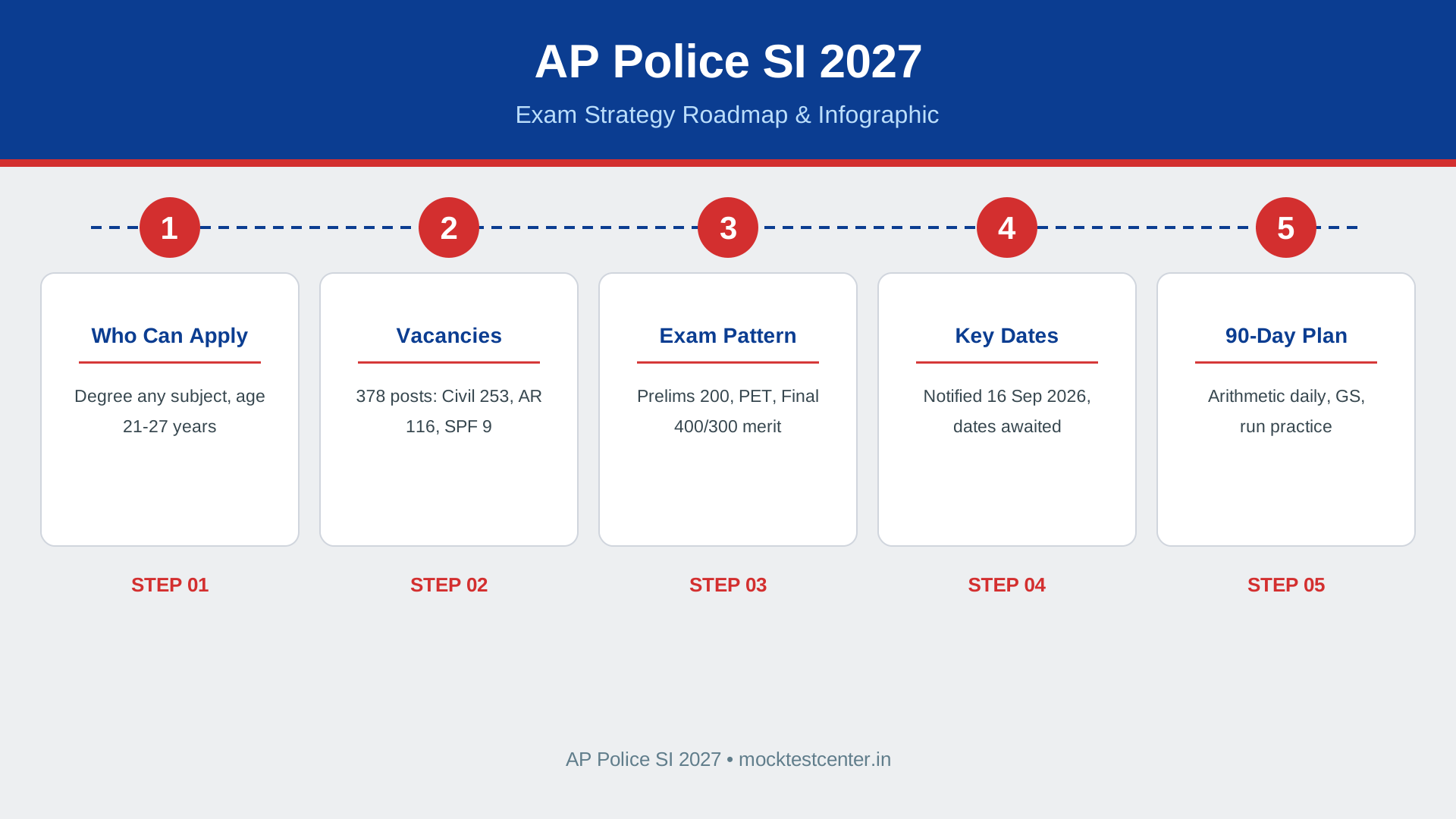
AP Police SI 2027 already has a notification, and that surprises most aspirants. The State Level Police Recruitment Board, Andhra Pradesh, issued notification Rc.No.81/SLPRB/Rect.1/2026 on 16 September 2026 for 378 Sub Inspector posts. The application dates and the Preliminary Written Test date have not been announced yet. The notification says plainly that both will come separately through a press release on the official website, slprb.ap.gov.in. So the 2027 cycle is real, it is open in the sense that the posts and the rules are published, and it is also unfinished, because nobody can apply until the board opens the window. Every fact in this guide comes from that notification, plus the last completed cycle of 2022 to 2023, which shows what the funnel actually looks like when the exam runs.
Three posts share this one notification, and they are not the same job. Stipendiary Cadet Trainee Sub Inspector of Police (Civil) has 253 posts and takes men and women. Stipendiary Cadet Trainee Reserve Sub Inspector of Police (AR) has 116 posts and also takes men and women. Sub Inspector in the Special Protection Force has 9 posts and takes men only. One application form covers all three, so you apply once and the board sorts you by the posts you are eligible for. The differences that matter sit further down the process. The physical test counts only as a pass or fail for Civil candidates, but it carries 100 merit marks for AR and SPF candidates. That single difference changes how much running matters to your final rank, and it changes which post a strong runner should prefer.
AP Police SI 2027 and the 2026 notification in numbers
| Item | Detail |
|---|---|
| Conducting body | State Level Police Recruitment Board, Andhra Pradesh (SLPRB, AP) |
| Notification number | Rc.No.81/SLPRB/Rect.1/2026, dated 16 September 2026 |
| Posts | 378 in total: SCT SI (Civil) 253, SCT RSI (AR) 116, SI (SPF) 9 |
| Application window | Not announced yet; will come by press release on slprb.ap.gov.in |
| Preliminary Written Test date | Not announced yet |
| Age as on 1 July 2026 | 21 to 27 years, before relaxations |
| Education | Degree in any discipline; SC and ST candidates need Intermediate plus a degree under study |
| Fee | Rs 600 for OC, EWS and BC local candidates; Rs 300 for SC and ST local candidates; Rs 600 for non-local candidates |
| Pay scale | Rs 44,570 to Rs 1,27,480 under Revised Pay Scale 2022 |
| Stages | Preliminary Written Test, Physical Measurement Test, Physical Efficiency Test, Final Written Examination, medical examination |
| Interview | None. The notification has no interview stage. |
Read the application line twice, because it is the detail most trackers get wrong. Several job sites published fixed application dates for this cycle in September and October 2026. Those dates do not exist in the notification. The notification says the exact dates for submission of the online application form and the Preliminary Written Test will be notified separately through a press release and published on the official website shortly. As of 20 November 2026 no such press release had fixed the dates. Any site that gives you a last date to apply is guessing, and a guess about a last date is the one error that can cost you the whole cycle. Check slprb.ap.gov.in itself, and check it weekly until the window opens.
The vacancy total needs the same care. The 378 figure covers only the three SI posts in notification Rc.No.81. The board issued six notifications on the same day, 16 September 2026, covering 2,050 posts in total across the police, fire services, prisons and forensic science departments. A second SI notification, Rc.No.82, covers 60 technical SI posts, 50 in Communications and 10 in the Police Transport Organisation. Those technical posts need a diploma or a degree in electronics, electrical, computer or automobile engineering, and they follow a different exam pattern with a technical paper. This guide covers only the 378 general SI posts. If you hold an engineering diploma, read Rc.No.82 separately, because its pattern and its merit calculation are different.
What the three posts actually are
Civil SI is the post most candidates picture when they say AP Police SI. A Civil Sub Inspector works in a police station, leads investigation of cases, supervises constables, handles law and order duty and appears in court. The post carries 253 vacancies in this cycle, spread across six zones: Zone 1 has 42, Zone 2 has 39, Zone 3 has 39, Zone 4 has 48, Zone 5 has 43 and Zone 6 has 42. One third of the vacancies in each category are reserved for women, as a horizontal reservation. That works out to roughly 84 of the 253 posts earmarked for women candidates, adjusted inside each communal category. If enough eligible women candidates are not available in a year, those reserved vacancies go to men of the same category instead of being carried forward.
Reserve Sub Inspector in the Armed Reserve is a different working life. AR units handle armed guards, escorts, bandobust duty at public events, and reserve force work. The post carries 116 vacancies: Zone 1 has 20, Zone 2 has 11, Zone 3 has 10, Zone 4 has 38, Zone 5 has 18 and Zone 6 has 19. Women get 20 percent reservation here, lower than the Civil share, which works out to roughly 23 of the 116 posts. The AR post is open to men and women, and the physical test is where it splits from Civil. An AR candidate must qualify in all three physical events, and the physical test adds 100 marks to the final merit. A Civil candidate only needs to pass the run and one more event. So a candidate who runs well gains a real edge in AR selection and gains nothing extra in Civil selection. Pick your preference with that arithmetic in mind, not with a vague idea of which post sounds better.
The Special Protection Force post is the smallest of the three, with 9 posts for men only, spread across six contiguous zonal cadres. SPF personnel guard sensitive installations and protected persons. Its selection mirrors AR: all three physical events, 100 physical marks in the final merit, and a final total of 300 marks. Nine posts means the cut off will swing wildly from year to year, because a handful of strong candidates can move the whole line. Treat SPF as a second preference to add on the same form, not as a plan on its own. You apply once for all three posts, so there is no extra fee for adding it, but do not build your preparation around 9 posts.
All three posts sit in the same pay scale, Rs 44,570 to Rs 1,27,480 under Revised Pay Scale 2022. The notification states the scale for post codes 11, 12 and 31 together, with no difference between them. Candidates appointed on or after 1 September 2004 come under the Contributory Pension Scheme. Older tracker pages quote Rs 28,940 to Rs 78,910 for this post. That was the old pay scale from the 2022 cycle. The 2026 notification supersedes it, and this guide uses the 2026 figure. The job title also carries the letters SCT, which stand for Stipendiary Cadet Trainee. You join as a trainee on a stipend, complete training, and then take up the Sub Inspector post. The training period is part of the job, not a separate hurdle after selection, but the notification ties your appointment to completing it.
Who can apply for AP Police SI 2027
Eligibility rests on four things: a degree, an age inside the limit, the physical standards, and local candidate status for most of the posts. Miss any one of them and the form itself will not save you, because the board verifies original documents only after you have qualified, and a candidate who fails verification at that late stage loses everything. Check each condition against your own certificates before you pay the fee, because the fee is never refunded.
The degree rule is simple for most candidates. As on 1 July 2026 you must hold a degree awarded by any university in India, established or incorporated by or under a Central Act or a State Act, or any institution recognised by the University Grants Commission, or any other equivalent qualification. The subject does not matter. A BA, a BSc, a BCom, a BTech and a BBA all qualify the same way. A higher qualification without the prescribed qualification also counts, and a candidate with a higher qualification than the prescribed one is considered along with the rest. Degrees earned through open universities or distance education must carry recognition by the Distance Education Council, Government of India. If your degree came through distance mode, confirm that recognition now, because the onus of proof rests on you.
One provision catches many SC and ST candidates by surprise, and it works in their favour. A candidate from the Scheduled Castes or the Scheduled Tribes must have passed the Intermediate examination as on 1 July 2026 and should have studied a degree in any university in India. Read that carefully. The rule asks for Intermediate passed, plus a degree under study. That is a deliberate relaxation written into the notification, and it is different from the general rule. If you belong to SC or ST and you are in the middle of your degree, you are eligible under this provision. Do not let a coaching centre tell you otherwise without showing you the notification.
The age rule is 21 to 27 years as on 1 July 2026. You must have been born not earlier than 2 July 1999 and not later than 1 July 2005. That is the general rule before relaxations, and the relaxations are generous. EWS candidates get up to 5 extra years. BC (non-creamy layer), SC and ST candidates get up to 5 extra years. An AP State Government employee gets relaxation equal to the length of regular service, up to 5 years, but employees of APTRANSCO, the DISCOMs, APGENCO, corporations, municipalities and local bodies do not get this one. Ex-servicemen get 3 years plus the length of service in the Army, Navy or Air Force. A whole time NCC Cadet Corps Instructor gets 3 years plus service, with a minimum of 6 months service. A retrenched temporary employee of the State Census Department gets up to 3 years, with a minimum of 6 months service during 1991. The notification adds that age validation is not done in the online form, so the form will not stop you from applying when you are over age. The responsibility is yours, and the board will catch it at verification.
| Category | Upper age with relaxation |
|---|---|
| General (OC), no relaxation | 27 years |
| EWS | 32 years |
| BC (non-creamy layer), SC, ST | 32 years |
| AP State Government employee | Up to 32 years, by length of service |
| Ex-serviceman | 27 years plus 3 years plus length of service |
Two tracker errors deserve a warning here. One popular tracker page lists the SI age limit as 21 to 30 years. That figure appears nowhere in either the 2022 or the 2026 notification, and it looks like a confusion with some other state's police recruitment. The correct general limit is 21 to 27, with the relaxations above taking it to 32 for most reserved categories. Second, the 2022 cycle itself revised its age limit midstream. The original 2022 notification also said 21 to 27, but a notice on 27 December 2022 raised the upper limit to 29 years for that cycle. That revision applied to the 2022 cycle only. It does not carry into 2026. If you read a page that says the AP SI age limit is 29, it is quoting the revised 2022 figure, and it is out of date for this cycle.
Local candidate status decides most of the seats. Under the Andhra Pradesh Public Employment (Organisation of Local Cadres and Regulation of Direct Recruitment) Order, 2025, the first 5 percent of posts are filled on open merit, locals and non-locals together, and the remaining 95 percent go to local candidates only. Local status rests on study certificates from Class 1 to Class 7, or on a residence certificate from the Tahsildar for the matching period if you did not study in a recognised school during that period. A single certificate covering the period is enough. Candidates who moved from Telangana to Andhra Pradesh within ten years from 2 June 2014 count as local at their place of residence in Andhra Pradesh. Non-local candidates pay Rs 600 and are treated under the Open Category, but they compete only for that 5 percent open slice. If you are a non-local candidate, understand that arithmetic before you invest months in preparation. Five percent of 378 is about 19 posts across all three SI posts.
Reservation inside the local pool follows Rule 22 of the AP State and Subordinate Service Rules, 1996, covering EWS, BC groups A to E, and SC groups 1, 2 and 3, plus ST. The BC-E reservation and age relaxation sit under litigation, and the notification says they apply to serial numbers 1 to 14 of the BC-E group under an interim Supreme Court order dated 25 March 2010. The special category quotas sit on top of this as horizontal reservations. For Civil SI, Police Executive gets 5 percent, Meritorious Sportspersons 3 percent, NCC 3 percent, ex-servicemen 2 percent, children of police personnel 2 percent, children of deceased and incapacitated police personnel 2 percent, and police ministerial 1 percent. For AR, Police Executive rises to 7 percent and the rest stay similar. For SPF, members of the SPF get 5 percent, children of SPF members 3 percent, sportspersons 3 percent, ex-servicemen 2 percent and NCC 2 percent. Police Executive means serving police constables, head constables and assistant sub-inspectors who are approved probationers with three years of service as on the notification date, with no major punishment and fewer than three minor punishments in their whole service.
The exam in four stages, and no interview
| Stage | What happens | Counts in final merit |
|---|---|---|
| Preliminary Written Test | Two objective papers, 100 marks each, 3 hours each | No, qualifying only |
| Physical Measurement Test | Height, chest and weight check | No, pass or fail |
| Physical Efficiency Test | 1600 metre run plus 100 metre run or long jump | No for Civil; 100 marks for AR and SPF |
| Final Written Examination | Four papers, 3 hours each | Yes, Papers 3 and 4 only |
| Medical examination | Vision and general fitness check | No, pass or fail |
There is no interview in this recruitment. That is worth stating plainly, because many general guides on police exams describe a viva or a personality test as the last stage, and some pages on this very exam mention one. The 2026 notification lists five elements and no interview appears in any of them. The 2022 notification had the same structure. Your rank comes from written papers and, for AR and SPF, from the physical test. Nobody will ask you questions across a table. That shapes preparation in a useful way. Every hour you spend on the written papers and the run moves your rank. An hour spent rehearsing interview answers moves nothing.
The order of stages matters too. The Preliminary Written Test comes first and it only qualifies you. Then the physical tests come, and they throw out a large share of candidates who passed the written test. Then the Final Written Examination decides the merit list. This order means a candidate who is weak physically can clear Prelims and still go home from the physical ground. The 2022 cycle shows the scale of that filter. Out of 1,51,288 candidates who attended Prelims, 57,923 qualified for the physical tests. That is about 38 percent. The physical stage then cut the field further before 18,637 candidates reached the Final Written Examination. Roughly one in eight of those who sat for Prelims reached the final written test. Treat the run as a paper, with the same seriousness and the same daily practice, because the board treats it that way.
Two process details from the notification deserve attention. First, the application runs in stages. You pay the fee first on slprb.ap.gov.in, then you submit the Stage 1 online application form. Paying the fee alone does not complete your application. If you pay and fail to press submit on the Stage 1 form, your case is rejected without notice and the fee is not refunded. Candidates who qualify in Prelims must then upload a Stage 2 application with scanned copies of original certificates before the physical tests. Second, there is no revaluation of answer sheets under any circumstances. Recounting of marks may be considered, but revaluation will not be entertained. That is the board's own language, and it means you should not plan on challenging a paper after the fact. Get the OMR bubbling right on the day, because there is no second look at your answers.
Prelims, paper by paper
Prelims has two papers on the same day, each of three hours, each with 100 objective questions and 100 marks. Paper 1 is Arithmetic at SSC standard plus Test of Reasoning and Mental Ability. Paper 2 is General Studies at degree standard. You must qualify in each paper separately. The qualifying marks are 40 percent for OC candidates including EWS, 35 percent for BC candidates, and 30 percent for SC, ST and ex-serviceman candidates. A candidate who scores 90 in Paper 1 and 35 in Paper 2 as an OC candidate fails, because 35 is below the 40 mark line in Paper 2. The total of the two papers is never used to qualify anyone. Each paper stands alone.
The questions are set in English, Telugu and Urdu, and you answer on an OMR sheet with a blue or black ball point pen. The board asks you to bring your own pens. That sounds like a small detail until you sit in a hall where the pen you borrowed skips on the OMR sheet. Carry two pens, both tested. Prelims marks have no relevance in the final selection. A candidate who scores 95 in both papers and a candidate who scores 41 in both papers walk into the physical tests as equals. That is liberating in one way and dangerous in another. It means you should not burn weeks chasing a 95 when a 55 would do, and it means you must not neglect the run while chasing that 95, because the run is where the next cut falls.
There is no negative marking in this exam. That statement needs care, because many trackers quote a deduction, and candidates plan their attempts around it. The 2026 notification prescribes no deduction for a wrong answer anywhere in its 42 pages. Its awarding rule says a candidate gets full marks for darkening only one bubble that matches the correct answer, and zero marks for leaving a question blank. No rule in the notification takes marks away for a wrong answer. The same was true in the 2022 notification. So the rational approach is to attempt every question. A blank answer earns zero, and a guessed answer earns zero at worst and one mark at best. The only cost of guessing is time. Do not leave questions blank in the hope of protecting a score that nothing threatens. That advice holds only while the notification stays silent on deductions, so recheck the rule in the press release that announces the exam date, in case the board changes it.
Paper 1 splits into two halves that reward different kinds of practice. Arithmetic at SSC standard covers the number system, simple interest, compound interest, ratio and proportion, average, percentage, profit and loss, time and work, work and wages, time and distance, clocks and calendars, partnership and mensuration. That list comes straight from Annexure 2 of the notification, and it is a gift, because it tells you exactly what to practise. None of it needs mathematics beyond Class 10. The trap is speed. One hundred questions in three hours gives you 108 seconds per question on paper, but the reasoning half eats time too, so the arithmetic half has to run fast. A candidate who can do a ratio question in 40 seconds beats a candidate who understands ratio well and takes three minutes.
The reasoning half covers verbal and non-verbal questions: analogies, similarities and differences, spatial visualisation, spatial orientation, problem solving, analysis, judgment, decision making and visual memory. These are the question types where practice matters more than study. You cannot memorise spatial visualisation. You can only do enough questions that the pattern becomes familiar. Ten reasoning questions a day from the start of preparation beats a month of reasoning crammed at the end. The paper is set at SSC standard, which means the difficulty stays modest. The challenge is volume and accuracy under time pressure, not depth.
Paper 2 is General Studies at degree standard, and its syllabus is short enough to quote in full. General science covers contemporary developments in science and technology and their implications, including matters of everyday observation and experience, plus contemporary issues in protection of the environment, at the level expected of a well educated person who has not made a special study of any scientific discipline. Then come current events of national and international importance, history of India with emphasis on broad general understanding in its social, economic, cultural and political aspects, the Indian National Movement, geography of India, and Indian polity and economy, including the political system, rural development, planning and economic reforms in India. That is the whole list. Five topics, no subtopics, no weightage given.
The breadth of that list is the point. A candidate who studies only current affairs will lose marks on history and geography. A candidate who studies only history will lose marks on polity and economy. The degree standard label means the questions assume a graduate's general knowledge, not a specialist's depth. The most useful way to cover it is to read one standard source per topic and then test yourself with previous papers. The 2022 Prelims papers are the closest model available, and the board's own pattern has not changed between 2022 and 2026. The papers look the same, the marks look the same, and the qualifying percentages look the same. Only the posts and the dates changed. Solve the 2022 papers under timed conditions, and you will know where you stand.
One more Prelims fact helps with planning. In the 2022 cycle, the Preliminary Written Test was held on 19 February 2023, with Paper 1 from 10 in the morning to 1 in the afternoon and Paper 2 from 2.30 to 5.30 the same day. Six hours of examination in one day, with a 90 minute break in between. That is a long day, and the second paper is where tired candidates make careless errors. Practise full days, not single papers. Sit for Paper 1 in the morning and Paper 2 in the afternoon on the same day, at least four times before the real exam, so the second paper does not catch you exhausted.
The physical tests: the stage that ends most runs
The Physical Measurement Test comes first and it is a pass or fail gate. Men must be at least 167.6 centimetres tall, with a chest of at least 86.3 centimetres on full inspiration and a minimum expansion of 5 centimetres. Women must be at least 152.5 centimetres tall and weigh at least 40 kilograms. Those are the general standards for all three post codes. Candidates from Aboriginal Scheduled Tribes in the agency areas of Vizianagaram, Anakapalli, Polavaram, Alluri Sitharamaraju, Eluru and Parvathipuram Manyam districts get relaxed standards: men 160 centimetres and 80 centimetres chest with 3 centimetres expansion, women 150 centimetres and 38 kilograms. Measurements are recorded through a digital measurement system, with height taken while the candidate stands upright in the correct position.
Two tracker errors circulate about these numbers, and both come from mixing up the constable standards with the SI standards. Several tracker tables list the male height as 162 centimetres and the chest as 84 centimetres. Those are constable figures, not SI figures. The SI notification is clear: 167.6 and 86.3. If you are a man who is 165 centimetres tall, you are eligible for the constable post and not eligible for SI, and no amount of preparation changes that. Measure yourself before you apply, with a proper stadiometer if you can, because a home measurement with a tape on a wall can be off by a centimetre, and a centimetre is the whole margin here.
| Standard | Men (general) | Women (general) | Men (ABO-ST agency areas) | Women (ABO-ST agency areas) |
|---|---|---|---|---|
| Height | 167.6 cm | 152.5 cm | 160 cm | 150 cm |
| Chest | 86.3 cm, 5 cm expansion | Not specified | 80 cm, 3 cm expansion | Not specified |
| Weight | Not specified | 40 kg | Not specified | 38 kg |
The Physical Efficiency Test follows, and it works differently for Civil candidates and for AR and SPF candidates. Civil candidates must qualify in the 1600 metre run and in one of the two remaining events, either the 100 metre run or the long jump. The test is qualifying only for them. AR and SPF candidates must qualify in all three events, and the events carry 100 marks: 40 for the 1600 metre run, 30 for the 100 metre run and 30 for the long jump. Marks follow a gradation table in Annexure 1 of the notification, so a faster run earns more than a bare pass. That is why a strong runner should think hard about AR. In AR selection, the physical test is worth 100 of the 300 final marks, a full third of the merit list. In Civil selection it is worth nothing beyond a pass.
| Event | General | Ex-servicemen | Women | Marks (AR and SPF) |
|---|---|---|---|---|
| 1600 metre run | 8 minutes | 9 minutes 30 seconds | 10 minutes 30 seconds | 40 |
| 100 metre run | 15 seconds | 16.5 seconds | 18 seconds | 30 |
| Long jump | 3.80 metres | 3.65 metres | 2.75 metres | 30 |
Those times are the qualifying standards, not targets. A man who runs 1600 metres in 7 minutes 55 seconds qualifies, but he qualifies by 5 seconds, and a bad day, a slow track or a false start can erase that margin. The 2022 cycle ran its physical tests from 25 August 2023, in the heat of late August in Andhra Pradesh, and the notification warns that the events use electronic timing, that spike shoes stay banned, and that once an event is conducted its result is final, with no second chance, no re-test and no reconduct under any circumstances. A fraction of a millisecond beyond the prescribed time is enough to fail. Participation in all prescribed events is compulsory, including for special category candidates. Train for a cushion, not for the line. A man should aim to run 1600 metres in 7 minutes or less before he calls himself ready, and a woman should aim for 9 minutes 30 seconds or less. Those cushions absorb a bad day.
The medical standards close the physical stage. Distant vision must be 6/6 in each eye and near vision 0/5 on the Snellen chart in each eye, with a full field of vision in each eye. Colour blindness, squint or any morbid condition of the eye or the lids is a disqualification. The candidate must be in sound health and free from any bodily defect that would render him or her unfit. The notification lists the disqualifying conditions by name: physically handicapped, knock knees, pigeon chest, flat feet, varicose veins, hammer toes, fractured limbs, decayed teeth, stammering, hard of hearing and abnormal psychological behaviour. The board advises candidates to get themselves examined by a civil surgeon before applying, to avoid disappointment. That advice is worth taking literally. An eye test and a basic physical check cost little, and they can tell you in an afternoon whether this recruitment is open to you at all.
The Final Written Examination
The Final Written Examination has four papers, each of three hours. Paper 1 is English, descriptive, at degree standard, for 100 marks. Paper 2 is Telugu or Urdu, descriptive, at degree standard, for 100 marks. Paper 3 is Arithmetic and Test of Reasoning and Mental Ability, objective, at SSC standard, with 200 questions. Paper 4 is General Studies, objective, at degree standard, with 200 questions. Papers 1 and 2 are qualifying only. Their marks never enter the merit list. Papers 3 and 4 decide the rank.
The qualifying marks in the final written test match Prelims: 40 percent for OC including EWS, 35 percent for BC, and 30 percent for SC and ST in each paper. Fail any one paper and you are out, whatever your other scores look like. The notification is explicit that candidates who do not secure the minimum qualifying marks in Papers 1 and 2 will not be considered for further selection, irrespective of their performance in Papers 3 and 4. That sentence is the trap in this exam. Papers 1 and 2 look like formalities because they carry no merit marks, so candidates ignore them, and then a weak English essay or a weak Telugu precis ends a run that was strong everywhere else. Both language papers test the same skills: a short essay, comprehension, precis, letter writing, paragraph or report writing, and translation. English paper asks for translation from English to Telugu. Telugu or Urdu paper asks for translation into English. Practise both directions, in handwriting, under time, because descriptive writing is a different skill from choosing options, and it fades fast without practice.
| Paper | Subject | Type | Civil marks | AR and SPF marks |
|---|---|---|---|---|
| Paper 1 | English (degree standard) | Descriptive | 100, qualifying only | 100, qualifying only |
| Paper 2 | Telugu or Urdu (degree standard) | 100, qualifying only | 100, qualifying only | |
| Paper 3 | Arithmetic and Reasoning (SSC standard, 200 questions) | Objective | 200 | 100 |
| Paper 4 | General Studies (degree standard, 200 questions) | Objective | 200 | 100 |
| Total merit | Papers 3 and 4 (plus PET for AR and SPF) | 400 | 300 |
Notice the arithmetic inside that table. Paper 3 has 200 questions. For a Civil candidate it carries 200 marks, so each question is worth one mark. For an AR or SPF candidate it carries 100 marks, so each question is worth half a mark. The same holds for Paper 4. The questions are the same for everyone. The weight is different. That means a Civil candidate's final merit runs out of 400 and an AR candidate's runs out of 300, with 100 of those 300 coming from the physical test. A Civil candidate who scores 280 out of 400 in the final written test has 70 percent. An AR candidate needs 210 out of 300 for the same percentage, and a third of it comes from running and jumping. The two merit lists are separate, so the percentages sit on different lists, and the preparation balance should reflect the list you are on.
When two or more candidates in a category score equal marks, the board gives preference to the candidate who was born earlier. That is the only tie rule in the notification. There is no rule that prefers a higher Paper 4 score or a younger candidate. In a list where the cut off can turn on a single mark, the tie rule is a reminder that the board expects ties and has a simple answer for them. It is also a reminder not to aim for the cut off. Aim 20 marks above it, because the cut off is where ties live.
What the last cycle tells you
The 2022 cycle is the only completed evidence of how this exam behaves, and its numbers are unusually complete. The notification was Rc.No.163/SLPRB/Rect.1/2022, dated 28 November 2022, issued under G.O.Ms.No.153 of the Home Department dated 20 October 2022, which sanctioned 411 SI posts and 6,100 constable posts, 6,511 in total. The SI posts were 315 Civil Sub Inspectors for men and women and 96 Reserve Sub Inspectors (APSP) for men, under post codes 11 and 13. Applications ran from 14 December 2022 to 18 January 2023. Prelims was held on 19 February 2023. The physical tests began on 25 August 2023. The Final Written Examination was held on 14 and 15 October 2023. The final selection list came out on 6 December 2023. From notification to final list took just over a year. Expect the same shape this time: a long cycle, with months between stages, and a final list that arrives a year after the notification.
The funnel numbers are the most useful part. A total of 1,73,047 candidates submitted applications for the 411 posts. Of those, 1,51,288 attended the Preliminary Written Test. That is 87 percent attendance, which is high for a police recruitment, and it means the hall was full of serious candidates. From those, 57,923 qualified for the physical tests. That is about 38 percent of those who appeared, or one in 2.6. Then 18,637 candidates reached the Final Written Examination, which is about 12 percent of those who appeared in Prelims, or one in 8. The final list filled 411 posts from 1,73,047 applicants, which is about 421 applicants for each post, or about 368 of those who actually appeared for each post. Those ratios sound forbidding, and they are, but the Prelims qualifying marks tell a kinder story. The qualifying line was 40 percent for OC candidates in each paper. That is 40 marks out of 100 in each paper. A prepared candidate clears it. The candidates who fail Prelims are mostly the ones who never prepared for the arithmetic half or never opened the reasoning section.
The official cut off marks for the 2022 cycle survive in a cut off document issued by the board under the same notification number, and the Civil SI figures show how the final merit actually landed. For OC general category men, the cut off out of 400 marks was 257 in Zone 1, 248 in Zone 2, 247 in Zone 3 and 246 in Zone 4. For OC women it was 230 in Zone 1, 221 in Zone 2, 233 in Zone 3 and 219 in Zone 4. For SC general men the figures ran from 213 to 224 across the zones, and for ST general men from 204 to 215. Read those numbers as a range, not as a promise. The OC male cut off sat between 246 and 257 out of 400, which is 61 to 64 percent. The OC female cut off sat between 219 and 233, which is 55 to 58 percent. A Civil candidate aiming for 280 out of 400 clears every zone's OC cut off with room to spare. A candidate aiming for 250 sits on the line in one zone and below it in another. The zone matters, because the merit list is zone-wise, and your zone is fixed by your local status. Check which zone you belong to and look at that zone's figure, not the state average.
One more lesson sits in the 2022 cycle. The AR post in 2022 was the APSP post, open to men only, with 96 posts. In 2026 the AR post is open to men and women, with 116 posts, and a new SPF post has appeared with 9 posts. The post mix changes between cycles, and the 2027 cycle may change it again. Do not prepare for the 2022 post list. Prepare for the 2026 post list in this guide, and recheck the list when the application window opens, because the board can modify any aspect of the recruitment during the process, and the notification reserves that right in its opening paragraphs.
The 90 day plan
Ninety days is enough if you treat it as a full time job and short if you treat it as an evening hobby. The plan below assumes three to four hours of study on weekdays and six hours on weekends, plus running on five days a week. If you have more time, add it to arithmetic practice and to mock tests. If you have less, cut the reading and keep the practice, because this exam rewards doing questions more than reading about them.
Days 1 to 30 build the base. Arithmetic gets the first hour every day, working through the notification's own topic list in order: number system, simple and compound interest, ratio and proportion, average, percentage, profit and loss, time and work, work and wages, time and distance, clocks and calendars, partnership and mensuration. One topic a day, with 30 questions on that topic after the study. Reasoning gets 30 minutes a day, ten questions each of analogies, series and non-verbal patterns. General Studies gets one hour a day, rotating through history, geography, polity, economy and science, one topic per day, from a single standard source per topic. Current affairs get 20 minutes a day, from one newspaper, with notes in a single notebook. Running starts on day 1, not day 60. Run 1600 metres on alternate days at an easy pace, and do 100 metre sprints and long jump practice twice a week. The first month builds the habit of running, so that the body is ready when the speed work starts. End the month with one full Prelims mock, both papers, morning and afternoon, timed.
Days 31 to 60 turn the base into exam skill. Arithmetic shifts from learning topics to mixed sets: 50 mixed questions a day, timed at 60 minutes, with every error written into a notebook with the correct method. Reasoning rises to 40 questions a day, with a focus on the types you get wrong, not the types you enjoy. General Studies shifts from reading to revision: reread your notes, add the last three months of current affairs, and start a second source only for the topic you are weakest in. Language papers enter the plan now, one essay and one precis a week in English and one in Telugu or Urdu, written by hand and timed. Running gets serious in this month. Three 1600 metre timed runs a week, with a target of beating your previous time by 10 seconds each week. Long jump gets one dedicated session a week, working on the run up and the takeoff, because most candidates lose distance on technique, not on strength. End the month with two full Prelims mocks and one full Final Written mock, Papers 3 and 4 only, under timed conditions.
Days 61 to 90 are revision and mocks, and nothing else. No new book, no new topic, no new source. Arithmetic becomes one mixed set of 100 questions a day, timed at 100 minutes, until the error rate falls below 8 percent. Reasoning becomes one mixed set of 50 questions a day. General Studies becomes revision of your own notes only, plus daily current affairs from the last six months. Language papers become two essays and two precis a week, one in each language, because the qualifying bar in Papers 1 and 2 is the cheapest way to lose this exam. Running peaks in week 11 and tapers in week 13, so that you arrive at the physical tests fresh rather than tired. Take a full mock every Sunday: Prelims papers in the morning and afternoon, then Final Written papers the next day, so that the two day rhythm of the real exam becomes familiar. In the last week, stop learning and start resting. Revise your error notebook, reread your current affairs notes, run lightly, sleep well, and check the hall ticket and the exam centre a day early. The candidates who fail in the last week are the ones who start a new book on day 85.
Books and sources
The notification prescribes no textbook, and it says so in plain words. The board names no book as its official source. That sentence frees you from chasing the one true book, and it also means no book can claim to be the official source. Pick standard books and stick with them. For arithmetic at SSC standard, a single book of solved examples with practice sets is enough, and the most used one is R.S. Aggarwal's Quantitative Aptitude, worked topic by topic rather than read cover to cover. For reasoning, the same author's reasoning book covers the verbal and non-verbal types in the syllabus, and a book of previous police exam papers adds the actual question style. For General Studies, the NCERT books for history, geography and polity from Classes 6 to 12 give the base, and a yearly current affairs compilation covers the rest. For English and Telugu descriptive writing, the habit matters more than the book. Write one essay a week from a newspaper editorial, and get it checked by a teacher or a senior who cleared a descriptive paper before. For Andhra Pradesh specific knowledge, the state board textbooks and the state government's own publications on the state's geography, history and schemes fill the gaps that national books leave.
Previous papers deserve a line of their own. The board has run this pattern twice in recent years, in 2019 and in 2022, with the same papers and the same marks. The 2022 Prelims papers and the Final Written papers for Papers 3 and 4 are the closest model of what you will face, and they are available from coaching institutes and bookshops as solved papers. Solve them timed, score them strictly, and use the score to decide what to study next. A candidate who scores 45 in Paper 1 arithmetic and 70 in Paper 2 General Studies needs arithmetic next, and the papers just proved it. Mock tests from this site help in the same way. Take them under the same conditions as the real exam, same time limits, same OMR style answering, and read the solutions for every question you got wrong, not just the ones you guessed.
AP Police SI aspirants often prepare for other state and national exams alongside this one. The UP Police Sub Inspector 2027, JK Police SI 2027, Karnataka PSI 2027, Bihar Police SI Daroga 2027, SSC Delhi Police Constable 2027, UP Police Constable 2027, SSC GD 2027, SBI PO 2027, IBPS PO 2027 and UPPSC PCS 2027 pages on this site carry mock tests in the same format, and working through a neighbouring exam's papers is a useful way to test arithmetic and reasoning under time pressure.
Mistakes to avoid
The first mistake is preparing for the wrong post. Candidates read a tracker page that lists Deputy Jailor and Station Fire Officer under the SI notification, and they prepare for a combined exam that does not exist. The 2022 SI notification covered only Civil SI and Reserve SI (APSP), 411 posts. Deputy Jailors and Station Fire Officers were recruited under separate notifications, and the tracker pages that lump them together are quoting a pre-notification plan, not the issued notification. The 2026 notification covers Civil, AR and SPF only. Prepare for those three posts, and read the technical SI notification separately if you hold an engineering diploma.
The second mistake is trusting tracker dates. Fixed application dates, fixed Prelims dates and fixed hall ticket dates appear on job sites within days of every notification, and they are invented. The board announces dates by press release on its own website. Until that press release appears, there is no date. A candidate who plans around an invented date either relaxes too early or panics too late. Check slprb.ap.gov.in weekly, and treat every other date as rumour until the board confirms it.
The third mistake is ignoring the language papers. Papers 1 and 2 carry no merit marks, so candidates skip them, and then the 40 percent qualifying bar ends their run. Forty marks out of 100 in a descriptive English paper is not a low bar for a candidate who has not written an essay in years. Write every week from the second month, and write by hand. Typing an essay does not prepare you for writing one.
The fourth mistake is starting the running too late. The physical tests come after Prelims, and candidates tell themselves they will start running after they clear Prelims. The 2022 cycle gave candidates about six months between Prelims in February and the physical tests in August, and many still failed the run, because six months of running after years of sitting is not enough for a safe margin. Start on day 1 of preparation. A 1600 metre run in 8 minutes needs months of training for most graduates, and the qualifying standard is a minimum, not a target.
The fifth mistake is leaving questions blank. There is no negative marking in this notification. A blank answer earns zero. A guessed answer earns zero at worst and a mark at best. Attempt every question in every objective paper, and spend the time you save on the questions you can solve rather than on the ones you cannot.
The sixth mistake is applying without checking the physical standards and the medical standards. A candidate who is 165 centimetres tall cannot become an SI in Andhra Pradesh, and a candidate with colour blindness cannot either. Both facts are in the notification. Read them before you pay Rs 600, because the fee is never refunded and the disappointment is avoidable.
What to check first
Open slprb.ap.gov.in and look for the press release that announces the application window for Rc.No.81/SLPRB/Rect.1/2026. That single page is the next event in this recruitment, and everything else waits for it. While you wait, measure your height and chest, get your eyes tested, confirm your degree recognition if it came through distance mode, and gather your Class 1 to Class 7 study certificates for local status. Then start the 90 day plan above, beginning with arithmetic and with running, on the same day. The notification is out, the posts are real, and the only date that matters now is the one the board has not yet fixed.
Sources: SLPRB Andhra Pradesh notification Rc.No.81/SLPRB/Rect.1/2026 dated 16 September 2026, 42 pages, read in full (official PDF via the Testbook CDN mirror, since slprb.ap.gov.in did not respond to direct requests during preparation); SLPRB notification Rc.No.163/SLPRB/Rect.1/2022 dated 28 November 2022, quoted in tracker reproductions of the official text; SLPRB cut off marks document for SCT SI (Civil) under Rc.No.163, hosted copy; Prepp report on the final selection list of 6 December 2023; IACE report on the 2022 cycle figures; Testbook pages on the 2022 selection process, eligibility and revised age limit; New Indian Express report of 29 November 2022 on the 6,511 vacancy notification.