About AP Police Constable 2027 Exam Series
📖 Table of Contents
- The 2026 notification in numbers
- What the last cycle actually looked like
- Who can apply for AP Police Constable 2027
- The physical standards you must clear
- The exam in four stages
- The syllabus, subject by subject
- Cut offs: what the last cycle really showed
- What to study, and what to study with
- A 90 day plan that fits around a job
- Mistakes that cost marks
- Sources
AP Police Constable 2027: Complete Exam Guide
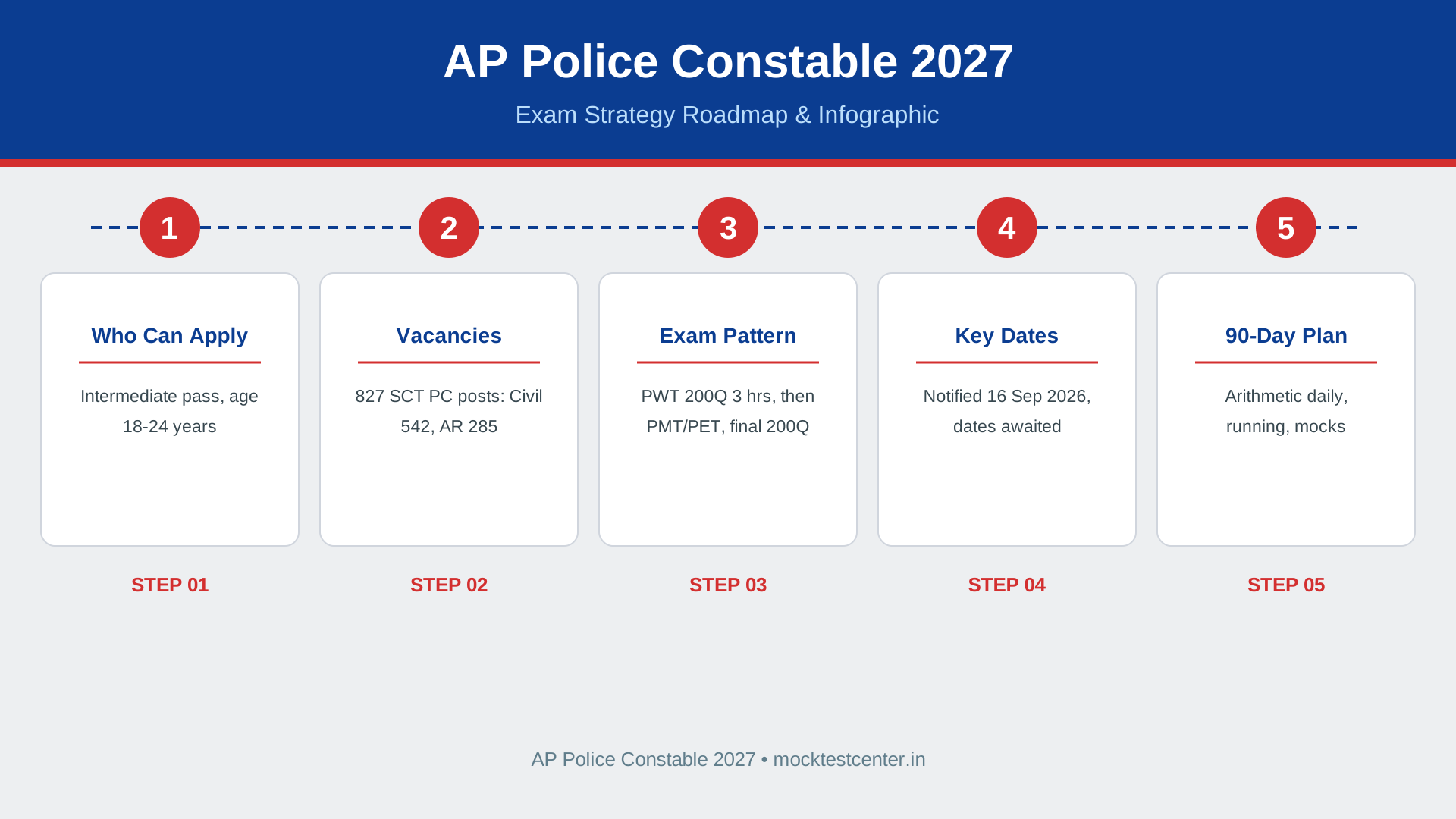
On 16 September 2026 the State Level Police Recruitment Board of Andhra Pradesh issued a fresh notification for police constables. It carries 827 Stipendiary Cadet Trainee Police Constable posts, 542 in the Civil stream and 285 in the Armed Reserve stream, under Rc.No.91/SLPRB/Rect.2/2026. The application dates have not been announced yet. The board says they will come through a press release on its website, and that is the date every aspirant is waiting for. AP Police Constable 2027 is the name this guide uses for the coming cycle, because the 2026 notification is the cycle that will fill these posts and the exam will run into 2027.
That notification is not the whole story. The last full cycle started with a notification on 28 November 2022 for 6,100 constable posts and ended only in August 2025, when the final results came out. It took almost three years from notification to appointment, and it shows what this exam really demands: a written test you must pass twice over, physical tests that end runs without warning, and a wait between stages that tests patience as much as preparation. This guide uses both cycles. The 2026 notification gives you the posts, the age limits, the fee and the pattern you will face. The 2022 cycle gives you the numbers that show how hard the competition is and where candidates actually fall out.
The 2026 notification in numbers
| Item | Detail |
|---|---|
| Conducting body | State Level Police Recruitment Board, Andhra Pradesh (SLPRB, AP), Mangalagiri |
| Notification number | Rc.No.91/SLPRB/Rect.2/2026, dated 16 September 2026 |
| SCT Police Constable (Civil), post code 21 | 542 posts, men and women |
| SCT Police Constable (AR), post code 22 | 285 posts, men and women |
| Firemen, post code 42 | 158 posts, men only |
| Warders (Men), post code 53 | 150 posts, men only |
| Warders (Women), post code 54 | 21 posts, women only |
| Total in Rc.No.91 | 1,156 posts |
| Application dates | Not announced as of 20 November 2026, to come by press release |
| Fee | Rs 300 for OC, EWS and BC local candidates and for all non-local candidates; Rs 150 for SC and ST local candidates |
| Pay scale | Rs 25,220 to Rs 80,910 under Revised Pay Scale 2022 |
| Official website | slprb.ap.gov.in |
Two companion notifications came out on the same day, and candidates mix them up with the main one. Rc.No.92/SLPRB/Rect.2/2026 covers 200 SCT Police Constables (Communications), a technical post that needs an ITI qualification or Intermediate with MPC. Rc.No.93/SLPRB/Rect.2/2026 covers 213 Police Transport Organisation constables, 15 Mechanics and 198 Drivers. Together the three constable notifications cover 1,569 posts. Add the three Sub Inspector notifications from the same day and the whole 16 September 2026 drive covers 2,050 posts. This package is about the Civil and AR constable posts in Rc.No.91 only. The Communications, Mechanics and Drivers posts have no Preliminary Written Test and follow different physical and trade tests, so their pattern does not apply here.
The vacancy figures are provisional. The notification says the number of vacancies is liable to change without notice, and the board can modify any part of the recruitment during the process. District-wise vacancies are given in the notification for Civil, AR and Firemen posts. NTR City carries 44 Civil constable posts and Tirupati 42, the two largest district shares, while Visakhapatnam City carries 23 and Srikakulam 8. A candidate applies for a district cadre, so the district you pick changes the competition you face. Read the district table in the notification before you choose, because a district with 44 posts and a district with 8 posts are different exams in practice even though the paper is the same.
One more number from the notification deserves attention. The 2022 cycle offered 6,100 constable posts. The 2026 notification offers 827. That is a steep fall, and it changes the arithmetic of the whole exam. Fewer posts mean a higher cut in the final written examination and less room for error in the physical tests. Candidates who prepared for the 2022 cycle with a plan built around 6,100 posts need a new plan. The paper is the same shape, but the bar is higher.
What the last cycle actually looked like
The 2022 notification, Rc.No.161/SLPRB/Rect.2/2022 dated 28 November 2022, invited applications for 6,100 Stipendiary Cadet Trainee Police Constables: 3,580 Civil constables for men and women under post code 21, and 2,520 APSP constables for men only under post code 23. APSP stood for Andhra Pradesh Special Police, the armed stream. In the 2026 notification the armed stream is called AR, Armed Reserve, under post code 22, and it is open to men and women. The name and the code changed, and the eligibility of women changed with them. Do not carry the 2022 post codes into the 2026 application. The 2026 codes are 21 for Civil and 22 for AR.
Applications for the 2022 cycle opened on 30 November 2022 and were to close on 28 December 2022. The board extended the last date to 7 January 2023. The Preliminary Written Test was held on 22 January 2023. A total of 5,03,486 candidates applied online, and 4,59,182 appeared for the Preliminary Written Test, according to the Times of India report on the final results. Scroll reported 4,58,219 candidates appeared, a difference of 963, and this guide uses the Times of India figure because it comes from the board's own briefing at the results. Either way, about 460,000 people sat for an exam with 6,100 posts, which is about 75 candidates for each post at the first stage.
From those who appeared, 95,208 qualified for the physical measurement and efficiency tests, held across 13 centres in the state. That is about one in five of those who appeared. From the physical stages, 38,914 candidates were shortlisted for the Final Written Examination, held on 10 July 2025. The final results were declared in August 2025, and the Times of India reported that 33,921 candidates qualified. The board released the results through Home Minister Vangalapudi Anitha at the DGP office in Mangalagiri, in the presence of DGP Harish Kumar Gupta and SLPRB chairman R.K. Meena. Training for the selected candidates was to start in the first week of September 2025.
Three names from that result tell you what the top of the merit list looks like. Gandi Nanaji from Visakhapatnam secured the first rank with 168 marks. G. Ramya Madhuri from Vizianagaram stood second with 159 marks. Merugu Achyuta Rao from Rajahmundry stood third with 144.5 marks. Among the Civil constable posts, 1,063 were secured by women candidates. The minister also said a fresh notification would soon be issued to fill the remaining vacancies in the department. That promise is the 16 September 2026 notification this guide is built on.
Read the funnel again, because it is the most useful set of numbers in this guide. About 5,03,000 applied. About 4,59,000 appeared. About 95,000 cleared the Preliminary Written Test. About 39,000 reached the Final Written Examination. The Preliminary Written Test removed four out of five candidates. The physical tests removed about three out of five of those who remained. The exam runs through four gates, and each gate takes a large share of the candidates who reach it. A plan that prepares only for the written papers ignores the gate that removes the most people after the first test.
Who can apply for AP Police Constable 2027
The education rule is simple. A candidate must have passed Intermediate, the 10+2 examination, or an equivalent examination recognised by the State Government, as on 1 July 2026. That date matters. The qualification must be held on 1 July 2026, not on the date you apply, because the application dates have not been announced and may fall after that date. Candidates from SC and ST communities have a special provision: they can apply if they have passed SSC and have studied and appeared for the Intermediate examinations in both the first year and the second year. A degree is not needed for this post. A graduate can apply, and many do, but the degree adds nothing to eligibility and nothing to the merit list.
Age is counted as on 1 July 2026. For Civil and AR constables, a candidate who is not an eligible Home Guard must have attained 18 years and must not have attained 24 years on that date. That means a birth date between 2 July 2002 and 1 July 2008. Serving Home Guards get a much wider window: 18 to 32 years, provided they are local to Andhra Pradesh, were on duty as Home Guards for at least 360 days within the two years before the notification, and are still serving on the date of the notification. Firemen and Warders also carry an 18 to 32 year limit. Drivers carry 18 to 27 years.
| Post | Age as on 1 July 2026 | Birth dates |
|---|---|---|
| SCT Police Constable (Civil), code 21 | 18 to 24 years | 2 July 2002 to 1 July 2008 |
| SCT Police Constable (AR), code 22 | 18 to 24 years | 2 July 2002 to 1 July 2008 |
| Eligible Home Guards, codes 21 and 22 | 18 to 32 years | 2 July 1994 to 1 July 2008 |
| Firemen, code 42 | 18 to 32 years | 2 July 1994 to 1 July 2008 |
| Warders, codes 53 and 54 | 18 to 32 years | 2 July 1994 to 1 July 2008 |
Age relaxations apply on top of these limits. Trackers reporting on the 2026 notification list relaxation of up to 5 years for EWS, BC Non-Creamy Layer and SC and ST candidates, up to 5 years for eligible AP State Government employees, and further relaxation for eligible ex-servicemen and NCC instructors. This guide lists those figures as tracker-reported, because the relaxation clauses sit deep in the notification text and no two tracker pages quote them in the same words. Check the exact relaxation for your category in the notification itself before you apply. The date of birth the board accepts is the one recorded in the SSC or Matriculation certificate, so a mismatch between your certificates can end an application before it starts.
The 2022 cycle shows why you must read the age clause in full instead of trusting a headline figure. The original 2022 notification set the general age limit at 18 to 24 years as on 1 July 2022, with Home Guards at 18 to 32 years. The board then issued an age-limit increase notice on 24 December 2022, and trackers report the raised limits as 26 years for other candidates and 34 years for local candidates working in the AP Police Department. This guide states the original 18 to 24 figure as the notification figure and flags the raised figures as tracker-reported, because the increase notice itself was not read during preparation. The lesson stands either way: the age limit in the notification you apply under is the only one that counts, and it can change after the notification comes out.
Local candidate rules apply to the main 1,156 post recruitment under the Andhra Pradesh Public Employment (Organisation of Local Cadres and Regulation of Direct Recruitment) Order, 2025. Candidates claiming local status may need study certificates from Class 1 to Class 7, and where a candidate has not studied in an institution during the relevant period, a residence certificate from the competent revenue authority may be needed. Non-local candidates can apply too, but they pay the Open Category fee of Rs 300 and are treated as Open Category. The notification also provides horizontal reservation for special categories: Home Guards, Children of Police Personnel, Meritorious Sportspersons, NCC, ex-servicemen, and Children of deceased and incapacitated Police Personnel. The percentages differ by post, so check the quota table for your post code.
The physical standards you must clear
Every candidate who clears the Preliminary Written Test faces the Physical Measurement Test first. It is a fixed bar, not a score. You either meet the standard or you do not, and no written score can make up for a shortfall. For men in the Civil, AR, Firemen and Warder posts, the height minimum is 167.6 cm and the chest minimum is 86.3 cm around the chest on full inspiration, with a minimum expansion of 5 cm. For women in the Civil, AR and Warder posts, the height minimum is 152.5 cm and the weight minimum is 40 kg. There is no chest standard for women and no weight standard for men in the notification.
Aboriginal ST candidates in the notified agency areas of Srikakulam, Vizianagaram, Visakhapatnam, East Godavari and West Godavari districts get relaxed standards: men 160 cm height and 80 cm chest with 3 cm expansion, women 150 cm height and 38 kg weight. Measurements are recorded with a digital measurement system, so there is no room for argument at the venue. Check your height and chest at home with a proper tape before you apply. A candidate who is 166 cm tall and applies anyway wastes the fee and the preparation.
| Standard | Men | Women |
|---|---|---|
| Height, general | 167.6 cm minimum | 152.5 cm minimum |
| Chest, general | 86.3 cm on full inspiration, 5 cm expansion | Not applicable |
| Weight, general | Not applicable | 40 kg minimum |
| Height, Aboriginal ST in agency areas | 160 cm minimum | 150 cm minimum |
| Chest, Aboriginal ST in agency areas | 80 cm on full inspiration, 3 cm expansion | Not applicable |
| Weight, Aboriginal ST in agency areas | Not applicable | 38 kg minimum |
The Physical Efficiency Test comes next, and it works differently for the two constable streams. That difference is the single most misunderstood part of this exam, so read it slowly. For Civil constables, Firemen and Warders, the PET is qualifying only. You must clear the 1600 metre run and one of the other two events, either the 100 metre run or the long jump. Clear them and you move on with no marks carried forward. For AR constables, the PET is scored. You must clear all three events, and your performance in each event is converted to marks through gradation tables in the notification, for a total of 100 marks that count in the final merit.
| Event | General | Ex-servicemen | Women | AR marks |
|---|---|---|---|---|
| 1600 metre run | 8 minutes | 9 minutes 30 seconds | 10 minutes 30 seconds | 40 |
| 100 metre run | 15 seconds | 16.5 seconds | 18 seconds | 30 |
| Long jump | 3.80 metres | 3.65 metres | 2.75 metres | 100 |
| Total PET marks for AR | 100 |
The AR gradation tables reward speed and distance well beyond the qualifying bar. For men, a 1600 metre run of 4 minutes or less earns the full 40 marks, a 100 metre run of 10.50 seconds or less earns the full 30 marks, and a long jump of 5.61 metres or more earns the full 30 marks. Those are athlete numbers, not the qualifying numbers. An AR candidate who trains only to the qualifying standard leaves PET marks on the table, and in a cycle with 285 AR posts those marks decide ranks. A Civil candidate faces the opposite trap: the PET carries no marks, so time spent chasing a 4 minute 1600 metre run is time taken from the written papers that decide the Civil merit list. Train to clear the Civil bar with a margin, then put the hours into the books.
Three PET rules apply to everyone. Timing and measurement use electronic equipment. Spike shoes are not permitted. There is no second chance, no re-test and no re-conduct after an event is held. A false start, a slip, or a mistimed run ends there. Practise on a real track with a stopwatch, in the shoes you will wear on the day, so the venue holds no surprises. Medical standards also apply before appointment. The notification prescribes distant vision of 6/6 in both eyes and near vision of 0.5 in both eyes on the Snellen standard, with a full field of vision in each eye. Colour blindness, squint and certain morbid conditions of the eye or eyelids are disqualifying. The notification advises candidates to get a medical examination by a Civil Surgeon before applying, and that advice is worth taking. An eye problem found at the medical stage, after two written tests and the physical tests, is the worst way to lose this exam.
The exam in four stages
| Stage | What happens | Marks | Counts in merit |
|---|---|---|---|
| Preliminary Written Test | One objective paper, 200 questions, 3 hours | 200 | No, qualifying only |
| Physical Measurement Test | Height, chest or weight against the fixed bar | Nil | No, qualifying only |
| Physical Efficiency Test | 1600 m run plus 100 m run or long jump | 100 for AR, nil for Civil | Yes for AR, no for Civil |
| Final Written Examination | One objective paper, 200 questions, 3 hours | 200 for Civil, 100 for AR | Yes |
The order is fixed: Preliminary Written Test, then physical measurement and efficiency tests, then the Final Written Examination. Only candidates who qualify in the Preliminary Written Test are called for the physical tests, and only candidates who qualify in the physical tests sit for the Final Written Examination. There is no interview in this recruitment. The final selection rests on the written examination and, for AR candidates, the PET marks.
The Preliminary Written Test is one objective paper of 200 questions for 200 marks, with a duration of 3 hours, at Intermediate standard. Each question carries 1 mark. The paper is set in English, Telugu and Urdu, and the candidate picks the language option in the application form. There is one exception to the language choice: the English questions stay in English even in the Telugu and Urdu versions of the paper. Answers go on an OMR sheet with a blue or black ball point pen only, and candidates must bring their own pens. The notification awards full marks for one correct bubble and zero for an unanswered question. The notification specifies no negative mark. That absence is unusual among police exams, and it changes how you should attempt the paper: a question you leave blank and a question you answer wrong cost you the same, so there is no penalty for an educated guess. Do not assume this will stay true. Check the 2027 notification when it appears, because a negative marking rule could be added.
The minimum qualifying marks in the Preliminary Written Test are 40 percent for OC candidates including EWS, 35 percent for BC candidates, and 30 percent for SC, ST and ex-servicemen candidates. In marks, that is 80 out of 200 for OC and EWS, 70 for BC, and 60 for SC, ST and ex-servicemen. Those are qualifying marks, not cut off marks. The board calls a fixed number of candidates for the physical tests from those who qualify, so the effective cut can sit well above the qualifying mark when applications are heavy. In the 2022 cycle about 95,000 of about 4,59,000 who appeared qualified for the physical tests, which is about 20 percent. A score of 80 out of 200 clears the qualifying bar for an OC candidate, but the 2022 funnel shows that clearing the bar and getting called are not the same thing.
The Final Written Examination follows the same shape: one objective paper, 200 questions, 3 hours, the same seven-subject syllabus at Intermediate standard, set in English, Telugu and Urdu, answered on an OMR sheet. The difference is in the marks. For Civil constables, Firemen and Warders, the paper is marked out of 200. For AR constables, the same 200 questions are marked out of 100, so each question carries half a mark. The qualifying marks are the same percentages as the Preliminary Written Test: 40 percent for OC including EWS, 35 percent for BC, and 30 percent for SC, ST and ex-servicemen.
Final merit is where the two streams split. For a Civil constable, final selection rests on the Final Written Examination alone, out of 200 marks. For an AR constable, final selection rests on the Final Written Examination out of 100 plus the PET out of 100, for a total of 200 marks. That split means a Civil candidate and an AR candidate prepare for the same papers but play different games. The Civil candidate's whole result comes from one 3 hour paper. The AR candidate's result is half written paper and half physical performance, and a strong runner with an average paper can outrank a strong writer with an average run.
The syllabus, subject by subject
Both written tests follow the same syllabus, given in Annexure 2 of the notification. The notification lists seven subjects at Intermediate standard, and it gives no question count per subject. That gap matters. Any book or website that prints a fixed question split for this paper is guessing, and the real paper can differ. Use the subject list to plan your study, not a made-up split.
English comes first in the list. It covers grammar, vocabulary and comprehension, and it is the one subject where the language option does not help you. The English questions are printed in English even in the Telugu and Urdu versions of the paper, so a Telugu medium candidate still needs English grammar and vocabulary. Parts of speech, tenses, articles and prepositions, error spotting and sentence correction, synonyms and antonyms, one-word substitution, idioms, and short reading passages make up the usual ground. Read one short passage a day and work through error spotting sets, because English is the subject where steady daily work beats a last month push.
Arithmetic is set at SSC standard, which is Class 10 level. The topics are the number system, interest, ratio and proportion, average, percentage, profit and loss, time and work, work and wages, time and distance, clocks and calendars, partnership and mensuration. These are the sums an Intermediate student has already met, and the exam tests speed and accuracy rather than new ideas. Learn the formulas first, then practise timed sets every day. A candidate who can do a time and work sum in 40 seconds beats a candidate who knows the method but takes two minutes, because the paper gives you 54 seconds per question across 200 questions in 3 hours.
Test of Reasoning and Mental Ability covers verbal and non-verbal questions on analogies, similarities and differences, spatial visualisation and orientation, problem solving, analysis, judgement, decision making and visual memory. Expect number and letter series, coding and decoding, paper folding, cubes and dice, embedded figures, mirror images, directions, puzzles, ranking, blood relations and data sufficiency. Solve a few sets every day. For figure questions, track one element of the figure at a time instead of staring at the whole picture.
General Science is set at the level of a well-educated person, not a science graduate. It covers contemporary developments in science and technology, everyday observation and experience, and environmental protection. Physics, chemistry and biology at school level, space, defence, IT and energy developments, and pollution, climate change and conservation make up the ground. Focus on the ideas behind everyday science and on recent science and technology news. A candidate who reads science news with attention will answer more of these questions than a candidate who memorises a textbook.
History of India, Indian culture and the Indian National Movement asks for a broad, general understanding of Indian history in its social, economic, cultural and political aspects. Ancient India from the Indus Valley through the Mauryas and Guptas, medieval India from the Delhi Sultanate through Vijayanagara and the Mughals, modern India from British rule through the revolt of 1857 and the social reform movements, and the national movement from the Congress through Non-Cooperation, Civil Disobedience and Quit India to Independence, with art, architecture and literature alongside. Focus on ideas and chronology rather than rare details. The paper tests whether you know the shape of Indian history, not whether you can name an obscure court poet.
Indian Geography, Polity and Economy covers physical, social and economic geography of India, the political system, rural development, planning and economic reforms. Relief, rivers, climate and monsoon, soils, agriculture, minerals, industries, transport, states and capitals, and census basics sit beside the Preamble, Fundamental Rights and Duties, Directive Principles, Union and State governments, Panchayati Raj, national income, inflation, budget, banking, the Five-Year Plans, NITI Aayog, the 1991 reforms and rural development programmes. Study geography with a map, linking rivers, soils, crops and minerals to their regions. Learn the key Articles and amendments in polity, and connect economy topics to current schemes.
Current events of national and international importance close the list. Government schemes, appointments, awards, sports, summits, and state government schemes and developments all appear. Revise the past year of news month by month, with extra attention to Andhra Pradesh. The state schemes, the state budget, and developments in Amaravati and the districts feed questions in both written tests, and a candidate who reads only national news leaves those marks behind.
Cut offs: what the last cycle really showed
Candidates ask for cut off marks more than anything else, and this guide gives a careful answer. The board publishes qualifying marks in the notification: 40 percent for OC including EWS, 35 percent for BC, and 30 percent for SC, ST and ex-servicemen, in both written tests. Those are the only cut figures the notification guarantees. The board also published category-wise cut off marks for the 2022 cycle on 1 August 2025 on its website, and the Times of India reported that the selection lists and category-wise cut off marks are available on slprb.ap.gov.in. The figures themselves were not retrieved during the preparation of this guide, so no cut off number is stated here. A tracker page that prints expected cut off figures for this exam is guessing, and the guesses from before the 2022 final result were wide of the mark.
What the last cycle does show is the funnel, and the funnel is a better guide than any guessed cut off. About 5,03,000 applied and about 4,59,000 appeared for the Preliminary Written Test. About 95,000 cleared it. That is a pass rate of about 21 percent at the first gate. About 39,000 of those reached the Final Written Examination after the physical tests. About 33,921 cleared the Final Written Examination. The top score in the final merit list was 168 marks out of 200, the second was 159, and the third was 144.5. Those three numbers tell you more than a cut off table would. The top of the list sits near 168, and the third rank sits at 144.5, so the scores at the top spread widely. A candidate aiming for a safe rank needs a final paper score well above the qualifying mark of 80, and the 2022 toppers show that scores above 140 are what separate the top ranks.
Two cautions belong here. First, the 2026 cycle has 827 constable posts against 6,100 in the 2022 cycle, so the final cut in the new cycle is likely to sit higher than in the last one, because the same number of serious candidates will chase far fewer posts. Second, the Preliminary Written Test marks do not count in the final selection at all. A candidate who scores 160 in the Preliminary Written Test and 110 in the Final Written Examination loses to a candidate who scores 90 in the Preliminary Written Test and 130 in the Final Written Examination. Treat the Preliminary Written Test as a gate to clear with a margin, and save your best performance for the final paper.
What to study, and what to study with
The books for this exam are the standard ones, and there is no secret list. For arithmetic, use Quantitative Aptitude by R.S. Aggarwal, and work through the chapters on time and work, time and distance, percentage, profit and loss, and mensuration until the methods are automatic. For reasoning, use a modern reasoning book with verbal and non-verbal sets, and practise series, coding, puzzles and figure questions daily. For English, use Wren and Martin for grammar and a vocabulary book for synonyms, antonyms and one-word substitution, with a daily reading passage. For history, use the NCERT history books for the base and a standard modern India book for the national movement. For geography, use NCERT geography with a map, and for polity use Indian Polity by M. Laxmikanth. For the economy, use NCERT economics and follow the Union Budget and the Andhra Pradesh Budget. For general science, use NCERT science from classes 6 to 10, and follow science and technology news.
Telugu Academy books for Intermediate classes carry weight here, because the paper is set at Intermediate standard and the state textbooks match that level better than national guidebooks. A candidate who studied Intermediate in Andhra Pradesh already owns most of the base material. The gap is not knowledge but exam practice: 200 questions in 180 minutes, on an OMR sheet, with a pen, under a hall clock. Previous year papers are the closest thing to the real paper. Solve the 2022 Preliminary Written Test paper under time, with the qualifying marks applied to your score. A mock score without the 80 mark OC bar applied to it tells you nothing. Track your score by subject, not just in total, because a total of 120 that hides an English score of 8 out of 20 is a warning that English needs work.
Current affairs need a notebook of your own. One page per month, with national news on one side and Andhra Pradesh news on the other. Schemes, appointments, awards, sports, summits, the state budget, and developments in the districts go in as short lines with dates. Update it weekly. A monthly current affairs magazine gives you national coverage, but no national magazine covers Andhra Pradesh schemes in the depth this paper rewards. Read the state government releases and the state budget speech itself for that part.
A 90 day plan that fits around a job
| Weeks | Focus | Daily time |
|---|---|---|
| 1 to 2 | Arithmetic formulas and timed sums, plus daily running to build the 1600 m base | 2 hours study, 30 minutes run |
| 3 to 4 | Reasoning sets daily, English grammar and vocabulary, plus 100 m sprint and long jump practice | 2 hours study, 30 minutes track |
| 5 to 6 | History and geography with maps, plus polity Articles and Panchayati Raj | 2 hours study, 30 minutes run |
| 7 to 8 | General science and economy, plus current affairs notebook from the past 6 months | 2 to 3 hours study, 30 minutes track |
| 9 to 10 | Full 200 question mocks every Sunday, review every wrong answer the same evening | 2 to 3 hours study, 30 minutes run |
| 11 | Two full mocks, Andhra Pradesh schemes and state budget revision, PET time trials | 3 hours study, 45 minutes track |
| 12 | Revision of notes and formulas only, one light mock, no new topics | 2 hours study, light run |
| Last 3 days | Formula sheet, current affairs notebook, OMR practice, rest | 1 hour study, rest |
The plan assumes two hours of study a day, which is realistic for a working candidate, and it puts the physical tests on the same footing as the books from week 1. That is deliberate. A candidate who starts running in the last month cannot build a 1600 metre time of 8 minutes from nothing, and a candidate who clears the written tests and fails the run loses everything. Run three or four days a week from the start, on a real track, with a stopwatch. Time your 1600 metres every fortnight. If you are a man and your time is above 9 minutes after a month of running, raise the running time and cut a study hour. If you are a woman and your time is above 11 minutes 30 seconds, do the same. The bar is 8 minutes for men and 10 minutes 30 seconds for women, and you need a margin under it, not a time that touches it.
Mock tests deserve a fixed slot, not leftover time. Take one full 200 question mock every Sunday from week 3 onward, in a single sitting of 3 hours, without pausing, on an OMR sheet if you can get one, and review every wrong answer the same evening. Track your score by subject, because a total that looks safe can hide a weak subject that the paper will expose. From week 9, add a second mock in the week. The last three days are for the formula sheet, the current affairs notebook, one light mock, and rest. Sleep matters more than one more chapter in those three days, and the candidates who reach the hall rested answer better than the ones who studied through the night.
AR candidates need one change to this plan. Add a second track session each week from week 5, and work on the 100 metre sprint and the long jump as scored events, not as qualifying events. The gradation tables reward a 100 metre time near 10.50 seconds and a long jump near 5.61 metres with full marks, and every second and every centimetre between the qualifying bar and those marks is worth points. Civil candidates should not copy that. For a Civil candidate the PET carries no marks, so the extra track time is better spent on the written papers.
Mistakes that cost marks
The first mistake is preparing for only one written test. This exam has two, and the second one decides your rank. Candidates pour months into the Preliminary Written Test, clear it, and then discover that the Final Written Examination uses the same syllabus and the same shape, and that their score resets to zero. Prepare for both from the start, because the syllabus is the same and the work carries over.
The second mistake is ignoring the physical tests until the Preliminary Written Test result comes out. The gap between the result and the physical tests is short, and fitness cannot be built in it. The 2022 cycle shows the scale of the loss: about 95,000 candidates cleared the Preliminary Written Test, and only about 39,000 reached the Final Written Examination. More than half the candidates who cleared the written test fell out at the physical stages or did not reach the final paper. Start running in week 1.
The third mistake is confusing the two constable streams. Civil merit comes from the Final Written Examination alone. AR merit comes from the Final Written Examination plus the PET, half and half. A Civil candidate who trains like an AR candidate wastes hours on sprint times that earn no marks. An AR candidate who trains like a Civil candidate leaves 100 marks on the table. Know your post code, 21 or 22, and train for its merit formula.
The fourth mistake is trusting a guessed cut off. The notification gives qualifying marks, 40 percent for OC, 35 percent for BC, and 30 percent for SC and ST. Those are the floor. The real cut depends on the paper, the applicants and the posts, and with 827 posts in the 2026 notification against 6,100 in 2022, the real cut will sit higher than last time. Aim for 130 or more out of 200 in the final paper in your mocks, because the 2022 toppers sat at 144.5 and above, and a score near the qualifying mark will not fetch a post in this cycle.
The fifth mistake is applying without checking the physical standards. Height 167.6 cm for men and 152.5 cm for women, chest 86.3 cm with 5 cm expansion for men, weight 40 kg for women. These are fixed bars measured by a digital system. A candidate who is short by a centimetre cannot argue the point at the venue. Measure yourself before you pay the fee.
The sixth mistake is trusting dates from social media. The 2026 notification says the application dates and the Preliminary Written Test date will come by press release on slprb.ap.gov.in. No date on a YouTube video or a Telegram group is real until it appears on that site. Check the official site every week, and do not pay any agent or website that claims to have the application link early. The application is online only, through slprb.ap.gov.in, and the fee is Rs 300 for OC, EWS and BC local candidates, Rs 150 for SC and ST local candidates, and Rs 300 for non-local candidates.
The seventh mistake is mixing this exam with the Sub Inspector exam. The same Government Order sanctioned both, and the same board runs both, but the SI posts need a degree, carry a 21 to 27 year age limit, and follow a different pattern with descriptive papers. This package is Constable only. If you hold only an Intermediate qualification, the SI exam is not open to you, and preparing for its papers wastes the weeks you need for the constable syllabus.
AP Police Constable aspirants often prepare for other police and constable exams alongside this one. The UP Police Constable 2027, SSC Delhi Police Constable 2027, SSC GD 2027, Bihar Police Constable 2027, JK Police Constable 2027, Ladakh Police Constable 2027, Karnataka Police Constable 2027, UP Police Sub Inspector 2027, Bihar Police SI Daroga 2027 and SSC CGL 2027 pages on this site carry the same style of mock test guide, and the running habit and the reasoning practice you build here transfers directly to them.
Sources
State Level Police Recruitment Board, Andhra Pradesh, notification Rc.No.91/SLPRB/Rect.2/2026 dated 16 September 2026, for the 1,156 posts, the post-wise split, the provisional vacancies, the application and exam dates to be announced by press release, the age limits, the fee, the pay scale and the selection stages, as reported by ApTeachers, Prepp, CompeteBits and PrepAtlas, each quoting the notification. The notification PDF itself is hosted on slprb.ap.gov.in, which could not be reached by curl during preparation on 20 November 2026, so the facts above rest on the tracker pages listed here and should be checked against the official notification before you apply. CompeteBits AP Police Constable syllabus page, for the Preliminary and Final Written Examination pattern, the seven-subject syllabus, the qualifying marks, the PET standards and gradation tables, and the note that the notification specifies no negative mark. ApTeachers AP SLPRB Police Constable Recruitment 2026 page, for the district-wise vacancies, the age relaxation list, the fee table, the medical standards, the local candidate rules and the special category quotas. The Times of India report on the final results of the 6,100 constable recruitment, for the 5,03,486 applications, the 4,59,182 who appeared, the 95,208 who qualified for the physical tests, the 38,914 shortlisted for the Final Written Examination held on 10 July 2025, the 33,921 who qualified, the toppers Gandi Nanaji with 168 marks, G. Ramya Madhuri with 159 and Merugu Achyuta Rao with 144.5, the 1,063 Civil posts secured by women, and the training start in the first week of September 2025. Scroll, for the Preliminary Written Test result of 5 February 2023 and the 95,208 qualifiers, and for the 2022 notification details. FreeJobAlert, for the 2022 notification dates, the extension of the last date to 7 January 2023, the age-limit increase notice of 24 December 2022, and the cut off marks published on 1 August 2025. The Andhra Pradesh Police page on Wikipedia and the Emblem of Andhra Pradesh page, for the state emblem adopted on 14 November 2018. The SLPRB AP official site at slprb.ap.gov.in, the official source for the notifications, the press releases, the hall tickets and the results.