
About Agniveer Vayu 2027 Exam Series
📖 Table of Contents
- Agniveer Vayu 2027: the two intakes, and what comes next
- Agniveer Vayu is not Army Agniveer
- Who could apply for Intake 02/2027
- Phase I: the online test that decides almost everything
- What the Science paper actually tests
- Phase II at the Airmen Selection Centre
- Phase III: the medical examination
- Agniveer Vayu 2027 pay, Seva Nidhi and the 25 percent question
- The fee and the form
- A 90 day plan that fits the real paper
- Mistakes that cost candidates a year
- What to check before the next notification
- Other uniformed entries worth a look
- Sources
Agniveer Vayu 2027: Indian Air Force Agnipath Entry Guide
Agniveer Vayu 2027 is the Indian Air Force entry for young men and women under the Agnipath scheme. It is a four year engagement, not a permanent job at the start. The Central Airmen Selection Board, known as CASB, runs the whole selection. Two intakes carried the 2027 name.
Intake 01/2027 registered in January 2026 and held its online test on 30 and 31 March 2026. Intake 02/2027 registered from 6 to 26 July 2026 and held its online test on 22 and 23 September 2026. Both windows are now closed. The Air Force has notified no third 2027 intake as of 19 November 2026.
The next intake, 01/2028, should arrive in January 2027, and that date is only an expectation drawn from the past two cycles, not an official announcement.
This page gives the full picture in one place. You will find the dates of both 2027 intakes, who could apply, the exact Phase I paper pattern, the Phase II fitness tests and the Phase III medical standards. You will also find the pay and Seva Nidhi figures, and a 90 day plan built around the real paper. Every number here comes from the official Intake 02/2027 notification or from a report that quotes it.
Where sources disagree, the page says so instead of picking the neater figure.
Agniveer Vayu 2027: the two intakes, and what comes next
The intake year in the name is the year selected candidates join training, not the year the form opens. That single fact clears up most of the confusion around Agniveer Vayu dates. Intake 01/2027 opened for registration on 12 January 2026 at 11 in the morning and the first window closed on 1 February 2026 at 11 at night. The Air Force opened the form again from 3 to 10 March 2026.
The online test ran on 30 and 31 March 2026. The result came out on 16 June 2026. One report puts the first closing date at 8 February 2026 instead of 1 February, and the official notification text itself says 1 February, so this page uses 1 February and flags the other date as a conflict.
Intake 02/2027 followed the same shape six months later. The notification came out on 17 June 2026. Registration ran from 6 July 2026 at 11 in the morning to 26 July 2026 at 11 at night, and the notification warned that the Air Force would give no extension. The exam city was told to candidates on 11 September 2026.
The admit card came out on 19 September 2026. The online test was held on 22 and 23 September 2026. The provisional answer key, the question paper and each candidate response sheet were put in the candidate login on 26 September 2026, and the notification gave three days for objections. The Provisional Select List is due in the last week of May 2027.
The enrolment list follows after 1 June 2027, and the select list stays valid for six months from the display date.
That leaves the question every reader actually wants answered. When does the next form open? The Air Force has run two intakes a year since the scheme began, one notified in January with the test around March, and one notified in June or July with the test around September. On that pattern the next notification, Intake 01/2028, should arrive in January 2027 with the test in March 2027.
Treat that as a planning guess, not a date. The Air Force has announced nothing for it yet, and this page will be wrong the day the notification lands if it prints a guessed date as fact. Check the Agnipath Vayu portal and the Indian Air Force website once a week from December 2026. The registration window in both 2027 intakes lasted about three weeks, and the 02/2027 notice said plainly that late registration would not be accepted.
One more date matters more than it looks. The admit card for Phase I reaches the registered email between 48 and 72 hours before the test, and the candidate can also download the same card from the login on the CASB portal. Candidates who wait for a newspaper notice will miss it. The notification says corrigendums and updates appear only on the CASB portal, with no notice in any newspaper or other media.
Agniveer Vayu is not Army Agniveer
The two entries share the Agnipath name and the four year term, and that is where the likeness ends. Agniveer Vayu is the Air Force entry, run by CASB. Army Agniveer is run by the Army through its own recruiting offices and rallies, and it already has its own live page on this site under Indian Army. The tests are different, the medical standards are different, and the trades are different.
A candidate who clears the Army rally process has cleared nothing in the Air Force process, and the reverse is just as true.
The mix of candidates is different too. Agniveer Vayu takes unmarried men and women in the same intake, through the same online test. The Army entry has run separate rallies for men and women in most cycles. The Air Force paper is an online test at a computer centre, with papers in Physics and Maths, plus English and Reasoning, set from the Class 11 and 12 CBSE syllabus.
The Army process starts with a rally and a physical test before the written test in many cycles. If a coaching centre sells one combined Agniveer course for both services, it is selling a shortcut that the two selection systems do not share.
There is also a separate Air Force entry that causes mix ups every cycle. The Agniveervayu Non Combatant intake for hospitality and housekeeping posts needs only Class 10, takes unmarried men only, and uses a paper application sent by post instead of an online form. Its 01/2027 intake closed on 17 August 2026. It is not the entry this page covers.
The same 02/2027 notification also covered Airmen Group Y Medical Assistant posts, which have their own education rules. If a form asks for a trade choice, read the notification for that intake before picking one, because the education and medical rules change with the trade.
Who could apply for Intake 02/2027
Age was set by a date of birth block, not by a round number. For Intake 02/2027, candidates born between 1 July 2005 and 1 January 2010, both dates counted, could apply. A candidate who cleared every stage still had to be no older than 22 years on the date of enrolment. In plain terms that is about 17 and a half to 22 years.
Intake 01/2027 used a different block, reported as 1 January 2006 to 1 July 2009, which shows why no one should reuse an old intake age block for the next form. Each notification prints its own block, and the next one will print a new one.
Only unmarried candidates could apply, and the same rule covered men and women. The rule did not end at enrolment. An Agniveervayu must not marry during the four year engagement, and the notification says plainly that one who marries during the period will be dismissed from service. Women had to undertake not to get pregnant during the four years, and a woman who became pregnant and turned Low Medical Category because of it was liable to be dismissed.
Pregnancy at any stage of selection meant disqualification. These are hard rules, and a candidate who plans to marry in the next four years should not apply.
Education offered two routes, Science and Other than Science, and the Science route opened both. For Science subjects, a candidate needed Intermediate or 10+2 or an equal exam with Mathematics and Physics, plus English, with at least 50 percent marks in aggregate and at least 50 percent in English. A three year diploma in Engineering counted too, in Mechanical, Electrical, Electronics, Automobile, Computer Science, Instrumentation Technology or Information Technology, with 50 percent in aggregate and 50 percent in English in the diploma course, or in Intermediate or Matriculation if English was not a subject in the diploma. A two year vocational course with non vocational Physics and Mathematics counted as well, with the same 50 percent marks in aggregate and 50 percent in English.
For Other than Science subjects, a candidate needed Intermediate or 10+2 or an equal exam in any stream, with at least 50 percent in aggregate and at least 50 percent in English, or a two year vocational course with the same marks. A Science eligible candidate could also sit the Other than Science paper in the same sitting, and the form gave that choice.
The 50 percent rule had a sharp edge that caught candidates every cycle. The exact aggregate percentage before the decimal point, as written in the marksheet, was the figure used. The rule counted a candidate with 49.99 percent as 49 percent, not rounded up to 50. That one line in the notification ended more applications than any other single rule.
Only boards recognised by Central, State or UT governments as on the date of registration counted.
Domicile mattered more than most candidates realised, because shortlisting for Phase II and the Provisional Select List were both done state wise, against vacancies given to each state and union territory. A candidate had to pick one of three domicile categories in the form and could not change it later. Permanent domicile meant the domicile of the districts of the state or union territory, proved by a certificate from a Gazetted Officer in the Revenue Department or another official the state government authorised, with the name and parent name matching the matriculation certificate. The other two categories were for children of Air Force personnel, one for children of those still serving and one for children of those retired, discharged or deceased, each with its own certificate.
A wrong domicile certificate meant the candidate was not allowed to sit Phase II at all, and a wrong declaration could cancel the candidature at any stage, even after training.
Phase I: the online test that decides almost everything
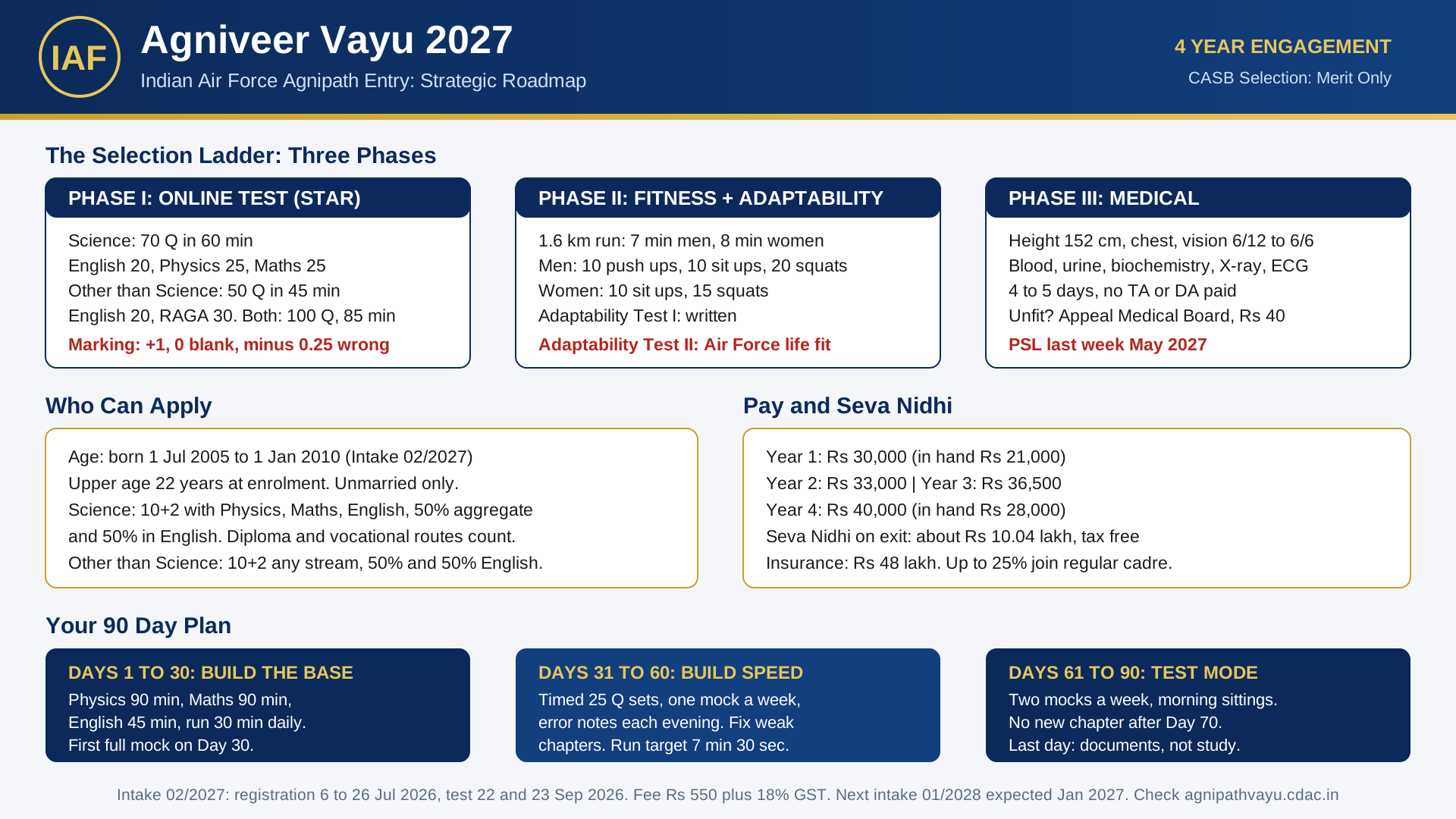
Phase I is an online objective test, called STAR, the Scheduled Test for Airmen Recruitment. The paper a candidate sat depended on the stream picked in the form. Science subjects meant 70 questions in 60 minutes: English 20, Physics 25, Mathematics 25. Other than Science meant 50 questions in 45 minutes: English 20 and Reasoning and General Awareness, called RAGA, 30.
Candidates who picked both sat all four papers, 100 questions in 85 minutes. The questions were bilingual in English and Hindi except for the English paper. Each right answer earned one mark, a question left blank earned zero, and each wrong answer lost 0.25 marks.
That minus 0.25 looks small on paper and it is not small in a 70 mark paper. A candidate who attempted 60 questions in the Science paper and got 45 right and 15 wrong scored 45 minus 3.75, which is 41.25, not 45. Four wrong guesses wiped out nearly four right answers. The right approach is to attempt what you know, mark the rest for a second look only if time is left, and never guess blindly in the last two minutes.
The paper has no sectional timing inside the 60 or 45 minutes, so a candidate can move time from a strong paper to a weak one. That freedom helps only if you plan it before the test day. Decide in advance how many minutes English gets, because English is the paper most Science students rush, and it is also the paper that ends applications through the 50 percent rule in the eligibility stage and through the per paper qualifying rule in the test itself.
Two features of the marking catch first timers out. First, a candidate had to qualify in each paper on its own, with normalised marks. A high Physics score did not rescue a failed English paper. Second, CASB normalised the marks.
The notification says CASB normalised the STAR Phase I marks with a formula on its portal, to allow for differences in difficulty between sessions. The cut off for Phase II and the final merit list were both based on normalised marks, not on raw marks. After normalisation a subject score could come out lower or higher than the raw score, and in rare cases higher than the total marks of that subject. That sounds strange, and it is the reason no one should compare raw scores with friends who sat a different shift.
The Air Force does not publish an official cut off list. CASB shortlisted candidates state wise, and the cut off can differ from state to state because vacancies are given state wise. Any cut off figure on a coaching site is an estimate, and this page prints none of them.
The test day rules were strict in small ways that mattered. Candidates had to bring one blue or black pen and the original Aadhaar card. The question paper, answer key and individual response sheet stayed in the candidate login for three days during the objection management period after the exam, and no one entertained any query about them after that period ended, or after six months from the exam date. The rules banned mobile phones and smart watches from the testing areas in Phase I and Phase II, along with other electronic devices, and a candidate found with one was debarred permanently.
Rough work or writing on the admit card was also a permanent debarment. The notification lists them as punishments, and candidates have lost years to them.
What the Science paper actually tests
Physics and Mathematics followed the Class 11 and 12 CBSE syllabus. That single line tells a candidate more than any topic list on a coaching site. The Physics paper of 25 questions draws on mechanics, heat, light and current electricity, with magnetism and waves, plus modern physics at the level a Class 12 student has already met. The Mathematics paper of 25 questions draws on algebra, trigonometry and calculus, with vectors and probability, plus coordinate geometry at the same level.
A candidate who finished Class 12 with Physics and Maths has already seen nearly every topic that can appear. The work is getting fast and exact at chapters already studied, under a 60 minute clock with a quarter mark penalty for each slip.
English carried 20 questions in every version of the paper, and it deserves more respect than it gets. The syllabus is Class 10+2 level, which in practice means comprehension passages and grammar, with vocabulary and sentence correction. A candidate who treats English as the easy paper and gives it ten rushed minutes is the candidate who fails one paper while passing the other two. RAGA, the 30 question paper for Other than Science candidates, mixes reasoning with general awareness: number and letter series, coding, direction sense, blood relations, non verbal reasoning, and current affairs with static general knowledge of India.
It rewards a daily habit, not a last month crash, because no one builds the general awareness half in a week.
The combined paper of 100 questions in 85 minutes is the hardest version to manage. It is four papers with four different rhythms, and the candidate who spends 40 minutes on Physics has 45 minutes left for three papers. Anyone picking both streams should practise full 85 minute papers, not separate 60 and 45 minute ones, because the switch between Maths and RAGA is where time leaks. Mock tests help here, and this site built its Agniveer Vayu 2027 mock test around the same counts: 70 questions in 60 minutes for Science, 50 in 45 for Other than Science, and 100 in 85 for both, with the same minus 0.25 rule, so the clock in practice feels like the clock on the day.
Phase II at the Airmen Selection Centre
CASB called candidates who cleared Phase I to a designated Airmen Selection Centre, called an ASC, for Phase II. The Phase II admit card reached the registered email, and the candidate could also download it from the login. The day started with verification of eligibility. Staff checked original certificates and marksheets before the physical test, and a detailed check followed for those who passed the fitness test.
A candidate without original educational marksheets and passing certificates could not appear at all, except one who brought a certificate from the college or school principal saying the documents were deposited with the college or school. The centre accepted DigiLocker verified certificates, with a printout and a mobile device to show the same certificate in DigiLocker. Internet copies of marksheets were not accepted. Photocopies from a mobile snapshot were not accepted.
Each candidate carried eight passport size colour photographs, the same as the one used in the online form, along with the Phase II admit card printout and the filled application form printout. A pencil and eraser, a sharpener and glue stick, a stapler and a black or blue ball point pen went in the same bag, with the original Phase I admit card carrying the Air Force seal and invigilator signature, the domicile or COAFP certificate in original with four self attested photocopies, and the NCC certificate if any.
The Physical Fitness Test came in two parts. PFT I was a 1.6 km run. Male candidates had to finish it within 7 minutes and female candidates within 8 minutes. Only those who passed the run went on to PFT II, after 10 minutes of rest.
Male candidates then had to do 10 push ups in one minute, 10 sit ups in one minute and 20 squats in one minute, with two minutes of rest between exercises. Female candidates had to do 10 sit ups in one minute and 30 seconds and 15 squats in one minute, with no push ups. The notification told candidates to bring sports shoes and shorts or track pants, and the exact technique for each exercise is published on the CASB portal. Each candidate signed a consent form before the physical and medical tests, or a parent or guardian signed it for candidates below 18, because the candidate appeared at his or her own risk and the Air Force paid no compensation for injury during the tests.
Two adaptability tests followed the fitness test, and both are qualifying in nature. Adaptability Test I is an objective written test that checks whether a candidate suits employment in the Air Force, with deployment in varied terrain and weather, and working conditions to match. Adaptability Test II checks whether a candidate can adjust to the Air Force environment and the military way of life, and the notification describes it only as per the policy in force, with no fixed format, marks or pass marks published. That vagueness frustrates candidates, and it is honest to say so.
No coaching centre can sell a fixed syllabus for a test whose format the Air Force does not publish. The useful preparation is simple: know why you want this life, be able to speak plainly about it, and be ready to work in a team under rules you did not write.
Phase III: the medical examination
Their ASC gave candidates who passed Adaptability Test II a medical appointment letter, and an Air Force medical team conducted the medical examination under the medical standards and policy in force. The medical could take four to five days, under the candidate own arrangement, with no travel or daily allowance paid. Passing the medical was not a promise of a job. The notification says so in plain words.
The notification printed the broad standards. Minimum height was 152 cm for both men and women. The rules accepted women from the North East or the hilly regions of Uttarakhand at 147 cm, and candidates from Lakshadweep at 150 cm, with a domicile certificate carrying the right endorsement. Weight had to be in proportion to height and age.
For men the chest had to be well proportioned and well developed, with a minimum circumference of 77 cm and expansion of at least 5 cm. For women the chest had to be well proportioned with a minimum expansion of 5 cm. Vision had to be 6/12 in each eye, correctable to 6/6 in each eye, with hypermetropia up to plus 2.0D and myopia up to minus 1D, including plus or minus 0.50D astigmatism. Colour vision had to be CP II.
Candidates with a history of LASIK or PRK surgery were not accepted. Hearing had to be normal, meaning the candidate could hear a forced whisper from 6 metres with each ear on its own. Teeth needed a minimum of 14 dental points, with healthy gums and a good set of teeth, and fixed or removable orthodontic appliances meant unfit. Permanent body tattoos were not allowed, except on the inner face of the forearms from the inside of the elbow to the wrist, the back of the hand or reverse side of the palm, and tribal tattoos that followed the customs of the tribe.
The rules banned offensive, obscene, indecent, sexist or racist tattoos anywhere on the body, and candidates with tattoos had to submit two postcard size photographs showing them. The notification also covered gynaecological examination for women and gender standards, along with a zero tolerance policy on narcotic drugs and alcohol.
The medical included baseline investigations. Blood tests covered haemoglobin and platelets. Urine tests and biochemistry came next, covering fasting and post meal blood sugar, serum cholesterol, renal function and liver function. A chest radiograph and an ECG followed, with an ultrasound of the lower abdomen and pelvis for women, and any other test the Recruiting Medical Officer thought necessary.
A candidate declared unfit could appeal to an Appeal Medical Board by depositing 40 rupees through an electronic or manual Military Receivable Order in a Government Treasury, the Reserve Bank of India or the State Bank of India, and submitting the application with the unfitness certificate to the ASC representative within three working days of the medical examination. The medical officers were the final authority on fitness, and the rules allowed no representation or review after the Appeal Medical Board.
Agniveer Vayu 2027 pay, Seva Nidhi and the 25 percent question
The Agniveer package started at 30,000 rupees a month in the first year and rose each year: 33,000 in the second year, 36,500 in the third and 40,000 in the fourth. The in hand amount was 70 percent of the package, so 21,000 rupees in the first year, 23,100 in the second, 25,550 in the third and 28,000 in the fourth. The other 30 percent went into the Agniveer Corpus Fund, with the Government putting in the same amount, 9,000 rupees a month each side in the first year and 12,000 each side in the fourth. After four years the total contribution from both sides came to about 5.02 lakh rupees each, and the one time Seva Nidhi package on exit was about 10.04 lakh rupees, excluding interest.
It was tax free. Risk and hardship allowances applied where the rules allowed them. Dress and travel allowances were paid too. Ration and clothing came with accommodation and Leave Travel Concession under the existing rules.
Leave was 30 days of annual leave a year plus sick leave on medical advice. Medical facility at service hospitals and CSD provisions applied during the engagement.
Candidates often miss three facts about the money, and all three are in the notification. First, an Agniveervayu did not contribute to any Provident Fund, and there was no gratuity and no pension of any kind. Second, the life insurance cover of 48 lakh rupees during the engagement was non contributory, which means the Agniveervayu paid nothing for it. Death and disability compensation followed the rules on the CASB portal.
Third, an Agniveervayu was not eligible for Ex Servicemen status after discharge at the end of four years. A candidate who joins for the pension or the Ex Servicemen quota has picked the wrong entry.
The question every candidate asks is what happens after four years. On completion of four years, based on the organisation requirements and the policies of the Air Force, the Air Force offered an Agniveervayu a chance to apply for enrolment in the regular cadre as an Airman. CASB considered applications centrally on objective criteria, including performance during the four year engagement, and up to 25 percent of each batch of Agniveervayu could join the regular cadre. That 25 percent is a ceiling, not a promise, and no Agniveervayu had a right to selection for further enrolment.
Selection was at the discretion of the Government of India. An Agniveervayu also got a detailed skill set certificate at the end of the engagement, setting out the skills and the level of competence gained during service. During the four years, an Agniveervayu could appear in all commissioning examinations in the Defence Forces, up to five attempts, subject to permission, and one who had applied for a Government exam before enrolment could be allowed to sit it. Release at a candidate own request before the four years ended was not allowed, except in rare cases with approval of the competent authority.
The fee and the form
The examination fee for Intake 02/2027 was 550 rupees plus 18 percent GST, non refundable, for all candidates in all categories, paid online through net banking, debit card, credit card or UPI. The total worked out to about 649 rupees. Once submitted, a candidate could not withdraw an application, and the fee stayed non refundable in every case, nor held for any other recruitment. A candidate could apply only once for one advertisement, and one who applied more than once and got different registration numbers had the candidature rejected.
Some websites quoted a fee of 250 rupees or even 100 rupees for this intake. Both figures are wrong for Intake 02/2027, and the official notification, paragraph 42.5, prints 550 rupees plus 18 percent GST. The 250 rupee figure belongs to other entries, and it shows why the notification itself is the only fee source worth trusting.
The form itself had two steps. Step one was registration of personal and contact details, with a one time password reaching the mobile number and email separately, and both had to be entered. The user ID was the email ID, and the password came by email and SMS. Step two was the full application.
It asked for personal and communication details. Qualification details and a declaration followed. Then came document upload and fee payment. The email and mobile number had to stay valid through the whole process, because the application sequence number and password, with every later message, went to them.
The notification warned candidates to check that mail from the portal was not going to the junk or spam folder. Candidates had to be careful with every entry, because no one could change a submitted form at will, and the President of CASB reserved the right to allot a Phase I centre that might not match the candidate choice.
A 90 day plan that fits the real paper
Ninety days is enough for this paper if the candidate already passed Class 12 with Physics and Maths, and it is not enough if the candidate starts from zero in two subjects at once. Be honest about which group you are in before you pick a plan. The plan below assumes a Science candidate with Class 12 done and a weak English paper, which is the most common shape of the problem. Other than Science candidates can swap the Physics and Maths slots for Reasoning and General Awareness, and keep the same shape.
Days 1 to 30 build the base. Physics gets 90 minutes a day, Maths gets 90 minutes, English gets 45 minutes, and running gets 30 minutes. In Physics, work through mechanics first, then current electricity and magnetism, because those two blocks carry the most questions in most years. In Maths, start with calculus and algebra.
Trigonometry and vectors come next. English in this month is reading and grammar, not mock tests: one comprehension passage a day, 20 grammar questions, and 10 new words with their use in a sentence. Running starts at 1.6 km in 9 minutes and comes down by 10 seconds a week. The exercises start at half the required count and rise by two each week.
At the end of day 30, sit one full Science paper of 70 questions in 60 minutes and mark it with the minus 0.25 rule. The score will be low. That is the point of day 30. It shows the real gap.
Days 31 to 60 turn the base into speed. Physics and Maths move to mixed chapter sets of 25 questions in 25 minutes each, which is faster than the real paper and builds a buffer. English moves to timed sets of 20 questions in 18 minutes. One full mock a week, always 70 questions in 60 minutes, always marked with negative marking, always reviewed the same evening.
The review matters more than the mock. Every wrong answer gets a one line note: the concept missed, not the question number. By day 60 the notes will show a pattern, usually two or three chapters that cause half the errors. Those chapters get the next two weeks.
Running should reach 1.6 km in 7 minutes 30 seconds for men and 8 minutes 30 seconds for women by day 60, with the full PFT II set done twice a week.
Days 61 to 90 are for the test, not for new study. Two full mocks a week, in the morning, in one sitting, phone switched off, with the same pen and the same admit card routine. Start no new chapter after day 70. The last 20 days are revision of the error notes, the formula sheets and the English words already learned.
Running should hit the qualifying time by day 75, and the last two weeks keep it there with three short runs a week instead of long ones, because an injury in the last week ends the whole attempt. The day before the test is not a study day. It is a documents day: the admit card printout and Aadhaar, plus a pen. Check the exam city too.
Candidates who study till midnight before a 60 minute paper are usually the ones who misread four questions in the first ten minutes.
Mistakes that cost candidates a year
The first mistake is guessing. The minus 0.25 rule turns a hopeful paper into a failed one, and the per paper qualifying rule means one bad paper ends the attempt even if the other two were strong. The second mistake is ignoring English, twice over: once in the 50 percent marks rule at the form stage and once in the per paper qualifying rule at the test stage. The third mistake is the domicile certificate, picked in a hurry and never checked against the matriculation certificate, which then blocks Phase II.
The fourth is the photograph rule: eight copies of the same photograph used in the online form, and candidates who bring a different photo waste a morning arguing at the gate.
The fifth mistake is believing a cut off list. The Air Force does not publish one, shortlisting is state wise on normalised marks, and a coaching centre estimate for one state says nothing about another. The sixth is paying an agent. The notification opens with a warning in capital letters that selection is fair and transparent and on merit only, that no one need pay a bribe at any stage, and that candidates should not fall prey to people posing as recruiting agents.
Anyone who asks for money for a seat is running a fraud, and the Air Force prosecutes impersonators. The seventh mistake is the tattoo rule and the medical standards, checked too late. A candidate with a tattoo on the wrong part of the arm, or with LASIK surgery in the past, finds out at the medical stage, after clearing two phases. Read the medical standards before the form, not after the result.
What to check before the next notification
Three checks cover almost every surprise. First, the date of birth block in the new notification, because it changes with each intake and the old block will not apply. Second, the 50 percent marks rule in aggregate and in English, worked out from the marksheet before the decimal point, because 49.99 percent counts as 49. Third, the medical standards in full, from height and chest to vision and tattoos, read before the form is filled.
Everything else, the paper pattern, the fitness times, the pay figures, has stayed steady across the recent intakes, and the mock test on this page follows the same pattern so that practice matches the real test. When the next notification arrives, check the dates and the fee first, because those are the two figures the Air Force changes most often.
Check the Agnipath Vayu portal for the notification, the Indian Air Force website for service news, and the career Indian Air Force portal for entry routes. Do not trust a date or a fee from any other site until it matches one of those three.
Other uniformed entries worth a look
A uniformed career has other doors besides this one. The Air Force officer route runs through AFCAT 2027. In Uttar Pradesh the UP Police Constable 2027 entry and the UP Police Sub Inspector 2027 entry sit beside the UP Police ASI 2027 entry.
The UP Police Jail Warder 2027 entry and the UP Police Fireman 2027 entry are separate doors in the same state. Bihar Police Constable 2027 is another state option. At the national level, SSC Delhi Police Constable 2027 and SSC Delhi Police Head Constable Ministerial 2027 run beside SSC GD 2027.
Sources
Indian Air Force, Agniveervayu Intake 02/2027 notification, hosted on the Ganjam district website of the Government of Odisha, ganjam.odisha.gov.in, for registration dates, exam dates, eligibility, paper pattern, marking, PFT standards, medical standards, pay, Seva Nidhi, fee of 550 rupees plus 18 percent GST, Provisional Select List in the last week of May 2027 and enrolment list after 1 June 2027. Indian Air Force, Agniveervayu Intake 01/2027 notification, for registration from 12 January 2026, exam on 30 and 31 March 2026. Jagran Josh, 12 January 2026, for Intake 01/2027 registration and exam dates. Defence Study, November 2026, for the intake cycle pattern and the expected January 2027 window for Intake 01/2028.
Sarkari All Updates and Govt Jobs Alert, October 2026, for the Intake 02/2027 answer key release on 26 September 2026. Official portals: agnipathvayu.cdac.in, indianairforce.nic.in, careerindianairforce.cdac.in.







