
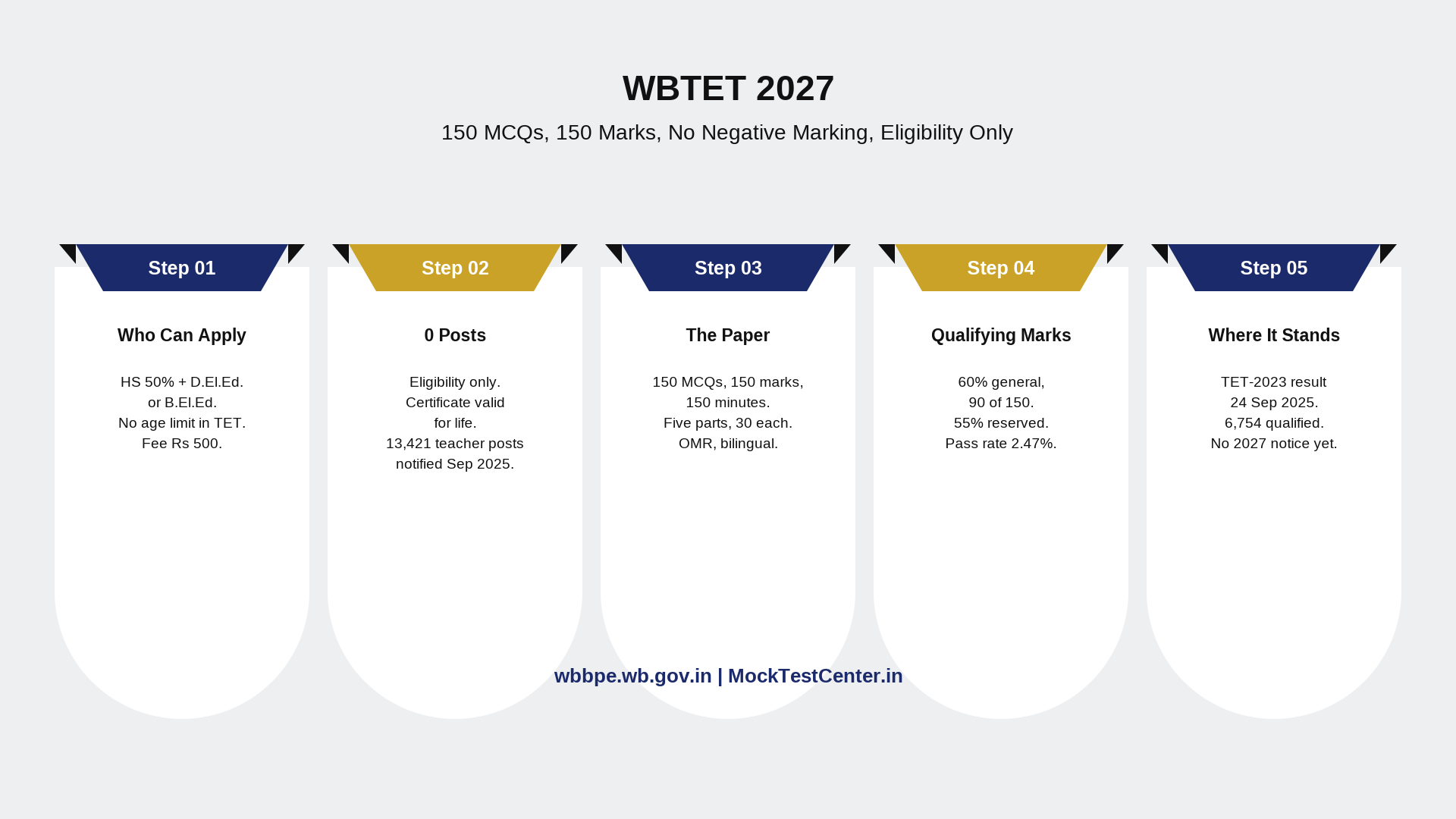
About WBTET 2027 Exam Series
📖 Table of Contents
- WBTET 2027 at a glance
- The TET-2023 result took 21 months, and the pass rate was 2.47 percent
- What WBTET is, and what it is not
- Who can apply: the four qualification routes
- The WBTET exam pattern: five parts, 30 questions each
- The qualifying marks, and why 82.5 is a number to check
- Fees and dates of the TET-2023 cycle
- What the 13,421 post recruitment means for TET passers
- The mistakes that cost candidates a TET certificate
- A preparation plan that fits 150 questions in 150 minutes
- Where the tracker pages get WBTET wrong
- What to watch for next
- Sources
WBTET 2027: Complete Exam Guide
WBTET 2027 is the page for the West Bengal Teacher Eligibility Test for primary classes, and the test it follows is TET-2023, the latest regular Primary TET held by the West Bengal Board of Primary Education. The board held TET-2023 on 24 December 2023 and declared its result on 24 September 2025, after a wait of 21 months. No new Primary TET notification has been published as of 23 November 2026, so this guide anchors on TET-2023 and says so plainly wherever a 2027 figure would otherwise be guessed. WBTET is an eligibility test only. It carries 0 posts. Passing it makes a candidate eligible to apply for primary teacher posts, and it gives no job by itself.
The single number that should shape every preparation plan is 2.47 percent. Out of 2,73,147 candidates who appeared for TET-2023, only 6,754 qualified. The paper looks gentle on its face, with 150 multiple choice questions, 150 marks, 150 minutes and no negative marking. The qualifying mark is 60 percent for general candidates and 55 percent for reserved categories. Yet 97 out of every 100 candidates who sat the paper went home without a certificate. That gap between an easy looking paper and a hard qualifying line is the whole story of this exam, and this guide spends its words on the gap rather than on the syllabus alone.
The result date is the first fact to get right, because most tracker pages still get it wrong. The provisional answer key came out on 7 May 2024, and many pages treated that date as the result. The result itself came out on 24 September 2025 at 6 PM, together with the final answer key. The board then put each candidate's scanned OMR sheet online on 25 September 2025 from 2 PM. A candidate who reads a page that says the TET-2023 result came in May 2024 is reading a page that mistook the answer key for the result, and that page cannot be trusted on anything else either.
WBTET 2027 at a glance
| Detail | WBTET 2027, as run in the TET-2023 cycle |
|---|---|
| Conducting body | West Bengal Board of Primary Education (WBBPE), Bidhannagar, Kolkata |
| Exam | Teacher Eligibility Test, Primary, Classes I to V |
| Live cycle | TET-2023, Notification No. 1945/WBBPE/2023 dated 13 September 2023 |
| Posts in this test | 0, eligibility only, passing gives no appointment by itself |
| Applications | 14 September 2023, 7 PM, to 4 October 2023, 11:59 PM, fee last date 5 October 2023, closed |
| Fee | General Rs 500, OBC-A and OBC-B Rs 400, SC, ST and PH Rs 250 |
| Exam date | 24 December 2023, 12 noon to 2:30 PM, rescheduled from 10 December 2023 |
| Paper | One paper, 150 MCQs, 150 marks, 150 minutes, OMR, no negative marking |
| Qualifying marks | 60 percent, 90 of 150, general, 55 percent reserved categories |
| Result | 24 September 2025, 6,754 qualified out of 2,73,147 who appeared, 2.47 percent |
| Certificate validity | Lifetime, for all categories, no limit on attempts |
| 2027 notification | Not published as of 23 November 2026 |
The TET-2023 result took 21 months, and the pass rate was 2.47 percent
The TET-2023 calendar is a lesson in patience. The board published the notification on 13 September 2023 and opened applications the next day, 14 September 2023 at 7 PM. Applications closed on 4 October 2023 at 11:59 PM, with the fee last date on 5 October 2023. The exam was first set for 10 December 2023 and then rescheduled to 24 December 2023, a Sunday, from 12 noon to 2:30 PM. The admit card window ran from 15 December to 24 December 2023. The provisional answer key followed on 7 May 2024, with objections open from 10 May to 9 June 2024. Then nothing happened in public for more than a year. The final answer key and the result came out together on 24 September 2025, 21 months after the exam.
The board said 3,09,054 candidates registered for the test. Of those, 2,73,147 appeared. Only 6,754 qualified, which is 2.47 percent of those who appeared. The Telegraph reported the topper as Ina Singh from Purba Bardhaman with 125 marks out of 150. Kajal Kuti from Murshidabad stood second with 116 marks. Soumik Mondal from Bankura and Swarnendu Bhar from North 24 Parganas shared third place with 115 marks each. The topper scored 125, which means even the best candidate in the state left 25 marks on the table. A paper that lets the topper drop 25 marks is not a paper a candidate can afford to take lightly.
The long wait had a stated reason. The board pointed to legal complications and reservation related issues for the delay, and the state education minister said the recruitment process would begin soon after the festive season. The recruitment did begin. On 25 September 2025, the day after the result, the board published a notification for 13,421 Assistant Teacher posts in government aided, government sponsored and junior basic primary schools. That recruitment is a separate process from the TET, and it is covered in its own section below. The TET result and the recruitment notification arrived a day apart, and tracker pages that merge the two into one event mislead candidates about both.
The 2.47 percent pass rate deserves a closer look, because it sits beside a qualifying mark of only 60 percent. A candidate needs 90 marks out of 150, which is 90 correct answers out of 150 questions, with no penalty for a wrong answer. In a paper with no negative marking, a candidate can attempt every question and still needs 90 right. The 2023 paper evidently asked questions that separated candidates sharply. The board's own information circular says the difficulty standard and the linkages of the questions could go up to the secondary stage, even though the teaching age group is 6 to 11 years. A candidate who prepares only at primary school level is preparing below the paper's ceiling.
What WBTET is, and what it is not
WBTET is a qualifying test. The board's own circular states it in plain words: qualifying the TET would not confer the right on any person for recruitment or employment, as it is only one of the eligibility criteria for appointment. A TET certificate is a ticket to apply for primary teacher posts when the board or the state notifies them. It is not an appointment letter, and it carries no post count, no joining date and no salary by itself.
This matters because tracker pages routinely attach post numbers to the TET. The 13,421 posts notified on 25 September 2025 belong to a recruitment of TET qualified trained candidates, not to the TET itself. The two processes have different notifications, different fees and different selection rules. The TET fee in 2023 was Rs 500 for general candidates, while the 2022 recruitment of primary teachers charged Rs 200 for general candidates, Rs 150 for OBC-A and OBC-B, and Rs 100 for SC, ST and PH candidates. A candidate who confuses the two fee tables will pay the wrong fee in the wrong process.
The certificate itself is generous. The board gives it a lifetime validity for all categories, and there is no restriction on the number of attempts. A candidate who qualifies can reappear in a future TET to improve the score. That lifetime validity is the reason the TET is worth taking even when no recruitment is open. A certificate earned now stays valid when the next recruitment opens, whenever that is.
The TET covers primary classes only, Classes I to V. The board held a separate TET on 22 February 2026 for Special Education Teacher posts in primary schools, under Notification Memo No. 324/WBBPE/2026 dated 6 February 2026. That is a different test for a different post, and its syllabus and eligibility differ from the regular Primary TET. This guide covers the regular Primary TET only, and flags the special education test wherever a tracker page mixes the two.
Who can apply: the four qualification routes
The TET-2023 notification gave four routes into the test, and a candidate needs only one of them. The routes all pair a school qualification with a teacher training qualification. The table below gives each route as the sources report it from the notification.
| Route | School qualification | Training qualification |
|---|---|---|
| Route 1 | Higher Secondary, 10+2, or equivalent, with at least 50 percent marks | 2 year Diploma in Elementary Education, D.El.Ed. |
| Route 2 | Higher Secondary, 10+2, or equivalent, with at least 50 percent marks | 4 year Bachelor of Elementary Education, B.El.Ed. |
| Route 3 | Higher Secondary, 10+2, or equivalent, with at least 50 percent marks | Diploma in Education, Special Education, recognised by the Rehabilitation Council of India |
| Route 4 | Graduation, in any stream | 2 year Diploma in Elementary Education, D.El.Ed. |
The 50 percent mark in Higher Secondary carries a 5 percent relaxation for SC, ST, OBC-A, OBC-B, Exempted Category, Ex-Servicemen, Differently Abled and Die-in-harness candidates, so 45 percent suffices for those categories. The training qualification must be complete or in its final year as the notification prescribes, and the candidate must check the latest notification for the exact status required at the time of application. This guide does not state a final year rule as fact, because the sources read did not quote the notification's wording on it.
Two points about eligibility catch candidates out. First, a B.Ed. degree alone does not open the regular Primary TET through the routes above. The notification's routes name D.El.Ed., B.El.Ed. and the RCI diploma, and a graduate with a B.Ed. enters through Route 4 only with a D.El.Ed. as well. Candidates with a B.Ed. should read the notification's exact wording before applying, because tracker pages that say B.Ed. alone suffices are guessing. Second, the TET notification sets no age limit. No upper age bar appears in the sources read for TET-2023, and the 18 to 40 years figure that some tracker pages print for this test is marked tentative on those pages and is not taken from the TET notification. The age limit that matters is the one in the recruitment notification that follows, not in the TET.
Language choice is part of eligibility in practice. Language I can be Bengali, Hindi, Urdu, Nepali, Santali, Odia, or Telugu. Language II is English. A candidate picks the Language I that matches the medium of the schools applied for later, because the recruitment that follows the TET is medium wise. A candidate who picks a Language I with no corresponding school medium has a certificate that fits no vacancy.
The WBTET exam pattern: five parts, 30 questions each
The TET-2023 paper is one OMR paper of 150 multiple choice questions, each carrying 1 mark, with four options and one correct answer. The duration is 150 minutes, which is 2 hours 30 minutes, so a candidate has exactly one minute per question on average. There is no negative marking. The question paper is bilingual, Bengali and English, except for the Language I and Language II papers, which are in their own languages. The five parts carry equal weight, 30 questions and 30 marks each.
| Part | Content | Questions | Marks |
|---|---|---|---|
| Part A | Child Development and Pedagogy | 30 | 30 |
| Part B | Language I, Bengali, Hindi, Urdu, Nepali, Santali, Odia, Telugu | 30 | 30 |
| Part C | Language II, English | 30 | 30 |
| Part D | Mathematics | 30 | 30 |
| Part E | Environmental Studies | 30 | 30 |
| Total | One paper, Classes I to V | 150 | 150 |
Child Development and Pedagogy carries the most conceptual weight. The board's circular says its questions focus on educational psychology of teaching and learning relevant to the age group of 6 to 11 years. The topics run through child development, learning theories, inclusive education, and the teaching learning process. A candidate who memorises definitions without understanding how a 7 year old learns will score poorly here, because the questions test application to classroom situations rather than recall of textbook lines.
Language I and Language II together carry 60 marks, which is 40 percent of the paper. Language I tests the candidate's first language, and Language II tests English. Both parts cover comprehension, grammar, and pedagogy of language teaching. The language sections are where strong candidates bank marks, because the questions are bounded by the prescribed syllabus and the answers are less open to interpretation than the pedagogy questions. A candidate weak in English grammar loses up to 30 marks in one part, and that loss alone can push the total below 90.
Mathematics carries 30 marks, and its syllabus runs through the topics of the prescribed syllabus for the primary stage, with linkages up to the secondary stage. The questions test number systems, arithmetic, geometry, and measurement, plus the pedagogy of teaching mathematics to young children. The Environmental Studies part carries 30 marks and covers the child's environment, family, school, society, and the natural world, again with pedagogy woven in. Neither part needs advanced study, but both need the candidate to answer at speed, because the paper allows one minute per question and the pedagogy part slows most candidates down.
The qualifying marks, and why 82.5 is a number to check
The qualifying mark for general candidates is 60 percent of 150, which is 90 marks. For SC, ST, OBC-A, OBC-B, PH and DA, EC, Ex-Servicemen and DH candidates, the relaxation is 5 percent, so the qualifying mark is 55 percent. Fifty five percent of 150 is 82.5 marks. A candidate cannot score half a mark in a paper of one mark questions, so the practical cut sits at 83 marks for a reserved candidate who needs 82.5, unless the board rounds the qualifying mark down to 82. Testbook prints 82 marks for the reserved qualifying mark, while the board's circular states the qualifying mark as a percentage, 55 percent, without naming a whole number of marks. This guide states the percentage, 55 percent, and flags the 82 versus 83 question as unresolved, because the board's own documents read for this guide do not settle it.
The qualifying mark is a fixed line, not a cut off that moves with the number of candidates. The board does not publish a merit list for the TET, because the TET is not a competition for posts. A candidate either crosses the line or does not. The 2.47 percent pass rate is therefore a direct measure of how hard the line is to cross, not of how many seats were available. In a recruitment with 13,421 posts, a 2.47 percent pass rate means the pool of eligible candidates is far smaller than the number of posts, which is the opposite of most government recruitments, where the posts are far fewer than the qualified candidates.
The certificate's lifetime validity changes the value of a pass. A candidate who qualifies in TET-2023 holds a certificate that never expires, and can apply in every primary teacher recruitment that follows, as long as the other conditions of that recruitment are met. A candidate who fails can attempt the next TET without limit. There is no penalty for a failed attempt, and no cap on attempts. The rational move for a candidate who is eligible is to take every TET held, because each attempt is a free option on a lifetime certificate.
Fees and dates of the TET-2023 cycle
The TET-2023 fee was Rs 500 for general candidates, Rs 400 for OBC-A and OBC-B candidates, and Rs 250 for SC, ST and PH candidates. The fee was paid online by credit card, debit card or net banking, with processing charges extra. Three independent sources agree on these figures, and Testbook's fee table matches them exactly. The older fee of Rs 150 for general, Rs 100 for OBC and Rs 50 for SC, ST and PH that Shiksha prints belongs to an earlier cycle and is not the TET-2023 fee. A candidate who budgets Rs 150 for the next TET is budgeting from a stale page.
| Event | Date |
|---|---|
| Notification, No. 1945/WBBPE/2023 | 13 September 2023 |
| Applications open | 14 September 2023, 7 PM |
| Applications close | 4 October 2023, 11:59 PM |
| Fee last date | 5 October 2023, 11:59 PM |
| Exam, first scheduled date | 10 December 2023, rescheduled |
| Admit card window | 15 December to 24 December 2023 |
| Exam, TET-2023 | 24 December 2023, 12 noon to 2:30 PM |
| Provisional answer key | 7 May 2024 |
| Objections on provisional key | 10 May to 9 June 2024 |
| Final answer key and result | 24 September 2025, 6 PM |
| Scanned OMR sheets online | 25 September 2025, 2 PM |
| Recruitment notification, 13,421 posts | 25 September 2025 |
The rescheduling of the exam from 10 December to 24 December 2023 is worth noting, because the board's information circular still prints 10 December 2023 as the exam date. The circular was printed before the rescheduling notice, Notification No. 2259/WBBPE/2023 dated 4 December 2023. A candidate who reads the circular alone will turn up on the wrong Sunday. The notice board of the board's official website is the only source for the current date, and the circular is a syllabus document, not a calendar.
What the 13,421 post recruitment means for TET passers
The day after the TET-2023 result, the board notified 13,421 Assistant Teacher posts in government aided, government sponsored and junior basic primary schools. The notification invites TET qualified trained candidates, which means the TET certificate is the entry ticket and the recruitment has its own selection rules on top of it. The recruitment follows the West Bengal Primary School Teachers Recruitment Rules, 2016, as amended, and its notification was published on the board's websites, wbbpe.org and wbbprimaryeducation.org. The board's current official website, as printed on its 2025 notices, is wbbpe.wb.gov.in.
The pay for a primary Assistant Teacher under the 2022 recruitment notification was a basic of Rs 28,900 per month, plus dearness allowance as admissible, plus house rent allowance at 12 percent of the basic, plus medical allowance as admissible. That figure comes from the 2022 recruitment notification, Notification No. 1573/WBBPE/2022 dated 29 September 2022, and this guide states it with that label, because the pay figure in the 2025 notification for 13,421 posts was not verified from the notification text in the sources read. A candidate should check the 2025 notification itself for its pay figure before quoting it.
The recruitment's fee was lower than the TET fee in the 2022 cycle, at Rs 200 for general, Rs 150 for OBC-A and OBC-B, and Rs 100 for SC, ST and PH candidates. The 2022 notification also carried a corrigendum on the fee, which shows that even the fee in a recruitment notification can change after publication. The lesson is the same in both processes: read the notification and its corrigenda on the board's website, and do not trust a tracker page's fee table.
The arithmetic of the recruitment is the reason the TET matters so much. The TET-2023 result produced 6,754 qualified candidates, and the recruitment that followed notified 13,421 posts. There are roughly twice as many posts as newly qualified candidates from TET-2023. The pool is larger than 6,754, because candidates who qualified in earlier TETs, including TET-2022 held on 11 December 2022, also hold lifetime certificates and can apply. Even so, the ratio is far kinder than in most teaching recruitments. A candidate who holds a TET certificate is applying into a market where the posts outnumber the fresh qualifiers.
The mistakes that cost candidates a TET certificate
The first mistake is preparing for the wrong paper. Tracker pages describe a Paper II for Classes VI to VIII with descriptive questions, and some print a negative marking of 0.25 per wrong answer. Neither belongs to the regular Primary TET. The Primary TET is a single paper of 150 MCQs with no negative marking, as the board's own information circular states. The upper primary TET is a different test run by a different body, and its pattern does not apply here. A candidate who practises descriptive answers for a paper that has none is wasting the weeks that matter.
The second mistake is leaving the language sections to the end. Language I and Language II together carry 60 marks, and both are bounded by a prescribed syllabus. Candidates who spend all their time on pedagogy theory and treat the language parts as easy marks discover in the hall that 60 marks of grammar and comprehension cannot be improvised. The language parts are the most predictable marks in the paper, and they should be secured first in preparation, not last.
The third mistake is ignoring the clock. One minute per question is the average, but the pedagogy questions take longer than a minute each, because they ask the candidate to read a classroom situation and pick the best response. A candidate who spends two minutes on each pedagogy question will run out of time in the mathematics and environmental studies parts, which are quicker marks. The fix is to practise full papers under a 150 minute limit, and to learn to move on from a question that resists an answer in 60 seconds. With no negative marking, every question should be attempted, and a guess in the last minute is worth more than a blank.
The fourth mistake is choosing the wrong Language I. The choice should follow the medium of the schools the candidate will apply to, because the recruitment is medium wise. A candidate who picks a Language I with no matching school medium holds a certificate that fits no vacancy. The choice is made at the application stage, and it cannot be changed after the exam.
The fifth mistake is trusting a tracker page's dates. The TET-2023 exam moved from 10 December to 24 December 2023, the result took 21 months, and the board's own circular still prints the old exam date. The only reliable calendar is the notice board on the board's official website. A candidate who plans from a tracker page's dates risks missing the application window entirely, because the TET-2023 window lasted only 20 days, from 14 September to 4 October 2023.
A preparation plan that fits 150 questions in 150 minutes
The plan below assumes 12 weeks and a candidate who is starting from the prescribed syllabus rather than from a guidebook's shortcuts. It divides the paper by its real weight, not by the number of chapters in a book. Pedagogy and the two language parts together carry 90 marks, so they take the most weeks. Mathematics and environmental studies carry 60 marks between them, and they take the remaining weeks.
Weeks 1 to 3 belong to Child Development and Pedagogy. Read the prescribed syllabus topic by topic, and after each topic write down one classroom example of the idea in action. A theory that cannot be turned into a classroom example is a theory the candidate does not yet understand. End each week with 30 pedagogy questions under a 30 minute limit, and note which questions took more than a minute. Those are the questions to revisit, not the ones answered quickly.
Weeks 4 to 6 belong to the two language parts. Work through the grammar and comprehension syllabus for Language I and for English, and practise reading comprehension passages under time. The language parts reward steady daily practice more than weekend cramming, because grammar rules stick only with repetition. A candidate who does 20 language questions a day for three weeks will answer the 60 language questions faster than a candidate who does 200 questions in one weekend.
Weeks 7 to 8 belong to Mathematics and Environmental Studies. Cover the prescribed topics, and practise the arithmetic at speed, because the mathematics questions are the quickest marks in the paper once the methods are automatic. Environmental studies needs reading rather than problem solving, and the candidate should cover the syllabus once fully rather than revising one topic five times.
Weeks 9 to 10 belong to full papers. Take one full 150 question paper each week under a strict 150 minute limit, with an OMR sheet if possible, and mark it against the answer key. The point is not the score, which will rise slowly, but the timing. Note the part where time ran out, and shift preparation time toward it. A candidate who finishes the paper with 10 minutes to spare has a timing problem in reverse, and should slow down on the pedagogy questions, where a second read changes the answer.
Weeks 11 to 12 belong to revision and to the board's own material. Re-read the board's information circular and its part wise model questions, and revise the topics where the mock papers showed errors. Do not start a new book in these two weeks. A new book in the last fortnight adds anxiety without adding marks. The final mock paper should be taken five days before the exam, not the day before, so that the last days are for rest and for checking the admit card, the exam centre, and the reporting time.
Where the tracker pages get WBTET wrong
The most common error is the negative marking claim. GeeksforGeeks prints a marking scheme of plus 1 for a correct answer and minus 0.25 for an incorrect answer, and describes a Paper II with 120 MCQs and 30 descriptive questions. Both are wrong for the regular Primary TET. The board's information circular states plainly that there will be no negative marking, and that the test is a single paper of 150 MCQs. The GeeksforGeeks page appears to mix the Primary TET with the upper primary test, which is a different examination. This guide follows the board's circular.
The second common error is the claim that the test is held twice a year, usually in February and August. The record does not support it. The regular Primary TET was held on 11 December 2022 and then on 24 December 2023, and no new regular Primary TET had been notified as of 23 November 2026. A test that has been held twice in four years is not a twice a year test. The claim seems to come from pages that confuse the TET with other state tests, or that repeat an old schedule without checking the board's notice board.
The third common error is the result date. Pages that say the TET-2023 result came out in May 2024 are confusing the provisional answer key, released on 7 May 2024, with the result, released on 24 September 2025. The gap between the two dates is 16 months, and a page that cannot tell an answer key from a result cannot be trusted on the qualifying marks either. The result date matters, because it sets the start of the recruitment that followed, and because it tells a candidate how long the board can take.
The fourth common error is the fee. Shiksha prints a fee of Rs 150 for general, Rs 100 for OBC and Rs 50 for SC, ST and PH candidates, and labels it as the application fee for the test. That fee belongs to an earlier cycle. The TET-2023 fee was Rs 500 for general, Rs 400 for OBC-A and OBC-B, and Rs 250 for SC, ST and PH candidates, as three independent sources agree. A candidate who budgets from the stale fee will find the payment page asking for more than expected, and a candidate who trusts the stale fee on the last day may miss the window while arranging the payment.
The fifth common error is the post count. Pages that say the TET carries 13,421 posts are attaching the recruitment's posts to the test. The TET carries 0 posts. The 13,421 posts belong to the recruitment of TET qualified candidates notified on 25 September 2025. The distinction matters, because a candidate who thinks the TET itself offers 13,421 posts will expect a merit list and a joining date from the TET, and neither exists.
What to watch for next
The next event in this story is a fresh Primary TET notification, and it has not arrived as of 23 November 2026. Testbook's page, last updated on 30 October 2026, says the notification for regular Primary Teacher recruitment is yet to be announced, and that the board's website currently lists TET-2023 as the latest regular notification for Classes I to V. A tracker page that claims a 2025 or 2026 Primary TET date is printing a guess, not a notification. The candidate's job is to watch the board's notice board on wbbpe.wb.gov.in, and to keep the D.El.Ed. or B.El.Ed. documents ready, because the application window in 2023 lasted only 20 days.
The recruitment of 13,421 posts is the live process to watch in the meantime. It is the process that turns a TET certificate into a job, and its dates, document verification, and merit rules are published on the board's website. A candidate who qualified in TET-2023 should follow that recruitment first, and a candidate who did not qualify should prepare for the next TET, because the certificate is lifetime valid and the next recruitment will need it. The board held a separate TET for Special Education Teachers on 22 February 2026, and candidates with the RCI diploma should watch that stream separately, because its notifications come under a different memo series.
The last thing to watch is the board's own website address. The board's notices in 2025 print wbbpe.wb.gov.in as the official website, while older pages use wbbpe.org and wbbprimaryeducation.org. All three appear in the sources read for this guide, and the 2025 notices are the most recent authority. A candidate who bookmarks the wrong address may miss a notification, and a notification missed is an attempt lost.
Sources
West Bengal Board of Primary Education, Relevant Information and Guidelines for Teacher Eligibility Test 2023, Primary, structure and content, 150 MCQs, 150 marks, 150 minutes, no negative marking, qualifying 60 percent general and 55 percent reserved, certificate valid for lifetime, question paper bilingual except language papers. JobSafal, WB-PRI-TET 2023, exam date, pattern, eligibility and fees, notification No. 1945/WBBPE/2023 dated 13 September 2023, rescheduling Notification No. 2259/WBBPE/2023 dated 4 December 2023, result Notice Memo No. 2121/WBBPE/2025 dated 24 September 2025, fee General Rs 500, OBC-A and OBC-B Rs 400, SC, ST, Differently Abled and Exempted Category Rs 250, checked 9 November 2026. News18, West Bengal Primary TET Result 2023 Declared, exam 24 December 2023, result 24 September 2025, 3,09,054 registered, 6,754 passed, 13,421 posts announced. Times Now News, West Bengal to Recruit 13,421 Teachers After Durga Puja, TET 2023 results out, 2,73,147 appeared, 6,754 qualified, 2.47 percent. CareerPower, WBBPE TET Result 2023 Out, result 24 September 2025, exam 24 December 2023, 2.7 lakh appeared, 6,754 qualified. Telegraph India, WBBPE Declares West Bengal TET Result 2023, 21 month wait, 2,73,147 appeared, 6,754 qualified, 2.47 percent, topper Ina Singh 125 marks, Kajal Kuti 116, Soumik Mondal and Swarnendu Bhar 115, OMR sheets from 25 September 2025, 2 PM. Shiksha, WB TET Exam Dates 2025, result 24 September 2025, provisional answer key 7 May 2024, objection window 10 May to 9 June 2024. Adda247, WBBPE TET Result 2023 West Bengal OUT, result 24 September 2025, 6 PM, OMR sheet images 25 September 2025, 2 PM. Testbook, WB TET 2023 Result OUT, result 24 September 2025, 21 month wait, OMR sheets 25 September 2025, 2 PM, 13,421 Primary Teacher vacancies notified. Testbook, WB TET Exam 2026, notification yet to be announced as of 30 October 2026, TET-2023 latest regular notification, fee General Rs 500, OBC Rs 400, SC, ST and PH Rs 250, qualifying 60 percent general, 55 percent reserved. RNS Academy, WBBPE TET 2023, application fee General Rs 500, OBC-A and OBC-B Rs 400, SC, ST and PH Rs 250, applications 14 September to 4 October 2023, fee last date 5 October 2023, exam 10 December 2023 as first scheduled. WBXPress, Recruitment of TET Qualified Trained Candidates in Primary Schools, Notification No. 1573/WBBPE/2022 dated 29 September 2022, scale of pay basic Rs 28,900 plus DA plus HRA at 12 percent plus MA, application fee General Rs 200, OBC-A and OBC-B Rs 150, SC, ST and PH Rs 100. PadhoDost, WB Primary TET Important Dates, TET-2023 held 24 December 2023, result 24 September 2025, 3,09,054 registered, 2,73,147 appeared, 6,754 qualified, no new Primary TET notified as of 4 October 2026, Special Education TET 22 February 2026, recruitment notification 25 September 2025 for 13,421 posts. PYQSathi, WB Primary TET Previous Year Question Papers, TET-2022 held 11 December 2022, TET-2023 held 24 December 2023, final answer keys 9 February 2023 and 24 September 2025. GeeksforGeeks, WB TET Exam 2023, cited only to record its errors, negative marking minus 0.25 and Paper II with descriptive questions, both contradicted by the board circular.







