
About UP Police Jail Warder 2027 Exam Series
📖 Table of Contents
- Has the UP Police Jail Warder 2027 notification come out?
- Who runs this recruitment, the police or the prisons department?
- How many posts, and why two different splits are doing the rounds
- The UP Jail Warder written exam: 150 questions, 300 marks, two hours
- Age and education: two different age rules, read the right one
- Height, chest, weight and the run
- What a Jail Warder actually does all day
- Pay: Rs 21,700 to Rs 69,100, and what lands in hand
- The four subjects, and where the marks actually come from
- Books and papers that are worth your time
- A 90 day plan that trains your legs as well as your head
- Mistakes that cost candidates this post
- How to apply when the notification comes
- Ten more mock tests to keep your preparation moving
- Sources
UP Police Jail Warder 2027: Mock Test, Pattern, Eligibility and 90 Day Plan
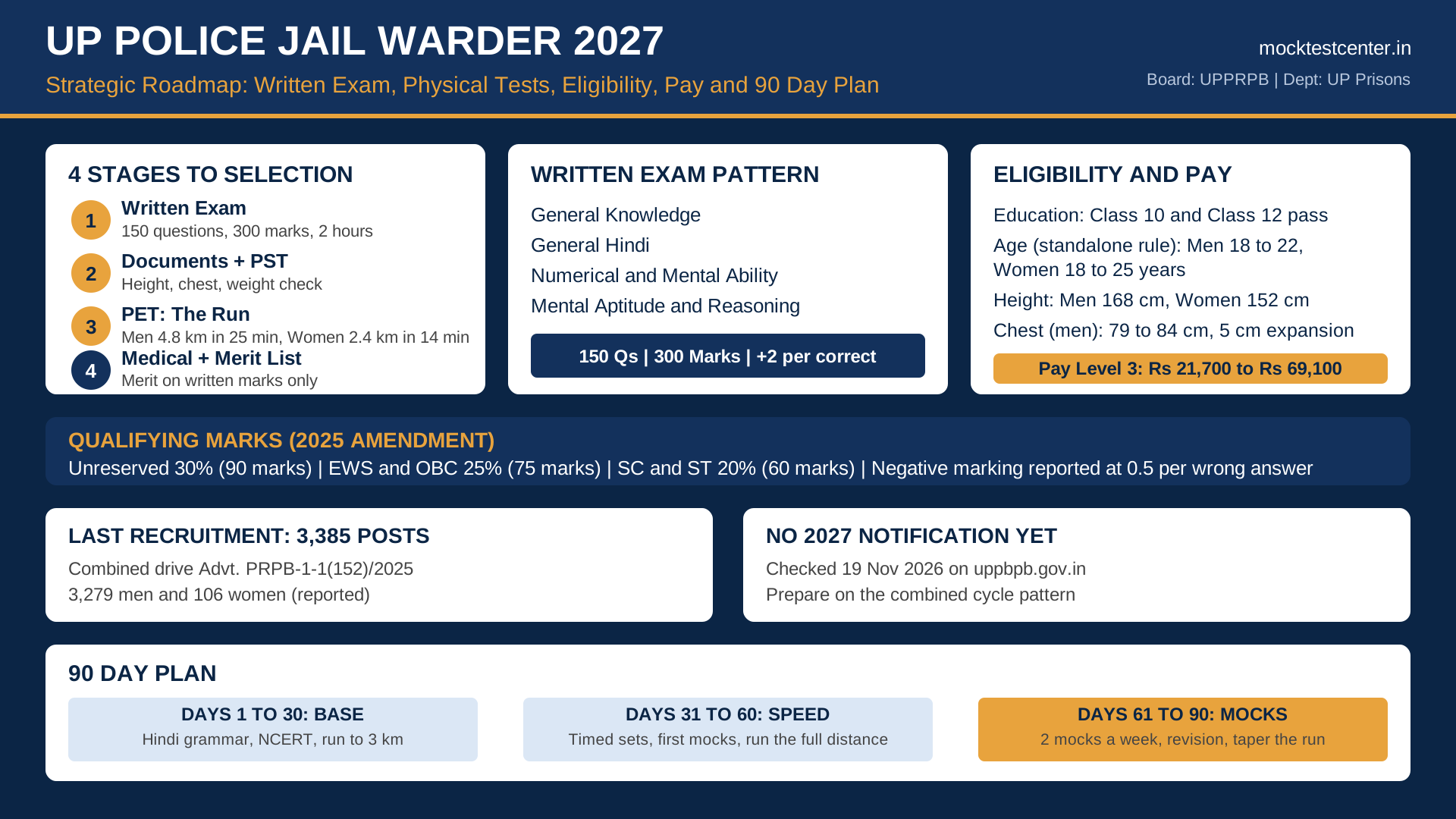
The UP Police Jail Warder 2027 notification has not come out yet. As of 19 November 2026, the Uttar Pradesh Police Recruitment and Promotion Board has published no fresh advertisement for Jail Warder, and the last recruitment for the post ran as part of a combined constable drive. That drive, Advertisement Number PRPB-1-1(152)/2025, opened on 31 December 2025, closed on 30 January 2026, and carried 3,385 Jail Warder posts inside a total of 32,679 posts.
Its final result was reported on 14 October 2026. So the UP Police Jail Warder 2027 cycle is a waiting game right now, and the smart move is to prepare on the combined cycle pattern while watching the board website for the new notice.
This UP Police Jail Warder 2027 guide covers the whole exam on that basis. You will find the vacancy story and the written exam pattern and the qualifying marks. You will find the age rules and the physical standards and the run.
You will find the daily work inside a jail and the pay and the syllabus subject by subject. You will find a 90 day plan and the mistakes that sink good candidates. Every number here comes from the combined 2025 notification as reported by trackers, or from the last standalone Jail Warder cycle of 2019, or from the UP Prisons Department itself.
Where sources disagree, this guide says so instead of picking the neater number.
Has the UP Police Jail Warder 2027 notification come out?
No. A check of the board website on 19 November 2026 found no new Jail Warder notification, and no tracker has reported one either. The post last went on offer in the combined drive that the board notified on 31 December 2025.
Applications ran from 31 December 2025 to 30 January 2026, the fee window ran to 2 February 2026, and the written exam was expected in the second quarter of 2026. The final result of that drive was reported on 14 October 2026, with score cards following on 16 November 2026.
That timing matters. The board folded Jail Warder into a combined constable recruitment instead of advertising it on its own. If it follows the same route next time, the Jail Warder notice will arrive inside a combined constable advertisement, and candidates who watch only for a standalone Jail Warder notice will miss it. Watch the board website at uppbpb.gov.in for any combined advertisement, and read the post list inside it before you decide the drive has nothing for you.
The cycle before the combined drive was a standalone one, and it took years to finish. Advertisement Numbers PRPB-1-1(135)/2018 and PRPB-1-2/2018, dated 17 January 2019, offered 5,766 posts in one advertisement: 3,638 Jail Warders, 2,065 Firemen, and 102 Constables on horseback. The written exam ran on 19 and 20 December 2020.
The written result came on 6 March 2021. The final merit list, 5,179 men and 626 women, came on 1 July 2021. From advertisement to final list, that cycle took about two and a half years.
Do not trust any date you see on a coaching poster or a social media post until the board publishes it. The only place that counts is the board website at uppbpb.gov.in. When the notice lands, it will carry the vacancy count and the age calculation date and the fee and the syllabus, plus the exam calendar in one document. Read that document end to end before you fill the form, because the notification overrules every guide on the internet, including this one.
One more warning about dates. Before the combined notification came out, several coaching sites wrote that a Jail Warder notification for 2,833 posts would arrive in the first week of December 2025. The real notification, when it came, carried 3,385 Jail Warder posts inside a combined drive.
The 2,833 figure was a guess dressed as news. Treat every pre-notification vacancy number the same way, as a guess, until the board prints the real one.
Who runs this recruitment, the police or the prisons department?
Both, in different roles, and the split confuses first time candidates. The Uttar Pradesh Police Recruitment and Promotion Board, UPPRPB, runs the recruitment. It issues the advertisement, takes the applications, holds the written exam, runs the physical tests, and declares the result.
The post itself belongs to the Prison Administration and Reforms Department of the Uttar Pradesh government, not to the police force. A Jail Warder serves in the state prisons, under the Director General of Prisons, and the chain of command above a warder runs through the jail superintendent, not through a police station.
That is why the name on the admit card says police recruitment board while the posting order comes from the prisons department. Candidates sometimes ask whether a Jail Warder can move into the civil police later. The answer is no, not through this recruitment.
The post sits in its own service, with its own promotion line inside the prisons department. If you want the civil police, apply for the constable post in the same combined drive. If you want a uniformed job with a Class 12 pass and a short selection process, Jail Warder is the better fit.
The department you will serve in runs 71 prisons across the state, according to the UP Prisons Department website at upprison.gov.in. The count breaks down as one Model Jail, 5 Central Jails, 61 District Jails, 2 Sub Jails, one Kishor Sadan at Bareilly, and one Nari Bandi Niketan at Lucknow. Naini Central Jail and all the district jails and sub jails hold undertrials as well as convicts.
The other central jails, the Model Jail at Lucknow, the Nari Bandi Niketan, and the Kishor Sadan hold only convicted inmates. Your first posting will most likely be a district jail, because district jails hold 61 of the 71 institutions and take the largest share of new warders.
The rules that govern daily life inside those jails come from the Uttar Pradesh Jail Manual, 2022, notified on 17 August 2022 under section 59 of the Prisons Act, 1894. The manual replaced the older jail manual and runs to 59 chapters. It covers admission of prisoners and classification and discipline and remission and jail industries and the duties of every rank.
You do not need to memorise the manual for the written exam. You do need to know it exists, because it shapes the job you are applying for, and interviewers in later stages respect a candidate who has read even a little of it.
How many posts, and why two different splits are doing the rounds
The combined 2025 drive offered 3,385 Jail Warder posts. That total is not in doubt. Every tracker that reported the notification agrees on it. The split between men and women is where the reports part ways, and the difference is large enough to matter.
Four trackers, Latestly, SarkariEdge, SarkariDisha, and SarkariJobers, give the split as 3,279 men and 106 women. SarkariJobers goes further and prints the category split behind those numbers. For men the split is 1,314 unreserved plus 327 EWS plus 885 OBC plus 688 SC plus 65 ST, which adds to 3,279.
For women the split is 44 unreserved plus 10 EWS plus 28 OBC plus 22 SC plus 2 ST, which adds to 106. The arithmetic checks out on both sides.
One tracker, SarkariExam, gives the split as 2,835 men and 550 women. That also adds to 3,385. But it prints no category split behind the numbers, and no other tracker agrees with it.
This guide uses 3,279 men and 106 women, because four sources agree on it and one of them shows the working. Treat the 2,835 and 550 split as a reporting error until the board notification proves otherwise. And read the notification yourself when it comes, because the women quota in this post is small, and a wrong split changes how a woman candidate judges her chances.
The small number of women posts deserves a plain sentence. In the combined drive, women got 106 of 3,385 Jail Warder posts, about 3 in every 100. In the standalone 2019 cycle, women got 626 of 3,638 posts, about 17 in every 100.
The women share fell sharply between the two cycles. The reason sits in the structure of the combined drive, which put most women posts in the women battalion constable quota instead. A woman candidate should still apply, and she should also look at the constable women battalion posts in the same advertisement, because that is where the larger women quota sits.
The standalone 2019 cycle gives the longer view. Its 3,638 Jail Warder posts split as 3,012 men and 626 women. The category split for that cycle, as printed at the time, was 1,821 general plus 982 OBC plus 763 SC plus 72 ST across the Jail Warder posts.
The full advertisement covered 5,805 posts in some reports and 5,766 in others, because one count included 39 extra posts that the other count left out. The 5,766 figure, 3,638 plus 2,065 plus 102, is the one that adds up, so this guide uses it.
What does all this mean for the UP Police Jail Warder 2027 cycle? Nothing firm. The board has not said whether the next UP Police Jail Warder 2027 recruitment will ride inside another combined drive or stand alone, and it has not said how many posts it will carry.
The 3,385 figure from the combined drive and the 3,638 figure from the standalone cycle are the two most recent real numbers. Use them to set your expectations, and do not quote any other number until the board prints it.
The UP Jail Warder written exam: 150 questions, 300 marks, two hours
The UP Jail Warder written exam is a single objective paper. It carries 150 questions for 300 marks, and candidates get two hours. Each correct answer earns 2 marks.
The paper covers four subjects: General Knowledge and General Hindi and Numerical and Mental Ability and Mental Aptitude, Intelligence Quotient and Reasoning Ability. The board fixes the detailed syllabus and the duration and the mode in the notification. It may run the paper in several shifts or on several dates with different papers, in which case it may normalise the marks.
| Part of the exam | What it looks like |
|---|---|
| Questions | 150 objective questions |
| Marks | 300 marks, 2 marks per correct answer |
| Duration | 2 hours |
| Subjects | General Knowledge, General Hindi, Numerical and Mental Ability, Mental Aptitude and Reasoning |
| Mode | Offline OMR, or computer based if the board says so |
| Negative marking | Reported as minus 0.5 per wrong answer in the combined cycle, see the note below |
| Qualifying marks | 30 percent unreserved, 25 percent EWS and OBC, 20 percent SC and ST |
The qualifying marks are new, and they change how you should attempt the paper. Since the 2025 amendment to the service rules, the written exam carries category wise minimum marks: 30 percent for unreserved candidates and 25 percent for EWS and OBC candidates and 20 percent for SC and ST candidates. On a 300 mark paper, that means 90 marks for an unreserved candidate, 75 marks for an EWS or OBC candidate, and 60 marks for an SC or ST candidate.
Those are floors, not targets. The final merit list runs on written exam marks, so a candidate who stops at the floor will not make the list. The floor only decides who gets to the physical tests.
Negative marking is the one point where the trackers refuse to agree, and you should know the shape of the disagreement before you sit down. SarkariExam, reporting the combined 2025 notification, states a penalty of 0.5 marks for each wrong answer. Testbook, on its Jail Warder pages, says the board had not disclosed any information on negative marking.
A third tracker, Syllabus4u, states a penalty of 0.25 marks. This guide reports the 0.5 figure because it is tied to the combined notification, but it flags the conflict plainly. Read the marking scheme in the next notification before you decide your guessing policy.
If the penalty is 0.5, a blind guess costs you a quarter of a correct answer. If there is no penalty at all, leaving a question blank is the only mistake.
The merit rule is the part candidates most often get wrong. The final select list runs on written exam marks alone. The physical tests carry no marks in the current pattern.
They only decide who stays in the race. That makes the written paper the whole game for your rank, and it makes the run a gate you must pass rather than a place to score. Train for both, but spend your study hours where the marks live.
One more practical point. The board may run the paper in several shifts with different question papers and normalise the marks across shifts. Normalisation means your raw score gets adjusted against the difficulty of your shift.
You cannot control which shift you get, and you cannot game the adjustment. The only sane response is to prepare for a hard paper, because a hard shift with normalisation hurts the underprepared far more than the well prepared.
Age and education: two different age rules, read the right one
Education is simple. A candidate must have passed Class 10 and Class 12 from a board established by law in India, or a qualification the government recognises as equivalent. Most trackers shorten this to Class 12 pass, and Class 12 is the qualification that matters.
Keep both certificates ready, because document scrutiny asks for both. A candidate who passed Class 12 through open schooling from a recognised board qualifies, provided the board is recognised. A candidate still appearing for Class 12 cannot apply, because the qualification must be complete on the date the notification fixes.
Age is where candidates trip. The standalone Jail Warder rule and the combined drive rule differ, and both are in circulation online. Under the standalone rule, as stated by RankRacer and Testbook, men must be 18 to 22 years and women must be 18 to 25 years, counted on 1 July of the calendar year in which the vacancies are advertised, with relaxation for reserved categories as the notification states.
Under the combined 2025 drive, the age window was wider. Men in the general category could be 18 to 25 years, and women could be 18 to 28 years, after a one time special relaxation of 3 years that the government granted to all categories. The notification gave birth dates to match: men born between 2 July 1999 and 1 July 2007, and women born between 2 July 1996 and 1 July 2007.
SC and ST and OBC candidates of Uttar Pradesh domicile got a further 5 years of relaxation on the upper limit. Age was calculated as on 1 July 2025.
The difference is not a typo. The combined drive applied the constable age rules, with the 3 year relaxation, to every post inside it, including Jail Warder. The standalone rule is the older Jail Warder rule.
Which one applies in the UP Police Jail Warder 2027 cycle depends on how the board advertises the post next time. If Jail Warder rides inside another combined drive, expect the wider window. If it stands alone, expect the narrower one.
Either way, the notification fixes the calculation date, and your age on that date is the only age that counts. Count it on the notification date, not on the exam date, and not on your birthday.
One small rule is worth knowing because it can break a tie in your favour. Other things being equal, preference goes to a candidate who holds a NIELIT, formerly DOEACC, O level computer certificate. The preference carries no marks.
It only breaks ties between candidates with equal marks. If you already hold the certificate, keep it ready. If you do not, do not chase it for this reason alone, because a tie at the cut off is rare and the certificate will not save a candidate who is short on marks.
The fee in both recent cycles was Rs 400 for all categories. The 2019 cycle charged Rs 400, and the combined 2025 drive charged Rs 400 as well. The next notification may change it, but Rs 400 is the figure to budget for. Pay it online through the board portal and save the receipt, because a failed payment with no receipt is the most common form filling disaster, and it is also the easiest to avoid.
Height, chest, weight and the run
Only candidates who clear the written exam reach the physical tests. The tests come in two parts: the Physical Standard Test, which measures the body, and the Physical Efficiency Test, which is the run. Both are qualifying in nature.
Fail either one and you are out, whatever your written score was. Pass both and your written score carries you to the merit list.
| Standard | Men, General, OBC and SC | Men, ST | Women, General, OBC and SC | Women, ST |
|---|---|---|---|---|
| Height | 168 cm | 160 cm | 152 cm | 147 cm |
| Chest, unexpanded | 79 cm | 77 cm | Not measured | Not measured |
| Chest, expanded | 84 cm | 82 cm | Not measured | Not measured |
| Weight | Not specified | Not specified | Minimum 40 kg | Minimum 40 kg |
The chest rule needs 5 cm of expansion. A man in the general, OBC, or SC category needs 79 cm unexpanded and 84 cm expanded. A man in the ST category needs 77 cm unexpanded and 82 cm expanded.
Chest is not measured for women. Women need a minimum weight of 40 kg, and the weight rule applies in every category, with the height bar lower for ST women at 147 cm against 152 cm for others.
Check your own measurements before you apply. Height is measured barefoot, and candidates who claim 168 cm on a home tape often measure 166 cm on the board equipment. If you are within 2 cm of the bar, check your height on a proper stadiometer, not against a wall marking.
For chest, practise the expansion: breathe in fully, hold the tape level, and measure both states. A candidate who trains the chest muscles for a month often gains the 2 cm that makes the difference, because expansion is partly a skill, not only a body type.
The run is the part that ends more attempts than any other stage. Men run 4.8 km in 25 minutes. Women run 2.4 km in 14 minutes.
The run is qualifying only, so the clock is the whole test. You either finish inside the limit or you do not.
| Run | Distance | Time limit | Pace per km |
|---|---|---|---|
| Men | 4.8 km | 25 minutes | About 5 minutes 13 seconds |
| Women | 2.4 km | 14 minutes | About 5 minutes 50 seconds |
An older set of figures still circulates, and it causes real confusion. Some trackers state 27 minutes for men and 16 minutes for women. Those figures come from the older pattern, under which the run carried marks, up to 200, with 120 marks for finishing inside the slower limit and deductions for every 15 seconds beyond the faster mark.
The current pattern gives the run no marks and sets the limits at 25 minutes for men and 14 minutes for women. This guide uses the current figures, which the combined cycle trackers agree on. If your coaching notes still show 27 and 16 minutes, update them, and train to the tighter limit, because training to the slower limit leaves you no margin on a bad day.
Start running now, even if the notification is months away. A candidate who starts from zero needs eight to ten weeks to run 4.8 km inside 25 minutes without stopping, and the board gives you no extra time because you started late. Run on a measured track, time every run, and build distance before speed. Three runs a week beats seven runs in one week followed by a fortnight of rest, because the body adapts to steady load and breaks under sudden load.
What a Jail Warder actually does all day
Many write-ups skip the job itself and jump to the syllabus. That is a mistake, because the job decides whether you will stay in it. A Jail Warder, called Bandi Rakshak in Hindi, guards prisoners inside a jail.
The work is shift based, and it runs through the night, through weekends, and through festivals, because a jail never closes. A warder counts prisoners at fixed times, watches the barracks, escorts prisoners to court, to hospital, and to work areas, checks cells for banned items, and keeps the daily register. The register matters more than the rifle.
A missing entry creates more trouble than a missed patrol.
The day starts before the prisoners wake. The warder on duty takes charge from the night shift, counts the barracks, and reports the count to the head warder. Then comes the opening of the cells, the morning parade, the distribution of food, and the movement of prisoners to work: the kitchen, the garden, the workshop, the hospital, the court van.
Between movements, the warder watches. Watching is the core skill. A warder who notices a change in mood, a new grouping, or a prisoner who has gone quiet prevents more trouble than a warder who reacts fast after trouble starts.
Night duty is the part candidates underestimate. A night shift warder patrols the barracks in the dark, listens for sounds that do not belong, and stays alert for hours with little to do. The boredom is the test.
Candidates who need constant activity struggle on night duty. Candidates who can stay steady through quiet hours do well. If you know you cannot stay awake and alert through a quiet night, think hard before you choose this post over a day job.
The job carries real authority and real restraint in equal measure. A warder can search a prisoner and a cell, and can use force to stop an escape or an attack. At the same time, the Jail Manual binds every action: searches follow a procedure, force is reported, and prisoners keep rights to food, medical care, legal aid, and contact with family.
The reform side of the job is written into the department name itself, Prison Administration and Reforms, and the state has moved openly in that direction, with the 2022 Jail Manual, talk of open jails, and the Chief Minister direction to treat jails as reform homes. A warder who understands both halves, custody and reform, will do better than one who sees only the custody half.
Posting is across the state. With 61 district jails, most new warders start in a district jail, often far from home. Transfers happen, but slowly, and home district posting is never promised.
Women warders serve mainly in the Nari Bandi Niketan at Lucknow and in the women wards of district and central jails, where women prisoners are held separately. That is one reason the women quota is small: the women wards are a small part of the estate.
Promotion runs inside the prisons department. A warder rises to head warder, then to deputy jailor and jailor, through seniority and departmental exams. The ladder is slower than the police constable ladder, because the department is smaller, but it is steady, and every step carries a pay rise. Candidates who want fast promotion should weigh that against the shorter selection process and the Class 12 entry bar, which are the real attractions of this post.
Pay: Rs 21,700 to Rs 69,100, and what lands in hand
A Jail Warder joins at Pay Matrix Level 3, with the scale running from Rs 21,700 to Rs 69,100, and a grade pay of Rs 2,000 under the Seventh Pay Commission. The basic pay at entry is Rs 21,700. That figure is firm, and every tracker that reports the combined notification agrees on it. The in hand pay is where the numbers spread, because allowances depend on the posting place.
Trackers put the monthly in hand pay at roughly Rs 30,000 to Rs 35,000 at entry. One estimate puts gross pay near Rs 40,000 and in hand near Rs 30,000 to Rs 34,000. Another puts gross near Rs 38,144 and in hand near Rs 34,515.
The realistic range is Rs 30,000 to Rs 35,000 a month in hand, with the exact figure depending on dearness allowance, house rent allowance for the posting town, and transport allowance. Do not plan your life on the top of the range. Plan on the middle, and treat anything above it as a bonus.
Two additions matter to the real income. The first is the annual increment, which moves the basic pay up the Level 3 scale each year, from Rs 21,700 toward Rs 69,100 over a career. The second is that warders, like UP civil police staff, are reported to draw an extra month pay each year as compensation for working on gazetted holidays. That claim rests on a single tracker, so treat it as reported rather than confirmed, and do not count it in your budget until the department confirms it.
Talk of the Eighth Pay Commission has started, and some sites quote a future basic near Rs 41,600 for this post. That figure is a projection, not a fact. The commission has not published its recommendations for this post, and no projection belongs in a decision about whether to apply. Judge the post on the Seventh Pay Commission scale that exists today.
The four subjects, and where the marks actually come from
The written paper has four subjects, and the board has never published a fixed question split between them. That silence is itself useful information. It means no subject can be skipped safely, and it means the split can shift between cycles.
Prepare all four, and give the most time to the two that carry the most weight in practice: General Hindi and General Knowledge. Reasoning and numerical ability decide the margin between two candidates who are equal on the first two.
General Hindi is the subject that decides the largest number of attempts. The syllabus covers Hindi grammar, vocabulary, idioms, and comprehension, at the level the board publishes. In practice, that means sandhi and samas and upsarg and pratyay.
It means synonyms and antonyms and one word substitution and idioms and proverbs. It means error spotting and a comprehension passage. Hindi carries the heaviest weight in the paper for most candidates, because it is the subject where a Class 12 pass candidate can score fastest, and also the subject where careless reading loses the most marks.
Read every option before you mark one. Hindi questions often put two nearly correct options side by side, and the difference sits in a single matra.
General Knowledge is the widest subject and the hardest to finish. It covers Indian history and polity and geography and economy and general science and current affairs and Uttar Pradesh specific awareness. The UP specific part is where this exam differs from a national exam, and it is where prepared candidates pull ahead.
Know the state: its districts and rivers and folk arts and freedom movement figures and the structure of its government. Know the prisons department too, because a question on the number of jails or the Jail Manual is exactly the kind of detail a board that recruits for the prisons department likes to ask. For current affairs, cover the twelve months before the exam, with extra attention to Uttar Pradesh government schemes, appointments, and national awards.
Numerical and Mental Ability is arithmetic with a stopwatch. The syllabus covers number systems and percentages and ratio and proportion and interest and averages and mensuration. The questions are Class 10 level, and the difficulty is the clock, not the maths.
Two hours for 150 questions gives you 48 seconds per question across the whole paper, and Hindi and reasoning will eat more than their share of that time. So the maths section must be fast. Learn the short methods for percentage, compound interest, and time and work, and practise them until the method comes before the thought.
A candidate who works every sum from first principles will run out of time in the third quarter of the paper.
Mental Aptitude, Intelligence Quotient and Reasoning Ability is the fourth subject, and it rewards a cool head. It covers aptitude and intelligence quotient questions and logical and analytical reasoning and series and coding and relationship problems. The questions look easy on a slow read and turn tricky under time pressure, because the setter hides the pattern one step deeper than the obvious one.
Practise series and coding daily in short sets of twenty, and check your answers the same day, because reasoning improves fastest on immediate feedback. Do not spend a whole evening on one puzzle type. Rotate, and let the pattern sense build across types.
A note on the subject split. Some coaching sites print a table with fixed question counts per subject. No such table appears in the board notification summaries, and the numbers differ from site to site.
This guide does not print one, because a guessed split misleads more than it helps. Prepare as if each subject carries a quarter of the paper, and let the real split surprise you on the day.
Books and papers that are worth your time
You do not need a shelf of books for this exam. You need four thin books and a stack of old papers, used properly. For General Hindi, use a standard Hindi grammar book at Class 10 level, and read one Hindi newspaper daily, because the comprehension and vocabulary questions reward daily reading more than any chapter.
For General Knowledge, use the Class 6 to 10 NCERT books for history and geography and polity and science, plus a yearly current affairs compilation for the twelve months before the exam. For numerical ability, use a standard quantitative aptitude book and work the chapters on percentage, ratio, interest, and averages first. For reasoning, use a standard reasoning book and practise in timed sets.
Old papers matter more than new books. The written exam of 19 and 20 December 2020 is the most recent UP Jail Warder paper, and its questions show the real level of the exam far better than any model paper. Work those papers under timed conditions, mark yourself strictly, and study every question you got wrong. The board may normalise across shifts, but the question style changes slowly, and the 2020 paper is still the best guide to it.
Mock tests earn their place only if you treat them as diagnosis, not as revision. Take one full mock a week, in two hours, without a break, and spend the next day on the questions you missed. A candidate who takes five mocks a week and never reviews them learns nothing except how to sit for two hours.
A candidate who takes one mock and reviews it properly learns where the marks leak. Use the mock tests on this site for that purpose: one paper, one review, one fix, every week.
A 90 day plan that trains your legs as well as your head
Ninety days is enough for this exam if you start from a Class 12 base and you train the run from day one. The plan below splits the time into three blocks of thirty days. The first block builds the base.
The second block adds speed. The third block is mocks and revision. The run builds alongside, because the run cannot be crammed in the last fortnight.
| Block | Study focus | Running focus |
|---|---|---|
| Days 1 to 30 | Finish Hindi grammar and NCERT base, start daily current affairs | Walk and run mix, build to 3 km without stopping |
| Days 31 to 60 | Numerical methods and reasoning sets, first full mocks | Timed runs, build to 4.8 km for men and 2.4 km for women |
| Days 61 to 90 | Two mocks a week, revision of weak topics, old papers | Two timed runs a week at target pace, taper in the last week |
Days 1 to 30 are the base. Study Hindi grammar for one hour a day, because it is the highest scoring subject per hour spent. Read NCERT history, geography, polity, and science for one hour a day, and note the UP specific facts separately in one notebook.
Do thirty numerical questions a day, and twenty reasoning questions a day. Read current affairs for thirty minutes a day. On the running side, start with a walk and run mix: run for two minutes, walk for two minutes, repeat for twenty minutes, three days a week.
By day 30, you should run 3 km without stopping.
Days 31 to 60 add speed. The study day grows to five hours: Hindi revision and comprehension, current affairs, numerical methods under time, and reasoning sets of twenty in twenty minutes. Take your first full mock at the end of week five, in two hours, without a break.
Review it the next day and list the topics that cost you marks. On the running side, add one timed run a week and one long slow run. By day 60, a man should cover 4.8 km and a woman should cover 2.4 km, even if the time is still above the limit.
Days 61 to 90 are mocks and revision. Take two full mocks a week, and spend the day after each mock on the questions you missed. Stop learning new topics after day 75.
Revision after that point earns more marks than new material, because new material in the last fortnight creates confusion, not marks. On the running side, run twice a week at target pace, and taper in the last week: short easy runs only, so your legs are fresh on the day of the test. Sleep properly in the last week.
A tired candidate fails the run more often than an unfit one.
Women candidates should note one difference in the plan. The women run is 2.4 km in 14 minutes, which is a gentler pace per kilometre than the men run, but the weight rule adds a separate check. If your weight sits near 40 kg, eat properly through the plan and do not diet during preparation. Losing weight to look fit and then failing the 40 kg minimum is a failure that no amount of study can fix.
Mistakes that cost candidates this post
The first mistake is applying without finishing the One Time Registration. The board made OTR mandatory from 31 July 2025, and the combined drive required it before the application. Candidates who left OTR to the last day found the portal slow and the helpdesk busy. Complete OTR the week the notification comes out, or earlier if the portal allows it, and keep the OTR number safe.
The second mistake is uploading a live photograph badly. The combined drive asked for a live photograph taken through the official app or webcam, plus a scanned signature. Candidates who uploaded an old studio photo, or a photo with the wrong background, faced rejection at document scrutiny. Take the live photograph on the day, in good light, against a plain background, and check the preview before you submit.
The third mistake is guessing blindly in the written exam. If the next notification keeps the 0.5 negative marking that the combined cycle reported, every blind guess costs you a quarter of a correct answer. Four blind guesses wipe out one correct answer.
Guess only when you can remove two options with confidence, and leave the rest blank. If the notification says there is no negative marking, the rule flips: attempt everything, because a blank answer is a certain zero and a guess is a free chance.
The fourth mistake is training the run too late. The board calls only written exam qualifiers for the physical tests, and the gap between the written result and the physical test is short. Candidates who start running after the written result discover that eight weeks of running cannot fit into three weeks. Start running on day one of preparation, and treat the run as a second exam with its own timetable.
The fifth mistake is waiting for the UP Police Jail Warder 2027 notification to start. The combined drive gave candidates 31 days between the start of applications on 31 December 2025 and the last date on 30 January 2026, and the written exam followed in the second quarter of 2026. That is a short window from notice to exam.
Candidates who start after the notification cannot build Hindi, current affairs, and running fitness in that window. Start now, on the combined cycle pattern, and let the notification fix your dates.
How to apply when the notification comes
Watch uppbpb.gov.in and apply through the board portal when the link opens. Complete the One Time Registration first, using Aadhaar and your mobile number. Log in with the OTR credentials, select the combined recruitment link or the Jail Warder link, whichever the notification uses, and fill the form in one sitting.
Upload the live photograph, the signature, and the certificates the form asks for. Pay the fee online and save the submitted form and the payment receipt. Note the age calculation date in the notification and count your age on that date.
Check the category, the fee, and the photograph specifications before you submit, because corrections after submission are limited and the correction window, if any, is short.
Ten more mock tests to keep your preparation moving
Police preparation rewards breadth, and a mock test in a neighbouring exam sharpens the same skills. These ten mock tests cover other police and defence exams, and each one is live now, so you can start them while you wait for the Jail Warder notification.
- UP Police Constable 2027: the closest cousin to Jail Warder, with the same written pattern and the same physical tests.
- UP Police Sub Inspector 2027: a graduate level exam with a wider syllabus for candidates who want a higher post.
- UP Police ASI 2027: the Assistant Sub Inspector exam for candidates who want a clerical and accounts route.
- UP Police Fireman 2027: the fire service exam that shared an advertisement with Jail Warder in the 2019 cycle.
- UP Police Computer Operator 2027: a technical route for candidates with computer skills.
- UP Police Head Operator 2027: the police radio and communications exam.
- Agniveer Vayu 2027: the Air Force entry for candidates who want a defence career.
- AFCAT 2027: the Air Force officer entry for graduates.
- Bihar Police Constable 2027: a neighbouring state police exam with a similar pattern.
- SSC GD 2027: the central paramilitary constable exam, the largest uniformed recruitment in the country.
Sources
Combined recruitment Advertisement Number PRPB-1-1(152)/2025, 32,679 posts, notification 31 December 2025, applications 31 December 2025 to 30 January 2026, fee to 2 February 2026, Jail Warder 3,385 posts, as reported by SarkariExam; SarkariEdge; SarkariDisha; Latestly. Jail Warder split 3,279 men and 106 women, with the category split for men at 1,314 unreserved plus 327 EWS plus 885 OBC plus 688 SC plus 65 ST, and for women at 44 unreserved plus 10 EWS plus 28 OBC plus 22 SC plus 2 ST, as reported by SarkariJobers; Latestly; SarkariEdge; SarkariDisha. The conflicting split of 2,835 men and 550 women, as reported by SarkariExam. Final result of the combined drive reported 14 October 2026, score cards reported 16 November 2026, as reported by SarkariJobers.
Standalone recruitment Advertisement Numbers PRPB-1-1(135)/2018 and PRPB-1-2/2018 dated 17 January 2019, 5,766 posts, Jail Warder 3,638 posts split as 3,012 men and 626 women, Fireman 2,065 posts, Constable Horse Rider 102 posts, written exam 19 and 20 December 2020, written result 6 March 2021, final merit list 1 July 2021 with 5,179 men and 626 women selected, as reported by Jagran Josh; GovernmentDailyJobs; IndyWP. Fee Rs 400 for all categories in the 2019 cycle.
Written exam pattern, 150 questions, 300 marks, 2 hours, 2 marks per correct answer, four subjects, qualifying marks 30 percent unreserved, 25 percent EWS and OBC, 20 percent SC and ST, final merit on written marks, physical tests qualifying only, as reported by RankRacer; Testbook. Negative marking of 0.5 marks per wrong answer in the combined cycle, as reported by SarkariExam, against Testbook stating the board had not disclosed negative marking, and Syllabus4u stating 0.25 marks. Age rules, standalone 18 to 22 years for men and 18 to 25 years for women counted on 1 July of the advertisement year, as reported by RankRacer; Testbook; combined cycle 18 to 25 years for men and 18 to 28 years for women with a one time 3 year relaxation, birth dates 2 July 1999 to 1 July 2007 for men and 2 July 1996 to 1 July 2007 for women, plus 5 years for SC, ST, and OBC candidates of Uttar Pradesh domicile, as reported by SarkariExam.
Physical standards, men General OBC and SC height 168 cm and chest 79 to 84 cm, men ST height 160 cm and chest 77 to 82 cm, women General OBC and SC height 152 cm and minimum weight 40 kg, women ST height 147 cm and minimum weight 40 kg, run 4.8 km in 25 minutes for men and 2.4 km in 14 minutes for women, as reported by Testbook; TeachingNinja; StudyClap. Older run limits of 27 minutes for men and 16 minutes for women under the earlier marks based physical test, as reported by StudyClap; TeachingNinja. Education, Class 10 and Class 12 pass, with preference for NIELIT O level certificate holders in ties, as reported by RankRacer. One Time Registration mandatory from 31 July 2025, as reported by Testbook.
Pay Matrix Level 3, Rs 21,700 to Rs 69,100, grade pay Rs 2,000, in hand pay roughly Rs 30,000 to Rs 35,000 a month, as reported by Testbook; CollegeSearch; BharatGeek. UP Prisons Department, 71 prisons: one Model Jail, 5 Central Jails, 61 District Jails, 2 Sub Jails, one Kishor Sadan at Bareilly, one Nari Bandi Niketan at Lucknow, as stated on the official website at upprison.gov.in. Uttar Pradesh Jail Manual, 2022, notified 17 August 2022 under section 59 of the Prisons Act, 1894.
No new Jail Warder notification as of 19 November 2026. Official websites: the Uttar Pradesh Police Recruitment and Promotion Board at uppbpb.gov.in, the UP Prisons Department at upprison.gov.in, and Uttar Pradesh Police at uppolice.gov.in.







