
About UP Police Fireman 2027 Exam Series
📖 Table of Contents
- What a UP Police Fireman actually does all day
- The last cycle in full: 2,065 posts and a cancelled advertisement
- Who can apply: age and education
- UP Police Fireman 2027 written exam: pattern and syllabus
- The physical test: height, chest and the run that ends campaigns
- Pay and allowances and the road after selection
- Fireman vs Constable vs Fire Service Second Officer: three doors, three exams
- Do not mix this up with the UPSSSC Fireman exam
- A 90 day plan that respects the run
- Mistakes that cost candidates a year
- What to watch next
- Sources
UP Police Fireman 2027: Fire Service Exam Guide
No UP Police Fireman 2027 notification has been issued as of 19 November 2026. That is the first fact to get straight, because half the pages that rank for this exam talk as if the form is already open. It is not. The board that runs this exam, the Uttar Pradesh Police Recruitment and Promotion Board, has not published fresh dates, a fresh vacancy count or a fresh application link for Fireman posts.
So this guide is built on the last full cycle, the 2018 notification for 2,065 Fireman posts. Every number in it comes from that cycle or from the board and the UP Fire Service itself, and every place where the sources disagree is marked as a disagreement instead of being smoothed over. If you are preparing now, you are preparing for a pattern that has stayed stable across cycles, while you wait for the board to announce the next one.
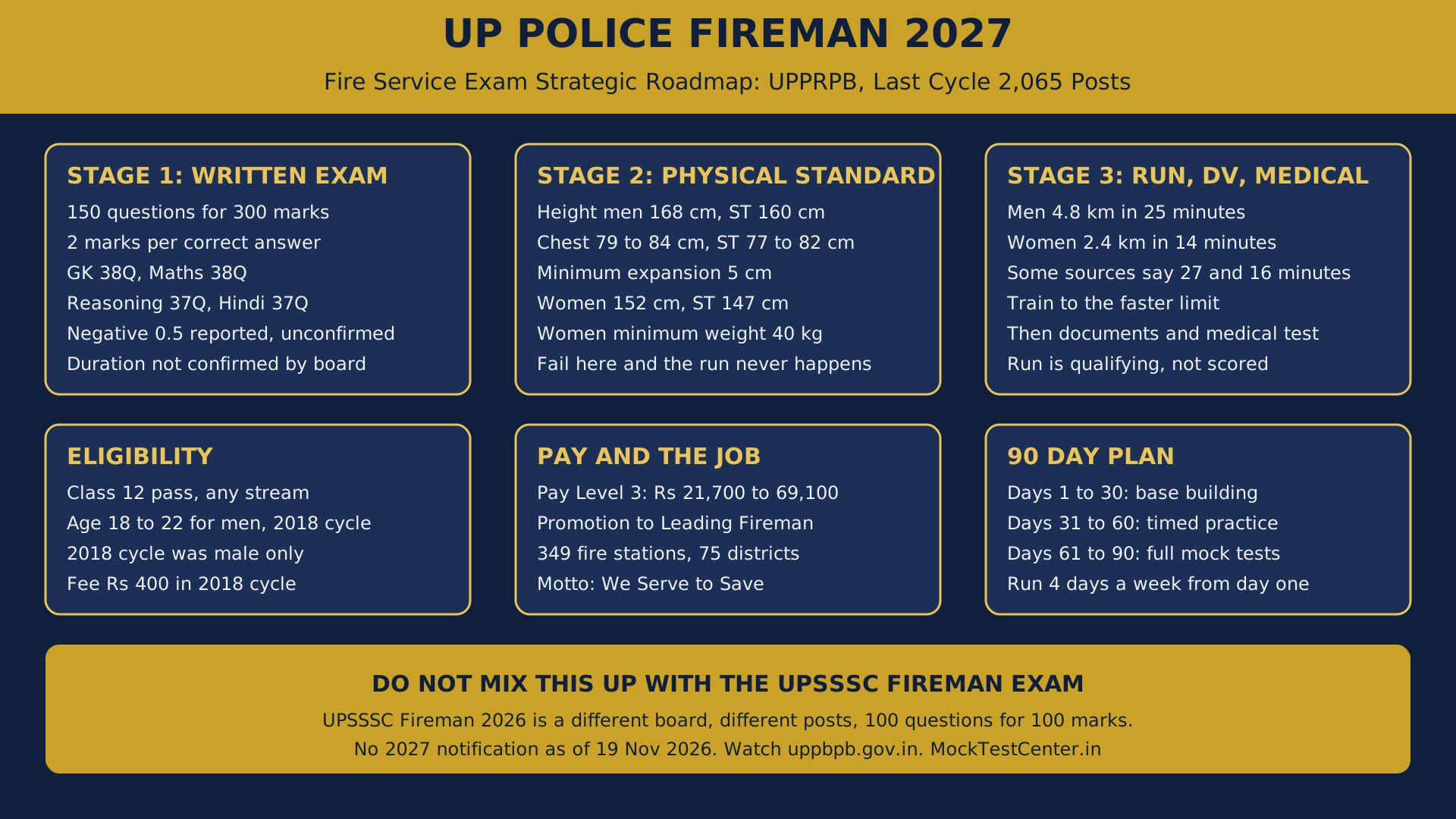
The short version: Fireman is a constable level post in the UP Fire Service. You need Class 12. The last cycle asked for men aged 18 to 22. The written paper carried 150 questions for 300 marks.
Then came measurement of height and chest. Then a 4.8 km run. Then document checks and a medical test. Pay sat in Level 3 of the pay matrix, Rs 21,700 to Rs 69,100 a month at entry.
What a UP Police Fireman actually does all day
A fireman in UP does not spend the day waiting for a fire. The UP Fire Service handles fire calls, rescue work after road accidents, and emergency help during floods and building collapses. The fire helpline is 101, and that number rings at a fire station staffed by men and women who have to be ready to move in minutes.
The service itself is old. It was set up on 26 July 1944, when the fire services of five towns run by municipal boards were taken over by the state government. It began with 8 fire stations and 198 personnel. The current figures on the official UP Fire Service site put it at 349 fire stations across 75 districts, with more than 8,278 personnel and more than 1,368 fire service machines.
Older pages on the same department quote different totals, 350 stations here, 242 stations there, because the network has kept growing and the pages were written in different years. The newest page is the one to trust.
The motto of the service is "We Serve to Save". In Sanskrit it reads "Tranay Seva Mahe". That sounds like a line on a wall until you think about what the job asks on a bad night: a cylinder blast in a crowded lane, a godown full of chemicals, a bus that has gone off an expressway. The October 2025 review by the Chief Minister pushed for small fire stations every 100 km along expressways and special units for chemical, biological or radiological emergencies and for very tall buildings.
The department is being built up, and that is part of why candidates keep asking when the next Fireman notification will come.
Daily work at a station runs on shifts. Crews check the tender and the hoses, drill with ladders and breathing sets, and keep the station ready. When a call comes, the crew turns out with the tender, lays hose lines, pulls people out of smoke filled rooms, and stays till the fire is fully out and the site is safe. Between calls there is station upkeep, equipment checks, fire safety visits to schools and markets, and seasonal duty.
From 1 March to 30 June every year the department runs seasonal fire stations at tehsil headquarters more than 20 km from a main station, because summer is when field and crop fires spike. A new fireman should expect heat and smoke and night duty, plus physical work that does not stop because it is a festival day.
This point matters for preparation. The physical test previews the job itself. If you cannot run 4.8 km inside the time limit, you cannot be relied on to climb stairs in full gear with a hose on your shoulder. Train for the run like it is a subject in its own right.
The last cycle in full: 2,065 posts and a cancelled advertisement
The 2018 Fireman recruitment did not start cleanly. The board had first advertised Fireman posts on 20 December 2016 and again on 16 January 2017. Both advertisements were cancelled. A fresh notification then came for 2,065 Fireman posts in the UP Fire Department, and the online application window opened on 8 December 2018.
The first closing date was 28 December 2018. The board later extended it, and the last date to apply became 16 February 2019, with the fee payable till 11 February 2019. The application fee was Rs 400 for every category. That fee figure and those dates were reported by NDTV and The Indian Express from the board notification, and the two reports agree on the vacancy count and the pay scale.
The 2,065 posts were split by category in the notification: 1,034 for General, 557 for OBC, 433 for SC and 41 for ST. Those four numbers add to 2,065 exactly, which is a useful check when a coaching site quotes a different split. All 2,065 posts were for men. The notification was for male Fireman posts, and the board has run this post as male only in that cycle.
That is worth stating plainly because many general guides list female height and run standards next to the Fireman post without saying the last cycle did not take women at all.
The 2018 notification was issued alongside the Jail Warder and Horse Rider recruitments, and the combined advertisement covered 5,766 posts. Fireman was the largest single block in it after Jail Warder. The exam that followed was held in December 2020, two years after the notification, which tells you something about how slowly this board has moved in the past. Candidates who applied in December 2018 waited about two years to sit the written paper.
Anyone planning around a 2027 notification should keep that history in mind and not assume a quick cycle.
One more thing the last cycle teaches: the board can change dates after announcing them. The closing date moved twice. Keep your documents ready before the window opens, because an extension is never guaranteed and a short window is always possible.
Who can apply: age and education
Education is simple. You must have passed Class 12 or an equivalent exam from a recognised board. The stream does not matter. Students from Arts, Science or Commerce are all eligible.
There is no demand for a degree, no demand for a technical certificate, and no demand for fire service experience. A Class 12 pass is the whole academic bar for Fireman, which is exactly why the competition is so heavy.
Age is where candidates trip up. In the 2018 cycle the rule was 18 to 22 years as on 1 July 2018, for men. That narrow window is the single harshest part of the UP Fireman exam. A candidate who turned 23 before the cut off date could not apply, even with a Class 12 pass and a good run time.
Relaxation applied as per UP government rules for reserved categories, and the exact relaxation for the next cycle will be printed in the new notification. Do not carry the 2018 relaxation figures into a 2027 application without checking them.
Some guides quote a female age limit of 18 to 25 for this post. That figure comes from the board general constable standards, where women get a higher upper age. It was not part of the 2018 Fireman notification, because that cycle took men only. If the next notification opens the post to women, the board will print female age and physical standards in the notification itself.
Till then, treat any female age limit for Fireman as unconfirmed.
One age fact does carry over with more confidence. The board has given a one time three year age relaxation in recent UP Police constable recruitments, because cycles were delayed and candidates had crossed the age limit while waiting. Whether that relaxation reaches the next Fireman notification is a decision the board will announce. It cannot be assumed, but it is the first thing to look for when the notification drops.
Nationality and domicile follow the usual UP Police rules. You must be a citizen of India, and the reserved category benefits apply to UP domicile candidates under state rules. Keep a domicile certificate and a caste certificate and your Class 12 marksheet ready in the format the board asks for, because document verification rejects more candidates than most people expect, and most of those rejections are for papers that could have been fixed in a week.
UP Police Fireman 2027 written exam: pattern and syllabus
The UP Fireman written exam is the first stage and the only stage that carries marks into the merit list in the way most candidates expect. It is a single paper with four subjects. General Knowledge carries 38 questions for 76 marks. Numerical and Mental Ability carries 38 questions for 76 marks.
Mental Aptitude and Reasoning, with IQ, carries 37 questions for 74 marks. General Hindi carries 37 questions for 74 marks. The total is 150 questions for 300 marks, with 2 marks for each correct answer.
That table is consistent across the sources that track this exam. What is not consistent is the marking for wrong answers and the time allowed. Testbook syllabus page says the board had not revealed the marking scheme or the duration. A separate Testbook page on the answer key says 0.5 marks are deducted for each wrong answer.
The board own notification is the only document that can settle this, and it is not on the public web in a form I could fetch for this guide. Treat negative marking of 0.5 as reported but unconfirmed, and treat the duration as unconfirmed too. Do not plan your mock tests around a 2 hour limit as if the board has fixed it. The UP Police Constable paper runs 2 hours, and many guides copy that figure across to Fireman without a source.
That is a guess dressed as a fact.
General Knowledge covers history and culture. Geography and economics. The Indian Constitution. Sports and literature.
Science. The paper has a clear UP tilt: culture and social customs of UP, revenue, the police and general administration system in UP, protection of women and children, and basics of information and communication technology. Environmental studies sits in the same paper too. Current affairs covers national and international events.
Important personalities and appointments. Prizes and important places. Main committees and commissions. Burning issues and disputes.
Major settlements and judicial decisions. Books and authors. Abbreviations.
General Hindi is grammar heavy. Expect alankar and samas. Vilom and paryayvachi. Ras and sandhi.
Tadbhav and tatsam. Lokoktiyan and muhavare. One word substitutions and anekarthi words. Sentence correction.
Ling and karak. This is the paper where UP board Hindi from Class 10 and 12 pays off directly. Candidates who read Hindi daily have an edge that no crash course can copy in a month.
Numerical and Mental Ability is school maths with speed. Number system and simplification. Decimals and fractions. HCF and LCM.
Ratio and proportion. Percentages. Profit and loss. Discounts.
Simple and compound interest. Partnership and averages. Time and work. Time and distance.
Tables and graphs. Mensuration. Nothing here needs college maths. It needs accuracy under time pressure, which is a different skill and one that only timed practice builds.
The reasoning paper covers analogies and similarities and differences. Space visualisation and problem solving. Analysis and judgement. Decision making.
Visual memory. Discrimination and observation. Relationships and concepts. Arithmetical reasoning.
Verbal and figure classification. Number series. Abstract ideas and symbols. Arithmetical computations and analytical functions.
The section rewards candidates who practise a little every day rather than those who cram reasoning in the last week.
One practical note on the written paper: the four subjects are close in weight, so there is no paper you can afford to leave weak. Hindi plus GK together are 150 of the 300 marks. A candidate who treats Hindi as a formality and loses 20 marks there has to find those marks in maths and reasoning, which is a harder place to find them.
The physical test: height, chest and the run that ends campaigns
After the written paper comes the Physical Standard Test, then the Physical Efficiency Test. The order matters. Measurement comes first, so a candidate who fails height or chest never gets to run.
For men in General, OBC or SC categories the minimum height is 168 cm. For ST men it is 160 cm. For women in General, OBC or SC the board general standard is 152 cm, and for ST women 147 cm. Chest is measured for men only.
Men in General, OBC or SC need 79 cm unexpanded and 84 cm expanded. ST men need 77 cm unexpanded and 82 cm expanded. The minimum expansion is 5 cm in every category. Women have a minimum weight of 40 kg in the board general standard, with no chest measurement.
Two cautions belong here. First, the female figures are the board general constable standards, not figures from the 2018 Fireman notification, because that cycle took men only. Second, some sources quote a different chest figure for ST men or a different height for SC men. The figures above are the ones Testbook physical test page reports for Fireman, and they match the UP Police constable standards that the board uses across constable level posts.
If the next notification prints different figures, the notification wins.
The run is where the disagreement sits. Testbook physical test page says men must run 4.8 km in 25 minutes. Other pages, including a career guide summary of the same exam, say 27 minutes for men and 16 minutes for women. Testbook own physical page contradicts itself in different paragraphs, giving 25 minutes in its table and 27 minutes in its text.
The female figure is given as 2.4 km in 14 minutes in the table and 16 minutes in the text of the same page.
Which figure should you train to? The faster one. Train to run 4.8 km in 25 minutes if you are a man, and 2.4 km in 14 minutes if you are a woman. If the board allows 27 or 16 on the day, you will have time in hand.
If it allows only 25 or 14, you will still pass. Training to the slower figure and meeting the faster limit on the day is how candidates lose a year. The run is qualifying, not scored, but failing it ends the campaign on the spot.
Start running now, even before the notification. A candidate who can already run 4.8 km in 25 minutes has one less thing to fear, and the written preparation gets easier when the physical test is not hanging over it. Build up slowly, three or four runs a week, with one longer slow run and one timed run. Add basic strength work for the shoulders and legs, because the job after selection involves carrying weight in heat.
Do not try to crash train in the last month. Shin pain and knee pain from sudden mileage have ended more campaigns than slow running ever has.
Pay and allowances and the road after selection
A selected Fireman joins in Pay Matrix Level 3, with a scale of Rs 21,700 to Rs 69,100. That is the figure in the 2018 notification as reported by NDTV and The Indian Express, and it matches the UP Police Fireman salary structure reported by PW and Testbook. Grade pay in the older pay band language was Rs 2,000, but the 7th Pay Commission matrix is the figure that matters now.
Basic pay is only part of the monthly amount. A fireman also gets dearness allowance, house rent allowance and other allowances as per UP government rules, and the in hand amount at entry is commonly reported in the range of Rs 30,000 to Rs 40,000 a month once allowances are added. That range is a coaching site estimate, not a board figure, and it moves with dearness allowance rates and posting place. Do not quote it as a promise.
The safe figure to carry is the Level 3 scale itself.
Promotion runs from Fireman to Leading Fireman, and then up the fire service ranks with service and departmental exams. The Fire Service Second Officer post, which sits in the SI stream, is a separate entry point for graduates and is not a promotion post for firemen in the ordinary sense. A fireman who wants the officer stream can apply for it separately when it is advertised, provided he holds a science degree and meets the age limit.
The job carries risk allowance in some form in most states, and UP is no exception in practice, but the exact allowances change with government orders. What does not change is the nature of the posting: shift duty at a fire station with night calls and work in smoke and heat. Candidates who join for the salary alone and dislike physical work will struggle. Candidates who like being outdoors and working with their hands will find the job suits them far better than a desk post at the same pay.
Fireman vs Constable vs Fire Service Second Officer: three doors, three exams
These three posts get mixed up constantly, and the mix up costs candidates the wrong application. Here is how they differ.
UP Police Fireman is a constable level post in the Fire Service. It needs Class 12. In the last cycle the age limit was 18 to 22 for men. The written paper was 150 questions for 300 marks across GK and maths and reasoning and Hindi.
The physical test was height and chest measurement plus the 4.8 km run. The job is fire fighting and rescue at a fire station.
UP Police Constable, in Civil Police and PAC, is the same level and the same Class 12 bar, with the same written paper shape and the same physical standards in most respects. The difference is the job. A constable does police duty and patrolling and station work, including law and order. A fireman does fire and rescue duty.
The constable exam draws far more applicants, and its cut offs run higher. A candidate who prepares for one is largely prepared for the other, since the written syllabus overlaps almost fully and the physical standards are the same.
Fire Service Second Officer is a different league. It is an SI level post, advertised with the UP Police SI recruitment. In 2021 the board advertised 23 Fire Service Second Officer posts inside a total of 9,534 SI level vacancies, alongside 9,027 Sub Inspector posts plus 484 Platoon Commander posts. It needs a science degree, not Class 12.
The age limit was 21 to 28. The written exam was 400 marks, with 160 questions in 2 hours. Four papers of 100 marks each: General Hindi. GK with Constitution and basic law.
Numerical and Mental Ability. Mental Aptitude. The pass bar was 35 percent in each subject and 50 percent overall, and there was no negative marking. A fireman with a science degree can aim for it later.
It is a graduate officer exam in its own right.
The practical advice follows from that. If you have only Class 12, Fireman or Constable are your doors. If you have a science degree and are under 28, the Second Officer post is also open, and it pays at SI level. Do not apply for the Second Officer post with only Class 12.
Do not prepare for Fireman with SI level books and ignore the Hindi grammar that carries 74 marks in your own paper.
Many candidates apply for more than one post in the same year. The UP Police Constable paper shares the Fireman syllabus almost fully. The Sub Inspector and ASI posts suit graduates who want officer rank. The Jail Warder post came from the same 2018 advertisement family as Fireman. Computer Operator and Head Operator are separate technical posts under the same board. Outside UP Police, Agniveer Vayu and AFCAT draw the same age group, and Bihar Police Constable and SSC GD are the usual parallel options for candidates who want a uniformed job and are willing to look beyond UP.
Do not mix this up with the UPSSSC Fireman exam
There is a second Fireman exam in UP, and it causes more confusion than any other fact in this guide. The Uttar Pradesh Subordinate Services Selection Commission (UPSSSC) advertised Fireman and Fire Guard posts in 2026 under Advertisement Number 09-Exam/2026. It offered 170 posts, 120 Fireman plus 50 Fire Guard, on the same Level 3 pay scale of Rs 21,700 to Rs 69,100. Applications ran from 9 June to 29 June 2026.
That exam comes from a different board, for different posts in the Fire Department, and it works differently. It needs Class 12 plus a qualified PET 2025 score. Its written paper is 100 questions for 100 marks in 2 hours, with 0.25 negative marking, split across General Studies and computer knowledge and UP general information. Its selection runs through PET shortlisting and a main exam, then physical tests and document verification, and ends with a final merit list.
Search results mix the two freely, and coaching sites often carry UPSSSC Fireman syllabus pages under a UPPRPB Fireman heading. If a page tells you the Fireman paper is 100 questions for 100 marks, it is talking about UPSSSC. If it tells you 150 questions for 300 marks, it is talking about UPPRPB. Keep the two apart or your whole preparation plan will be built on the wrong paper.
A 90 day plan that respects the run
Ninety days is enough if you already have Class 12 level Hindi and maths in some shape. It is not enough if you are starting from zero in all four subjects and cannot yet run 2 km. Be honest about where you stand on day one, because the plan below assumes you can run 2 km without stopping and can solve Class 10 maths at a slow pace.
Days 1 to 30 are for base building. Hindi grammar every day, one topic at a time, with 20 questions after each topic. Maths every day, one chapter at a time, starting with number system and percentages and ratio. Reasoning for 30 minutes a day, rotating between series and analogy and classification.
GK in the evenings, with UP specific topics first: UP history and culture. UP geography and rivers. UP administration. And the fire service itself.
Run four days a week, building from 2 km to 4 km at a slow pace. Take one mock test at the end of week two and one at the end of week four, untimed at first, to find your weak topics.
Days 31 to 60 are for speed. Start timed practice in every subject. Maths sets of 25 questions in 25 minutes. Reasoning sets of 25 in 25 minutes.
Hindi sets of 25 in 20 minutes. GK revision from your own notes, not from a new book. Add current affairs from the last six months, with a focus on UP news and national appointments and awards. Running shifts to pace work: one timed 4.8 km attempt every week, plus two easy runs and one interval session.
Take a full mock test every Sunday under exam conditions and spend Monday fixing the questions you got wrong.
Days 61 to 90 are for exam shape. Two full mock tests a week, 150 questions each, with the same subject order as the real paper. Review every wrong answer the same day. Stop learning new GK topics in the last two weeks and revise what you already know.
Hindi grammar revision from a single notebook. Maths formula revision from a single sheet. Running tapers in the last ten days so your legs are fresh: shorter runs, no new personal best attempts. Sleep properly in the last week.
A tired candidate makes mistakes in Hindi grammar that he would never make fresh.
Across all ninety days, keep one rule: the run is a subject. It gets four sessions a week on the calendar, next to Hindi and maths, not after them. Candidates who leave running to the end discover in week ten that they cannot finish 4.8 km, and no amount of GK can fix that in the time left.
Mistakes that cost candidates a year
The first mistake is preparing for the wrong exam. Candidates download the UPSSSC Fireman syllabus and practise 100 mark papers for a 300 mark exam. Others prepare for the SI paper and walk into a constable level Hindi test they have not revised. Check the board name on every source you use.
UPPRPB is this exam. UPSSSC is a different one.
The second mistake is ignoring Hindi. It carries 74 marks, the same as reasoning, and it is the easiest paper to improve quickly for a Hindi medium student. Yet candidates spend weeks on maths and treat Hindi as something they already know. They do not.
Alankar and samas and sandhi need revision like any other topic.
The third mistake is leaving the run till the physical test call arrives. By then there are only weeks left, and the body cannot be rushed. Shin splints and knee pain and exhaustion follow, and the candidate either fails the run or reaches it injured.
The fourth mistake is trusting vacancy news. Pages that promise 32,497 new UP Police posts or a Fireman notification next month are guessing, and some are copying old news with a new date. The only reliable signal is a notification on uppbpb.gov.in. Till it appears, prepare on the last pattern and keep your documents ready.
The fifth mistake is waiting for the notification to start. The last cycle took two years from notification to exam. The next cycle may move faster or slower, and nobody can promise which. Starting now costs nothing.
Waiting costs the base fitness and the Hindi revision that take months to build.
What to watch next
Watch the UPPRPB site at uppbpb.gov.in for the next Fireman notification, and the UP Fire Service site at upfireservice.gov.in for news about the department. When the notification comes, read four things first: the vacancy count and category split, the age cut off date, whether the post is open to women this time, and the physical test timings. Those four facts decide whether you can apply and how you should train.
Do not pay any agent who promises a Fireman seat or a place in the merit list. The board selects through a written paper and measurement, a run and documents, and a medical test. No payment changes any of those stages, and paying one is the fastest way to lose money and a year.
Start with the run this week and Hindi grammar tomorrow morning. The notification will come when it comes. Your preparation does not need it to begin.
Sources
UP Police Fireman 2018 notification, 2,065 posts and dates, fee and pay scale, as reported by NDTV on 5 December 2018 and The Indian Express on 5 December 2018 and 23 January 2019.
Category split of 1,034 General and 557 OBC and 433 SC and 41 ST, and advertisement numbers PRPB-1-1 (135)/2018 and PRPB-1-2/2018 dated 17 January 2019, as compiled from the notification text. Age limit 18 to 22 as on 1 July 2018 and Class 12 pass, per the same reports. Written exam pattern of 150 questions for 300 marks across four subjects, per Testbook UP Police Fireman syllabus page. Negative marking of 0.5 per wrong answer, per Testbook UP Police Fireman answer key page, in conflict with the Testbook syllabus page statement that the marking scheme had not been revealed.
Physical standards and run timings, per Testbook UP Police physical efficiency test page and Likhpadh UP Police Fireman page, with the 25 minute versus 27 minute run conflict noted in the text. Pay Matrix Level 3, Rs 21,700 to Rs 69,100, per the 2018 notification reports and PW UP Police Fireman salary page. Fire Service Second Officer, 23 posts in the 2021 SI recruitment of 9,534 vacancies, science degree, age 21 to 28, 400 mark written exam, per Scroll and Jagran Josh and the UPPRPB SI notification summaries. UP Fire Service history, 349 stations, 8,278 personnel and 1,368 machines, per the official UP Fire Service site at upfireservice.gov.in.
Fire helpline 101, per the UP government portal at up.gov.in. UPSSSC Fireman 2026, Advertisement Number 09-Exam/2026, 170 posts, 100 questions for 100 marks, per Testbook UPSSSC Fireman syllabus page and the UPSSSC notification summaries. No UP Police Fireman 2027 notification as of 19 November 2026, checked against UPPRPB site listings and current search results.
Uttar Pradesh Police Recruitment and Promotion Board







