
About UGC NET Sociology 2027 Exam Series
📖 Table of Contents
- What NET gives you after you qualify
- Where the June 2027 cycle stands right now
- The exam pattern in plain words
- Paper 1 in brief: the common paper everyone faces
- Who can apply: the eligibility rules
- Age limit and relaxations
- How the qualifying mark and the cut off work
- Paper 2 syllabus: units one to five
- Unit 1: Sociological Theory
- Unit 2: Research Methodology and Methods
- Unit 3: Basic Concepts and Institutions
- Unit 4: Rural and Urban Transformations
- Unit 5: State, Politics and Development
- Paper 2 syllabus: units six to ten
- Unit 6: Economy and Society
- Unit 7: Environment and Society
- Unit 8: Family, Marriage and Kinship
- Unit 9: Science, Technology and Society
- Unit 10: Culture and Symbolic Transformations
- June 2026 cycle: what actually happened
- December 2026 cycle: the dates that changed
- Best books for UGC NET Sociology 2027
- Haralambos and Holborn, Sociology: Themes and Perspectives
- Anthony Giddens, Sociology
- George Ritzer, Sociological Theory
- NCERT Class 11, Introducing Sociology and Understanding Society, and Class 12, Indian Society and Social Change and Development in India
- Iravati Karve, Kinship Organisation in India, and A. M. Shah on the Indian family
- A previous year papers book
- A 90 day plan that fits real life
- Mock test strategy: how to use mocks without wasting them
- Common mistakes that cost good candidates marks
- What to check the day the June 2027 notice arrives
UGC NET Sociology 2027: Syllabus, Pattern, Eligibility and Cut Off
UGC NET Sociology 2027 opens the door to college teaching and funded research for sociology graduates across India. The exam tests two papers in one sitting, a common Paper 1 and a subject Paper 2 with code 05. Pass it and a college can appoint you as an Assistant Professor.
Score higher and you also win a Junior Research Fellowship, a monthly fellowship that pays for your PhD.
This guide covers the full picture of UGC NET 2027 in plain words. You will find the pattern, the eligibility rules, the age limits, the qualifying marks, the cut off method, the complete Paper 2 syllabus unit by unit, the June 2026 and December 2026 cycles, the best books, a 90 day plan, a mock test strategy and the mistakes that cost good candidates marks. The June 2027 notification has not come out yet, as of 19 November 2026, so this guide rests on the last two cycles and says clearly where the facts end and the waiting begins.
What NET gives you after you qualify
NET gives eligibility, and eligibility is what colleges ask for before they appoint a teacher. The result comes in three categories. Category 1 means JRF and Assistant Professor plus PhD admission.
Category 2 means Assistant Professor and PhD admission. Category 3 means PhD admission only. Every candidate who qualifies lands in one of the three, and the category decides what doors open next.
Pass UGC NET Sociology 2027 and a college can appoint you as an Assistant Professor. Score higher and you also win a Junior Research Fellowship, a monthly fellowship that pays for your PhD.
A JRF pays 37,000 rupees a month for the first two years, then 42,000 rupees a month as a Senior Research Fellow after that, plus house rent allowance as per UGC rules. The fellowship supports full time research, and a JRF holder joins a university department to work on research in university sociology departments and social science institutes, on caste, class, family, religion, development and social change. The money matters, but the real value is the research position itself, because a PhD with a fellowship carries weight in every later application.
For Categories 2 and 3, universities give the NET score 70 percent weight and their own interview 30 percent weight for PhD admission. The NET score stays valid for PhD admission for one year from the result. Sociology graduates teach in colleges and universities, and they also find work in social science research institutes, development organisations, policy research, survey work and the social sector.
A NET qualification opens the college gate, and a JRF opens the research gate.
One warning belongs here, early. NET gives eligibility for a teaching post, and it gives a fellowship for research, but it gives no job by itself. A candidate still faces interviews, college selection processes and university rules.
Treat NET as the key, and keep the key separate in your mind from the door it opens.
Where the June 2027 cycle stands right now
The June 2027 notification has not come out yet. NTA releases the notification on the official portal, ugcnet.nta.ac.in, and the UGC NET 2027 notice will appear there first. As of 19 November 2026, no date, no fee and no exam window for June 2027 exists in any official notice, so any website that gives you a fixed June 2027 exam date today is guessing.
That leaves you with a clear choice. You can wait for the notice, or you can start now with the syllabus and the pattern from the last two cycles. The syllabus has stayed unchanged since June 2019, and the pattern has stayed the same across cycles, so preparation that starts now will still count when the notice arrives.
The only things that change with each cycle are the dates, the fee and the cut off, and those three come from the notice itself.
The December 2026 cycle runs first, with exams on 14, 15, 16, 17, 18 and 21 December 2026. Candidates who sit in December will see their result before the June 2027 notice arrives, and their experience will set the tone for June. If you plan to sit in June 2027, use the December cycle as a live rehearsal in your mind, watch its dates, its admit card timing and its result date, and you will know the rhythm of the exam before your own cycle starts.
The common paper guide at UGC NET Paper 1 2027 follows the same cycle, so read it beside this page.
The exam pattern in plain words
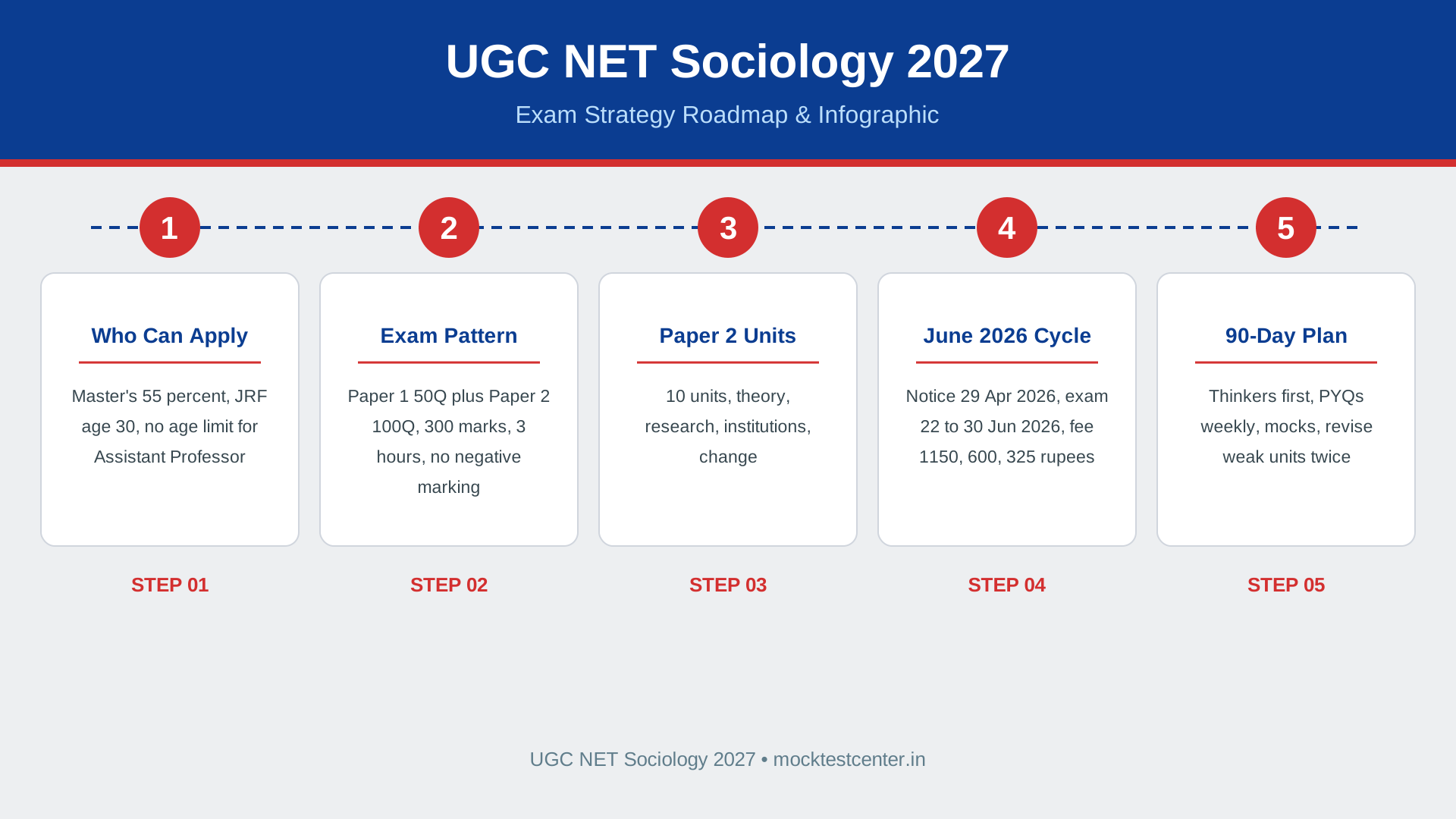
NTA holds UGC NET as a computer based test, both papers together in a single session of three hours, with no break between the papers. Paper 1 carries 50 questions for 100 marks, two marks each. Paper 2 carries 100 questions for 200 marks, two marks each.
The total comes to 150 questions for 300 marks. All questions are compulsory, and each question carries four options with one correct answer.
The rule that shapes every strategy in this guide is simple. There is no negative marking in either paper. A wrong answer costs nothing, and a skipped question also costs nothing, so an attempt never hurts your score.
That changes how you should use the last minutes of the paper, and the mock test section of this guide explains how.
Paper 1 is the general paper on teaching and research aptitude, common for every subject, with code 00. Paper 2 is your subject, Sociology, with code 05, and it carries twice the marks of Paper 1. A candidate who treats Paper 2 as the main paper and Paper 1 as the support paper reads the pattern correctly, because 200 of the 300 marks come from your own subject.
Candidates from other subjects face the same split, and the UGC NET Psychology 2027 page shows how the common paper looks from another subject's side.
The exam runs in shifts across several days, because lakhs of candidates sit for 85 subjects. Your shift, your centre and your reporting time come from the admit card, which NTA releases a few days before the exam. Keep your application number and your password safe from the day you apply, because the admit card, the answer key and the result all need the same login.
Paper 1 in brief: the common paper everyone faces
Paper 1 has ten units, and each unit gives about five questions worth ten marks. The units are Teaching Aptitude, Research Aptitude, Comprehension, Communication, Mathematical Reasoning and Aptitude, Logical Reasoning, Data Interpretation, Information and Communication Technology, and People, Development and Environment, plus the Higher Education System. The syllabus has stayed unchanged since June 2019, so the previous year papers tell you the real shape of this paper better than any new book can.
Teaching Aptitude and Research Aptitude together give about ten questions, and they reward short notes and repeated revision. Comprehension gives one passage with five questions, and it rewards a candidate who reads the passage twice before touching the options. Communication, Mathematical Reasoning, Logical Reasoning and Data Interpretation reward practice, and a daily set of ten questions in each area builds speed faster than a weekend of theory.
ICT and People, Development and Environment reward current knowledge. The Higher Education System unit rewards a candidate who knows the bodies that run Indian higher education, UGC, AICTE, NCTE and the national policies, by name and by function. Give Paper 1 one hour of study a day, every day, and treat it as a subject of its own, because a strong Paper 1 lifts a borderline Paper 2 score over the cut off line.
Who can apply: the eligibility rules
You need a Master's degree or an equivalent qualification, with at least 55 percent marks for General and General EWS candidates, or 50 percent for OBC Non Creamy Layer, SC, ST, PwD and third gender candidates, without rounding off, from a UGC recognised university. Final year Master's students may apply provisionally, and they must complete the degree within the window the bulletin sets.
Holders of a four year bachelor's degree with eight semesters need 75 percent aggregate, or 70 percent for reserved categories, and they qualify for JRF and PhD admission only, and not for Assistant Professor. The Master's degree must be complete within two years of the result date for Categories 1 and 2, and within one year for Category 3, though that Category 3 window comes from a single source and needs a check against the official bulletin.
Your Paper 2 subject should match your Master's subject, or a closely related subject, and the bulletin lists the permitted combinations. A sociology Master's degree fits Paper 2 Sociology directly. Candidates with a degree in a related field should read the subject list in the bulletin before they apply, because a wrong subject choice can waste a whole cycle.
The UGC NET Geography 2027 page shows how another subject handles the same eligibility rule.
There is no limit on the number of attempts, as long as you stay within the age limit for JRF. A candidate who misses the cut off in one cycle can sit again in the next cycle, and many successful candidates qualify on their second or third attempt.
Age limit and relaxations
The age limit applies to JRF only. The maximum age for JRF is 30 years as on the first day of the exam month. For the June 2026 cycle that date was 1 June 2026, and for the December 2026 cycle it is 1 December 2026.
The June 2027 cycle will use the first day of its own exam month, and the notice will state the date.
Relaxation goes up to five years for OBC Non Creamy Layer, SC, ST, PwD, third gender candidates and women. Research experience, an LLM degree and armed forces service also earn relaxation, and the total relaxation stays capped at five years. A candidate who claims relaxation must hold the certificate that proves it, because the certificate check happens at the time of admission or appointment.
Assistant Professor posts and PhD admission carry no upper age limit. A candidate of any age can qualify for Category 2 or Category 3, and a candidate over 30 can still sit for the exam and qualify as an Assistant Professor. That rule makes NET a second chance exam for working teachers, for candidates who finished their Master's late, and for anyone who returns to study after a break.
Age never blocks the teaching path, and only the fellowship path carries a clock.
How the qualifying mark and the cut off work
Two numbers decide your result, and they work in sequence. First comes the qualifying mark, the minimum aggregate across both papers. General and General EWS candidates need 40 percent, which means 120 marks out of 300.
SC, ST, OBC Non Creamy Layer, PwD and third gender candidates need 35 percent, which means 105 marks out of 300. You must appear in both papers to count, and the qualifying mark only lets you enter the race.
Then comes the cut off, and the cut off decides who actually qualifies. NTA caps the number of candidates who qualify for Assistant Professor at 6 percent of the candidates who appeared in both papers. That 6 percent pool splits by reservation category and then by subject, and the split produces the subject wise and category wise cut off.
A subject with many candidates gets a larger share of the pool, and a subject with few candidates gets a smaller share.
That method explains why the cut off moves every cycle. More candidates, a harder paper, or a different category split can all push the line up or down. It also explains why no one can predict the June 2027 cut off today.
The honest way to use the cut off is to study the last cycle's cut off for your own subject and category, and to aim ten marks above it in your mocks. This guide gives no cut off numbers for Sociology, because the exact subject cut off figures were not verified against the NTA cut off PDF of 28 August 2026 in this pass, and a wrong number here would mislead you. Read the mechanism, aim above the last line, and check the official cut off list when NTA releases it.
The UGC NET Home Science 2027 page explains the same method from another subject's side.
The three result categories follow from the same merit list. The highest scorers take Category 1, JRF plus Assistant Professor plus PhD admission. The next band takes Category 2, Assistant Professor plus PhD admission.
The next band takes Category 3, PhD admission only. A candidate who misses Category 1 by a few marks still holds a useful result, so never treat a Category 2 or 3 result as a failure.
Paper 2 syllabus: units one to five
Paper 2 for Sociology has ten units, and each unit gives about ten questions. The syllabus comes from the official UGC syllabus for subject code 05, and the unit titles below follow that official document. The brief for this package listed different unit names, and the package note at the end of this file records the change and the reason.
Learn the units in order, because the order itself teaches you how the subject fits together.
Unit 1: Sociological Theory
Sociological theory is the backbone of this paper, and it decides more marks than any other unit. Start with the classical thinkers, Karl Marx, Emile Durkheim and Max Weber, and learn each thinker as a system, the central question, the key concepts and the method. Marx gives class, conflict and historical materialism.
Durkheim gives social facts, solidarity and suicide. Weber gives social action, rationalisation and the Protestant ethic. Then move to functionalism, Parsons and Merton, conflict theory, symbolic interactionism, Mead, Blumer and Goffman, and structuralism.
Contemporary theory follows, with Bourdieu, Foucault, Habermas and Giddens among the names that appear most. Keep a thinker comparison table, one row per thinker, one column for the core idea, one for the key work, one for the key concept. Revise it until you can fill it from memory.
Unit 2: Research Methodology and Methods
Research methodology is the second pillar of the paper, and it rewards precise study. Learn the nature of social research, its types, and the steps of the research process from problem formulation to report writing. Positivism and its critics, quantitative and qualitative techniques, and the choice between them, form the conceptual core.
Sampling needs full attention, probability and non probability methods, sample size, and the errors that sampling can carry. Data collection covers observation, interview, questionnaire, schedule and case study, with the strengths and limits of each. Hypothesis, variables, scaling, measurement, validity, reliability and ethics close the unit.
Practise with numbers, because questions here often give a small data set and ask what the researcher should do next.
Unit 3: Basic Concepts and Institutions
This unit holds the vocabulary of sociology, and the paper tests it directly. Learn the basic concepts first, society, community, association, institution, culture, socialisation, status, role, norms, values and sanctions. Then study the institutions, family, marriage, kinship, religion, economy, polity and education, and what each one does for society.
Social stratification runs through this unit, caste, class, status and power, and the theories that explain them. Social processes close the unit, cooperation, competition, conflict, accommodation, assimilation and social change. Make flashcards for every concept with one definition and one Indian example, because a question often gives an example and asks for the concept it shows.
Unit 4: Rural and Urban Transformations
This unit studies India as it moves from village to town. The rural half covers agrarian structure, land ownership, land reforms, the green revolution, rural poverty and rural development programmes. The urban half covers urbanisation, its causes and its pace in India, the growth of towns and cities, urban problems, slums, housing, transport and pollution, and migration between village and town.
The transformation between the two, how rural life changes as towns grow, ties the unit together. Keep the major land reform laws and the major urban programmes by name and year, because questions often test whether you can place a programme in its decade.
Unit 5: State, Politics and Development
This unit studies power and the state. Learn the concepts of power, authority and legitimacy, and the types of authority Weber described. The state, its theories, democracy, political parties, pressure groups and elections follow.
Development forms the second half, the theories of development, modernisation, dependency and world systems, and the debates about growth and equity in India. Social movements belong here too, their types, their causes and their role in democratic politics, and civil society and governance. Read this unit with the news, because a movement, an election or a development debate in the news often carries a Unit 5 concept inside it.
Five units done, and five to go. The first half of the syllabus covers the base of the subject, and the second half covers its applications. Candidates who finish the first five units well find the second five easier, because the second half keeps using the ideas of the first.
The UGC NET Political Science 2027 page follows the same ten unit shape in its own subject, so a look at it shows how the pattern repeats.
Paper 2 syllabus: units six to ten
The second half of the Sociology syllabus moves from the base to the wider world. These five units ask you to apply what the first five taught, and the paper rewards candidates who can make that jump. Read each unit with the first half in mind, and look for the links between them.
Unit 6: Economy and Society
Economy and society studies how work, markets and inequality connect. Learn the sociological view of the economy, formal and informal sectors, and the place of labour in each. Capitalism, its features and its critics, and globalisation, its causes and its effects on Indian society, form the core.
The unit covers industrialisation, the division of labour, and the changes that factory work brings to family and community. Consumption, markets and the new middle class appear in recent papers, as do issues of work, gender and informality. Keep Indian examples ready, the informal worker, the gig worker, the small farmer selling in a distant market, because the paper often asks you to recognise a concept in an Indian setting.
Unit 7: Environment and Society
Environment and society is one of the newest units in the syllabus, and it grows in importance every cycle. Learn the sociological view of the environment, how societies use natural resources and how that use creates conflict. Environmental movements in India need names, places and issues, Chipko, Narmada Bachao Andolan and the movements against mining and dams among them.
Sustainable development, its meaning and its critics, and the debates about growth and ecology, form the conceptual core. Climate change, displacement, and the social effects of environmental damage close the unit. This unit rewards a newspaper habit, because an environmental conflict in the news today can become a question in the next paper.
Unit 8: Family, Marriage and Kinship
Family, marriage and kinship form the most personal unit in the syllabus. Learn the family, its types, joint, nuclear, extended and single parent, and its functions, and how the Indian family has changed. Marriage, its forms, rules of mate selection, and the changes in marriage practices follow.
Kinship needs its own notes, descent, kinship terminology, clan and lineage, and the differences between North and South Indian kinship systems. Gender runs through the whole unit, the division of work in the home, patriarchy, and the changing position of women. Indian sociologists like Iravati Karve and A. M. Shah wrote the classic work here, so learn their names with their books.
Unit 9: Science, Technology and Society
Science, technology and society studies how knowledge changes social life. Learn the sociology of science, how scientific knowledge grows, who controls it and who benefits from it. Technology follows, its spread, its effects on work, family and communication, and the digital divide between those with access and those without.
The unit covers the information society, social media, and the new forms of community and conflict that digital life creates. Questions here often connect a technology, the mobile phone, the internet, artificial intelligence, with a social change, so practise making that connection in one sentence for each technology you read about.
Unit 10: Culture and Symbolic Transformations
Culture and symbolic transformations close the syllabus with meaning itself. Learn culture, its elements, material and non material, cultural relativism, ethnocentrism, and the processes of cultural change, acculturation, assimilation and diffusion. Religion belongs here as a system of symbols, its forms, its functions and its role in social life.
Media, popular culture and the symbols of modern India, cinema, cricket, festivals and advertising, appear in recent papers. The unit also covers identity, its making and remaking, and the symbolic struggles of caste, religion, region and gender. Read this unit slowly, because its questions test understanding, and understanding grows from examples, not from lists.
Ten units done. The syllabus now sits complete in front of you, and the next step is a plan for covering it. The UGC NET History 2027 page covers its own ten units the same way, and a comparison of the two pages shows how much of the exam method stays the same across subjects.
June 2026 cycle: what actually happened
The June 2026 notification came on 29 April 2026, though one source records 28 April, and this guide uses 29 April as the majority date while flagging the other claim. Applications ran from 29 April to 20 May 2026, and NTA extended the window to 23 May 2026, with fee payment open till 23 May at 11:50 PM. One source says the window closed on 24 May, and that claim stays flagged here.
NTA held the exam on 22 to 30 June 2026, on 22, 23, 24, 25, 29 and 30 June, as a computer based test. The fee was 1,150 rupees for General and Unreserved candidates, 600 rupees for General EWS and OBC Non Creamy Layer candidates, and 325 rupees for SC, ST, PwD and Third Gender candidates, paid online only and non refundable. The number of subjects is reported as 85 by most trackers, while one source says 87 including two newly added subjects, Statistics and Forestry, and that difference stays flagged until the official bulletin settles it.
NTA released the cut off lists on 28 August 2026, and a re exam cut off list for English and Commerce on 17 September 2026, with the final answer key for the re exam on the same date. Certificates came on 24 September 2026. Candidates who sat in June 2026 should check their certificate and their category on the official portal, ugcnet.nta.nic.in, because the certificate is the document a college asks for.
The UGC NET Economics 2027 page records the same June 2026 cycle from its own subject side.
December 2026 cycle: the dates that changed
The December 2026 notification came on 8 October 2026, with a revised bulletin and corrigendum on 16 October 2026. Applications ran from 8 October to 31 October 2026, with fee payment extended to 1 November 2026, and the correction window opened from 2 November 2026. Candidates who applied in this cycle should keep the correction window in mind, because a wrong photo, a wrong signature or a wrong category entry can cost a whole attempt.
The exam dates changed once. NTA first announced 14 to 19 December 2026, then revised the schedule to 14, 15, 16, 17, 18 and 21 December 2026. That revision shows why candidates should check the official site, nta.ac.in, after every notice, because a date in an old article can mislead a candidate who never checks again.
The December cycle will set the pattern for June 2027, so watch its admit card date, its answer key date and its result date, and note each one down.
Best books for UGC NET Sociology 2027
Sociology rewards candidates who read the original thinkers, so pick books that give you the thinkers in their own terms. Six books cover the syllabus, and each one earns its place for a different reason.
Haralambos and Holborn, Sociology: Themes and Perspectives
The most used sociology textbook for this paper. Read the chapters on theory, research methods, family, religion and stratification slowly, and make notes in your own words.
Anthony Giddens, Sociology
Use this book after Haralambos, for a modern view of globalisation, identity, media and social change. It suits the newer units, 7, 9 and 10, better than any other single book.
George Ritzer, Sociological Theory
Use this book for Unit 1 depth. Learn each theory with its thinker, its core idea and its key work, and keep a comparison table as you read.
NCERT Class 11, Introducing Sociology and Understanding Society, and Class 12, Indian Society and Social Change and Development in India
Read this set first if sociology is new to you. It covers the Indian ground of Units 3, 4 and 8 in simple language, and the paper often lifts its examples.
Iravati Karve, Kinship Organisation in India, and A. M. Shah on the Indian family
Read these for Unit 8 depth. Indian kinship questions often trace back to Karve, so learn her regional patterns and her terms.
A previous year papers book
Finish with a UGC NET Sociology previous year papers book from Arihant or Trueman's, solved year by year, and check every answer against the syllabus unit it belongs to.
Buy the latest edition of each book, and check the edition year before you pay. A book from 2019 still teaches the syllabus, because the syllabus has stayed unchanged since June 2019, but a newer edition carries better questions and cleaner answers. Keep one book per unit open at a time, and finish one book before you buy the next.
A shelf full of unread books helps no one, and a single book read twice beats three books read once.
The UGC NET English 2027 page lists its own subject books the same way, and a candidate preparing for two subjects can compare the two lists before buying anything.
A 90 day plan that fits real life
Ninety days divide into three parts, and each part has one job. Days 1 to 30 build the base. Read the syllabus unit by unit, two units a week, and make short notes as you read.
Give Paper 1 one hour a day in this phase, and give your subject three hours a day. End each week with a previous year paper, solved without a time limit, and mark the questions you got wrong.
Days 31 to 60 build speed. Start timed practice, one full Paper 2 set every third day, and one Paper 1 set every week. Revise your notes every Sunday, and rewrite the notes that feel thin.
This is the phase where weak units show themselves, and the honest move is to give the weakest unit the most hours, even when the strongest unit feels better to study. A plan that only feeds your strengths leaves the weak unit to cost you marks on exam day.
Days 61 to 90 build exam fitness. Sit for a full mock every second day, 150 questions in three hours, in one sitting, with no break and no phone. Analyse each mock the same evening, and write down three things, the units that cost marks, the question types that ate time, and the silly errors.
Revise only from your notes and your error list in the last ten days, and stop learning new material five days before the exam. Sleep well in the last week, because a tired mind drops more marks than a thin syllabus does.
Working candidates can follow the same plan with smaller daily hours. Two hours a day for ninety days beats six hours a day for thirty days, because the syllabus needs repetition more than it needs long sittings. Keep a simple daily log, date, hours, units covered, questions solved, and the log itself will keep you honest when motivation dips.
The UPSC CAPF 2027 page uses the same 90 day shape, so one log can serve both subjects.
Mock test strategy: how to use mocks without wasting them
A mock test measures, and the analysis after it teaches. Sit for the mock in exam conditions, three hours, one sitting, no break, no phone, no notes. Sociology mocks test thinker matching and concept recognition, so practise those two skills in every mock.
A question that names a thinker rewards the candidate who can place that thinker in one line.
Analyse the mock the same day, while the questions still feel fresh. Sort every wrong answer into three piles, concept gap, silly error, and time pressure. Concept gaps need a return to the book.
Silly errors need a slower reading habit. Time pressure needs more timed sets. A mock without this sorting wastes three hours, because the score alone teaches nothing.
Use the no negative marking rule in the last fifteen minutes of every paper. With no penalty for a wrong answer, every unanswered question is a lost chance, so mark an answer for every question before time ends. Guess with sense, remove the options you know are wrong, and pick from what remains.
A mock is the place to practise this, so that the habit feels natural on exam day.
Take mocks from the full syllabus, and mix subjects only for Paper 1. Your Paper 2 mocks should stay inside UGC NET Sociology 2027, because a mixed mock hides your weak units. Keep a running table of your UGC NET 2027 mock scores, Paper 1 and Paper 2 separately, and watch the trend across weeks, because a rising trend tells you the plan works and a flat trend tells you to change the plan.
Common mistakes that cost good candidates marks
The first mistake is starting without the syllabus. Candidates read random books for months and then find the paper asking about units they never opened. Print the syllabus, pin it on the wall, and tick each unit as you finish it.
The syllabus is the exam, and everything else is commentary on it.
The second mistake is reading Paper 1 last. Paper 1 carries 100 marks, a third of the total, and candidates who leave it to the final month score far below their subject level. One hour a day from day one keeps Paper 1 level with Paper 2, and a level Paper 1 saves many borderline results.
The third mistake is collecting books instead of finishing them. Many sociology candidates memorise thinker names and skip the concepts. The paper tests concepts through examples, so a candidate who knows the name and not the idea gives away marks.
The fourth mistake is taking mocks and skipping the analysis. A mock score without analysis is a number without a lesson, and a candidate who repeats the same errors in ten mocks learns nothing from any of them. Analyse every mock, write the error list, and fix one error type before the next mock.
The fifth mistake is trusting unofficial dates. Websites guess the June 2027 dates every year, and candidates who plan around a guessed date lose weeks. Trust only the official portal, and plan around the syllabus until the notice arrives.
What to check the day the June 2027 notice arrives
Read the notice on the official portal, ugcnet.nta.ac.in, and check six things in order. First, the application window and the last date for fee payment. Second, the exam window and the exam month, because the JRF age limit counts from the first day of that month.
Third, the fee for your category. Fourth, the subject list, to confirm UGC NET Sociology 2027 with code 05 and the permitted degree combinations. Fifth, the syllabus link, to confirm the units have stayed the same.
Sixth, the correction window dates.
Apply early in the window, and keep a copy of the filled form, the fee receipt and the application number. Check your photo, your signature, your category and your subject before you submit, because the correction window fixes small errors and never fixes a wrong subject. Then return to your plan, and let the notice change your dates, not your study.
The SSC MTS and Havaldar 2027 page follows the same notice check, and a candidate preparing for two exams can use one checklist for both.
Your preparation starts before the notice, and the notice only sets the dates. A candidate who has covered the syllabus, solved the previous year papers and taken the mocks will meet the notice with calm, and a candidate who waits for the notice will meet it with panic. Start now, and let UGC NET 2027 find you ready.







