
About MPSC Rajyaseva 2027 Exam Series
📖 Table of Contents
- MPSC Rajyaseva 2027 at a glance
- The 601 posts, and how 385 became 601
- The prelims paper, and the quarter mark that punishes guessing
- The mains papers, where the merit is made
- The interview, and how the final list is made
- Who can apply, what it costs, and the age rule
- The 2026 cycle is already running, and it changes the maths
- The 2027 scheme change, and what is still only a report
- A preparation plan that fits the numbers
- The mistakes that cost candidates a year
- Sources
MPSC Rajyaseva 2027: Complete Exam Guide
The MPSC Rajyaseva 2027 page on this site follows the live cycle of the Maharashtra State Services examination, and the live cycle is the 2025 examination. The Maharashtra Public Service Commission, known as MPSC, published the notification for the Maharashtra Civil Services Gazetted Combined Preliminary Examination 2025 on 18 March 2025 for 385 posts. Applications ran from 28 March to 17 April 2025. The Preliminary Examination was first set for 28 September 2025, then moved to 9 November 2025 after heavy rain and floods across Maharashtra. The Main Examination ran across April and May 2026, and the mains result came out on 25 August 2026. No separate 2027 notification has been published as of 22 November 2026, so this guide anchors on the 2025 cycle and says so wherever a 2027 figure would otherwise be guessed.
That anchoring matters because MPSC runs its examinations on a calendar that slips across years. The cycle called 2025 began in March 2025 and will finish only when interviews and final selection close, well into 2026. A newer cycle, the 2026 cycle, is already under way, with its own prelims held on 31 May 2026. A candidate who mixes the two cycles will prepare from the wrong post count and the wrong dates. This guide keeps the 2025 cycle as the anchor, uses the 2026 cycle as a running update, and labels each figure with the cycle it belongs to.
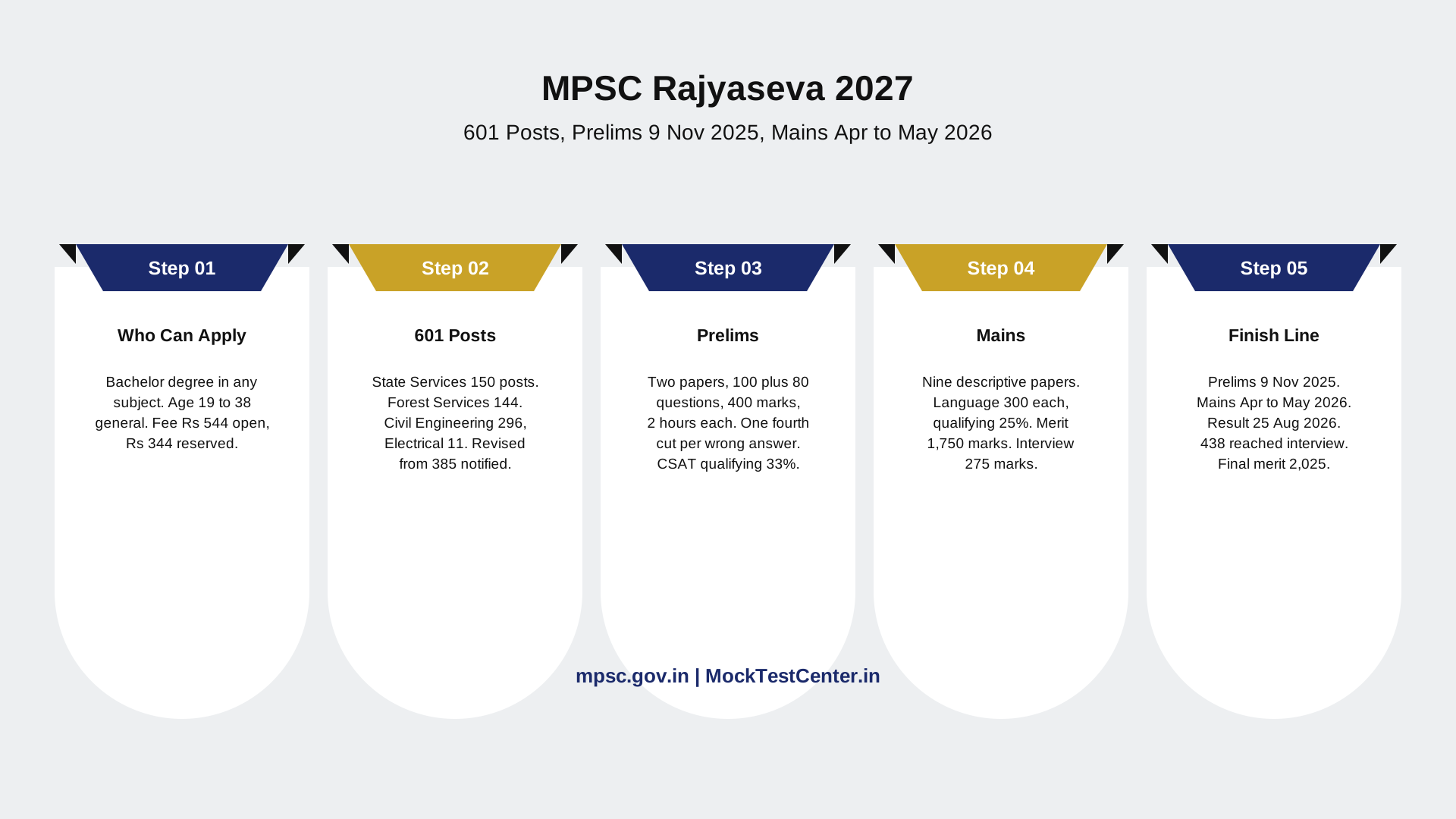
The examination has three stages. An objective prelims screens candidates. A descriptive mains, new in pattern from the 2025 cycle, decides most of the merit. An interview of 275 marks closes the selection. Final merit comes from mains merit marks plus interview, 2,025 marks in all. Prelims marks count for nothing beyond the shortlist. That single fact shapes every sensible preparation plan, and this guide returns to it more than once.
MPSC Rajyaseva 2027 at a glance
| Detail | MPSC Rajyaseva 2027, as run in the 2025 cycle |
|---|---|
| Conducting body | Maharashtra Public Service Commission (MPSC), Mumbai |
| Exam | Maharashtra Civil Services Gazetted Combined Preliminary Examination, commonly called MPSC Rajyaseva |
| Live cycle | 2025, notification dated 18 March 2025, Advertisement Number 012/2025 |
| Posts in live cycle | 385 notified, revised to 601 by corrigendum |
| Applications | 28 March to 17 April 2025, closed |
| Fee | Rs 544 for open category, Rs 344 for reserved categories |
| Prelims | 9 November 2025, two papers, 100 questions plus 80 questions, 400 marks in all |
| Prelims result | 27 February 2026 |
| Mains | 5 April, 18 April, 19 April, 26 April and 2 May 2026, nine descriptive papers |
| Mains result | 25 August 2026, 438 candidates qualified for interview |
| Interview | 275 marks, personality test, interviews held 7 to 12 September 2026 |
| Final merit | Mains merit 1,750 plus interview 275, total 2,025 marks |
| Education | Bachelor degree from a recognised university, with post wise conditions for some posts |
| Age limit | 19 to 38 years for general category, relaxation for reserved categories |
| 2027 notification | Not published as of 22 November 2026 |
The 601 posts, and how 385 became 601
The notification of 18 March 2025 opened with 385 posts. That figure did not survive the year. MPSC issued a corrigendum that raised the count to 601 posts, and the Free Press Journal reported the same revision as 605 posts, so the two tracker figures differ by four posts and this guide uses 601 because Testbook publishes a service wise break up that adds to 601 exactly. The revised count covers four service groups. State Services carry 150 posts. Maharashtra Forest Services carry 144 posts. Maharashtra Civil Engineering Service carries 296 posts. Maharashtra Electrical Engineering Service carries 11 posts. Those four numbers add to 601, and the addition is worth checking because it is the only way to tell which of the two reported totals is internally consistent.
The revision matters for more than arithmetic. The original 385 posts split as 127 in State Services, 144 in Forest Services and 114 in Civil Engineering Service, as reported by Adda247 at the time of the notification. The corrigendum added posts mainly in the engineering services and in the State Services, which means the character of the examination shifted after applications had closed. Candidates who had applied for a small State Services examination found themselves competing for a much larger combined examination that included nearly 300 engineering posts. The lesson for the next cycle is plain. The notified count is a starting figure, and a corrigendum can add a large block of posts months later.
The posts themselves cover the senior administration of Maharashtra. Deputy Collector, Deputy Superintendent of Police, Assistant Commissioner of State Tax, Assistant Director in the Maharashtra Finance and Accounts Service, Block Development Officer at the higher grade, Assistant Regional Transport Officer, Section Officer in the Mantralaya departments and Assistant Commissioner in the State Excise Department sit in the State Services group. Forest Services carry Forest Ranger posts. The engineering services carry Assistant Executive Engineer and Assistant Engineer posts in the civil and electrical streams. A candidate fills service preferences after the mains result, and the rank in the final list decides which preference is granted.
Some posts carry conditions beyond a degree. The Assistant Director in the Finance and Accounts Service needs a B.Com degree with at least 55 percent marks, or a pass in the final examination of Chartered Accountancy or Cost Accountancy, or an M.Com, or an MBA in Finance from an AICTE approved institute. The Assistant Regional Transport Officer needs a degree in Mechanical or Automobile Engineering and a heavy vehicle driving licence by the mains stage. The Forest Service posts need a degree in subjects such as Botany, Chemistry, Forestry, Physics, Zoology or Agriculture. A candidate who applies without checking the post wise conditions risks clearing the whole examination and then failing the eligibility check for the very post that drew them in.
The scale of the competition is large even by state service standards. The 2024 cycle, the one before this, advertised 274 vacancies on 29 December 2023, revised that figure to 524 on 8 May 2024, and then added 258 Agriculture Service posts in September 2024 after sustained protests by aspirants in Pune. The 2025 cycle followed the same pattern of a notified figure that grew. Candidates should treat the notified number as the floor and watch mpsc.gov.in for corrigenda rather than treat the first number as fixed.
The prelims paper, and the quarter mark that punishes guessing
The MPSC Rajyaseva exam pattern starts with two objective papers, both held on the same day. Paper I is General Studies, with 100 questions for 200 marks in 2 hours. Paper II is the Civil Services Aptitude Test, known as CSAT, with 80 questions for 200 marks in 2 hours. Both papers are set in Marathi and English. The standard of Paper I is that of a bachelor degree. The standard of Paper II mixes degree level and school level topics, with decision making questions drawn from Class X and Class XII level material. Together the two papers carry 400 marks and 180 questions in 4 hours of sitting.
The marking rule is where careless candidates lose marks they never expected to lose. For every wrong answer, one fourth of the marks allotted to that question is deducted. In Paper I each question carries 2 marks, so a wrong answer costs 0.5 marks. Four wrong answers cancel one correct answer. Questions left unattempted carry no penalty. Two options marked for the same question also attract the one fourth deduction. The decision making questions in Paper II, usually question numbers 74 to 80, carry no negative marking even when answered wrongly. That exception is small but it changes how a candidate should treat the last seven questions of the CSAT paper.
Paper II is a qualifying paper. A candidate must score at least 33 percent in it, which is 66 marks out of 200. Below that mark the candidate is out, however high the Paper I score. Only Paper I marks are used to shortlist candidates for the mains, against category wise cut offs set by the Commission. The prelims is a screening test only. Its marks do not count in the final merit list. A candidate who tops the prelims and then treats the mains lightly has misunderstood the examination.
The 2025 prelims was first scheduled for 28 September 2025. Heavy rain and floods across several districts of Maharashtra forced a postponement, and MPSC moved the examination to 9 November 2025. Admit cards came out on 3 November 2025. The result followed on 27 February 2026. The gap of nearly four months between the examination and the result is normal for MPSC, and candidates who wait for the result before starting mains preparation lose that whole period. The sensible habit is to start mains answer writing the week after the prelims, while the result is still months away.
The syllabus for Paper I is wide rather than deep. History of India with weight to Maharashtra, geography of India and Maharashtra, Indian polity and governance, the Indian economy, general science, current events of state, national and international importance, and Maharashtra specific topics such as its culture, social reform movements and administrative history fill the paper. Maharashtra specific questions are the part of the paper where a well prepared candidate pulls away from the rest, because national level material is common to every state service examination and every serious candidate covers it. The Maharashtra portion is where local preparation pays.
Speed matters as much as knowledge. One hundred questions in 120 minutes allows 72 seconds per question on average in Paper I. A candidate who spends three minutes on a single hard question has already borrowed time from two other questions. The mock test habit that pays off fastest is the habit of marking an answer and moving on, then returning only if time remains. Blind guessing across the whole paper is a losing strategy because of the one fourth deduction. Informed guessing, where two options can be eliminated, is a different matter and usually pays.
The mains papers, where the merit is made
From the 2025 cycle the mains is a descriptive examination, and the change is the biggest event in the history of this examination. The old objective mains, six papers for 800 marks, is gone. The new mains has nine descriptive papers. Two are language papers that qualify a candidate but do not count for merit. Seven carry the merit marks, totalling 1,750. Every paper runs for 3 hours. The papers are written in a question cum answer booklet, and recent MPSC notices say the answer sheets are evaluated through on screen marking.
| Paper | Subject | Marks | Time | Counts for merit |
|---|---|---|---|---|
| I | Marathi language | 300 | 3 hours | No, qualifying, 25 percent needed |
| II | English language | 300 | 3 hours | No, qualifying, 25 percent needed |
| III | Essay | 250 | 3 hours | Yes |
| IV | General Studies I | 250 | 3 hours | Yes |
| V | General Studies II | 250 | 3 hours | Yes |
| VI | General Studies III | 250 | 3 hours | Yes |
| VII | General Studies IV | 250 | 3 hours | Yes |
| VIII | Optional subject, Paper I | 250 | 3 hours | Yes |
| IX | Optional subject, Paper II | 250 | 3 hours | Yes |
| Total merit | Papers III to IX | 1,750 | 21 hours | Yes |
The language papers are gatekeepers, and the bar is low but real. A candidate must score at least 25 percent in each, which is 75 marks out of 300. Failing either language paper makes the rest of the mains count for nothing. That rule has ended more than one strong candidacy, because candidates who can write a good General Studies answer sometimes write weak Marathi or weak English under time pressure. The language papers deserve a weekly slot in the timetable, not a last minute revision.
The essay paper carries 250 marks and rewards structure more than vocabulary. General Studies I covers Indian heritage and culture, history and geography of the world and society, with weight to Maharashtra. General Studies II covers governance, constitution, polity, social justice and international relations. General Studies III covers technology, economic development, biodiversity, environment, security and disaster management. General Studies IV covers ethics, integrity and aptitude. The four General Studies papers together carry 1,000 marks, which is more than half the merit total, so a candidate who is average in all four papers and strong in none will finish in the middle of the list.
The optional subject is chosen from a list of 26 subjects, and the choice is the single highest value decision in the whole examination. Two papers of 250 marks each mean the optional carries 500 marks, nearly 29 percent of the merit total. A candidate should pick the subject they have studied at degree level, or the subject they can read for two hours a day without boredom for a year. Picking an optional because a topper picked it is the most common expensive mistake in this examination. The optional papers can be written in Marathi or English, in the medium the candidate chooses, as can Papers III to VII.
The 2025 mains ran on five days: 5 April, 18 April, 19 April, 26 April and 2 May 2026. The result came on 25 August 2026 under Advertisement Number 001/2026, and 438 candidates qualified for the interview. Interviews ran from 7 to 12 September 2026 at Navi Mumbai. One figure in that chain deserves attention. The mains result list held 438 names for 601 posts, which means the interview stage had fewer candidates than posts in the cycle. That is unusual, and it follows from the new descriptive pattern, which is a harder filter than the old objective mains. A candidate who treats the descriptive mains as a slightly longer prelims will find out why the filter bites.
A separate mains notification complicates the record and should be flagged rather than smoothed over. FreeJobAlert and SarkariResult report a State Service Main Examination 2025 notification for 139 posts, with applications from 28 February to 14 March 2026 and mains papers from 29 March to 26 April 2026 at six centres. That notification covers the State Services stream only, while the combined mains dates in the table above cover the full cycle. The two sets of dates do not match, and this guide could not reconcile them from the sources available. The mains result of 25 August 2026 and the 438 qualified candidates are the verified end point of the cycle, and the 139 post figure is recorded here as an unverified sub notification rather than as the cycle total.
The interview, and how the final list is made
The interview is a personality test of 275 marks. It tests awareness, judgement, suitability for administrative posts and the ability to hold a view under questioning. Candidates who clear the mains cut off are called for interview in a ratio to the posts set by the Commission. There is no fixed syllabus for the interview, which is why candidates who prepare only from books arrive unprepared. The interview panel reads the detailed application form first, so every hobby, every posting preference and every gap in education on that form is a possible opening question.
Final merit equals mains merit marks out of 1,750 plus interview marks out of 275, a total of 2,025. A candidate with 900 in the mains and 170 in the interview finishes at 1,070 out of 2,025. Posts are then allotted by merit, category and the preferences the candidate stated. Prelims marks play no part in this calculation. The arithmetic has one practical consequence. The interview is 275 marks out of 2,025, about 14 percent of the total, so it can move a candidate up or down by a few dozen ranks but it cannot rescue a weak mains score. The mains is where the list is made, and the interview is where the list is settled.
The 2024 cycle shows what the old pattern produced and why the Commission changed it. The 2024 cycle was the last on the objective mains pattern. Its prelims ran on 1 December 2024 after a postponement from 25 August 2024, which itself followed a clash with the IBPS Clerk prelims and protests by aspirants. The provisional selection list for that cycle was reported on 5 January 2026. The Commission moved to the descriptive pattern from the 2025 cycle to bring the examination closer to the UPSC pattern, with written answers replacing multiple choice questions in the mains. Candidates who prepare from pre 2025 mains papers will find the format has changed entirely, and only the prelims format remains recognisable.
Who can apply, what it costs, and the age rule
The education rule is a bachelor degree from a recognised university. Most posts accept a degree in any discipline. The exceptions are the posts listed in the posts section above, where the degree subject is prescribed. Final year students could apply in earlier cycles subject to producing proof of passing before the mains examination, and the 2025 advertisement keeps the same structure of eligibility. The degree rule is the reason Rajyaseva draws candidates from engineering, medicine, law, commerce and arts into the same hall.
The age rule is 19 to 38 years for the general category. The minimum age is 19 years for most posts and 18 years for a few, so the advertisement states the limit as 18 or 19 years depending on the post. Reserved categories get relaxation under Maharashtra government rules. The figures reported for the 2025 cycle are 41 years for Other Backward Classes, 43 years for Scheduled Castes and Scheduled Tribes, and 45 years for persons with disabilities. The age is counted as on a cut off date stated in the advertisement, and that date changes between cycles, so a candidate near the upper edge should read the advertisement itself rather than rely on a summary.
The fee in the 2025 cycle is Rs 544 for the open category and Rs 344 for reserved categories, including Scheduled Castes, Scheduled Tribes, persons with disabilities, Economically Weaker Sections and orphans. The fee is the same for the prelims and the mains stages, and it is paid online through debit card, credit card, net banking or UPI. Bank charges and taxes are extra. The application window closed on 17 April 2025, with the last date for fee payment by challan on 21 April 2025. An application filed without the fee is rejected, and the Commission does not reopen the window.
There is no Maharashtra domicile condition that bars other Indians from applying, and there is no requirement to have passed a Marathi language paper at the application stage. That surprises candidates who know the Punjab or Haryana services, where a state language at matric level is mandatory. Maharashtra asks for no such certificate for Rajyaseva. The examination itself is bilingual, Marathi and English, and the mains Paper I tests Marathi directly. A candidate who cannot write Marathi at all will struggle with Paper I, which is a practical barrier even though no certificate is demanded.
The 2026 cycle is already running, and it changes the maths
The 2026 cycle began while the 2025 cycle was still in its interview stage. MPSC published Advertisement Number 132/2025 on 24 December 2025 for the Maharashtra Civil Services Gazetted Combined Preliminary Examination 2026. The advertisement opened with 87 posts. Applications ran to 20 January 2026. The prelims was held on 31 May 2026. The result came on 22 June 2026, and 4,013 candidates qualified for the State Services Mains. The cut off for the open category was 98.00 marks in Paper I, with the open female cut off at 92.00. The Scheduled Caste cut off was 94.00 and the Scheduled Tribe cut off was 86.50.
The post count moved again. A corrigendum dated 17 June 2026 raised the total to 265 posts across three services: State Services 238, veterinary services 7, and civil engineering 4. The State Services Mains notification, Advertisement Number 018/2026, came out on 25 August 2026 for 238 State Service posts. Applications for the mains ran from 27 August to 10 September 2026, with the fee payable to 13 September 2026. The mains papers were scheduled from 3 October to 1 November 2026, on 3, 4, 5, 10, 11, 17, 18 and 31 October and 1 November, all from 11 in the morning to 2 in the afternoon, at six centres. Then MPSC issued a notice dated 28 September 2026 postponing the mains, and as of the sources available the new dates had not been announced. Candidates who had applied for the mains were told to watch the announcement page on mpsc.gov.in.
Two lessons sit in that short history. The first is that the post count in a Rajyaseva cycle is never final at notification. The 2025 cycle grew from 385 to 601. The 2026 cycle grew from 87 to 265. The second lesson is that dates move. The 2025 prelims moved by six weeks because of floods. The 2026 mains moved days before it was due to start. A preparation plan that depends on a fixed date will break, and a plan that depends on a fixed post count will mislead. The plan should depend on the syllabus and on daily answer writing, because those two things do not move.
The 2027 scheme change, and what is still only a report
MPSC has announced a revised scheme that applies from the State Services Mains 2027, and the change is large. Under a corrigendum dated 22 July 2026, the optional subject papers are dropped. The written marks counted for merit fall from 1,750 to 1,250. The interview falls from 275 marks to 175 marks. The merit total becomes 1,425 marks instead of 2,025. The mains would then have seven papers instead of nine. AglaSem and Testkart both report this change, and Testkart sets it out in a table against the 2026 cycle figures.
That change is reported, not confirmed from an MPSC document read for this guide, and the distinction matters. No 2027 notification has been published as of 22 November 2026, so the revised scheme has not yet been tested against an actual advertisement. Testkart also reports that news items mention a move to computer based prelims from 2027, and that since September 2026 the state government has been reviewing whether to keep the descriptive mains at all, with some reports suggesting a return to an objective format. None of that is final. A candidate preparing for the 2027 cycle should prepare for the descriptive mains as it stands in the 2025 and 2026 cycles, keep the optional subject ready, and check mpsc.gov.in before dropping any subject from the timetable. Dropping the optional on the strength of a tracker report would be a costly error if the corrigendum is revised or delayed.
The sensible reading of the 2027 change is that MPSC wants a shorter mains with less weight on a single optional subject. The General Studies papers and the essay would carry a larger share of the merit total, which rewards candidates with broad preparation and punishes candidates who bet everything on one optional. That shift, if it holds, makes the daily answer writing habit more valuable, not less, because General Studies answers are the part of the mains that cannot be prepared by reading one book.
A preparation plan that fits the numbers
The plan starts from the marks. The prelims carries 400 marks and decides nothing beyond the shortlist. The mains carries 1,750 merit marks and decides almost everything. The interview carries 275 marks and settles the order. A candidate who spends 70 percent of the year on prelims and 30 percent on mains has the ratio backwards. The working split that fits the numbers is about 40 percent of study time on prelims material in the first months, moving to 80 percent on mains writing once the prelims syllabus is covered. The prelims material and the mains material overlap heavily in General Studies, so the split is about the form of practice, not the subject. Prelims practice is multiple choice questions under time. Mains practice is written answers under time.
Answer writing should start early and stay small. One answer a day, 150 words, in 11 minutes, is enough in the first month. The point is the habit, not the volume. By the third month the candidate should be writing two answers a day and one essay a fortnight. By the sixth month the candidate should be writing a full three hour paper every week, with the language papers getting a weekly slot of their own. The 25 percent qualifying bar in Marathi and English looks easy until a candidate tries to write 300 marks of Marathi in 3 hours after months of ignoring it. The language papers are the cheapest marks in the examination to lose and the cheapest to protect.
The optional subject deserves a decision in the first month, not the sixth. Two papers of 250 marks each mean the optional is nearly 29 percent of the merit total. The right choice is the subject the candidate studied at degree level, or the subject with the most overlap with the General Studies papers. The wrong choice is the subject a topper chose, or the subject with the shortest syllabus on paper. A short syllabus that bores the candidate is worse than a long syllabus that holds their attention for a year. Once chosen, the optional should get a fixed daily slot, because 500 marks cannot be prepared in a final month.
Mock tests have a specific job in this examination, and it is not to predict the rank. Their job is to expose the habits that cost marks. In the prelims, the habits are blind guessing, slow reading, and ignoring CSAT until the last month. In the mains, the habits are writing too much on the first answer and too little on the last, skipping the language papers in practice, and never finishing a paper in 3 hours. A candidate should take a mock test, spend an hour on the mistakes, and change one habit before the next test. A candidate who takes twenty mock tests and changes nothing has bought twenty confirmations of the same errors.
Current affairs need a Maharashtra filter. National and international events matter, but the prelims Paper I and the mains General Studies papers both give weight to Maharashtra, its history, its social reform movements, its geography, its economy and its administration. A candidate who reads only national current affairs will score well on half the paper and poorly on the other half. The habit that pays is a daily note of one Maharashtra fact, one national fact and one international fact, kept in a single notebook and revised weekly. After six months that notebook holds more than 500 facts, and the revision of it takes an hour.
The mistakes that cost candidates a year
The first mistake is preparing for the prelims as if it were the examination. The prelims is a gate. Candidates who clear it by a wide margin and then discover they have never written a mains answer lose the months between the prelims and the mains to learning a skill they should have built a year earlier. The mains is the examination. The prelims is the ticket to sit it.
The second mistake is ignoring CSAT. The 33 percent qualifying bar looks low, and it is low, but every year strong General Studies candidates fail it. The reason is simple. They never take a timed CSAT test until the last month, and then they discover that comprehension and reasoning under time pressure are skills, not knowledge. One timed CSAT paper a fortnight from the start of preparation is enough to keep the skill alive.
The third mistake is choosing the optional subject late or on someone else's advice. The optional is 500 marks. A late choice means the candidate prepares 500 marks in half the time available. A borrowed choice means the candidate prepares 500 marks in a subject they do not enjoy. Either way the result is the same, and the result is visible in the final list.
The fourth mistake is trusting a single tracker site for dates and post counts. The 2025 cycle alone produced two different revised totals, 601 and 605, and two different mains date sets. The 2026 mains was postponed days before it was due. A candidate who plans from one site will plan from one error. The official site, mpsc.gov.in, is the only source for dates, and the advertisement PDF is the only source for post counts. Tracker sites are useful for explanation, and they are not a source for facts that decide an attempt.
The fifth mistake is waiting for the result before starting the next stage. The 2025 prelims result took nearly four months. The 2026 mains was postponed with days to go. The candidates who keep moving during those gaps are the ones who arrive at the next stage ready. The candidates who wait arrive at the next stage and start from zero. The examination rewards the candidate who treats waiting time as study time, because in this examination waiting time is most of the calendar.
Sources
Testbook, MPSC Mains Result 2026, Advertisement Number 001/2026, mains result 25 August 2026, prelims 9 November 2025, mains dates 5 April, 18 April, 19 April, 26 April and 2 May 2026, posts revised from 385 to 601, State Services 150, Forest Services 144, Civil Engineering Service 296, Electrical Engineering Service 11. Brolly Exam Prep, MPSC Rajyaseva 2026, Advertisement Number 132/2025 dated 24 December 2025, 87 posts revised 17 June 2026 to 265, prelims 31 May 2026, result 22 June 2026, mains Advertisement Number 018/2026 dated 25 August 2026, 238 posts, applications 27 August to 10 September 2026, mains papers 3 October to 1 November 2026, postponement notice 28 September 2026, 2025 cycle prelims Advertisement Number 012/2025 postponed from 28 September to 9 November 2025 for floods, result 27 February 2026, mains result 25 August 2026 with 438 candidates qualified, interviews 7 to 12 September 2026. Sarkari Job, MPSC Rajyaseva Prelims Result 2026, fee Rs 544 open and Rs 344 reserved, age 18 or 19 to 38 open, 43 reserved, 45 divyang, 4,013 qualified for State Services Mains, cut off open 98.00. Adda247, MPSC Rajyaseva Exam Date 2025 Revised, notification 18 March 2025, 385 vacancies, State Services 127, Forest Services 144, Civil Engineering Service 114, applications 28 March to 17 April 2025, prelims moved from 28 September to 9 November 2025, admit card 3 November 2025, fee Rs 544 general and Rs 344 reserved, age 19 to 38 general. Career Power, MPSC Rajyaseva Mains Exam Date 2025, fee Rs 544 general and Rs 344 reserved. Free Press Journal, MPSC Increases Vacancies For Maharashtra Gazetted State Services Exam 2025 From 385 To 605, corrigendum raising the count, 144 Forest Ranger posts, 28 Assistant Executive Engineer civil posts, 86 Assistant Engineer Grade 1 posts, 182 Assistant Engineer Grade 2 posts, 11 Electrical Engineering Service posts. FreeJobAlert and SarkariResult, MPSC State Service Main Exam Notification 2026, 139 posts, applications 28 February to 14 March 2026, mains 29 March to 26 April 2026, age as on 1 July 2025, fee Rs 544 open and Rs 344 reserved. AglaSem, MPSC Rajyaseva Exam Pattern and Syllabus, prelims Paper I 100 questions 200 marks, Paper II 80 questions 200 marks, CSAT qualifying 33 percent, negative marking one fourth, mains nine descriptive papers, merit 1,750, interview 275, corrigendum 22 July 2026 dropping optional papers, merit 1,250, interview 175. Testkart, MPSC Exam Pattern 2026, prelims 400 marks, mains papers Marathi 300, English 300, Essay 250, General Studies I to IV 250 each, Optional I and II 250 each, merit 1,750, interview 275, total 2,025, revised scheme from 2027 with 7 papers, merit 1,250, interview 175, total 1,425, state review of the descriptive mains reported as of 11 October 2026. BYJU'S, MPSC Syllabus Exam Pattern, negative marking changed from one third to one fourth, mains nine papers, 1,750 marks, language papers qualifying. Drishti IAS, MPSC State Services Exam Pattern, prelims Paper I 100 questions 200 marks 2 hours, Paper II 80 questions 200 marks 2 hours, CSAT qualifying 33 percent, interview 275 marks. Disha Publication, MPSC 2025 Guide, notification 18 March 2025, fee Rs 544 and Rs 344, age 19 to 38 general, 41 OBC, 43 SC and ST, 45 PwD. Government Daily Jobs, MPSC Recruitment 2025, 385 posts, applications 28 March to 17 April 2025, fee payment to 17 April 2025 online and 21 April 2025 by challan. The Bridge Chronicle, MPSC to Conduct Civil Services Exam on December 1, Adds 258 Agricultural Posts, 2024 cycle 274 vacancies advertised 29 December 2023, revised to 524 on 8 May 2024, Agriculture Service posts 258 added September 2024. Times of India, MPSC Postpones Civil Services Prelims Exam, 2024 prelims postponed from 25 August 2024, 258 Agriculture Service posts demanded by aspirants.







