About MP Sub Engineer 2027 Exam Series
📖 Table of Contents
- MP Sub Engineer 2027 at a glance
- 1,715 posts, and the two revisions behind the number
- The two 2026 advertisements, and why the count looks different elsewhere
- Who can apply for MP Sub Engineer 2027
- The age rule, 18 to 40, and the 45 year ceiling
- The fee, Rs 500 and Rs 250, plus the portal charge
- The pattern, 200 questions in 3 hours
- Negative marking, the one open conflict
- Qualifying marks and normalisation
- Branches and papers, Civil first by a long way
- Exam day, shifts, cities and the admit card
- How selection works
- Pay, post by post
- The 2024 cycle, 283 posts
- Part A, subject by subject
- Part B Civil, the diploma syllabus in full
- Part B for the other branches
- A 90 day plan that fits the real paper
- Five mistakes that cost Sub Engineer candidates marks
- Sub Engineer against Group 4, Group 2, SSC JE and RRB JE
- Sources
MP Sub Engineer 2027: Complete Exam Guide
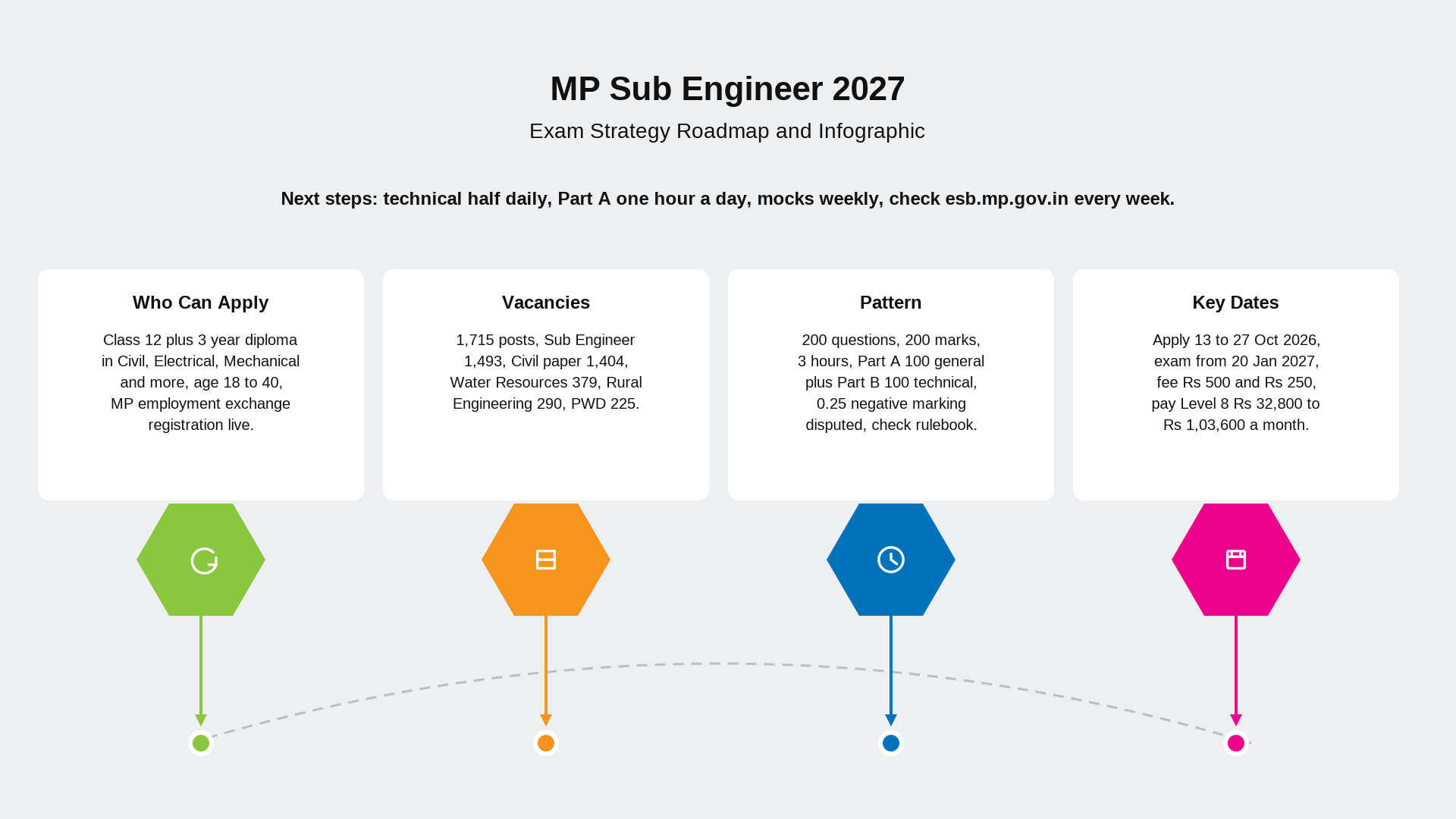
The Madhya Pradesh Employees Selection Board runs the MP Sub Engineer 2027 combined recruitment test for diploma engineers who want a technical post in the state government. The live cycle is the Group 03 Combined Recruitment Examination 2026 (Second), which carries 1,715 posts of Sub Engineer, Draftsman, Laboratory Technician and equivalent technical posts across Madhya Pradesh government departments.
The exam in this cycle begins on 20 January 2027. It is a single online paper of 200 questions for 200 marks in 3 hours, with 100 marks of general subjects and 100 marks of the technical subject of the post applied for. Civil engineering dominates the recruitment, with 1,404 of the 1,715 posts sitting on the Civil Engineering paper.
This MP Sub Engineer 2027 guide works from the 2026 (Second) advertisement and its revisions. The vacancy count, the application window and the exam date all changed after the first announcement, and the trackers disagree on one point that changes how candidates should attempt the paper. Every change and every disagreement is recorded here, so the next cycle holds no surprise of that kind.
Sub Engineer is the main diploma level technical entry point in Madhya Pradesh. A three year engineering diploma opens posts in the Water Resources Department, Rural Engineering Services, the Public Works Department and dozens of smaller departments, on a Level 8 pay scale of Rs 32,800 to Rs 1,03,600 a month. That combination of a diploma qualification and officer scale pay is why this exam draws candidates from every polytechnic in the state.
MP Sub Engineer 2027 at a glance
| Detail | Group 03 2026 (Second), the live cycle |
|---|---|
| Conducting body | Madhya Pradesh Employees Selection Board, Bhopal, earlier called MPPEB or PEB |
| Exam name | Group 03 Sub Engineer, Draftsman, Laboratory Technician and Equivalent Combined Recruitment Examination 2026 (Second) |
| Posts | 1,715 revised, Sub Engineer 1,493, Laboratory Technician 91, Draftsman 87 and others |
| Notification | Rulebook 27 August 2026, revised notice 9 October 2026 |
| Application window | 29 August to 12 September 2026, reopened 13 October to 27 October 2026 |
| Application fee | Rs 500 for unreserved, Rs 250 for SC, ST, OBC, EWS and PwD candidates of Madhya Pradesh |
| Age limit | 18 to 40 years as on 1 January 2026, upper limit 45 for reserved categories |
| Education | Class 12 plus a three year diploma in the relevant engineering branch, degree accepted for some posts |
| Written test | From 20 January 2027, online, 200 questions, 200 marks, 3 hours |
| Negative marking | Disputed, see the negative marking section of this guide |
| Qualifying marks | 50 percent for unreserved, 40 percent for reserved categories |
| Pay | Sub Engineer Level 8, Rs 32,800 to Rs 1,03,600 per month |
| Official website | esb.mp.gov.in |
Read the table as the skeleton and the rest of this MP Sub Engineer 2027 guide as the flesh. The dates belong to the 2026 (Second) cycle. The pattern, the age rule, the fee structure and the paper shape carry over to the next advertisement unless the board changes them in print.
1,715 posts, and the two revisions behind the number
The board first printed 1,700 posts in the Group 03 Combined Recruitment Examination 2026 (Second). The first application window ran from 29 August to 12 September 2026, with corrections to 17 September 2026, and the exam was set to begin on 7 October 2026. That plan did not hold.
On 1 October 2026 the board postponed the exam, and on 9 October 2026 it issued a revised notice. The form reopened from 13 October to 27 October 2026, with corrections to 28 October 2026, and the exam moved to 20 January 2027. The vacancy count rose by 15 posts, from 1,700 to 1,715.
The 15 extra posts all sit with the Tribal Affairs Department. Its Sub Engineer (Civil) post code 123 rose from 27 posts to 42 posts, and the category split moved with it. The revised split reads as 634 unreserved, 147 EWS, 247 SC, 256 ST and 431 OBC posts.
One tracker gives a different correction date. SarkariGuideJob records the correction window as open to 1 November 2026, while Testbook and CivilGyan both record 28 October 2026. The majority reading is 28 October 2026, and this guide uses it.
The post wise break up shows how heavily the recruitment leans on Sub Engineer posts. Sub Engineer posts across Civil, Electrical, Mechanical and other disciplines total 1,493. Engineering Assistant (Sub Engineer) adds 12, Laboratory Technician 91, Draftsman and Cartographer 87, Technical Assistant 9, Surveyor 14, Mineral Surveyor 4, Junior Instructor 2, Instructor 1, Computer Operator 1 and Campus Supervisor 1. The total comes to 1,715.
The lesson for the next cycle is plain. The first notice is a draft until the board says otherwise. Check the board website after applying, and check it again before the exam. A vacancy revision, a reopened window or a postponed date can arrive weeks after the first advertisement, and candidates who miss it prepare for the wrong count or the wrong date.
The two 2026 advertisements, and why the count looks different elsewhere
Candidates searching for this exam will meet a second vacancy figure, 1,040 posts, and a second exam date, 6 October 2026. That figure belongs to a different advertisement, the first Group 03 Combined Recruitment Test 2026, which is separate from the (Second) advertisement this guide covers.
The first 2026 advertisement carried about 1,040 technical posts, with Sub Engineer at 866 posts, and its exam was set to begin on 6 October 2026. The (Second) advertisement, which this guide covers, carried 1,700 posts first and 1,715 after revision, with its exam first set for 7 October 2026 and then moved to 20 January 2027.
The two advertisements share a board, a paper shape and a syllabus, and that is why trackers mix them up. A candidate must check the advertisement number on the notice in hand. The (Second) advertisement is the one with 1,715 posts and the January 2027 exam. Any page that quotes 1,040 posts is describing the first advertisement, and its dates do not apply to the (Second) cycle.
The same care applies to the 2024 cycle. The Group 03 Combined Recruitment Test 2024 filled 283 posts, a much smaller recruitment, and its dates belong to 2024 alone. The 2026 (Second) cycle is more than six times that size, and it is the largest Sub Engineer recruitment the board has run in recent years.
Who can apply for MP Sub Engineer 2027
The base qualification is a three year diploma in the relevant engineering branch from a recognised institution or university, plus a pass in Class 12 from a recognised board. Testbook records the condition as Class 12 plus a diploma, and CivilGyan records the same for the Civil posts. A diploma in Civil Engineering qualifies for almost every Sub Engineer (Civil) post, including the Water Resources Department, Rural Engineering Services and the Public Works Department.
A degree in engineering is accepted for some posts. The Public Works Department post code 020 and the MP Laghu Udyog Nigam post code 129 accept a degree as well as a diploma.
The Tribal Affairs posts under code 123 take a civil diploma or degree with at least 50 percent marks. The rule is simple. Read the qualification line for the exact post code applied for, because a diploma qualifies almost everywhere and a degree qualifies only where the post code says so.
Minimum marks are a tracker sourced condition. Sarkari24 records 50 percent marks for unreserved candidates and 40 percent for SC, ST, OBC and PwD candidates. That condition appears in the tracker pages for the 2026 cycle, and the upload pre check should confirm it against the official rulebook, because the CivilGyan page records the 50 percent condition only for the Tribal Affairs post code.
A live registration with a Madhya Pradesh employment exchange is mandatory for all posts, as recorded by CivilGyan and Sarkari24 from the rulebook. Candidates without a live registration should renew or obtain one before applying, because the document check at the end of the process asks for it.
The branches covered in this recruitment are Civil, Electrical, Mechanical, Electronics and Communication, Computer Science, Information Technology, Architecture and allied trades. Civil is by far the largest, with 1,404 posts on the Civil paper. Electrical and Mechanical follow, with the remaining branches sharing the smaller blocks. Draftsman and Laboratory Technician posts need a diploma or ITI in the relevant trade, as the post code specifies.
Indian citizens can apply, and candidates from outside Madhya Pradesh can apply too. The fee concession of Rs 250 applies only to SC, ST, OBC, EWS and PwD candidates who are natives of Madhya Pradesh. A candidate from another state pays the unreserved fee of Rs 500 and competes without the domicile based concessions.
The age rule, 18 to 40, and the 45 year ceiling
The age limit for the 2026 (Second) cycle runs from 18 to 40 years as on 1 January 2026. That cut off date is recorded by Testbook, CivilGyan, SarkariGuideJob and the EA Publications page, and it is the one point on which the trackers agree without exception.
Reserved categories get a higher ceiling. SC, ST and OBC candidates of Madhya Pradesh, women candidates, serving government and corporation employees, home guards and persons with disabilities have an upper age limit of 45 years. That five year relaxation is the main age concession in this exam, and it applies to the same groups that get the fee concession.
The age rule matters here because the diploma window is wide. A candidate can finish a three year diploma at 18 or 19 and enter at once, and the window runs to 40, or 45 with relaxation. That pulls in fresh polytechnic leavers, graduates waiting for a government job, and working candidates in their thirties who hold a diploma from years earlier. The competition is wide because the window is wide.
The fee, Rs 500 and Rs 250, plus the portal charge
Unreserved candidates paid Rs 500 for the 2026 (Second) cycle. SC, ST, OBC, EWS and PwD candidates who are natives of Madhya Pradesh paid Rs 250. Backlog direct recruitment posts carried no fee at all, as recorded by EA Publications from the notification.
The portal charge sits on top of the fee. Candidates who paid through an MP Online kiosk paid Rs 60 extra, and candidates who paid as registered citizen users on the portal paid Rs 20 extra.
That is why some trackers quote totals of Rs 560 for unreserved and Rs 310 for reserved candidates. Both figures are right. Rs 500 and Rs 250 are the exam fees, and Rs 560 and Rs 310 are the totals with the kiosk portal charge added.
Each correction to a submitted form costs Rs 20 plus a Rs 40 portal charge, as recorded by CivilGyan. Candidates should preview the form carefully before the final submit, because a correction costs money and a wrong post code choice cannot be fixed by a correction alone. Payment runs through the MP Online portal by debit card, credit card, net banking and UPI, and offline payment runs through a bank challan at an authorised MP kiosk.
The pattern, 200 questions in 3 hours
The written test is a single online paper. It carries 200 multiple choice questions for 200 marks, one mark per question, and the time allowed is 3 hours. The paper runs in two shifts a day, 9 AM to 12 PM and 2.30 PM to 5.30 PM, from 20 January 2027 onwards.
The paper splits into two equal halves. Part A carries 100 marks of general subjects, and Part B carries 100 marks of the technical subject of the post. The split is the one fact about the syllabus that the rulebook states in full, and every tracker agrees on it.
| Part | Subjects | Questions | Marks |
|---|---|---|---|
| Part A | General Knowledge, General Hindi, General English, General Mathematics, General Reasoning, General Science, General Computer Knowledge | 100 | 100 |
| Part B | Technical subject of the post, Civil, Electrical, Mechanical and other trades | 100 | 100 |
| Total | One online paper | 200 | 200 |
One tracker calls the exam offline. Adda247 describes the 2026 exam as an offline pen and paper test.
That description conflicts with Testbook, GovtJobDeck, CivilGyan and the other trackers, which all record an online computer based test, and with the two shift online schedule the board published. This guide follows the majority. The exam is online.
The rulebook gives the 100 plus 100 split and a table that maps each post code to a trade paper. It gives no topic list for Part B, as CivilGyan states plainly. The Part B topics in this guide follow the Madhya Pradesh polytechnic diploma syllabus that this paper has always been set against, and they are a well founded guide rather than a board document. Candidates should treat them that way.
Which Part B paper a candidate sits is fixed by the post code applied for. Civil Engineering is Paper C, and it covers 48 of the 132 post codes and 1,404 of the 1,715 vacancies. Candidates on post code 088, Assistant Architectural Draftsman, may sit either the Civil or the Architecture paper.
Negative marking, the one open conflict
Negative marking is the single most important unsettled fact in this exam, because it changes the attempt strategy completely. Two groups of trackers give opposite answers, and both claim the rulebook.
CivilGyan states that 0.25 marks are deducted for every wrong answer, and it cites clause 3.8(i) of the MPESB rulebook for the figure. Sarkari24 records the same, 1 mark for each correct answer and 0.25 deducted for each wrong answer, and Civil Engineering Mock Test repeats it. The CivilGyan page also warns that four blind guesses wipe out one correct answer, and its preparation advice tells candidates to leave what you do not know.
Testbook states the opposite. Its pattern section says there will be no negative marking for wrong answers. Adda247 agrees, stating plainly that there is no negative marking in the MPESB Group 3 exam, with 1 mark for each correct response and 0 marks for unanswered or incorrect questions. One preparation site even contradicts itself, with a pattern table that says no negative marking and a FAQ that says negative marking applies.
This guide follows the CivilGyan reading, 0.25 deducted per wrong answer, for one reason. It is the only account that cites a specific rulebook clause, clause 3.8(i), while the no negative marking accounts give no clause and no source.
A clause citation can be checked against the rulebook at the upload pre check, and it should be, because the cost of getting this wrong is high. If the rulebook says 0.25, a candidate who attempts every question loses marks on every guess. If the rulebook says none, a candidate who leaves questions blank loses marks they could have gained.
Until the pre check confirms the clause, the safe strategy is the cautious one. Attempt every question where one option can be eliminated with confidence, and leave the pure guesses blank. That strategy loses little under either rule, while the all attempt strategy loses a quarter mark per wrong answer under the 0.25 rule.
Qualifying marks and normalisation
The minimum qualifying marks are 50 percent for unreserved candidates and 40 percent for SC, ST, OBC, EWS and PwD candidates, as recorded by Sarkari24, SarkariRojgarwala, Sarkari247 and SarkariJob from the rulebook. That is 100 marks out of 200 for unreserved candidates and 80 out of 200 for the reserved categories.
One point needs care. Sarkari247 records that EWS candidates get a 10 percent relaxation in minimum qualifying marks, which would put the EWS bar at 45 percent, while the other trackers put EWS in the 40 percent group with the other reserved categories. This guide uses the 40 percent figure for EWS, following the majority, and flags the 45 percent reading for the pre check.
Qualifying is not the same as selection. The board prepares the result on a percentile basis across shifts, using Normalised Equi Percentile scaling, so a raw score in one shift is converted before it is compared with a raw score in another shift. A candidate who clears the qualifying bar still needs a percentile high enough for the post codes marked in the preference order.
Preference order decides the result. The merit list is prepared post code by post code, in descending order of percentile, and only for the post codes the candidate marked in the preference order. A candidate who fails to mark a post in the preference order is out of that post result even with a high percentile. That is the most expensive clerical error in this exam, and it costs nothing to avoid.
Ties are resolved first by proportional technical marks, then by higher age, with the older candidate given preference. A waiting list of 15 percent is maintained for up to one year or until the next examination results, as recorded by SarkariJob from the rulebook.
Branches and papers, Civil first by a long way
Civil engineering is this recruitment. The Civil paper, Paper C, covers 48 of the 132 post codes and 1,404 of the 1,715 vacancies, about 82 percent of the whole advertisement. A civil diploma holder competes for the largest block of posts, the largest number of departments, and the widest choice of post codes.
The biggest civil recruiters are the Water Resources Department with 379 Sub Engineer (Civil) posts, Rural Engineering Services with 290, and the Public Works Department with 225. The Urban Development Company takes 49 Sub Engineer posts on contract, the Indore Development Authority takes 41, the Tribal Affairs Department takes 42 after revision, and the Public Health Engineering Department takes 24.
One detail inside the Water Resources figure deserves attention. CivilGyan records that 170 of the 379 Water Resources posts are reserved for serving contract employees, after a department letter dated 28 September 2026. A fresh candidate competes for the remaining 209 posts in that department, and the post code table in the rulebook should be read for the exact split.
Divyangjan reserved posts add 84 Sub Engineer (Civil) posts under codes 125, 126 and 127, split as 28 for visually handicapped, 25 for hearing handicapped and 31 for multiple disabilities. Those posts sit inside the 1,404 civil total, and they carry their own reservation conditions in the rulebook.
Electrical, Mechanical, Electronics and Communication, Computer Science and Information Technology papers cover the rest of the Sub Engineer posts. The exact post count per branch is not printed in a single tracker table, and the rulebook post code table is the only source that gives it. Candidates should read the post code table for their branch before choosing preferences, because the branch paper and the post codes move together.
Draftsman, Laboratory Technician, Surveyor and the smaller posts sit on their own trade papers. Draftsman posts are 87, Laboratory Technician 91, Surveyor 14, Mineral Surveyor 4, Technical Assistant 9, Engineering Assistant 12, Junior Instructor 2, Instructor 1, Computer Operator 1 and Campus Supervisor 1. Those posts are small in number, and they are also the posts where a candidate with the exact trade qualification faces the least competition.
Exam day, shifts, cities and the admit card
The exam begins on 20 January 2027, a Wednesday, and runs in two shifts. The first shift reports between 7 AM and 8 AM, with reading time from 8.50 AM to 9 AM and the paper from 9 AM to 12 PM. The second shift reports between 12.30 PM and 1.30 PM, with reading time from 2.20 PM to 2.30 PM and the paper from 2.30 PM to 5.30 PM.
The earlier date was 7 October 2026. The board postponed it on 1 October 2026 to a proposed December 2026 to January 2027 window, and the revised schedule of 13 October 2026 fixed the start at 20 January 2027. Candidates who booked travel for October had to rebook, and that is the second date change in this cycle after the September to October shift in the application window.
The exam runs in 11 cities, as recorded by CivilGyan from the revised schedule. The cities are Bhopal, Indore, Jabalpur, Khandwa, Neemuch, Ratlam, Rewa, Sagar, Satna, Sidhi and Ujjain. Candidates rank four cities in order of preference in the application form. The list is shorter than the 13 city list the board uses for its Group 4 clerical test, which adds Balaghat and Gwalior, so candidates from those districts should be ready to travel to the nearest city on this list.
Aadhaar registration and biometric verification are compulsory at entry, as recorded by CivilGyan from the revised schedule. Candidates should carry the Aadhaar card and the admit card, and they should reach the centre inside the reporting window, because the gates close before the reading time starts.
The admit card arrives in January 2027, about a week before the exam, on the board website esb.mp.gov.in. Candidates download it with the application number, date of birth, the first two letters of the mother name and the last four digits of the Aadhaar number, the same login the board uses for its other tests. The card carries the exam centre, the shift timing and the venue, and the exact centre appears only on the card.
How selection works
Selection rests on the written test first. The single online paper of 200 marks is the only stage that ranks candidates, and the merit list follows from its normalised percentile scores. Testbook lists the stages as the written examination and document verification, and the other trackers agree.
Document verification closes the process. The departments verify the Class 12 mark sheet, the diploma or degree certificate, the category certificate where claimed, the domicile certificate where the fee concession was taken, and the live Madhya Pradesh employment exchange registration. A missing certificate at this stage ends the candidature, whatever the written test score was.
A medical examination follows for the departments that require it. SarkariRojgarwala and SarkariJob list a medical examination as the final stage, conducted by the medical board under departmental rules. Candidates should treat it as part of the process, because the appointment order follows it.
There is no interview and no skill test in this recruitment. Sarkari24 states plainly that there is no interview or skill test, and the selection stages in every tracker list only the written test, document verification and medical examination. One Adda247 result page for the 2024 cycle says candidates were selected on a written exam followed by an interview. That line conflicts with the 2026 pattern pages and with the 2024 result pages that list only the written test, and this guide treats it as an error.
Pay, post by post
The headline pay figure belongs to the Sub Engineer post. Sub Engineer sits on Level 8 of the pay matrix, with a scale of Rs 32,800 to Rs 1,03,600 per month. Testbook puts the take home salary between Rs 25,000 and Rs 30,000 a month after deductions, depending on the place of posting and the allowances, and the post also carries dearness allowance, travel allowance, medical reimbursement, provident fund and pension under state government rules.
Draftsman posts sit lower. Draftsman and Manchitrakar posts are on Level 6, with a scale of Rs 25,300 to Rs 80,500 per month, as recorded by CivilGyan and OdishaJobsDesk. The other small posts carry scales from Level 4 to Level 8, as recorded by OdishaJobsDesk for the first 2026 advertisement, and the exact scale for each post code sits in the rulebook.
Pay grows with service. The pay matrix moves the basic pay up one cell every year, and the allowances rise with dearness allowance revisions. A candidate who joins as Sub Engineer at Rs 32,800 reaches the top of the Level 8 matrix over a career, and promotion to higher engineering grades follows the department rules. The job is permanent, the pay is strong for a diploma qualification, and the security is the real draw.
The 2024 cycle, 283 posts
The previous full cycle ran in 2024, and it was far smaller than 2026. The board notified 283 posts on 2 August 2024, as the Group 03 Sub Engineer, Sahayak Manchitrakar, Technician and Other Equivalent Combined Recruitment Test 2024. Applications ran from 5 August to 19 August 2024, and the exam ran on 19 September 2024.
One tracker gives a different exam date. JagranJosh records 12 September 2024 as the exam date, while PW Live, Scroll, SarkariExam and SarkariDisha all record 19 September 2024, with the admit card on 12 September 2024. The majority reading is 19 September 2024, and the 12 September date reads as the admit card date mistaken for the exam date. The admit card itself is also disputed by a day, with SarkariExam recording 13 September 2024 against the 12 September date in the other trackers.
The 2024 split shows the shape of a small cycle. Direct recruitment held 276 posts, contract recruitment held 5, and backlog held 2. The category split read as 160 unreserved, 13 EWS, 25 SC, 39 ST and 46 OBC posts. The answer key and objection window ran from 25 September to 27 September 2024, and the result came out on 5 December 2024, less than three months after the exam.
The jump from 283 posts in 2024 to 1,715 posts in 2026 is steep, and it sets the expectation for the next cycle. A big cycle clears backlogs across departments, and the next cycle fills only the fresh vacancies. Candidates should not plan on 1,700 posts returning. A count near a few hundred, with the same departments appearing in smaller numbers, is the safer assumption for the cycle after this one.
Part A, subject by subject
Part A carries 100 marks, half the paper, and it is the half most technical candidates neglect. The seven subjects are General Knowledge, General Hindi, General English, General Mathematics, General Reasoning, General Science and General Computer Knowledge. The rulebook gives no per subject mark split, so no tracker can print one with authority, and any page that prints exact marks per subject is guessing. Treat Part A as seven subjects of roughly equal weight, and give each its share of time.
General Knowledge carries the Madhya Pradesh share. Indian history and the national movement, Indian and world geography, Indian polity and the Constitution, the Indian economy, art, culture and heritage, important days, books and authors, awards and sports, countries, capitals and currencies, science and technology, government schemes and current affairs all appear.
The state share is heavy inside it. MP history and dynasties, its geography, rivers and national parks, tribes, festivals and folk arts, state polity and economy, and MP specific schemes and current affairs recur every year. National GK alone will not carry this section.
General Hindi rewards daily reading more than any other section. Alphabet and spelling, sandhi and samas, prefixes and suffixes, nouns, pronouns, adjectives and verbs, synonyms and antonyms, words with many meanings, idioms and proverbs, sentence correction, fill in the blanks and unseen comprehension passages form the section. Candidates who read Hindi newspapers and books score here without extra study, and candidates who start Hindi only a month before the exam struggle with the idioms and the comprehension speed.
General English is school level grammar and vocabulary. Tenses, articles and prepositions, subject verb agreement, active and passive voice, narration, synonyms, antonyms, one word substitution, idioms and phrases, spelling, error detection, sentence improvement, fill in the blanks, cloze test, para jumbles and reading comprehension fill the section. The trap is neglect. Candidates who focus on the technical half and leave English to the last week lose marks in the easiest section of the paper.
General Mathematics runs at Class 10 level with a few diploma level touches. Number system, simplification and approximation, HCF and LCM, percentage, ratio and proportion, average, profit, loss and discount, simple and compound interest, time and work, time, speed and distance, mixtures and alligation, mensuration, basic algebra and trigonometry, and data interpretation recur every year. The section needs practice, not theory. Fifty questions a day from these topics, timed, builds the speed the paper needs.
General Reasoning tests logic, not memory. Analogy, classification and odd one out, coding and decoding, number, letter and mixed series, blood relations, direction and distance sense, ranking and order, seating arrangement and puzzles, syllogism, Venn diagrams, calendars and clocks, mathematical operations and non verbal reasoning fill the section. Ten questions a day from a reasoning book, over three months, covers it.
General Science covers Physics, Chemistry and Biology at school level. Units and measurement, force and motion, work, energy and power, light, sound, heat, electricity and magnetism, atomic structure, the periodic table, acids, bases and salts, chemical reactions, metals and non metals, carbon compounds, cell and tissue, human body systems, nutrition and diseases, plant and animal kingdoms, and environmental science all appear. Candidates with a science background in Class 12 revise this fast, and candidates without it should give it a fixed hour a week.
General Computer Knowledge covers the basics. Computer fundamentals and generations, hardware and software, input and output devices, memory, operating systems and Windows, MS Office Word, Excel and PowerPoint, internet, email and web services, networking basics, database basics, computer abbreviations and cyber safety form the section. Diploma candidates already know most of this, and a week of revision is enough.
Part B Civil, the diploma syllabus in full
Part B Civil is a diploma paper, not a degree paper. The subjects are the ones a Madhya Pradesh polytechnic teaches in its three year civil diploma, and the depth is diploma depth. Candidates who study degree level structural analysis waste weeks on material the paper never asks, while candidates who master the diploma subjects score steadily.
Applied Mechanics opens the paper. Composition and resolution of forces, equilibrium and its conditions, moments and couples, centre of gravity and moment of inertia, friction and its applications, simple lifting machines, mechanical advantage, velocity ratio and efficiency, laws of motion, and work, power and energy form the subject.
Mechanics of Structures follows. Simple stress and strain, elastic constants, thermal and compound stresses, principal stresses and Mohr circle, shear force and bending moment diagrams, bending and shear stress in beams, deflection of beams, torsion of shafts, columns and struts, Euler and Rankine, analysis of simple trusses, and thin cylinders form the subject.
Material Technology and Building Construction is the largest memory subject in the paper. Building stones, bricks and tiles, lime, cement and its testing, aggregates, mortar and concrete, timber and artificial timber, paints, varnishes and distempers, glass, plastics and modern materials, building components from foundations to roofs, damp proofing, plastering and pointing, and scaffolding, shoring and formwork all appear.
Building Drawing tests standards and practice. Drawing standards and instruments, lettering, dimensioning and scales, conventional signs and symbols per IS 962, orthographic, isometric and sectional views, plan, elevation and section of buildings, site plan and line diagram, planning of residential and public buildings, building bye laws basics, and an introduction to computer aided drafting form the subject.
Surveying is the subject that decides many civil papers. Principles and classification of surveying, chain and cross staff survey, compass survey, bearings and local attraction, plane table surveying, levelling with the dumpy level, reduction of levels, contouring, theodolite survey and traversing, tacheometry, curves and setting out, areas and volumes, errors and their adjustment, and an introduction to total station, GPS and remote sensing form the subject.
Hydraulics covers fluid mechanics in full. Properties of fluids, hydrostatic pressure and its measurement, pressure on plane and curved surfaces, buoyancy and floatation, fundamentals of fluid flow and Bernoulli equation, flow through pipes, losses and pipe networks, flow in open channels, uniform flow and hydraulic jump, flow measuring devices from orifice to venturimeter, and hydraulic machines such as pumps and turbines form the subject.
Soil Mechanics follows the standard diploma course. Origin and formation of soils, the three phase system, index properties and classification of soils, permeability and seepage, flow nets, effective stress and capillarity, compaction and field control, consolidation and settlement, shear strength of soils and its measurement, bearing capacity of soils, earth pressure theories, shallow and deep pile foundations, soil stabilisation, and site investigation and exploration with the standard penetration test form the subject.
Structural Design and Drafting splits into RCC and steel. The RCC half covers properties of concrete, grades and mix design, working stress and limit state methods, singly and doubly reinforced beams, T beams and flanged sections, shear, bond and development length, one way and two way slabs, columns and footings, staircases, retaining walls, water tanks, and bar bending schedule and detailing of reinforcement. The steel half covers structural steel, rolled sections and IS 800 basics, riveted, bolted and welded connections, tension members, compression members and columns, design of beams, column bases and foundations, roof trusses and purlins, plate girders, and detailing and drafting of steel joints.
Irrigation Engineering is the subject that matters most for the Water Resources Department, the largest recruiter in this cycle. Necessity and methods of irrigation, the hydrological cycle, rainfall and rain gauges, runoff and flood discharge estimation, water requirement of crops, duty and delta, reservoirs and storage, dams both earthen and gravity, spillways and energy dissipators, diversion headworks, canals, canal design and lining, canal regulation works, outlets and metering flumes, cross drainage works, river training, hydro electric power basics, and wells and tube wells form the subject.
Transportation Engineering covers roads, railways and bridges. Classification of roads and highway alignment, highway geometric design from camber to curves, highway materials and their tests, flexible and rigid pavement construction, road drainage and maintenance, traffic engineering, signs, signals and road markings, railway permanent way from rails to fastenings, points and crossings, bridges and culverts, and an introduction to airports and harbours form the subject.
Estimating, Costing and Quantity Surveying is the most scoring subject for candidates who practise it. Types of estimates, approximate and detailed, units of measurement and mode of measurement, methods of taking out quantities by long wall short wall and centre line, detailed and abstract estimate of buildings, roads and canals, earthwork calculation, bar bending schedule, analysis of rates and schedule of rates, specifications general and detailed, tenders and contracts, valuation of buildings and rent fixation, and basic construction management, scheduling and site supervision form the subject.
Public Health and Sanitary Engineering closes the civil syllabus. Sources of water and water demand, quality of water and drinking water standards, water treatment from screening to disinfection, distribution systems and pipe appurtenances, house plumbing and water supply fittings, sanitation, sewerage systems and sewer design, sewage characteristics, BOD, COD and DO, sewage treatment and disposal, sanitary fittings and traps, solid waste management, and rural sanitation and low cost sanitation form the subject.
Part B for the other branches
Electrical candidates face a paper built on the diploma electrical syllabus. Basic electrical engineering opens it, with DC circuits, AC fundamentals, electrical engineering materials, conductors, insulators and semiconductors, and their properties and applications. Machines, power systems, measurement and control follow, and the paper tests the diploma course rather than degree level power system analysis.
Mechanical candidates face a paper built on the diploma mechanical syllabus. Engineering materials, thermodynamics, fluid mechanics, theory of machines, machine design, manufacturing processes, industrial engineering and refrigeration follow the same shape as the civil paper. Strength of materials and production technology carry the most questions, and candidates should give them the most time.
Electronics and Communication candidates face a paper built on the diploma electronics syllabus. Electronic devices and circuits, digital electronics, communication systems, microprocessors and instrumentation form the core. Computer Science and Information Technology candidates face a paper built on the diploma computer syllabus, with programming, data structures, databases, operating systems, networks and software engineering.
Architecture candidates face a paper built on the diploma architecture syllabus, and post code 088 candidates may choose between the Civil and the Architecture paper. That choice should be made on strength, not on habit. A candidate strong in surveying and estimating should take the Civil paper, and a candidate strong in design and drawing should take the Architecture paper.
A 90 day plan that fits the real paper
Start with Part B and Part A together, not one after the other. The technical half carries 100 marks and the general half carries 100 marks, and a candidate who finishes one half before starting the other runs out of time for the second. Give the technical half two hours a day and the general half one hour a day for the first month, and both bases build together.
Give the first month to the core technical subjects and to the general subjects that need daily contact. For civil candidates, that means surveying, building materials, soil mechanics and estimating in the technical hours, and Hindi, English and Maths in the general hour. Knowledge, science and computer can wait for the second month, because they need reading and revision, not daily drills.
Give the second month to the remaining technical subjects and to mock tests. Read the state yearbook in the morning for General Knowledge, solve one full paper every Sunday, and review every wrong answer the same day. The review matters more than the score. A mock test without review teaches nothing, and a mock test with a careful review teaches the paper.
Keep the last month for revision and for full mocks on the real clock. Revisit the technical formulas, the Hindi idioms, the English vocabulary lists, and the state facts.
Sit a full mock test from 9 AM to 12 PM, because the morning shift is the shift most candidates draw. Track the score by subject, not by total, because the total hides the weak subject. A total of 140 with 30 in Part A means the next month belongs to Part A, not to more technical study.
Attempt strategy deserves its own week. If the 0.25 negative marking rule holds, four blind guesses wipe out one correct answer. Practise leaving questions blank in the mocks, and count the score both ways, with guesses and without them. The comparison shows in numbers what the rulebook says in words, and it trains the discipline the exam hall demands.
Five mistakes that cost Sub Engineer candidates marks
The first mistake is choosing the wrong post codes. A candidate who marks post codes for a branch paper they cannot clear, or who forgets to mark a post code they qualify for, loses the post before the paper starts. Read the post code table in the rulebook, match the diploma branch to the paper, and mark every post code the qualification allows.
The second mistake is ignoring Part A. Half the paper is general subjects, and candidates who chase only the technical half leave 100 marks to chance. Give Part A its hour a day from the first week, and the 100 marks take care of themselves.
The third mistake is trusting the first notice. The 2026 cycle changed its vacancy count, reopened its application window, and moved its exam date from 7 October 2026 to 20 January 2027. Check esb.mp.gov.in every week until the admit card arrives, and read every corrigendum the board puts out.
The fourth mistake is preparing at degree depth. Part B is a diploma paper, and candidates who study degree level structural analysis or power systems waste weeks on material the paper never asks. Study the polytechnic diploma syllabus, and keep the degree books for the graduate level tests.
The fifth mistake is applying without the employment exchange registration. A live Madhya Pradesh employment exchange registration is mandatory for all posts, and the document check asks for it. Renew or obtain it before applying, not after the result.
Sub Engineer against Group 4, Group 2, SSC JE and RRB JE
MPESB runs its combined tests in numbered groups, and the number marks the level of the post. Group 4 is the Class 12 level test for clerical and stenography posts, with a general subjects paper only. Group 3 is the diploma level test for technical posts such as Sub Engineer, Draftsman and Lab Technician, with a technical paper that carries half the marks. Group 2 is the graduate level test for posts such as Junior Engineer, Laboratory Technician, Field Officer and Inspector, with a degree level technical paper.
The difference shows in the qualification first. Group 4 asks for Class 12 plus a computer diploma and CPCT.
Group 3 asks for a diploma in the relevant trade. Group 2 asks for a graduation degree in the relevant discipline. A candidate with only a diploma can sit for Group 3 and Group 4, and a graduate can sit for all three, though the graduate who sits for Group 3 competes with diploma holders for a diploma level post.
The difference shows in the pay next. Group 4 Assistant Grade 3 sits on Level 4 at Rs 19,500 to Rs 62,000.
Group 3 Sub Engineer sits on Level 8 at Rs 32,800 to Rs 1,03,600. Group 2 posts sit higher still. The diploma is the cheapest qualification in this ladder that reaches Level 8 pay, and that is the heart of this exam's pull.
SSC JE and RRB JE are the national cousins of this exam. SSC JE tests diploma and degree engineers for central government departments, and RRB JE tests them for the railways. Both carry a technical paper and a general paper, and both are harder to clear than the MP Sub Engineer test because the whole country competes for them. A candidate who prepares for MP Sub Engineer with the diploma syllabus is already halfway ready for SSC JE and RRB JE, and the MP paper is the right first target.
Sources
Testbook: MP Sub Engineer Recruitment 2026, 1,715 vacancies, exam 20 January 2027, reopened form 13 to 27 October 2026, pattern, fee, age, salary
CivilGyan: MP Vyapam Sub Engineer Civil 2026, 1,715 posts, 1,404 on Civil paper, rulebook clause 3.8(i) negative marking 0.25, 11 exam cities, post code table, Water Resources 379 posts
GovtJobDeck: MPESB Group 3 Recruitment 2026, 1,700 vacancies, rulebook, apply 29 August to 12 September 2026, exam 7 October 2026, pattern 200 marks
EA Publications: MP Sub Engineer Recruitment 2026, notification 27 August 2026, category split, age as on 1 January 2026, fee, backlog posts no fee
SarkariGuideJob: MP ESB Sub Engineer Re-Revised Form 2026, 1,700 posts, exam 20 January 2027, fee, age, correction window to 1 November 2026 noted as a conflict
IES Master: MPESB Sub Engineer Recruitment 2026, 1,715 posts, reopened applications, exam 20 January 2027, post wise split
Sarkari24: MPESB Group 3 Sub Engineer Recruitment 2026, 1,715 vacancies, 50 percent qualifying marks, 0.25 negative marking, employment exchange registration
Sarkari247: MP ESB Group 3 Recruitment 2026, selection stages, minimum qualifying marks, EWS relaxation noted as a conflict
Adda247: MP Sub Engineer Recruitment 2026, no negative marking noted as a conflict, offline mode noted as a conflict
JagranJosh: MP Sub Engineer Recruitment 2024, 283 posts, notification 2 August 2024, apply 5 to 19 August 2024, exam date noted as a conflict
PW Live: MP Sub Engineer Result 2024, 283 posts, exam 19 September 2024, result 5 December 2024
Scroll: MPESB Group 3 result 2024 declared, exam held from 19 September 2024, result 5 December 2024
SarkariDisha: MPESB Group 3 Sub Engineer Result 2024, 283 posts, answer key 25 to 27 September 2024, result 5 December 2024
OdishaJobsDesk: MPESB Group 3 Recruitment 2026 first advertisement, 1,040 posts, exam 6 October 2026, pay scales Level 4 to Level 8