About MAHA TET 2027 Exam Series
📖 Table of Contents
- MAHA TET 2027 at a glance
- What MAHA TET is, in plain words
- The 2024 cycle, date by date
- The 2026 examination that did not happen
- MAHA TET exam pattern: Paper 1 for classes 1 to 5
- MAHA TET exam pattern: Paper 2 for classes 6 to 8
- Who can sit each paper
- Qualifying marks and what the certificate is worth
- Fee, admit card and the examination day
- A preparation plan for both papers
- Where candidates lose marks they already earned
- Sources
MAHA TET 2027: Complete Exam Guide
The MAHA TET 2027 page on this site follows the last completed cycle of the Maharashtra Teacher Eligibility Test, and that cycle is the 2024 examination. The Maharashtra State Council of Examination, known as MSCE, Pune, published the notification on 9 September 2024. Applications ran from 9 to 30 September 2024. Both papers were held on 10 November 2024, Paper 1 in the morning and Paper 2 in the afternoon. No separate 2027 notification has been published as of 22 November 2026, so this guide anchors on the 2024 cycle and says so wherever a 2027 figure would otherwise be guessed.
The first thing to understand about MAHA TET is its limit. It gives no job, no rank and no posting. It gives a certificate that says a candidate is eligible to teach in Maharashtra schools, and that certificate is now valid for life. A candidate who passes MAHA TET still has to apply separately when the state advertises teacher posts, and still has to clear that recruitment. Candidates who treat the TET result as an appointment letter are disappointed twice, once when no posting follows and again when they learn that the teacher recruitment has its own separate process.
The second thing to understand is that the examination is a qualifying test, not a race. The pass mark is fixed at 60 percent for general category candidates and 55 percent for reserved category candidates. Scoring 95 percent earns the same certificate as scoring 61 percent. There is no merit list, no cut off that moves with the number of applicants, and no benefit in chasing a top score. That single fact changes how a sensible candidate prepares. The goal is a safe margin above the qualifying line in every section, not a perfect score in one section and a fail in another.
MAHA TET 2027 at a glance
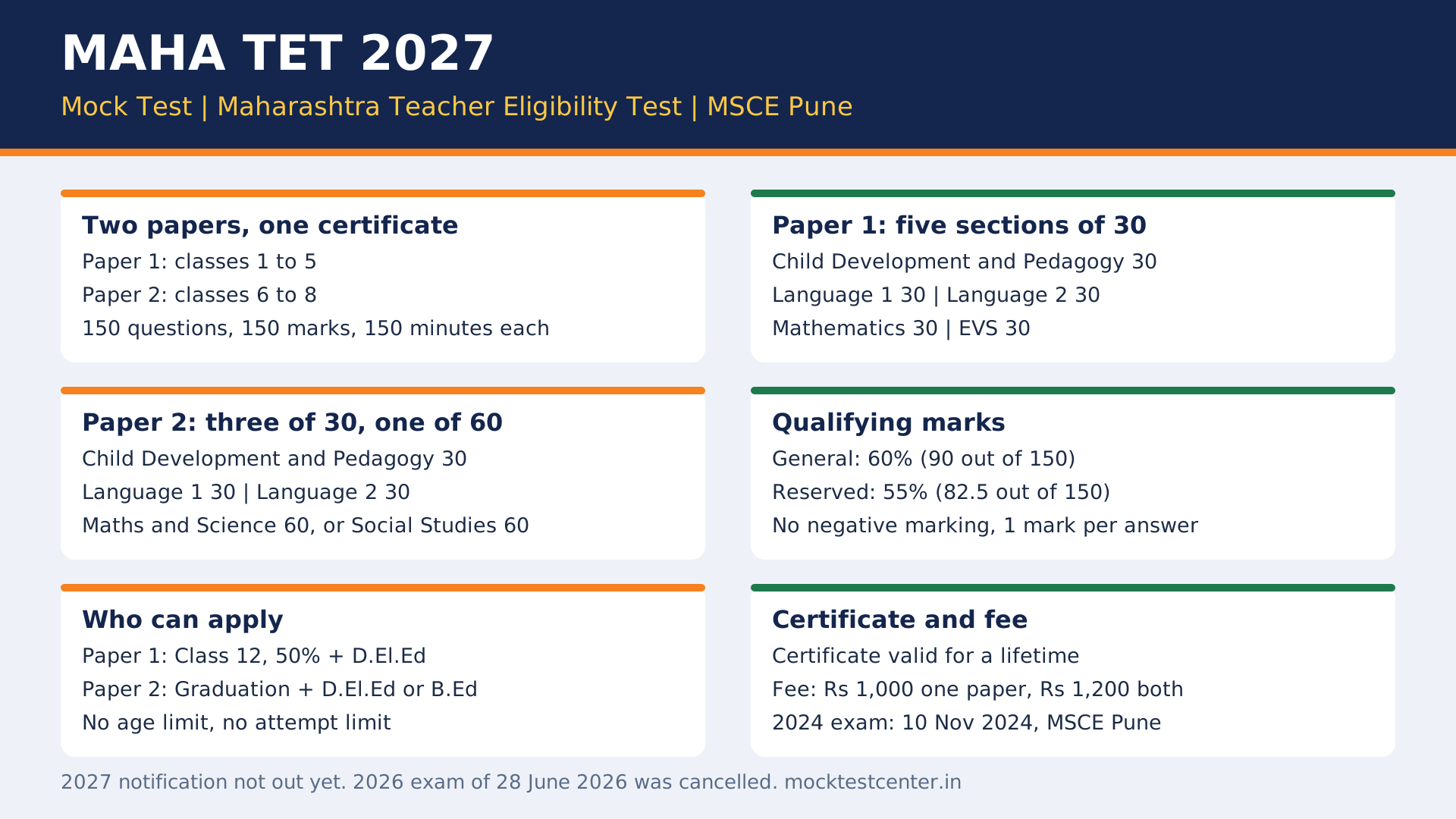
| Detail | MAHA TET 2027, as run in the 2024 cycle |
|---|---|
| Conducting body | Maharashtra State Council of Examination (MSCE), Pune |
| Exam | Maharashtra Teacher Eligibility Test (MAHA TET) |
| Posts | None, eligibility test only |
| Notification | 9 September 2024 |
| Applications | 9 to 30 September 2024 on mahatet.in |
| Admit card | 28 October 2024 |
| Examination | 10 November 2024, Paper 1 from 10.30 am to 1 pm, Paper 2 from 2 pm to 4.30 pm |
| Papers | Paper 1 for classes 1 to 5, Paper 2 for classes 6 to 8 |
| Questions and marks | 150 questions, 150 marks per paper, 150 minutes per paper |
| Marking | One mark per correct answer, no negative marking |
| Qualifying marks | 60 percent for general category, 90 out of 150, 55 percent for reserved categories, 82.5 out of 150 |
| Certificate validity | Lifetime |
| Age limit | None |
| Attempt limit | None |
| Fee in 2024 cycle | Rs 1,000 for one paper and Rs 1,200 for both papers, Rs 700 and Rs 900 for SC, ST and handicapped candidates |
| 2027 notification | Not published as of 22 November 2026 |
What MAHA TET is, in plain words
MAHA TET is the state level eligibility test for teaching in Maharashtra. It is run by the Maharashtra State Council of Examination in Pune, and it follows the guidelines of the National Council for Teacher Education, known as NCTE. The test has run since the Right to Education framework made a teacher eligibility test compulsory, and MSCE notes that the test has been compulsory in Maharashtra from 13 February 2013. A candidate who wants to teach in a government school, a local body school or an aided school in Maharashtra needs this certificate or the central equivalent, the Central Teacher Eligibility Test, before applying for a teaching post.
The test has two papers, and the two papers open different classrooms. Paper 1 qualifies a candidate to teach classes 1 to 5, the primary stage. Paper 2 qualifies a candidate to teach classes 6 to 8, the upper primary stage. A candidate who wants to teach classes 1 to 8 takes both papers. The papers are independent. Passing one does not help or harm the other, and a candidate can take one paper in one cycle and the other paper in a later cycle. Many candidates do exactly that, because the eligibility for the two papers rests on different qualifications.
The examination is held offline on an OMR sheet, in Marathi and English. Language 1 and Language 2 can be chosen from Marathi, English, Hindi, Urdu, Gujarati, Bengali, Telugu, Sindhi and Kannada. That choice matters, because the language papers test the language the candidate chooses, and a candidate should choose the languages he reads and writes best, not the languages he thinks will be easiest. The rest of the paper is set in Marathi and English, and the syllabus follows the Maharashtra state board textbooks published by Balbharati.
One misunderstanding appears on almost every tracker site, and it needs clearing up here. Some pages describe MAHA TET as a recruitment examination with stages that include a personal interview and document verification. That is wrong. MAHA TET itself has one stage, the written papers. Interviews and verification belong to the teacher recruitment that follows, which is a separate process run separately. A candidate who prepares for an interview that does not exist wastes time that the written papers need.
The 2024 cycle, date by date
The 2024 cycle is the last cycle that ran to completion, and its dates are reported consistently across Careers360, Nagpur Today, GetMyUni and Government Daily Jobs. The notification came out on 9 September 2024. The application window opened the same day, 9 September, and closed on 30 September 2024. The admit card was issued on 28 October 2024 and remained available for download until the examination day. The examination was held on 10 November 2024, with Paper 1 from 10.30 am to 1 pm and Paper 2 from 2 pm to 4.30 pm.
The provisional answer key followed on 25 November 2024, according to the tracker SarkariExam. The final result was declared on 16 January 2026, again according to SarkariExam. That gap of fourteen months between the examination and the result is long, and it is reported by a single tracker, so this guide flags it rather than presenting it as settled. Readers should treat the result date as tracker reported and check mahatet.in for the official record. The long gap is also a warning to candidates. The certificate arrives slowly, so a candidate who needs it for a teacher recruitment advertised in the months after the examination should not count on having it in hand.
The 2024 cycle also settled the fee for the current pattern. Candidates from OBC, EWS, SEBC, open category, SBC, NT-B, NT-C, NT-D, VJA and other general categories paid Rs 1,000 for one paper and Rs 1,200 for both papers. Candidates from SC and ST categories and handicapped candidates with 40 percent or more disability paid Rs 700 for one paper and Rs 900 for both papers. Those figures come from Careers360 and Nagpur Today, both reporting at the time of the notification in September 2024. An older set of figures still circulates on GetMyUni, which lists Rs 500 for one paper and Rs 800 for both, with concessional rates of Rs 250 and Rs 400. Those lower figures belong to an earlier cycle and should not be used for the next application.
The application process itself is online on mahatet.in. A candidate registers on the portal and receives a registration ID and password, logs in, fills the form, uploads a passport size photograph and a signature, previews the form, pays the fee and downloads the acknowledgement receipt. No documents other than the photograph and signature are uploaded at the time of filling the form. The photograph must be recent and taken against a white background, and the signature must be scanned in the size the portal specifies. A candidate cannot edit the photograph or other information after payment, so the preview page deserves a slow read before the fee is paid.
The 2026 examination that did not happen
Readers who search for MAHA TET today will also meet a 2026 cycle, and it ended in a way candidates should know about. The 2026 examination was scheduled for 28 June 2026. On 27 June 2026, one day before the examination, MSCE cancelled it after Bhiwandi police recovered material suspected to match the question paper. The tracker Quiz4Exam reports that as of September 2026 the revised date was still to be announced, and that MSCE would publish it only on mahatet.in. Adda247 also reports a MAHA TET 2026 notification with the examination marked postponed.
That cancellation is the most recent news in this examination, and it carries two lessons. The first is about sources. Any page that lists a 2026 result or a 2026 cut off as if the examination took place is wrong, because the examination did not take place. The second is about preparation. Candidates who had prepared for June 2026 kept their preparation warm for a revised date that had not been announced by September 2026, and the honest advice for them is to keep the syllabus fresh with mock tests rather than start over or stop entirely. A cancelled examination leaves every candidate with the attempt still unused, and there is no attempt limit in any case.
As of 22 November 2026 no revised date for the 2026 examination and no separate 2027 notification has been published on mahatet.in as far as this research could establish. This guide will not guess a date. The next notification, whenever it comes, will carry fresh dates, a fresh fee and possibly revised eligibility, and this page should be checked against it before the upload pre-check.
MAHA TET exam pattern: Paper 1 for classes 1 to 5
The MAHA TET exam pattern for Paper 1 is five sections of 30 marks each, 150 questions for 150 marks in 150 minutes. Each correct answer earns one mark. There is no negative marking, so a wrong answer costs nothing and a blank answer costs the same as a wrong one. The paper is set in Marathi and English. The qualifying mark is 60 percent for general category candidates, which is 90 out of 150, and 55 percent for reserved category candidates, which is 82.5 out of 150.
| Paper 1 section | Questions | Marks |
|---|---|---|
| Child Development and Pedagogy | 30 | 30 |
| Language 1 | 30 | 30 |
| Language 2 | 30 | 30 |
| Mathematics | 30 | 30 |
| Environmental Studies | 30 | 30 |
| Total | 150 | 150 |
Child Development and Pedagogy is the section that decides whether a candidate thinks like a teacher. It covers child growth and development, how children learn, inclusive education, children with special needs, assessment and the ideas of learning that the D.El.Ed and B.Ed courses teach. The questions test understanding, not memory. A candidate who has taught, even as a tutor, will recognise the classroom situations in the questions. A candidate who has only read theory will find the questions harder than they look.
Language 1 and Language 2 test reading comprehension, grammar in context, vocabulary and language teaching methods. Language 1 is usually Marathi for Maharashtra candidates, and Language 2 is usually English. The language sections reward daily reading more than last minute grammar study. A candidate who reads Marathi and English every day will answer comprehension questions faster than a candidate who memorises grammar rules, because comprehension questions are about the passage in front of the candidate, not about rules learned last week.
Mathematics in Paper 1 stays at the primary level, classes 1 to 5, and covers numbers, operations, geometry, measurement, data handling and mathematics teaching methods. The questions are straightforward for a candidate who is comfortable with school arithmetic, and they are the most scoring section in the paper for most candidates. A candidate who is weak in mathematics should not avoid it. Thirty marks is a fifth of the paper, and the questions are easier than the mathematics in a graduate level examination.
Environmental Studies covers the family, water, plants and animals, food and shelter, and the section called Our State Maharashtra, along with teaching methods for environmental studies. The Maharashtra content is the part of the paper where local knowledge pays. Questions on the state, its districts, its rivers and its environment appear regularly, and a candidate who has read the state board textbooks for classes 1 to 5 has already met most of the content.
One figure in the older sources needs a correction here. The Indian Express, reporting the 2021 examination, states that candidates get 90 minutes for the paper. That figure is out of date. The 2024 sources, including GetMyUni, Careers360 and the official schedule, all give 150 minutes for each paper, which is two and a half hours. A candidate planning for 90 minutes would rush and lose marks. The correct duration is 150 minutes, and the pace it allows is one minute per question.
MAHA TET exam pattern: Paper 2 for classes 6 to 8
Paper 2 follows the same frame as Paper 1, with one large difference. It has 150 questions for 150 marks in 150 minutes, with one mark per correct answer and no negative marking. Three sections carry 30 marks each, and the fourth section carries 60 marks. The qualifying marks are the same as Paper 1, 60 percent for general category and 55 percent for reserved categories.
| Paper 2 section | Questions | Marks |
|---|---|---|
| Child Development and Pedagogy | 30 | 30 |
| Language 1 | 30 | 30 |
| Language 2 | 30 | 30 |
| Mathematics and Science, or Social Studies | 60 | 60 |
| Total | 150 | 150 |
The fourth section is a choice, and the choice is made by the candidate at the time of application. A candidate with a mathematics and science background takes Mathematics and Science, which splits into 30 marks of mathematics and 30 marks of science. A candidate with a social science background takes Social Studies, a single 60 mark paper covering Maharashtra geography, Maratha and Shivaji history, the three tier local self government system and the state economy. The choice should follow the candidate degree, not a guess about which paper is easier. A science graduate who takes social studies to avoid science questions will meet 60 marks of history and geography instead, and that is not an easier paper for a science graduate.
Child Development and Pedagogy in Paper 2 covers the same ground as in Paper 1, pitched at the 11 to 14 year age group rather than the 6 to 11 year group. The questions ask about adolescents, about learning difficulties at the upper primary stage, and about assessment methods suited to older children. Language 1 and Language 2 follow the same pattern as Paper 1, with comprehension, grammar in context and language teaching methods, and the language choice rules are the same.
The science half of the Mathematics and Science option covers the state board science syllabus for classes 6 to 8, which is content knowledge rather than deep theory. The social studies option leans heavily on Maharashtra, with questions on the geography of the state, on Shivaji and the Maratha period, on panchayati raj and municipal government, and on the state economy. Both options reward a candidate who has read the state board textbooks for classes 6 to 8. The textbooks are the syllabus in practice, even though the official syllabus document lists topics rather than chapters.
A candidate taking both papers should note that the two papers share three sections in spirit, but not in questions. Child Development and Pedagogy, Language 1 and Language 2 appear in both papers, and preparation for one paper helps the other. The remaining 60 marks differ completely, and a candidate taking both papers needs to prepare the Paper 1 mathematics and environmental studies sections as well as the Paper 2 subject option. That is why the fee for both papers is higher, and why candidates who take both papers should plan more study weeks than candidates who take one.
Who can sit each paper
Paper 1 is for primary teachers, classes 1 to 5. A candidate needs to have passed Class 12, Senior Secondary, with at least 50 percent marks, and to have passed or be appearing in the final year of a two year Diploma in Elementary Education. Candidates from reserved categories need 45 percent in Class 12, as reported by GetMyUni. A B.Ed degree holder can also appear for Paper 1, and a candidate in the final year of D.El.Ed or B.Ed can appear as well. The professional qualification is the key. Class 12 alone, without a teaching diploma or degree, does not qualify a candidate for Paper 1.
Paper 2 is for upper primary teachers, classes 6 to 8. A candidate needs a graduation degree and to have passed or be appearing in the final year of a two year Diploma in Elementary Education or a one year Bachelor in Education, B.Ed. The graduation percentage reported by trackers is 50 percent for general category and 45 percent for reserved categories, though some sources state the requirement as a graduation degree with a B.Ed and give no percentage. A candidate who holds a four year B.El.Ed or B.A.Ed after Class 12 can also appear for Paper 2. The pattern is the same as Paper 1. The academic qualification opens the door, and the professional qualification is what lets the candidate walk through it.
There is no age limit for MAHA TET. The council prescribes no minimum age beyond the qualifications themselves and no maximum age at all. A candidate can apply at any age with adequate qualifications, and a candidate who qualifies late in life holds the same certificate as a candidate who qualifies at 22. There is also no limit on the number of attempts. A candidate who fails can apply again in the next cycle, and a candidate who has already qualified can apply again to improve the score, though a higher score earns no advantage, because the certificate is the same.
Two points in the eligibility rules cause confusion every cycle. The first is the final year rule. A candidate appearing in the final year of D.El.Ed or B.Ed can sit the examination, but the certificate is issued only after the professional qualification is completed and proved. The second is the percentage rule. The 50 percent requirement applies to the academic qualification, Class 12 for Paper 1 and graduation for Paper 2, and the reserved category relaxation to 45 percent is reported by trackers rather than read from the official notification in this research. A candidate near the percentage line should check the notification itself, because the relaxation differs between the academic and professional qualifications in some cycles.
Qualifying marks and what the certificate is worth
The qualifying line is 60 percent for general category candidates and 55 percent for candidates from SC, ST, OBC, VJ, NT and PwD categories. In marks that is 90 out of 150 for general category, and 82.5 out of 150 for reserved categories. The 82.5 figure creates a rounding question that trackers answer differently. JagranJosh lists the reserved cut off as 82 marks, while SarkariExam lists 82.5 and rounds it to 83. A candidate who scores 82 should not assume the result either way, and should wait for the official result, because the rounding rule is set by MSCE and is not stated in the tracker reports.
The certificate is valid for a lifetime. That rule changed with the NCTE decision reported by the Indian Express in 2021, which extended TET certificate validity from seven years to lifetime. Candidates who passed before that change also hold lifetime validity now, because the extension applied to existing certificates as well. One tracker, GetMyUni, still states that candidates who qualify will be eligible for two years to apply for teaching recruitment. That figure is out of date and should be ignored. The lifetime rule is the current position, and it is the reason a candidate who qualifies once never needs to sit the examination again for validity, though some do sit it again to improve a score.
The lifetime certificate is also the reason MAHA TET is worth taking even when no teacher recruitment is in sight. A candidate who qualifies in the next cycle holds the eligibility for every teacher recruitment that follows, in any year, without sitting the test again. That changes the calculation for a candidate who is still finishing a B.Ed. Taking the test in the final year, or in the year after, banks the eligibility while the syllabus is fresh. Waiting for a recruitment advertisement before taking the test means preparing for the test and the recruitment at the same time, which is a heavier load.
Passing MAHA TET does not guarantee a teaching job, and this guide repeats that because tracker sites blur it. The test certifies eligibility. Teacher recruitment is a separate process with its own notification, its own application and its own selection, and the number of teacher posts in that process has nothing to do with the number of candidates who pass the TET. A year in which many candidates pass the TET is not a year with many teacher posts. The two numbers move independently, and a candidate should follow both.
Fee, admit card and the examination day
The fee in the 2024 cycle was Rs 1,000 for one paper and Rs 1,200 for both papers for general category candidates, and Rs 700 for one paper and Rs 900 for both papers for SC, ST and handicapped candidates with 40 percent or more disability. The fee is paid online at the time of application, and the application is not considered complete without it. The fee for both papers is less than twice the fee for one paper, which is a small saving for candidates who take both, and the saving is the least important reason to take both. The reason to take both is the wider eligibility it gives.
The admit card is issued on mahatet.in about two weeks before the examination. In the 2024 cycle it was issued on 28 October 2024 for the 10 November examination. The admit card carries the candidate name, roll number, date of examination, time, centre and venue code, and the instructions for the day. A candidate downloads it, prints it, and carries it with a valid photo identity proof and two recent passport size photographs, the same photographs as those uploaded in the application form. The identity proof can be an Aadhaar card, PAN card, voter card, driving licence, passport or ration card.
The examination day runs in two shifts. Paper 1 runs from 10.30 am to 1 pm. Paper 2 runs from 2 pm to 4.30 pm. A candidate taking both papers spends the whole day at the centre, with a short break between the papers. The break is not long enough to revise a whole subject, and candidates who take both papers should use it to eat, rest and check the Paper 2 admit card details rather than open a book. The OMR sheet needs a black or blue ballpoint pen as the instructions state, and a candidate should carry two pens rather than one.
Differently abled candidates get extra time. The 2021 syllabus document gives 50 minutes extra, which takes the paper to 200 minutes for those candidates. A candidate who needs that provision should claim it in the application form with the disability certificate, because it cannot be arranged on the examination day. The provision is part of the notification, and the notification is the document that settles it for each cycle.
A preparation plan for both papers
The qualifying line is 90 marks out of 150 for general category, and the plan should aim for 105 rather than 90. A margin of 15 marks absorbs a bad section, a misread question set, or a paper that runs harder than expected. A candidate who aims at exactly 90 will fail on any day when one section goes wrong. The margin is the plan.
The five sections of Paper 1 and the four sections of Paper 2 are equal enough that no section can be ignored. Child Development and Pedagogy carries 30 marks in both papers, and it is the section where a D.El.Ed or B.Ed holder has a natural advantage, because the section tests the course content. A candidate who has finished the professional course should revise the course notes rather than buy a new book for this section. The notes already cover development, learning, inclusive education and assessment.
Languages carry 60 marks across the two language sections, and they are the sections where daily habit beats weekend study. Reading Marathi and English every day, a newspaper, a textbook chapter, a short story, builds the comprehension speed that the language sections test. Grammar study fits into the same habit. Ten minutes a day on Marathi grammar and ten minutes a day on English grammar, kept up for three months, will do more than a grammar book finished in a week.
Mathematics and Environmental Studies in Paper 1, and the subject option in Paper 2, are the sections where the state board textbooks matter most. The textbooks for classes 1 to 5 cover the Paper 1 content, and the textbooks for classes 6 to 8 cover the Paper 2 content. A candidate who works through those textbooks chapter by chapter will meet the questions in the examination in familiar form. Coaching material that strays from the textbooks adds topics the paper does not test, and a candidate with limited weeks should stay with the textbooks.
Mock tests should follow the real pattern, 150 questions in 150 minutes, one mark each, no negative marking. The mock tests on this site follow that pattern for both papers. A candidate should sit one full mock test a week from two months before the examination, and should score it the same day, section by section. The section scores matter more than the total. A candidate who scores 100 in total but 12 out of 30 in Child Development and Pedagogy has a problem that the total hides, because the qualifying line applies to the total while the teaching job needs the pedagogy.
Where candidates lose marks they already earned
The first loss is the OMR sheet. A candidate who marks the wrong circle for a question answered correctly in his head loses a mark he earned. The fix is a habit from mock tests, which is to mark the answer on the OMR sheet the moment it is decided, rather than marking a block of answers at the end. A block marked in a hurry at the end is where the wrong circles happen, and a wrong circle in a paper with no negative marking is a mark lost for nothing.
The second loss is time. One hundred and fifty questions in 150 minutes allows one minute per question on average, and a candidate who spends five minutes on a hard question has spent the time of five other questions. The habit that prevents this is to answer the easy questions first, mark the hard ones for review, and return to them only after the rest of the paper is done. A candidate who works the paper in order, from question one to question 150, will meet the hard questions in the middle and lose time there.
The third loss is the language choice. A candidate who chooses Language 1 and Language 2 by habit rather than by ability will score lower in 60 marks of the paper. The choice should follow the languages the candidate reads and writes best. A Marathi medium candidate who chooses English as Language 1 because it sounds more impressive is choosing a harder paper for no reason. The languages are scored the same, and the certificate does not record which languages were chosen.
The fourth loss is the subject option in Paper 2. A candidate who chooses Mathematics and Science without a science background, or Social Studies without a history and geography background, has chosen 60 marks of unfamiliar content. The option should follow the candidate degree. A science graduate takes Mathematics and Science. An arts graduate takes Social Studies. The choice is made at application, and it cannot be changed on the examination day.
The fifth loss is the fee and the form. A candidate who pays for one paper and later decides to take both cannot add the second paper after the window closes. A candidate who uploads a photograph that does not meet the specification can face trouble at the centre. Both losses are avoidable in ten minutes at the time of filling the form. The preview page should be read once, slowly, before the fee is paid.
Sources
Maharashtra State Council of Examination, Pune, official website mahatet.in, as reported by Careers360, GetMyUni and Nagpur Today. Careers360, Maharashtra TET 2024 registration begins on mahatet.in, notification 9 September 2024, applications 9 to 30 September 2024, examination 10 November 2024, Paper 1 from 10.30 am to 1 pm, Paper 2 from 2 pm to 4.30 pm, admit card 28 October 2024, fee Rs 1,000 for one paper and Rs 1,200 for both, Rs 700 and Rs 900 for SC, ST and handicapped candidates, eligibility Paper 1 Class 12 with Diploma in Education or B.Ed, Paper 2 graduation with Diploma in Education or B.Ed. Nagpur Today, Maharashtra TET 2024 registration begins, exam on Nov 10, same dates and fees, 150 questions per paper, one mark each, no negative marking. GetMyUni, MAHATET 2024, examination 10 November 2024, Paper 1 classes 1 to 5, Paper 2 classes 6 to 8, 150 questions, 150 minutes, no negative marking, eligibility Class 12 with 50 percent and Diploma in Elementary Education for Paper 1, graduation with Diploma or B.Ed for Paper 2, older fee figures Rs 500 and Rs 800 flagged as out of date in this guide. Government Daily Jobs, MAHA TET 2024 notification, notification 9 September 2024, applications 9 to 30 September 2024, examination 10 November 2024, eligibility Paper 1 Senior Secondary with 50 percent and two year Diploma in Elementary Education, Paper 2 graduation with Diploma or B.Ed, no age limit. SarkariExam, MAHA TET Result 2025-26, provisional answer key 25 November 2024, final result 16 January 2026, qualifying marks 60 percent general and 55 percent reserved, 90 and 82.5 out of 150. JagranJosh, MAHA TET Cut Off 2024, qualifying marks general 90 out of 150, reserved 82 out of 150, examination 10 November 2024 in two shifts. Indian Express, MAHA TET 2021, Paper 1 five subjects of 30 marks, Paper 2 three subjects of 30 marks and a fourth of 60 marks, no negative marking, certificate lifetime validity. Quiz4Exam, MAHA TET Syllabus and Exam Pattern 2026, 2026 examination scheduled 28 June 2026 and cancelled 27 June 2026 after Bhiwandi police recovered suspected question paper material, revised date to be announced as of September 2026, pattern 150 questions 150 marks 150 minutes, qualifying 60 percent general and 55 percent reserved, validity lifetime. Adda247, MAHA TET 2026 vs CTET 2026 and MAHA TET Notification 2026, examination postponed, qualifying marks general 90 out of 150, reserved 82 out of 150, Paper 1 Class 12 with 50 percent and Diploma, Paper 2 graduation with B.Ed, validity lifetime. SlideShare, Maha TET 2021, test compulsory from 13 February 2013, Paper 1 and Paper 2 patterns, duration 150 minutes, qualifying 60 percent, validity lifetime, no age limit, no attempt limit, languages Marathi, English, Hindi, Urdu, Gujarati, Bengali, Telugu, Sindhi and Kannada.