
About KTET 2027 Exam Series
📖 Table of Contents
- KTET 2027 at a glance
- The Supreme Court order changed who needs KTET
- Three sittings in 2026, and what each one was
- The four categories, and which one is yours
- KTET exam pattern, category by category
- Who can apply, category by category
- Qualifying marks, and the one disagreement in the sources
- Fee, application, admit card and answer key
- What the certificate gives you, and what it does not
- How to prepare when the paper has no negative marking
- Mistakes that cost candidates a certificate
- What to watch next
- Sources
KTET 2027: Complete Exam Guide
KTET 2027 is the page for the Kerala Teacher Eligibility Test, and the test it follows is the December 2025 session, which Kerala Pareeksha Bhavan held on 21 and 23 February 2026. No notification for a separate 2027 cycle has appeared as of 23 November 2026, so this guide anchors on the December 2025 session and the two further sittings held in 2026, and says so plainly wherever a 2027 figure would otherwise be guessed. KTET is an eligibility test only. It carries 0 posts. Passing it makes a candidate eligible to apply for teacher posts in government and aided schools in Kerala, and it gives no job by itself.
The fact that should shape every preparation plan is the Supreme Court order dated 1 September 2025. The Court struck down the exemption that had let teachers work without TET qualification and directed that the state remove teachers without it from service, giving them two years to clear the test. Mathrubhumi reported that around 64,000 teachers in Kerala faced job uncertainty when the order came, that more than half had cleared KTET during 2026, and that around 30,000 still had to qualify. The Economic Times reported that the state government granted temporary pay scale approval to nearly 20,000 affected teachers appointed before 1 September 2025, on the condition that they clear KTET within two years. The deadline was first reported as September 2027 and later reported by Mathrubhumi as extended to September 2028. This guide records that extension as reported, not as a verified order, because the two reports do not agree on the date and neither quotes the extension order itself.
The result of the order is visible in the calendar. Kerala Pareeksha Bhavan held three KTET sittings in 2026: the December 2025 session on 21 and 23 February 2026, a further session on 8 and 9 August 2026, and the September 2026 session on 14 and 15 November 2026. Before the order, KTET ran twice a year, typically in June and November. The extra sittings exist because serving teachers now have a deadline hanging over their jobs, and the board has had to give them more chances to clear the test. A candidate preparing now is therefore not preparing for a quiet annual exam. The candidate is preparing for a test that the state is running more often, with more serving teachers in the hall, and with the qualifying line unchanged.
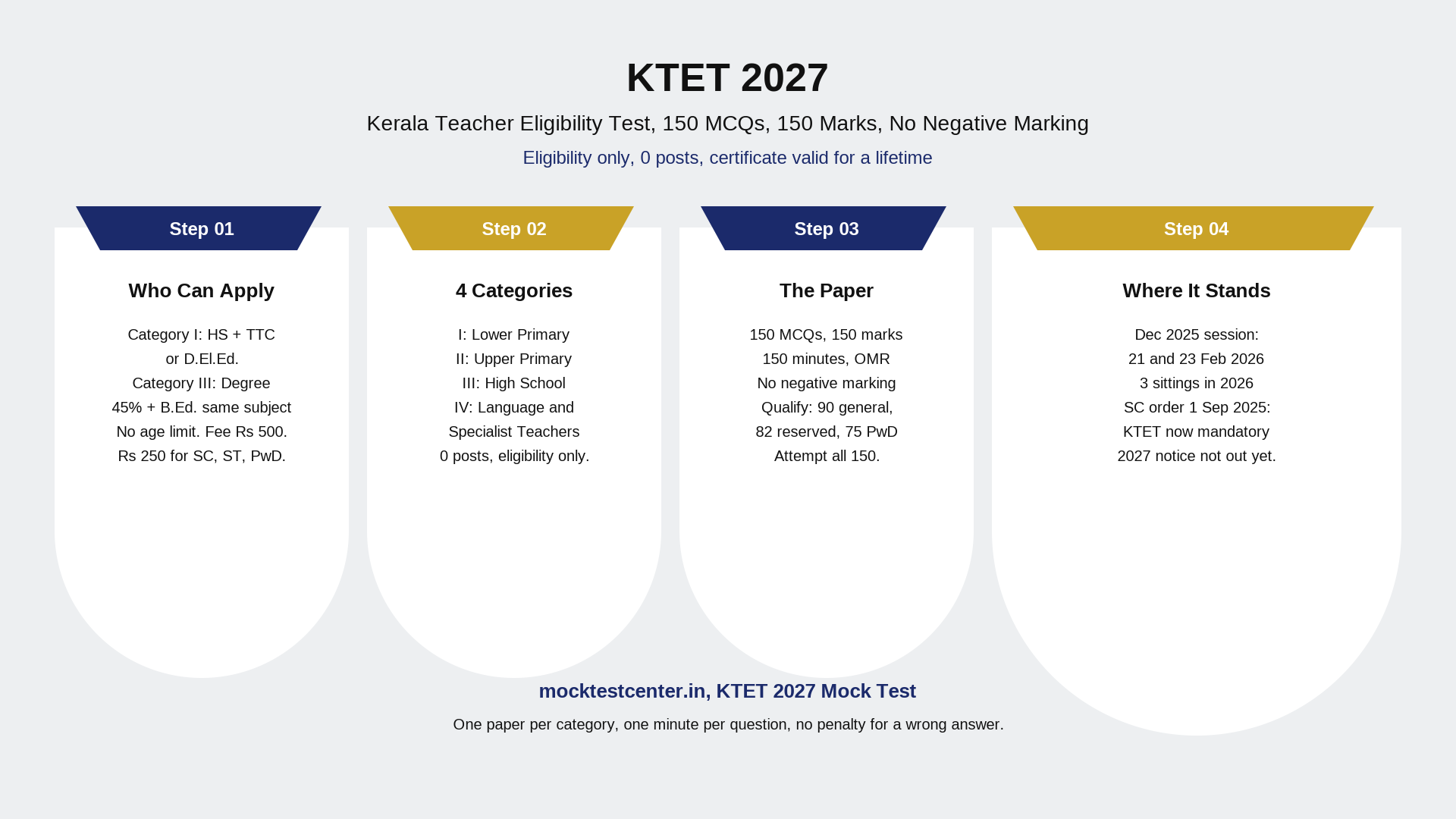
The KTET exam pattern itself is forgiving on its face. Every category runs as one paper of 150 multiple choice questions, 150 marks, 150 minutes, with no negative marking. The qualifying mark for general candidates is 60 percent, which is 90 marks out of 150. For SC, ST, OBC and OEC candidates it is 55 percent, which is 82 marks, and for PwD candidates it is 50 percent, which is 75 marks, according to the December 2025 notification as reported by Mathrubhumi. A candidate needs 90 correct answers out of 150, and a wrong answer costs nothing, so a candidate should attempt every question. The paper still fails most candidates who sit it, because 90 correct answers in 150 minutes across pedagogy, language and subject content is a real bar, and because the subject content runs to Class 10 level in Categories III and IV.
KTET 2027 at a glance
| Detail | KTET 2027, as run in the December 2025 session |
|---|---|
| Conducting body | Office of the Commissioner for Government Examinations, Kerala Pareeksha Bhavan, Thiruvananthapuram |
| Exam | Kerala Teacher Eligibility Test, Categories I to IV |
| Live session | December 2025 session, notification released 22 December 2025 |
| Posts in this test | 0, eligibility only, passing gives no appointment by itself |
| Applications | 22 December 2025 to 7 January 2026, 5 PM, closed, see conflicts note |
| Fee | Rs 500 per category, Rs 250 for SC, ST and PwD candidates |
| Exam dates | 21 February 2026, Categories I and II, and 23 February 2026, Categories III and IV |
| Paper | One paper per category, 150 MCQs, 150 marks, 150 minutes, OMR, no negative marking |
| Qualifying marks | 60 percent, 90 of 150, general, 55 percent, 82 of 150, SC, ST, OBC and OEC, 50 percent, 75 of 150, PwD |
| Certificate validity | Lifetime, for all categories, no limit on attempts |
| Age limit | None, as stated in the December 2025 notification summary |
| 2027 notification | Not published as of 23 November 2026 |
The Supreme Court order changed who needs KTET
KTET began under the Right to Education Act, 2009, and became operational in 2012. For years it applied mainly to new aspirants, while teachers appointed before 2012 worked under an exemption. The Supreme Court later ruled that even pre-2012 appointees must obtain TET qualification, and the order dated 1 September 2025 removed the exemption altogether. The Economic Times report on the order says the Court directed that teachers without KTET qualification be removed from service, and that the state government then gave temporary pay scale approval to nearly 20,000 teachers appointed before 1 September 2025, on the condition that they clear KTET within two years.
Mathrubhumi put the scale of the problem in numbers. Around 64,000 teachers in Kerala faced job uncertainty when the order came. More than half cleared KTET during 2026, leaving around 30,000 still to qualify, and another examination stood scheduled for June, by which the report meant the next sitting after the one it was describing. The same report puts the deadline for obtaining KTET qualification at September 2028. The Economic Times report, published earlier, says teachers got two years to clear the test, which points to September 2027. This guide prints both dates with their sources and does not pick one, because no order extending the deadline to 2028 appears in the material read. A serving teacher should treat September 2027 as the safe date and treat September 2028 as unconfirmed until the government publishes the extension.
The order also changed what the exemptions mean. Mathrubhumi lists six exemptions in the December 2025 notification, and adds that all of them are subject to the Supreme Court orders dated 1 September 2025. That sentence matters. An exemption that was safe before the order may not be safe after it, and a candidate who relies on an exemption should check the current notification rather than an old guide. The exemptions as listed are: CTET Primary stage pass exempts a candidate from KTET Category I, CTET Elementary stage pass exempts from Category II, NET, SET, M.Phil, Ph.D or M.Ed exempts from Categories I to IV, a Category III pass exempts from Category II, a pass in either Category I or II can be considered for LP and UP appointments, and language teachers who have cleared Category III are exempted from Category IV. Each of those is subject to the Court orders, and this guide repeats that qualification rather than printing the list as settled law.
The practical effect for a new aspirant is simpler. KTET is now a gate that almost every teacher in Kerala must pass through, whether newly appointed or already in service. That raises the number of candidates in each sitting and raises the value of the certificate, but it does not change the paper. The paper is still 150 questions, still no negative marking, still 90 marks to qualify for a general candidate. The competition is not against other candidates, since there is no merit list and no fixed number of seats. The competition is against the qualifying line, and the line has not moved.
Three sittings in 2026, and what each one was
The December 2025 session is the anchor session for this guide. Pareeksha Bhavan released its notification on 22 December 2025, according to Competitive Cracker, and applications opened the same day. Mathrubhumi says candidates could submit applications online at ktet.kerala.gov.in up to 5 PM on 7 January 2026, with the fee to be paid within the same limit. Competitive Cracker puts the last date at 30 December 2025 instead. This guide uses 7 January 2026, because Mathrubhumi quotes the application window directly from the notification, and records 30 December 2025 as a conflict. Pareeksha Bhavan released the admit card on 11 February 2026, and held the exam on 21 February 2026 for Categories I and II and 23 February 2026 for Categories III and IV, with a morning session from 10 AM to 12.30 PM and an afternoon session from 2 PM to 4.30 PM on each day.
The June 2025 session came before it and shows the older rhythm. Pareeksha Bhavan released its notification on 2 July 2025, applications ran from 3 July to 15 July 2025 according to Shiksha, and it held the exam on 18 and 19 September 2025. One Shiksha table puts the exam on 23 and 24 August 2025, but the same page, the Times of India and Adda247 all put it on 18 and 19 September 2025, and the result came out on 3 December 2025, so this guide uses 18 and 19 September 2025. The May 2025 exam for service teachers ran alongside it, with its result declared on the same day, 3 December 2025, on a separate result link. The June session result came about eleven weeks after the exam, which is a normal wait for KTET, and far shorter than the 21 month wait that the West Bengal TET result took in the same period.
After the February 2026 sitting, Pareeksha Bhavan held two more sessions in the same calendar year. Prepp records a session held on 8 and 9 August 2026, which AglaSem calls the February 2026 session, and a September 2026 session held on 14 and 15 November 2026, with registration from 23 September to 9 October 2026, extended, and hall tickets published before the exam. Prepp labels the August session as the February 2026 session in its own table, which is plainly a labelling slip, since the February sitting had already happened on 21 and 23 February 2026. The dates themselves are consistent across Prepp, AglaSem and Sarkari Result, so this guide prints the three 2026 sittings as 21 and 23 February, 8 and 9 August, and 14 and 15 November, and treats the session names as unreliable. A candidate who searches for the February 2026 result should know that one tracker page attaches that name to the August sitting, and should check the exam date on the result page rather than the session label.
No pass percentage for any 2026 sitting was found in the sources read. Pareeksha Bhavan publishes the result as a scorecard with qualifying status, and tracker pages report the result date without a category wise pass rate. This guide therefore prints no pass rate for KTET, and says so, rather than borrowing a figure from another state TET. The only hard number about outcomes is the Mathrubhumi report that more than half of the 64,000 affected serving teachers had cleared KTET during 2026, which is a report about a group of serving teachers, not a pass rate for a sitting.
The four categories, and which one is yours
KTET is held in four categories, and a candidate must pick the category that matches the level at which they want to teach. Category I is for Lower Primary classes, Classes 1 to 5. Category II is for Upper Primary classes, Classes 6 to 8. Category III is for High School classes, Classes 8 to 10 in the Prepp description, which overlaps Class 8 with Category II, and Classes 9 and 10 in the Adda247 description. The overlap is in the tracker pages, not in the notification, and this guide records it as a conflict rather than resolving it. Category IV is for Language Teachers in Arabic, Hindi, Sanskrit and Urdu up to UP level, and Specialist Teachers in Art and Craft and Physical Education.
A candidate can appear for more than one category in the same session if eligible, since each category is held in a separate shift. Prepp confirms this, and Mathrubhumi adds that a candidate applying in different categories should submit only one application form but must pay the fee separately for each category. The fee is Rs 500 per category for general candidates and Rs 250 for SC, ST and PwD candidates, so two categories cost Rs 1,000 for a general candidate. A candidate who has already qualified in a category cannot apply again in the same category, according to Mathrubhumi, so a second attempt in the same category is not an option once the certificate is in hand.
The category choice has a second consequence that candidates miss. A pass in Category III exempts a candidate from Category II, and a pass in either Category I or II can be considered for LP and UP appointments. Language teachers who have cleared Category III need not take Category IV. Those cross exemptions mean that a candidate who is eligible for Category III and passes it may not need Category II or IV at all, but the Supreme Court orders dated 1 September 2025 govern all of them, so the exemption should be confirmed in the notification for the session the candidate applies under.
KTET exam pattern, category by category
Every KTET category paper has the same frame. Each category runs as a single paper, 150 multiple choice questions, 150 marks, 150 minutes, answered on an OMR sheet, offline, with one mark for each correct answer and no negative marking. The medium is Malayalam, and the language papers are in the language concerned. The frame is identical across categories. The section split is not, and the split is where preparation time should go.
Category I, Lower Primary, splits into five equal parts of 30 questions each. Child Development and Pedagogy carries 30, Malayalam, Tamil or Kannada carries 30, English or Arabic carries 30, Mathematics carries 30, and Environmental Studies carries 30. No part dominates, so a candidate cannot pass Category I on subject knowledge alone or on pedagogy alone. A candidate who scores full marks in four parts and nothing in the fifth still falls short of 90 only if the fifth part is empty and the other four are perfect, which never happens in practice, but the equal split means a weak part costs exactly as much as a strong part gains.
Category II, Upper Primary, has four parts. Child Development and Pedagogy carries 30, Language I carries 30, Language II carries 30, and Mathematics and Science or Social Science carries 60. The 60 mark part is the decision maker. A candidate chooses Mathematics and Science or Social Science according to the subject they intend to teach, and that choice carries 40 percent of the paper. A candidate who picks the wrong 60 mark part, or prepares the other one by mistake, has lost the paper before it starts.
Category III, High School, is where the sources disagree, and the disagreement is worth a full paragraph because it changes how a candidate should divide 150 minutes. Prepp gives the split as Adolescent Psychology, Approaches of Learning and Pedagogy 40, Language 30, and Subject Specific Content and Pedagogy 80. Entri gives it as Adolescent Psychology, Theories of Learning and Teaching Aptitude 30, Subject Content 60, Language I 30, and Language II 30. Both add to 150, but they divide the paper differently, with the subject part at 80 in one and 60 in the other. This guide prints the Prepp split in the table and records the Entri split as a conflict, because Prepp ties its split to the 2026 question papers it publishes, while Entri describes its own corrected pattern. A candidate should check the model question paper for their subject on ktet.kerala.gov.in before trusting either split.
Category IV, Language and Specialist Teachers, has the same disagreement in smaller form. Prepp gives Child Development, Pedagogy and Teacher Aptitude 30, Language 40, and Subject Specific Content 80. Entri gives Child Development, Pedagogy and Teaching Aptitude 40, Language I 30, and Subject Specific Content and Pedagogy 80. The subject part is 80 in both, so the preparation advice is the same either way: the subject carries more than half the paper. The language and pedagogy parts together carry 70, so a candidate cannot ignore them, but a candidate who is weak in the subject cannot make it up elsewhere.
| Category | Sections and questions | Total |
|---|---|---|
| Category I, Lower Primary | Child Development and Pedagogy 30, Language I Malayalam, Tamil or Kannada 30, Language II English or Arabic 30, Mathematics 30, Environmental Studies 30 | 150 |
| Category II, Upper Primary | Child Development and Pedagogy 30, Language I 30, Language II 30, Mathematics and Science or Social Science 60 | 150 |
| Category III, High School | Adolescent Psychology, Approaches of Learning and Pedagogy 40, Language 30, Subject Specific Content and Pedagogy 80, per Prepp, see conflict note | 150 |
| Category IV, Language and Specialist | Child Development, Pedagogy and Teacher Aptitude 30, Language 40, Subject Specific Content 80, per Prepp, see conflict note | 150 |
The marking scheme rewards attempting every question. One mark for a correct answer, zero for a wrong answer, and 150 minutes for 150 questions, which gives one minute per question. A candidate who leaves questions blank is giving away marks for nothing, since there is no penalty to avoid. The practical rule is to answer every question, mark the uncertain ones, and return to them if time remains. The OMR sheet is the answer record, so a candidate should also check that the question number on the paper matches the circle on the sheet, because nobody can fix a shifted row on an OMR sheet after submission, and there is no revaluation or rechecking of KTET answer sheets.
Who can apply, category by category
Eligibility for KTET depends on the category, and the notification sets it out in detail for each one. This guide gives the summary that the tracker pages agree on, and marks the points where they do not. Category I needs Higher Secondary with at least 45 percent marks plus a Trained Teachers Certificate, Diploma in Education, two year Diploma in Elementary Education under the 2002 NCTE rules, four year Bachelor of Elementary Education, or two year Diploma in Education in Special Education. Competitive Cracker puts the Higher Secondary bar at 45 percent. AglaSem puts it at 50 percent for Category I with a recognised primary teacher training qualification. The two figures conflict, and this guide records both rather than choosing one, because the notification itself was not read in full. A candidate near the boundary should read the notification for their session before paying the fee.
Category II needs a degree eligible for the B.Ed. course plus a recognised elementary teacher training qualification, or Higher Secondary with at least 50 percent marks plus a four year B.El.Ed. or four year B.Sc. or B.A. in Education. AglaSem summarises it as a relevant graduation together with D.El.Ed. or TTC, or graduation with at least 50 percent marks and a B.Ed. or B.El.Ed. The common thread is that a plain degree without teacher training does not qualify for Category II. A candidate with a degree and no training qualification should look at Category III instead, if their degree and B.Ed. match.
Category III needs a B.Sc., B.A. or B.Com. degree from a recognised university with at least 45 percent marks and a B.Ed. in the same subject, or a degree in Mathematics, Physics and related subjects with the matching B.Ed. AglaSem puts the degree bar for Category III at 50 percent with a B.Ed. in the relevant subject, which is the same 45 versus 50 disagreement as Category I. The B.Ed. must be in the same subject as the degree, and that matching rule is the part candidates most often get wrong. A degree in English with a B.Ed. in Social Science does not qualify a candidate for the English paper in Category III.
Category IV needs the qualification prescribed for the language or specialism concerned, together with the matching teacher training. For language teachers in Arabic, Hindi, Sanskrit and Urdu, that means the degree and training in that language. For Physical Education teachers it means the physical education qualification, and for Art and Craft teachers the specialist qualification in that field. The notification lists these subject by subject, and this guide does not reproduce the full list because it runs to many combinations and the notification is the only safe source for it.
Two rules cut across all four categories. First, candidates studying in the final year of B.Ed., D.Ed. or D.El.Ed., in semester 3 or 4, are eligible to apply, according to Mathrubhumi, but Pareeksha Bhavan will release their KTET certificate only after they produce the degree certificate for the training course. Second, candidates admitted to B.Ed. on the basis of marks in their postgraduate degree are also eligible. There is no age limit for applying, as Mathrubhumi states plainly. Competitive Cracker says the minimum age is 21 with no upper limit, which conflicts with the no age limit statement, and this guide uses the Mathrubhumi version because it summarises the notification directly. A candidate who is 20 and otherwise qualified should still check the notification, because the two sources cannot both be right.
GovtJobOnline reports relaxation in qualification marks as 5 percent for SC, ST and PH candidates and 3 percent for OBC and OEC candidates. That relaxation applies to the percentage marks in the qualifying examination, not to the KTET qualifying marks, which are set separately at 60, 55 and 50 percent. A candidate who needs the relaxation should confirm it in the notification, because one tracker page reports it and the Mathrubhumi summary does not confirm it.
Qualifying marks, and the one disagreement in the sources
The December 2025 notification, as reported by Mathrubhumi, sets one qualifying line for all four categories. General candidates need 60 percent, which is 90 marks out of 150. SC, ST, OBC and OEC candidates need 55 percent, which is 82 marks. PwD candidates need 50 percent, which is 75 marks. JagranJosh, reporting the 2026 result, gives the same flat line with PH at 55 percent instead of 50, and AglaSem gives 60 percent for general and 55 percent for OBC, SC, ST and PwD, with no separate PwD line. The difference between the PwD figures is 75 marks against 82 marks, which means seven questions, and it matters to every PwD candidate.
An older rule explains where the confusion comes from. CareerPower, reporting the 2024 result, says the minimum qualifying marks for the general category were 60 percent for Categories I and II and 55 percent for Categories III and IV, and for ST, SC, PH and OBC candidates 55 percent for Categories I and II and 50 percent for Categories III and IV. The Shiksha guide for 2025 repeats the same split. That older split gave Category III and IV candidates a lower bar than Category I and II candidates. The December 2025 notification as reported by Mathrubhumi does not split by category at all, and the 2026 result reports also give a flat line. This guide uses the flat line from the December 2025 notification as the current rule, and records the older split as superseded but still circulating. A candidate reading a page that quotes 55 percent for general candidates in Category III is reading the old rule.
The qualifying mark is a pass mark, not a cut off. There is no merit list, no ranking, and no fixed number of certificates. Every candidate who reaches the line qualifies, and no candidate who falls short qualifies, however close the miss. That makes the arithmetic of the paper unusually transparent. A general candidate needs 90 correct answers. A reserved candidate needs 82. A PwD candidate needs 75 on the Mathrubhumi figures, or 82 on the JagranJosh and AglaSem figures. The seven mark gap for PwD candidates is the single most important unresolved figure in this guide, and a PwD candidate should aim for 82 to be safe under either version.
Fee, application, admit card and answer key
The fee is Rs 500 per category for general candidates and Rs 250 for SC, ST and PwD candidates, paid online. Mathrubhumi and AglaSem agree on those two figures, and Shiksha agrees for general and SC, ST and PH, with Blind candidates also at Rs 250. OBC candidates pay the full Rs 500 in the December 2025 notification, which surprises candidates who expect a concession, but the fee concession covers only SC, ST and PwD. A candidate applying in two categories pays the fee twice, once per category, even though the candidate submits only one application form.
Candidates submit applications online at ktet.kerala.gov.in, which is the only official website for the test. The December 2025 session took applications from 22 December 2025 to 7 January 2026 at 5 PM, on the Mathrubhumi version, or to 30 December 2025 on the Competitive Cracker version. Pareeksha Bhavan released the admit card for that session on 11 February 2026, ten days before the exam. For the September 2026 session, registration ran from 23 September to 9 October 2026, extended, with hall tickets published before the 14 and 15 November exam. The pattern is that the admit card comes about ten days before the exam, and the candidate downloads it from the official website using the application credentials.
After the exam, Pareeksha Bhavan publishes a provisional answer key, takes objections, and then publishes the final answer key with the result. For the June 2025 session Pareeksha Bhavan released the provisional answer key on 29 September 2025 and the result on 3 December 2025. Candidates submit objections to the answer key in the prescribed complaint format with supporting references to the Secretary, Pareeksha Bhavan, Poojappura, Thiruvananthapuram 695012, in person or by post, before the deadline, according to Prepp. There is no revaluation or rechecking of answer sheets, so the objection window is the only chance to challenge a key. A candidate who misses it has no second route.
Pareeksha Bhavan publishes the result as a scorecard on ktet.kerala.gov.in, showing the candidate name, roll number, aggregate marks, subject wise marks, and pass or fail status. Pareeksha Bhavan published the June 2025 result separately for the May 2025 service teacher exam and the June 2025 exam, on separate result links, and a candidate should use the link for their own session. The scorecard is the document a candidate needs for the certificate and for any later verification by the District Educational Officer, since candidates who clear KTET must produce their original documents before the District Educational Officer for verification, according to Shiksha.
What the certificate gives you, and what it does not
The KTET certificate is valid for a lifetime, for all categories, with no limit on attempts. Competitive Cracker, Prepp and the December 2025 notification summary all state that, and it is one of the few facts on which every source agrees. A candidate who qualifies once never needs to qualify again in that category. A candidate who fails can appear again in the next session, and there is no cap on the number of attempts. The lifetime validity is also why the Supreme Court order matters so much: a certificate earned now protects a teacher for the rest of a career.
What the certificate does not give is a job. KTET is only an eligibility test. A qualified candidate must still satisfy the eligibility conditions for appointment as a teacher and must apply and appear for the selection process conducted by the relevant agency, as Mathrubhumi states. For government and aided school posts the Kerala Public Service Commission or the management concerned runs that selection, depending on the post, and the KTET certificate is one document in that process, not the process itself. A candidate who treats the certificate as an appointment letter faces disappointment, and a candidate who treats it as worthless will be wrong in the other direction, since without it the appointment cannot happen at all.
The certificate also does not carry a score that matters beyond the pass line. There is no merit list and no rank, so scoring 140 instead of 90 gives no advantage in a later recruitment, except the confidence that the preparation was thorough. The rational target is therefore the qualifying line plus a safety margin of ten marks, not the maximum. A candidate who is scoring 100 in mock tests is ready. A candidate who is scoring 85 is not, and should spend the remaining time on the weakest part rather than on polishing the strongest one.
How to prepare when the paper has no negative marking
The absence of negative marking changes preparation in a specific way. In a paper with a penalty, a candidate must learn when to skip. In KTET, skipping is never right, so the skill to build is speed, not caution. One hundred and fifty questions in 150 minutes gives one minute per question, and a candidate who spends three minutes on a hard pedagogy question has spent the time of two easier questions. The drill is to attempt every question once, mark the uncertain ones, and return to them only after attempting the full paper. A candidate should take mock tests with that rule enforced, not with unlimited time, because a mock taken slowly teaches the wrong habit.
Pedagogy carries 30 marks in Categories I and II and 30 or 40 in Categories III and IV, and it is the part where reading pays off fastest. Prepp lists the recurring topics as the theories of Piaget, Vygotsky, Bruner and Kohlberg, multiple intelligence, constructivism, learning disabilities, inclusive education, the Kerala Curriculum Framework 2007, the National Curriculum Framework 2005, and the Right to Education Act 2009. Those topics appear in every sitting, and they are worth more per hour of study than any other part, because the list stays fixed and predictable while subject content stays wide. A candidate should be able to state each theory in one sentence and match it to a classroom example before moving on to subject revision.
Subject content is where the categories diverge, and a candidate should prepare it from Kerala SCERT textbooks for Classes 1 to 10, which Prepp recommends as the base. Category I mathematics and environmental studies sit at primary level, Category II subject content at upper primary level, and Category III and IV subject content up to Class 10. The model question papers on ktet.kerala.gov.in show the level for each category, and they are the closest thing to a syllabus that the board publishes. A candidate who prepares from a national TET book without checking the Kerala model papers will find questions on Kerala geography, Kerala curriculum and Malayalam grammar that the national book does not cover.
Language preparation is the part candidates leave last and regret most. Category I gives 60 of its 150 marks to the two language papers, Category II gives 60, and Category III gives 30 to 60 depending on which split is correct. Malayalam grammar and literature, English grammar, reading comprehension, vocabulary and language teaching methods recur in every sitting. A candidate who reads Malayalam and English every day, even for twenty minutes, will gain more in the language parts than a candidate who crams grammar rules in the final week.
Mistakes that cost candidates a certificate
The first mistake is applying in the wrong category, or in a category the candidate is not eligible for. Pareeksha Bhavan does not refund the fee, and the application cannot move to another category after submission. A candidate should match their training qualification to the category before paying, and should check the B.Ed. subject match for Category III in particular, since a mismatched B.Ed. is the most common eligibility failure.
The second mistake is trusting a tracker page over the notification. This guide records at least five live disagreements between tracker pages: the application closing date for December 2025, the qualifying marks for PwD candidates, the Higher Secondary percentage for Category I, the Category III section split, and the session names for the 2026 sittings. Any one of those, trusted wrongly, can cost a candidate an attempt. The notification on ktet.kerala.gov.in is the only source that settles them, and a candidate should read it before applying rather than after.
The third mistake is leaving questions blank. With no negative marking, a blank answer is a certain zero, while a guessed answer has a one in four chance. Over 150 questions, guessing on the ten questions a candidate does not know is worth two or three marks on average, and two or three marks is often the gap between 87 and 90. The OMR sheet should have no empty circles when the candidate hands it in.
The fourth mistake is ignoring the answer key objection window. Pareeksha Bhavan publishes the provisional key, invites objections for a short period, and then publishes the final key with the result. A candidate who finds an error in the key and does nothing about it has accepted a wrong answer. The objection must be sent in the prescribed format with supporting references to the Secretary at Poojappura, and it must reach before the deadline. There is no revaluation afterwards, so the window is the whole remedy.
The fifth mistake is treating KTET as a job exam. It is a qualifying test with a fixed line, not a competitive exam with a cut off that moves with the number of applicants. Preparation that chases rank, or that compares mock scores with other candidates, misses the point. The target is 90 marks, or 82, or 75, depending on the candidate category, and a candidate should build the preparation plan backwards from that number, part by part, with the weakest part getting the most hours.
What to watch next
Three things deserve attention after this guide goes live. The first is the next KTET notification, which will set the dates, the fee, the qualifying marks and the eligibility rules for the next sitting, and which may resolve the disagreements recorded here. The notification appears on ktet.kerala.gov.in, and a candidate should trust no tracker page over it. The second is the Supreme Court deadline. Whether the last date for serving teachers to qualify is September 2027 or September 2028 changes how many sittings a teacher can still attempt, and the government order that settles it should be read when it appears. The third is the result of the September 2026 session, held on 14 and 15 November 2026, which will show whether the extra sittings are continuing into 2027 or whether the board returns to two sittings a year.
Mock tests for this exam should follow the real pattern: 150 questions, 150 marks, 150 minutes, no negative marking, with the section split for the candidate category. A mock that adds negative marking, or that uses a different number of questions, teaches the wrong timing and the wrong risk habit. The mock tests on this site follow the pattern in this guide, category by category, so that a candidate who practises here walks into the hall with the timing already in their hands.
Sources
Mathrubhumi English, K-TET, understanding categories, exemptions and application process, Office of the Commissioner of Government Examinations, Kerala Pareeksha Bhavan, December 2025 session, exams 21 and 23 February 2026, morning session 10 AM to 12.30 PM and afternoon session 2 PM to 4.30 PM, one paper 150 MCQs, 150 marks, no negative marking, qualifying 60 percent, 90 marks, general, 55 percent, 82 marks, SC, ST, OBC and OEC, 50 percent, 75 marks, PwD, applications to 5 PM on 7 January 2026, fee Rs 500 per category, Rs 250 for SC, ST and PwD, no age limit, exemptions listed with Supreme Court orders dated 1 September 2025, final year B.Ed., D.Ed. and D.El.Ed. students eligible, certificate released after degree certificate produced, updated 2 January 2026. Shiksha, KTET 2025, notification for June session released 2 July 2025, applications 3 to 15 July 2025, exam 18 and 19 September 2025, provisional answer key 29 September 2025, fee Rs 500 general, Rs 250 SC, ST, PH and Blind, 150 questions, 150 marks, 150 minutes, no negative marking, twice a year, certificate lifetime, older qualifying split 60 percent Categories I and II general and 55 percent Categories III and IV general, 55 percent Categories I and II reserved and 50 percent Categories III and IV reserved, cited to record the older rule. Prepp, KTET 2026 question paper and answer key, three sessions in 2026, 21 and 23 February 2026, 8 and 9 August 2026, 14 and 15 November 2026, categories Classes 1 to 5, 6 to 8, 8 to 10, and language, specialist and physical education, offline OMR, 150 questions, 150 marks, 150 minutes, no negative marking, certificate lifetime, section splits Category I five parts of 30, Category II 30, 30, 30 and 60, Category III 40, 30 and 80, Category IV 30, 40 and 80, no revaluation or rechecking, answer key objections to Secretary, Pareeksha Bhavan, Poojappura, Thiruvananthapuram 695012, multiple categories allowed with fee per category, updated 16 November 2026. Competitive Cracker, KTET 2026 notification released, December 2025 notification, applications 22 to 30 December 2025, admit card 11 February 2026, exam 21 and 23 February 2026, Category I 10 AM to 12.30 PM and Category II 2 PM to 4.30 PM on 21 February 2026, Category III 10 AM to 12.30 PM and Category IV 2 PM to 4.30 PM on 23 February 2026, fee Rs 500 and Rs 250, minimum age 21, cited to record the application date and age conflicts. India TV News, KTET result 2025 out, exam 18 and 19 September 2025, result declared December 2025, qualifying 60 percent general and 55 percent SC, ST and OBC, 82 marks out of 150. Times of India, KTET May and June 2025 results out, applications 3 to 10 July 2025, admit cards from 1 September 2025, exams 18 and 19 September 2025, results 3 December 2025, May 2025 exam for service teachers, June 2025 exam for all eligible candidates, separate result links for May and June 2025. Adda247, KTET Result 2025, result released 3 December 2025, exams 18 and 19 September 2025, Category III Classes 9 and 10, qualifying 90 of 150 general and 82 of 150 OBC, SC and ST. Mathrubhumi English, Supreme Court ruling on K-TET, around 64,000 teachers faced job uncertainty, more than half cleared KTET during 2026, around 30,000 still to qualify, deadline extended to September 2028, TET introduced under Right to Education Act 2009 and operational in 2012, Supreme Court ruled pre-2012 appointees must obtain TET qualification. Economic Times, Kerala grants temporary pay relief to 20,000 teachers after Supreme Court K-TET ruling, Supreme Court order 1 September 2025 struck down exemption and directed removal of teachers without K-TET qualification, two years to clear, temporary pay scale approval for teachers appointed before 1 September 2025. AglaSem, KTET 2026, February 2026 session held 8 and 9 August 2026, September 2026 session held 14 November 2026 for Categories I and II and 15 November 2026 for Categories III and IV, registration 23 September to 9 October 2026 extended, fee Rs 500 general and Rs 250 SC, ST and PwD, qualifying 60 percent general and 55 percent OBC, SC, ST and PwD, Category I Higher Secondary 50 percent plus teacher training, Category III degree 50 percent plus B.Ed., cited to record the session dates and the percentage conflicts. Entri, KTET Syllabus 2026, Category III split 30, 60, 30 and 30, Category IV split 40, 30 and 80, September 2026 notification 18 September 2026, qualifying 60 percent general, 55 percent SC, ST, OBC and OEC, cited to record the section split conflict. JagranJosh, KTET Cutoff 2026, general 60 percent, 90 of 150, SC, ST, OBC and PH 55 percent, 82 of 150, same for all four categories, cited to record the PwD figure conflict. CareerPower, KTET Result 2024, exam 22 and 23 June 2024, result 3 September 2024, older qualifying split 60 percent Categories I and II general and 55 percent Categories III and IV general, cited to record the older rule. GovtJobOnline, Kerala Teachers Eligibility Test, application dates 25 October to 7 November 2025, exam 26 and 27 November 2025, relaxation 5 percent SC, ST and PH and 3 percent OBC and OEC in qualification marks, cited to record the relaxation figure and the superseded 2025 dates.







