
About KSEB Assistant Engineer 2027 Exam Series
📖 Table of Contents
- KSEB Assistant Engineer 2027 at a glance
- Two doors into the same post
- Where the live cycle stands now
- The KSEB Assistant Engineer exam pattern, in full
- The ten modules, one by one
- Who can apply
- Pay and what the job actually involves
- A preparation plan that fits the real paper
- Mistakes that cost candidates this post
- What to watch next
- Mock tests for KSEB Assistant Engineer 2027: Full Tests, PYQ, Chapter Tests, Sectional Tests, NCERT-based Tests, Current Affairs and PYQ PDF Downloads
- Sources
KSEB Assistant Engineer 2027: Complete Exam Guide
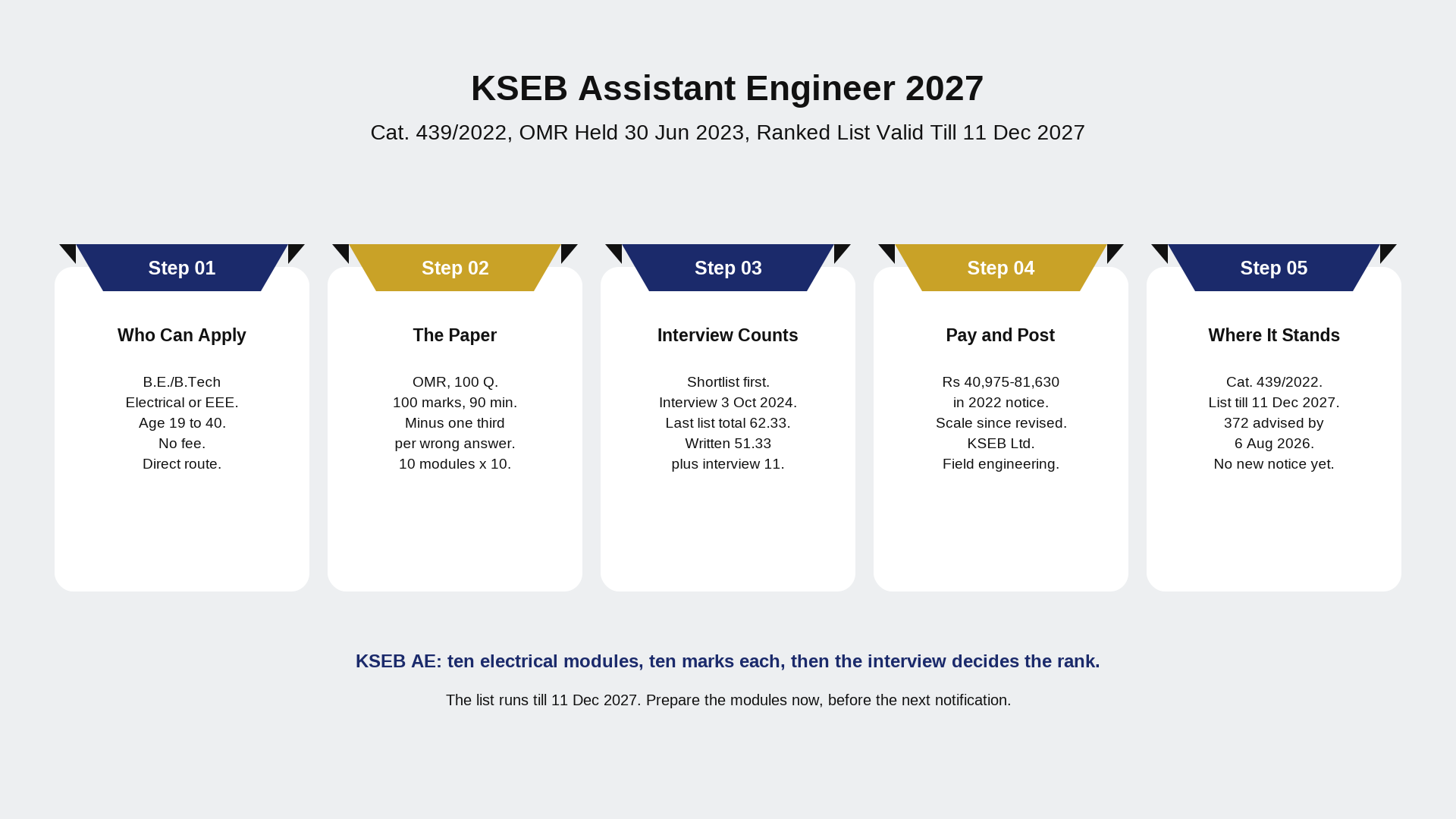
KSEB Assistant Engineer 2027 on this page follows the live recruitment for Assistant Engineer (Electrical) in the Kerala State Electricity Board Ltd, run by the Kerala Public Service Commission. The KSEB Assistant Engineer exam pattern for the live cycle is a single OMR paper of 100 questions and 100 marks in 90 minutes, followed by an interview for shortlisted candidates. KPSC held that OMR paper on 30 June 2023 for Category Number 439/2022, and the ranked list from it, Number 1271/2024/SSVII, stays valid till 11 December 2027. No new direct recruitment notification has been published as of 23 November 2026, so this guide anchors on the 439/2022 cycle and on the by transfer notifications that followed it, and says so wherever a 2027 figure would otherwise be guessed.
One fact about this examination surprises first time candidates, and it shapes everything else in this guide. The ranked list is still alive. A candidate who waits for a fresh notification is waiting for a list that runs till December 2027, and the 372 advices made from it by 6 August 2026 show that the list keeps supplying candidates while it runs. The next direct notification comes after this list, not before it.
The second surprise is the shape of the paper. Ten modules, ten marks each, all from electrical engineering, no general knowledge, no language paper, no arithmetic section. The paper tests one degree and nothing else. A candidate with a B.Tech in Electrical or Electrical and Electronics Engineering faces a paper written entirely in the language of that degree.
The third surprise is the second door into the same post. KSEB fills 10 percent of Assistant Engineer posts by transfer from its own in service staff, and those notifications carry their own category numbers, their own age window and their own vacancy counts. The 378/2025 notification, with 21 vacancies and applications from 15 October to 19 November 2025, is a by transfer notification. It is closed to the general public, and a general candidate who prepares for it prepares for the wrong door.
KSEB Assistant Engineer 2027 at a glance
| Detail | KSEB Assistant Engineer 2027, as run in the 439/2022 cycle |
|---|---|
| Conducting body | Kerala Public Service Commission (KPSC), Thiruvananthapuram, website keralapsc.gov.in |
| Department | Kerala State Electricity Board Ltd (KSEB) |
| Post name on the notification | Assistant Engineer (Electrical), direct recruitment, state wide |
| Live cycle | Category Number 439/2022, gazette 15 November 2022, last date 14 December 2022 |
| Written test | OMR test held 30 June 2023, 100 questions, 100 marks, 90 minutes, English medium |
| Shortlist | Published 6 February 2024 |
| Interview | Held 3 October 2024, marks added to the written score |
| Ranked list | Number 1271/2024/SSVII, in force from 12 December 2024, valid till 11 December 2027 |
| Advices from the list | 372 advised by 6 August 2026, last advice 6 August 2026 |
| Last main list candidate | 62.33 in total, 51.33 in the written test and 11 in the interview |
| Pay scale in the notification | Rs 40,975 to Rs 81,630 per month, scale since revised |
| Qualification | B.E. or B.Tech in Electrical Engineering or Electrical and Electronics Engineering, or an equivalent approved by the PSC |
| Age, direct recruitment | 19 to 40 years, with the usual relaxations for reserved categories |
| Application fee | No application fee |
| 2027 notification | No new direct recruitment notification published as of 23 November 2026 |
Two doors into the same post
KSEB Assistant Engineer has two entry routes, and the notifications for the two routes look alike enough to confuse candidates. The direct recruitment route takes B.Tech graduates from the open market. The by transfer route takes KSEB employees under the 10 percent in service quota, and only candidates who have declared probation or are approved probationers in KSEB can apply under it. The post, the pay scale and the syllabus are the same.
The eligibility is different.
The direct route is Category Number 439/2022. The gazette notification came out on 15 November 2022, applications closed on 14 December 2022, and the OMR test ran on 30 June 2023. The ranked list, Number 1271/2024/SSVII, came into force on 12 December 2024 and runs till 11 December 2027. That list is the live list for the direct route, and it is the list this guide follows.
The by transfer route ran first under Category Number 034/2023. That notification came out in the gazette dated 29 April 2023, applications closed on 31 May 2023, and it carried 16 vacancies. Its ranked list, Number 1154/2024/SSVII, came into force on 21 November 2024. The top of that list shows how the interview counts: the first ranked candidate scored 68.00 in the test and 12.0 in the interview, for a total of 80.00.
The by transfer route ran again under Category Number 378/2025. That notification came out on 15 October 2025, applications ran to 19 November 2025, and it carries 21 vacancies under the 10 percent in service quota. Some tracker pages present 378/2025 as a general KSEB Assistant Engineer recruitment, and that presentation is wrong. The notification is for KSEB employees only, and a general candidate cannot apply under it.
The confusion costs candidates time in both directions. A general candidate who prepares for the 378/2025 by transfer test prepares for a test they cannot sit. A KSEB employee who misses the by transfer notification waits years for the next one, because the quota is small and the notifications are rare. Read the method of appointment line in the notification first.
Direct recruitment means the open market. By transfer means KSEB staff only.
Where the live cycle stands now
The 439/2022 cycle moved through its stages in order. The gazette notification came out on 15 November 2022. Applications closed on 14 December 2022. The OMR written test ran on 30 June 2023.
The shortlist came out on 6 February 2024. The interview ran on 3 October 2024. The ranked list, Number 1271/2024/SSVII, came into force on 12 December 2024. The list stays valid till 11 December 2027, and it supplies candidates as KSEB reports vacancies.
The advice figures show the list working. KPSC had advised 372 candidates from the list by 6 August 2026, with the last advice on that date. The appointment chart for the post also records 6 Not Joined Duty vacancies reported on 14 October 2025, which the list then fills. The list does not sit idle.
It advises in batches as vacancies arrive, and the rank up to which advice has gone moves with each batch.
The last main list candidate in the ranked list scored 62.33 in total, with 51.33 in the written test and 11 in the interview. That number is the most useful cut off figure in this guide, because it shows what the last advised candidate actually scored. A candidate aiming for the next list should treat 62.33 as the floor to beat, while remembering that the next list will have its own paper and its own competition.
One tracker page reports that 18,078 candidates appeared for the 30 June 2023 OMR test. That figure comes from a single tracker source, and no second source in the pages read confirms it. This guide prints it with that caution. The hard numbers are the advice figures from the KPSC appointment chart, and those are the numbers that decide who gets the post.
The 378/2025 by transfer notification sits alongside the live direct list. Its applications closed on 19 November 2025, and its test and interview stages follow the same sequence as the direct cycle. KSEB employees under that notification should watch keralapsc.gov.in for the test date notice.
The KSEB Assistant Engineer exam pattern, in full
The KSEB Assistant Engineer exam pattern for the live cycle is one OMR paper plus an interview. The OMR paper carries 100 questions and 100 marks. Each correct answer carries 1 mark. Each wrong answer loses one third of a mark.
Unanswered questions carry no penalty. The medium of the examination is English, and the duration for the direct recruitment test on 30 June 2023 was 90 minutes.
One point about the duration needs care, because tracker pages print two different figures. The direct recruitment test under 439/2022 ran for 90 minutes, and three tracker sources agree on that figure. The generic Kerala PSC Assistant Engineer pages print 75 minutes, and the by transfer syllabus pages also print 75 minutes. The 75 minute figure belongs to the generic AE papers and to the by transfer cycle, and the 90 minute figure belongs to the 439/2022 direct test.
A candidate preparing for the next direct notification should check the duration printed in the admission ticket, because the two figures keep getting mixed on tracker pages.
The paper divides into ten modules of 10 marks each. Every module carries the same weight, so no module can be skipped and no module can carry the paper alone. The module list below comes from the KPSC detailed syllabus for Assistant Engineer (Electrical), KSEB, printed under Category Number 034/2023. The same ten modules applied to the 439/2022 direct test, and the syllabus notes that questions from other topics of the qualifying degree may also appear.
| Module | Subject | Marks |
|---|---|---|
| Module 1 | Electric Circuits | 10 |
| Module 2 | Magnetic Circuits | 10 |
| Module 3 | Electrical Machines | 10 |
| Module 4 | Digital Electronics, with the 8085 microprocessor | 10 |
| Module 5 | Power Systems | 10 |
| Module 6 | Control Systems | 10 |
| Module 7 | Power Electronics and Operational Amplifiers | 10 |
| Module 8 | Measurements and Instrumentation | 10 |
| Module 9 | Signals and Systems | 10 |
| Module 10 | Transducers, Batteries and Electrical Wiring | 10 |
| Total | 100 questions, 100 marks | 100 |
The interview follows the written test. KPSC shortlists candidates from the OMR paper, verifies certificates, and interviews the shortlisted candidates. The interview marks add to the written test marks, and the ranked list follows the total. The last main list candidate in the 439/2022 list scored 51.33 in the written test and 11 in the interview.
The by transfer list under 034/2023 shows interview marks up to 13.0, and the top candidate there scored 12.0. The interview is not a formality. Eleven marks out of a total near 62 is a large share, and a candidate who treats the interview as a formality gives away the margin that decides the rank.
Some tracker pages print a different module list for this examination, with DC generators, electromagnetic theory and digital signal processing in place of magnetic circuits, transducers and wiring. That list comes from older papers and older syllabuses, and it does not match the detailed syllabus printed under Category Number 034/2023. This guide uses the 034/2023 list, because it is the latest detailed syllabus KPSC printed for this post, and it records the older list as a conflict.
The ten modules, one by one
Electric Circuits opens the paper, and it rewards the candidate who can solve fast. Kirchhoff laws, maximum power transfer, star delta transformation, energy stored in capacitors and inductors, coupled circuits with the dot polarity convention, sinusoidal steady state analysis, rms value, average value, peak factor and form factor, AC through series R, L and C circuits, series resonance with resonant power and bandwidth, and resonance in parallel circuits form the module. The questions are numerical and short, and the module tests whether the candidate can reach the answer in under a minute.
Magnetic Circuits follows, and it tests the physics behind the machines. Absolute and relative permeability, magnetic field intensity, flux, reluctance, magnetisation curves, hysteresis and eddy current loss, and the link between the magnetic circuit and the electric circuit form the module. A candidate who understands the magnetic circuit understands why a transformer behaves the way it does, and the module feeds directly into the machines module that follows it.
Electrical Machines carries the same 10 marks and the heaviest weight in the minds of most candidates. DC generators and motors, transformers, induction machines and synchronous machines form the module, with equivalent circuits, losses, efficiency, regulation and starting methods. The machines questions are the most numerical in the paper after the circuits module, and they reward a candidate who has solved problems rather than read theory.
Digital Electronics, with the 8085 microprocessor, is the module that dates the paper. Number systems, logic gates, Boolean algebra, combinational and sequential circuits, and the architecture, instruction set and interfacing of the 8085 form the module. The 8085 is an old processor, and candidates sometimes ask why it still appears. It appears because the KPSC syllabus still names it, and the paper follows the syllabus.
Learn the 8085 as the syllabus asks, and do not argue with the syllabus.
Power Systems is the module closest to the job. Generation, transmission and distribution, load flow in outline, fault analysis, protection, switchgear, tariffs and load curves form the module. A candidate who joins KSEB will work on the systems this module describes, and the interview often returns to it. The module also carries the questions that repeat most often from earlier papers, because the core facts of power systems change slowly.
Control Systems tests transfer functions, block diagrams, signal flow graphs, time response, stability criteria, root locus and frequency response. The module is mathematical, and the questions are usually short problems with one right method. A candidate who practices the standard problems scores the full 10 marks here, because the module has fewer surprises than the machines module.
Power Electronics and Operational Amplifiers pair two topics that share the same skill: reading a circuit and finding what it does. Power semiconductor devices, converters, choppers and inverters form the first half, and op amp circuits, amplifiers, filters and oscillators form the second. The questions test application more than memory, and a candidate who has built or simulated these circuits answers them faster.
Measurements and Instrumentation covers instruments, bridges, errors, transducers in outline, and the measurement of voltage, current, power and energy. The module is short and factual, and it is the easiest 10 marks in the paper for a candidate who has read it once. It is also the module most candidates skip, which is why it decides ranks.
Signals and Systems covers signal classification, Fourier series and transforms, Laplace transforms, convolution, and system response. The module is mathematical, and it overlaps with the control systems module in method. A candidate who prepares the two together saves time, because the tools are the same.
Transducers, Batteries and Electrical Wiring closes the paper with the most practical module. Transducer types and working, battery types, charging and capacity, wiring systems, earthing and safety form the module. The wiring and earthing questions connect directly to KSEB field work, and the interview can return to them. Ten marks here reward the candidate who has seen a real installation, not only a textbook diagram.
Who can apply
The qualification for the direct recruitment is a B.E. or B.Tech in Electrical Engineering or Electrical and Electronics Engineering from an institution recognised by AICTE, or an equivalent qualification approved by the PSC. The notification names Electrical and Electrical and Electronics as the qualifying branches. Electronics and Communication on its own does not qualify, and a candidate from another branch should check the equivalence list in the notification before applying.
The age limit for the direct recruitment is 19 to 40 years, with the usual relaxations for reserved categories. The by transfer notification under 378/2025 carries an age window of 18 to 36 years, and that figure comes from a single tracker source, so a KSEB employee applying under the by transfer route should read the age line in the notification itself. The direct and by transfer age windows are different, and applying under the wrong window wastes the application.
KPSC charges no application fee for this post. Applications run through the one time registration system on keralapsc.gov.in, and the candidate applies online against the category number while the notification is open. The qualification, the age and the branch all get checked at certificate verification, so a candidate should keep the degree certificate, the mark lists and the age proof ready before the shortlist, not after it.
Assistant Engineer (Civil) in KSEB is a different post with its own notification and its own ranked list, and candidates sometimes mix the two. The civil list had advised 141 candidates by 7 April 2026. The electrical list is the one this guide follows, and the two lists never mix.
Pay and what the job actually involves
The scale of pay printed in the 439/2022 notification is Rs 40,975 to Rs 81,630 per month. That scale has since been revised, and the revised figure for the KSEB scale was not verified in the sources read for this guide. The nearest verified figure is the current Kerala Government Assistant Engineer scale of Rs 55,200 to Rs 1,15,300, and that figure belongs to the Public Works Department, not to KSEB. This guide prints the KSEB figure from the notification, notes the revision, and does not present the PWD figure as the KSEB pay.
An Assistant Engineer in KSEB works in the state power utility, which handles generation, transmission and distribution of electricity across Kerala. The work is field engineering: supervising section works, maintaining lines and substations, attending faults, checking metering and connections, and keeping the supply running in the area under charge. The Assistant Engineer is the officer who signs off on the work of the section and answers for it, and the job mixes office work with field visits in all weather.
The post carries the responsibility that comes with electricity. A fault at night, a fallen line after a storm, a transformer failure in a town, all of these reach the Assistant Engineer first. The interview tests whether a candidate understands that responsibility, and the power systems and wiring modules test whether the candidate has the knowledge for it. A candidate who prepares only the theory and never thinks about the field work will find the interview harder than the paper.
The career path runs upward through the KSEB engineering service, and the ranked list is the entry point. The 372 advices from the 439/2022 list show the scale of the intake, and the list runs till December 2027, so the intake continues. A candidate who joins from this list joins a large batch, and the batch system shapes the early career.
A preparation plan that fits the real paper
The plan below assumes four months and a candidate who works or studies alongside preparation. It spends time evenly across the ten modules, because the paper gives each module the same 10 marks, and it adds interview preparation from the start, because the interview decides the final rank.
Month one covers the base modules. Electric Circuits, Magnetic Circuits and Electrical Machines, three hours a day, with problems from the degree textbooks and from the previous year papers. The circuits module and the machines module together carry 20 marks and the most numerical questions, so they get the first month. The candidate should solve, not read, because the paper tests solving speed.
Month two covers the systems modules. Power Systems, Control Systems and Signals and Systems, with the methods shared between control and signals practiced together. The power systems module gets an extra hour a week, because its questions repeat most often from earlier papers and because the interview returns to it.
Month three covers the remaining modules. Digital Electronics with the 8085, Power Electronics and Operational Amplifiers, Measurements and Instrumentation, and Transducers Batteries and Electrical Wiring. The measurements module is short and factual, so it should be finished in a week, and the time saved goes to the 8085, which needs memorisation of the instruction set.
Month four is the paper. Previous year question papers under timed conditions, then mock tests in the same 100 question format with one third negative marking. The published previous year papers for this post include the papers coded 129/2024, 225/2023, 193/2014 and 030/2016, and the 2008 paper. Every mock test gets a review the same day: which module lost marks, which guesses cost marks, and which questions were left blank that should have been attempted.
The negative marking rule shapes the attempt strategy. Three wrong answers cancel one correct answer. A candidate who guesses on 30 questions and gets 10 right loses 20 marks on the other 20, and the net gain is zero. A candidate who attempts only the questions where two options can be eliminated scores higher with fewer attempts.
The rule for the mock tests is the rule for the real paper: attempt a question only when at least two options can be ruled out, and leave the rest blank.
The interview preparation runs alongside the paper from month one. A candidate should be able to explain their final year project, their favourite module, and one real KSEB topic such as distribution, metering or fault attendance, in plain words and without notes. The interview in the 439/2022 cycle ran on 3 October 2024, months after the written test, and candidates who started interview preparation only after the shortlist had weeks to prepare. A candidate who prepares from month one has months.
Two hours a day, split between solving problems and reviewing mistakes, beats six hours of reading theory alone. The paper is 100 marks of problem solving, and the interview is a conversation about the same subjects. Both reward the candidate who has worked the problems.
Mistakes that cost candidates this post
The first mistake is waiting for a new notification while the live list still runs. The ranked list from 439/2022 stays valid till 11 December 2027, and it advised 372 candidates by August 2026. A candidate who waits for the next advertisement instead of preparing for it will find the advertisement comes after the list expires, and the preparation window after that is short. The time to prepare is now, while the list runs.
The second mistake is confusing the by transfer notification with the direct recruitment. Category Number 378/2025, with 21 vacancies, is for KSEB employees only. A general candidate who prepares for it cannot apply under it, and a KSEB employee who misses it waits for the next by transfer notification. Read the method of appointment line first.
The third mistake is preparing the wrong module list. Older tracker pages print a module list with DC generators, electromagnetic theory and digital signal processing. The detailed syllabus printed under Category Number 034/2023 lists magnetic circuits, transducers, batteries and wiring instead. A candidate who prepares the older list studies three modules that the paper does not test and skips three that it does.
The fourth mistake is ignoring the interview. The last main list candidate scored 51.33 in the written test and 11 in the interview, for a total of 62.33. Eleven marks is a large share of the total, and the interview decides the rank among candidates whose written scores sit close together. A candidate who scores 55 in the written test and 8 in the interview finishes behind a candidate who scores 51 in the written test and 12 in the interview.
The fifth mistake is guessing in the OMR paper. One third negative marking punishes guessing hard, and the paper is designed for it. The candidates who top the list are usually the ones who attempted 80 to 90 questions with high accuracy, and the candidates who attempted all 100 with guesses fall behind them.
The sixth mistake is preparing the civil pattern for an electrical paper. Kerala PSC runs Assistant Engineer examinations for several departments, and the civil syllabus differs completely from the electrical syllabus. A candidate who studies the civil modules for the KSEB electrical paper studies the wrong degree. Check the department and the branch on the notification before opening a book.
The seventh mistake is trusting a single tracker page for the cut off. The only verified cut off figure for the 439/2022 list is the last main list candidate total of 62.33, with 51.33 written and 11 interview. Tracker pages print other cut off figures for this examination, and those figures come without a source. The KPSC ranked list is the authority, and the appointment chart is the second authority.
What to watch next
The direct ranked list runs till 11 December 2027. Candidates on that list should watch for advice notices, because KPSC advises in batches as KSEB reports vacancies, and the rank up to which advice has gone moves with each batch. The appointment chart on keralapsc.gov.in shows the advice position, and it is the most useful page for a listed candidate.
The 378/2025 by transfer notification closed on 19 November 2025, and its test and interview stages follow. KSEB employees under that notification should watch keralapsc.gov.in for the test date notice and for the shortlist.
The next direct notification is the question every new candidate asks, and no date exists for it as of 23 November 2026. The direct list runs till December 2027, and KPSC opens a new direct notification when KSEB reports fresh vacancies after the list expires or exhausts. A candidate who wants the next direct cycle should keep the degree certificate ready, keep the one time registration profile updated, and prepare the ten modules now, because the gap between a new notification and its OMR test is short.
Check keralapsc.gov.in for every date in this guide. The notification, the shortlist, the ranked list and the appointment chart all appear there first, and tracker pages copy them with errors. The KSEB Assistant Engineer 2027 mock test on this site follows the 439/2022 paper, so a candidate who practices here practices the real pattern.
Mock tests for KSEB Assistant Engineer 2027: Full Tests, PYQ, Chapter Tests, Sectional Tests, NCERT-based Tests, Current Affairs and PYQ PDF Downloads
The Full Tests tab follows the live paper. Each full test carries 100 questions and 100 marks in 90 minutes, with 1 mark for a correct answer and minus one third for a wrong answer. Unanswered questions carry no penalty. The medium is English, and the paper follows the 30 June 2023 direct test under Category Number 439/2022.
The Previous Year Papers tab carries the papers named in this guide. Those papers are coded 129/2024, 225/2023, 193/2014, 030/2016 and 2008. Each one follows the same 100 question and 100 mark shape, and each one tests the electrical degree syllabus. No other previous paper is named here, because no other paper appears in the sources read for this guide.
Chapter Tests follow the ten modules of the KPSC detailed syllabus, with 10 marks for each module. The modules are Electric Circuits, Magnetic Circuits, Electrical Machines, Digital Electronics with the 8085 microprocessor, Power Systems, Control Systems, Power Electronics and Operational Amplifiers, Measurements and Instrumentation, Signals and Systems, and Transducers Batteries and Electrical Wiring. A chapter test lets a candidate finish one module at a time and see the score for that module alone. The syllabus notes that questions from other topics of the degree may also appear.
Sectional Tests group the modules into practice sections, because the paper has no separate General Knowledge, language or arithmetic section. Circuits, magnetic circuits and machines form one practice section, and power systems, control systems and signals and systems form another. Digital electronics, power electronics, measurements and the final module on transducers, batteries and wiring form the remaining practice. Each sectional test keeps the one third negative marking rule, so the score means the same as a full test score.
NCERT-based Tests have a small role in this examination, and this guide says so plainly. The paper tests a Bachelor of Engineering or Bachelor of Technology degree in Electrical or Electrical and Electronics Engineering, and every module sits at degree level. School physics and mathematics from Classes 11 and 12 help with the base ideas behind Electric Circuits, Magnetic Circuits and Signals and Systems. That base helps a candidate start, and the degree textbooks and the previous papers carry the preparation from there.
Current Affairs carries no marks in this paper, and this guide says so plainly. All 100 marks sit in the ten electrical modules, with no General Knowledge part and no Current Affairs part in the pattern. The Current Affairs tab therefore stays small, and it covers power sector developments that help in the interview and in the Power Systems module. A candidate should spend most of the preparation time on the ten modules, because the written test decides the shortlist and the interview follows it.
The PYQ PDF Downloads tab points to keralapsc.gov.in, where KPSC publishes the notification, the question paper, the shortlist and the ranked list. The papers named in this guide are 129/2024, 225/2023, 193/2014, 030/2016 and 2008, and the tab will add new papers as KPSC publishes them. No download link is printed here, because no PDF link appears in the sources read for this guide.
Start with chapter tests for one module at a time, then move to sectional tests to build speed across grouped modules, then sit full tests under timed conditions. Review every full test on the same day, and note which module lost marks and which guesses cost marks.
Sources
Engineering PSC, KSEB Assistant Engineer notification syllabus and preparation, conducting body Kerala Public Service Commission direct recruitment for Kerala State Electricity Board, status no new notification yet, ranked list from Category Number 439/2022 active till 11 December 2027, qualification B.E. or B.Tech in Electrical Engineering or Electrical and Electronics or an equivalent approved by the PSC, pay scale Rs 40,975 to Rs 81,630 in the 2022 notification with the scale since revised, age limit 19 to 40 with the usual relaxations, no application fee, last exam OMR written test on 30 June 2023 Category Number 439/2022, ranked list Number 1271/2024/SSVII published in December 2024, written test 100 marks, 100 questions in 90 minutes across ten modules, module list Electric Circuits 10, Magnetic Circuits 10, Electrical Machines 10, Digital Electronics with the 8085 microprocessor 10, Power Systems 10, Control Systems 10, Power Electronics and Operational Amplifiers 10, Measurements and Instrumentation 10, Signals and Systems 10, Transducers Batteries and Electrical Wiring 10, ten modules of 10 marks each as printed in the Kerala PSC detailed syllabus for Assistant Engineer Electrical KSEB Category Number 034/2023, syllabus notes that questions from other topics of the qualifying degree may appear, timeline 15 November 2022 gazette notification Category Number 439/2022, 30 June 2023 OMR written test, 6 February 2024 shortlist, 3 October 2024 interview, December 2024 ranked list Number 1271/2024/SSVII valid till 11 December 2027, last main list candidate 62.33 in total, 51.33 in the written test and 11 in the interview. Engineering PSC, KSEB Assistant Engineer ranked list valid till December 2027, ranked list Number 1271/2024/SSVII from Category Number 439/2022 valid till 11 December 2027, last main list candidate 62.33 in total, no new notification published yet. Engineering PSC, Kerala PSC exams for B.Tech Electrical and Electronics graduates, status as of 13 November 2026, Assistant Engineer KSEB Electrical or EEE degree, ranked list from Category Number 439/2022 active till 11 December 2027, Assistant Engineer PWD Rs 55,200 to Rs 1,15,300 per month, the current Kerala Government AE scale, KSEB scale revised after its last notification.
Competitive Cracker, KSEB Assistant Engineer Exam Date 2023, PSC Assistant Engineer recruitment gazetted 15 November 2022, last day to apply 14 December 2022, Category Number 439/2022, exam date 30 June 2023, exam mode OMR, duration 1 hour 30 minutes, total marks 100, medium English, 18,078 candidates, qualification B.Tech in Electrical or Electrical and Electronics Engineering from an institution recognised by AICTE, vacancies reported as per the notification are in existence, ranked list to remain for a minimum period of one year or till the expiry of three years whichever is earlier. Entri, KSEB Assistant Engineer Electrical Syllabus 2025, conducting body Kerala Public Service Commission, department Kerala State Electricity Board, post Assistant Engineer Electrical, Category Number 378/2025, vacancy 21, selection by transfer 10 percent in service quota, application 15 October 2025, last date 19 November 2025, exam pattern total questions 100, total marks 100, mode OMR, duration 1 hour 30 minutes, negative marking one third mark per wrong answer, module list Electric Circuits 10, Magnetic Circuits 10, Electrical Machines 10, Digital Electronics 10, Power Systems 10, Control Systems 10, Power Electronics and Operational Amplifiers 10, Measurements and Instrumentation 10, Signals and Systems 10, Transducers Batteries and Electrical Wiring 10, syllabus Module 1 Electric Circuits Kirchhoff laws, maximum power transfer theorem, star delta transformation, energy stored in capacitor and inductor, coupled circuits dot polarity convention, sinusoidal steady state analysis, rms value, average value, peak factor, form factor, AC through series R L C circuit, series resonance, resonant power, bandwidth, resonance in parallel circuits. Entri, KSEB Assistant Engineer 378/2025 Notification 2025, Kerala State Electricity Board Ltd Assistant Engineer Electrical recruitment 2025 exclusively for in service staff, not open to the general public, Category Number 378/2025, vacancy 21, selection by transfer 10 percent in service quota, application 15 October 2025, last date 19 November 2025, age limit 18 to 36 years, ranked list to remain in force for a minimum period of one year and up to three years or until a new ranked list is published whichever comes earlier, previous year question papers 129/2024, 225/2023, 193/2014, 030/2016, 2008.
Kerala Public Service Commission, ranked list page, Assistant Engineer Electrical by transfer under 10 percent service quota in Kerala State Electricity Board Ltd, Category Number 034/2023, ranked list Number 1154/2024/SSVII with effect from 21 November 2024. Kerala Public Service Commission, Assistant Engineer Electrical KSEB appointment chart, date of last advice 6 August 2026, total advice 372, ranked list Number 1271/2024/SSVII with effect from 12 December 2024, Assistant Engineer Electrical in Kerala State Electricity Board Ltd Category Number 439/2022. Kerala Public Service Commission, appointment chart Number R1B-2/19/2024-KPSC dated 23 October 2025, Assistant Engineer Electrical, Kerala State Electricity Board Ltd, date of receipt of vacancy 14 October 2025, number of vacancies reported 6 Not Joined Duty, active ranked list 439/2022 state wide Assistant Engineer Electrical direct, with effect from 12 December 2024. Kerala Public Service Commission, ranked list for Assistant Engineer Electrical by transfer on Rs 40,975 to Rs 81,630 in Kerala State Electricity Board Ltd, ranked list Number 1154/2024/SSVII, Category Number 034/2023, brought into force with effect from 21 November 2024, rank 1 Rani T R test 68.00 interview 12.0 total 80.00, rank 2 Gopakumar M S test 64.67 interview 13.0 total 77.67, rank 3 Bijo Reji test 63.00 interview 12.0 total 75.00.
Kerala Public Service Commission, Assistant Engineer Civil KSEB appointment chart, total advice 141, date of last advice 7 April 2026. Study4Sure, Kerala PSC Assistant Engineer Electrical Exam, Category Number 034/2023 by transfer, scale of pay Rs 40,975 to Rs 81,630, vacancies 16, gazette date 29 April 2023, last date 31 May 2023, qualification B.Tech in Electrical or Electrical and Electronics Engineering from an institution recognised by AICTE, exam pattern written OMR online test, duration 1 hour 15 minutes, 100 questions 100 marks, medium English, negative marking one third per wrong answer, syllabus list Electric Circuits 10, DC generators 10, Power Systems 10, Measurements and Instrumentation 10, Power Electronics 10, Electromagnetic theory 10, Digital Electronics 10, Control Systems 10, Signals and Systems 10, Digital Signal Processing 10. Testbook, Kerala PSC Assistant Engineer Syllabus and Exam Pattern 2025, total questions 100, each question 1 mark, total duration 1 hour 15 minutes, negative marking 0.33 per wrong answer, medium English.







