
About Kerala Police SI 2027 Exam Series
📖 Table of Contents
- Kerala Police SI 2027 at a glance
- Where the recruitment stands right now
- Three doors into the same post
- Who can apply
- Physical standards, measured to the decimal
- Kerala Police SI exam pattern in full
- The physical efficiency test, 5 of 8 events
- Does the SI selection include an interview
- Weightage that can move a rank
- Training, probation and the career after
- The syllabus, subject by subject
- A preparation plan that fits the real paper
- Mistakes that cost candidates a place
- What to watch next
- Sources
Kerala Police SI 2027: Complete Exam Guide
Kerala Police SI 2027 on this page follows a live recruitment, and that is rare enough to say first. The Kerala Public Service Commission published the Sub Inspector of Police (Trainee) notification on 28 November 2025 under Category Numbers 448/2025, 449/2025 and 450/2025. Applications ran from 28 November to 31 December 2025. The commission has not announced the examination date yet. The page carries 2027 in its title because the site groups examination pages by that year, and the examination itself will fall in the 2026 to 2027 window.
The notification covers the Kerala Civil Police, and a parallel notification covers the Armed Police Battalion. Category Numbers 446/2025 and 447/2025 are for Armed Police Sub Inspector (Trainee), open market and constabulary. The two notifications ran together, with the same dates, the same pay scale of Rs 45,600 to Rs 95,600, and the same closing date of 31 December 2025. A graduate who applied in December 2025 could have applied for both, if the physical standards for each were met.
One fact about this recruitment shapes everything else in this guide. Kerala PSC does not publish a vacancy total for the SI post. The notification says anticipated vacancies, and the ranked list stays in force for one year from the date of finalisation. The commission advises candidates from the list as vacancies arise. Any page that prints a firm vacancy total for this cycle is guessing, and this guide prints none.
The SI post is a degree level post, and that changes the examination. A graduate applies, and the written test is a degree level OMR test of 100 marks. The physical standards are strict, the physical efficiency test is the same eight event test used across Kerala Police recruitment, and the selection adds weight for NCC certificates, Student Police Cadet work, sports and military training. A candidate who prepares only the written test will fail the physical test, and a candidate who prepares only the physical test will fail the written one. Both halves decide the rank.
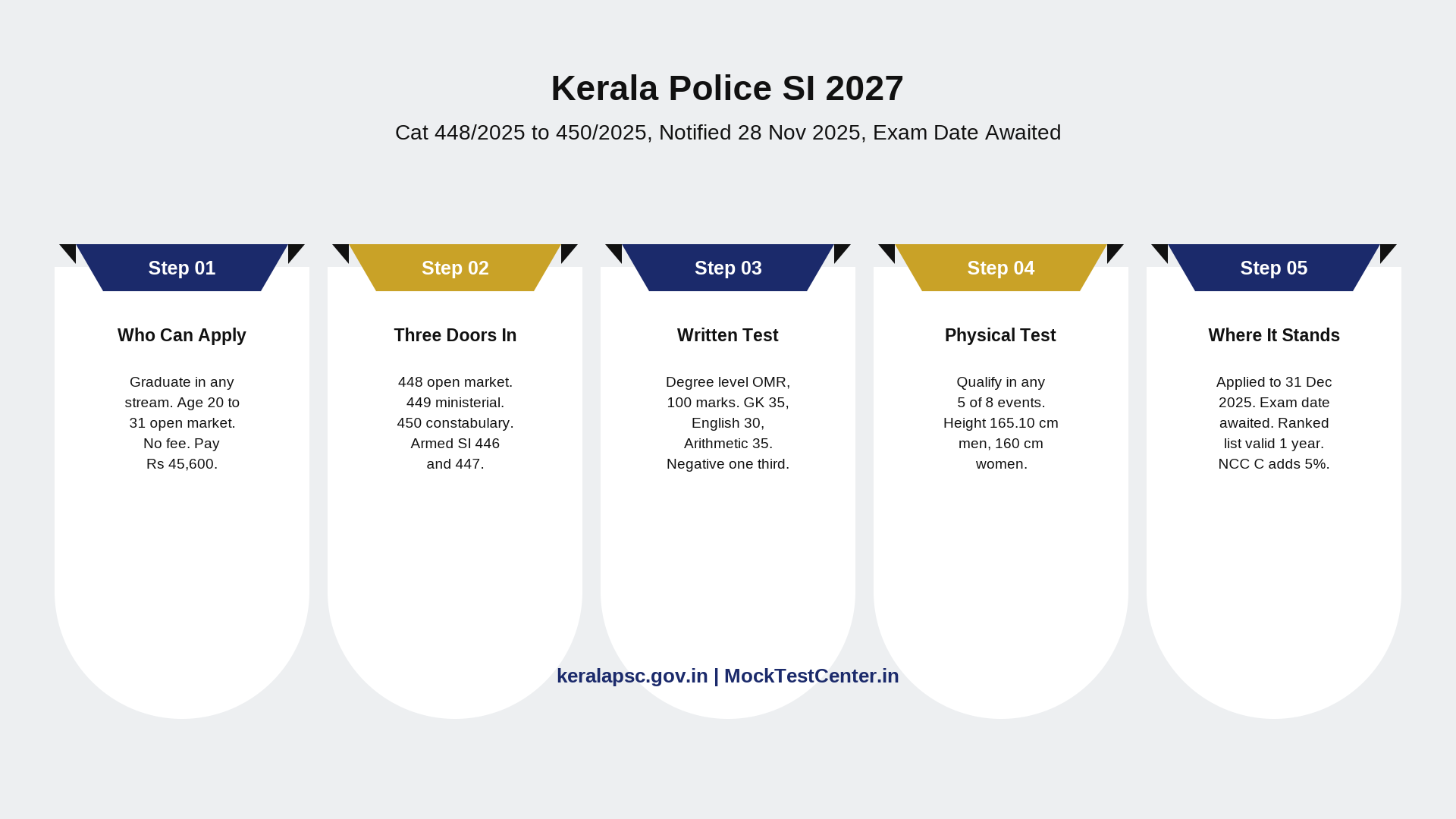
Kerala Police SI 2027 at a glance
| Detail | Kerala Police SI 2027, as run in the 2025 cycle |
|---|---|
| Conducting body | Kerala Public Service Commission (Kerala PSC), website keralapsc.gov.in |
| Post | Sub Inspector of Police (Trainee), Kerala Civil Police, Cat 448/2025, 449/2025, 450/2025; Armed Police SI (Trainee), Cat 446/2025, 447/2025 |
| Live cycle | Notification 28 November 2025; applications 28 November to 31 December 2025 |
| Vacancies | Anticipated; no firm total published; ranked list valid one year from finalisation |
| Qualification | Graduation from a recognised university |
| Age, open market | 20 to 31 years, born between 2 January 1994 and 1 January 2005 |
| Age, ministerial and constabulary | Should not have completed 36 years as on 1 January 2025 |
| Pay scale | Rs 45,600 to Rs 95,600 per month, plus allowances |
| Application fee | Nil; Kerala PSC charges no application fee, applications go through One Time Registration |
| Written test | Degree level OMR test, 100 questions, 100 marks, 75 minutes; General Knowledge and Current Affairs 35, General English 30, General Arithmetic and General Ability 35; negative one third mark |
| Physical test | Physical Measurement, then Physical Efficiency Test, qualify in any 5 of 8 events of the National Physical Efficiency One Star Standard Test |
| Where it stands | Applications closed 31 December 2025; examination date to be announced as of 23 November 2026 |
Where the recruitment stands right now
The application window is closed and the examination is awaited. The commission published the notification in the gazette on 28 November 2025, and the last date to apply was 31 December 2025, Wednesday, up to midnight. Entri, Competitive Cracker and Defence Jobs Malayalam all print the same dates, and the official notification PDF on the Kerala PSC website, noti-448-450-25.pdf, carries the same category numbers and the same closing date. The commission had announced no examination date as of 23 November 2026, and Entri prints the examination date as to be announced.
The wait between application and examination is normal for Kerala PSC degree level posts. The SI selection runs through the degree level common preliminary examination first, and the commission runs that preliminary examination for many posts together, in stages, across several dates. The commission conducted the degree level common preliminary examinations for 2026 on 2 May, 16 May and 6 June 2026, and published the standardisation procedure for those examinations on the Kerala PSC website. A candidate who applied under 448/2025 should watch the Kerala PSC examination updates page and the Thulasi profile for the examination programme, because the date appears there first and the hall ticket follows it.
The ranked list, once the commission publishes it, will stay in force for one year from the date of finalisation, as the notification states, citing notification number AV(2) 2376/14/GW dated 4 April 2016. That one year limit matters. A candidate who clears the examination and the physical test but sits low on the list has one year of advice to wait through, and the list expires after that. The constable lists show how that wait can go, and the SI list will follow the same rule.
For a candidate who missed the December 2025 window, the position is plain. There is no second window in this cycle, and the next SI notification will carry its own category numbers, its own dates and its own age window. SI notifications do not come every year on a fixed date. Tracker pages expected the last SI notification through 2025, and it arrived on 28 November 2025, after months of pages saying it would be published soon. A candidate who wants the next cycle should prepare the degree level syllabus now, because the preparation does not depend on the notification date.
Three doors into the same post
The civil police SI notification opens three doors, and a candidate should know which door they are walking through. Category Number 448/2025 is the open market, for graduate candidates from the general public. Category Number 449/2025 is the ministerial wing, for graduate ministerial staff of the Police and Vigilance Departments, and for Fingerprint Experts and Fingerprint Searchers of the Fingerprint Bureau who have completed two years of service. Category Number 450/2025 is the constabulary wing, for graduate Police Constables, Head Constables and officers of corresponding rank in the Police and Vigilance Departments who have successfully completed probation.
The three categories differ in more than eligibility. The rules of reservation and rotation apply only to Category 448/2025, the open market. The commission judges Categories 449/2025 and 450/2025 on merit only, with no reservation. The age limit differs too. The open market runs from 20 to 31 years, for candidates born between 2 January 1994 and 1 January 2005, both dates included. The ministerial and constabulary categories run to 36 years, for candidates who have not completed 36 years of age as on 1 January 2025. A serving constable with a degree can apply under the constabulary category until 36, and can also apply under the open market if inside the 20 to 31 band, but the notification bars applying in both the open and the reserve quota, so the choice must be made at application time.
Government Orders apportion vacancies among the three wings, specifically G.O. (Ms) Number 240/85/Home dated 30 December 1985 and G.O. (Ms) Number 196/95/Home dated 26 July 1995. The notification prints the orders but not the shares, so no candidate can say in advance how many posts each wing will get. A serving constable should not assume the constabulary quota is large, and an open market candidate should not assume it is small. The shares appear only when the advice begins.
The Armed Police SI notification runs on the same pattern with two categories. Category Number 446/2025 is the open market, for men only, with an age limit of 20 to 31 years. Category Number 447/2025 is the constabulary, for graduate Head Constables, Police Constables and officers of equivalent rank in the Police and Vigilance Departments, with an age limit of 20 to 36 years. Women and differently abled candidates are not eligible for the Armed Police SI post. The civil police SI post is open to women, and the notification says so in plain words.
Who can apply
Graduation is the qualification, and it is the only educational bar. A degree from a recognised university, in any discipline, is enough. The notification prescribes no subject, states no minimum percentage, and asks for no higher qualification. The commission accepts equivalent qualifications the government declares through official orders, and a candidate with an equivalent qualification must produce the government order when called for.
One exception sits inside the qualification rule, and it matters to SC and ST candidates. If sufficient qualified SC and ST candidates are not available, applications from SC and ST candidates who have passed the Intermediate or Pre University examination of a recognised university will be considered, only to fill the quota reserved for them under Category 448/2025, under G.O. (Ms) Number 239/Home dated 4 May 1961. The exception applies only when graduate SC and ST candidates fall short, and only for the reserved quota. A candidate should not plan on it.
The age limit for the open market is 20 to 31 years, for candidates born between 2 January 1994 and 1 January 2005, both dates included. The usual age relaxations apply for SC, ST and OBC candidates under government norms, though the notification summary read does not print the relaxed upper limits separately. The ministerial and constabulary categories run to 36 years as on 1 January 2025. A candidate should read the birth dates in the notification, because the notification year fixes the window and a candidate born a month outside it is out.
Women candidates are eligible for the civil police SI post. The official notification bars differently abled candidates from both the civil and the armed SI posts. A candidate should also note that the post carries a medical examination, and the visual and physical standards below are part of the eligibility, not an afterthought.
Physical standards, measured to the decimal
Kerala PSC prints the SI physical standards to two decimal places, and the measurement is done to the same precision. For men in the civil police, the minimum height is 165.10 cm, and 160.02 cm for SC and ST candidates. The minimum chest measurement is 81.28 cm, with a minimum expansion of 5.08 cm. For women in the civil police, the minimum height is 160 cm, and 155 cm for SC and ST candidates. For men in the Armed Police Battalion, the minimum height is 167 cm, and 160 cm for SC and ST candidates, with a chest of 81 cm and a minimum expansion of 5 cm.
| Standard | Civil Police SI, men | Civil Police SI, women | Armed Police SI, men |
|---|---|---|---|
| Height | 165.10 cm | 160 cm | 167 cm |
| Height, SC and ST | 160.02 cm | 155 cm | 160 cm |
| Chest | 81.28 cm | Not applicable | 81 cm |
| Chest expansion | 5.08 cm | Not applicable | 5 cm |
The two decimal places come from converting the old imperial standards, 5 feet 5 inches and 32 inches, into centimetres, and the commission measures against the converted figures. A candidate who is 165 cm tall fails the civil police standard by 0.10 cm, and a candidate who is 165.10 cm passes. There is no rounding in the candidate favour. A candidate near the line should measure themselves with a proper stadiometer before the measurement day, because a home measurement with a tape on a wall can be out by a centimetre.
Examiners test vision without glasses, and the standards are strict. Distant vision must be 6/6 by the Snellen test in each eye, and near vision 0.5 in each eye. Full field of vision is mandatory. Colour blindness, squint, knock knee, flat feet, varicose veins, bow legs and other physical defects are listed as disqualifications. A candidate who wears glasses should get tested without them before applying, because the standard is without glasses and there is no relaxation for it.
Candidates need a medical certificate from a Civil Surgeon at the Physical Efficiency Test stage. The certificate must state that the candidate is physically fit for the post of Sub Inspector of Police (Trainee) in Kerala Civil Police, in the form the notification prescribes. A certificate in the wrong form, or from the wrong authority, is treated as no certificate, and the candidate is not allowed to take the physical test.
Kerala Police SI exam pattern in full
The Kerala Police SI exam pattern runs in two tiers, and the two tiers confuse tracker pages more than any other part of this recruitment. The SI is a degree level post, so the selection starts with the Kerala PSC degree level common preliminary examination, and the main examination follows for candidates who clear it. Competitive Cracker prints the pattern plainly: two OMR examinations, a preliminary examination under the PSC common degree level prelims, and a main examination, with the syllabus for each released separately. The written main examination is 100 marks, with 100 questions, and the duration is printed as 1 hour 30 minutes in one source and 75 minutes in another, a conflict this guide records below.
The main OMR test, as printed by Testbook, carries three subjects. General Knowledge and Current Affairs carries 35 marks, General English 30 marks, and General Arithmetic and General Ability 35 marks, for a total of 100 marks in 75 minutes. The questions are multiple choice, and candidates sit the test offline on an OMR answer sheet. There is a penalty of one third, or 0.33 marks, for each wrong answer. Three wrong answers cancel one correct answer, and the same penalty applies in the preliminary examination.
| Subject, main OMR test | Questions | Marks |
|---|---|---|
| General Knowledge and Current Affairs | 35 | 35 |
| General English | 30 | 30 |
| General Arithmetic and General Ability | 35 | 35 |
| Total | 100 | 100 |
The duration conflict needs care. Testbook prints 75 minutes for the 100 question main test. Competitive Cracker prints 1 hour 30 minutes for the written examination. Both pages describe the same main OMR test, and the two figures cannot both be right. The degree level common preliminary examination runs for 75 minutes, and the main examination for degree level posts has commonly run for 90 minutes, so the 75 minute figure may belong to the preliminary examination and the 90 minute figure to the main examination. This guide prints both figures with their sources and does not settle the question, because the notification is the only source that can settle it, and the examination programme has not been published yet.
The preliminary examination itself follows the degree level common pattern, with General Knowledge, Current Affairs, General English, Arithmetic and Mental Ability, and the same one third negative marking. The commission conducts it in stages across several dates, and the Kerala PSC website carries the standardisation procedure for the 2026 degree level preliminary examinations, held on 2 May, 16 May and 6 June 2026. A candidate who clears the preliminary examination is called for the main examination, and a candidate who clears the main examination is called for the physical tests.
The physical efficiency test, 5 of 8 events
The Physical Efficiency Test uses the National Physical Efficiency One Star Standard Test, and a candidate must qualify in at least five of the eight events. The events and the minimum standards are printed in full in the official notification, and every tracker page that prints them agrees on the figures. The standards differ for men and women, and the events differ too.
| Event, men | Minimum standard |
|---|---|
| 100 metres run | 14 seconds |
| High jump | 132.20 cm |
| Long jump | 457.20 cm |
| Putting the shot, 7,264 grams | 609.60 cm |
| Throwing the cricket ball | 6,096 cm |
| Rope climbing, hands only | 365.80 cm |
| Pull ups or chinning | 8 times |
| 1,500 metres run | 5 minutes 44 seconds |
| Event, women | Minimum standard |
|---|---|
| 100 metres run | 17 seconds |
| High jump | 1.06 metres |
| Long jump | 3.05 metres |
| Putting the shot, 4 kg | 4.88 metres |
| 200 metres run | 36 seconds |
| Throwing the throw ball | 14 metres |
| Shuttle race, 25 metres x 4 | 26 seconds |
| Skipping, one minute | 80 times |
Five of eight sounds generous, and it is, for a candidate who trains. It is not generous for a candidate who arrives untrained. The rope climb needs grip and technique, and a candidate who has never climbed a rope will fail it however strong their arms are. The 1,500 metres run needs pacing, and a candidate who sprints the first lap will walk the last one. The shot put and the cricket ball throw reward technique as much as strength, and a week of coaching on the throwing action can add a metre that months of gym work cannot. The sensible plan is to pick five events early and train those five, rather than spreading effort across all eight.
For women, the shuttle race and the skipping test reward agility and rhythm rather than raw strength, and they are the events where a trained candidate can bank two easy passes. The 200 metres run and the throw ball throw reward speed and technique. A woman candidate who trains the shuttle race and the skipping test alongside the 100 metres run has three passes in hand before she touches the jumps.
The physical test comes after the written test, and the gap between the two is short once the result is out. Physical fitness takes months to build and days to lose. A candidate who trains through the written preparation, even for half an hour a day, arrives at the physical test ready. A candidate who starts after the written result arrives does not. The written marks are wasted if the physical test is failed, and the physical test is failed more often than the written one.
Does the SI selection include an interview
Tracker pages disagree on whether the SI selection includes an interview, and the disagreement is worth stating plainly. CIGI lists the selection process as shortlisting, Physical Efficiency Test, medical examination, document verification and personal interview. Testbook lists the selection as three stages, the written examination, the Physical Efficiency Test and document verification, with no interview. Entri lists the stages as the written examination, the physical tests, training and probation, with no interview named separately.
The official notification PDF, as quoted in the sources read, prints the method of appointment, the age limits, the qualifications and the physical standards, and the quoted extracts do not name an interview stage. The weightage provisions in the notification, for NCC certificates, Student Police Cadet work, sports and military training, add marks to the selection, which points to a merit built from the written test and the weightage, not from an interview board. This guide does not state that an interview exists, and does not state that it does not exist, because the sources read do not settle it. A candidate should read the examination programme when it is published, because that document will name the stages that follow the physical test.
What is certain is that the selection does not end at the physical test. Medical examination follows, document verification follows, and the ranked list follows those. A candidate who clears the written test and the physical test should keep the documents ready, because verification is the stage where a missing certificate or a wrong date of birth can remove a candidate who has passed everything else.
Weightage that can move a rank
The SI selection gives extra marks for achievements outside the examination hall, and those marks can move a rank. NCC certificates carry weight: the A certificate adds 2 percent, the B certificate 3 percent, and the C certificate 5 percent. The Student Police Cadet certificate carries weight. Meritorious sports achievements carry weight. Military training carries weight. The notification prints these provisions, and the tracker pages that quote the notification agree on the NCC figures.
Five percent is a large number in a 100 mark examination. A candidate with an NCC C certificate starts the merit list five marks ahead of a candidate with the same written score and no certificate. A candidate with a B certificate starts three marks ahead. Those marks count toward the selection score under the rules the notification prints. A candidate who holds a certificate should make sure it is claimed in the application, because a certificate that is not claimed is worth nothing, and a candidate who does not hold one should know the gap exists and prepare the written test to close it.
The weightage also explains why the SI post attracts NCC cadets and Student Police Cadets in large numbers. The recruitment is designed to reward them, and the certificate holders know it. A candidate without a certificate still has a path, though the race is against people who start a few marks ahead, and the written preparation has to be that much better.
Training, probation and the career after
Selected candidates undergo one year of training at the Police Training College, or at another institution the government or the State Police Chief specifies, followed by ten and a half months of practical training in a district. After training, the candidate is on probation for two years within a continuous period of three years. The training is residential, it covers law, drill, weapons, physical fitness, investigation and field work, and a candidate who fails the training is not confirmed in the post.
The pay scale is Rs 45,600 to Rs 95,600 per month, and it is the same for the civil police SI and the Armed Police SI. Dearness allowance, house rent allowance and other allowances sit on top of the basic pay. Tracker pages print gross monthly figures of Rs 55,000 to Rs 75,000 for the SI post. Those are estimates, because the amount in hand varies with posting, allowances and deductions, and this guide prints the official scale and labels the gross figures as estimates.
The SI is the first gazetted rung of the Kerala Police for most officers, and the ladder above it runs to Inspector, Deputy Superintendent of Police and beyond, through seniority and promotion. The SI commands a police station, investigates cases, and supervises constables and head constables. It is a post with real authority and real responsibility, and the training is built to match that. A candidate who joins for the pay alone will find the work harder than expected. A candidate who joins for the work will find the pay a fair part of it.
The syllabus, subject by subject
General Knowledge and Current Affairs carries 35 marks in the main test, and it is the largest single subject. It covers Indian history, geography, economics, the Constitution, Kerala history and administration, science, and current events of the year before the examination. The degree level standard means the questions go deeper than the constable paper. A candidate should read the Constitution in full, not in summary, because the questions test articles and provisions rather than general ideas. Kerala administration carries weight too, because the examination is for the Kerala Police, and the questions ask about the state government, the district administration and local self government.
General English carries 30 marks, and it covers grammar, vocabulary, synonyms and antonyms, one word substitution, spelling correction, idioms and phrases, direct and indirect speech, subject verb agreement, conjunctions, tenses, phrasal verbs, voices, articles, nouns and verbs, and comprehension. Thirty marks is a large share for a language paper, and it rewards a candidate who reads English every day. A candidate who memorises word lists will do worse than a candidate who reads a newspaper and a novel, because the comprehension passage and the usage questions test reading, not memory.
General Arithmetic and General Ability carries 35 marks, and it covers number work, percentages, ratios, averages, time and work, simple interest, and reasoning questions that test observation, logic and mental ability. The level is degree, but the questions reward speed and accuracy rather than advanced mathematics. A candidate who practises twenty sums a day for three months will finish this section inside the time. A candidate who leaves it to the last month will run out of time in the hall, because the arithmetic questions are the ones that eat the clock.
The preliminary examination syllabus is wider, because the common degree level prelims cover the same subjects at a broader level, with General Knowledge, Current Affairs, General English, Arithmetic and Mental Ability, and the regional language. A candidate should prepare the preliminary syllabus first, because the preliminary examination comes first, and then deepen the preparation for the main examination, because the main test carries the marks that decide the rank.
A preparation plan that fits the real paper
The main test is 100 marks in 75 or 90 minutes, and the plan should follow the marks and the clock. General Knowledge and Current Affairs is 35 marks, so it takes the largest share of time. General Arithmetic and General Ability is 35 marks, and it takes daily practice. General English is 30 marks, and it takes daily reading.
A candidate with six months should spend the first two months on the degree level base: the Constitution, Indian history, geography, economics, and Kerala administration, with arithmetic practice every day and English reading every day. The next two months should add current affairs every day and start solving previous year papers under time. The last two months should be mock tests, one full paper a week at first and two a week near the end, with each paper followed by an hour of review. The review matters more than the score. A candidate who writes a mock test and never looks at the wrong answers has wasted the paper.
Previous year papers are the best preparation material for this examination, and Kerala PSC publishes them on its website. The degree level common preliminary papers from 2 May, 16 May and 6 June 2026 are the closest model for the preliminary examination, and the SI main papers from earlier cycles are the closest model for the main test. A candidate should solve at least five previous papers before the examination, because the pattern repeats and the same topics return in different words.
Physical training runs alongside the study, not after it. Half an hour a day, five days a week, is enough to build the base. Running builds the 1,500 metres time. Pull ups build the chinning count. Rope climbing needs a rope and a ground, and a candidate without access to one should practise grip work and climbing technique at a gym. The high jump and long jump need a ground and a coach, even for a few sessions, because the technique matters as much as the strength. A candidate who trains the body and the mind together arrives at both tests ready.
Mistakes that cost candidates a place
The first mistake is applying under the wrong category. The open market, the ministerial wing and the constabulary wing have different age limits, different eligibility and different reservation rules, and the notification bars applying in both the open and the reserve quota. A serving constable who applies under the open market when the constabulary wing fits better gives away the age relaxation and the separate quota. Read the three categories, match your service record to them, and apply under the one that fits.
The second mistake is missing the confirmation. Kerala PSC asks for confirmation through the Thulasi profile before the examination, and a candidate who applies and forgets it does not sit the test. The confirmation window is short, and the commission does not send reminders to individual candidates. Check the profile every week after applying.
The third mistake is preparing only the written test. The physical test removes candidates who score well in writing, and the standards are exact to the decimal. A candidate who is 165 cm tall fails the civil police standard by 0.10 cm, and no written score can fix that. Train the body through the written preparation, and measure yourself before the measurement day.
The fourth mistake is guessing blindly. One third of a mark goes for each wrong answer, and three wrong answers cancel one correct answer. Attempt a question only when two options can be eliminated, and leave the rest. The same discipline applies in the preliminary and the main test.
The fifth mistake is ignoring the weightage. An NCC C certificate adds 5 percent, and a candidate who holds one and does not claim it in the application gives away five marks. A candidate who does not hold one should know the gap exists and prepare the written test to close it.
The sixth mistake is trusting a vacancy total from a tracker page. Kerala PSC does not publish a firm total for the SI post, and this cycle has no published total. A page that prints a firm number for the 448/2025 cycle is guessing, and a candidate who plans around a guessed number plans around nothing.
The seventh mistake is assuming the interview. Some tracker pages list a personal interview as the last stage, and others do not list it at all. A candidate who prepares for an interview that does not exist wastes time, and a candidate who ignores an interview that does exist fails it. Read the examination programme when it is published, because that document names the stages that follow the physical test.
What to watch next
The examination date is the next thing to watch, and it will appear on the Kerala PSC examination updates page and in the Thulasi profile. The commission conducts the degree level common preliminary examination in stages, and the SI candidates will be called under that programme. A candidate who applied in December 2025 should check the profile every week, because the examination programme, the confirmation window and the hall ticket all appear there, and the gap between the programme and the examination is short.
Candidates who missed the December 2025 window should prepare the degree level syllabus now, because the preparation does not depend on the notification date. The Constitution, the arithmetic, the English and the current affairs will be the same in the next cycle, and the candidate who starts in November is ahead of the candidate who starts when the notification appears. The next SI notification will carry its own category numbers and its own age window, and the birth dates in it will decide who can apply. A candidate near the age limit should watch the dates with care, because a year can close the door.
Sources
Kerala Public Service Commission, official notification PDF noti-448-450-25.pdf, keralapsc.gov.in, Category Numbers 448/2025, 449/2025 and 450/2025, Sub Inspector of Police (Trainee), Kerala Civil Police, pay Rs 45,600 to Rs 95,600, anticipated vacancies, ranked list valid one year from finalisation under notification number AV(2) 2376/14/GW dated 4 April 2016, method of appointment direct recruitment, open market 448/2025, ministerial staff 449/2025, constabulary 450/2025, vacancies apportioned under G.O. (Ms) Number 240/85/Home dated 30 December 1985 and G.O. (Ms) Number 196/95/Home dated 26 July 1995, age open market 20 to 31, born between 2 January 1994 and 1 January 2005, ministerial and constabulary not completed 36 years as on 1 January 2025, qualification graduation, SC and ST Intermediate or Pre University under G.O. (Ms) Number 239/Home dated 4 May 1961, physical standards men height 165.10 cm, SC and ST 160.02 cm, chest 81.28 cm, expansion 5.08 cm, women height 160 cm, SC and ST 155 cm, vision distant 6/6 Snellen, near 0.5 Snellen, without glasses, disqualifications colour blindness, squint, knock knee, flat feet, varicose veins, bow legs, women candidates eligible, differently abled candidates not eligible. Kerala Public Service Commission, Tips to Applicants page, One Time Registration, photograph taken within six months valid for ten years, no application fee is required, confirmation for writing the examination through the One Time Registration profile. Kerala Public Service Commission, PSC Examination Updates page, standardisation procedure for Degree Level Common Preliminary Examinations 2026 conducted on 2 May, 16 May and 6 June 2026.
Competitive Cracker, Kerala PSC Sub Inspector of Police (Trainee) Notification 2025, Category Numbers 448/2025, 449/2025 and 450/2025, notification 28 November 2025, applications 28 November to 31 December 2025, pay Rs 45,600 to Rs 95,600, age open market 20 to 31, born between 2 January 1994 and 1 January 2005, ministerial and constabulary below 36 years as on 1 January 2025, reservation and rotation apply only to Category 448/2025. Defence Jobs Malayalam, Kerala Police Sub Inspector Recruitment, Category Number 446/2025 Armed Police Sub Inspector (Trainee), Category Number 448/2025 Sub Inspector of Police (Trainee), applications 28 November to 31 December 2025, physical standards Armed Police SI height 167 cm, chest 81 cm with 5 cm expansion, civil police SI height 165.10 cm, chest 81.28 cm with 5.08 cm expansion, women height 160 cm, Physical Efficiency Test five of eight events with standards for men and women. Entri, Kerala PSC SI Recruitment 2026, notification 28 November 2025, Category Numbers 448/2025 to 450/2025, examination date to be announced, training one year at Police Training College followed by ten and a half months practical training in a district, probation two years within a continuous period of three years, NCC weightage A 2 percent, B 3 percent, C 5 percent.
Testbook, Kerala PSC SI Syllabus and Exam Pattern 2025, written OMR test 100 marks, 100 questions, 75 minutes, General Knowledge and Current Affairs 35, General English 30, General Arithmetic and General Ability 35, negative marking one third or 0.33 marks per wrong answer, three stages written examination, Physical Efficiency Test, document verification, five of eight PET events to qualify. Competitive Cracker, Kerala PSC Civil and Armed Police SI Notification 2025, two OMR examinations, preliminary examination under PSC Common Degree Level prelims, main examination 100 marks, 100 questions, 1 hour 30 minutes, physical test five of eight events. Sarkkarjoli, Kerala PSC Recruitment 2025 Armed Police Sub Inspector (Trainee), Category Numbers 446/2025 open market and 447/2025 constabulary, pay Rs 45,600 to Rs 95,600, anticipated vacancies, age open market 20 to 31, constabulary 20 to 36, graduation, one year training at Police Training College, last date 31 December 2025, and Sub Inspector of Police (Trainee) Category Numbers 448/2025, 449/2025, 450/2025, age open market 20 to 31, ministerial and constabulary not completed 36 as on 1 January 2025, NCC weightage A 2 percent, B 3 percent, C 5 percent. CIGI, Kerala PSC SI Recruitment Notification 2025, Sub Inspector of Police (Trainee), applications 30 December 2024 to 29 January 2025, physical standards and PET events, selection process shortlisting, Physical Efficiency Test, medical examination, document verification, personal interview. Technogold, Kerala Police Recruitment 2026, Sub Inspector gross salary Rs 55,000 to Rs 75,000 estimate, selection Preliminary Test, Physical Measurement Test, Physical Efficiency Test, Main Written Test, Medical.







