
About Kerala Police Constable 2027 Exam Series
📖 Table of Contents
- Kerala Police Constable 2027 at a glance
- Where the recruitment stands right now
- The name problem, and why tracker pages disagree
- Posts and vacancies, battalion by battalion
- Who can apply
- Physical standards, the first gate
- Kerala Police Constable exam pattern in full
- The physical efficiency test, 5 of 8 events
- How selection actually runs
- Pay, training and what the job leads to
- The syllabus, subject by subject
- A preparation plan that fits the real paper
- Mistakes that cost candidates a place
- What to watch next
- Sources
Kerala Police Constable 2027: Complete Exam Guide
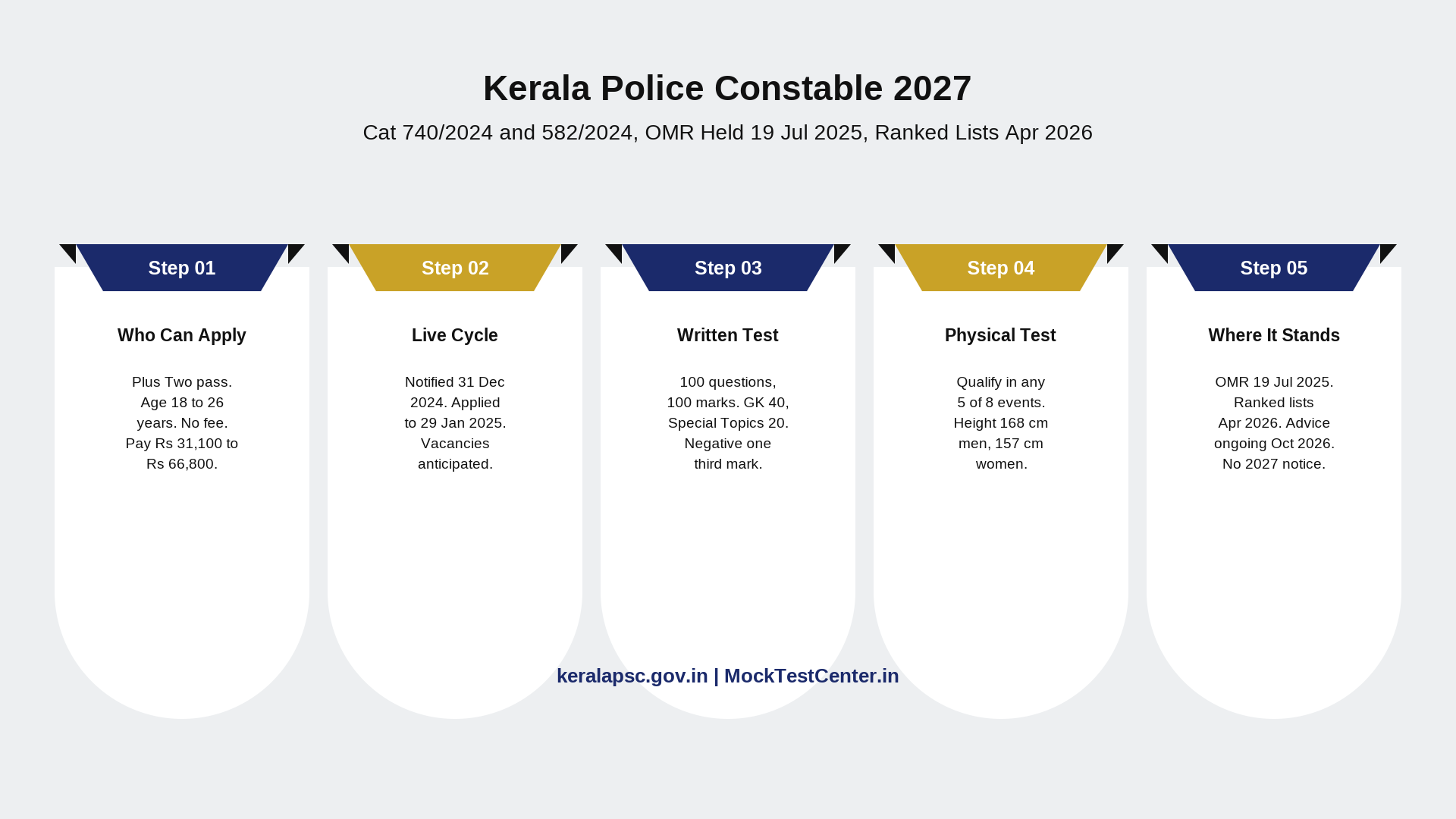
Kerala Police Constable 2027 on this page follows the live recruitment run by the Kerala Public Service Commission, and the live cycle is the notification published on 31 December 2024 under Category Numbers 740/2024 and 582/2024. Applications for that cycle ran from 31 December 2024 to 29 January 2025. The common OMR test was held on 19 July 2025. Ranked lists came into force in April 2026, and advice of candidates from those lists was still going on in October 2026.
No separate 2027 notification has been published as of 23 November 2026, so this guide anchors on the 2024 cycle and on the cycles that ran before it, and says so wherever a 2027 figure would otherwise be guessed. The page carries 2027 in its title because the site groups examination pages by that year. The facts below carry the category numbers they belong to, so a reader can check each one against the Kerala PSC website at keralapsc.gov.in.
One fact about this recruitment surprises first time candidates, and it shapes everything else in this guide. Kerala PSC does not publish a firm total of vacancies in the constable notification. The notification names the post, the battalions, and the districts, and says vacancies are anticipated. The ranked list then stays alive and the commission advises candidates from it as vacancies arise, battalion by battalion. Any page that prints a firm vacancy total for the live cycle is guessing.
The post itself carries two names, and the two names cause half the confusion on the internet. In Kerala the constable in the civil police is called a Civil Police Officer, shortened to CPO. The Armed Police Battalion post is called Police Constable (Trainee). Trackers use the two names as if they were two different examinations. They are two doors into the same uniformed service, run under different category numbers, with the same pay scale of Rs 31,100 to Rs 66,800 and the same Plus Two qualification.
The 2024 cycle covered both doors. Category Number 740/2024 was Police Constable (Trainee) in the Armed Police Battalion, for men. Category Number 582/2024 was Woman Police Constable in the Woman Police Battalion. The earlier cycle that most candidates still talk about was Category Number 537/2022, gazetted on 15 December 2022, with applications from 17 December 2022 to 18 January 2023 and its OMR test on 15 and 22 July 2023. This guide uses the 2024 cycle as the live one and the 2022 cycle as the last finished reference point.
Kerala Police Constable 2027 at a glance
| Detail | Kerala Police Constable 2027, as run in the 2024 cycle |
|---|---|
| Conducting body | Kerala Public Service Commission (Kerala PSC), website keralapsc.gov.in |
| Posts | Police Constable (Trainee), Armed Police Battalion, Cat 740/2024; Woman Police Constable, Woman Police Battalion, Cat 582/2024 |
| Live cycle | Notification 31 December 2024; applications 31 December 2024 to 29 January 2025 |
| Vacancies | Anticipated, battalion wise; no firm total published |
| Qualification | Pass in Higher Secondary (Plus Two) examination or its equivalent |
| Age | 18 to 26 years, with relaxation to 29 for OBC, 31 for SC and ST, 40 for ex servicemen |
| Pay scale | Rs 31,100 to Rs 66,800 per month, plus allowances |
| Application fee | Nil; Kerala PSC charges no application fee, applications go through One Time Registration |
| Written test | OMR test, 100 questions, 100 marks, General Knowledge 40, Current Affairs 10, Arithmetic and Mental Ability 10, General English 10, Regional Language 10, Special Topics 20 |
| Physical test | Physical Measurement, then Physical Efficiency Test, qualify in any 5 of 8 events of the National Physical Efficiency One Star Standard Test |
| Where it stands | Common OMR test held 19 July 2025; ranked lists in force from April 2026; advice from the lists ongoing as of October 2026 |
| 2027 notification | Not out as of 23 November 2026; constable notifications have typically appeared in December |
Where the recruitment stands right now
The 2024 cycle is in its last stage. The common OMR test for Category Number 582/2024 was held on 19 July 2025, and the Physical Measurement and Physical Efficiency Test for that category were held on 3, 4, 5 and 6 February 2026, with a remeasurement on 19 February 2026. The ranked list for the Woman Police Constable post, Ranked List Number 320/2026/ER XV, came into force on 21 April 2026. Ranked lists for Category Number 740/2024, the Armed Police Battalion constable post, were published on 17 April 2026, battalion by battalion, and the commission was still advising candidates from them in October 2026. For KAP III Battalion at Pathanamthitta, advice had reached 340 candidates by 23 October 2026, with the list due to run to 16 April 2027.
That calendar matters because Kerala PSC ranked lists do not live forever. A ranked list for the constable post stays in force for a fixed period, and candidates who sit below the advised ranks wait for vacancies to arise before it expires. The women CPO list from the earlier cycle shows what that wait can look like. That list came into force on 20 April 2024 with 964 candidates, and by April 2025 only 268 appointments had been made from it. Rank holders protested outside the Secretariat in April 2025, and 45 advice memos went out two days before the list expired. A candidate who treats a place on the ranked list as a job offer will be disappointed. A place on the list is a chance, and the chance depends on vacancies arising before the list runs out.
The cycle before that tells the same story on a larger scale. The CPO notification was first issued on 31 December 2019. The preliminary examination was held in 2021, the main examination on 20 March 2022, and the physical tests in October and November 2022. The ranked list came into effect on 23 April 2023 with 13,975 candidates across seven battalions. By December 2024 only 4,784 of them had received appointment, and thousands were still waiting. The commission had already issued a fresh notification for the same post in December 2022, before that ranked list was even published, and rank holders called that step illegal in their protest. The dispute shows a hard truth about this recruitment. The list is long, the appointments are slow, and a new notification does not wait for the old list to finish.
For a candidate reading this page in November 2026, the practical position is plain. The 2024 cycle is closed to new applications. Its lists are running. The next chance is the next notification, and constable notifications have typically appeared in December, as the 2019, 2022 and 2024 notifications all did. That pattern is a tracker observation, not a promise from the commission. The only safe watch is the Kerala PSC website and the Thulasi profile, where the notification appears first.
The name problem, and why tracker pages disagree
Search for this examination and the results will call it four different things. Civil Police Officer, CPO, Police Constable, Kerala Police Constable. Some pages add Armed Police Battalion, some add Woman Police Constable, some print a vacancy total of 7,000, some print 1,250, and one page says the notification is out while another on the same site says it is expected shortly. The mess has a cause, and the cause is the way Kerala PSC runs the recruitment.
Kerala PSC notifies the constable post battalion by battalion and category by category. The Armed Police Battalion constable, the Woman Police Battalion constable, the IRB Commando Wing constable, and the district civil police constable can each carry their own category number in the same gazette, or in different gazettes months apart. A tracker that copies one category number and calls it the whole recruitment will be wrong about the rest. A candidate who reads only one tracker page will apply under the wrong category number, or miss the category that fits them.
The 537/2022 notification illustrates it. Competitive Cracker lists it as Civil Police Officer with Category Number 537/2022, gazetted 15 December 2022, and names the post Police Constable (Armed Police Battalion) in the same table, with battalion wise anticipated vacancies, pay Rs 31,100 to Rs 66,800, age 18 to 26, and the OMR test on 15 and 22 July 2023. Kerala Job Point lists the same category number as Civil Police Officer with applications from 17 December 2022, an unofficial vacancy claim of 7,000 plus, and the same age and pay. Both pages describe the same notification. Neither page is wrong about the core facts. The vacancy total is the part with no official source, and this guide prints no total for that reason.
The 740/2024 notification illustrates the same trap from the other side. Skill Rhino calls Category Number 740/2024 the Civil Police Officer notification, while the Kerala PSC website lists 740/2024 as Police Constable (Trainee) in the Armed Police Battalion. The two labels describe the same category. The civil police constable and the armed battalion constable share the pay scale, the Plus Two qualification and the 100 mark OMR pattern, so a tracker that swaps the labels still gets the preparation facts right and the post name wrong. This guide uses the post names exactly as the Kerala PSC website prints them, and gives the category number with every fact, so the reader can match each claim to the right notification.
One more label needs care. Testbook says the last date to apply for Kerala Police Constable recruitment was 29 January 2026. That date does not fit any notification in the sources read. The 740/2024 and 582/2024 applications closed on 29 January 2025, with one tracker page putting the Woman Police Constable closing date at 31 January 2025. Testbook appears to have carried the 2025 closing date forward by a year. This guide uses 29 January 2025 and records the 31 January 2025 date as a conflict.
Posts and vacancies, battalion by battalion
The constable recruitment is organised by battalion, and the battalion decides where a candidate serves. In the 537/2022 cycle the battalions included SAP at Thiruvananthapuram, KAP III covering Kollam, Alappuzha and Pathanamthitta, and KAP V at Idukki, with each battalion tied to a PSC district office. In the 740/2024 cycle the battalions included SAP at Thiruvananthapuram, KAP III at Pathanamthitta, and KAP IV at Kasaragod, among others. A candidate applies for a battalion, not for the state as a whole, and the ranked list is prepared battalion by battalion. The choice of battalion is a real decision. A battalion with more vacancies advises deeper into its list, and a candidate who picks a battalion with few vacancies waits longer for the same rank.
Vacancies are described as anticipated in the notification, which is Kerala PSC language for a number the department has not fixed yet. The commission prepares the ranked list, and the police department reports vacancies against it over the life of the list. That is why no firm total exists at notification time, and why tracker totals disagree so widely. Kerala Job Point prints an unofficial 7,000 plus for the 537/2022 cycle. State Govt Jobs prints 1,250 posts for a 2026 constable recruitment with a last date of 23 November, a page that carries no category number in the material read and that this guide could not tie to any Kerala PSC notification. Technogold prints an expected 2,000 to 5,000 for CPO. None of the three totals comes from the commission, and this guide repeats none of them as fact. The only vacancy numbers with an official source are the advice figures on the Kerala PSC website, such as the 340 candidates advised for KAP III by 23 October 2026.
Alongside the general constable notifications, Kerala PSC notifies small special recruitment and No Candidate Available categories through the year. The gazette of 30 October 2026, Categories 162/2026 to 173/2026, included one Police Constable (Trainee) post in KAP I Battalion at Ernakulam, Category Number 172/2026, reserved for Latin Catholic and Anglo Indian candidates, with Plus Two qualification, age 18 to 33, and the same pay scale of Rs 31,100 to Rs 66,800. Categories 646/2025 and 830/2025 covered Woman Police Constable posts, Category 640/2025 covered Havildar in the Armed Police Battalion for ST candidates only, and Category 790/2025 covered Senior Civil Police Officer for ST candidates only, with its shortlist published on 9 October 2026. These small categories matter to the candidates they cover, and they are easy to miss, because they sit inside large gazettes with a dozen other posts. A candidate from a reserved community should read every gazette, not only the big constable notification.
Who can apply
The qualification is simple, and that simplicity is part of why the competition is fierce. A pass in the Higher Secondary examination, Plus Two, or its equivalent is enough. No degree is needed, no subject is prescribed, and no minimum percentage is stated in the notification summaries read. A candidate who has finished Plus Two can apply. A graduate can also apply, and many do, because the constable post is a secure government job with a pension, and graduates compete for it alongside Plus Two holders.
The age limit in the 537/2022 cycle was 18 to 26 years, for candidates born between 2 January 1996 and 1 January 2004, both dates included. The upper limit relaxes to 29 years for OBC candidates, 31 years for SC and ST candidates, and 40 years for ex servicemen. The same 18 to 26 band is printed by every tracker page for the constable post, and Testbook repeats it for the current cycle. The birth window for the 740/2024 cycle was not stated in the sources read, so this guide does not print one. A candidate should read the birth dates in the notification they apply under, because the window moves with the notification year and a candidate who is a year over the limit in one cycle may be inside it in the next, or the other way round.
Indian citizenship is required. Differently abled candidates are not eligible for the constable post in the Armed Police Battalion, and the same exclusion appears in the SI notification for the civil police. Women apply under the Woman Police Constable category, not under the Armed Police Battalion constable category. The physical standards below are the gate that removes more candidates than the written test does, and they deserve more preparation time than most candidates give them.
Physical standards, the first gate
Kerala PSC measures the body before it tests the mind, and the measurement standards are exact to the centimetre. For men in the 537/2022 cycle, the minimum height was 168 cm, the minimum chest 81 cm, with a minimum expansion of 5 cm. For the Woman Police Constable post, the minimum height is 157 cm, and 150 cm for SC and ST candidates. Testbook prints 167 cm as the male height for the constable post, which matches the Armed Police SI standard rather than the 168 cm printed in the 537/2022 notification summary. This guide uses 168 cm and records the 167 cm figure as a conflict, because the two figures come from different posts and a candidate who trains to the wrong figure can fail measurement by a centimetre.
Chest measurement is taken twice, once at rest and once after full expansion, and the difference must reach the minimum expansion. A candidate whose chest measures 81 cm at rest and expands to 84 cm fails, because the expansion is only 3 cm. A candidate whose chest measures 79 cm at rest and expands to 86 cm also fails, because the rest measurement is below the minimum. Both numbers must pass together. Candidates who train the chest muscles and practise full breathing can add a centimetre or two of expansion, and that centimetre is often the difference between passing and going home.
Vision standards are strict, and they are checked with the same care as height and chest. The SI notification prints them in full: distant vision 6/6 in each eye by the Snellen test, near vision 0.5 in each eye, without glasses, with full field of vision. Colour blindness, squint, knock knee, flat feet, varicose veins and bow legs are listed as disqualifications. The constable notification summaries read do not print the vision figures separately, but the same standards apply across Kerala Police recruitment, and a candidate with weak eyesight should get tested before applying, not after the measurement day.
A medical certificate from a Civil Surgeon is needed at the Physical Efficiency Test stage for the SI post, and the same practice applies to the constable selection. The certificate states that the candidate is physically fit for the post. A candidate should carry it in the form the notification asks for, because a certificate in the wrong form is treated as no certificate.
Kerala Police Constable exam pattern in full
The Kerala Police Constable exam pattern is a single OMR test of 100 questions and 100 marks. The pattern below comes from the 537/2022 and 740/2024 cycle syllabus as printed by Competitive Cracker and PYQ Sathi, and it matches the pattern printed for the Police Constable post in the 2022 cycle. The earlier 2019 cycle ran differently, with a preliminary examination in 2021 and a main examination on 20 March 2022, so a candidate using a 2019 cycle question paper should know the structure has changed since then.
| Section | Marks |
|---|---|
| General Knowledge | 40 |
| Current Affairs | 10 |
| Simple Arithmetic and Mental Ability | 10 |
| General English | 10 |
| Regional Language (Malayalam, Kannada or Tamil) | 10 |
| Special Topics related to the post | 20 |
| Total | 100 |
General Knowledge carries 40 marks, and its internal break up is printed in the syllabus. History carries 5 marks, Geography 5, Economics 5, the Indian Constitution 8, Kerala and its systems of administration 3, Biology and public health 4, Physics 3, Chemistry 3, and Arts, sports, literature and culture 4. The Constitution alone carries more marks than Physics and Chemistry together, and Kerala administration carries only 3, which surprises candidates who spend weeks on Kerala history and skip the Constitution. The marks say where the time should go.
Special Topics carries 20 marks, a fifth of the paper, and it is the section that separates constable candidates from general PSC candidates. The break up is the Indian Penal Code 4 marks, the Code of Criminal Procedure 3, the Indian Evidence Act 2, the Kerala Police Act 3, the Narcotic Drugs and Psychotropic Substances Act 2, the Protection of Children from Sexual Offences Act 2, the Information Technology Act 2, and the Right to Information Act 2. A candidate who has never read a section of the Kerala Police Act will lose marks here that no amount of general knowledge can recover. The three old codes, the IPC, the CrPC and the Evidence Act, were replaced by new criminal laws in 2024, and the syllabus as printed still names the old codes. A candidate should check whether the current notification prints the new law names, because a question paper written after the change may use them.
Negative marking follows the Kerala PSC standard of one third of a mark per wrong answer. The constable notification summaries read do not print the negative marking figure separately, but the SI written test prints a penalty of one third, or 0.33 marks, per wrong answer, and the same rule applies across Kerala PSC OMR tests. Three wrong answers cancel one correct answer. A candidate who guesses on thirty questions and gets ten right loses ten marks net against a candidate who leaves the same thirty blank, and that gap is often the gap between the ranked list and the waiting room.
The duration of the OMR test was not stated in the constable sources read. Kerala PSC OMR tests of 100 questions commonly run for 75 minutes, and the SI main OMR test prints 75 minutes for 100 questions. This guide does not state a duration for the constable test, because the notification is the only source that can settle it, and the figure was not found in the sources read. A candidate should read the duration in the hall ticket and practise at that pace, not at a pace guessed from another post.
The physical efficiency test, 5 of 8 events
The Physical Efficiency Test uses the National Physical Efficiency One Star Standard Test, and a candidate must qualify in any five of the eight events. The events and the minimum standards for men are the same across Kerala Police recruitment, and they are printed in full in the SI notification. The constable notification summaries read name the same test and the same five of eight rule without printing the event table separately, so the table below follows the SI notification and is marked as such.
| Event, men | Minimum standard |
|---|---|
| 100 metres run | 14 seconds |
| High jump | 132.20 cm |
| Long jump | 457.20 cm |
| Putting the shot, 7,264 grams | 609.60 cm |
| Throwing the cricket ball | 6,096 cm |
| Rope climbing, hands only | 365.80 cm |
| Pull ups or chinning | 8 times |
| 1,500 metres run | 5 minutes 44 seconds |
| Event, women | Minimum standard |
|---|---|
| 100 metres run | 17 seconds |
| High jump | 1.06 metres |
| Long jump | 3.05 metres |
| Putting the shot, 4 kg | 4.88 metres |
| 200 metres run | 36 seconds |
| Throwing the throw ball | 14 metres |
| Shuttle race, 25 metres x 4 | 26 seconds |
| Skipping, one minute | 80 times |
Five of eight sounds generous until a candidate tries the rope climb or the 1,500 metres run. The rope climb needs grip and technique, not only arm strength, and a candidate who has never climbed a rope will fail it on the day however fit they are. The 1,500 metres run needs pacing, and a candidate who sprints the first lap will walk the last one. The sensible plan is to pick five events early and train those five, rather than spreading effort across all eight. The shot put and the cricket ball throw reward technique as much as strength, and a week of coaching on the throwing action can add a metre that months of gym work cannot.
The physical test comes after the written test, and the gap between the two is short. In the 582/2024 cycle the OMR test was held on 19 July 2025 and the physical tests on 3 to 6 February 2026, a gap of about six months, but a candidate who waits for the written result before starting physical training has already lost. Physical fitness takes months to build and days to lose. A candidate who trains through the written preparation, even for half an hour a day, arrives at the physical test ready. A candidate who starts after the result arrives does not.
How selection actually runs
Selection runs in stages, and each stage removes candidates. The written OMR test comes first, and only candidates who clear it are called for physical measurement. Physical measurement removes candidates who miss the height or chest standards. The Physical Efficiency Test removes candidates who fail to qualify in five events. Medical examination follows, and document verification closes the process. The commission then publishes the ranked list, battalion by battalion, in order of merit.
One step in the middle catches more candidates than any other, and it has nothing to do with study or fitness. Kerala PSC asks candidates to submit a confirmation for writing the examination through their One Time Registration profile, within the period the commission announces. A candidate who applies and forgets the confirmation is not allowed to sit the test. The confirmation window for the 740/2024 cycle ran in May, with Skill Rhino noting that confirmation ran to 15 May. A candidate should check the Thulasi profile every week after applying, because the confirmation window is announced on the profile and the commission does not chase candidates who miss it.
One Time Registration itself is the first step, and it must be done before applying. A candidate registers on keralapsc.gov.in, uploads a photograph taken within six months, with the name and the date of the photograph printed legibly at the bottom, and the photograph once uploaded stays valid for ten years. No application fee is required, and the Kerala PSC tips page states that plainly. A candidate who pays anyone to apply, or to confirm, is paying a fraud. The application, the confirmation and the hall ticket are all free.
The ranked list is the end of the process and the start of the wait. The list is prepared in order of merit from the written test and the physical stages, and it stays in force for a fixed period. Advice follows as vacancies are reported. The 740/2024 lists came into force in April 2026, and advice was still going on in October 2026. A candidate on the list should keep the Thulasi profile updated and watch for advice memos, because an advice memo that is not answered in time can lapse.
Pay, training and what the job leads to
The pay scale is Rs 31,100 to Rs 66,800 per month, and it has stayed the same across the 537/2022 and 740/2024 cycles. Dearness allowance, house rent allowance and other allowances sit on top of the basic pay. Tracker pages print gross monthly figures of Rs 40,000 to Rs 58,000 for the constable post. Those are estimates, because the amount in hand varies with posting, allowances and deductions, and this guide prints the official scale and labels the gross figures as estimates.
The constable is the bottom rung of the Kerala Police, and the ladder above it is real. A constable can rise to Senior Civil Police Officer, then Head Constable, then Assistant Sub Inspector and Sub Inspector through seniority and departmental tests. The SI notification itself reserves a constabulary quota for graduate constables and head constables who have completed probation, Category Number 450/2025, so a constable with a degree has a direct route to the SI post without competing in the open market. That route is one reason graduates apply for a Plus Two post.
Training follows selection. A selected constable undergoes training at the Police Training College or an institution the government specifies, and the training covers law, drill, weapons, physical fitness and field work. The training period for the constable post was not stated in the sources read, and this guide does not guess it. The SI notification prints one year of training at the Police Training College followed by ten and a half months of practical training in a district, and two years of probation within a continuous period of three years, and the constable training follows the same pattern in outline.
The syllabus, subject by subject
General Knowledge is the largest section, and it rewards steady reading rather than last minute cramming. History covers ancient, medieval and modern India, with Kerala history inside it. Geography covers physical and Indian geography, with Kerala geography inside it. Economics covers basic concepts, Indian economy and Kerala economy. The Indian Constitution carries 8 marks, the largest single share, and it covers the Preamble, fundamental rights, directive principles, the President, Parliament, the judiciary and the states. Kerala administration carries 3 marks and covers the state government, the district administration and local self government. Biology and public health carry 4 marks. Physics and Chemistry carry 3 each. Arts, sports, literature and culture carry 4, and they cover Kerala art forms, Malayalam literature and Indian sports.
Current Affairs carries 10 marks, and it covers the news of the year before the examination, with Kerala news, national news and international news. A candidate who reads a newspaper every day for six months will score here. A candidate who tries to cover a year of news in a week will not. The Kerala PSC question papers ask about appointments, awards, sports results, government schemes and state events, and the answers are in the newspaper, not in a guide book.
Simple Arithmetic and Mental Ability carries 10 marks, and it covers number work, percentages, ratios, averages, time and work, simple interest, and reasoning questions of the kind that test observation and logic. The level is Plus Two, and the questions reward speed. A candidate who practises twenty sums a day for three months will finish this section inside the time. A candidate who leaves it to the last month will run out of time in the hall.
General English carries 10 marks, and it covers grammar, vocabulary, synonyms and antonyms, one word substitution, spelling, idioms and phrases, and comprehension. The level is Plus Two, and the questions are straightforward. A candidate who reads English every day, even for twenty minutes, will do better than a candidate who memorises word lists.
Regional Language carries 10 marks, and the candidate answers in Malayalam, Kannada or Tamil. The section covers grammar, vocabulary and comprehension in the language the candidate chooses. A candidate from Kasaragod who studied in Kannada medium, or from Palakkad who studied in Tamil medium, should answer in the language they are strongest in, not the language their friends choose.
Special Topics carries 20 marks, and it is the only section that tests the job itself. The Indian Penal Code covers offences, punishments and general exceptions. The Code of Criminal Procedure covers arrest, investigation and trial. The Indian Evidence Act covers what counts as proof. The Kerala Police Act covers the organisation and powers of the Kerala Police. The NDPS Act covers drug offences. The POCSO Act covers offences against children. The Information Technology Act covers cyber offences. The Right to Information Act covers the right to information and the duties of public authorities. A candidate who reads the bare provisions of each Act, with a short guide to what each section means, will score here. A candidate who skips this section gives away a fifth of the paper.
A preparation plan that fits the real paper
The paper is 100 marks, and the plan should follow the marks. General Knowledge is 40 marks, so it takes the largest share of time. Special Topics is 20 marks, so it takes the next largest share. Current Affairs is 10 marks, and it takes daily reading rather than a block of study. Arithmetic and Mental Ability, General English and Regional Language are 10 marks each, and they take practice rather than reading.
A candidate with six months should spend the first two months on General Knowledge and Special Topics, reading the Constitution and the Kerala Police Act slowly, and building a notebook of facts. The next two months should add Current Affairs every day and start solving previous year papers under time. The last two months should be mock tests, one full paper a week at first and two a week near the end, with each paper followed by an hour of review. The review matters more than the score. A candidate who writes a mock test and never looks at the wrong answers has wasted the paper.
Previous year papers are the best preparation material for this examination, and Kerala PSC publishes them on its website. The 537/2022 cycle papers from 15 and 22 July 2023, and the IRB Commando Wing paper from 30 September 2022, are available with answer keys. PYQ Sathi hosts the same papers with a note that the commission does not permit rehosting, and links to the official PDF. A candidate should solve at least five previous papers before the examination, because the pattern repeats and the same topics return in different words.
Physical training runs alongside the study, not after it. Half an hour a day, five days a week, is enough to build the base. Running builds the 1,500 metres time. Pull ups build the chinning count. Rope climbing needs a rope and a ground, and a candidate without access to one should practise grip work and climbing technique at a gym. The high jump and long jump need a ground and a coach, even for a few sessions, because the technique matters as much as the strength. A candidate who trains the body and the mind together arrives at both tests ready.
Mistakes that cost candidates a place
The first mistake is preparing for the wrong cycle. Tracker pages mix the 2019, 2022 and 2024 cycles, and they print different patterns for each. A candidate who studies the two stage pattern of the 2019 cycle for a single OMR test wastes months. Read the category number. The live cycle is 740/2024 and 582/2024, and it runs on a single common OMR test.
The second mistake is missing the confirmation. Kerala PSC asks for confirmation through the Thulasi profile before the examination, and a candidate who applies and forgets it does not sit the test. The confirmation window is short, and the commission does not send reminders to individual candidates. Check the profile every week after applying.
The third mistake is skipping Special Topics. Twenty marks is a fifth of the paper, and it is the section where a constable candidate can outscore a general PSC candidate. A candidate who reads the Kerala Police Act and the POCSO Act for a week will pick up marks that other candidates leave on the table.
The fourth mistake is guessing blindly. One third of a mark goes for each wrong answer, and three wrong answers cancel one correct answer. Attempt a question only when two options can be eliminated, and leave the rest. The same discipline applies in every Kerala PSC OMR test.
The fifth mistake is starting physical training after the written result. The gap between the written test and the physical test is short, and fitness takes months to build. A candidate who trains through the written preparation passes the physical test. A candidate who starts after the result often fails it, and the written marks are wasted.
The sixth mistake is trusting a vacancy total from a tracker page. Kerala PSC does not publish a firm total in the constable notification, and the 2024 cycle has no published total. A page that prints 7,000 or 1,250 for the live cycle is guessing, and a candidate who plans around a guessed number plans around nothing. The hard numbers are the advice figures on the Kerala PSC website, and they are the only ones this guide prints.
The seventh mistake is choosing the battalion carelessly. The ranked list is prepared battalion by battalion, and a battalion with more vacancies advises deeper into its list. Read the battalion list in the notification, ask serving constables which battalions have more vacancies, and choose with that in mind. The choice cannot be changed after the application is submitted.
What to watch next
The next notification is the next chance, and constable notifications have typically appeared in December. The 2019 notification came on 31 December 2019, the 2022 notification on 15 December 2022, and the 2024 notification on 31 December 2024. That pattern points to December, but it is a tracker observation, not a promise from the commission, and the commission has never announced a date in advance. Candidates should watch keralapsc.gov.in and their Thulasi profile through December, and should have the One Time Registration ready before the notification appears, because the application window runs for about a month and the first days are the easiest time to apply.
Candidates on the 2024 ranked lists should watch for advice memos and keep their profiles updated, because advice was still going on in October 2026 and the lists run to April 2027. Candidates who missed the 2024 cycle should prepare the base subjects now, because the syllabus changes little between cycles, and the candidate who starts in November is ahead of the candidate who starts when the notification appears. The preparation for the next notification starts now, and the examination rewards the candidate who started early.
Sources
Kerala Public Service Commission, official website keralapsc.gov.in, Ranked List Number 320/2026/ER XV, Woman Police Constable (Woman Police Battalion), Category Number 582/2024, pay Rs 31,100 to 66,800, common OMR test held 19 July 2025, Physical Measurement and Physical Efficiency Test held 3, 4, 5 and 6 February 2026, remeasurement 19 February 2026, ranked list in force from 21 April 2026. Kerala Public Service Commission, Ranked List Number 306/2026/DOH dated 17 April 2026 and Ranked List Number 305/2026/DOT dated 17 April 2026, Police Constable (Trainee), Armed Police Battalion, Category Number 740/2024, KAP III Pathanamthitta and SAP Thiruvananthapuram. Kerala Public Service Commission, Police Constable KAP III Battalion advice page, Category Number 740/2024, advice to 340 candidates by 23 October 2026, list to run to 16 April 2027. Kerala Public Service Commission, Tips to Applicants page, One Time Registration, photograph taken within six months valid for ten years, no application fee is required, confirmation for writing the examination through the One Time Registration profile.
Competitive Cracker, Kerala PSC Civil Police Officer Study Materials, notification gazetted 15 December 2022, Category Number 537/2022, Police Constable (Armed Police Battalion), pay Rs 31,100 to Rs 66,800, age 18 to 26 years, OMR test 15 and 22 July 2023, syllabus mark break up General Knowledge 40, Current Affairs 10, Simple Arithmetic and Mental Ability 10, General English 10, Regional Language 10, Special Topics 20, special topics break up IPC 4, CrPC 3, Evidence Act 2, Kerala Police Act 3, NDPS Act 2, POCSO Act 2, IT Act 2, RTI Act 2. Kerala Job Point, Kerala Police CPO Notification 2023, Category Number 537/2022, applications 17 December 2022 to 18 January 2023, age 18 to 26, born between 2 January 1996 and 1 January 2004, relaxation to 29 for OBC, 31 for SC and ST, 40 for ex servicemen, Plus Two qualification, height 168 cm, chest 81 cm with 5 cm expansion, Physical Efficiency Test any five of eight events of the National Physical Efficiency One Star Standard Test, unofficial vacancy claim 7,000 plus.
Skill Rhino PSC, Civil Police Officer page, notification 31 December 2024, Category Number 740/2024, Woman Civil Police Officer Category Number 582/2024, confirmation period to 15 May, women height 157 cm, SC and ST 150 cm. Defence Jobs Malayalam, Kerala Police Constable Male and Female Recruitment, Category Numbers 740/2024 and 582/2024, applications 31 December 2024 to 29 January 2025, Police Constable (Trainee) Armed Police Battalion and Woman Police Constable Woman Police Battalion. KPSC Helper, Kerala PSC Woman Police Constable Recruitment 2025, Category Number 582/2024, notification 31 December 2024, applications 31 December 2024 to 31 January 2025. PYQ Sathi, Kerala PSC Police Constable 2022 papers, Police Constable IRB Commando Wing Category Number 095/2022, OMR test 30 September 2022, pattern 100 questions, General Knowledge 40, Current Affairs 10, Simple Arithmetic and Mental Ability 10, General English 10, Regional Language 10, Special Topics 20.
New Indian Express, Kerala Candidates in CPO rank list demand additional posts, 29 December 2024, notification first issued 31 December 2019, preliminary examination 2021, main examination 20 March 2022, physical tests October to November 2022, ranked list 23 April 2023 with 13,975 candidates across seven battalions, 4,784 advised by December 2024. Mathrubhumi English, Women CPO Kerala PSC issues advise memos to 45, 18 April 2025, women CPO ranked list published 20 April 2024 with 964 candidates, 268 appointments by April 2025, 45 advice memos two days before expiry. Testbook, Kerala Police Constable 2026 page, last date to apply 29 January 2026, qualification Class 12, selection Written Exam, Physical Efficiency Test, Physical Measurement Test, Medical Exam, age 18 to 26, height 167 cm. State Govt Jobs, Kerala PSC Civil Police Officer and Armed Police Battalion 2026, 1,250 vacancies, last date 23 November, pay Rs 31,100 to 66,800, age 18 to 26. Technogold, Kerala Police Recruitment 2026, expected CPO vacancies 2,000 to 5,000, gross salary Rs 40,000 to 58,000, selection Preliminary Test, Physical Measurement Test, Physical Efficiency Test, Main Written Test, Medical. Saja, Kerala PSC Notification 2026 Cat No 162 to 173, gazette 30 October 2026, Police Constable (Trainee) KAP I Ernakulam Category Number 172/2026, Latin Catholic and Anglo Indian, 1 vacancy, age 18 to 33, pay Rs 31,100 to 66,800. IndGovtJobs, Kerala PSC Latest Notifications 2026, Category Numbers 640/2025 Havildar Armed Police Battalion, 646/2025 Woman Police Constable, 790/2025 Senior Civil Police Officer, 830/2025 Woman Police Constable.







