About JKSSB SI Finance 2027 Exam Series
📖 Table of Contents
- JKSSB SI Finance 2027 and the 2026 advertisement in numbers
- What a Sub-Inspector in the Finance Department does
- Who can apply for JKSSB SI Finance 2027
- The written exam, section by section
- The syllabus, subject by subject
- How the earlier cycle ran
- How hard is it to get in
- Mistakes that cost marks
- A 90 day plan that fits around a job
- Books and papers that actually help
- How to apply, and the documents to keep ready
- Previous papers and mock tests: how to use them
- Finance knowledge that helps after selection
- Sources
JKSSB SI Finance 2027: Sub Inspector Finance Guide
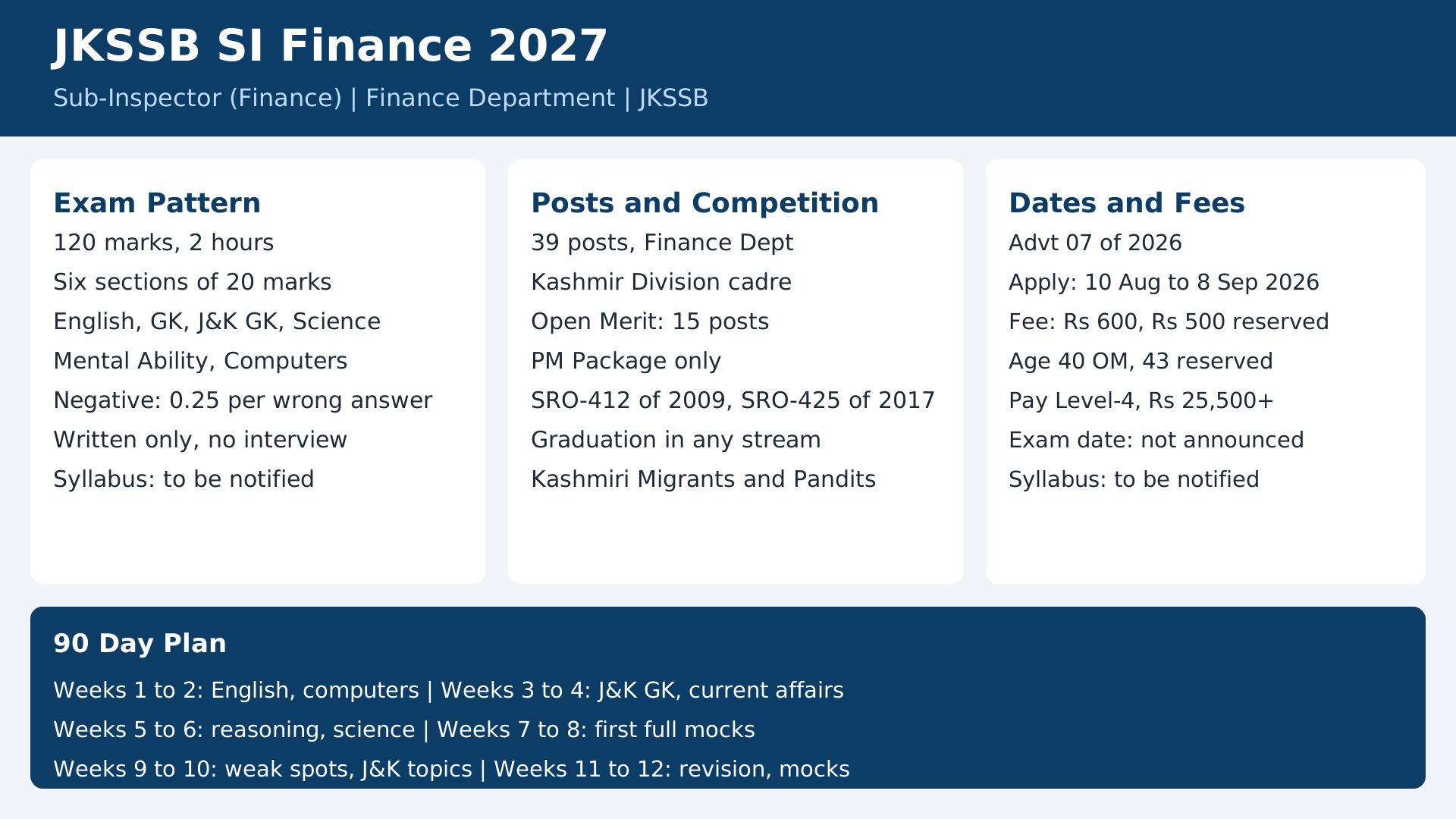
JKSSB advertised 39 Sub-Inspector (Finance) posts in the Finance Department under Advertisement No. 07 of 2026, and only a defined group of candidates can apply for them. The Jammu and Kashmir Services Selection Board opened applications on 10 August 2026 and closed them on 8 September 2026. JKSSB SI Finance 2027 has no separate fresh advertisement, so every fact in this guide comes from that 2026 advertisement and from the earlier graduate level Sub-Inspector Finance pattern. Read the eligibility condition first, because it decides whether this guide applies to you at all.
These 39 posts fall under the Prime Minister's Package for Kashmiri Migrants and Non-Migrant Kashmiri Pandits, and only candidates covered under SRO-412 of 2009 or SRO-425 of 2017 can apply. A general candidate with a graduation degree cannot apply for this cycle, however strong the preparation. The post carries Kashmir Division cadre and Level-4 pay, the board selects through a written examination only with no interview, and the detailed syllabus had not appeared as of 20 November 2026. If you hold the PM Package eligibility, the paper to prepare for is the 120 mark graduate level paper described below.
JKSSB SI Finance 2027 and the 2026 advertisement in numbers
| Item | Detail |
|---|---|
| Conducting body | Jammu and Kashmir Services Selection Board (JKSSB) |
| Advertisement | No. 07 of 2026 |
| Department | Finance Department |
| Posts | 39, all Kashmir Division cadre |
| Open Merit | 15 posts |
| Reserved categories | ST-1 4, ST-2 4, RBA 4, EWS 4, SC 3, OBC 3, ALC/IB 2 |
| Application window | 10 August 2026 to 8 September 2026, online only |
| Eligibility restriction | PM Package, SRO-412 of 2009 or SRO-425 of 2017 only |
| Pay scale | Level-4, Rs 25,500 to Rs 81,100 |
| Exam date | Not announced as of 20 November 2026 |
| Syllabus | To be notified separately by JKSSB |
Thirty nine posts is a small recruitment, and the Open Merit share of 15 posts is the number most candidates will be chasing. The reserved split is unusually even, with four posts each for ST-1, ST-2, RBA and EWS, three each for SC and OBC, and two for ALC and IB. Because the PM Package restriction limits the eligible pool, the competition is narrower than the post count suggests, but it is also a pool where most candidates are graduates preparing seriously, so the paper will still be decided by accuracy.
The cadre point needs care. These are Kashmir Division cadre posts, which means the posting will be within Kashmir Division. Candidates from across the Union Territory can apply, provided they meet the PM Package condition and the other eligibility conditions, but the job itself sits in Kashmir Division. A candidate from Jammu who applies should be ready to live and work in the Valley.
What a Sub-Inspector in the Finance Department does
A Sub-Inspector in the Finance Department works in the enforcement and inspection side of the department's work, and the job is a field post rather than a secretariat desk. The Finance Department runs the tax and accounts machinery of the Union Territory, and its inspectors and sub-inspectors are the people who visit offices, check records, verify returns and follow up on cases. The day involves reading files, visiting establishments, writing reports and keeping the paper trail straight, and the work rewards a candidate who is comfortable with numbers and with rules.
The post is often confused with the Finance Inspector post, which is a different post with a different pattern. The Inspector paper carries 100 marks with Finance and Accounts at 30 marks, while the Sub-Inspector paper carries 120 marks across six general sections of 20 marks each. The two posts also sit at different levels, and their notifications are separate. Candidates should check the post name on their application and prepare for the paper that matches it.
The career path runs inside the Finance Department, from Sub-Inspector upward through the inspector and officer grades as vacancies and seniority allow. The pay is Level-4, from Rs 25,500 to Rs 81,100, with the allowances that apply to Union Territory employees. It is a modest starting pay by the standards of graduate posts, and candidates who are comparing it with Level-6 posts should weigh the pay against the fact that this cycle admits only a small eligible pool, which changes the odds in a way no pay scale can.
The PM Package condition is the defining fact of this recruitment. The Prime Minister's Package for Kashmiri Migrants and Non-Migrant Kashmiri Pandits is a rehabilitation and employment scheme, and these 39 posts are part of it. The advertisement requires candidates to satisfy the conditions in SRO-412 of 2009 or SRO-425 of 2017, and applications from candidates who do not meet those conditions are liable to be rejected. The eligibility certificate for the package is a document to keep ready alongside the domicile and category certificates.
Who can apply for JKSSB SI Finance 2027
The educational qualification is a graduation degree from a recognised university, in any discipline. The notification accepts arts, science, commerce, management, computer applications and other streams, because it does not restrict the discipline. The degree must be held on or before the cut-off date in the notification, and the board checks the original certificates at document verification.
Domicile is compulsory, with a valid domicile certificate of the Union Territory of Jammu and Kashmir issued by the competent authority. On top of that, the candidate must satisfy the PM Package conditions under SRO-412 of 2009 or SRO-425 of 2017. This is not a preference or a quota within the 39 posts. It is the gate, and every one of the 39 posts falls under it.
| Category | Maximum age |
|---|---|
| Open Merit | 40 years |
| SC, ST-1, ST-2, RBA, ALC/IB, OBC, EWS | 43 years |
| Government service or contractual employment | 40 years |
| Ex-Servicemen | As per government rules |
The board counts age as on the cut-off date in the advertisement, and the Open Merit ceiling of 40 years is the standard JKSSB figure. Reserved categories get 43 years, which is the usual three year relaxation. Ex-servicemen are covered by the government rules rather than a fixed number in the tracker summaries, so an ex-serviceman candidate should read the age clause in the notification itself rather than rely on a summary table.
The fee is Rs 600 for the general category and Rs 500 for SC, ST-1, ST-2, EWS and PwBD candidates, paid through the online payment gateway during the application. The board does not consider an application without the fee. The window ran from 10 August to 8 September 2026, and it has now closed, so this guide is for candidates who already applied and are waiting for the exam date and the syllabus notice.
The written exam, section by section
Selection is by a written examination only, followed by document verification for shortlisted candidates. There is no interview, no physical test and no viva. The advertisement says JKSSB will notify the detailed syllabus separately, and until that notice appears the best guide is the pattern JKSSB used for the Sub-Inspector Finance post in its earlier graduate level cycle.
| Subject | Marks |
|---|---|
| General English | 20 |
| General Knowledge and Current Affairs | 20 |
| General Knowledge with special reference to UT of Jammu and Kashmir | 20 |
| General Science | 20 |
| Mental Ability Test | 20 |
| Computer Applications | 20 |
| Total | 120 |
The earlier pattern is a 120 mark paper in 2 hours, with six sections of 20 marks each and one mark per question. Negative marking is 0.25 marks for each wrong answer, and the board sets the questions in English only. The board draws the merit from the written examination only, which means the paper is the whole selection, and a weak section cannot be rescued later.
Two warnings belong here. The first is that this pattern is the earlier pattern, not the 2026 pattern, and the syllabus notice may change the weights when it appears. Candidates should check the notice the day it is published and adjust, rather than treating these six sections as final. The second is that finance and accounts does not appear as a section in the earlier Sub-Inspector paper, even though the post sits in the Finance Department. The earlier paper is a general graduate paper, and the finance knowledge that helps on the job is not tested as a separate section.
Until the syllabus notice appears, the sensible preparation is the six sections above, with extra attention to General Knowledge with special reference to Jammu and Kashmir and to Computer Applications, because those two sections reward preparation most directly. When the notice comes, the candidates who have already covered the general sections will only need to adjust, while candidates who waited will be starting from zero.
The syllabus, subject by subject
General English carries 20 marks and covers the standard graduate level grammar and comprehension topics: tenses, narration, modals, articles, clauses, prepositions, active and passive voice, error spotting, sentence correction, spelling correction, synonyms and antonyms, idioms and phrases, pairs of words, rearranging jumbled sentences, fill in the blanks, and reading comprehension. The section is steady and predictable, and a daily habit of twenty questions makes it one of the most reliable sources of marks in the paper.
General Knowledge and Current Affairs carries 20 marks and covers current events of national and international importance, Indian history with special reference to the Freedom Movement, the Constitution, Indian economy, geography, science and technology, environment and ecology, and culture and heritage. The current affairs half needs a daily note, because the questions reward candidates who followed the news for months rather than candidates who read a yearly booklet in the last week.
General Knowledge with special reference to the Union Territory of Jammu and Kashmir carries 20 marks and is the section where preparation pays most. History, economy, geography with weather, climate, crops, rivers, lakes, flora and fauna, heritage and culture, important tourist destinations, and the Jammu and Kashmir Reorganisation Act, 2019 are the named topics. Candidates should also cover the Centrally Sponsored Schemes and the Panchayati Raj Act, because they appear in the graduate level JKSSB papers with regularity.
General Science carries 20 marks and covers physics, chemistry and biology at school level, with everyday science, health, environment and technology in the mix. The level is school science, not a science degree, so a graduate from any stream can cover it with a standard general science book and a month of steady reading.
Mental Ability Test carries 20 marks and covers number series, letter series, analogies, classification, coding and decoding, blood relations, direction sense, statements and conclusions, Venn diagrams, problem solving and numerical operations. Speed matters here, and the only way to build it is timed practice with previous papers.
Computer Applications carries 20 marks and covers basic applications and components, fundamentals of computer science, hardware and software, input and output devices, MS Word, MS Excel, MS PowerPoint, internet and email, computer viruses and anti-virus, and the role of information technology in governance. The topics are memory based, so they give quick marks to anyone who revises them properly.
How the earlier cycle ran
The Sub-Inspector Finance post appeared in the JKSSB graduate level recruitment, and the board held a computer based test for these posts from 20 December 2021 onwards. That cycle covered Sub-Inspector and Inspector posts across several departments under the graduate level umbrella, and the Finance Sub-Inspector paper followed the six section pattern above. The board completed the result and selection for that cycle on written merit alone.
The 2026 cycle has a different shape. It is a single department, single post advertisement with 39 posts, all Kashmir Division cadre, all under the PM Package. The application window of 10 August to 8 September 2026 is short, at just under a month, and the exam date and syllabus are both still to be notified as of 20 November 2026. Candidates who applied should watch jkssb.nic.in for the syllabus notice first, because the exam date notice usually follows it, and the gap between the two notices runs short.
The restricted pool changes the preparation math. In an open JKSSB graduate paper, the applicant count can run into the tens of thousands for a few dozen posts. Here the eligible pool is limited to PM Package candidates, which keeps the numbers lower, but the candidates inside that pool are competing for only 39 posts, and the Open Merit seats are only 15. The paper will still be decided by a handful of marks.
How hard is it to get in
The board has published no applicant count for the 2026 cycle, so the competition can only be described, not measured. Thirty nine posts with a graduation only eligibility would normally draw a very large pool, but the PM Package restriction cuts that pool sharply. The candidates who remain hold the package eligibility and a graduation degree, and most of them will prepare seriously because the post is one of the few graduate openings tied to the package.
The 120 mark paper with 0.25 negative marking makes accuracy the deciding factor. With six sections of equal weight, there is no section to hide in and no section to skip. A candidate who scores evenly across all six sections will beat a candidate who is strong in three and weak in three, because the weak sections leak marks that the strong ones cannot make up. The merit list in a 39 post recruitment is thin, and a difference of two or three marks can move a candidate across the cut.
General Knowledge with special reference to Jammu and Kashmir is the section where the list will separate. It is the section most candidates underprepare, because the national current affairs feel more urgent and the Union Territory topics feel familiar enough to skip. They are not. The Reorganisation Act, the geography of the two divisions, the rivers and lakes, the tourist destinations and the schemes are all named topics, and they will appear as direct questions.
Mistakes that cost marks
The first mistake is applying without the PM Package eligibility. The advertisement is explicit, and the board will reject applications from ineligible candidates. A candidate who does not hold the SRO-412 or SRO-425 eligibility and still applies loses the fee and the time, and gains nothing. Check the certificate before the form, not after.
The second mistake is preparing for the Finance Inspector paper instead of the Sub-Inspector paper. The Inspector paper has Finance and Accounts at 30 marks and a 100 mark total, while the Sub-Inspector paper is six general sections of 20 marks each. The names are close and the department is the same, but the papers are different, and a month spent on accountancy for this post is a month spent on a section that does not exist in the paper.
The third mistake is waiting for the syllabus notice before starting. The notice will come, and when it does the exam date will follow soon after. The six general sections above are the preparation that transfers whatever the notice says, and a candidate who starts now will only need to adjust, while a candidate who waits will be starting from zero with weeks left.
The fourth mistake is guessing blindly under negative marking. Four wrong answers wipe out one right answer, and in a 120 mark paper with a thin merit list, that arithmetic decides ranks. Attempt what you can narrow down to two options, and leave the rest blank.
The fifth mistake is treating General Science as a section for science graduates only. The level is school science, and a month with a standard general science book is enough for a graduate from any stream. Candidates who skip it give away 20 marks, which is a sixth of the paper, for no reason at all.
JKSSB SI Finance aspirants often prepare for other state and national exams alongside this one. The IBPS PO 2027, SBI PO 2027, RBI Grade B 2027, NABARD Grade A 2027, SEBI Grade A 2027, IBPS Clerk 2027, SBI Clerk 2027, RBI Assistant 2027, IBPS SO 2027, UGC NET Commerce 2027 pages on this site carry the same style of mock test guide, and the pattern habit you build here transfers directly to them.
A 90 day plan that fits around a job
Weeks 1 to 2 belong to English and computers. Cover the grammar core in English and all the computer topics, with MS Office and input and output devices first. End each day with twenty questions in each subject, and keep an error notebook from day one.
Weeks 3 to 4 belong to General Knowledge with special reference to Jammu and Kashmir. History, geography, economy, heritage, tourist destinations and the Reorganisation Act need reading, not skimming. Add a daily current affairs note of ten lines, and revise the whole note every Sunday.
Weeks 5 to 6 belong to reasoning and science. Series, analogies, classification, coding and Venn diagrams in reasoning, and school level physics, chemistry and biology in science. Practise reasoning with a timer, because speed is a skill that only comes from timed work.
Weeks 7 to 8 are for the first full mocks. Two full 120 mark papers in 2 hours each week, reviewed the same day. Sort every wrong answer into three piles: did not know, knew but rushed, and guessed badly. Shrink the third pile first, because it is the only one you can fix by behaviour alone.
Weeks 9 to 10 are for the weak spots the mocks exposed, plus a second pass over the Jammu and Kashmir topics and the computer topics. Re-read the error notebook, re-do the sections where the score is lowest, and add one mock a week with the 0.25 negative marking applied in full.
Weeks 11 to 12 are for revision and mocks only. No new theory and no new book. Re-read the notes, re-do the computer and Jammu and Kashmir sections, and sit for three more full mocks in exam conditions. In the last week, cut the study hours and protect your sleep, because a fresh mind on the exam day is worth more than one more chapter.
Books and papers that actually help
For General Knowledge, a standard general knowledge manual plus a Jammu and Kashmir general knowledge book covers the syllabus, and a daily newspaper covers current affairs. One manual read twice beats three manuals read once.
For English, a school level grammar book and a previous papers book for graduate level exams cover the section. The grammar is standard, and twenty questions a day for ninety days is enough to make it automatic.
For reasoning, science and computers, standard books at school and graduate level are enough, and the JKSSB graduate level previous papers are the best guide to the level. Solve them in 2 hours with the 0.25 negative marking applied, and score yourself strictly, because a mock without negative marking teaches you nothing about this exam.
The single most useful habit is the error notebook. Every mock, every practice set, every wrong answer goes in with the reason it went wrong. In the last two weeks, that notebook is your revision, and it is worth more than any new book.
How to apply, and the documents to keep ready
The application for Advertisement No. 07 of 2026 ran online on the JKSSB portal from 10 August to 8 September 2026, and the window has now closed, so this section is for candidates who applied and for candidates who will apply when the next cycle opens. The steps are the same in every JKSSB recruitment, and the PM Package condition adds one document to the list.
First, read the advertisement in full, including the PM Package condition, before touching the form. The notification requires candidates to satisfy the conditions in SRO-412 of 2009 or SRO-425 of 2017, and the form asks for the package eligibility alongside the domicile and category details. Second, complete the one time registration on the portal if you have not done so already, and keep the login details safe, because the same login carries the admit card and the result later.
Third, fill the form with the details as they appear on the matriculation certificate, because the board matches the name, the date of birth and the parents names against that certificate. Fourth, upload the photograph and signature in the size and format the notification prescribes, and check the preview before submitting. Fifth, upload the domicile certificate, the category certificate if you claim reservation, and the PM Package eligibility certificate. Sixth, pay the fee online and download the confirmation page, because the payment receipt is the proof that the application went through.
Keep a folder ready with the matriculation certificate, the domicile certificate, the category certificate if you claim reservation, the PM Package eligibility certificate, the graduation degree and marks sheets, a valid photo identity proof, and two recent passport size colour photographs. The board checks the original certificates at document verification, and it gives no later chance to produce a certificate that was missing at the application stage.
Previous papers and mock tests: how to use them
The best practice material for this post is the set of previous JKSSB graduate level papers, including the Sub-Inspector Finance paper from the earlier cycle. The six sections in the earlier pattern appear in the same form in the graduate level papers, and the level is the same. Solve them in 2 hours with the 0.25 negative marking applied, and score yourself strictly, because a mock without negative marking teaches you nothing about this exam.
Use the mocks in three stages. In the first stage, solve section-wise papers to build speed in each subject, with English and computers first, because they are the fastest sections. In the second stage, solve full 120 mark papers in 2 hours, with the whole paper reviewed the same day. In the third stage, in the last month, solve two full papers a week in exam conditions, at the same time of day as the real exam, with no breaks and no phone.
The review matters more than the score. Write down every question you got wrong and why, and sort the reasons into three piles: did not know, knew but rushed, and guessed badly. The third pile is the one to shrink first, because it is the only one you can fix by behaviour alone. Re-do the questions in the first pile after a week, and check whether they stick. A mock that is solved and forgotten is a wasted mock, and a mock that is reviewed properly is worth more than a chapter of theory.
Finance knowledge that helps after selection
The paper tests no finance section, but the job sits in the Finance Department, and a candidate who learns the basics of government accounts before joining will settle in faster. The department works with budgets, expenditure statements, treasury operations, tax collection and audit, and the language of the work is the language of double entry bookkeeping: journal, ledger, trial balance, bank reconciliation, receipts and payments, and financial statements.
A candidate who has never studied commerce can pick up the basics in a few weeks with a standard accountancy textbook, and the effort pays twice. It helps in the General Knowledge section, where economy and taxation topics appear, and it helps on the job, where the first month is easier for a candidate who already knows what a voucher, a challan and a treasury are. The Finance Department also runs the Public Financial Management System, and a working familiarity with computer based accounting will help from the first week.
None of this is required for the exam, and a candidate should not let it crowd out the six sections that actually appear. Learn the basics in the last month, after the six sections are strong, and treat it as preparation for the job rather than for the paper. The paper decides the selection, and the finance knowledge decides how fast you settle in after it.
Sources
JKSSB Edge Sub-Inspector Finance recruitment page, for Advertisement No. 07 of 2026, the 39 posts, the category-wise split, the Kashmir Division cadre, the PM Package restriction, the application window of 10 August to 8 September 2026, the Level-4 pay scale, the age limits, the fee and the written only selection.
Oliveboard JKSSB Graduate Level Post page, for the earlier Sub-Inspector Finance pattern of 120 marks in six sections of 20 marks, the 2 hour duration, the 0.25 negative marking and the written only selection, and for the CBT held from 20 December 2021.
FreshersNow JKSSB Finance Inspector and SI previous papers page, for the same 120 mark, six section pattern and the 0.25 negative marking.