
About JKSSB Panchayat Account Assistant 2027 Exam Series
📖 Table of Contents
- JKSSB Panchayat Account Assistant 2027 and the 2020 cycle in numbers
- What an Accounts Assistant in a panchayat actually does
- Who can apply for JKSSB Panchayat Account Assistant 2027
- The written exam, section by section
- The syllabus, subject by subject
- How the 2020 cycle actually ran
- How hard is it to get in
- Mistakes that cost marks
- A 90 day plan that fits around a job
- Books and papers that actually help
- How to apply, and the documents to keep ready
- Previous papers and mock tests: how to use them
- Sources
JKSSB Panchayat Account Assistant 2027: Complete Guide
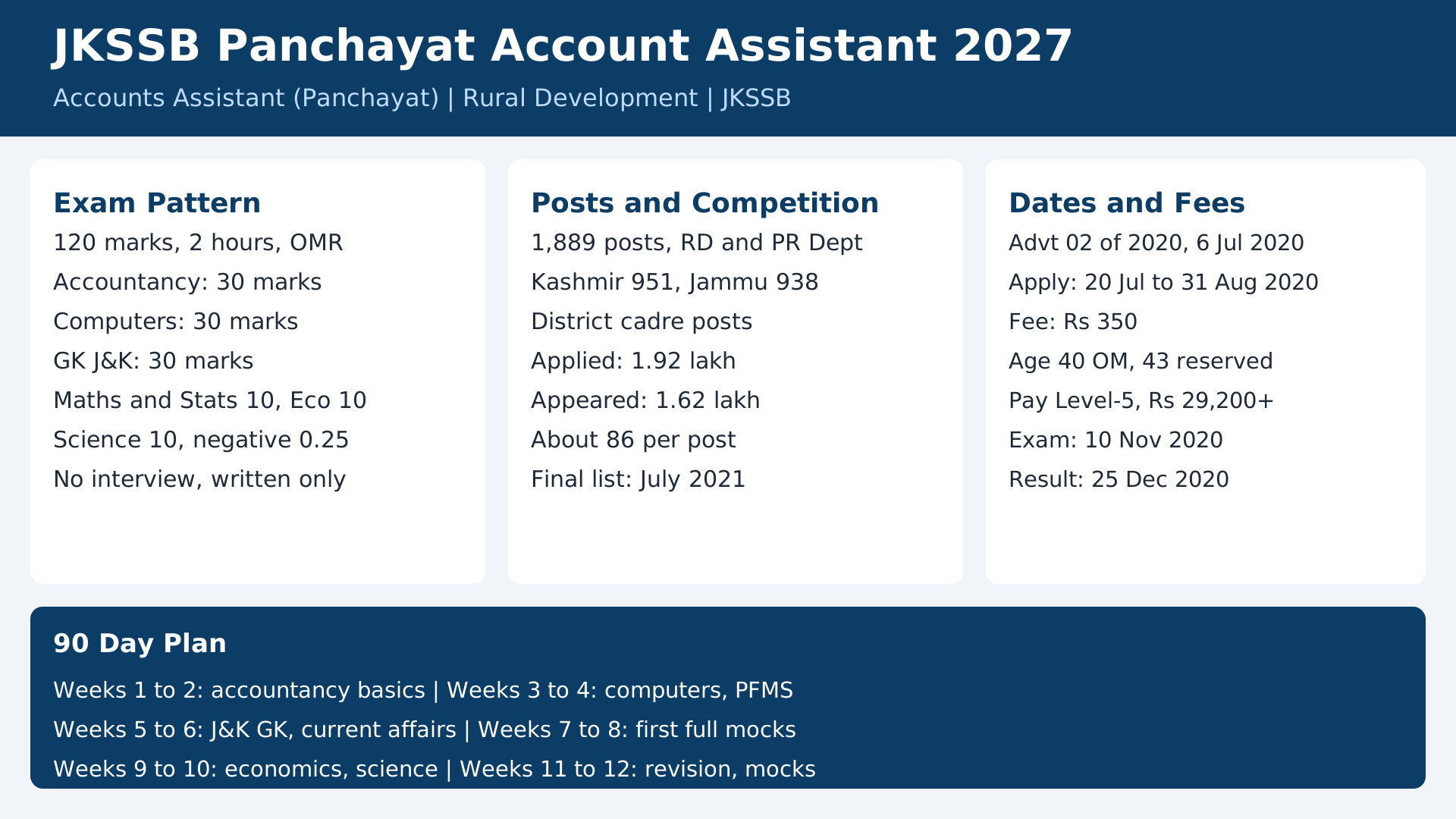
JKSSB advertised 1,889 Accounts Assistant (Panchayat) posts under Advertisement No. 02 of 2020, and the written exam on 10 November 2020 drew 1.62 lakh candidates. The Jammu and Kashmir Services Selection Board declared the result on 25 December 2020 and approved the final selection list in July 2021. JKSSB Panchayat Account Assistant 2027 has no fresh notification yet, so every fact in this guide comes from the 2020 advertisement, read directly from the official notification PDF in prep, and from the exam that followed it. If you plan to sit for the next cycle, the 2020 cycle is the closest picture you have of the posts, the pattern, the fee and the competition.
The post is officially Accounts Assistant (Panchayat), in the Rural Development and Panchayati Raj Department, and it is the largest single recruitment in this set at 1,889 posts. A graduation in any stream with 50 percent marks for Open Merit and 45 percent for reserved categories makes you eligible, the selection is a single written exam of 120 marks in 2 hours with no interview, and the pay is Level-5. Accountancy and computers together carry 60 marks, which is half the paper, and they decide more of the merit list than any other pair of sections.
JKSSB Panchayat Account Assistant 2027 and the 2020 cycle in numbers
| Item | Detail |
|---|---|
| Conducting body | Jammu and Kashmir Services Selection Board (JKSSB) |
| Advertisement | No. 02 of 2020, dated 6 July 2020 |
| Department | Rural Development and Panchayati Raj |
| Posts | 1,889, district cadre |
| Kashmir Division | 951 posts |
| Jammu Division | 938 posts |
| Application window | 20 July 2020 to 31 August 2020, online only |
| Application fee | Rs 350 |
| Pay scale | Level-5, Rs 29,200 to Rs 92,300 |
| Written exam | 10 November 2020, 120 marks, 2 hours, OMR |
| Candidates who applied | 1.92 lakh |
| Candidates who appeared | 1.62 lakh |
| Result | 25 December 2020 |
| Final selection list | Approved July 2021, 184th board meeting |
| 2027 notification | Not issued as of 20 November 2026 |
Divide 1.62 lakh candidates who appeared by 1,889 posts and you get about 86 candidates for each post. That is steep, and it is the reality of a post that needs only a graduation and carries no interview. The exam is the only filter, and the merit list is drawn from 120 marks, so a single mark can move a candidate across hundreds of ranks. The attendance rate of about 84 percent is high for a JKSSB exam, which says the candidates took this recruitment seriously from the start.
The division split is nearly even, with 951 posts in Kashmir and 938 in Jammu, and the district cadre means the real competition is district by district. A candidate should read the district-wise vacancies in the notification, because a small district with few posts will have a higher cut than a large district, even in the same cycle. The result came fast, in six weeks, and the final selection list followed in July 2021, which is a quicker finish than most JKSSB recruitments of the period.
What an Accounts Assistant in a panchayat actually does
An Accounts Assistant in a panchayat keeps the accounts of the panchayat. The work is the daily bookkeeping of panchayat funds: recording receipts and payments, maintaining the cash book, preparing the trial balance, reconciling the bank statements, and keeping the vouchers in order. When a scheme reaches a village, whether it is a housing grant, a rural employment guarantee, a sanitation drive or a pension, the money passes through the panchayat accounts, and the Accounts Assistant is the person who records it and reports it.
The post sits at the intersection of accounts and rural development, and the syllabus reflects that. Accountancy and Book Keeping carries 30 marks, and Knowledge of Computer Applications carries 30 marks, because the accounts are now kept on the computer and reported through the Public Financial Management System. General Economics carries 10 marks, and the Panchayati Raj Act of 1989 and the Gram Panchayat Development Plan appear in the General Knowledge syllabus, because the assistant needs to know the law and the planning process behind the money.
The pay is Level-5, from Rs 29,200 to Rs 92,300, with the allowances that apply to Union Territory employees. For a graduate post with no interview and a district cadre posting, it is a solid starting pay, and the career path runs inside the Rural Development Department as vacancies and seniority allow. The work is office based in the panchayat and the block, with field visits when accounts need to be checked on the ground.
One confusion to clear up at the start is the difference between this post and the Accounts Assistant in the Finance Department, often called FAA. The Finance post is a different post with its own advertisement, its own 600 post cycle under Advertisement No. 10 of 2025, and a different section split, with Economics at 20 marks and Computers at 20 marks. This post is the Panchayat post, in the Rural Development Department, with the split described below, and the two must not be mixed.
Who can apply for JKSSB Panchayat Account Assistant 2027
The qualification is graduation in any stream from a recognised university, with a minimum of 50 percent marks for Open Merit and 45 percent for reserved categories. Candidates with a post graduation degree with 50 percent marks, or a PhD degree or equivalent, are also eligible. The degree must be held on or before the last date of application, and the board checks the original certificates at document verification. The percentage bar is the point that ends candidacies, so check the marks before the form, not after.
Domicile of the Union Territory of Jammu and Kashmir is compulsory, with a valid domicile certificate. The application fee for the 2020 cycle was Rs 350, paid online only through net banking or a credit or debit card, and the fee once paid was not refunded. Applications without the fee were not considered.
| Category | Maximum age | Not born before |
|---|---|---|
| Open Merit | 40 years | 1 January 1980 |
| SC, ST, RBA, ALC/IB, EWS, PSP, OSC | 43 years | 1 January 1977 |
| Physically challenged | 42 years | 1 January 1978 |
| Ex-Servicemen | 48 years | 1 January 1972 |
| Government service or contractual employment | 40 years | 1 January 1980 |
Age is counted as on 1 January 2020, and no candidate may be born after 1 January 2002. The minimum age is 18 years on that date. The Open Merit ceiling of 40 years is the standard JKSSB figure, and the reserved categories get 43 years, which is the usual three year relaxation.
Applications for the 2020 cycle ran from 20 July to 31 August 2020, and the notification itself was read directly from the official PDF in prep, so the fee, the age table, the percentage bar and the post count in this guide are notification figures, not tracker figures. The 2027 cycle has not been notified as of 20 November 2026, and its fee and age table will come only with the next notification.
The written exam, section by section
Selection is by a written test only, with no interview. The paper is objective, with multiple choice questions set in English only, and the merit is drawn from the written marks alone. The board conducted the exam as an OMR based paper on 10 November 2020, from 12 noon to 2 pm.
| Subject | Marks |
|---|---|
| General Knowledge with special reference to Jammu and Kashmir | 30 |
| Mathematics and Statistics | 10 |
| General Economics | 10 |
| Knowledge of Computer Applications | 30 |
| Accountancy and Book Keeping | 30 |
| Science | 10 |
| Total | 120 |
The paper runs for 2 hours, with 120 questions carrying one mark each, and negative marking of 0.25 marks for each wrong answer. The pattern above is the one from the notification itself, Annexure C, and it is the pattern that governed the exam held on 10 November 2020.
Accountancy and computers together carry 60 marks, which is half the paper, and they are the sections that decide the merit list. A commerce graduate starts ahead here, because accountancy is a degree subject, but a non-commerce graduate who works through the bookkeeping topics properly can match that advantage, because the accountancy syllabus is an introduction to financial accounting rather than an advanced course. The computer section is memory based, and it gives quick marks to anyone who revises it.
The Finance Accounts Assistant split is different, and candidates should not mix the two. The Finance post uses Economics at 20 marks, Computers at 20 marks, Accountancy at 20 marks and Science at 20 marks, while the Panchayat post uses Economics at 10, Computers at 30, Accountancy at 30 and Science at 10. The Panchayat split is the one used here, taken from the notification itself.
The syllabus, subject by subject
General Knowledge with special reference to Jammu and Kashmir carries 30 marks and covers popular names of personalities in religion, politics, scientific discoveries, geography, sports and history, the Constitution of India with its formation, Fundamental Rights and Directive Principles, the 73rd amendment, Centrally Sponsored Schemes with their guidelines and objectives, important tourist destinations, the history of Jammu and Kashmir with places and their importance, Sustainable Development Goals, agriculture in economic development, industrialisation and economic development, the Panchayati Raj Act of 1989 as amended up to October 2018 with its rules, climate and crops in Jammu and Kashmir and India, and current events of state, national and international level. The Panchayati Raj Act and the Centrally Sponsored Schemes matter more for this post than for most, because the assistant works with them every day.
Mathematics and Statistics carries 10 marks and covers the standard graduate level topics in arithmetic, algebra, statistics and data handling. The section is small, but it is also the slowest, so do it after the fast sections in the exam hall.
General Economics carries 10 marks and covers the introduction to economics with basic concepts and principles, gross domestic product and budgeting including own resource generation and budgeting for the panchayat, and the concept of the Gram Panchayat Development Plan. The panchayat budgeting topics are the ones that connect the section to the job, and they deserve attention beyond their 10 marks.
Knowledge of Computer Applications carries 30 marks and covers basic applications of computers and their components, fundamentals of computer science, hardware and software, input and output devices, MS Word, MS Excel, MS Access, MS PowerPoint, PDF, internet and email, computer viruses and anti-virus, and the role of information technology in governance. MS Office features, the difference between hardware and software, input and output devices and virus basics are easy marks once revised.
Accountancy and Book Keeping carries 30 marks and covers the introduction to financial accounting and its terms, the accounting equation and journal, the voucher approach in accounting, bank reconciliation statements, financial management and financial statements, partnership accounts, cash book, financial audit, elements of double entry bookkeeping, rules of journalising, trial balance, trading account, profit and loss account and balance sheet, the concept of social accounting, social audit and the cash based single entry system of accounting, and the Public Financial Management System. The section is an introduction to financial accounting, and a candidate who works through a standard accountancy textbook will find it familiar.
Science carries 10 marks and covers school level physics, chemistry and biology, with everyday science, health, environment and technology in the mix. The level is school science, not a science degree, so a graduate from any stream can cover it with a standard general science book and a month of steady reading.
How the 2020 cycle actually ran
The Department of Rural Development and Panchayati Raj forwarded the indent for 1,889 posts of 20 districts on 15 May 2020, and the board issued Advertisement No. 02 of 2020 on 6 July 2020. Applications ran from 20 July to 31 August 2020, and the board conducted the OMR based written exam across all districts of the Union Territory on 10 November 2020, from 12 noon to 2 pm. The board notified the result and score sheet on 25 December 2020, six weeks after the exam.
The 184th board meeting approved the final selection list and the allocation of districts, and the board notified the provisional allocation of districts in May 2021. The whole cycle, from indent to final list, ran inside about fourteen months, which is a quicker finish than most JKSSB recruitments of the period. The 1.92 lakh applicants and the 1.62 lakh who appeared make it one of the largest JKSSB exams ever held, and the attendance rate of about 84 percent is high for a recruitment of this size.
The syllabus for the post was revised and notified on 23 April 2020, before the advertisement, and the revised syllabus is the one that governed the exam. The qualification was also changed in the run-up to the advertisement, with the board announcing that any graduate with 50 percent marks could apply, where an earlier version of the indent had pointed toward a commerce background. That change is the reason the applicant count was so large.
How hard is it to get in
Eighty six candidates per post is the headline, and it is steep, but the percentage bar changes the shape of the competition. A graduation with 50 percent marks for Open Merit and 45 percent for reserved categories cuts the pool before the exam is even held, because a pass degree is not enough. The candidates who reach the exam hall are already a selected group, and the paper is decided among them.
Accountancy and computers together carry 60 marks, and they are the sections where the list separates. A commerce graduate starts ahead in accountancy, and a candidate who revises the computer topics properly can score close to full marks in the other 30. General Knowledge with special reference to Jammu and Kashmir carries 30 marks, and it is the section most candidates underprepare, because the national current affairs feel more urgent and the Union Territory topics feel familiar enough to skip. They are not.
No official cut-off for the 10 November 2020 exam was retrieved in prep, so no cut-off number is stated here. The useful target is a standard rather than a number: aim for 50 out of 60 in accountancy and computers together, 20 out of 30 in General Knowledge, and steady marks in the three 10 mark sections, with the blind guesses kept to zero.
Mistakes that cost marks
The first mistake is preparing the Finance Accounts Assistant pattern instead of the Panchayat pattern. The Finance post uses a different split, with Economics at 20 marks and Computers at 20 marks, while the Panchayat post uses Economics at 10 and Computers at 30. A candidate who practises the wrong split will misjudge the time and the weight of the two sections that carry half the paper.
The second mistake is skipping computers because it feels non-academic. Thirty marks is a quarter of the paper, and the topics are the most learnable in the whole syllabus. A candidate who gives computers two hours a day for three weeks will outscore a candidate who gives it the last three days, and the gap will be larger than the gap in any other section except accountancy.
The third mistake is treating accountancy as a section for commerce graduates only. The syllabus is an introduction to financial accounting, and a non-commerce graduate who works through a standard textbook can match a commerce graduate, because the topics are journal, ledger, trial balance, bank reconciliation, partnership accounts and financial statements, all of which can be learned from scratch in a month.
The fourth mistake is guessing blindly under negative marking. Four wrong answers wipe out one right answer, and in a list with 86 candidates per post, that arithmetic decides ranks. Attempt what you can narrow down to two options, and leave the rest blank.
The fifth mistake is ignoring the percentage bar until the form stage. A graduation with less than 50 percent marks for Open Merit, or less than 45 percent for reserved categories, does not meet the qualification, and the application will fail at document verification even if the exam is cleared. Check the marks before the form, not after the result.
JKSSB Panchayat Account Assistant aspirants often prepare for other state and national exams alongside this one. The IBPS Clerk 2027, SBI Clerk 2027, RBI Assistant 2027, IBPS RRB Clerk 2027, NABARD Grade A 2027, SEBI Grade A 2027, IBPS PO 2027, SBI PO 2027, UGC NET Commerce 2027, SSC GD 2027 pages on this site carry the same style of mock test guide, and the pattern habit you build here transfers directly to them.
A 90 day plan that fits around a job
Weeks 1 to 2 belong to accountancy. Introduction to financial accounting, the accounting equation and journal, the voucher approach, bank reconciliation, trial balance, trading account, profit and loss account and balance sheet, with numericals every day. Keep a notebook of the rules of journalising and the formats, because the section tests formats as much as concepts.
Weeks 3 to 4 belong to computers. All the computer topics, with MS Office, hardware and software, and input and output devices first, and the Public Financial Management System alongside them, because it appears in the accountancy syllabus as well. End each day with twenty computer questions.
Weeks 5 to 6 belong to General Knowledge, with the Jammu and Kashmir block given its own hour every day. History, geography, economy, heritage, tourist destinations and the Reorganisation Act need reading, and the Panchayati Raj Act of 1989 and the Centrally Sponsored Schemes need their names, their purpose and their target group. Add a daily current affairs note of ten lines, and revise it every Sunday.
Weeks 7 to 8 are for the first full mocks. Two full 120 mark papers in 2 hours each week, with the whole paper reviewed the same day. Sort every wrong answer into three piles: did not know, knew but rushed, and guessed badly. Shrink the third pile first, because it is the only one you can fix by behaviour alone.
Weeks 9 to 10 are for Economics, Mathematics and Statistics, and Science, plus the weak spots the mocks exposed. Panchayat budgeting and the Gram Panchayat Development Plan in economics, and school level science with a standard book. Re-do the accountancy numericals that went wrong in the mocks.
Weeks 11 to 12 are for revision and mocks only. No new theory and no new book. Re-read the accountancy formats, re-do the computer topics, re-read the Jammu and Kashmir notes, and sit for three more full mocks in exam conditions. In the last week, cut the study hours and protect your sleep, because a fresh mind on the exam day is worth more than one more chapter.
Books and papers that actually help
For accountancy, a standard Class 11 and 12 accountancy textbook covers the syllabus, because the topics are journal, ledger, trial balance, bank reconciliation, partnership accounts and financial statements. Work through the numericals rather than reading the theory alone, because the section tests formats and steps.
For computers, a basic computer awareness book plus the MS Office programs on your own computer covers the section, and actually opening Word, Excel and PowerPoint while you study makes the features stick in a way reading alone does not.
For General Knowledge, a standard general knowledge manual plus a Jammu and Kashmir general knowledge book covers the syllabus, and a daily newspaper covers current affairs. One manual read twice beats three manuals read once.
The single best practice material is the set of previous JKSSB graduate level papers, because the board repeats its style even when it changes its subjects. Solve them in 2 hours with the 0.25 negative marking applied, and score yourself strictly. A mock without negative marking teaches you nothing about this exam.
How to apply, and the documents to keep ready
The application for Advertisement No. 02 of 2020 ran online on the JKSSB portal from 20 July to 31 August 2020, and the window has now closed, so this section is for candidates who will apply when the next cycle opens. The steps are the same in every JKSSB recruitment, with one point that is specific to this post and easy to get wrong.
First, read the advertisement in full, including the district-wise vacancy list, before touching the form. The post is district cadre, and the district you pick decides where you will work, so read the district list and pick with care. Second, complete the one time registration on the portal if you have not done so already, and keep the login details safe, because the same login carries the admit card and the result later.
Third, fill the form with the details as they appear on the matriculation certificate, because the board matches the name, the date of birth and the parents names against that certificate. Fourth, check the percentage before the form, because the qualification needs 50 percent marks for Open Merit and 45 percent for reserved categories, and the board checks the marks sheet at document verification. A candidate below the bar cannot be selected, even with a high exam score. Fifth, upload the photograph and signature in the size and format the notification prescribes, and check the preview before submitting. Sixth, upload the domicile certificate and the category certificate in the prescribed format, pay the fee online, and download the confirmation page, because the payment receipt is the proof that the application went through.
Keep a folder ready with the matriculation certificate, the domicile certificate, the category certificate if you claim reservation, the graduation degree and marks sheets showing the percentage, a valid photo identity proof, and two recent passport size colour photographs. The board checks the original certificates at document verification, and it gives no later chance to produce a certificate that was missing at the application stage.
Previous papers and mock tests: how to use them
The best practice material for this post is the written paper held on 10 November 2020, plus the set of previous JKSSB graduate level papers. The 2020 paper follows the 120 mark pattern with the same six sections and the same weights, so it is the closest thing to a model paper that exists for this post. Solve it in 2 hours with the 0.25 negative marking applied, and score yourself strictly, because a mock without negative marking teaches you nothing about this exam.
Use the mocks in three stages. In the first stage, solve section-wise papers to build depth in accountancy and computers, with numericals in accountancy every day, because the two sections carry 60 marks between them. In the second stage, solve full 120 mark papers in 2 hours, with the whole paper reviewed the same day. In the third stage, in the last month, solve two full papers a week in exam conditions, at the same time of day as the real exam, with no breaks and no phone.
The review matters more than the score. Write down every question you got wrong and why, and sort the reasons into three piles: did not know, knew but rushed, and guessed badly. The third pile is the one to shrink first, because it is the only one you can fix by behaviour alone. For accountancy, re-solve the numericals that went wrong after a week, and check whether the formats stick. A mock that is solved and forgotten is a wasted mock, and a mock that is reviewed properly is worth more than a chapter of theory.
Sources
JKSSB Advertisement Notice No. 02 of 2020 dated 6 July 2020, read directly from the official notification PDF in prep, for the 1,889 posts, the Kashmir 951 and Jammu 938 split, the Level-5 pay scale, the age table, the Rs 350 fee, the graduation with 50 percent for Open Merit and 45 percent for reserved categories, and the application window of 20 July to 31 August 2020.
AffairsCloud and Entri JKSSB Accounts Assistant syllabus pages, for the 120 mark pattern with General Knowledge with special reference to J and K 30, Mathematics and Statistics 10, General Economics 10, Knowledge of Computer Applications 30, Accountancy and Book Keeping 30 and Science 10, the 2 hour duration and the 0.25 negative marking.
Free Press Kashmir report of 3 July 2021, for the final selection list approved in the 184th board meeting, the 1.92 lakh applicants, the 1.62 lakh who appeared, the exam on 10 November 2020 and the result on 25 December 2020.







