
About JKSSB Class IV 2027 Exam Series
📖 Table of Contents
JKSSB Class IV 2027: Complete Exam Guide
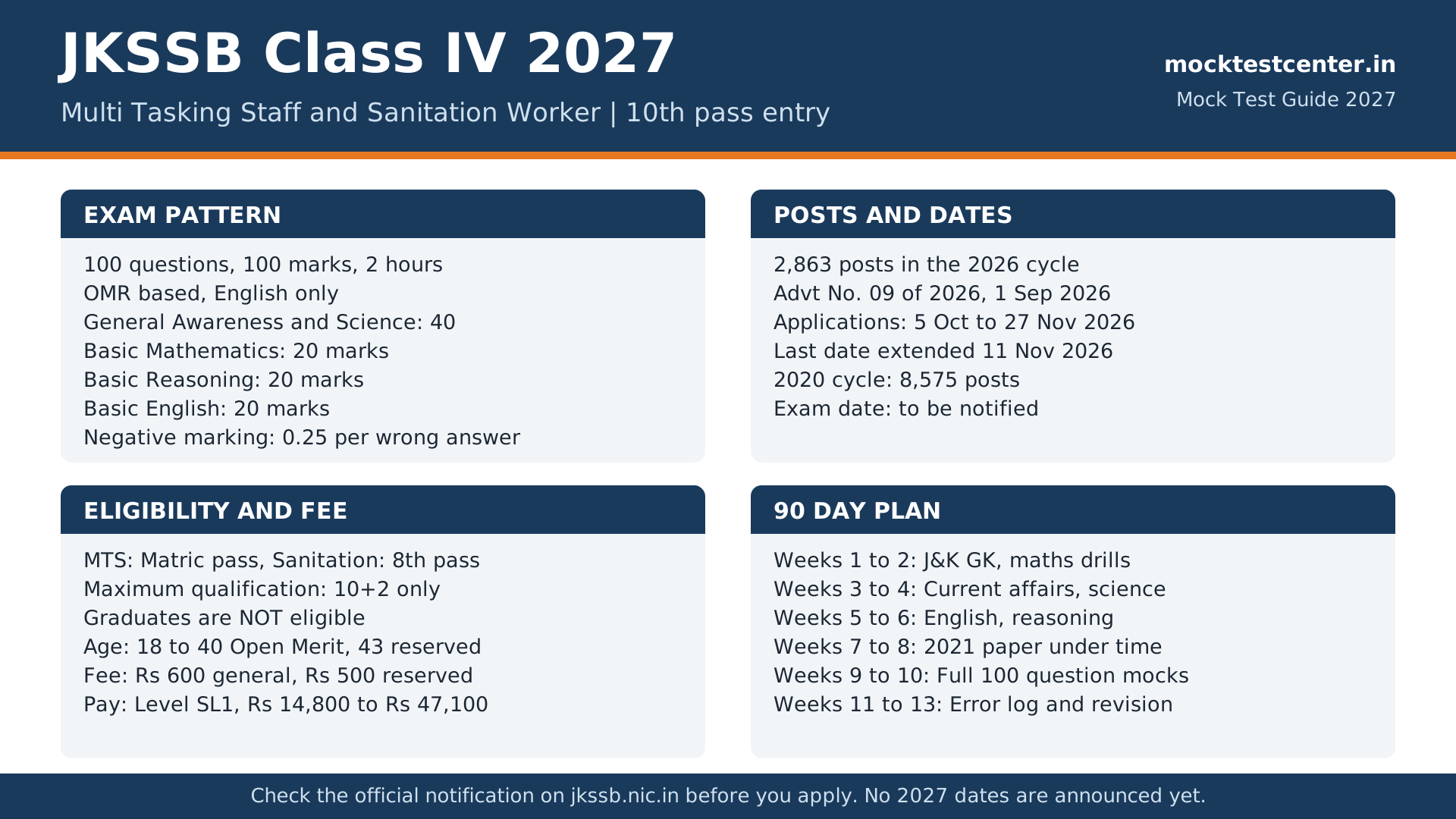
Applications for the latest Class IV recruitment are open right now. The Jammu and Kashmir Services Selection Board advertised 2,863 Class IV posts under Advertisement Notification No. 09 of 2026, dated 1 September 2026, covering Class IV Multi Tasking Staff and Sanitation Worker posts across departments in the Union Territory. Applications opened on 5 October 2026, and the last date was extended to 27 November 2026 by a notice dated 11 November 2026. JKSSB Class IV 2027 has no separate notification, because the 2026 cycle is the live cycle, and this guide is built on it and on the 2020 cycle before it. If you hold a Matric certificate and a Jammu and Kashmir domicile, this is the largest entry level recruitment in the Union Territory, and the window is open as you read this.
Class IV is the entry level of the Jammu and Kashmir government. The posts are Multi Tasking Staff and Sanitation Worker posts in departments across all 20 districts, and the work is the daily running of a government office and its premises: carrying files, keeping offices and records in order, and the cleaning and upkeep work that keeps a public office functioning. The qualification is Matric, a 10th pass, for Multi Tasking Staff, and 8th pass for Sanitation Worker, with a ceiling of 10+2 for both. A candidate who holds a diploma, a graduation degree or a post graduation degree faces rejection of the candidature at any stage. That ceiling is the most unusual rule in this exam, and it is the rule that most applicants get wrong.
The 2026 cycle in numbers
| Item | Detail |
|---|---|
| Conducting body | Jammu and Kashmir Services Selection Board (JKSSB) |
| Posts | Class IV Multi Tasking Staff and Sanitation Worker |
| Advertisement | Notification No. 09 of 2026, dated 1 September 2026 |
| Total posts | 2,863 |
| Application window | 5 October to 12 November 2026, extended to 27 November 2026 |
| Fee | Rs 600 for OM, OBC, RBA and ALC/IB; Rs 500 for SC, ST 1, ST 2, EWS and PwBD |
| Pay | Level SL1, Rs 14,800 to Rs 47,100 |
| Exam date | Not announced as of 20 November 2026 |
The 2,863 post total is agreed across trackers, and the split between the two posts is where the reports differ. One set of trackers gives 2,697 Multi Tasking Staff posts and 166 Sanitation Worker posts, which adds to 2,863. Another tracker gives 2,736 Multi Tasking Staff posts, which would leave 127 Sanitation Worker posts. This guide states the total of 2,863 and flags the split as a conflict. The department wise breakup sits in the notification, and the upload pre-check should read it from the official PDF before the split is quoted to candidates. The extension of the last date to 27 November 2026 is reported consistently, and the extension notice is dated 11 November 2026. The fee payment deadline is a separate matter. The corrigendum dated 1 October 2026 fixed the fee payment deadline at 12 November 2026, and the extension notice does not say whether that deadline also moves. Pay the fee early, and do not wait for the last date.
The qualification ceiling deserves a full paragraph, because it is the rule that ends the most applications. The minimum qualification for Multi Tasking Staff is Matric, a 10th pass. The minimum for Sanitation Worker is 8th pass. The maximum qualification for both posts is 10+2, Higher Secondary. A candidate holding any qualification above 10+2, such as a diploma, graduation or post graduation, faces summary rejection of the candidature at any stage, including after the written test. That rule comes from S.O. 184 of 2020 dated 4 June 2020, read with SRO 99 of 2008, and it is stated in the same words in the 2020 and the 2026 notifications. A graduate who applies for Class IV out of desperation loses the fee and the application, and gains nothing. Apply only if your highest qualification is 10+2 or below.
The 2020 cycle: 8,575 posts
The cycle before this one was the largest Class IV recruitment the Board has ever run. Advertisement No. 01 of 2020, dated 26 June 2020, advertised 8,575 Class IV posts for District, Divisional and Union Territory cadres in various departments, under the Jammu and Kashmir Appointment to Class IV (Special Recruitment) Rules, 2020. Applications ran from 10 July to 25 August 2020. The written examination was held on 27 February, 28 February and 1 March 2021, across three days, because the applicant count was too large for a single day. That cycle is the one that set the pattern, the syllabus and the selection criteria that the 2026 cycle follows.
The 2020 cycle matters for a practical reason. It is the last completed cycle with a full public record: notification, syllabus, exam dates, and the selection criteria in Annexure B of the notification. The 2026 cycle is still at the application stage. The pattern, the syllabus weight and the negative marking in this guide come from the 2020 notification, and the 2026 trackers confirm that the selection follows the same Class IV (Special Recruitment) Rules, 2020. When this guide describes the paper, it describes the paper that was actually set in February and March 2021, and the paper that the 2026 cycle will set on the same pattern.
One comparison gives a sense of scale. The 2020 cycle offered 8,575 posts and the 2026 cycle offers 2,863, a third as many. The 2020 cycle was a one time drive under special recruitment rules framed for that year, and the vacancy count reflected years of accumulated Class IV vacancies across departments. The 2026 cycle is a regular cycle, and the vacancy count reflects the current indent from departments. A candidate who compares the two cycles should not expect the 2026 cut off to sit where the 2020 cut off sat. Fewer posts with the same paper means a higher cut off, and the 2026 selection will be tighter than the 2020 selection.
Who can apply for JKSSB Class IV 2027
Eligibility rests on four things: the qualification within the ceiling, an age inside the limit, a Jammu and Kashmir domicile certificate, and the fee. The qualification rule is stated above, and it bears repeating because it is the rule that ends applications. Minimum Matric for Multi Tasking Staff, minimum 8th pass for Sanitation Worker, maximum 10+2 for both. The qualification must be held on or before the cut off date in the notification, which the 2026 trackers give as 3 November 2026.
| Category | Maximum age, as on 1 January 2026 |
|---|---|
| Open Merit | 40 years |
| SC, ST 1, ST 2, RBA, ALC/IB, EWS, OBC | 43 years |
| Persons with Benchmark Disabilities | 42 years |
The minimum age is 18 years for every category, reckoned as on 1 January 2026. Open Merit candidates must not have been born before 1 January 1986 and must not have been born after 1 January 2008. Reserved category candidates must not have been born before 1 January 1983. Ex-servicemen can deduct the period of service from their actual age, and the age condition is deemed satisfied where the resultant age exceeds the maximum age limit by no more than 3 years. Candidates claiming benefits as casual workers under S.O. 184 of 2020 get a relaxation of 5 years in the upper age limit. Those relaxation rules come from the 2026 notification summaries, and they are the figures to check against your own date of birth before you pay the fee.
Domicile is not optional. Only domiciles of the Union Territory of Jammu and Kashmir can apply, and the domicile certificate must have been issued on or before the cut off date. The Board has held the domicile condition across cycles, and it is stated in the same terms in the 2020 and the 2026 notifications. A candidate who lives in Jammu and Kashmir without a domicile certificate is not eligible. Keep the certificate ready before the application window closes, because the window in 2026 runs to 27 November and the certificate cannot be arranged in a day.
The pay sits at Level SL1, Rs 14,800 to Rs 47,100 per month, and that figure appears in both the 2020 and the 2026 notifications. The post is the lowest rung of the government pay matrix, and the salary is modest. The value of the post is the permanence: a regular government appointment with the allowances and the pension benefits that come with it, and a first step into government service for a candidate whose highest qualification is 10+2. The promotion path runs through the Class IV cadre and into clerical posts under the departmental rules, and this guide states no promotion timeline, because no notification quoted one.
The paper, section by section
| Section | Questions | Marks |
|---|---|---|
| Basic Mathematics | 20 | 20 |
| Basic Reasoning | 20 | 20 |
| Basic English | 20 | 20 |
| General Awareness and Science | 40 | 40 |
| Total | 100 | 100 |
The paper runs for 2 hours, carries 100 objective questions for 100 marks, and gives 1 mark for each correct answer. A wrong answer costs 0.25 marks. A question left blank costs nothing. The questions are set in English only, and the exam is OMR based. That is the whole pattern, and it has stayed the same from the 2020 notification to the 2026 cycle. Seventy two seconds per question is the arithmetic, and it is generous for a Class 10 level paper, which means the exam rewards accuracy rather than speed. A candidate who answers 80 questions correctly and leaves 20 blank will score 80, and that is a strong score. A candidate who guesses all 100 and gets 60 right and 40 wrong will score 50, and that is a weak score.
General Awareness and Science carries 40 marks, twice the weight of any other section, and it is the section that decides the rank. The syllabus covers general current events at the national level, sports, Indian culture, Indian history, Indian geography, capitals and states, general science, health, hygiene and sanitation, and the geography, culture and history of Jammu and Kashmir. The Jammu and Kashmir part is the part that most candidates underprepare, because it needs local knowledge that no national book covers. Learn the districts, the rivers, the lakes, the passes, the history of the region, and the major government schemes running in the Union Territory, and the 40 marks will follow.
Basic Mathematics carries 20 marks and covers percentage, average, time, work and distance, ratios and proportions, problems of age, probability, LCM and HCF, and mensuration. Basic Reasoning carries 20 marks and covers analogies, series, classification, and the standard reasoning set at Class 10 level. Basic English carries 20 marks and covers articles, tenses, synonyms and antonyms, error spotting, and comprehension at Class 10 level. None of these three sections needs a separate book. A Class 10 mathematics book, a reasoning practice book, and a basic English grammar book will cover them, and the marks in them are the marks that a steady candidate collects while the General Awareness section decides the rank.
The exam day: what to expect
The Class IV exam is an OMR based test, and the exam day follows the standard JKSSB routine. The admit card comes out on jkssb.nic.in about a week before the exam, and it carries the centre, the reporting time, and the shift. Candidates must carry the printed admit card and a valid photo identity proof, and the Board checks both at the gate. Mobile phones, calculators and written material are not allowed inside the hall. The paper is set in English only, and the OMR sheet must be filled with a black or blue ball point pen as the instructions on the sheet direct. A wrongly filled circle cannot be corrected, so fill the sheet carefully and keep the question paper work on the question paper itself.
The 2021 exam ran across three days, 27 February, 28 February and 1 March, because the applicant count was too large for a single day. The 2026 cycle has fewer posts and is likely to draw fewer applicants than the 2020 cycle, but the exam may still run across more than one day if the applicant count is large. If the exam runs in more than one shift, the Board normalises the scores across shifts, and the notification for the cycle will say so. Read the admit card notice when it comes out, because it carries the shift, the centre, and the reporting time, and those three details are the ones that decide whether you reach the hall on time.
After the exam, the Board issues a provisional answer key on jkssb.nic.in, takes objections for a fixed window, and then issues a final key. The FAA exam of 15 November 2026 shows the pace: the provisional key came out on the exam day itself, and objections were accepted for three working days. The Class IV key will follow the same routine. Check the site on the exam day and the day after, and file an objection within the window if a key answer is wrong, with the evidence the notice asks for. The window closes without extension, and a late objection is not entertained.
How the selection is scored
The selection is not decided by the written test alone. The written test carries a fixed weight that depends on the cadre, and the rest of the total comes from additional points awarded under the Class IV (Special Recruitment) Rules, 2020. The split is the same in the 2020 notification and the 2026 cycle.
| Cadre | Written test | Additional points | Total |
|---|---|---|---|
| UT cadre | 85 | 15 | 100 |
| Divisional cadre | 80 | 20 | 100 |
| District cadre | 75 | 25 | 100 |
The written test of 100 marks is scaled to the weight for the cadre, so a candidate in the UT cadre has the written test counted out of 85, a candidate in the Divisional cadre out of 80, and a candidate in the District cadre out of 75. The additional points make up the rest, to a total of 100. That structure means the written test is worth more in the UT cadre and less in the District cadre, and the additional points matter most where the written weight is lowest. A candidate who applies for a District cadre post should understand that a quarter of the total sits outside the written test.
The exact breakup of the additional points was not retrieved during preparation, and this guide states no figure for it. The notification carries the breakup in Annexure B, under S.O. 184 of 2020 and SRO 404 of 2018, and the upload pre-check should read it from the official PDF before it is quoted. What the record does show is the shape: the additional points reward the categories the rules name, and they are added to the scaled written score to reach the total of 100. The additional points are awarded only where the candidate meets the conditions the rules fix, and the conditions differ by cadre.
One more rule belongs here. There is no provision for re-evaluation or rechecking of scores. The Board states that plainly in the notification, and it holds across cycles. A candidate who is unhappy with the score cannot ask for the paper to be rechecked. The answer key is the only check, and the Board issues a provisional key, takes objections, and then issues a final key. Watch for the provisional key after the exam, and file an objection within the window if a key answer is wrong, because that window is the only chance to change a score.
Fee and how to apply
The application fee in the 2026 cycle is Rs 600 for Open Merit, OBC, RBA and ALC/IB candidates, and Rs 500 for SC, ST 1, ST 2, EWS and PwBD candidates, payable online only through net banking, credit card or debit card. The fee is never refunded. That fee structure matches the Accounts Assistant 2025 notification and the Junior Assistant 2025 notification, and it is consistent across the trackers that report the 2026 Class IV notification. The 2020 cycle fee is not stated in the sources read during preparation, and this guide states no 2020 fee figure.
Applications go in online only, through jkssb.nic.in, in the window the notification fixes. The 2026 window opened on 5 October 2026 and was first fixed to close on 12 November 2026. The extension notice of 11 November 2026 moved the last date for application submission to 27 November 2026. The fee payment deadline is the detail to watch. The corrigendum dated 1 October 2026 fixed the fee payment deadline at 12 November 2026 at 11.59 pm, and the extension notice does not say separately whether the fee deadline also moves. Pay the fee well before the last date, and keep the payment receipt, because an application without a completed fee payment is not accepted.
The form asks for personal details, the domicile certificate, the qualification details, the category certificate where applicable, a photograph and a signature, and the fee payment. Check the qualification against the ceiling before submitting, because a candidate whose highest qualification is above 10+2 and who pays the fee loses both the fee and the application. The Board has run correction windows in recent cycles, but a correction window is not a promise. Fill the form right the first time, and check the category and the cadre twice, because those two choices decide the merit list you are drawn in.
What to study first
Start with General Awareness and Science, because it carries 40 marks, twice the weight of any other section. Read a Jammu and Kashmir yearbook for the history, geography, culture and heritage of the region, and add a monthly current affairs compilation for the national part. Then add Basic Mathematics as daily drills, because the 20 marks there are the most predictable marks in the paper. Basic Reasoning and Basic English come after, as short daily drills rather than as separate study blocks.
Books are simple to list. For general awareness, a Jammu and Kashmir yearbook and a standard general knowledge book, plus a notebook of local news. For mathematics, a Class 10 mathematics book. For reasoning, a basic reasoning practice book with analogies, series and classification. For English, a Class 10 English grammar book with error spotting and comprehension practice. For science, NCERT science from classes 6 to 10. No other book is needed for the written paper, and buying more books is the most common way to waste the first month.
The science part of the General Awareness section deserves its own note, because it is the part that candidates either overstudy or ignore. The syllabus names general science, health, hygiene and sanitation, and those topics sit at Class 10 level. The questions ask for everyday facts: the human body and common diseases, food and nutrition, water and sanitation, and the basic physics and chemistry of daily life. A candidate who reads NCERT science from classes 6 to 10 will answer them. A candidate who opens a separate science guide for competitive exams will find the same facts with more detail than the paper needs. Read the NCERT books, make a short note set of the facts, and revise the note set weekly. The science questions are 10 to 12 marks inside the 40 mark section, and they are the easiest marks in the paper for a candidate who has read the school books.
Previous year papers are the second half of preparation. The 2021 papers from 27 February, 28 February and 1 March 2021 are the official papers for this post, and solving one of them under time, 100 questions in 120 minutes, with the 0.25 negative marking applied, is the best check of where you stand. A mock score without negative marking is a figure that flatters you and teaches you nothing. Solve the paper twice, once at the start of preparation to find the weak sections, and once in the last week to check whether the weak sections moved.
A 90 day plan that fits around a job
| Weeks | Focus | Daily time |
|---|---|---|
| 1 to 2 | Jammu and Kashmir history and geography, plus mathematics drills | 2 hours |
| 3 to 4 | National current affairs and general science, plus reasoning drills | 2 hours |
| 5 to 6 | English grammar and comprehension, plus mathematics revision | 2 hours |
| 7 to 8 | The 2021 paper under time, plus the facts sheet | 2 to 3 hours |
| 9 to 10 | Full mocks, 100 questions in 120 minutes, with negative marking applied | 2 to 3 hours |
| 11 | Revision of the error log and the Jammu and Kashmir notebook | 3 hours |
| 12 | Two full mocks, light revision, one rest day before the exam | 3 hours |
| 13 | Final revision of the facts sheet and the formulae sheet | 2 hours |
The plan runs for 13 weeks because 90 days is 13 weeks near enough, and the last week is deliberately light. The first four weeks build the General Awareness section and the mathematics drills. The middle four weeks add English, reasoning and the first full paper. The last five weeks are mocks and revision, with the error log doing the teaching. Keep the log in a notebook, one line per mistake, with the section, the topic, and the correct rule. A candidate who reviews the log every Sunday will not repeat the same mistake in the second mock, and that is the whole point of mock tests.
One habit matters more than the timetable. Write the Jammu and Kashmir facts on a single sheet, and revise that sheet every night for ten minutes. The sheet holds the districts, the rivers, the lakes, the passes, the major schemes, and the census figures. Ten minutes a night across 90 days is 15 hours of revision, and it is the revision that turns a read chapter into a remembered answer. The General Awareness section is 40 marks, and the facts sheet is where those marks are won.
Other exams worth preparing alongside
JKSSB Class IV aspirants often prepare for other state and national exams alongside this one. The SSC GD 2027, UP Police Constable 2027, Bihar Police Constable 2027, SSC Delhi Police Constable 2027, UP Police Fireman 2027, UP Police Jail Warder 2027, Agniveer Vayu 2027, AFCAT 2027, IBPS Clerk 2027 and SBI Clerk 2027 pages on this site carry the same style of mock test guide, and the pattern habit you build here transfers directly to them.
Sources
The Jammu and Kashmir Services Selection Board site at jkssb.nic.in, the official source for the notification, the syllabus, the admit card and the answer key, which could not be reached by direct fetch during preparation on 20 November 2026, so the facts below rest on the tracker pages listed here and should be checked against the official notification before you apply. Oliveboard, for Advertisement No. 01 of 2020 dated 26 June 2020, 8,575 posts, the exam dates of 27 February, 28 February and 1 March 2021, the pattern of Basic Mathematics 20, Basic Reasoning 20, Basic English 20 and General Awareness and Science 40, and the Class IV (Special Recruitment) Rules, 2020. Jobsplane, Technical ATG, Viksit Haryana and JK Youth Guide, for Advertisement Notification No. 09 of 2026 dated 1 September 2026, 2,863 posts, applications from 5 October 2026, the last date extended to 27 November 2026, the fee of Rs 600 and Rs 500, the age limits of 40 for Open Merit, 43 for reserved categories and 42 for persons with benchmark disabilities as on 1 January 2026, the qualification of minimum Matric and maximum 10+2 for Multi Tasking Staff and minimum 8th pass and maximum 10+2 for Sanitation Worker, and the pay of Level SL1 Rs 14,800 to Rs 47,100. Adda247, for the conflicting Multi Tasking Staff figure of 2,736 posts, flagged in this guide. Future Job Alerts, for Annexure B of the 2020 notification, the selection criteria of written test 85, 80 and 75 with additional points 15, 20 and 25 for UT, Divisional and District cadres, the qualification under S.O. 184 of 2020 and SRO 99 of 2008, and the syllabus in Annexure C with total marks 100 and time 2 hours. Bankersadda and Kashmir Pulse, for the application window of 10 July to 25 August 2020 and the negative marking of 0.25.







