
About JK Bank PO 2027 Exam Series
📖 Table of Contents
- JK Bank PO 2027 and the November 2026 notifications in numbers
- Who can apply for JK Bank PO 2027
- The selection process in three stages
- Prelims, paper by paper
- Mains: the paper that decides your rank
- The interview carries 100 marks
- Pay, probation, bond and the five year zone rule
- The 2020 cycle: what the last recruitment looked like
- Exam centres and the application itself
- A 90 day plan that fits the real exam
- Mistakes that cost candidates this exam
- Other exams worth preparing alongside JK Bank PO 2027
- Sources
JK Bank PO 2027: Probationary Officer Exam Guide
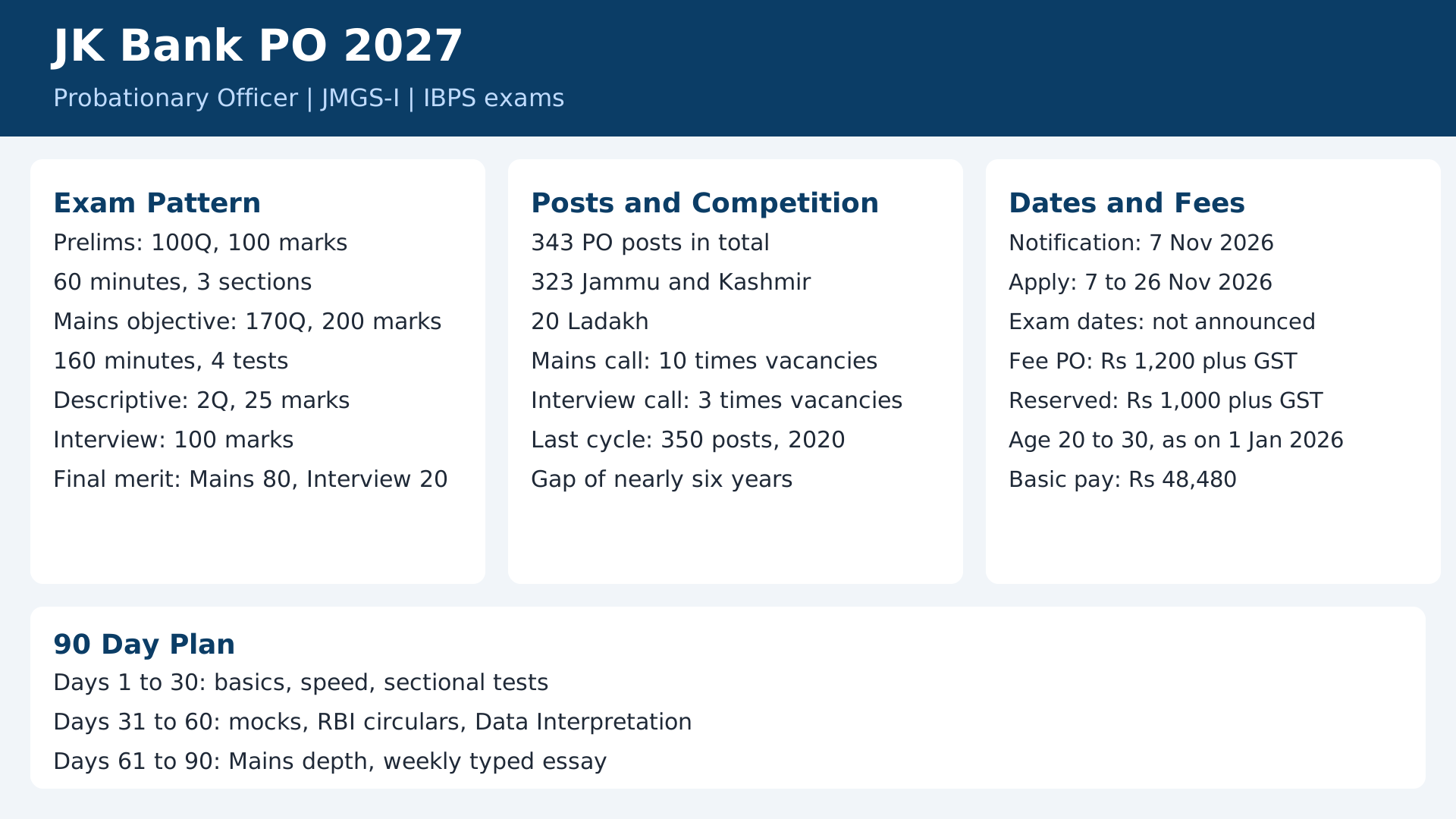
Jammu and Kashmir Bank has opened 343 Probationary Officer posts after a gap of nearly six years. The bank issued four recruitment notifications on 7 November 2026, and the Probationary Officer share is 323 posts for domiciles of the Union Territory of Jammu and Kashmir and 20 posts for domiciles of the Union Territory of Ladakh. Applications run from 7 November to 26 November 2026 through the Careers section of the bank website, and the Institute of Banking Personnel Selection conducts the online examinations. JK Bank PO 2027 has no separate notification of its own. The 2027 branding in this guide follows the site rule that new pages target 2027, while every fact below comes from the November 2026 notifications and the last full cycle in 2020.
The gap matters more than the post count. The previous Probationary Officer recruitment, notified in July 2020, offered 350 posts alongside 1,500 Banking Associate posts, and its final result came on 13 April 2021. Since then the bank hired apprentices, 276 of them in May 2024, but it ran no Probationary Officer recruitment at all. Thousands of graduates in Jammu, Kashmir and Ladakh have waited through those six years, and the age limit in the new notification shows it. The maximum age is now 30 years, down from 32 in the previous cycle, and the Jammu and Kashmir Students Association has already written to the Lieutenant Governor asking for relaxation to 40. That protest may or may not move the bank. What you can control is speed. The application window is 20 days, the exam dates will follow separately, and the candidates who start serious preparation in November will hold a clear lead over those who wait for the exam date.
JK Bank PO 2027 and the November 2026 notifications in numbers
| Item | Detail |
|---|---|
| Conducting body | Jammu and Kashmir Bank Ltd, online exams by the Institute of Banking Personnel Selection (IBPS) |
| Post | Probationary Officer, Junior Management Grade Scale I |
| Notifications | JKB/HR/Rectt/2026-492 (PO, Jammu and Kashmir) and JKB/HR/Rectt/2026-494 (PO, Ladakh), dated 7 November 2026 |
| Posts | 343 in total: 323 in Jammu and Kashmir, 20 in Ladakh |
| Application window | 7 November to 26 November 2026, online only at jkb.bank.in |
| Exam dates | Not announced yet; call letters and dates will be notified separately |
| Age as on 1 January 2026 | 20 to 30 years, before relaxations |
| Qualification | Graduation in any discipline, completed by 26 November 2026 |
| Domicile | Only domiciles of the Union Territory named in the notification; the two domiciles are not interchangeable |
| Fee, Probationary Officer | Rs 1,200 plus GST for all other candidates; Rs 1,000 plus GST for SC, ST, SEBC and persons with benchmark disabilities |
| Starting basic pay | Rs 48,480 in the scale 48480-2000/7-62480-2340/2-67160-2680/7-85920 |
| Probation and bond | Two years probation; Rs 2 lakh bond for two years of service |
Read the vacancy table with care, because several tracker pages report the wrong total. Some pages quote 1,356 posts for this recruitment. That figure is the Jammu and Kashmir share only: 323 Probationary Officers plus 1,033 Banking Associates. Others quote 1,397, which is the full total across both Union Territories: 343 Probationary Officers plus 1,054 Banking Associates, with Ladakh contributing 20 Probationary Officer posts and 21 Banking Associate posts. A few pages even print 1,053, which counts only two of the four notifications. This guide uses 343 for the Probationary Officer post and 1,397 for the whole drive, because those are the figures that add up across all four advertisement numbers, 492, 493, 494 and 495.
The four notifications split by post and by Union Territory, and you must apply under the one that matches your domicile. Advertisement 492 covers Probationary Officer posts in Jammu and Kashmir. Advertisement 494 covers Probationary Officer posts in Ladakh. Advertisements 493 and 495 cover Banking Associate posts in Jammu and Kashmir and Ladakh. A Jammu and Kashmir domicile holder cannot apply for a Ladakh post, and a Ladakh domicile holder cannot apply for a Jammu and Kashmir post. No change of category or Union Territory is allowed after registration, and the bank will verify domicile, education, age and category certificates before appointment.
Who can apply for JK Bank PO 2027
Eligibility rests on three things: a degree, an age inside the limit, and the right domicile. A graduation degree in any discipline from a university recognised by the Government of India qualifies you, or an equivalent qualification recognised by the Central Government or the University Grants Commission. The degree subject plays no part in selection. Your graduation must be complete by 26 November 2026, the last date of registration, and you must supply your graduation percentage when you register. Final year students whose results come after that date cannot apply in this cycle.
The age limits use 1 January 2026 as the reference date. The minimum age is 20 years and the maximum is 30 years, which means you must have been born not earlier than 1 January 1996 and not later than 1 January 2006. That is the basic limit before relaxations, and the relaxations differ by category. Scheduled Caste and Scheduled Tribe candidates get five years. Other Backward Classes, residents of areas adjoining the Line of Control and the International Border, and residents of backward areas get three years. Persons with benchmark disabilities get ten years. Economically Weaker Section candidates get no age relaxation, so the 30 year limit stands for them.
| Category | Upper age limit |
|---|---|
| General and EWS | 30 years |
| SC and ST | 35 years |
| OBC, ALC and IB areas, residents of backward areas | 33 years |
| Persons with benchmark disabilities | 40 years |
| Ladakh, one-time special dispensation | 35 years for unreserved and reserved alike, under GAD Order 280-LA(GAD) of 2025 dated 30 June 2025 |
Two relaxations deserve a closer look. Ladakh carries a one-time additional five year relaxation for the 2025-26 recruitment, available to reserved and unreserved candidates alike under the Ladakh General Administration Department order dated 30 June 2025. That lifts the Ladakh Probationary Officer limit to 35 years before other relaxations apply, and the total relaxation is subject to a cap that the trackers quoting the notification do not state in full. Candidates who completed apprenticeship training with Jammu and Kashmir Bank get one extra year over and above their category relaxation. That is a small concession, but in a cycle where the age ceiling fell from 32 to 30, one year can decide whether a candidate is in or out.
The reservation structure in the Jammu and Kashmir notifications follows the Jammu and Kashmir Reservation Rules of 2005 as amended, with the structure notified through Government Order S.O. 176 dated 15 March 2024. Scheduled Castes hold 8 percent, Scheduled Tribes hold 20 percent, split equally between the existing Scheduled Tribe communities and the groups added by the 2024 amendment, and the Socially and Educationally Backward Classes hold 22 percent across three groups: Other Backward Classes 8 percent, residents of areas adjoining the Line of Control and the International Border 4 percent, and residents of backward areas 10 percent. Economically Weaker Sections hold 10 percent. That takes total vertical reservation to 60 percent and leaves 40 percent for open merit. Of the 1,356 Jammu and Kashmir posts, 542 fall under open merit. The notifications also carry horizontal reservation: 4 percent for persons with benchmark disabilities, divided into four groups of 1 percent each. The Banking Associate notification adds 6 percent horizontal reservation for ex-servicemen. That provision does not figure in the Probationary Officer reservation table.
One distinction in the notifications is easy to miss and worth understanding. Open merit is not the same as unreserved category. Reserved category candidates who qualify on their own merit and figure in the General Category selection list are treated at par with General Category candidates, and their selection is not adjusted against the vacancies reserved for their categories. A reserved category candidate who clears the open merit cut off therefore takes an open merit seat and leaves the reserved seats for other candidates of that category. The open merit list is open to anyone who earns it, not only to unreserved candidates.
The selection process in three stages
| Stage | Format | Marks | What it decides |
|---|---|---|---|
| Preliminary Examination | Online objective, 100 questions, 60 minutes | 100 | Shortlisting for Mains only |
| Main Examination | Online objective plus descriptive paper | 200 objective plus 25 descriptive | 80 percent of final merit, with the interview |
| Interview | Conducted by the bank | 100 | 20 percent of final merit |
The bank shortlists candidates for Mains at up to ten times the number of vacancies in each category, based on Prelims performance and subject to the minimum aggregate qualifying marks. It calls candidates for interview at up to three times the vacancies in each category, based on Mains performance. With 343 Probationary Officer posts, that means roughly 3,430 Mains seats and roughly 1,029 interview seats across the two Union Territories, before category-wise arithmetic. Prelims marks do not count in the final merit. The final merit uses Mains and interview in an 80 to 20 ratio, and a candidate must qualify in both the Mains examination and the interview to be considered for final selection.
The minimum aggregate qualifying marks run through every stage. In Prelims the bar is 40 percent for General Category candidates and 35 percent for reserved category candidates, subject to overall merit. The same 40 and 35 percent figures apply as the minimum aggregate in Mains. In the interview the minimum qualifying marks are 40 percent for General Category candidates and 35 percent for reserved category candidates, which works out to 40 marks and 35 marks out of 100. Sectional cut offs also apply in the online examinations: you must clear the prescribed minimum in each individual test as well as the aggregate, so a strong total with one collapsed section will not carry you through.
Prelims, paper by paper
| Test | Questions | Maximum marks | Time |
|---|---|---|---|
| English Language | 30 | 30 | 20 minutes |
| Quantitative Aptitude | 35 | 30 | 20 minutes |
| Reasoning Ability | 35 | 40 | 20 minutes |
| Total | 100 | 100 | 60 minutes |
Prelims is a speed test with a twist in the marks. English gives one mark per question. Quantitative Aptitude gives 30 marks for 35 questions, so some questions carry less than a mark. Reasoning gives 40 marks for 35 questions, so some questions carry more than a mark. The notification does not publish a question-wise mark split, and no tracker has one either, so do not plan around which individual questions pay more. Plan around the sections. Each section has its own 20 minute limit, and the clock does not carry over. You cannot borrow time from English to finish Reasoning.
Negative marking follows the standard IBPS rule: one-fourth of the marks assigned to a question is deducted for each wrong answer. A wrong answer in English costs 0.25 marks. In the other two sections the cost depends on the marks assigned to that question, which the notification does not break down. The safe way to read it is that every guess costs you a quarter of what the question was worth, and a guess between two options still pays over a full paper while a blind guess does not. Unattempted questions carry no penalty.
The three sections test different skills, and the preparation for each is different. English Language covers reading comprehension, cloze test, error spotting, sentence improvement, para jumbles, fill in the blanks, vocabulary and idioms. The comprehension passages in IBPS style exams run long, and the 20 minute limit means you must read fast and answer from the passage rather than from general knowledge. Quantitative Aptitude covers simplification, number series, quadratic equations, data interpretation, percentage, profit and loss, simple and compound interest, time and work, time speed and distance, ratio and proportion, averages, mensuration, probability, permutation and combination, and problems on trains, boats and streams. Data interpretation sets carry the most marks per minute in this section, so they deserve the largest share of practice time. Reasoning Ability covers puzzles and seating arrangement, syllogism, coding and decoding, blood relations, direction sense, inequalities, order and ranking, alphanumeric series, input and output, and data sufficiency. Puzzles and seating arrangements decide this section. A candidate who solves one puzzle set cleanly in the time allowed will outscore a candidate who attempts everything and finishes nothing.
One practical detail about Prelims often surprises first time candidates. The Banking Associate online examination uses exactly the same three tests, the same question counts, the same marks and the same 20 minute sectional limits. If you apply for both posts, and many candidates do, your Prelims preparation is also your Banking Associate preparation. The difference is what comes after. Banking Associate selection ends with that one online examination. Probationary Officer selection continues to Mains and interview.
Mains: the paper that decides your rank
| Test | Questions | Maximum marks | Time |
|---|---|---|---|
| Reasoning | 40 | 60 | 45 minutes |
| General, Economy, Banking, Digital and Financial Awareness, including RBI circulars | 50 | 60 | 35 minutes |
| English Language | 40 | 20 | 35 minutes |
| Data Analysis and Interpretation | 40 | 60 | 45 minutes |
| Objective total | 170 | 200 | 160 minutes |
| Descriptive paper, essay and comprehension | 2 | 25 | 30 minutes |
| Grand total | 172 | 225 | 190 minutes |
Mains is a different exam from Prelims, not a longer version of it. Reasoning returns at a higher level, with 40 questions worth 60 marks in 45 minutes. That is 1.5 marks per question on average, and the questions are harder than the Prelims set: complex puzzles, multi-layer seating arrangements, coded inequalities, and input output sets that punish a careless first step. Data Analysis and Interpretation carries the same weight, 40 questions for 60 marks in 45 minutes, and it is the section where a prepared candidate gains the most. Caselets, missing data interpretation, and calculation heavy sets reward daily practice with a calculator-free approach, because the online exam gives you no calculator and the arithmetic must be done by hand.
The awareness section is the one that separates Jammu and Kashmir Bank Mains from a generic bank Mains. Fifty questions carry 60 marks in 35 minutes, which is 42 seconds per question, and the syllabus names General, Economy, Banking, Digital and Financial Awareness, including RBI circulars. That last phrase matters. RBI circulars are not general knowledge. They are specific documents with dates, thresholds and rule changes, and the exam can ask about a circular from the last six months. Read the RBI website directly, not summaries alone, and keep a running note of every circular that changes a rate, a limit, a deadline or a rule. Banking awareness covers the structure of the Indian banking system, the roles of RBI, SEBI, IRDAI and PFRDA, priority sector lending, non-performing assets, Basel norms, payment systems such as UPI, NEFT, RTGS and IMPS, and the recent history of bank mergers and licences. Economy covers the Union Budget, the Economic Survey, GDP and inflation figures, fiscal deficit, monetary policy, and government schemes with a banking link. Digital awareness covers digital payments, fintech, cyber security basics, and the Digital India programme. Current affairs from the last six months before the exam carry the most weight, and Jammu and Kashmir specific economic news, including the bank itself, is fair game.
English in Mains looks generous and is not. Forty questions carry only 20 marks in 35 minutes, which is half a mark per question. That makes English the lowest value section per minute in the whole Mains paper, and the correct strategy is to answer it accurately and fast, then move the saved time in your head to Reasoning and Data Analysis. The questions cover reading comprehension, grammar, vocabulary, error detection and sentence rearrangement, at a level above Prelims.
The descriptive paper is small in marks and large in risk. Two questions, essay and comprehension, carry 25 marks in 30 minutes. The topics broadly cover economic and social issues, emerging trends in banking and technology, current events and ethics. Thirty minutes for an essay and a comprehension passage is tight, and handwriting speed on a keyboard matters here because the paper is typed. A candidate who has never typed an essay under time pressure will lose marks to the clock, not to the content. Practise typing one essay a week from the start of Mains preparation, on a fresh topic, in 15 minutes, and keep the structure simple: a clear stand in the first paragraph, two facts that support it, one counterpoint, and a close that follows from the facts.
One point about the final merit needs an honest flag. The notifications and the trackers agree that final selection uses Mains and interview in an 80 to 20 ratio, and that the objective Mains carries 200 marks with the descriptive paper adding 25. What no tracker states clearly is whether the 80 percent weight applies to the 200 objective marks alone or to the full 225 including the descriptive paper. The most natural reading is that the whole Mains examination, objective plus descriptive, feeds the 80 percent share, but this guide does not state that as a verified fact. Check the notification PDF before the Mains, and treat the descriptive paper as counting, because 25 marks inside an 80 percent share is worth more than 25 marks looks.
The interview carries 100 marks
The interview is conducted by the bank, not by IBPS, and it carries 100 marks with minimum qualifying marks of 40 percent for General Category candidates and 35 percent for reserved category candidates. The interview panel will test what the written papers cannot: your knowledge of banking, your awareness of Jammu and Kashmir and Ladakh, your reasons for joining this bank rather than any other, and your ability to speak clearly under pressure. Expect questions on the bank itself, its history, its branches, its role in the economy of the Union Territories, and the difference between its work and that of a nationalised bank. Jammu and Kashmir Bank was founded in 1938, it is the only private sector bank designated as the Reserve Bank of India agent for banking business in Jammu and Kashmir, and it is the banker to the Government of Jammu and Kashmir. Those three facts are the kind of detail an interview panel expects a serious candidate to know.
Prepare for the interview the way you would prepare for a job, not an exam. Read the bank annual report summary, follow its quarterly results, know the current repo rate and the current governor of the Reserve Bank, and be ready to explain your own degree, your hometown, and why you want to work in a bank that posts you in one zone for five years. Selected candidates must serve in the zone initially allotted to them for at least five years, and transfer outside that zone is not permitted during that period. The panel will probe whether you understand that condition. A candidate who says they want a posting in Srinagar or Jammu without knowing the five year rule looks unprepared.
Pay, probation, bond and the five year zone rule
| Item | Probationary Officer |
|---|---|
| Grade | Junior Management Grade Scale I |
| Starting basic pay | Rs 48,480 per month |
| Pay scale | 48480-2000/7-62480-2340/2-67160-2680/7-85920 |
| Probation | Two years |
| Service bond | Rs 2 lakh for two years of service |
| First posting | Zone initially allotted, minimum five years, no transfer outside the zone in that period |
The notifications print basic pay and scale only, not gross or in-hand salary, and this guide does the same. Allowances and perks come on top of the basic pay as per the rules of the Junior Management Grade Scale I cadre, and any in-hand figure quoted by a tracker is an estimate, not a notification figure. The bond is real money: Rs 2 lakh if you leave before completing two years of service. The Banking Associate bond, for comparison, is Rs 1 lakh for six months, with a six month probation and a starting basic pay of Rs 24,050. A Probationary Officer who clears the interview should read the appointment terms before resigning from any current job, because the bond and the five year zone rule are conditions of the post, not fine print to discover later.
The 2020 cycle: what the last recruitment looked like
| Item | 2020 cycle |
|---|---|
| Notification | 2 July 2020, JKB/HRD/Rectt/2020-73 |
| Posts | 350 Probationary Officers, 1,500 Banking Associates, 1,850 in total |
| Application window | 2 to 24 July 2020 |
| PO Prelims | 25, 27, 28 and 29 November and 1 December 2020 |
| PO Mains | 27 December 2020 |
| PO final result | 13 April 2021 |
| Banking Associate exam | 1, 2, 3, 5, 9, 10, 17, 24 and 31 January 2021 |
| Banking Associate result | 27 March 2021 |
| PO maximum age then | 32 years |
The 2020 cycle is the closest model for how the 2026 cycle will run, and the timeline is instructive. Applications closed on 24 July 2020, Prelims ran across five days in late November and early December, Mains followed on 27 December, and the final result came on 13 April 2021. That is about five months from the close of applications to Prelims, and about nine months from notification to final result. If the 2026 cycle follows a similar pace, Prelims would fall in the first half of 2027, but this guide does not state that as a date. The bank has announced no exam date for the 2026 cycle, and any tracker page that prints one is guessing.
Two differences between the cycles matter for preparation. The first is the age ceiling, down from 32 to 30, which removes a whole cohort of candidates who were eligible in 2020. The second is the post count. The 2020 cycle offered 350 Probationary Officer posts for the undivided state of Jammu and Kashmir. The 2026 cycle offers 343, split 323 and 20 between the two Union Territories. The competition per post will be similar, but the Ladakh share is small enough that Ladakh candidates face a different arithmetic: 20 posts, with Mains calls at ten times and interview calls at three times, which means about 200 Mains seats and about 60 interview seats for the whole Union Territory.
No official cut off marks from the 2020 cycle were retrieved during preparation, so this guide states none. Tracker pages that print 2020 cut offs do not cite a bank document, and cut offs from a different cycle with a different vacancy count and a different applicant pool would mislead more than they help. What the 2020 cycle does show is the shape of the exam: the same three Prelims sections, the same Mains structure with a descriptive paper, and the same 80 to 20 final ratio. The pattern has not changed in six years, which means the previous year papers from 2020 are still the best practice material you have.
Exam centres and the application itself
Candidates choose six centres when they register. For the Jammu and Kashmir notifications at least three of the six must be outside Jammu and Kashmir. Inside Jammu and Kashmir the centres are Pulwama, Jammu, Srinagar, Baramulla and Samba. For the Ladakh notifications at least four of the six must be outside Ladakh, and inside Ladakh the centres are Leh and Kargil. The bank can add or change centres, and the call letter is final, so choose centres you can actually reach on short notice rather than centres that look convenient on a map.
The application runs through the IBPS portal linked from the bank Careers page at jkb.bank.in. Registration and fee payment both close on 26 November 2026. The fee is non-refundable, and the notifications prescribe different fees for the two posts, so a candidate applying for both pays both fees: Rs 1,200 plus GST for the Probationary Officer post and Rs 800 plus GST for the Banking Associate post, or the reduced rates for the reserved categories. Keep the registration number and the fee receipt. The bank will not reopen the window for a candidate who paid but did not complete the form, and no change of category is permitted after submission. Reserved category certificates must be valid on the date of online registration, and for Economically Weaker Section applicants the income and asset certificate must be valid for the financial year 2026-27.
A 90 day plan that fits the real exam
| Phase | Focus | Daily work |
|---|---|---|
| Days 1 to 30 | Basics and speed | Two hours of Quant and Reasoning basics, one hour of English reading, 30 minutes of current affairs, one sectional test every third day |
| Days 31 to 60 | Mock tests and awareness | One full Prelims mock every second day with full review, one hour of banking awareness and RBI circulars, one Data Interpretation set daily |
| Days 61 to 90 | Mains depth and writing | One Mains level mock every third day, one typed essay a week, daily revision of notes, two full Prelims mocks in the final week |
The plan above assumes the exam is at least 90 days away, which is likely but not guaranteed. If the bank announces Prelims sooner, compress the first phase, never the mock test phase. Mock tests are where the score comes from. A candidate who has solved 40 mock tests with honest review will outscore a candidate who has read three books and solved none. Review means something specific: for every wrong answer, write down why you got it wrong, whether it was a concept gap, a calculation slip, or a time pressure error, and revisit that note before the next mock. Concept gaps need study. Calculation slips need slower practice, not more practice. Time pressure errors need a different question order, not more speed.
Four habits decide the Prelims score. First, fix your question order in each section and never change it in the exam hall. In Reasoning, do the short questions first and leave puzzles for the second pass. In Quant, do simplification and number series first, data interpretation second, and the long word problems last. In English, do the vocabulary and grammar questions first and the comprehension passage last, because the passage rewards a calm read. Second, keep a strict attempts target. With negative marking of one-fourth, an attempt rate of 80 percent with 85 percent accuracy beats an attempt rate of 100 percent with 70 percent accuracy. Third, practise with a timer on every set, not only on full mocks. Speed is a skill, and it only grows under timed conditions. Fourth, revise banking awareness every day in the last month. Awareness marks decay faster than any other section, and a circular you read in November will be gone by February unless you revise it.
For Mains, the single highest value habit is the daily Data Interpretation set. Forty questions for 60 marks in 45 minutes makes it the joint heaviest section in the paper, and it is the section where practice translates most directly into marks. The second habit is the weekly essay. The descriptive paper is only 25 marks, but it is also the only part of Mains where a candidate can lose marks to the clock rather than to knowledge. The third habit is the RBI circular note. Keep one page per month, list every circular with its date and its one-line change, and revise the whole file every Sunday. The awareness section gives you 42 seconds per question, which is enough to recall a fact you revised and not enough to reason one out.
Mistakes that cost candidates this exam
The first mistake is applying under the wrong notification. Jammu and Kashmir and Ladakh are separate, and the bank will not move your application. Check your domicile certificate before you register, not after. The second mistake is missing the fee deadline. Registration and fee payment both close on 26 November 2026, and a form without a fee is not a form. The third mistake is treating Prelims as the exam. Prelims is a screen. A candidate who peaks for Prelims and has no Mains preparation will clear the screen and then fail the paper that decides the rank. Start Mains level Reasoning and Data Interpretation from the second month, not after the Prelims result.
The fourth mistake is ignoring the sectional cut offs. The minimum aggregate is 40 percent for General Category candidates, but each section has its own bar too, and the notification does not publish the sectional numbers in advance. A candidate who scores 90 overall with 8 in English can still fail. Keep every section above the level where a sectional cut off could hurt you, which in practice means never letting a section fall below 40 percent in a mock. The fifth mistake is preparing from stale material. The 2020 papers are useful, but the banking awareness syllabus has moved on. RBI circulars from 2021 will not help you in 2027. The sixth mistake is believing a tracker cut off. No official cut off from any cycle was verified during preparation, and a made-up cut off tells you nothing about the cut off you will face.
Other exams worth preparing alongside JK Bank PO 2027
Many candidates prepare for other state and national exams alongside this one. The SBI PO 2027, IBPS PO 2027, IBPS Clerk 2027, SBI Clerk 2027, RBI Assistant 2027, IBPS RRB PO 2027, IBPS RRB Clerk 2027, NABARD Grade A 2027, RBI Grade B 2027 and LIC AAO 2027 pages on this site carry the same style of mock test guide, and the pattern helps because the Prelims syllabus overlaps heavily with every one of them. The difference is the Mains awareness section and the domicile rule. No other bank exam restricts entry to two Union Territories, and no other bank exam gives its own bank this much weight in the interview. Use the overlap for Prelims, and prepare the Jammu and Kashmir Bank specifics separately.
Sources
Kashmir Life report on the November 2026 notifications, checked 20 November 2026. Oliveboard JK Bank PO syllabus and exam pattern 2026 page, checked 20 November 2026. Oliveboard JK Bank Clerk syllabus and exam pattern 2026 page, checked 20 November 2026. GetJobAlert JK Bank PO and Banking Associate recruitment 2026 page, checked 20 November 2026, which cites notification numbers JKB/HR/Rectt/2026-492, 493, 494 and 495 dated 7 November 2026. FreeJobAlert JK Bank recruitment 2026 page, checked 20 November 2026. Jobriya JK Bank recruitment 2026 page, checked 20 November 2026, which verified the vacancy figures against the official Jammu and Kashmir Bank Careers page at jkb.bank.in. Kashmir Reader report of 9 November 2026 on the Jammu and Kashmir Students Association letter to the Lieutenant Governor, checked 20 November 2026. Oliveboard JK Bank PO final result 2021 page, checked 20 November 2026. CareerIndia JK Bank Banking Associate result 2021 page, checked 20 November 2026. The official Jammu and Kashmir Bank site at jkbank.com and the careers portal at jkb.bank.in could not be reached from this workspace during preparation, so no fact in this package rests on a direct read of the official notification PDF. The upload pre-check must open the four notification PDFs and confirm posts, pattern, fee, age limits and the descriptive paper weightage before publishing.







