About Indian Army TES 10+2 2027 Exam Series
📖 Table of Contents
Indian Army TES 10+2 2027
TES means Technical Entry Scheme. It is the Indian Army's officer entry for students who have just passed Class 12 with Physics, Chemistry and Mathematics. There is no written exam in TES. Your JEE (Main) score decides if you are called for the SSB interview, and the SSB decides if you become an officer. If you are a PCM student with a good JEE score, TES is one of the fastest doors to the Army uniform. This page explains it in simple words.
What is this exam
The full name is the 10+2 Technical Entry Scheme, or TES. The Indian Army runs it through its official site joinindianarmy.nic.in. TES gives a Permanent Commission, which means a full career in the Army till retirement. It is a technical entry, which means you become a technical officer — an engineer in uniform.
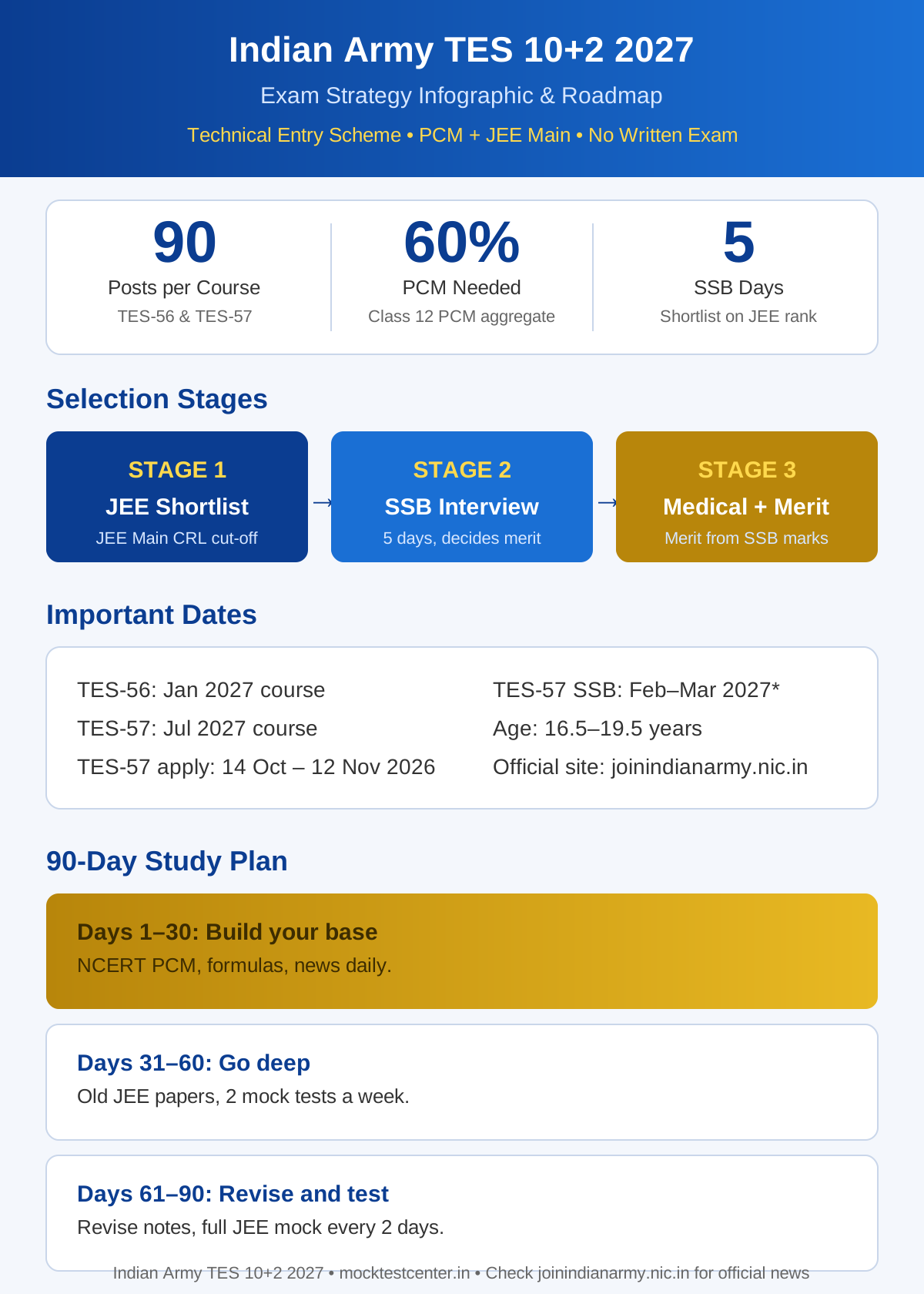
TES runs two courses every year, one starting in January and one starting in July. TES-56 is the January 2027 course, and TES-57 is the July 2027 course. Each course has about 90 posts. The posts are provisional, which means the Army can raise or lower the number as per its need.
Who can apply
This entry is for unmarried male students only. Women cannot apply for TES. You must have passed Class 12 with Physics, Chemistry and Mathematics, and you must have appeared in JEE (Main). Both conditions must be met together. A student with 60 percent in PCM but no JEE (Main) appearance cannot apply.
You must be an Indian citizen. You must be between 16.5 and 19.5 years old on the date fixed in the notice — 1 January 2027 for TES-56 and 1 July 2027 for TES-57. There is no age relaxation for any category.
Eligibility
Eligibility means the rules you must meet before you apply. The first rule is education. You must have passed Class 12 or an equal exam with Physics, Chemistry and Mathematics from a recognised board, with at least 60 percent aggregate marks in PCM. The 60 percent is counted only from your Class 12 PCM marks.
The second rule is JEE (Main). You must have appeared in JEE (Main). For TES-57, the July 2027 course, you must have appeared in JEE (Main) 2026. For TES-56, the January 2027 course, most sources say JEE (Main) 2026, but one source says JEE (Main) 2025. The article uses 2026 as the majority figure and flags this conflict, because the sources do not agree.
The third rule is age. You must be 16.5 to 19.5 years old on the course date. For TES-57 that means you must be born between 1 January 2008 and 1 January 2011, both dates included. The fourth rule is fitness. You must be medically fit as per the Army rules. The exact height, chest and eye numbers are not verified for 2027, so this page gives no such numbers. Read them in the official notice on joinindianarmy.nic.in.
Posts and vacancies
Vacancy means the number of seats. TES-56, the January 2027 course, has 90 posts. TES-57, the July 2027 course, also has 90 posts. Both figures are provisional, which means the Army can change them as per the training capacity and its need.
There is no stream-wise split of the 90 posts. TES does not divide seats by Civil, Mechanical or other branches at the time of application. Do not trust any site that gives a branch-wise split for TES, because no such split is published.
Exam pattern
Exam pattern means how the selection is set. TES has no written exam of its own. The selection has four steps. Step one is shortlisting. The Army makes a cut-off list from the JEE (Main) Common Rank List, called CRL, and the PCM marks. Only students above the cut-off are called for the SSB.
Step two is the SSB interview. It lasts about five days and has a screening test on day one, psychology tests, group tasks and a personal interview. Step three is the medical examination. Step four is the final merit list, which is made only from the SSB marks, for students who are medically fit.
| Stage | What happens | Marks / time |
|---|---|---|
| Step 1: Shortlisting | Cut-off from JEE (Main) CRL + PCM marks | No marks — only a cut-off |
| Step 2: SSB interview | 5 days: screening, psychology, group tasks, interview | SSB marks decide merit |
| Step 3: Medical test | Full health check | Must pass |
| Step 4: Final merit | Made from SSB marks only | 90 posts per course |
Syllabus
Syllabus means the list of topics you must study. TES has no syllabus of its own, because it has no written exam. Your syllabus is the JEE (Main) syllabus, plus the SSB.
JEE (Main) covers Class 11 and 12 Physics, Chemistry and Mathematics. Physics covers mechanics, electricity, optics and modern physics. Chemistry covers physical, organic and inorganic chemistry. Mathematics covers algebra, calculus, trigonometry, geometry and vectors. The JEE paper tests speed and accuracy, so practise with a timer.
Your Class 12 PCM marks also matter, because you need at least 60 percent aggregate in PCM. Do not ignore your board exams while you prepare for JEE. A student who scores well in JEE but falls below 60 percent in PCM cannot apply for TES.
Important dates
The dates below are from the official TES notices as reported by secondary sources. The TES-56 and TES-57 application windows are already closed. The next chance is TES-58, for which no dates are verified yet. Check joinindianarmy.nic.in every week.
TES-57, the July 2027 course, opened applications on 14 October 2026 and closed them on 12 November 2026. The shortlisting cut-off is expected in the fourth week of November 2026, and the SSB interviews are expected in February to March 2027. Both of those dates are tentative.
| Event | TES-56 (Jan 2027) | TES-57 (Jul 2027) |
|---|---|---|
| Applications open | 13 May 2026 | 14 October 2026 |
| Applications close | 12 June 2026 | 12 November 2026 |
| Shortlisting cut-off | First week of July 2026 (tentative) | 4th week of Nov 2026 (tentative) |
| SSB interviews | Aug – Sep 2026 | Feb – Mar 2027 (tentative) |
| Course starts | 1 January 2027 | July 2027 |
| Vacancies | 90 | 90 (provisional) |
Cut-off
Cut-off means the lowest rank that can pass a stage. In TES there are two cut-offs. The first is the JEE (Main) CRL cut-off for shortlisting. Only students above that rank are called for the SSB. The second is the final merit list, which is made from SSB marks only.
No cut-off number is verified for TES-56 or TES-57. The Army has not published the JEE CRL cut-off for either course. The article gives no cut-off number, because no real number exists in any source we checked. Do not trust any site that gives a TES cut-off rank as fact.
Best books
Do not buy ten books for one subject. One good book for each subject is enough. Read it two times and solve its questions.
For JEE (Main), use your Class 11 and 12 NCERT books first, because the paper is set from that base. Then use one good practice book for each subject with many solved questions and mock papers. For Physics, practise numerical questions daily. For Chemistry, learn the reactions and tables by heart. For Maths, practise a little every day, because speed comes only from daily practice.
For your board exams, your school books are the base. Do not ignore them while you prepare for JEE, because you need 60 percent in PCM. No exact book title is given here, because no title has been verified for this entry. Ask your teacher or a senior who cleared TES which books helped them. Also solve the old JEE (Main) papers of the last five years with a timer.
90-day study plan
Days 1 to 30: Build your base. Read your Class 11 and 12 Physics, Chemistry and Maths books again and make short notes. Learn the formulas and reactions by heart. Read the news for 30 minutes each day. Give one small JEE test each week. Do not skip Maths on any day, because Maths needs daily touch.
Days 31 to 60: Go deep. Solve old JEE (Main) papers in full, sitting for the whole time like a real exam. Practise Physics numericals and Chemistry reactions in one sitting and note your weak topics. Give two mock tests each week and write your mistakes in a diary. Start speaking in English for a few minutes each day, because the SSB interview needs clear speech.
Days 61 to 90: Revise and test. Read your notes and formulas again and again. Do not start any new book now. Give a full JEE mock test every two days. In the last week, solve one full paper each day and sleep well. A fresh mind answers faster than a tired mind. If your SSB call comes, shift your focus to group tasks and interview practice.
How to use mock tests
Mock tests are practice tests that look like the real exam. They show your weak topics, teach you time control, make you brave, and show your true score. A student who gives many mock tests walks into the real exam hall without fear.
Take mock tests on mocktestcenter.in. Start with one test each week, then two each week, and in the last month, one every two days. Always check your answers after a test and write the right answers in your notes. Sit in a quiet room, keep your phone away, and use a clock. Give the full JEE paper in one sitting, just like the real exam day.
If you are getting ready for more than one Army entry, you can also look at Indian Army NDA 2027, Indian Army CDS 2027 and Indian Army TGC 2027. For other government exams on this site, see 72nd BPSC Prelims 2027, BPSC TRE 4.0 Teacher Recruitment 2027, BPSC Assistant Engineer 2027, BPSC Assistant Section Officer 2027, BPSC District Statistical Officer 2027, BPSC Motor Vehicle Inspector 2027, BPSC Auditor 2027 and 33rd Bihar Judicial Services 2027. Each page has its own mock tests, study plan and simple notes.
A last word
TES is the fastest door for a PCM student who wants the Army uniform without a written exam. You need 60 percent in PCM, a JEE (Main) appearance, and an age of 16.5 to 19.5 years. TES-56 starts in January 2027 and TES-57 starts in July 2027, each with 90 posts.
Start today. Do not wait for the next notice. Build your JEE score daily, keep your PCM above 60 percent, and practise for the SSB. When the next notice comes, read it on joinindianarmy.nic.in and apply at once. The uniform is waiting for the student who prepares every day.