About HSSC CET Group D 2027 Exam Series
📖 Table of Contents
- HSSC CET Group D 2027 at a glance
- The 2026 cycle, and the post count that is still blank
- The 2023 cycle, the one that actually finished
- The HSSC CET Group D exam pattern in full
- Who can apply, what it costs, and the age rule
- What the score buys: the posts, the pay, and the 100 percent rule
- The three year score, and how to use it
- A preparation plan that fits a 100 mark paper
- The mistakes that cost candidates a year
- Sources
HSSC CET Group D 2027: Complete Exam Guide
The HSSC CET Group D 2027 page on this site follows the live cycle of the Haryana Common Eligibility Test for Group D posts, and the live cycle is the 2026 cycle under Advertisement Number 05/2026. The Haryana Staff Selection Commission, known as HSSC, published that advertisement on 18 June 2026. Registration ran from 19 June to 5 July 2026, and the correction window ran from 9 to 11 July 2026. HSSC has not announced the exam date as of 22 November 2026. No separate 2027 notification has been published as of 22 November 2026, so this guide anchors on the 2026 cycle and on the 2023 cycle that finished before it, and says so wherever a 2027 figure would otherwise be guessed.
That anchoring matters because the CET for Group D has changed its shape between cycles, and a candidate who mixes the two cycles will prepare from the wrong marks, the wrong fee, and the wrong post count. The 2023 cycle carried 13,536 Group D posts and a paper of 95 marks. The 2026 cycle carries no published post count at all, and its paper carries 100 marks. The old cycle also ran through a court case that removed the socio-economic marks, so the selection rule itself changed. This guide keeps the two cycles separate, labels each figure with the cycle it belongs to, and flags every number that trackers report without an official text behind it.
The CET is a single paper at matric level, and it is the whole selection for most Group D posts. There is no second stage, no interview, and no skill test for the bulk of the posts. The score stays valid for three years, and HSSC uses it to build merit lists whenever Group D vacancies open. That makes the CET different from an ordinary recruitment examination. A candidate writes one paper, and the score from that paper can serve several vacancy rounds across three years. The 2026 cycle is the one that decides who holds a live score when the next vacancy round opens.
HSSC CET Group D 2027 at a glance
| Detail | HSSC CET Group D 2027, as run in the 2026 cycle |
|---|---|
| Conducting body | Haryana Staff Selection Commission (HSSC), Panchkula |
| Exam | Common Eligibility Test (CET) for Group D posts in Haryana government departments, boards and corporations |
| Live cycle | 2026, Advertisement Number 05/2026, published 18 June 2026 |
| Posts in live cycle | Not published in the advertisement, details to be published separately |
| Registration | 19 June to 5 July 2026, extended from 3 July 2026, closed |
| Correction window | 9 to 11 July 2026, closed |
| Exam date | Not announced as of 22 November 2026, to be communicated separately |
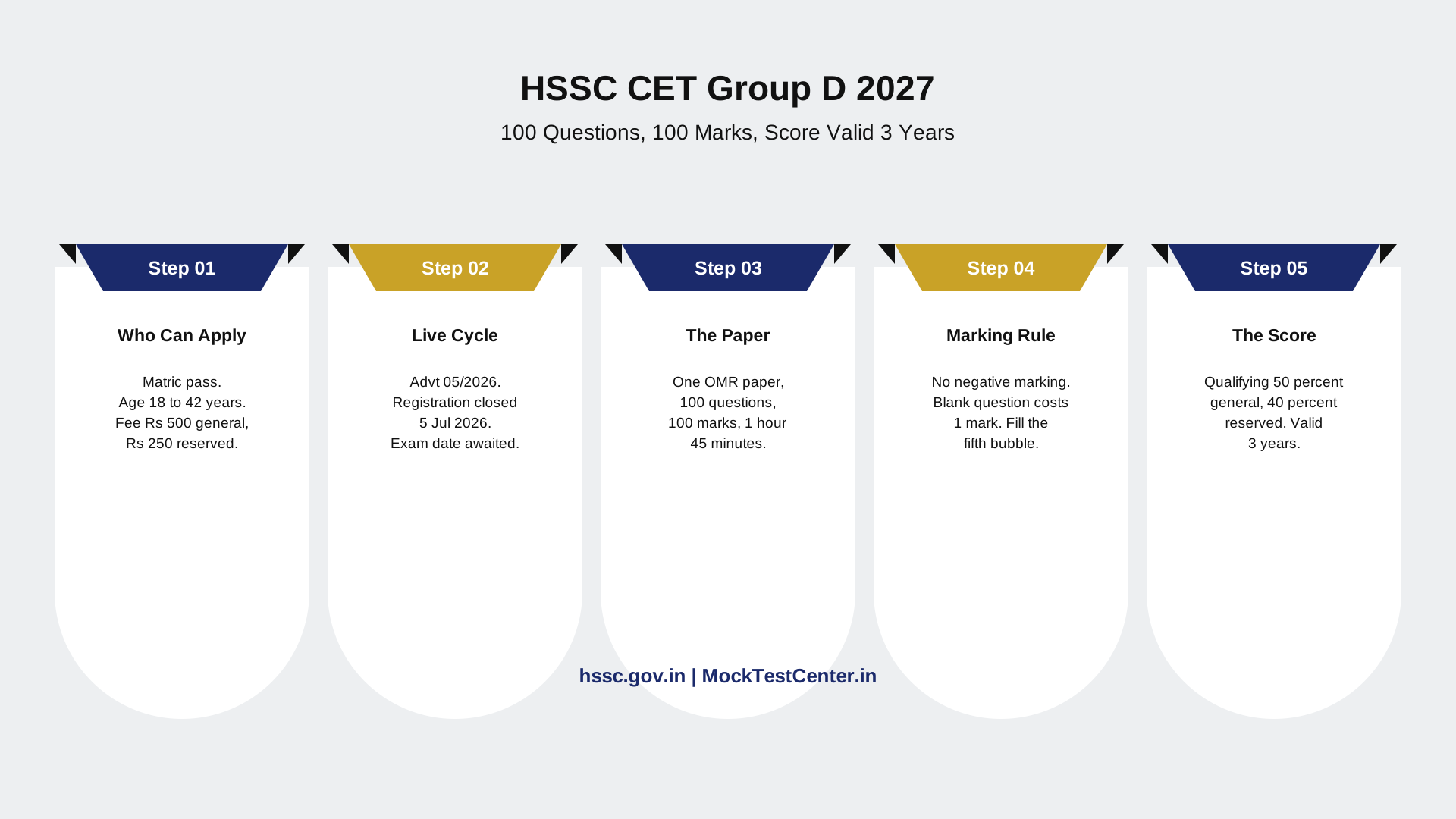
| Paper | One OMR paper, 100 questions, 100 marks, 1 hour 45 minutes, matric level |
| Qualifying marks | 50 percent general category, 40 percent reserved categories |
| Score validity | Three years from the date the result is declared |
| Education | Matriculation (Class 10) pass from a recognised board, with Hindi or Sanskrit |
| Age limit | 18 to 42 years as on 3 July 2026, relaxation per Haryana government rules |
| Fee | Rs 500 general male, Rs 250 reserved categories, female, ex servicemen and PwD, with PPP or Aadhaar; double without it |
| Pay scale | Level DL, Rs 16,900 to Rs 53,500 per month, plus allowances |
| Last finished cycle | 2023, Advertisement Number 01/2023, 13,536 posts, exam 21 and 22 October 2023 |
| 2027 notification | Not published as of 22 November 2026 |
The 2026 cycle, and the post count that is still blank
Advertisement Number 05/2026 is a short document with one large blank in it. Chapter 2.1 of the advertisement states the detail of Group D posts will be published separately. No post count, no department list, and no category split appears in the advertisement text that tracker pages quote. The registration window still ran on schedule, from 19 June 2026 to 3 July 2026, and HSSC extended the last date to 5 July 2026 by a public notice dated 3 July 2026. The fee deadline ran to 6 July 2026, and the correction window ran from 9 to 11 July 2026. Every step except the exam itself has closed. The exam date line in the advertisement reads "will be communicated separately", and it still reads that way as of 22 November 2026.
Tracker pages fill the blank with a figure of around 8,000 vacancies. That figure appears on Testbook, ExamLover, Rojgar Updates and Rapido Jobs India, and none of them cites an HSSC notice for it. The advertisement says the vacancy detail will come separately, and no separate vacancy notice has surfaced in the sources read for this guide. This guide records the 8,000 figure as an unverified tracker claim and uses no post count for the 2026 cycle. A candidate who plans around 8,000 posts is planning around a rumour. The notified number, when HSSC publishes it, is the only number that counts.
The exam calendar is the next thing to watch. On 8 November 2026 the HSSC chairman told the press that the commission was finalising a comprehensive exam calendar, and that the calendar would carry the official dates for the CET Group D examination and the CET Group C Stage 2 examination. The calendar had not been published as of 22 November 2026. Tracker pages float expected dates in the meantime, one tracker puts the exam on 6 December 2026 and another on 20 December 2026, and both label their own dates as expected and unconfirmed. HSSC has published no date, so this guide publishes none. The place to check is hssc.gov.in, and the check that matters is the notice board, not a tracker countdown.
The HSSC CET Group D 2027 cycle also carries a warning for candidates who qualified the last CET. The advertisement states that candidates who qualified the Group D CET held on 12 January 2024 hold a score valid up to 11 January 2027. That date is now less than two months away. If the 2026 examination slips past January 2027, the old score lapses before the new result arrives. A candidate who holds the old score and wants a live score through 2029 should have registered for the 2026 cycle, which closed on 5 July 2026. A candidate who missed that window has no live route until HSSC opens the next registration.
The 2023 cycle, the one that actually finished
The 2023 cycle is the finished cycle that shows the full arc of this examination, from notification to department allocation, and it is worth reading in full because the 2026 cycle follows the same rules with a different marks scheme. Advertisement Number 01/2023 opened applications on 5 June 2023, and the last date to apply was 6 July 2023. One tracker page gives the notification date as 30 May 2023, and this guide uses 5 June 2023 from the tracker page that lists the full date table. About 13.5 lakh candidates registered, and about 8.5 lakh appeared for the examination. The National Testing Agency, known as NTA, conducted the examination on 21 and 22 October 2023 in four shifts across Haryana. The answer key came out on 10 November 2023. The scorecards came out on 12 January 2024, and the result notices followed on 7 and 11 March 2024.
The result did not settle quickly. The socio-economic criteria marks, five marks that the original scheme added to the 95 mark paper, were suspended during the court case CWP Number 25781 of 2023, Varun Bhardwaj versus State of Haryana and another, and the court struck the socio-economic marks down. HSSC then reworked the result on CET marks alone. A correction portal opened from 26 to 29 February 2024 for category changes, and a second correction window ran in July 2024. One tracker page dates the revised result to 26 and 27 June 2024, and two other tracker pages date it to 6 July 2024. This guide records both dates as a conflict and uses neither as certain. A remaining result notice followed in August 2024, and a revised result for additional posts appeared on 26 June 2026. The preference portal then let qualified candidates choose their post and department, and department allocation followed on the recruitment portal of the Haryana government.
The 2023 cycle also shows how long a CET score can stay useful. The scorecards released on 12 January 2024 carried a validity of three years, up to 11 January 2027, and the 2026 advertisement confirms that validity and explains how the old scores join the new merit list. The old paper carried 95 marks, and the new paper carries 100 marks, so HSSC converts the old marks into a percentage before merging the two lists. A candidate who scored 70 out of 95 in the old paper and a candidate who scores 75 out of 100 in the new paper sit on the same list by percentage, not by raw marks. That conversion rule is the bridge between the two cycles, and it is the reason the old score still matters in 2026.
The scale of the 2023 cycle deserves a plain statement. Thirteen thousand five hundred and thirty six posts, 13.5 lakh registrations, 8.5 lakh candidates in the halls, and a result that took five months from the examination to the first result notice and another four months to the revised result. The CET is not a small examination. It is the single largest recruitment examination Haryana runs, and the 2026 cycle will draw a similar crowd whenever HSSC fixes the date. A candidate who treats it as a minor test will find the competition heavier than expected.
The HSSC CET Group D exam pattern in full
The HSSC CET Group D exam pattern for the 2026 cycle is one OMR paper of 100 questions for 100 marks, held in 1 hour 45 minutes. The level is matriculation, and the paper runs in Hindi and English. General subjects carry 75 percent of the paper, and Haryana specific subjects carry 25 percent. The advertisement states that split and gives no question count per subject, so the subject table below comes from the 2023 paper, which every tracker page reports in the same shape. Treat it as the best guide to the shape of the paper, not as a promise for 2026, because HSSC can shift the counts inside the 75 and 25 blocks.
| Subject | Questions in the 2023 paper | Marks in the 2023 paper |
|---|---|---|
| General Knowledge | 15 | 14.25 |
| General Science | 15 | 14.25 |
| Reasoning | 10 | 9.5 |
| Maths | 15 | 14.25 |
| English | 10 | 9.5 |
| Hindi | 10 | 9.5 |
| Haryana General Knowledge | 25 | 23.75 |
| Total | 100 | 95 |
Two numbers in that table need care. The 2023 paper gave each question 0.95 marks, so 100 questions made 95 marks, and the remaining 5 marks came from the socio-economic criteria. The 2026 paper gives each question 1 mark, so 100 questions make 100 marks, and the socio-economic marks are gone. A candidate who reads an old tracker page and prepares for a 95 mark paper is preparing for a paper that no longer exists. The qualifying marks also sit on the new total. A general category candidate needs 50 percent, which is 50 marks out of 100 in the 2026 paper. A reserved category candidate needs 40 percent, which is 40 marks out of 100. Those two numbers decide who holds a live score and who does not.
The marking rule has a twist that punishes carelessness more than wrong answers. A wrong answer costs nothing. A question left blank costs 1 mark, unless the candidate fills the fifth bubble on the OMR sheet to mark it as not attempted. Every question needs exactly one bubble filled, either an answer or the fifth bubble. The 2023 examination ran the same rule at 0.95 marks per blank question, and the 2026 advertisement keeps the rule at 1 mark. A candidate who rushes through the last ten questions and leaves them blank loses 10 marks, which is a fifth of the qualifying score for a general candidate. A candidate who fills the fifth bubble on the questions left unanswered loses nothing on those questions. The habit to build is simple. Never leave a bubble empty.
One more conflict sits in the duration. The 2023 admit card put the first shift at 10.00 am to 11.45 am, which is 1 hour 45 minutes. The 2025 and 2026 CET policy papers also state 1 hour 45 minutes. Some tracker pages state 90 minutes for the Group D paper, and that figure conflicts with the shift timing and the policy text. This guide uses 1 hour 45 minutes. A candidate who plans for 90 minutes will rush the last quarter of the paper for no reason.
Computer knowledge is the subject that tracker pages get wrong most often for this paper. The 2025 CET syllabus gives the 75 percent block as General Awareness, Reasoning, Quantitative Ability, English at matric level, Hindi at matric level, and Computer Knowledge for Group C. Computer knowledge belongs to the Group C paper, not the Group D paper. Several tracker pages list computer fundamentals in the Group D syllabus, and that listing conflicts with the policy text. This guide leaves computer knowledge out of the Group D paper and records the tracker listing as an error. A Group D candidate who spends a month on computers is spending it on a subject that will not appear.
Who can apply, what it costs, and the age rule
The education rule is matriculation. A candidate needs a Class 10 pass from a recognised board, with Hindi or Sanskrit as a subject, or as per the Haryana Group D Employees Act of 2018. The post is open to fresh Class 10 pass candidates, and no experience is required. The age rule is 18 to 42 years, counted as on the closing date of the application window. For the 2026 cycle the closing date was 3 July 2026, extended to 5 July 2026, so the age was counted as on that date. Relaxation applies under Haryana government rules for reserved categories, ex servicemen, and persons with disabilities, and the exact relaxation table sits in the advertisement. A candidate from outside Haryana can apply, but the state reservations go to Haryana domicile candidates.
The fee depends on two things, the category and whether the candidate proves identity with a Parivar Pehchan Patra number or an Aadhaar number. The table below gives the fee with identity proof, which is the fee most candidates pay. Without the PPP or Aadhaar number, the fee doubles.
| Category | Fee with PPP or Aadhaar | Fee without PPP or Aadhaar |
|---|---|---|
| General category male | Rs 500 | Rs 1,000 |
| Female, general or reserved | Rs 250 | Rs 500 |
| SC, Backward Classes, EWS male | Rs 250 | Rs 500 |
| Ex servicemen | Rs 250 | Rs 500 |
| Persons with disabilities | Rs 250 | Rs 500 |
Registration runs through the one time registration portal at onetimeregn.haryana.gov.in, not through a separate HSSC application form. The fee deadline for the 2026 cycle ran to 6 July 2026, and one tracker page puts the extended fee deadline at 8 July 2026. This guide records that as a conflict and uses 6 July 2026 from the tracker pages that quote the advertisement dates. A candidate who qualified the CET earlier and wants to re-appear to improve the score pays the fee again, and the new score carries a fresh three year validity from its own result date. The advertisement states no limit on the number of attempts, and the limit in practice is the age rule of 18 to 42 years.
What the score buys: the posts, the pay, and the 100 percent rule
Group D posts are the support posts of the Haryana government: peon, chowkidar, mali, helper, sweeper, and similar roles in departments, boards, and corporations. The HSSC CET Group D 2027 merit list feeds these posts across the state. The 2023 cycle filled 13,536 such posts, and the post preference portal let qualified candidates choose their post and department before allocation. The 2026 cycle has published no post list yet, so no department split can be stated for it. The pay for a Group D post sits in Pay Matrix Level DL, from Rs 16,900 to Rs 53,500 per month, plus dearness allowance, house rent allowance, and medical benefits under Haryana government rules. One tracker page gives the salary as Rs 9,300 to Rs 34,800, and that figure conflicts with the Level DL scale quoted by the other tracker pages. This guide uses Rs 16,900 to Rs 53,500.
The selection rule changed after the 2023 cycle, and the change is the most important fact in this guide for a candidate who read old material. The original scheme gave 95 marks to the CET paper and 5 marks to the socio-economic criteria. The court struck the socio-economic marks down in the Varun Bhardwaj case, and the amended Haryana Group D Employees Act removed the provision. Recruitment to Group D posts now rests entirely on CET marks, with 100 percent weight to the CET score, except for the few posts where the minimum qualification is below matriculation. There is no interview, no second stage test, and no skill test for the bulk of the posts. The CET paper is the selection. A candidate who scores 50 percent qualifies, and a candidate who scores 80 percent stands far up the merit list when the vacancy round opens.
That rule makes the CET score a durable asset. A candidate who qualifies in the 2026 cycle holds a score that HSSC can use for any Group D vacancy round in the three years after the result. The candidate does not write a fresh paper for each vacancy. The candidate waits for the vacancy notice, applies against it with the live score, and lands on the merit list by percentage. The old 95 mark scores join the same list by percentage conversion, so a 2024 qualifier and a 2026 qualifier compete on equal terms. The score is the ticket, and the vacancy rounds are the doors it opens.
The three year score, and how to use it
A score earned in the HSSC CET Group D 2027 cycle stays valid for three years from the date the result is declared. The scorecards of 12 January 2024 stay valid up to 11 January 2027, and the 2026 advertisement confirms that date in its own text. A candidate who qualified in January 2024 and has waited for a vacancy round has watched that validity run down to its last weeks. The 2026 cycle exists in part to refresh those scores. A candidate who qualifies in the 2026 cycle gets a fresh three years from the new result date, which should run into 2029 or 2030 depending on when HSSC declares the result.
The practical question is what to do with a live score. The answer is to watch the HSSC notice board for Group D vacancy rounds, not to wait for a fresh CET. The CET is the gate, and the vacancy round is the race. A candidate with a live score applies against the vacancy notice with the score already in hand. A candidate without a live score cannot apply at all, however strong the preparation. That is why the registration window matters more than the exam date. The window for the 2026 cycle closed on 5 July 2026, and a candidate who missed it has no live route until HSSC opens the next registration. The exam date, whenever HSSC fixes it, is the second date that matters. The first date already passed.
One more detail in the advertisement deserves attention. Candidates who qualified the Group D CET on 12 January 2024 and candidates who qualify in future cycles sit on one combined merit list, and the old marks out of 95 convert into a percentage for that list. The conversion is simple arithmetic, and it is fair to both sets of candidates. A candidate who scored 66.5 out of 95 in the old paper holds 70 percent, and a candidate who scores 70 out of 100 in the new paper holds 70 percent. The two sit together. A candidate who wants to improve an old score can re-appear in the new cycle, pay the fee again, and replace the old percentage with the new one if it is higher.
A preparation plan that fits a 100 mark paper
The plan starts from the marks. Haryana General Knowledge carries 25 questions out of 100 in the 2023 shape, and the 2026 policy keeps the Haryana block at 25 percent of the paper. General subjects carry the other 75. A candidate who ignores Haryana and prepares only national material prepares for three quarters of the paper. A candidate who gives Haryana a quarter of the study time covers a quarter of the marks. The Haryana block covers the history, geography, economy, polity, literature, culture, and current affairs of the state, and the questions sit at matric level. The districts, the rivers, the folk traditions, the social reform movements, and the state schemes recur in past papers, because the paper tests the state a candidate will serve in.
The general block needs a different habit for each subject. General Knowledge and General Science reward steady reading rather than cramming, because the questions cover a wide field at matric level. Reasoning and Maths reward practice under time, because the paper gives about one minute per question across 105 minutes. English and Hindi at matric level reward grammar and comprehension practice, not literature. A candidate should take a mock test every week from the first month, in 105 minutes, on an OMR sheet if possible, and spend an hour after each test on the mistakes. The mock test habit that pays off fastest is the habit of filling the fifth bubble on every question left unanswered, because that habit alone saves up to 10 marks in a paper where 50 marks is the qualifying line.
The HSSC CET Group D exam pattern gives about one minute per question across 105 minutes, so speed matters as much as knowledge. A candidate who spends three minutes on a single hard Maths question has already borrowed time from two other questions. The working method is to answer the easy questions first, mark the hard ones for a second pass, and fill the fifth bubble on anything still unanswered at the end. Blind guessing costs nothing in this paper, since a wrong answer carries no penalty, but a blank question costs 1 mark. The rational move on a question where two options can be eliminated is to guess between the remaining two. The irrational move is to leave it blank.
Current affairs need a Haryana filter. National and international events matter, but a quarter of the paper tests the state, its schemes, its appointments, its sports persons, and its festivals. A candidate who reads only national current affairs will score well on part of the paper and poorly on the Haryana block. The habit that pays is a daily note of one Haryana fact and one national fact, kept in a single notebook and revised weekly. After six months that notebook holds more than 300 facts, and the revision of it takes less than an hour. The CET rewards that kind of steady accumulation more than it rewards a final month of cramming.
The mistakes that cost candidates a year
The first mistake is waiting for the HSSC CET Group D 2027 exam date before starting preparation. HSSC has not announced the date as of 22 November 2026, and the chairman's statement of 8 November 2026 says only that the calendar is in its final stage. A candidate who waits for the date will get a few weeks of notice and a syllabus that needs months. A candidate who starts now will arrive at the date with the syllabus already covered. The examination rewards the candidate who treats the waiting time as study time, because in this cycle waiting time is most of the calendar.
The second mistake is trusting a tracker post count. The figure of around 8,000 vacancies for the 2026 cycle appears on several tracker pages, and none of them cites an HSSC notice. The advertisement says the post detail will be published separately. A candidate who plans around 8,000 posts and finds the real number is half that will have aimed at the wrong cut off. The post count arrives with the vacancy notice, and it is the only number that counts.
The third mistake is leaving questions blank without filling the fifth bubble. The rule is written in the advertisement and repeated on every tracker page, and candidates still lose marks to it every cycle. A blank question costs 1 mark in the 2026 paper. Ten blank questions cost 10 marks, which is a fifth of the qualifying score. The fifth bubble exists to protect the candidate, and it only works if the candidate uses it on every question left unanswered.
The fourth mistake is preparing for the old 95 mark paper instead of the current HSSC CET Group D exam pattern. The 2023 paper gave 0.95 marks per question and 5 marks to the socio-economic criteria. Both are gone. The 2026 paper gives 1 mark per question and 100 percent weight to the CET score. A candidate who studies old material and old cut offs will aim at the wrong total and the wrong qualifying line. The qualifying line is 50 marks for a general candidate and 40 marks for a reserved candidate, out of 100.
The fifth mistake is paying the higher fee by skipping the identity proof. A general male candidate with a PPP or Aadhaar number pays Rs 500. The same candidate without it pays Rs 1,000. The difference is a formality, and it doubles the fee. A candidate should link the PPP or Aadhaar number before registering, because the fee is fixed at the time of registration and HSSC does not refund the difference.
The sixth mistake is ignoring the expiry date on an old score. The January 2024 score stays valid up to 11 January 2027. A candidate who holds that score and assumes it lasts forever will find it lapsed when the next vacancy round opens. The 2026 cycle was the chance to refresh it, and its registration closed on 5 July 2026. Check hssc.gov.in for the next registration window, and check the score validity before planning around an old result.
Check hssc.gov.in for the HSSC CET Group D 2027 exam date notice and the vacancy detail before you change anything in this plan, and read the advertisement PDF line by line when the next notice appears. The pattern, the post count, and the dates in the next notice will be the ones that decide your attempt, not the figures in any guide.
Sources
HSSC CET Group D Advertisement Number 05/2026, published 18 June 2026, as quoted by ExamDetail and Scribd, registration 19 June to 3 July 2026, extended to 5 July 2026 by public notice dated 3 July 2026, correction window 9 to 11 July 2026, exam date to be communicated separately, post detail to be published separately, Group D CET held on 12 January 2024 valid up to 11 January 2027, old 95 mark scores converted to percentage for the combined merit list, qualifying marks 50 percent general and 40 percent reserved, CET score 100 percent of selection for Group D posts, fee with PPP or Aadhaar Rs 500 general male and Rs 250 reserved, female, ex servicemen and PwD, double without it, age 18 to 42 years, matric pass with Hindi or Sanskrit, paper 100 questions, 100 marks, 1 hour 45 minutes, OMR, no negative marking, 1 mark deducted for an unattempted question without the fifth bubble. CareerPower, HSSC CET Notification 2025, notification 27 May 2025, registration 28 May to 14 June 2025, fee payment to 16 June 2025, Group C exam 26 and 27 July 2025, result 5 December 2025, CET scores valid for three years, qualifying marks 50 percent general and 40 percent reserved, Group D needs a matric pass. Adda247, Haryana CET Exam Date 2025, Group C exam 26 and 27 July 2025 in four shifts at 1,350 centres, notification 26 May 2025. NeedUp, HSSC CET Haryana fee, eligibility and validity, last checked 5 October 2026, CET Group D Advertisement 05/2026 registration 19 June to 5 July 2026, corrections to 11 July 2026, exam date not announced as of 5 October 2026, Group D CET held on 12 January 2024 valid up to 11 January 2027, score validity three years from result declaration. HaryanaJobs, HSSC CET Group D 2024, notification 5 June 2023, apply last date 6 July 2023, exam city intimation 10 October 2023, admit card 16 October 2023, exam 21 and 22 October 2023, answer key 10 November 2023, correction portal 26 to 29 February 2024, revised result 26 and 27 June 2024, 13,536 vacancies, 10th pass, age 18 to 42 years, paper 100 questions, 95 marks, 0.95 per question, no negative marking, 0.95 deducted for a blank question, 5 marks socio-economic criteria, subject split General Knowledge 15, General Science 15, Reasoning 10, Maths 15, English 10, Hindi 10, Haryana General Knowledge 25, NTA conducted the examination. Telegraph India, HSSC Group D CET Result, updated 13 January 2024, exam 21 and 22 October 2023 for 13,536 vacancies, socio-economic marks suspended during CWP Number 25781 of 2023 Varun Bhardwaj versus State of Haryana, scorecards valid for three years from the result date. AllUniversityResult, HSSC CET Group D Revised Result 2024, exam 21 and 22 October 2023, about 8.5 lakh appeared out of 13 lakh registrations, score card 12 January 2024, result 8 March 2024, revised result 6 July 2024 after the court rejected the socio-economic marks. Mockers, HSSC CET Group D Revised Result 2024, 6 July 2024, exam 21 and 22 October 2023 in four shifts, more than 8.5 lakh appeared, revised result after the court dismissed the socio-economic marks. Testbook, HSSC CET Group D 2026, notification 18 June 2026, registration 19 June to 3 July 2026, correction window 9 to 11 July 2026, around 8,000 vacancies claimed, salary Rs 16,900 to Rs 53,500, final selection on CET scores alone. FreeJobAlert, HSSC CET Group D 2026 notification, Advertisement 05/2026 published 18 June 2026, 100 mark, 100 question offline OMR exam at matric level, qualifying 50 percent general and 40 percent reserved, Group D CET 12 January 2024 valid to 11 January 2027, old 95 mark scores converted to percentage. ExamDetail, HSSC CET Group D 2026, status on 5 November 2026, application window closed, exam date not announced, post details unpublished, Chapter 2.1 says post details will be published separately. Shishya, HSSC CET Haryana 2026, updated 7 October 2026, CET Group D exam date not announced, November 2026 window floated but unconfirmed, expected exam 6 December 2026 unconfirmed. Patamde Study, HSSC CET Group D and Group C Stage 2 Exam 2026 calendar expected soon, 8 November 2026 HSSC chairman said the exam calendar is in its final stage, Group D Advertisement 05/2026, Group C Phase 2 Advertisement 06/2026. ToppersExam, HSSC Group D Recruitment 2026, age 18 to 42 years, salary Rs 16,900 to Rs 53,500 plus special pay, fee Rs 500 general male and Rs 250 reserved and female with PPP or Aadhaar, Rs 1,000 and Rs 500 without it. ExamLover, HSSC CET Group D Recruitment 2026, approximately 8,000 vacancies claimed, pay Rs 16,900 to Rs 53,500, fee last date 8 July 2026 extended, correction 9 to 11 July 2026. GetMyUni, HSSC Exam Pattern 2024, CET paper 100 questions, 90 minutes claimed, 0.95 marks per question, no negative marking, 0.95 lost for an unattempted question. ExamSyllabusHub, HSSC Group D Syllabus, OMR paper at matric level, general subjects 75 percent and Haryana General Knowledge 25 percent, 100 questions, 100 marks, 1 hour 45 minutes, 1 mark cut for a question left without the fifth bubble.