About HSSC CET Group C 2027 Exam Series
📖 Table of Contents
- HSSC CET Group C 2027 at a glance
- What the CET is, and what it is not
- The 2025 cycle, in numbers
- The HSSC CET Group C exam pattern
- The Haryana quarter, and why it decides the paper
- Who can apply, what it costs, and the age rule
- What happens after the CET
- The 2022 cycle, and what it taught candidates
- A preparation plan that fits the paper
- The mistakes that cost candidates the certificate
- Sources
HSSC CET Group C 2027: Complete Exam Guide
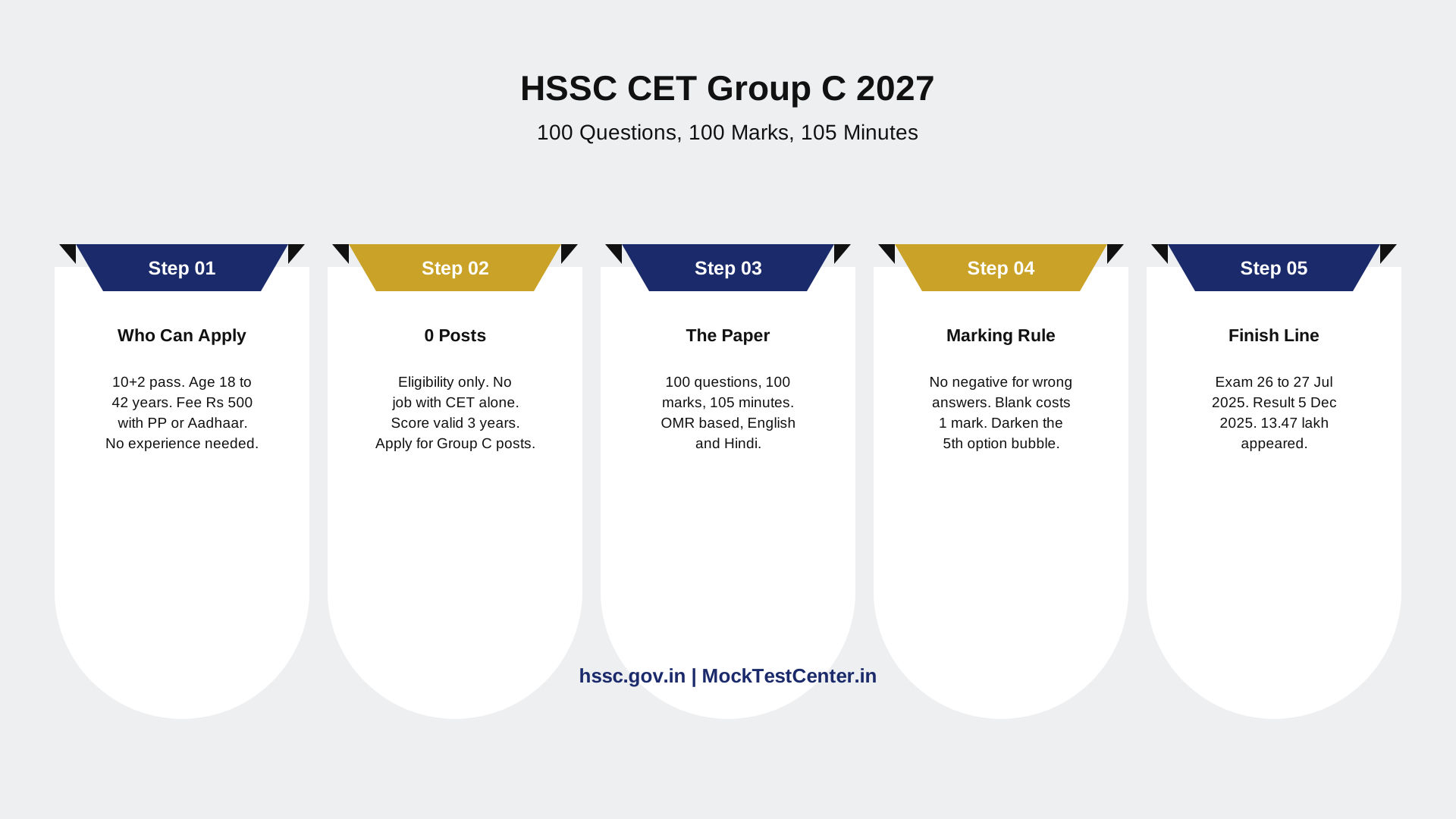
The HSSC CET Group C 2027 page on this site follows the live cycle of the Haryana Common Eligibility Test for Group C posts, and the live cycle is the 2025 test. The Haryana Staff Selection Commission, known as HSSC, published the notification on 27 May 2025 under Advertisement Number 01/2025. Registration ran from 28 May to 14 June 2025. HSSC held the examination on 26 and 27 July 2025 across 1,350 centres in Haryana, and about 13.47 lakh candidates appeared. The result came out on 5 December 2025, and 8,12,000 candidates qualified. No separate 2027 notification has been published as of 22 November 2026, so this guide anchors on the 2025 cycle and says so wherever a 2027 figure would otherwise be guessed.
The first thing to understand about this examination is what it is not. The CET carries no posts of its own. It is an eligibility test, and passing it buys nothing except the right to apply for Group C posts when HSSC advertises them. The score stays valid for three years, and a qualified candidate can apply for any Group C post advertised inside that window, then face a second stage for that post. A candidate who treats the CET as a job examination will misunderstand the whole design. The CET is a gate, and the job comes later, in a different examination, for a specific post, with its own advertisement.
That design is also the reason the CET draws the largest crowds of any Haryana examination. About 13.47 lakh candidates appeared in July 2025, which is more than fifteen times the number that applied for the HCS examination in the same period. The paper is set at the 10+2 level, the fee is Rs 500 for most candidates, and the qualification is 10+2 or matric with an additional qualification. The CET is the single door through which almost every Group C job in Haryana now passes, from clerk to patwari to junior engineer to staff nurse, and that is why this guide treats the test itself as the subject, not any one post behind it.
HSSC CET Group C 2027 at a glance
| Detail | HSSC CET Group C 2027, as run in the 2025 cycle |
|---|---|
| Conducting body | Haryana Staff Selection Commission (HSSC), Panchkula |
| Exam | Common Eligibility Test (CET) for Group C posts, commonly called HSSC CET Group C |
| Live cycle | 2025, notification dated 27 May 2025, Advertisement Number 01/2025 |
| Posts in live cycle | 0, eligibility only. The CET carries no posts. Qualified candidates apply for Group C posts advertised separately. |
| Registration | 28 May to 14 June 2025, fee payment to 16 June 2025 |
| Fee | Rs 500 for general category with Parivar Pehchan Patra or Aadhaar, Rs 1,000 without it, Rs 250 for other categories with it, Rs 500 without it |
| Exam | 26 and 27 July 2025, OMR based, 100 questions, 100 marks, 1 hour 45 minutes |
| Answer keys | 30 July 2025 |
| Result | 5 December 2025, about 13.47 lakh appeared, 8,12,000 qualified |
| Qualifying marks | 50 percent for general category, 40 percent for reserved categories |
| Score validity | 3 years from the result |
| Education | 10+2 or equivalent, or matric with an additional qualification |
| Age limit | 18 to 42 years as on 12 June 2025 |
| 2027 notification | Not published as of 22 November 2026 |
What the CET is, and what it is not
The CET is a screening examination that HSSC introduced to replace the old system in which every Group C post had its own separate written test from the start. Under the CET system a candidate sits one common test, and the score from that test decides eligibility for every Group C post advertised in the next three years. The candidate then applies for a specific post, and HSSC shortlists candidates for that post on the basis of the CET score, usually ten times the number of vacancies, for a second stage that belongs to that post alone. The second stage can be a skill test, a written examination, or a physical test, depending on the post.
The CET score itself works as a qualifying score. It ranks candidates only when HSSC shortlists for a specific post, and the qualifying marks are 50 percent for the general category and 40 percent for reserved categories. A candidate who scores 50 percent and a candidate who scores 95 percent both hold the same eligibility certificate, and both can apply for the same posts. The difference between them matters only at the shortlisting stage for a specific post, where HSSC ranks applicants by CET score and calls the top candidates. A high CET score is therefore worth chasing, not because it wins a job on its own, but because it decides whether a candidate gets called for the second stage of the post that candidate wants.
The CET also covers Group D posts, but the Group D test is separate. Group D candidates need only a matric pass, and the Group D paper is set at the matric level. HSSC advertised the Group D CET under Advertisement Number 05/2026, dated 18 June 2026, and tracker pages report that applications have closed while the examination date has not been announced. This guide covers the Group C test only, and it says so plainly, because the two tests differ in level, in syllabus weight and in the posts they open.
One more distinction matters. The CET replaced the old Group C examinations that ran before 2022. The first CET was held on 5 and 6 November 2022, as a computer based test run with the National Testing Agency, and it drew 7,73,572 candidates, of whom 3,57,930 qualified. The 2025 test was held on OMR sheets instead, and it drew about 13.47 lakh candidates, of whom 8,12,000 qualified. The test has grown by about six lakh candidates between its first and second cycles, and the mode has changed from computer based to OMR based. A candidate who prepares from 2022 material should know that the 2025 paper was an OMR paper, and that the mode for the next cycle will be whatever HSSC decides in the next advertisement.
The 2025 cycle, in numbers
The 2025 cycle is the live cycle, and its numbers are the ones a candidate should carry in mind. The notification came out on 27 May 2025 under Advertisement Number 01/2025. Registration opened on 28 May 2025 and closed on 14 June 2025, with the fee payable to 16 June 2025. The examination was held on 26 and 27 July 2025 across 1,350 centres in Haryana. HSSC issued the answer keys on 30 July 2025. The result came out on 5 December 2025, more than four months after the examination, and the scorecard went up on the same day on hssc.gov.in and on the CET portal at cet2025groupc.hryssc.com.
About 13.47 lakh candidates appeared for the examination, and 8,12,000 qualified. That is a pass rate of about 60 percent, which is high for a government examination, and it reflects the design: the CET is a qualifying test, not a competitive merit list, and the qualifying marks are set at 50 percent for the general category and 40 percent for reserved categories. A candidate who scores 50 percent passes. A candidate who scores 49 percent does not. The line is fixed, and it does not move with the number of applicants.
The score stays valid for three years from the declaration of the result, so a candidate who qualified on 5 December 2025 can apply for Group C posts advertised until December 2028. There is no restriction on the number of attempts, and a candidate can sit the CET again in a later cycle to improve the score. The registration number from the one time registration on onetimeregn.haryana.gov.in stays the same for every later CET, and candidates from the 2022 and 2025 cycles use their old number. Anyone can appear for the CET, whether a resident of Haryana or not, but the reservations and the fee concessions belong to Haryana domicile candidates.
The posts that the CET opens are the Group C posts of the Haryana government, in departments, boards and corporations. The list includes patwari, constable, junior engineer, assistant lineman, staff nurse, sub inspector, stenographer, gram sachiv, tracer, lab technician, clerk, typist, assistant manager and data entry operator, among others. Tracker pages report that more than 50,000 vacancies across Group C and Group D categories are expected to be filled through the CET route, but that figure is a tracker estimate, not a notified number, and this guide does not use it as a fact. The notified numbers arrive post by post, in separate advertisements, and each one carries its own vacancy count.
The HSSC CET Group C exam pattern
The HSSC CET Group C exam pattern is a single paper of 100 multiple choice questions for 100 marks, held in 1 hour 45 minutes, or 105 minutes, on OMR sheets, in English and Hindi. Each question carries 1 mark. HSSC sets the paper at the senior secondary, or 10+2 level, except for the Hindi and English subjects, which sit at the matric level. The paper is bilingual, and the candidate answers on an OMR sheet that software marks, with no re-evaluation.
| Subject | Questions |
|---|---|
| General Knowledge and Computer | 15 (11 General Knowledge, 4 Computer) |
| Reasoning | 15 |
| Mathematics | 15 |
| English | 15 |
| Hindi | 15 |
| Haryana General Knowledge | 25 |
| Total | 100 |
The marking rule is the most unusual part of this examination, and it is the part candidates get wrong most often. There is no negative marking for a wrong answer. A wrong answer costs nothing. But a question left unattempted costs 1 mark, unless the candidate darkens the fifth option on the OMR sheet to mark it as intentionally unattempted. The OMR sheet carries five options per question, four answer options and a fifth option that means no answer, and the candidate must darken the fifth bubble for every question the candidate does not attempt. A candidate who leaves a question blank, with no bubble darkened, loses 1 mark for it. A candidate who darkens the fifth bubble loses nothing for it. The rule punishes carelessness, not ignorance, and it rewards the candidate who reads the instructions on the OMR sheet before the paper starts.
The practical consequence is simple. A candidate should attempt every question, because a wrong answer costs nothing and a right answer gains 1 mark, and a candidate who cannot answer a question should darken the fifth option rather than leave it blank. Blind guessing across the whole paper is a rational strategy in this examination in a way it is not in examinations with negative marking, because the only losing move is the blank. The candidate who leaves ten questions blank has already lost ten marks before the paper is marked. The candidate who guesses on those ten questions will get some of them right and lose nothing on the rest.
Speed matters too. A hundred questions in 105 minutes allows 63 seconds per question on average. That is generous compared with most government examinations, and it is generous on purpose, because the paper is set at the 10+2 level and the test is a qualifying test. A candidate who spends three minutes on a single hard question has already borrowed time from two other questions. The mock test habit that pays off fastest is the habit of marking an answer and moving on, then returning only if time remains, and the habit of darkening the fifth bubble for every question that stays unanswered at the end.
One figure in the record needs flagging. Tracker pages report that the CET scorecard shows marks out of 95, not out of 100, even though the paper carries 100 questions for 100 marks. The 2022 result notification also gave cut offs out of 95, with 47.50 for the general category and 38.00 for reserved categories, described as 50 percent and 40 percent. The reason for the 95 figure is not stated in the sources read for this guide. It may be that five questions were dropped, or that five marks were set aside for something else. This guide records the paper as 100 questions for 100 marks, records the scorecard figure of 95 as reported, and flags the gap as unresolved. A candidate should read the scorecard notice itself to see how the marks are shown.
The Haryana quarter, and why it decides the paper
A quarter of the paper belongs to Haryana. Section B carries 25 percent weight, and it covers the history, current affairs, literature, geography, environment and culture of Haryana. That is 25 questions out of 100, and it is the single largest block in the paper, larger than any other subject. A candidate who ignores Haryana General Knowledge gives away a quarter of the paper before the examination starts.
Section A carries the other 75 percent, and it covers General Awareness, Reasoning, Quantitative Ability, English, Hindi and Computer Knowledge. The General Awareness portion covers current events, history, polity, geography, economics, science, environment and national and international organisations. Reasoning covers verbal and non verbal reasoning, analogy, classification, coding and decoding, series, relationships, Venn diagrams and critical thinking. Quantitative Ability covers the number system, ratio and proportion, percentage, profit and loss, simple and compound interest, time and work, time and distance, mensuration, algebra, geometry and trigonometry. English covers grammar, vocabulary, synonyms and antonyms, spellings, idioms, one word substitution, voice, narration and comprehension. Hindi covers grammar, synonyms, antonyms, idioms, sentence correction, sandhi, samas and spelling. Computer Knowledge covers the basics of computers, MS Office, the internet, browsing, searching, downloading, uploading and email management.
The Haryana portion is where a well prepared candidate pulls away from the rest, because the national material is common to every candidate and every serious candidate covers it. The history of Haryana, the formation of the state in 1966, the districts and their headquarters, the rivers and the canals, the agricultural economy, the industrial corridors, the sports culture, the folk traditions, the literature of Haryana, the geography of the state and the current affairs of Haryana are the topics where local preparation pays. A candidate who reads only national current affairs will score well on three quarters of the paper and poorly on the quarter that decides the difference between passing and failing.
The Haryana quarter also rewards a specific kind of preparation. The questions are factual and direct, and they reward a candidate who has read a Haryana General Knowledge book cover to cover, rather than a candidate who has skimmed the news. The districts, the tehsils, the blocks, the rivers, the dams, the sanctuaries, the folk dances, the fairs, the festivals, the sports persons, the writers, the freedom fighters and the administrative structure of the state are all fair game. A daily note of one Haryana fact, kept in a single notebook and revised weekly, builds more than 180 facts in six months, and the revision of it takes half an hour.
Who can apply, what it costs, and the age rule
The education rule for Group C is 10+2 or an equivalent qualification, or matric with an additional qualification. The exact qualification depends on the post, because the CET is a common test and the posts behind it carry their own educational requirements. A candidate who holds 10+2 can sit the CET, and the post wise advertisements will state which posts that qualification opens. The Group D test, by contrast, needs only a matric pass, and it is a separate test.
The age rule is 18 to 42 years, counted as on 12 June 2025 for the 2025 cycle. That is the last date of registration, and the age was counted as on that date. The window is wide, and it is one reason the applicant pool is so large: a candidate of 18 and a candidate of 42 can sit the same paper, and both can hold the same eligibility certificate for three years.
The fee in the 2025 cycle depended on whether the candidate gave a Parivar Pehchan Patra number or an Aadhaar number. General category candidates who gave the number paid Rs 500, and those who did not paid Rs 1,000. Other category candidates who gave the number paid Rs 250, and those who did not paid Rs 500. The fee was payable online only, through net banking, debit card or credit card, and the last date to pay was 16 June 2025. The Parivar Pehchan Patra is the family identity document of Haryana, and the fee difference is the government's way of pushing candidates to link it. A candidate from outside Haryana can appear for the CET, but the fee concessions and the reservations belong to Haryana domicile candidates.
Registration runs through the one time registration portal at onetimeregn.haryana.gov.in. The candidate registers once, gets a registration number, and uses that number for every later CET. Candidates from the 2022 and 2025 cycles keep their old number. Candidates download the scorecard from hssc.gov.in or from the CET portal with that login.
What happens after the CET
Passing the CET is the first step, not the last one. The qualified candidate waits for HSSC to advertise a Group C post, applies for it, and then faces a second stage that belongs to that post. HSSC shortlists candidates for the second stage on the basis of the CET score, and tracker pages report that the shortlist is usually ten times the number of vacancies. A post with 100 vacancies would call about 1,000 candidates for its second stage, ranked by CET score. That is where a high CET score matters: two candidates who both passed the CET are not equal at the shortlisting stage, and the candidate with the higher score gets called first.
The second stage depends on the post. For a clerk post it can be a typing test or a skill test. For a junior engineer post it can be a written examination in the subject. For a police constable post it can be a physical measurement test and a physical screening test. For a patwari post it can be a written examination. The CET score, the second stage marks, and in some cases socio economic criteria and experience, combine into the final merit for the post under the HSSC (Process of Recruitment of Group C and D posts) Rules, 2025. Tracker pages report that socio economic criteria can add up to 10 marks in the final merit for a post, but this guide flags that figure as reported by trackers and not read from the rules directly, because the 2024 court judgement on the CET is a warning against treating socio economic marks as settled.
The warning comes from the first CET cycle. HSSC revised the 2022 result in June 2024 after a judgement of the Punjab and Haryana High Court dated 31 May 2024 in LPA Number 1037 of 2023, and the revised result rested solely on CET marks, without any weightage for socio economic criteria marks. The original 2022 result had given weight to socio economic criteria, and the court ordered it removed. The revised result of 25 June 2024 stood on CET marks alone. A candidate who counts on socio economic marks for a post should read the current rules for that post before relying on them, because the court has already struck them from the CET result once.
The Group D route is different again. For Group D posts the CET score is the merit list itself, and there is no second stage in the same way. A candidate who qualifies the Group D CET is ranked by score and allotted a post directly. That is why the Group D test is a separate test with its own advertisement, and why this guide does not mix the two. The Group C candidate should not assume that passing the CET wins a job, and the Group D candidate should not assume that the Group C rules apply to the Group D test.
The 2022 cycle, and what it taught candidates
The first CET ran on 5 and 6 November 2022, as a computer based test run with the National Testing Agency, across 1,200 testing locations in 17 districts. It drew 7,73,572 candidates, of whom 3,57,930 qualified. HSSC declared the result on 10 January 2023, and the cut offs were 47.50 for the general category and 38.00 for reserved categories, out of 95, described as 50 percent and 40 percent. The skill test for the first cycle was held on 30 and 31 December 2023 and on 6, 7 and 14 January 2024.
The first cycle taught candidates three lessons that still apply. The first is that the CET is a long game: the examination was held in November 2022, the result came out in January 2023, the skill test ran a year later, and the result was revised in June 2024. A candidate who treats the CET as a single examination with a single result will be surprised by how long the process takes. The second lesson is that the rules can change in court: the socio economic marks that the original result carried were removed by the High Court, and the revised result stood on CET marks alone. The third lesson is that the score is an asset that lasts: the 2022 score stayed valid for three years, and candidates used it to apply for posts advertised long after the examination.
The 2025 cycle fixed some of the first cycle's problems and created new ones. The mode changed from computer based to OMR based, which removed the computer interface but added the fifth option rule, and the fifth option rule is the one candidates get wrong most often. The applicant pool grew from about 7.7 lakh to about 13.5 lakh, which made the examination bigger but did not change the qualifying marks. The result took more than four months to come out, from 27 July to 5 December 2025, which is longer than the two months the 2022 result took. A candidate preparing for the next cycle should expect the same shape: a large crowd, a long wait for the result, and a second stage that belongs to the post, not to the CET.
A preparation plan that fits the paper
The plan starts from the shape of the paper. A hundred questions in 105 minutes, with no negative marking for a wrong answer and a 1 mark penalty for a blank, means the candidate should attempt every question and darken the fifth option for any question left unanswered. The preparation should therefore focus on speed and coverage, not on depth in any one subject. The paper is set at the 10+2 level, and the questions are direct. A candidate who has covered the whole syllabus once will score better than a candidate who has mastered one subject and left two subjects untouched.
The working split that fits the paper is about 25 percent of study time on Haryana General Knowledge, because it carries 25 percent of the marks, and the remaining 75 percent spread across General Awareness, Reasoning, Mathematics, English, Hindi and Computer Knowledge in proportion to their weight. Reasoning and Mathematics together carry 30 questions, and they are the two subjects where practice under time pays fastest, because the questions are mechanical and the speed comes from repetition. English and Hindi together carry 30 questions, and they are set at the matric level, so a candidate who reads the grammar rules once and practises them daily will cover them. General Knowledge and Computer carry 15 questions, and they reward a daily reading habit rather than a single book.
Mock tests have a specific job in this examination, and it is not to predict the score. Their job is to build the habit of finishing 100 questions in 105 minutes, and the habit of darkening the fifth option for every question left unanswered. A candidate should take a mock test on an OMR sheet, not on a screen, because the 2025 paper was an OMR paper and the OMR sheet is where the fifth option rule bites. A candidate should take a mock test, spend half an hour on the mistakes, and change one habit before the next test. A candidate who takes twenty mock tests and changes nothing has bought twenty confirmations of the same errors.
Current affairs need a Haryana filter. National and international events matter, but a quarter of the paper is Haryana, and the Haryana current affairs of the last year recur in it. The habit that pays is a daily note of one Haryana fact, one national fact and one international fact, kept in a single notebook and revised weekly. After six months that notebook holds more than 500 facts, and the revision of it takes an hour. The computer section deserves a weekly slot of its own, because it carries only 4 questions but they are the cheapest marks in the paper: the basics of computers, MS Office, the internet and email management can be covered in a fortnight, and the questions are direct.
The mistakes that cost candidates the certificate
The first mistake is leaving questions blank on the OMR sheet. A blank costs 1 mark, a wrong answer costs nothing, and a fifth option bubble costs nothing. A candidate who leaves ten questions blank has already lost ten marks before the paper is marked, and ten marks is the difference between passing and failing for a candidate near the 50 percent line. The rule is written on the OMR sheet and in the advertisement, and it is the single most expensive mistake in this examination. Darken the fifth bubble for every question you do not answer.
The second mistake is ignoring the Haryana quarter. Twenty five questions out of a hundred belong to Haryana, and a candidate who scores well on the national material and poorly on Haryana will fall short of the qualifying marks. The Haryana section is the largest block in the paper, and it is the block where a candidate from Haryana has a natural advantage, if the candidate uses it. A candidate who has lived in Haryana for twenty years and never read a Haryana General Knowledge book is wasting that advantage.
The third mistake is treating the CET as a job examination. The CET carries no posts. A candidate who passes the CET and then waits for a job to arrive will wait for ever. The CET is a certificate that stays valid for three years, and the candidate must watch hssc.gov.in for post wise advertisements, apply for the posts the candidate wants, and prepare for the second stage of each post. The CET is the door, and the post is on the other side of it.
The fourth mistake is trusting a single tracker site for dates and numbers. The 2025 cycle alone produced a scorecard figure of 95 marks against a paper of 100 marks, a vacancy estimate of more than 50,000 posts that no notification supports, and a Group D examination date that has not been announced. A candidate who plans from one site will plan from one error. The official site, hssc.gov.in, is the only source for dates, and the advertisement PDF is the only source for the pattern, the fee and the qualifying marks. Tracker sites are useful for explanation, and they are not a source for facts that decide an attempt.
The fifth mistake is missing the registration window. The 2025 registration ran from 28 May to 14 June 2025, a window of 18 days, and the fee had to be paid by 16 June 2025. The CET is held once in a cycle, and there is no late window. A candidate who misses the registration waits for the next cycle, which may be years away. The one time registration number stays the same, but the registration itself must be done afresh for each cycle, and the fee must be paid before the deadline.
Check hssc.gov.in for the next notification before you change anything in this plan, and read the advertisement PDF line by line when it appears. The mode, the paper, the fee and the dates in the next cycle will be the ones that decide your attempt, not the figures in any guide. The 2025 cycle changed the mode from computer based to OMR based, and the next cycle could change something else. The advertisement is the only document that counts.
Sources
CareerPower, HSSC CET Notification 2025 Out, Group C Exam Schedule Released, notification 27 May 2025, Advertisement Number 01/2025, registration 28 May to 14 June 2025, fee payment to 16 June 2025, examination 26 and 27 July 2025, OMR based, 100 questions, 100 marks, 1 hour 45 minutes, no negative marking, 1 mark deducted for an unattempted question, qualifying marks 50 percent general and 40 percent reserved, Section A 75 percent weight, Section B Haryana 25 percent weight, fee Rs 500 general with Parivar Pehchan Patra or Aadhaar, Rs 1,000 without it, Rs 250 others with it, Rs 500 without it, age 18 to 42 years as on 12 June 2025, education Group C 10+2 or matric with additional qualification, Group D matric pass, score validity 3 years, Group C posts patwari, constable, junior engineer, assistant lineman, staff nurse, sub inspector, stenographer, gram sachiv, tracer, lab technician, clerk, typist, assistant manager, data entry operator. JagranJosh, HSSC CET Result 2025 OUT, result 5 December 2025, about 13.47 lakh candidates attempted, 1,350 exam centres, eligibility certificate valid for 3 years, result portals hssc.gov.in and cet2025groupc.hryssc.com. CareerPower, HSSC CET Result 2025 Declared, 8,12,000 candidates qualified, score validity 3 years, qualifying marks 50 marks general and 40 marks reserved, scorecard shows obtained marks out of 95. NDTV, Haryana Common Entrance Test 2025 Group C Result Out, 13.47 lakh candidates appeared, 1,350 centres, qualifying criteria 50 percent general and 40 percent reserved, scores valid for three years. News18, Haryana HSSC CET Group C Result 2025 Announced, result 5 December 2025, answer keys issued 30 July 2025, Haryana GK 20 percent, Computer 10 percent, subject specific topics 70 percent for the Group C main examination, top 10 times the number of vacancies shortlisted on CET scores, more than 50,000 vacancies expected across Group C and D categories. CareerPower, HSSC CET Group C Score Card 2025 Out, scorecard 5 December 2025, Advertisement Number 01/2025, qualifying normalised marks out of 100, 50 general and 40 reserved, validity 3 years, socio economic criteria up to 10 marks and experience for final merit lists. AUBSP, HSSC CET Exam Date 2025 OUT for Group C, examination 26 and 27 July 2025, subject split General Knowledge and Computer 15, Reasoning 15, Mathematics 15, English 15, Hindi 15, Haryana GK 25, total 100, fifth option bubble, 1 mark deducted for an unattempted question. Adda247, Haryana CET Syllabus 2026 And Exam Pattern, 100 questions, 100 marks, 1 hour 45 minutes, offline OMR based, no negative marking, syllabus General Awareness, Reasoning, Haryana GK, Mathematics, English, Computer. SarkariBase, HSSC CET Group C 2025, registration 28 May to 12 June 2025, fee General male Rs 500 with Parivar Pehchan Patra or Aadhaar, qualifying marks 50 percent general and 40 percent reserved, unattempted questions minus 1 mark. GK24, Haryana CET and HCS 2026, CET Group C Advertisement Number 01/2025 dated 26 May 2025, Group D Advertisement Number 05/2026 dated 18 June 2026, CET Policy notified 31 December 2024 and amended 11 July 2025, HSSC Process of Recruitment of Group C and D posts Rules 2025, one time registration on onetimeregn.haryana.gov.in, CET 2025 Group C result 5 December 2025, Group D applications closed and examination date not announced. PratinidhiTime, Haryana CET 2022, examination 5 and 6 November 2022, more than 9 lakh candidates, 1,200 testing locations in 17 districts, result 10 January 2023, answer key 7 December 2022, cut offs out of 95, General 47.50 and above, reserved 38.00 and above. ABP Live, HSSC Releases Revised CET Result 2024 For Group C Posts, revised result June 2024, High Court judgement 31 May 2024, 7,73,572 candidates appeared, 3,57,930 qualified. Scroll, HSSC CET Group C revised result 2024 out, revised result prepared solely on CET marks without socio economic criteria weightage, High Court judgement 31 May 2024 in LPA Number 1037 of 2023, skill test 30 and 31 December 2023 and 6, 7 and 14 January 2024. Business Standard, CET Haryana 2024, revised CET results for Group C posts, examination 5 and 6 November 2022.