
About Goa TET 2027 Exam Series
📖 Table of Contents
- Goa TET 2027 at a glance
- What Goa TET is, and what it is not
- Two GTET cycles in eight months
- Who can apply
- The fee, and why it surprises first timers
- Goa TET Paper 1: five sections of 30 marks
- Goa TET Paper 2: the 60 mark section decides it
- Qualifying marks: 90 and 83
- Language 2: the Konkani or Marathi choice
- No negative marking, and what it means for strategy
- Biometric capture and the photo rules
- After the exam: answer keys, certificates, and the GSSC link
- A 90 day plan that follows the marks
- Five mistakes that cost candidates the certificate
- How this guide was put together
- Sources
Goa TET 2027: Complete Exam Guide
The Goa Teacher Eligibility Test, called GTET, decides who can apply for a teaching post in Goa schools. Goa TET 2027 is the next cycle candidates wait for, and this guide works from the two cycles the Goa Board of Secondary and Higher Secondary Education already ran: the December 2025 test and the July 2026 test. No 2027 notification has appeared yet, so every date and rule here comes from those two bulletins.
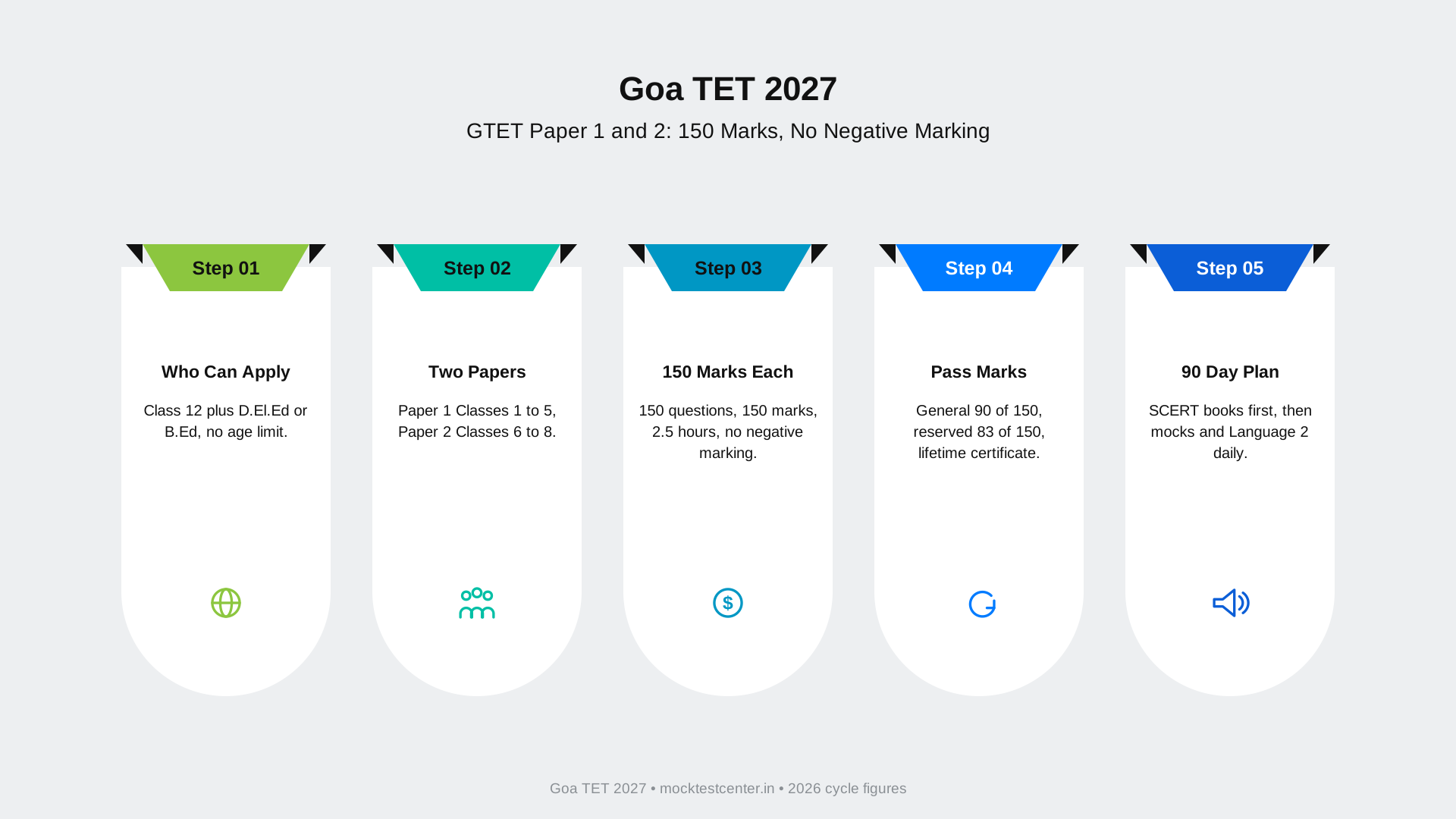
GTET Paper 1 covers Classes 1 to 5, and GTET Paper 2 covers Classes 6 to 8. Each paper carries 150 questions for 150 marks, and each paper runs for two and a half hours. A pass gives a lifetime certificate. It gives no job by itself. Teaching posts come through separate recruitment, and the GSSC primary teacher drive of 2026 asked for a TET pass as one of its conditions.
Three numbers shape the whole test. General candidates need 90 marks out of 150. Reserved category candidates need 83. The fee for one paper is Rs 1800 for general and OBC candidates, and Rs 900 for SC and ST candidates. Those three numbers sit at the centre of this guide, because most first time candidates get one of them wrong.
Goa TET 2027 at a glance
| Detail | Goa TET 2027 |
|---|---|
| Full name | Goa Teacher Eligibility Test (GTET) |
| Conducting body | Goa Board of Secondary and Higher Secondary Education (GBSHSE), Alto Porvorim |
| Official website | gbshse.in |
| Test type | Eligibility test only, no vacancies, no job on clearing |
| Papers | Paper 1 for Classes 1 to 5, Paper 2 for Classes 6 to 8 |
| Questions and marks | 150 questions, 150 marks per paper, 1 mark each |
| Duration | 2 hours 30 minutes per paper |
| Negative marking | None |
| Pass marks | General 60 percent (90 marks), SC, ST, OBC and differently abled 55 percent (83 marks) |
| Fee, one paper | Rs 1800 General and OBC, Rs 900 SC and ST, no fee for PwD candidates |
| Fee, both papers | Rs 3000 General and OBC, Rs 1500 SC and ST |
| Certificate validity | Lifetime |
| Age limit | None set in the July 2026 bulletin |
| Latest cycles | December 2025 (9 and 10 December 2025), July 2026 (21 and 22 July 2026) |
| 2027 notification | Not announced yet |
What Goa TET is, and what it is not
A candidate who clears GTET holds proof of eligibility to teach Classes 1 to 8 in Goa. Government schools, aided schools and private schools under the Government of Goa all treat the pass as one of the conditions for appointment. The bulletin says this in plain words: qualifying gives no right to recruitment or employment. The vacancy itself comes through a separate process, and school managements give weight to the GTET score when they fill posts.
This point matters because Goa runs the test often and the recruitment rarely. The board held its first GTET in May and June 2024, its second in December 2025, and its third in July 2026. Three tests in about two years produced certificates. The teaching posts those certificates open came in far smaller numbers, and the biggest recent drive, the GSSC primary teacher recruitment of 2026, offered 390 posts and asked for a TET pass plus two years of teaching experience.
A candidate who treats GTET as a job ticket will feel cheated. A candidate who treats it as a licence, and plans the recruitment separately, will use it right.
The test follows the national framework for teacher eligibility tests. The Right to Education Act, 2009, sets the idea, and the National Council for Teacher Education sets the minimum qualifications for a person to teach Classes 1 to 8. The Government of Goa handed the job of running the test to GBSHSE. The board runs it from Alto Porvorim, and it publishes the information bulletin on gbshse.in before each cycle.
One more distinction helps. GTET differs from CTET, the central test, in one visible way: its Language 2 paper. Goa offers Konkani or Marathi as Language 2. A candidate who grew up speaking Konkani at home has a real edge here, and a candidate who cannot read Konkani or Marathi will struggle with 30 marks out of 150. That single choice shapes preparation more than any other decision in the form.
Two GTET cycles in eight months
Goa held two GTET cycles within eight months, and the contrast between them tells a candidate most of what the 2027 cycle will look like. The December 2025 cycle ran on a short winter timetable. The July 2026 cycle ran on a summer timetable with a revised bulletin. Both cycles used the same pattern, the same pass marks, and the same fee.
The December 2025 cycle opened applications on 1 November 2025 and closed them on 15 November 2025 at 4 pm. Candidates applied online through a dedicated portal, gtetdec25.azurewebsites.net. Biometric capture and training took place on 5 and 6 December 2025 from 2 pm. Paper 1 ran on 9 December 2025 from 3 pm to 5.30 pm, and Paper 2 ran on 10 December 2025 at the same hours. North Goa candidates sat at St Xavier Higher Secondary School in Mapusa, and South Goa candidates sat at Rosary Higher Secondary School in Navelim. The Times of India reported that at least 3,000 teachers were expected to take the test, with about 1,000 for Paper 1 and about 2,000 for Paper 2.
The July 2026 cycle opened applications on 22 June 2026 and closed them on 11 July 2026 at 4 pm. The board published a revised information bulletin on 30 June 2026, mid way through the application window, so candidates who applied early needed to read the revision. Correction requests went by email from 12 to 15 July 2026.
Biometric capture and training ran on 17 and 18 July 2026. The exam followed on 21 and 22 July 2026, with Paper 1 on 21 July and Paper 2 on 22 July, according to tracker pages that split the two days. Centres sat in Mapusa, Ponda and Margao. Certificates for qualified candidates became available for collection from 8 October 2026 at the Board Office in Alto Betim.
Two details from the December 2025 cycle deserve a second look. The Times of India reported that candidates would receive provisional marks as soon as they left the hall, and that the board would release answer keys soon after the test with eight days to challenge them. That report also described the test as a computer based test on OMR sheets, a phrase that mixes two modes. The bulletin itself calls the test an online application process with an OMR based exam, and no bulletin text seen for this guide confirms provisional marks on exit. Treat the provisional marks claim as a newspaper report, not a bulletin rule.
The July 2026 result picture stays hazy. A tracker page that checked gbshse.in on 5 October 2026 found no answer key or result notice for the July 2026 round among the board announcements, and the board results portal listed only SSC and HSSC results. Certificates reached collection on 8 October 2026, which shows the board did finish the process, but no public result date has been verified for this guide. Candidates for 2027 should watch gbshse.in and the GTET portal rather than tracker pages for the result.
Who can apply
GTET eligibility follows the NCTE framework, and the paper a candidate picks decides the qualification the board checks. Only teacher training courses the NCTE recognises count, and special education courses need recognition from the Rehabilitation Council of India. A candidate in the final year of the course can appear, and the board issues the certificate only after the candidate passes the course and submits proof.
Paper 1 opens five routes. Senior Secondary with at least 50 percent marks plus a two year Diploma in Elementary Education works. Senior Secondary with at least 45 percent marks plus the same diploma works under the NCTE Recognition Norms and Procedure Regulations, 2002. Senior Secondary with at least 50 percent marks plus a four year Bachelor of Elementary Education works. Senior Secondary with at least 50 percent marks plus a two year Diploma in Education in Special Education works. Graduation with at least 50 percent marks plus a Bachelor of Education works too.
Paper 2 opens six routes. Graduation plus a two year Diploma in Elementary Education works. Graduation with at least 50 percent marks plus a B.Ed. works. Graduation with at least 45 percent marks plus a B.Ed. works under the applicable NCTE regulations.
Senior Secondary with at least 50 percent marks plus a four year B.El.Ed. works. Senior Secondary with at least 50 percent marks plus a four year B.A. or B.Sc. B.Ed., or a B.A.Ed. or B.Sc.Ed., works. Graduation with at least 50 percent marks plus a B.Ed. in Special Education works.
SC, ST, OBC and differently abled candidates get up to 5 percent relaxation in the marks their qualifying degree or diploma needs. The July 2026 bulletin sets no minimum or maximum age, and it sets no limit on attempts. A candidate can sit GTET again to improve a score, and the certificate stays valid for life either way.
One rule catches B.Ed. holders by surprise. A B.Ed. holder who wins appointment to teach Classes 1 to 5 must complete a six month NCTE recognised bridge course in Elementary Education within two years of appointment. The bridge course does not block the GTET application, and it does not block the exam. It blocks a career that ignores it, so a B.Ed. candidate should treat the bridge course as part of the plan, not as a surprise after selection.
Eligibility to sit the exam does not prove eligibility for appointment. The board checks the form, and the recruiting authority checks the qualification again at appointment. A candidate whose degree and training combination sits on the edge of a rule should confirm it against the information bulletin before paying the fee, because the fee does not come back.
The fee, and why it surprises first timers
GTET charges more than most state eligibility tests, and the gap shocks candidates who prepared with other states in mind. One paper costs Rs 1800 for general and OBC candidates, and both papers cost Rs 3000. SC and ST candidates pay Rs 900 for one paper and Rs 1500 for both. Candidates with disabilities pay no fee. The fee goes online by debit card, credit card or net banking, and the board does not refund it or carry it to a later cycle.
Compare that with the December 2025 cycle, where the Times of India reported that the board had waived the fee for persons with disabilities and charged reserved category candidates only 50 percent of the fee. The two reports agree on the shape: full fee for general candidates, half fee for reserved candidates, no fee for PwD candidates. The July 2026 bulletin figures match the same shape at Rs 1800 and Rs 900.
Two fee traps sit in the form. The first trap is the two paper choice. A candidate who picks both papers pays Rs 3000, not Rs 1800 twice, so the second paper costs Rs 1200 extra. A candidate who picks one paper now and the other paper in a later cycle pays Rs 1800 each time.
Anyone who qualifies for both levels should sit both papers in the same cycle and save Rs 600. The second trap is the edit lock. Particulars cannot change once the fee is paid, so a wrong Language 2 choice or a wrong paper choice stays wrong. Check every detail before payment, then pay.
The fee also explains why the board runs the test so often. Three cycles in about two years, each with its own fee collection, keep the test available to working teachers who missed a cycle. The December 2025 cycle drew about 3,000 candidates, a small number next to the lakhs who sit bigger state tests. Goa is a small state, and its teacher test stays small with it.
Goa TET Paper 1: five sections of 30 marks
Paper 1 tests a candidate for Classes 1 to 5, and it splits into five equal sections of 30 marks each. Child Development and Pedagogy takes 30. Language 1, English, takes 30. Language 2, Konkani or Marathi, takes 30. Mathematics takes 30. Environmental Studies takes 30. The total is 150, and the paper runs for two and a half hours.
The balance matters more than the list. No section dominates Paper 1, so no section can rescue a candidate who ignores another. A candidate who scores 28 in Mathematics and 12 in Language 2 still faces the same aggregate bar of 90 marks, and the weak section drags the total down by 18 marks that the strong section cannot replace, because the strong section caps at 30. Paper 1 rewards even preparation, not a single strength.
Child Development and Pedagogy covers growth and development, heredity and environment, Piaget stages, intelligence in its several forms, personality and adjustment, learning theories from conditioning to constructivism, motivation and memory, curriculum and evaluation, continuous and comprehensive evaluation, test construction, and inclusive education for gifted children, slow learners and children with learning disabilities. The section tests how children learn, not only what a teacher knows.
The language sections test comprehension and teaching method together. Unseen prose and poem passages carry comprehension, grammar and verbal ability questions. The method half asks about aims and methods of language teaching, listening, speaking, reading and writing skills, teaching learning materials, diagnostic testing and remedial teaching. Language 1 runs in English. Language 2 runs in Konkani or Marathi, and the candidate picks one at the form stage.
Mathematics covers numbers, the four operations, geometry and shapes, measurement, time, money, data handling and patterns, plus methods of teaching mathematics, error analysis and remedial teaching. Environmental Studies covers family and friends, animals, plants, food, shelter, water and travel, plus EVS teaching methods such as observation, project work, role play and activity based learning.
Half of each subject section in Paper 1 tests content, and half tests teaching method. Fifteen of the 30 questions in each language, mathematics and EVS section ask about how to teach the topic, not about the topic itself. A candidate who revises only content walks into the hall with half the paper unprepared. The pedagogy half is where Paper 1 is won and lost, and the SCERT textbooks for Classes 1 to 5 give the content base for both halves.
Goa TET Paper 2: the 60 mark section decides it
Paper 2 tests a candidate for Classes 6 to 8, and it breaks the even split of Paper 1. Child Development and Pedagogy takes 30 marks. Language 1, English, takes 30. Language 2, Konkani or Marathi, takes 30. Mathematics and Science, or Social Studies and Social Science, takes 60. The total is 150, and the paper runs for two and a half hours.
The 60 mark section carries 40 percent of the paper, so it decides the result for most candidates. A candidate who scores 45 out of 60 in the subject section needs only 45 from the other 90 marks to reach 90. A candidate who scores 25 out of 60 needs 65 from the other 90, which means near perfection everywhere else. The choice of subject stream, Mathematics and Science or Social Studies, should follow the candidate's degree subject and teaching comfort, not a guess about which stream runs easier in a given year.
Child Development and Pedagogy in Paper 2 covers the same ground as Paper 1, pitched at ages 11 to 14. The language sections follow the Paper 1 shape, with comprehension and method halves. The subject section splits by stream. Mathematics covers the number system, integers, fractions, algebra, ratio and proportion, geometry, mensuration and data handling. Science covers food, materials, the living world, electric current and circuits, magnets, natural phenomena and resources. Social Studies covers history from early societies to India after independence, and geography including the Earth in the solar system. Pedagogy of mathematics, science and social studies runs through the section.
Two thirds of the Paper 2 subject section tests content, and one third tests pedagogy. That split differs from Paper 1, where the split is half and half. A Paper 2 candidate should spend more time on subject content than a Paper 1 candidate, and should still keep a third of the effort for teaching method. The difficulty can reach Senior Secondary level in Paper 2, while Paper 1 difficulty can reach Secondary level, so both papers ask more than the class level they qualify a teacher for.
Questions run in English except Language 2, which runs in Konkani or Marathi. A candidate who picks Mathematics and Science should check the form twice, because the stream choice locks at application and cannot change after the fee is paid.
Qualifying marks: 90 and 83
A general candidate qualifies with 60 percent, which is 90 marks out of 150. SC, ST, OBC and differently abled candidates qualify with 55 percent, which is 83 marks out of 150. The pass mark applies to the aggregate, not to each section. A candidate can score low in one section and still qualify, as long as the total reaches the bar.
The two numbers are close, and the closeness misleads. Seven marks separate the general bar from the reserved bar, and seven marks equal seven questions. A candidate in the general category who treats 83 as the target will fall seven marks short. A reserved category candidate who treats 90 as the target wastes nothing, because a higher score helps when school managements give weight to the GTET score in recruitment. Aim for 90 whatever the category, and treat 83 as a floor, not a goal.
No section wise pass mark applies. The board counts the total, and the certificate records a pass, not a rank. There is no merit list and no interview. The result shows Qualified or Not Qualified, and the certificate follows for those who qualify.
The pass marks have stayed steady across the recent cycles. The board chairperson stated the same two numbers, 90 and 83, for the December 2025 cycle. The July 2026 bulletin kept them. A 2027 candidate should still read the new bulletin when it appears, because a single line in a fresh bulletin can move the bar, and tracker pages copy old numbers for months after a change.
Language 2: the Konkani or Marathi choice
Language 2 is the most Goa specific part of GTET, and it is the part most out of state guides describe worst. Goa offers Konkani or Marathi, and nothing else, as Language 2. Language 1 is English for every candidate. A candidate who picks Konkani answers 30 questions in Konkani. A candidate who picks Marathi answers 30 questions in Marathi.
The choice should follow reading comfort, not speaking comfort. Many Goa candidates speak Konkani at home and read Marathi at school, or the reverse. The exam tests reading, comprehension and grammar in the written language, so the right pick is the language the candidate reads fastest and most accurately under time pressure. A candidate who speaks Konkani fluently but reads it slowly will lose marks to the clock, not to knowledge.
Half of the Language 2 section tests teaching method, like the other Paper 1 sections. The method questions ask about aims and methods of language teaching, the four skills of listening, speaking, reading and writing, teaching learning materials, diagnostic testing and remedial teaching. A candidate who reads Konkani newspapers and Marathi school books has the content half covered. The method half needs study, and the SCERT language teaching material covers it.
Konkani also matters after GTET. The Goa Staff Selection Commission asks for knowledge of Konkani for state posts, and the GSSC primary teacher recruitment of 2026 listed Konkani and Marathi mediums for its 390 posts. A GTET pass in the Konkani stream lines up with the Marathi medium and Konkani medium posts that follow. A candidate who plans to teach in Goa should treat Language 2 as a career choice, not a form tick.
No negative marking, and what it means for strategy
GTET carries no negative marking. A wrong answer costs nothing, and a blank answer costs the same as a wrong one. Every question deserves an answer, and the last five minutes of the paper belong to the unanswered questions, not to a review of the answered ones.
The rule changes how a candidate should use time. With 150 questions in 150 minutes, the paper allows one minute per question on average. A candidate who spends three minutes on one hard question steals two minutes from two other questions. Mark the hard question, move on, and return to it only after the rest of the paper is answered. A guessed answer has a one in four chance of adding a mark, and a blank answer has no chance at all.
No negative marking also changes how a candidate should treat the 60 mark subject section in Paper 2. A candidate who knows half the subject section well should still attempt the other half, because each attempted question can only add. The same logic applies to the pedagogy halves, where elimination often leaves two plausible options. Pick the better one and move on.
The rule has one cost. Candidates who guess wildly on every question they do not know will score near chance on those questions, and chance is 25 percent. Guessing helps only when it replaces a blank. It does not replace study. A candidate who answers 100 questions with confidence and guesses 50 will land near 100 plus 12 or 13, which clears 90 with room. A candidate who guesses 100 will land near 25, and no strategy saves that paper.
Biometric capture and the photo rules
GTET asks for more than a form and a fee. Each cycle includes a biometric capture and training session before the test, and the July 2026 cycle set it for 17 and 18 July 2026. The December 2025 cycle set it for 5 and 6 December 2025 from 2 pm. Candidates attend at allotted centres, and the session covers the biometric record and the exam process. A candidate who skips the session risks trouble at the exam hall, so the dates deserve the same attention as the exam date itself.
The photo and signature rules are exact, and the portal enforces them. The photograph must be a recent passport size image in JPG or JPEG, 100 by 130 pixels, up to 1 MB. The signature must be a JPG, 140 by 60 pixels, up to 1 MB. Certificates go up as PDF files of up to 1 MB each. A candidate should prepare these files before the application window opens, because the window runs for only about three weeks, and a rejected photo on the last day leaves no time to fix it.
The application runs online only, through the GTET portal linked from gbshse.in under Services. The July 2026 portal sat at gtet.co.in, and the December 2025 portal sat at a separate address for that cycle. Registration needs a mobile number and an email, both verified, and the board sends updates and alerts to the registered mobile number. Admit card notifications come before the exam, and candidates download the admit card from the portal dashboard.
Documents to keep ready cover the Class 10 certificate, the Class 12 certificate, and the marksheets of the qualifying examination. The portal asks for them during the form, and the recruiting authority asks for them again at appointment. Keep the confirmation page and the fee receipt after payment, because the portal does not allow edits once the fee is paid.
After the exam: answer keys, certificates, and the GSSC link
The board releases answer keys after the test, and the December 2025 cycle gave candidates eight days to challenge them. Feedback can change the final key, and the final key decides the final marks. A candidate should download the provisional key, check every disputed answer, and file the challenge inside the window. A challenge filed late counts for nothing.
The certificate is valid for life. That single fact makes GTET different from many eligibility tests that expire after a few years. A candidate who qualifies in 2027 holds the certificate for every recruitment that asks for it in the years after, including drives that open long after the test. The lifetime validity also means a candidate can sit the test again to improve a score, since school managements give weight to the score, and a better score helps in a tight recruitment.
The certificate pays off in the GSSC primary teacher recruitment. The Goa Staff Selection Commission advertised 390 Government Primary School Teacher posts in January 2026 under Advertisement 1 of 2026, with 352 posts in Marathi medium and 38 in Konkani medium, under the Directorate of Education. Applications ran from 30 January to 20 February 2026 through gssc.goa.gov.in. The drive asked for a TET certificate, a Higher Secondary pass with at least 50 percent marks plus a D.El.Ed. or equivalent, and two years of teaching experience in a recognised primary school. The age limit ran to 45 years, and the pay sat at Level 6, from Rs 35,400 to Rs 1,12,400 a month.
That drive shows the full path. GTET opens the door, and the GSSC recruitment walks through it. The experience condition surprises many GTET holders, because the eligibility test itself needs no teaching experience. A fresh D.El.Ed. holder who clears GTET still needs two years in a recognised primary school before the GSSC primary teacher drive accepts the application. Working teachers who sat GTET in December 2025 and July 2026 already hold the experience, and they are the candidates the 2026 drive was built for.
The December 2025 cycle drew about 3,000 candidates, and the first cycle in May and June 2024 drew a similar small crowd. Goa is a small state, and its teacher test stays small. That small size helps a prepared candidate, because the competition for the certificate is thinner than in big state tests, and the certificate itself never expires.
A 90 day plan that follows the marks
Ninety days is enough for GTET, and the plan should follow the marks, not the calendar. Paper 1 splits evenly, so the plan splits evenly. Paper 2 puts 60 marks in one section, so the plan puts the most time there. Both papers carry 30 marks of Child Development and Pedagogy, so pedagogy gets daily time in either plan.
Days 1 to 30 build the base. Read the SCERT textbooks for Classes 1 to 8, and cover the content of each section once. For Paper 1, that means the Class 1 to 5 books for mathematics and EVS, and the language books for English and the chosen Language 2. For Paper 2, that means the Class 6 to 8 books for mathematics, science and social studies. Keep a notebook of teaching method points as they appear, because the method half of each section comes from the same books. Study two hours a day, and test each section with 30 questions at the end of the week.
Days 31 to 60 turn the base into exam skill. Work through previous GTET papers, and AglaSem hosts 12 GTET papers as free PDFs for this. Sit one full paper each weekend under the real clock, 150 questions in 150 minutes, with no breaks and no phone. Mark the paper the same day, and log every wrong answer by section. The log will show the weak section within two weekends, and the weak section gets the extra hour each day after that. Pedagogy questions deserve a second pass in this phase, because they carry half the marks in Paper 1 and a third of the subject section in Paper 2.
Days 61 to 75 sharpen the weak spots. Spend the daily study hour on the two weakest sections, and keep one full paper each weekend. For Paper 1 candidates, the weak spot is usually Language 2 or EVS method. For Paper 2 candidates, it is usually the 60 mark subject section, where a 10 mark gap costs more than a 10 mark gap anywhere else. Read the SCERT pedagogy notes again for the weak sections, and redo the logged wrong answers from the earlier phase.
Days 76 to 90 run the exam routine. Sit a full mock every third day, and spend the days between on revision of the log, not on new material. New material in the last fortnight adds stress and adds little. The day before the exam, read the admit card instructions, check the centre, and pack the documents. The morning of the exam, answer every question, guess on the ones that resist, and use the last five minutes for the blanks.
Mock tests decide the result more than reading does in the last month. A candidate who scores 85 in mocks needs five more marks, and the log shows where those five live. A candidate who scores 105 in mocks should protect the score by keeping the routine, not by adding new books. The mock score is the honest number, and the plan should follow it.
Five mistakes that cost candidates the certificate
First, picking the wrong paper. A candidate who qualifies for Classes 1 to 5 only should sit Paper 1. A candidate who qualifies for Classes 6 to 8 only should sit Paper 2. A candidate who qualifies for both should sit both, because the second paper costs Rs 1200 extra in the same cycle and Rs 1800 in a later cycle. The form locks the choice after payment, so the decision belongs before the fee, not after it.
Second, picking Language 2 by pride instead of by reading speed. A candidate who speaks Konkani at home but reads Marathi faster should pick Marathi, because the exam tests reading. The 30 marks in Language 2 equal the whole Mathematics section, and a slow reader loses them to the clock.
Third, revising content and skipping pedagogy. Half of each Paper 1 section tests teaching method, and a third of the Paper 2 subject section does the same. A candidate who knows the EVS facts but not the EVS teaching methods walks into the hall with 15 marks already at risk. The SCERT books carry the method material, and the previous papers show how the board asks it.
Fourth, ignoring the biometric session and the photo rules. The board runs biometric capture and training before the test, and the portal enforces exact photo and signature sizes. A candidate who leaves the photo to the last day can lose the whole cycle to a rejected file. Prepare the files when the bulletin appears, not when the deadline nears.
Fifth, treating the certificate as a job. GTET gives eligibility, not appointment. The GSSC primary teacher drive of 2026 asked for two years of teaching experience on top of the TET pass, and a fresh certificate holder without that experience could not apply. Plan the experience alongside the test, or the certificate will wait on a shelf.
How this guide was put together
This guide rests on the official GTET 2025 information bulletin published by GBSHSE, which gives the December 2025 dates, centres, portal, and the rule framework. It also rests on the July 2026 cycle as reported by AglaSem and Improvam, both of which worked from the revised bulletin of 30 June 2026. The Times of India report on the December 2025 cycle gives the candidate numbers, the fee waiver for PwD candidates, and the answer key challenge window. Tracker pages give the GSSC primary teacher recruitment of 2026, and those figures are flagged as tracker reported where the official notification was not read directly.
Two conflicts in the sources deserve a note. The 2025 bulletin calls the framework the Goa Teacher Eligibility Test Rules, 2025, notified by gazette on 9 September 2021. AglaSem calls the same framework the Goa Teacher Eligibility Test Rules, 2026. This guide uses the bulletin wording and flags the year. The second conflict covers the exam mode. The Times of India described the December 2025 test as a computer based test on OMR sheets. The bulletin describes an online application process with an OMR based exam. This guide follows the bulletin.
No 2027 notification has appeared as of the writing of this guide. The dates, fees and rules here come from the December 2025 and July 2026 cycles, and the next bulletin can change any of them. Read the fresh bulletin on gbshse.in when it appears, and treat this guide as the base to check against it, not as a replacement for it.
Sources
GBSHSE, Information Bulletin, Goa Teacher Eligibility Test 2025, gbshse.in. AglaSem, Goa TET 2026 (GTET): Notification, Eligibility, Syllabus, Result, updated 29 October 2026, career.aglasem.com. Improvam, GTET 2026: Syllabus and Exam Dates, last checked 5 October 2026, improvam.com. EntranceZone, Goa TET 2027: Exam Date, Syllabus and Application Form, checked 9 November 2026, entrancezone.com. Times of India, 3,000 candidates set to take Goa Board's second teacher eligibility test, December 2025, timesofindia.indiatimes.com. NitiExam, Goa TET 2026, updated 24 October 2026, nitiexam.in. Adda247, GSSC PRT Recruitment 2026 Out for 390 Posts, adda247.com. FreeJobAlert, GSSC Recruitment 2026, 390 Government Primary School Teacher Posts, freejobalert.com. IndiaJobCentral, Goa SSC Group C Recruitment 2026, indiajobcentral.in.







