
About Goa Fire Fighter 2027 Exam Series
📖 Table of Contents
- Goa Fire Fighter 2027 at a glance
- The 2021 cycle, and the wait since
- The job: 17 stations, 24 hours on, 24 off
- Who can apply
- The physical test, in exact numbers
- The written paper: English carries 55 marks
- Selection order: documents, physical test, then the paper
- Pay and the road upward
- A 90 day plan that starts with the body
- Mistakes that cost candidates a cycle
- How this guide was put together
- Sources
Goa Fire Fighter 2027: Complete Exam Guide
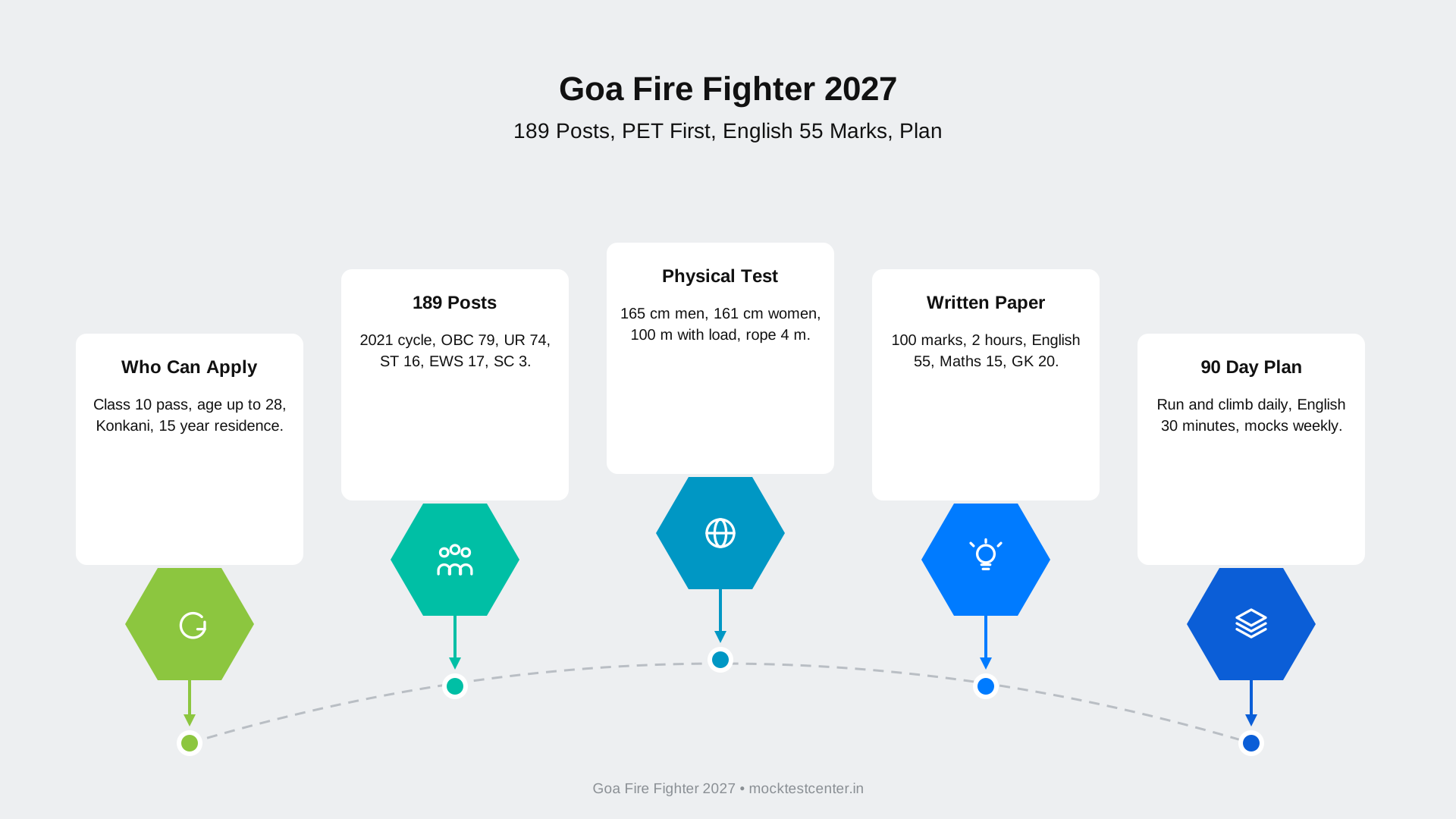
One hundred and eighty nine posts. That is the size of the last Fire Fighter recruitment in Goa. The Directorate of Fire and Emergency Services advertised 189 Fire Fighter posts in 2021, inside an advertisement for 268 Group C posts that also covered Sub Officers, Driver Operators, Watch Room Operators, a Junior Stenographer and Lower Division Clerks.
This Goa Fire Fighter 2027 guide works from that 2021 cycle, because no fresh Fire Fighter notification has come out since. Tracker pages that carry a 2026 date still print the same 2021 advertisement, and the Directorate site still hosts the 2021 advertisement file. A candidate who waits for a new notification before starting physical training will start late, and in this exam the physical test comes before the written paper.
The post takes Class 10 pass candidates, men and women both. It asks for two things that no book can give in a month. The first is a body that can run 100 metres carrying 50 kilos in a minute, or run the same 100 metres in under 13 seconds without a load, and then climb a rope four metres high.
The second is eyesight of 6/6 without glasses, with no colour blindness. The written paper comes after the body passes, and it carries 100 marks in two hours, with English alone worth 55 of those marks.
Pay sits at Level 2 of the pay matrix, from Rs 19,900 to Rs 63,200 a month as basic pay, and the job runs on 24 hour shifts followed by 24 hours off, from one of 17 fire stations across the state. The age limit in the 2021 advertisement was 28 years. The rest of this guide works through each of those facts in turn, with the exact figures from the 2021 advertisement and the gaps in the public record marked clearly where they are.
Goa Fire Fighter 2027 at a glance
| Detail | Goa Fire Fighter 2027 |
|---|---|
| Conducting body | Directorate of Fire and Emergency Services, Goa |
| Post | Fire Fighter, Group C, Non Ministerial, Non Gazetted |
| Latest verified cycle | Advertisement No. 2 of Year 2021 |
| Fire Fighter posts in 2021 | 189 |
| Application last date in 2021 | 29 October 2021, 5 PM, prescribed form |
| Education | Secondary School Certificate pass, knowledge of Konkani |
| Age | Not exceeding 28 years as on 29 October 2021 |
| Pay | Pay Matrix Level 2, Rs 19,900 to Rs 63,200 |
| Height | Male 165 cm, female 161 cm |
| Selection | Document verification, physical efficiency test, written examination |
| Written paper | 100 marks, 2 hours, English 55, Mathematics 15, Science 10, General Knowledge 20 |
| 2025 and 2026 cycles | None found for Fire Fighter |
| Official website | dfes.goa.gov.in |
The 2021 cycle, and the wait since
Advertisement No. 2 of Year 2021 invited applications in the prescribed form, with attested copies of certificates and a passport size photograph pasted on the form, to reach the Director at St Inez, Panaji, by 29 October 2021 before 5 PM. The advertisement listed six designations. Junior Stenographer took one post. Sub Officer took 12. Driver Operator took 44. Watch Room Operator took 10. Fire Fighter took 189. Lower Division Clerk took 12. Those six numbers add to 268, and the Fire Fighter share of that total is just over 70 percent.
The reservation split for the 189 Fire Fighter posts shows the shape of the contest. Scheduled Caste candidates held 3 posts, Scheduled Tribe candidates held 16, Other Backward Class candidates held 79, unreserved candidates held 74, and Economically Weaker Section candidates held 17. Eight of the 189 posts were reserved for ex servicemen. The Other Backward Class share is the largest single block, at 79 posts, which means the OBC merit list moves the most in this recruitment.
Five years have passed since that last date, and no new Fire Fighter advertisement has followed. The check behind that claim is direct. The Directorate site, dfes.goa.gov.in, still hosts the 2021 advertisement file, re uploaded in May 2025, and it carries no newer Fire Fighter advertisement. Tracker pages for the post print "notified soon" against the vacancy count and "coming soon" against the application dates, which is tracker language for no notification on record. One career guide that tracks the Directorate lists zero active notifications for 2026. The Goa Staff Selection Commission, which now handles most Group C recruitment in the state, advertised 219 posts in December 2025 and 32 posts in October 2026, and neither list carries a Fire Fighter post.
That silence matters more for this post than for most, because the physical test cannot be crammed. A graduate level paper can be prepared in 90 days from books. A 100 metre run with a 50 kilo load in a minute cannot be prepared in 90 days from zero, and a rope climb to four metres needs grip and technique that build over months. A candidate who starts running and climbing only when the advertisement appears will face a physical test within weeks of applying, and the test is a gate. Candidates who fail it never see the written paper.
The wait also changes the age arithmetic. The 2021 age limit was 28 years as on 29 October 2021. A candidate who was 24 in 2021 is 28 or 29 now, and the next advertisement will set a fresh cut off date. Candidates near the upper edge should watch the new advertisement the day it appears, because the age counts as on the last date of that advertisement, and a candidate who misses the cut off by a month has no remedy. The guide keeps the 2021 age figure throughout, and it flags every place where the new advertisement may reset it.
One more point belongs here. Some tracker pages show the 2021 advertisement with a 2026 date stamp, because the page itself was updated or re indexed in 2026. The advertisement is from 2021 all the same, and its last date of 29 October 2021 has long passed. Any page that invites applications for Goa Fire Fighter posts right now, without a new advertisement number on dfes.goa.gov.in or gssc.goa.gov.in, deserves a check against the official list before a candidate pays a fee or shares documents.
The job: 17 stations, 24 hours on, 24 off
The Directorate of Fire and Emergency Services is the fire brigade of the Government of Goa, and it runs 17 fire stations across the state, with its headquarters and logistics centre at St Inez, Panaji. The station list covers Panaji, Mapusa, Margao, Vasco da Gama, Ponda, Curchorem, Canacona, Bicholim, Valpoi, Pernem, Verna, Kundaim, Pilerne, Old Goa and Porvorim. The remaining stations cover the smaller towns. The department divides the state into three zones: North, Central, South, each under a Deputy Director, and each fire station works as the basic unit of the service, with its jurisdiction running across the taluka where it sits.
The approved strength of the service is 1,078 posts, officers and administrative staff together, and the department provides round the clock cover. Fire stations work in two shifts, and the shift pattern in the service rules is 24 hours on duty followed by 24 hours off. A Fire Fighter therefore lives a large part of the posting at the station, sleeping there on duty nights and eating there, and turning out at any hour when the bell rings. Candidates who want fixed office hours should not apply.
The work goes beyond fire. The department's own disaster plan lists fire prevention and fire protection and fire suppression and disaster response and training as its roles, and it notes that the department attends emergency calls that have no direct link to fire, in order to help people in distress. A Fire Fighter cuts open vehicles after road accidents, rescues people from wells and lifts, pumps out flooded houses in the monsoon, and stands by at public events. The Directorate is also the sole authority in Goa that issues a No Objection Certificate for fire safety, and Fire Fighters support the inspection work that sits behind those certificates.
Women have served in the Goa fire service since the 2021 advertisement opened the Fire Fighter post to male and female candidates both, with separate physical standards for each. A proposal in 2010 to allow women to become firefighters would have made Goa the first state in western India to do so, and the 2021 advertisement carried that change into practice, with a female height standard of 161 cm and a female load standard of 40 kilos. The department also put six Royal Enfield bikes into the fleet in 2013 for firefighting in congested lanes where a tender cannot enter, and Fire Fighters ride those bikes to first response in the old town areas of Panaji and Margao.
The Director who signed the 2021 advertisement was Ashok Menon. The Director who heads the department now is Nitin V Raiker, with deputies for administration and fire and the three zones. A candidate who joins will serve under that chain, from Station Fire Officer up through Divisional Officer to the Director, and the station is where the service is learned. The classroom training comes first, but the station floor is where a Fire Fighter learns to read smoke, to handle a hose under pressure, and to trust the person next to them.
Who can apply
Eligibility for Fire Fighter rests on four conditions, and the physical standards are part of eligibility rather than a later stage. The first condition is education. The 2021 advertisement asks for a Secondary School Certificate or an equivalent qualification from a recognised board. Class 10 pass is enough, and no higher qualification is needed. Graduates can apply, and many do, but the degree adds no marks and no advantage at any stage.
The second condition is language. The advertisement asks for knowledge of Konkani, and it lists knowledge of Marathi as desirable. Konkani is the official language of Goa, and a Fire Fighter takes calls from the public, gives instructions at an incident, and writes station records in the language the public speaks. A candidate who cannot speak Konkani will struggle at the station even if the paper goes well, and the department tests the language through the application and the interview stages of the process.
The third condition is residence and registration. The application form in the 2021 advertisement asks for a 15 year residence certificate number and date of issue, and for an employment registration number. The 15 year residence certificate proves long residence in Goa, and the employment exchange registration is part of the state recruitment record. Candidates should obtain the residence certificate well before the advertisement appears, because the certificate takes time to issue and the application window in 2021 lasted only a few weeks from advertisement to last date.
The fourth condition is age. The 2021 advertisement sets the age limit as not exceeding 28 years as on the last date of application, 29 October 2021. The age is relaxable for government servants by five years, and for candidates in the reserved categories as per the instructions or orders issued by the government from time to time. The advertisement gives no fixed relaxation table for this post, so a reserved category candidate should read the new advertisement for the exact relaxation, because the table changes with government orders.
Two conditions that candidates often ask about do not appear in the 2021 advertisement for this post. The first is a driving licence. Driver Operator needs a heavy vehicle licence and two years of unblemished driving experience, but Fire Fighter needs no licence. The second is a height relaxation. The advertisement gives no relaxation on height for any category, and the height standard applies as written. A candidate who is short of 165 cm as a man or 161 cm as a woman should not spend a season preparing for this post.
The physical test, in exact numbers
The physical efficiency test is the heart of this recruitment, and the 2021 advertisement prints it in full, with separate standards for men and women. The test follows document verification, and only candidates who clear it sit the written paper. The table below gives every figure from the advertisement, and the text after it explains what each figure means in practice.
| Standard | Male candidates | Female candidates |
|---|---|---|
| Height without shoes | 165 cm | 161 cm |
| Chest, normal | 79 cm | No chest standard |
| Chest, expanded | 84 cm | No chest standard |
| Chest expansion | 5 cm | No chest standard |
| 100 metres with load | 50 kg load in 1 minute | 40 kg load in 1 minute |
| 100 metres run, alternative | Under 13 seconds | Under 15 seconds |
| Rope or vertical pipe climb | Up to 4 metres | Up to 4 metres |
| Distant vision, each eye | 6/6 without glasses | 6/6 without glasses |
| Near vision, each eye | 0.5 without glasses | 0.5 without glasses |
Height is measured without boots or shoes, and the chest is measured at 79 cm normal and 84 cm expanded, which means the candidate must show 5 cm of expansion. That expansion figure is the part candidates miss. A candidate with a 79 cm chest who cannot expand it to 84 cm fails the standard, even though the resting measurement is correct. Breathing exercises and chest expansion work belong in the training plan from the first week, because expansion is trainable and candidates who never practise it discover the shortfall on the test ground.
The run gives two ways through. A male candidate can run 100 metres carrying about 50 kilos in a minute, or run 100 metres in less than 13 seconds without a load, and climb a rope or a vertical pipe to a height of up to four metres from the ground. A female candidate can run 100 metres carrying about 40 kilos in a minute, or run 100 metres in less than 15 seconds, and climb the same four metres. The load run is the harder of the two for most candidates, because 50 kilos is close to body weight for a light candidate, and the load must be carried rather than dragged. The sprint alternative is the faster route for a light and fast candidate, and the rope climb is a separate skill that needs grip strength and technique.
Vision is a hard gate with no remedy on the day. Each eye must show distant vision of 6/6 and near vision of 0.5 on the Snellen chart, without glasses. Each eye must have a full field of vision. Colour blindness, squint, or any morbid condition of the eye or the eyelids of either eye counts as a disqualification. A candidate who wears glasses should get an eye test before preparing, because laser correction and contact lenses do not change the "without glasses" condition at the test, and a candidate who fails vision at the test goes out whatever the run time.
The order of the standards matters. Height and chest are measured first, then the run and climb, then vision. A candidate who trains only for the run and ignores the chest expansion or the eye test is preparing for one third of the test. The plan in the later section of this guide trains all four, in the order the test applies them.
The written paper: English carries 55 marks
The written examination carries 100 marks and runs for two hours, and the subject split is the most lopsided of any Goa Group C paper. English carries 55 marks, Mathematics carries 15, Science carries 10, and General Knowledge carries 20. A candidate who treats the four subjects as equal will spend a quarter of the time on a subject worth more than half the paper, and that mistake alone decides the merit list.
| Subject | Marks | Topics in the syllabus |
|---|---|---|
| General English | 55 | Idioms and phrases, sentence framing, letter writing, paragraph writing, essay writing, similar sounding words, meaning of sentences |
| Mathematics | 15 | Percentage, area, square root, multiplication, fractions |
| Science | 10 | Basic scientific awareness |
| General Knowledge | 20 | Abbreviations and expansion, state and national affairs |
| Total | 100 | Two hours |
English breaks into seven parts, and the marks inside it show where the paper bites. Common phrases and idioms carry 10 marks. Correct framing of sentences carries 5. Letter writing carries 5. Paragraph writing carries 5. Essay writing of not more than 100 words carries 10. Comparison of similar sounding words carries 10. Meaning of sentences carries 10. Those seven parts add to 55, and three of them, idioms, similar sounding words and meaning of sentences, carry 10 marks each. A candidate who can tell apart words that sound alike, and who can explain what a sentence means, holds 20 marks before the essay is even attempted.
The essay and the letter are the only writing tasks in the paper, and they reward practice more than reading. An essay of not more than 100 words needs a clear opening, two short points and a close, and a candidate who practises one essay a week will write it inside the time the paper allows.
Letter writing needs the format, formal and informal both. A candidate who learns the format once can score the full five marks on every attempt. Paragraph writing needs the same discipline at a smaller scale, with one idea per paragraph and no drift.
Mathematics stays at Class 10 level, and the syllabus names five topics only: percentage, area, square root, multiplication, fractions. Fifteen marks across five topics means about three marks per topic, and the questions test speed and accuracy rather than depth. A candidate who practises 20 sums a day from those five topics will cover the section in a month, and the marks are nearly free for a candidate who keeps the arithmetic sharp.
Science is the smallest section, at 10 marks for basic scientific awareness, and General Knowledge is the second largest, at 20 marks split evenly between abbreviations and expansion at 10 marks, and basic general knowledge of state and national affairs at 10 marks. Goa knowledge inside the General Knowledge section covers the state symbols and the districts and the capital and the Assembly and the fire service itself, and a candidate who knows the department will answer questions that a general candidate cannot guess.
One clarification from the department belongs here. An official clarification on the Directorate site records that the 15 percent weightage mentioned in the syllabus for the competitive examination was discontinued, in view of a government order of 8 January 2016. The written examination therefore stands at its face value of 100 marks, and no weightage adjustment applies to it. Candidates who read old syllabus copies that still show the 15 percent line should ignore it, because the department has formally withdrawn it.
Selection order: documents, physical test, then the paper
Selection for the 2021 cycle ran in three stages, in a fixed order, and the order is the most important fact in the process. Document verification came first. Candidates who qualified in verification went to the physical efficiency test. Candidates who qualified in the physical test sat the written examination of 100 marks. The advertisement states the order plainly, and the tracker guides that reproduce the process print the same three stages in the same order.
That order changes how a candidate should spend the months before the advertisement. A candidate who spends all the time on books and none on running will clear verification and then fail the physical test, and the book work will count for nothing. A candidate who spends all the time on running and none on English will clear the physical test and then score low on the 55 mark English section. The balance is physical training first and English second and the rest of the paper third, because the physical test is a gate and English is more than half the paper.
Document verification is a real stage rather than a formality. The candidate produces the Secondary School Certificate, the birth proof, the caste certificate where claimed, the 15 year residence certificate, the employment registration number and the application form with the photograph. A certificate in the wrong format can fail verification, and a residence certificate that is still under process on the verification date can do the same. Candidates should keep originals and two sets of attested copies ready from the day they apply, because the verification call can come with short notice.
The 2021 advertisement carries no application fee line in the text available, and no fee is printed anywhere in the advertisement. One tracker prints a fee of Rs 200 for general candidates and Rs 100 for reserved candidates, but that figure appears on no official document retrieved for this guide, and the 2021 advertisement used a prescribed offline form rather than an online payment portal. This guide records the tracker figure as unverified and advises candidates to check the fee line in the new advertisement, because a new cycle run through the Goa Staff Selection Commission will carry a fee and an online payment step.
No interview stage appears in the 2021 advertisement or in the tracker reproduction of the selection process. The three stages are verification and physical test and written examination, and the merit list follows the written paper. A candidate should still expect a medical examination after selection, because the service needs a medical fitness certificate before appointment, and the vision and physical standards of the test are only the first medical check.
Pay and the road upward
Fire Fighter pays at Pay Matrix Level 2, from Rs 19,900 to Rs 63,200 a month as basic pay, and the starting basic pay for a fresh Fire Fighter sits at Rs 19,900. Dearness allowance, house rent allowance and transport allowance sit on top of basic pay at the rates the Goa government notifies from time to time, so the monthly in hand figure moves with those rates and with the posting station. The post is a Group C, non ministerial, non gazetted post, and it carries the allowances and leave of the state government service.
The 2021 advertisement shows the pay ladder inside the same department. Junior Stenographer and Sub Officer sit at Level 4, from Rs 25,500 to Rs 81,100. Driver Operator sits at Level 3, from Rs 21,700 to Rs 69,100. Watch Room Operator and Lower Division Clerk sit at Level 2, the same level as Fire Fighter. A Fire Fighter who later moves to Driver Operator gains a level, and a Fire Fighter who later moves to Sub Officer gains two levels, but those moves run through departmental selection and the qualifications of the higher post. Sub Officer needs a Higher Secondary Certificate, preferably in science or engineering subjects, and the same physical standards as Fire Fighter, with the age limit at 35 years.
The service hierarchy above Fire Fighter runs through Leading Fireman and Driver Operator and Sub Officer, then Assistant Station Fire Officer, Station Fire Officer, Assistant Divisional Officer, Divisional Officer and Director. The Goa State Fire Force Rules of 1997 list those categories, and the recruitment rules of 1996 set the sanctioned numbers for each post. Promotion runs on seniority and departmental examination, and the station record of a Fire Fighter, including incident attendance and training courses and discipline, counts toward it. A Fire Fighter who completes the service training courses and builds a clean station record can rise through the ranks over a career, and the department fills its officer posts largely from its own ranks.
One caution belongs with the pay figure. The 2021 advertisement lists the pay as "Pay Matrix Level 2 Rs 19,900 to Rs 63,200", and that range comes from the Seventh Pay Commission matrix, which the Goa government follows. If the next advertisement revises the level or the state revises the matrix, the figure moves with it. The level is the fixed fact. The amount follows the matrix in force on the date of appointment.
A 90 day plan that starts with the body
Most candidates for this post are Class 10 or Class 12 pass, and many work in shops, in tourism or in family businesses. The plan below assumes two hours a day on weekdays and four hours a day on weekends, and it puts physical training first, because the physical test is the gate and the body needs the longest lead time.
Days 1 to 30 build the body and the English base. Running takes 45 minutes a day, six days a week, starting with 2 km at an easy pace and adding 500 metres every week. Strength work takes 20 minutes, with push ups and pull ups and squats and planks, and rope climbing practice starts in the second week, with two sessions a week on a rope or a vertical pipe at a gym or a training ground. Chest expansion breathing takes five minutes a day, with deep breathing and chest stretches. English takes 30 minutes, with 10 idioms a day and one passage a day. Mathematics takes 20 minutes, with one of the five syllabus topics a day. General Knowledge takes 15 minutes, with Goa facts first.
Days 31 to 60 add load and speed. The run splits into three kinds of session: a long slow run, a sprint session of 100 metre repeats, and a load session carrying weight in a backpack, starting at 20 kilos and adding 5 kilos a week toward 50 kilos for men and 40 kilos for women. Rope climbing moves to three sessions a week, with timed climbs to four metres. English moves to 20 questions a day plus one essay and one letter a week. Mathematics moves to 30 timed sums a day. The first mock test lands on day 42, the second on day 49 and the third on day 56, each followed by a full review day. The eye test happens in this block. A candidate who wears glasses, or who has never had an eye test, should get one now, because the result decides whether the post is open at all.
Days 61 to 90 are mock tests and repair, with the physical training held at full level. Two mocks a week, on fixed days, with the day after each mock spent only on the questions that went wrong. English revision runs from a notebook of idioms and similar sounding words, built across the first 60 days, and the essay and letter formats get one practice each per week. General Knowledge revision runs from a Goa notebook, not from new books, because new books in the last month add facts that never settle. Height and chest and documents get checked in this block too. Measure height and chest expansion, collect the Class 10 certificate, the birth proof, the residence certificate and the caste certificate where claimed, and keep the set ready, because the verification call can follow the application by days rather than weeks.
One rule runs through all 90 days. No new subject enters the plan after day 60, and no new physical target enters it after day 75. A new book or a new test series in the last month costs more marks than it adds, and a new training target in the last two weeks risks injury. The last month belongs to the notebooks and the mocks and the rope.
Mistakes that cost candidates a cycle
The first mistake is training for the paper and forgetting the body. A candidate who scores 80 in the written paper and fails the rope climb never sees the merit list, because the physical test comes first. The body needs 90 days. The books need 90 days too, and the candidate who gives the body 30 days and the books 60 has the balance backwards.
The second mistake is treating English as a small subject. English carries 55 of 100 marks, and the three 10 mark parts inside it, idioms, similar sounding words and meaning of sentences, carry 30 marks between them. A candidate who spends equal time on all four subjects will spend a quarter of the time on the subject worth more than half the paper, and the merit list will show it.
The third mistake is skipping the eye test. A candidate who wears glasses and never checks vision against the 6/6 standard without glasses discovers the shortfall at the test ground, after months of training. Get the eye test in the first month, and make the decision on the result rather than on hope.
The fourth mistake is trusting a 2026 date stamp on a 2021 advertisement. Tracker pages re index old pages, and the date on the page is the date of the page, not the date of the advertisement. The advertisement number is the check. Advertisement No. 2 of Year 2021 is the last real advertisement for this post, and any page that claims a newer one should show a newer advertisement number on dfes.goa.gov.in before a candidate believes it.
The fifth mistake is waiting for the advertisement. The last window closed on 29 October 2021, and the next one may last only a few weeks. A few weeks is enough to fill a form and revise a notebook. It is not enough to learn to run 100 metres with 50 kilos, or to climb a rope four metres high, or to cover 55 marks of English from zero. The candidate who starts now holds the advantage, and the candidate who starts on the notification date holds the queue ticket.
How this guide was put together
Every figure in this guide comes from Advertisement No. 2 of Year 2021 on the Directorate of Fire and Emergency Services site, from the official syllabus and clarification documents on the same site, and from tracker guides that reproduce the advertisement and the syllabus. The official advertisement file sits on dfes.goa.gov.in, and it was read in full for this guide, including the post wise reservation, the physical standards, the vision standards and the selection order. The syllabus figures come from the FreshersNow and Toppersexam reproductions of the department syllabus, which agree on the subject split of English 55, Mathematics 15, Science 10, General Knowledge 20, and on the English topic split inside the 55 marks.
Three points in the record are worth naming. The first is the fee. One tracker prints Rs 200 for general candidates and Rs 100 for reserved candidates. The 2021 advertisement text carries no fee line, and the application used a prescribed offline form. This guide records the tracker figure as unverified and does not use it as a fact.
The second is the station count. The department disaster plan of December 2021 lists 14 fire stations by name, and the department profile lists 17 stations. The difference is new stations opened after the plan, including Porvorim, plus stations at the headquarters and the training section. This guide uses 17, from the department profile, and names the main stations.
The third is the gap that matters most. No Fire Fighter notification has appeared for 2025 or 2026 on the Directorate site, on the Goa Staff Selection Commission advertisement list, or on any tracker that prints a real advertisement number. The study plan in this guide is preparation advice built on the 2021 advertisement and syllabus, and it says so where it appears. The upload check should confirm the post count and the age limit and the fee and the syllabus against the new advertisement when it appears, because any of those can change the application.
The pay range of Rs 19,900 to Rs 63,200 for Level 2 comes from the advertisement itself, which prints the range beside the level. The next Fire Fighter advertisement will carry the final word on posts and age and fee and syllabus, and candidates should read it in full on dfes.goa.gov.in or gssc.goa.gov.in before they apply. A candidate who trains the body on the 2021 standards and studies the 2021 paper holds the best position this post allows.
Sources
Directorate of Fire and Emergency Services, Goa, Advertisement No. 2 of Year 2021, with 189 Fire Fighter posts and physical standards and vision standards and selection order, on dfes.goa.gov.in.
Directorate of Fire and Emergency Services, Goa, clarification on the syllabus for the competitive examination for direct recruitment to Sub Officer, Driver Operator, Watch Room Operator and Fire Fighter, on the discontinuation of the 15 percent weightage.
FreshersNow DFES Goa Syllabus and Exam Pattern page, with the Fire Fighter subject split and the English topic split, updated December 2023.
Toppersexam DFES Goa Fire Fighter syllabus and exam pattern page, with the 100 mark, two hour paper and the subject marks.
Government of Goa, Directorate of Fire and Emergency Services, Disaster Management Response Plan, updated 8 December 2021, with the approved strength of 1,078, the station list and the three zones.
Government of Goa, Directorate of Fire and Emergency Services, Group C and D Non Ministerial, Non Gazetted posts, Recruitment Rules, 1996, plus the Goa State Fire Force Rules, 1997, on the service hierarchy and the shift pattern.
Directorate of Fire and Emergency Services, Goa, profile, with 17 fire stations and the headquarters at St Inez, Panaji, plus the Government of Goa directory listing for the Director and Deputy Directors.
Goa Staff Selection Commission advertisement list, Advertisement No. 3 of Year 2025 dated 5 December 2025 and Advertisement No. 4 of Year 2026 dated 1 October 2026, on gssc.goa.gov.in.







