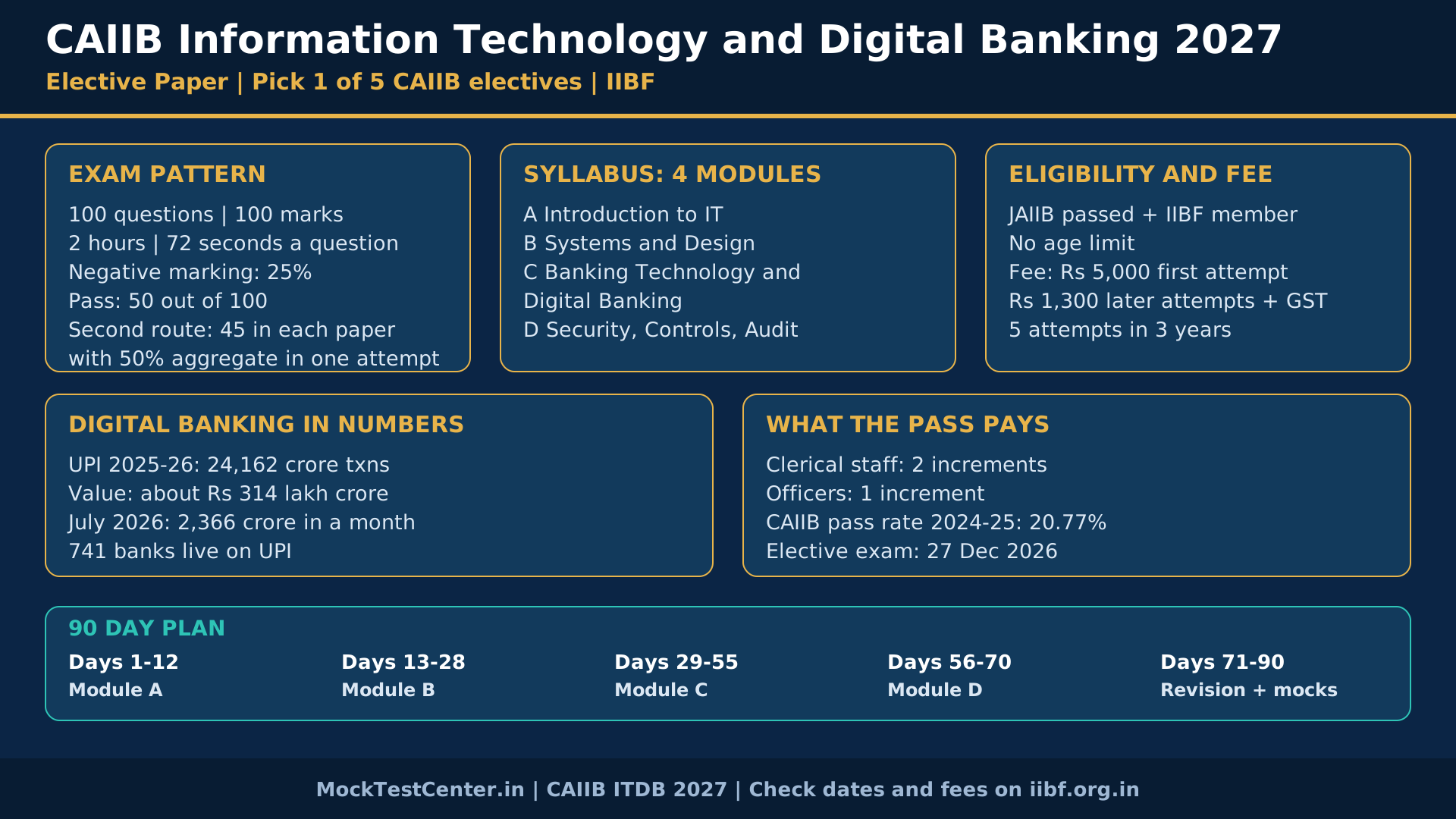
About CAIIB Information Technology and Digital Banking 2027 Exam Series
📖 Table of Contents
- CAIIB in one page
- Who can sit for CAIIB
- The ITDB syllabus, module by module
- Module A: Introduction to Information Technology
- Module B: Systems and design
- Module C: Banking technology applications and digital banking
- Module D: Information system security controls and audit
- How the paper is marked
- Why bankers pick ITDB
- Digital banking in real life
- What the pass is worth
- A 90 day plan around branch hours
- Mistakes that cost marks
- Using mock tests the right way
- If you are preparing for more than one exam
- Sources
CAIIB Information Technology and Digital Banking 2027: Elective Paper Guide
Information Technology and Digital Banking is one of five electives in CAIIB, and you pick only one of them. The paper carries 100 questions for 100 marks, runs for two hours, and has negative marking of 25 percent of the marks of the question. You pass with 50 marks out of 100. The syllabus runs from computer basics to core banking, digital payments, cybersecurity and audit.
If you work with systems every day, much of it will feel familiar. If systems are new to you, the guide below walks through every module in plain words.
CAIIB stands for Certified Associate of the Indian Institute of Bankers. The Indian Institute of Banking and Finance runs it twice a year for bankers who have already cleared JAIIB. The December 2026 cycle ran from 6 December to 27 December 2026, with the elective paper on 27 December 2026. The 2027 schedule has not been announced as of 19 November 2026, so no 2027 date appears in this guide.
When IIBF releases the 2027 notification, check the dates on the IIBF website before you fix your plan.
Digital banking is no longer a side subject in a bank. It is the counter. UPI processed more than 24,162 crore transactions in 2025-26, worth about Rs 314 lakh crore, according to finance ministry figures reported in the press. Your branch now serves customers who never visit it.
This paper asks whether you understand the systems behind that change, and whether you know the rules that keep them safe.
CAIIB in one page
CAIIB has five papers. Four are compulsory for every candidate. The fifth is your elective, and Information Technology and Digital Banking is one of the five choices. The table below shows the full structure.
| Paper | Name | Questions | Marks | Time |
|---|---|---|---|---|
| Compulsory 1 | Advanced Bank Management | 100 | 100 | 2 hours |
| Compulsory 2 | Bank Financial Management | 100 | 100 | 2 hours |
| Compulsory 3 | Advanced Business and Financial Management | 100 | 100 | 2 hours |
| Compulsory 4 | Banking Regulations and Business Laws | 100 | 100 | 2 hours |
| Elective, pick one | Information Technology and Digital Banking | 100 | 100 | 2 hours |
The other four electives are Rural Banking and Human Resources Management. Risk Management and Central Banking complete the set. You register for one elective only. A second elective adds nothing to your CAIIB result, and IIBF asks you to clear just one.
Pick the paper that matches your daily work and your comfort with technology, then give it your full attention.
Every CAIIB paper follows the same pattern. Each paper has 100 objective questions, each worth one mark, with two hours on the clock. That gives you about 72 seconds per question. The exam runs online at IIBF notified centres.
The medium is English or Hindi, and you choose it at registration.
JAIIB sits below CAIIB in the same IIBF ladder. JAIIB has four papers: Indian Economy and Indian Financial System; Principles and Practices of Banking; Accounting and Financial Management for Bankers; Retail Banking and Wealth Management. The November 2026 JAIIB papers ran on 1 November, then on 22 November, then on 28 November and on 29 November 2026. You must clear JAIIB before you can register for CAIIB, and that order never changes.
Who can sit for CAIIB
Two conditions decide eligibility. You must have passed JAIIB or Part 1 of the Associate Examination, and you must hold IIBF membership with your subscription paid up to date. IIBF runs these exams for working bankers in member banks, so membership is part of the entry rule. If your subscription has lapsed, renew it before registration opens, because a lapsed membership can block your form.
There is no age limit for CAIIB. A clerk in the first year of service and a chief manager with twenty years behind the counter sit the same paper under the same rules. That matters for this elective in particular. A young officer who grew up with phones and apps may find Module A easy, while a senior officer who has seen three core banking migrations may find Module C easy.
The paper rewards both kinds of experience, and it tests both.
Registration happens separately for every cycle. For the December 2026 cycle, registration ran from 13 September 2026, with the last date extended to 8 October 2026. Some trackers print 1 October 2026 as the last date, and that earlier date was the original close before the extension. The lesson is clear: read the IIBF notification for the cycle you want, and do not trust a date copied from an older page.
Fees follow the same rule. Trackers that quote the IIBF fee notice put the CAIIB first attempt at Rs 5,000 plus GST, with later attempts at Rs 1,300 plus GST. Confirm the amount in the notification for your cycle, because IIBF revises fees from time to time.
IIBF gives a candidate five attempts to clear CAIIB within three years from the date of first registration, whichever ends first. The older rule of four attempts in two years no longer applies. That change matters for planning. You can spread five papers across cycles if branch work leaves you short of time, but the three year clock keeps running from your first registration, so a slow start still needs a finish date in view.
The ITDB syllabus, module by module
The ITDB elective has four modules, labelled A to D. They move from IT basics to systems design, then to banking applications and digital banking, and finally to security and audit controls. IIBF publishes the module list, and coaching trackers that quote the IIBF syllabus agree on the four module titles. No official weightage per module has been published, so treat every module as capable of producing questions.
Trackers that analyse past papers say Modules C and D carry the most weight in practice, because they cover the work a bank actually does. That is a useful hint for revision order, and it is not a reason to skip Modules A and B.
Module A: Introduction to Information Technology
Module A builds the base. It opens with information technology and its implications: what IT changed in banks, and what strategic questions it raised. A bank that once kept ledgers in bound books now keeps them in databases, and that change altered every job in the branch. The syllabus asks you to know the impact, not just the tools.
Learn the difference between a tool and its effect, because a question can describe an effect and ask which technology caused it.
Introduction to computing follows. It covers the computer itself, data processing and its methods, computing environments and virtualisation of servers. Data processing is the work of turning raw figures into useful reports: a day's transactions become a trial balance, and a month's transactions become a profit figure. Virtualisation lets one physical server act as several smaller servers, which saves cost and space in a data centre.
The exam tests these ideas with definitions, so learn each term as one line.
Introduction to software comes next. It covers computer software, open source software and web browsers. Software splits into system software, which runs the machine, and application software, which does a job like accounting. Open source software is software whose code anyone can see and use, and banks use it in many places.
A browser is the window through which staff and customers reach web applications. The distinctions look basic, and they produce easy marks for a candidate who has read them once.
Networking systems close Module A. The syllabus names data communications, wide area network technology, TCP/IP and the internet. A network is a set of computers that talk to each other. A wide area network links branches across cities, while a local area network links computers inside one office.
TCP/IP is the set of rules that lets computers on the internet find each other and exchange data. Learn the layers by name only at the level the syllabus asks: what each part does, not how engineers build it.
Module B: Systems and design
Module B is the most technical module in the paper, and it is the one that worries non technical candidates most. It opens with information systems: their types, the structure of a management information system, decision support systems, executive information systems and group decision support systems. A management information system turns daily data into reports for managers. A decision support system helps a manager test options before deciding.
An executive information system gives senior officers a short view of the whole bank. Learn what each system gives its user, because the exam asks exactly that.
Project management and the capability maturity model sit in the same block. Project management covers how a bank runs a large IT job: a core banking migration, for example, needs a plan and a team, plus a budget and a date. The capability maturity model grades how mature an organisation's processes are, from ad hoc work to work that is measured and improved. Building data centres appears here too.
A data centre is the building that holds a bank's servers, and it needs power and cooling, plus security and a backup site.
Database management systems form the second block. A database is an organised store of data, and a database management system is the software that runs it. The syllabus names relational databases and normalisation, plus Oracle. A relational database stores data in tables that link to each other: a customer table links to an account table, which links to a transaction table.
Normalisation is the method of arranging those tables so that data is stored once and stays consistent. Oracle is a widely used database product in banks. The exam can ask what normalisation prevents, and the answer is duplication and inconsistency.
Data warehousing and data mining close Module B. A data warehouse is a large store built for analysis rather than for daily transactions. A bank copies its daily data into the warehouse, then analysts query it for patterns. Data mining is the search for those patterns: which customers take loans, which accounts turn dormant, which branches miss targets.
Business intelligence turns the findings into reports and dashboards. Expert systems and neural networks appear in the same block as early forms of artificial intelligence. Emerging trends in analytics close the module, and they point forward to the AI and big data topics in Module C.
Module C: Banking technology applications and digital banking
Module C is the heart of the paper, and it is where your daily work meets the syllabus. It opens with the e learning environment, then moves to banking software. Banking software covers the integrated banking solution, the centralised banking solution, online banking features and internet service providers, plus hosting, bandwidth and vendor selection. A centralised banking solution, often called core banking, keeps all accounts of a bank on one system, so a customer can use any branch.
Vendor selection is the process of choosing a software supplier, and retention is the work of keeping that supplier honest after the contract is signed.
Electronic clearing and settlement systems follow. The syllabus names MICR, OCR and CTS for cheque clearing. It also names debit and credit clearing, RTGS, NEFT, NPCI products and services, and SFMS. CTS, the cheque truncation system, lets a bank clear a cheque from its image instead of moving paper across cities.
RTGS settles large payments one by one in real time, while NEFT settles them in batches.
NPCI runs UPI and IMPS, plus RuPay and other national payment products. SFMS is the secure messaging system banks use to talk to each other. Learn each system as a name and a purpose, plus one fact. RTGS is for large value, NEFT is for smaller value in batches, UPI is instant and round the clock.
Plastic money is the next block. It covers credit cards, debit cards, smart cards, CVV, RuPay, payment gateways, SET, ATMs, point of sale terminals and card tokenisation. A CVV is the three digit number on a card that proves the buyer holds the card. RuPay is India's own card network, run by NPCI.
Tokenisation replaces a real card number with a token during a payment, so a stolen token is useless to a thief. The exam can ask what tokenisation protects, and the answer is the card number itself.
Electronic commerce and banking follow. The syllabus names e business, e commerce, e banking, mobile payments, SMS banking, call centres, electronic bill presentment and payment, and emerging digital payments. Mobile banking lets a customer check a balance and move money from a phone. SMS banking does the same through text messages for customers without smartphones.
Electronic bill presentment lets a customer see a bill and pay it in one place. These are familiar services, and the exam tests them through definitions and small cases about how a customer uses them.
The IT Act 2000 and its 2008 amendment form the legal block of Module C. The Act gives legal recognition to electronic records and digital signatures, defines computer crime, and sets penalties. The 2008 amendment widened the Act to cover new offences and added rules on data protection and intermediaries. Digital rights management appears here as well.
Learn the Act as a purpose, not as a list of sections: it makes electronic records valid in law, and it punishes misuse of computers.
Emerging technologies close Module C, and this is the block that changes fastest. The syllabus names open banking, application programming interfaces and embedded banking, big data analytics, blockchain, artificial intelligence and machine learning, zero trust cybersecurity, 5G, fintech and cloud computing, plus digital banking units and central bank digital currency. Open banking lets a customer share bank data with an app of her choice through an interface. Blockchain is a shared ledger that many computers hold together, so no single computer can alter a record alone.
A central bank digital currency is digital money issued by the Reserve Bank of India, and the e rupee pilot is the Indian example. The exam tests these topics at the level of definitions and purpose, so learn what each technology does for a bank and its customers.
Module D: Information system security controls and audit
Module D is the module that protects the bank, and it is the module where a careful candidate can score heavily. It opens with computer security: physical security, logical security, network security and biometric security. Physical security guards the building and the machines. Logical security guards the data with passwords and access rules.
Network security guards the links between machines. Biometric security uses a fingerprint or an iris to prove who a person is. The ISO 27000 series appears here as the international standard for information security management, and the Basel recommendations appear as the banking view of the same problem. Viruses and frauds close the block, and the exam can ask how each type of fraud works.
Communication security follows. It covers cryptography, digital signatures, public key infrastructure and certification authorities. Cryptography scrambles a message so that only the intended reader can read it. A digital signature proves that a message came from a named sender and was not altered on the way.
Public key infrastructure is the system of keys and certificates that makes signatures work, and a certification authority is the body that issues the certificates. Learn the four terms as a chain: cryptography scrambles, the signature proves, the infrastructure organises, and the authority vouches.
Business continuity and disaster recovery planning form the third block. A business continuity plan keeps essential banking running during a crisis. A disaster recovery plan brings systems back after a failure. The two plans are partners, and the exam can ask which one applies to a given case.
A flood that closes a branch needs the continuity plan. A server that fails needs the recovery plan. The Reserve Bank of India has issued guidelines on both, and the syllabus expects you to know that the guidelines exist and what they require at a broad level.
Information system audit follows. It covers the concept of audit, audit procedures and audit security, plus audit controls and approaches, and the RBI guidelines on IS audit. An IS audit checks whether a bank's systems do what they should, whether access is controlled, and whether data is safe. The auditor looks at logs and tests controls, then reports gaps.
The exam tests the purpose of audit and the types of controls, not the detail of an audit programme.
The competitive bid process, request for proposal and service level agreement form the fifth block. A request for proposal is the document a bank sends to suppliers when it wants to buy a system. Suppliers reply with proposals, the bank evaluates them, and the winner signs a contract. A service level agreement is the part of the contract that promises a level of service: how fast the supplier must fix a fault, and what happens if it fails.
The Reserve Bank of India has issued guidelines on outsourcing IT services, and the syllabus names them. A bank that outsources its IT still owns the risk, and the guidelines say so.
The module closes with the RBI guidelines on cybersecurity of 2016 and on digital payment security of 2021. The 2016 guidelines set a cybersecurity framework for banks, with a board approved policy, a security operations centre, and regular reporting. The 2021 master directions on digital payment security set controls for online payments, with rules on fraud prevention and customer alerts, plus grievance handling. The exam can ask which year a guideline belongs to, and it can ask what each one covers.
Learn the two years with the two purposes, and the questions answer themselves.
How the paper is marked
The marking rule punishes blind guessing. Each question carries one mark, and a wrong answer costs a quarter mark under the negative marking rule of 25 percent. Attempt a question when you can rule out at least two options, and leave the ones you know nothing about. A guess that lands right adds a mark, but three wrong guesses wipe that mark out.
A wrong guess costs a quarter mark, so answer the questions you know first, then return to the ones you are unsure about only when you can rule out at least two options.
| Item | Detail |
|---|---|
| Questions | 100 objective questions |
| Marks | 100, one mark per question |
| Time | 2 hours |
| Negative marking | 25 percent of the marks of the question |
| Pass mark | 50 out of 100 in the paper |
| Second way to pass | 45 in each paper with 50 percent aggregate in one attempt |
| Medium | English or Hindi, chosen at registration |
| Mode | Online at IIBF notified centres |
The pass rule has two routes, and candidates should know both. The direct route is 50 marks in each paper. The second route applies when you attempt several papers in one cycle: you pass if you score at least 45 in every paper you attempted and your total across those papers reaches 50 percent. A paper below 45 fails on its own, whatever your total.
So a candidate who scores 48 in ITDB and 52 in the other papers of the same attempt can still clear the set, while a candidate who scores 44 in ITDB cannot, even with high scores elsewhere.
Time is the real test in this paper. Two hours for 100 questions gives about 72 seconds each, and ITDB questions often name a technology and ask for its purpose. Read the question first, then the options. If a question names a term you have never seen, eliminate the options you know are wrong, pick the best of the rest, and move on.
A question that takes more than two minutes is stealing time from three easy ones.
Why bankers pick ITDB
ITDB suits a clear type of candidate: the officer who works with systems, the officer in the IT department, and the young banker who is comfortable with technology. Coaching trackers that compare the electives place ITDB at a moderate difficulty level, below Risk Management and Central Banking, and above the purely theory papers. The CAIIB ITDB paper is concept heavy and highly scoring for candidates who know the definitions, because most questions test recall and application rather than calculation. There are almost no numerical questions, and that matters for officers who dread maths.
The syllabus overlaps with daily work more than candidates expect. An officer who has raised a ticket for a CBS error, helped a customer set up UPI, or reported a phishing call has already met Modules C and D in real life. The exam asks for the names behind those events. A phishing call is a social engineering attack.
A CBS error is a system fault. A UPI failure is a settlement problem. Learning the names turns experience into marks.
The counterpoint matters too. ITDB has the widest syllabus of the electives in one sense: it runs from computer basics to blockchain, and a candidate who reads only the banking parts will miss the questions from Modules A and B. The paper also changes faster than the others, because technology moves every year. A definition that was right three years ago can be out of date now, so the IIBF syllabus for your cycle is the only safe source.
Read the module list for your cycle, and do not rely on a friend's notes from an older cycle.
The wider CAIIB pass rate sets the context. An analysis of the IIBF Annual Report 2024-25 put the CAIIB pass rate at 20.77 percent for 2024-25, with 13,953 candidates passing out of more than 67,000 who appeared. The rate nearly doubled from 10.23 percent in 2023-24. Enrolment stood at 89,179.
Those figures cover the whole CAIIB exam, not ITDB alone, and IIBF does not publish a pass rate per elective. Still, the message is clear: four in five candidates do not clear CAIIB in a given year, and the elective is the paper you control most directly. Pick it with care and prepare it with the same rigour as the compulsory papers.
Digital banking in real life
UPI is the example that makes this paper real. The Unified Payments Interface was launched on 25 August 2016 by the National Payments Corporation of India, under the oversight of the Reserve Bank of India. In 2016-17 it processed 1.78 crore transactions. By 2025-26 the annual volume had risen to more than 24,162 crore transactions, worth about Rs 314 lakh crore, according to finance ministry figures.
Monthly volume crossed 2,300 crore for the first time in May 2026, with 2,320 crore transactions, and July 2026 set a record with 2,366 crore transactions. August 2026 went higher still, with 24.51 billion transactions worth about Rs 29.82 lakh crore, as reported from NPCI data. The platform now handles about 66 crore transactions a day, and 741 banks were live on UPI as of July 2026. The International Monetary Fund has recognised UPI as the world's largest real time payment system by volume.
Those numbers explain why the syllabus gives UPI and digital payments so much room. A banker who cannot explain UPI to a customer cannot do the job in 2026. UPI links bank accounts through a virtual payment address, moves money instantly, and works round the clock. IMPS does the same for instant transfers between accounts.
NEFT moves money in batches during working hours. RTGS settles large payments one by one in real time. Each system has a purpose, and the exam tests whether you know which one fits a given need.
Core banking is the system behind the counter. Before core banking, each branch kept its own accounts, and a customer belonged to one branch. After core banking, all accounts sit on one system, and a customer belongs to the bank. That change made anywhere banking possible, and it made the IT department central to the bank.
When the core system fails, the whole bank stops, which is why business continuity and disaster recovery matter so much in Module D.
Cybersecurity is the price of going digital. A bank that offers online services invites attacks, and the attacks grow more skilled every year. Phishing mails pretend to come from the bank. Vishing calls pretend to come from the bank's helpline.
Malware hides in an attachment. The RBI cybersecurity guidelines of 2016 ask banks to run a security operations centre, to test their defences, and to report incidents. The digital payment security directions of 2021 add rules for online payments, with customer alerts and quick grievance handling. A candidate who knows these two documents by year and purpose will answer several questions with ease.
Data analytics is the quiet revolution in the syllabus. Banks hold data on every customer, and analytics turns that data into decisions: which customers need a loan, which accounts may turn bad, which branches need more staff. Big data means data too large for old tools, and the syllabus treats it as a banking tool rather than a technical marvel. Artificial intelligence in banking covers chatbots that answer customer questions, models that score credit, and tools that flag fraud.
The exam asks what each tool does, not how it is built.
Fintech and open banking are the newest part of the picture. Fintech firms build payment apps and lending platforms, plus investment tools, on top of bank systems. Open banking lets a customer share bank data with an app through an interface, with the customer's consent. Embedded banking puts a payment or a loan inside a non banking app, so a customer can pay without leaving the app she is using.
Digital banking units are dedicated outlets that serve customers through digital channels. A central bank digital currency is digital money issued by the central bank, and the e rupee pilot is the Indian test of the idea. These topics are new, and the exam treats them as definitions with one bank example each.
What the pass is worth
Money is the first reason most bankers sit for CAIIB, and candidates should know the figures before they pay the fee. Clearing CAIIB brings two extra increments for clerical staff and one extra increment for officers, and the increment stays in the pay for the rest of service. Trackers that quote bank pay scales put the value of a CAIIB increment at about Rs 4,000 a month for a probationary officer and about Rs 2,680 a month for a clerk, though the exact amount depends on the bank and the pay scale in force. The count of increments is the settled fact; the rupee value varies by bank, so treat the rupee figures as a guide rather than a promise.
JAIIB brings one increment on its own, and CAIIB adds to it. Together the two qualifications lift basic pay in a way that compounds across a career, because every later increment and every promotion calculation starts from a higher base. That is why bankers who are short of time still find a way to sit for these exams. The fee for a CAIIB first attempt is Rs 5,000 plus GST, and later attempts cost Rs 1,300 plus GST, as quoted by trackers from the IIBF fee notice.
The fee is small beside the lifetime value of the increments, and it is not refundable, so register only when you intend to sit.
Promotion is the second reason. Clearing CAIIB leaves your scale unchanged on its own. Banks still weigh it in promotion interviews and internal exams. An officer with CAIIB shows the bank that she has studied banking beyond her daily work, and that counts when a promotion panel compares two officers with the same years of service.
The ITDB paper adds a third benefit for future managers: it teaches the systems knowledge that a branch head needs when the core system fails or a fraud breaks. A scale 2 officer who can talk to the IT team in its own language will manage a crisis better than one who cannot.
A 90 day plan around branch hours
Ninety days is enough for ITDB if you study every day, and the plan below assumes two hours a day on working days and four hours on Sundays. Branch work will break the plan some days, so the plan builds in catch up time. Do not restart the plan after a missed day. Pick up where you left off and use the catch up slots to close the gap.
Days 1 to 12 cover Module A. Read the IT basics, computing and software, plus networks. Make a one page note per topic with the definition and one example. TCP/IP and virtualisation need a full page each, because the terms are easy to mix up.
Test yourself at the end of each topic with ten questions from a mock test or a question bank. If you score below seven, reread the topic the same evening.
Days 13 to 28 cover Module B. Systems and databases, plus warehousing and mining, need slow reading because the terms are close together. A management information system is not a decision support system, and a data warehouse is not a database. Make a table of your own: system name in one column, what it gives its user in the next, and one bank example in the third.
Write the table by hand once. The act of writing fixes the differences in memory better than reading them twice.
Days 29 to 55 cover Module C. This is the largest module, so it gets the most days. Payment systems need a separate page each: CTS, RTGS, NEFT, UPI, IMPS, SFMS, with purpose and one fact per system. Plastic money and e banking read fast, and a single read with notes is enough for most of them.
The IT Act needs a careful read, with the 2000 Act and the 2008 amendment kept apart. Emerging technologies need a page per technology, with the definition and one bank use each. End the block with a full mock test on Modules A to C and note every wrong answer in a small book.
Days 56 to 70 cover Module D. Security, cryptography, continuity, audit, the bid process and the RBI guidelines need a different method: read the topic, write its purpose in one line, and write one case where it applies. The 2016 cybersecurity guidelines and the 2021 digital payment security directions must stay apart in your notes, with the year written beside each. A wrong answer in Module D usually comes from mixing up two guidelines, and the one line purpose note is what stops the mix up.
Days 71 to 78 cover the first full revision. Revise Modules A and B from your notes only, without opening the book. Revision from notes shows what you have actually kept. Anything you cannot recall from notes goes back into the book for a second read.
Then revise Module C the same way, because it is the largest module and it fades fastest.
Days 79 to 90 are for mock tests and final revision. Take a full 100 question mock test every second day, in two hours, without a break. Score it the same evening and read the explanation for every wrong answer. Spend the days between tests on your weak module.
In the last week, revise the wrong answer book and the one page notes, and take one final mock test three days before the exam. The day before the exam is for light revision only. A tired mind answers worse than a rested one.
Mistakes that cost marks
The first mistake is reading only Module C. It is the most interesting module, and it is also the module most candidates enjoy. Modules A and B still produce questions, and a candidate who skips them gives away marks to every candidate who read them once. The basics are easy marks, and easy marks are the ones that lift a score from 46 to 50.
The second mistake is learning names without purposes. A question can ask what a system does, and "the UPI chap" is not an answer. Learn RTGS, NEFT, IMPS, UPI, CTS, SFMS by name, with one line each on purpose. Names with purposes are cheap marks.
The third mistake is mixing up the two RBI documents. The cybersecurity guidelines belong to 2016, and the digital payment security directions belong to 2021. A question can ask which year a rule belongs to, and the only safe answer is the year you have written in your notes. Keep the two documents on separate pages.
The fourth mistake is ignoring case based questions. IIBF frames many ITDB questions as a small story from a branch: a customer gets a phishing call, a system fails on a salary day, a vendor misses a deadline. The story points at one concept if you know the concepts. A candidate who only memorised definitions will read the story and see no concept in it.
Practise with case questions in mock tests, and after each one, name the concept the case tested.
The fifth mistake is poor time use in the exam hall. Some candidates spend five minutes on one hard question and then rush the last twenty. The paper carries negative marking of 25 percent, so a hard question you guess wrong costs a quarter mark, while a hard question you solve is worth the same one mark as an easy one. Answer the easy ones first, mark the hard ones, and return to them with the time that is left.
The sixth mistake is choosing ITDB for the wrong reason. A candidate who picks ITDB only because friends call it modern, while her own work is in credit or HR, may find the paper less easy than the stories promised. The paper is easy for officers whose daily work is systems work. For others it is a technical paper like any other, and it needs the same ninety days.
Using mock tests the right way
A CAIIB ITDB mock test is a rehearsal, not a scorecard. Take it in exam conditions: two hours, with no phone and no book, and no break in between. Score it at once, then spend as long on review as you spent on the test. The review is where learning happens.
For each wrong answer, write the right answer, the reason it is right, and the topic it came from. That note goes into the wrong answer book, and the book is what you revise in the last week.
Track your score by module, not only as a total. A total of 62 can hide a Module B score of 4 out of 20, and that hidden weakness will cost you in the real exam. When a module scores low twice in a row, stop taking full tests and go back to the book for that module. A full test after a weak module test tells you nothing new.
Take at least eight full CAIIB Information Technology and Digital Banking 2027 mock tests before the exam, and space them out. Two tests in one day teach less than two tests in one week, because the gap gives your memory time to settle. The last mock test should happen three days before the exam, not the night before. The night before is for sleep and for the one page notes, nothing more.
If you are preparing for more than one exam
Many CAIIB candidates are also preparing for a recruitment exam, and the two preparations can help each other. The banking awareness you build for IBPS RRB PO 2027, IBPS RRB Clerk 2027, IBPS SO 2027 and RBI Assistant 2027 overlaps with the banking knowledge CAIIB expects, and the reasoning practice from LIC AAO 2027 and NIACL AO 2027 keeps your mind sharp for objective papers. Officers who joined through IDBI JAM 2027 often pair CAIIB with RBI Grade B DEPR 2027 reading, and those eyeing regulation add PFRDA Grade A 2027 material. The point is simple: one mock test habit serves every exam you sit, so keep the habit even when the exam changes.
Defence aspirants in the same family often prepare for AFCAT 2027 alongside a banking paper, and the discipline of a daily mock test helps both.
Sources
Indian Institute of Banking and Finance, official website, for the CAIIB and JAIIB exam structure and eligibility, plus notifications. Oliveboard CAIIB syllabus page, for the module wise syllabus of the ITDB elective and the exam pattern. Adda247 CAIIB exam page, for the December 2026 dates and fee, plus pass criteria. EduTap CAIIB guide, for the attempt limit and pass rule, plus increment counts.
PW CAIIB pass percentage analysis, for the 2024-25 pass rate, drawn from the IIBF Annual Report 2024-25. Finploy and Bankersadda JAIIB November 2026 pages, for the JAIIB paper dates. Times of India and Economic Times UPI ten year reports, for the UPI volume and value figures, drawn from finance ministry and NPCI data. Oliveboard and Guidely CAIIB elective pages, for the ITDB difficulty view and the scoring view.
The Hindu BusinessLine NPCI report, for the August 2026 UPI monthly record.