About AFCAT 2027 Exam Series
📖 Table of Contents
- The dates that decide everything
- 284 seats, and where they actually sit
- Who can apply: the age and degree checks that reject most forms
- The AFCAT 2027 paper: 100 questions, 300 marks, one old trap
- What the cut offs really say
- AFSB: five days that no mock test can copy
- Pay and training after selection
- The form: what to keep ready before 11 December
- A 90 day plan that fits the real calendar
- Three mistakes that cost candidates a cycle
- Other uniformed entries worth a look
- Sources
AFCAT 2027: Air Force Common Admission Test Guide for Flying and Ground Duty
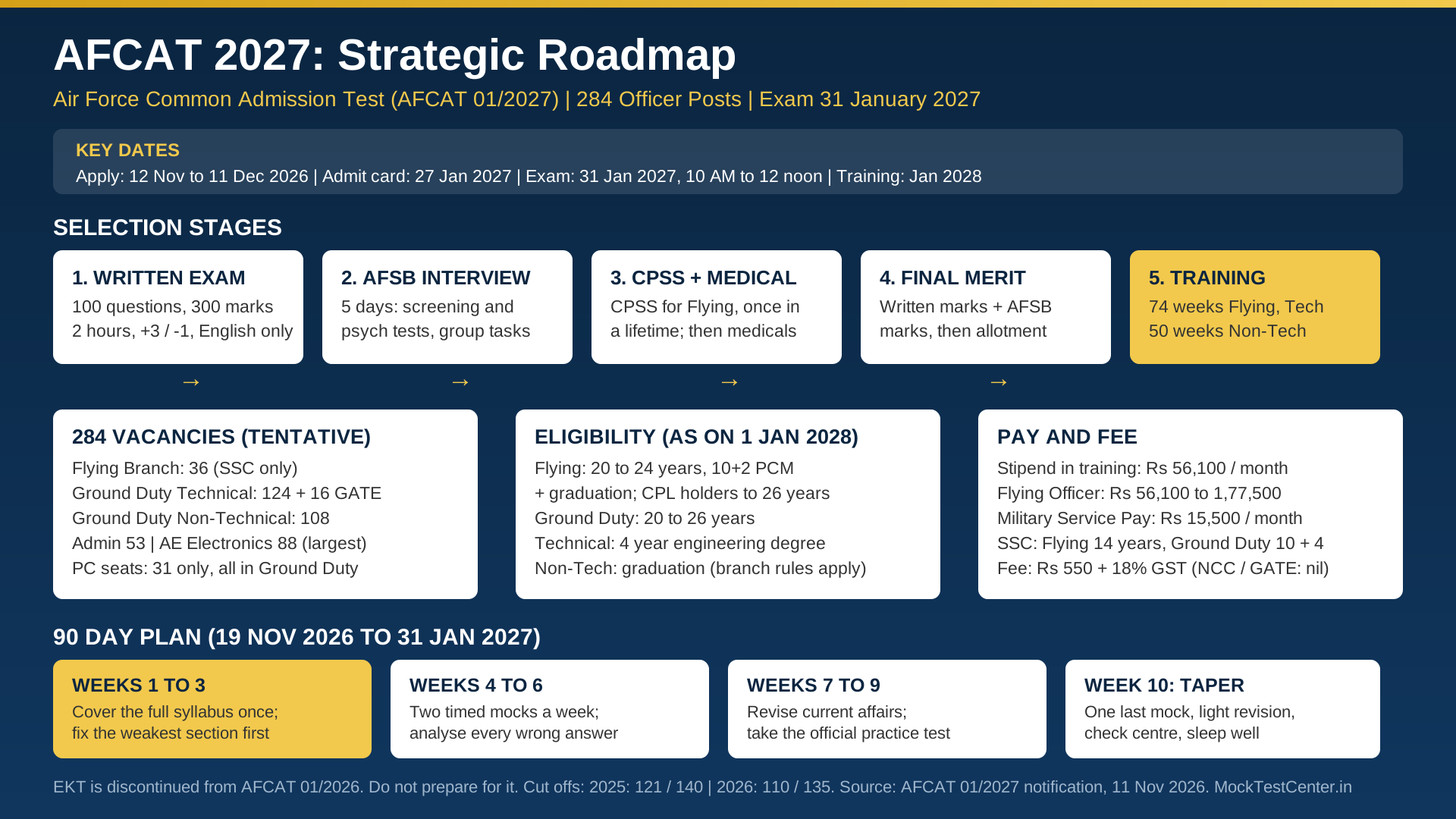
The Indian Air Force has opened AFCAT 2027 with 284 officer posts, and the AFCAT exam falls on 31 January 2027. The detailed notification for AFCAT 01/2027 came out on 11 November 2026, applications run from 12 November to 11 December 2026, and the courses begin in the first week of January 2028. That gives applicants 30 days to file the form and about seven weeks after the last date to prepare for the paper. This guide works from that notification, and it says plainly where the notification stays silent.
AFCAT 2027 is the short name for the Air Force Common Admission Test in the 01/2027 cycle. It picks Group A Gazetted Officers for the Flying Branch and for Ground Duty in its Technical and Non-Technical streams. Two more doors sit beside the main entry. NCC Special Entry takes Air Wing cadets with a C certificate straight to the Air Force Selection Board, and GATE Score Entry takes engineers on their GATE score without a written test.
Every number in this guide comes from the 66 page notification or from the cut off lists the Air Force published with earlier results. Where two sources disagree, the guide names the clash instead of hiding it.
The dates that decide everything
Five dates carry this cycle. Miss one and the rest of the preparation counts for nothing.
| Event | Date |
|---|---|
| Detailed notification released | 11 November 2026 |
| Online applications open | 12 November 2026, 11:00 AM |
| Last date to apply and pay the fee | 11 December 2026, 11:30 PM |
| Admit card download opens | 27 January 2027, 11:00 AM |
| AFCAT 01/2027 online exam | 31 January 2027, Sunday, 10:00 AM to 12:00 noon |
| Answer key and objection window | 3 February 2027, 10:00 AM to 5 February 2027, 10:00 AM |
| Result and AFSB interview dates | Not given in the notification |
| Training begins | First week of January 2028 |
Two details on exam day deserve attention. Reporting time is 8:00 AM and the last entry is 9:00 AM, half an hour earlier than the 9:30 AM gate closing in the AFCAT 01/2026 cycle. Verification runs from 8:00 AM to 9:45 AM. It covers the admit card and identity proof.
Biometrics and seating are checked in the same window, and nobody is let in once pre-exam verification starts. Plan to reach the centre by 7:30 AM. A late train or a wrong turn on exam morning ends a year of work.
The exam falls on a Sunday this time. The last two AFCAT exams were held on Saturdays, so candidates who built their mock test routine around Saturday mornings should shift it. Take your full length mocks on Sunday mornings at 10:00 AM for the last three weeks, in a room without your phone, and the real morning will feel familiar.
One gap in the notification matters for planning. It gives no date for the result and none for the AFSB interviews. Those will be announced by the Air Force later, on the official portal. Do not trust any site that prints a result date for this cycle.
As of 19 November 2026, no such date exists.
284 seats, and where they actually sit
The notification lists 284 fixed number vacancies through AFCAT Entry and GATE Score Entry, plus NCC Special Entry seats counted separately as a percentage. The Air Force calls every figure tentative, and it can change with organisational needs and training slots. Still, the split tells a candidate where the real openings are.
| Entry and branch | Vacancies | Commission |
|---|---|---|
| AFCAT, Flying Branch | 36 | SSC only, men 28, women 8 |
| AFCAT, Ground Duty Technical, Aeronautical Engineer Electronics | 88 | PC 7, SSC 81 |
| AFCAT, Ground Duty Technical, Aeronautical Engineer Mechanical | 36 | PC 10, SSC 26 |
| AFCAT, Ground Duty Non-Technical, Weapon Systems | 30 | SSC only, men 25, women 5 |
| AFCAT, Ground Duty Non-Technical, Administration | 53 | PC 2, SSC 51 |
| AFCAT, Ground Duty Non-Technical, Logistics | 11 | PC 2, SSC 9 |
| AFCAT, Ground Duty Non-Technical, Accounts | 8 | PC 2, SSC 6 |
| AFCAT, Ground Duty Non-Technical, Education | 4 | PC 2, SSC 2 |
| AFCAT, Ground Duty Non-Technical, Meteorology | 2 | PC only, men 1, women 1 |
| GATE Score Entry, Aeronautical Engineer Electronics | 11 | PC 2, SSC 9 |
| GATE Score Entry, Aeronautical Engineer Mechanical | 5 | PC 2, SSC 3 |
| Total | 284 | 268 through AFCAT Entry, 16 through GATE Score Entry |
Read the table from the top. Aeronautical Engineer Electronics holds 88 seats, the largest single share, and Administration follows with 53. Together those two branches hold about half the cycle. A candidate with an electronics or electrical engineering degree who ignores this cycle is walking past the widest door the Air Force has opened in years.
At the other end, Education has 4 seats and Meteorology has 2. Those branches are real, and they are worth applying for if the degree fits, but nobody should build a whole preparation plan around a 4 seat branch.
The Flying Branch takes 36, all on Short Service Commission. There is no Permanent Commission seat for pilots through AFCAT Entry in this cycle. That is not a mistake in the table. Flying through AFCAT has always been SSC, and the notification keeps it that way.
The 14 year engagement that follows is covered later in this guide.
Permanent Commission seats exist only in Ground Duty, and there are few of them. Across the whole cycle, 31 PC seats sit inside the 284, and 17 of those sit in the two technical branches. So a candidate who wants a full career to retirement age with a pension should look hard at Aeronautical Engineer Mechanical, which carries 10 PC seats, and Aeronautical Engineer Electronics, which carries 7. The other Ground Duty Non-Technical branches share the rest, two each, except Meteorology where both seats are PC.
The maths is blunt. Most selected candidates in this cycle will serve on Short Service Commission, and they should choose the branch with that fact in mind rather than discovering it at the AFSB.
NCC Special Entry sits outside the 284. The notification reserves 10 percent of the AFCAT SSC Flying seats for NCC Air Wing Senior Division C certificate holders, and 10 percent of Ground Duty vacancies for the same certificate holders. Two Ground Duty Non-Technical seats are reserved for candidates holding an LLB degree. These are reservations inside the intake, not extra seats on top of it, so do not add them to 284.
Who can apply: the age and degree checks that reject most forms
Eligibility for AFCAT 2027 turns on three checks. Age on 1 January 2028, the subjects taken in Class 12, and the degree. The form asks for all three, and the Air Force accepts only the date of birth recorded in the Class 10 certificate. No later change is accepted, so check that certificate before filling anything.
| Branch | Age on 1 January 2028 | Date of birth range |
|---|---|---|
| Flying Branch (AFCAT and NCC Special Entry) | 20 to 24 years | 2 January 2004 to 1 January 2008 |
| Flying Branch, with a valid DGCA Commercial Pilot Licence | Up to 26 years | 2 January 2002 to 1 January 2008 |
| Ground Duty (Technical and Non-Technical) | 20 to 26 years | 2 January 2002 to 1 January 2008 |
The Flying window is narrow, and it closes fast. A candidate born on 1 January 2004 is inside it, and a candidate born a day earlier is outside it. There is no relaxation on the upper age for Flying, and no category relaxation is mentioned in the notification. Ground Duty gives two extra years, which is why many graduates who miss Flying on age still have a genuine shot at Administration or Logistics.
Candidates applying for constable level state exams face wider age windows, so the contrast is worth noting. The UP Police Constable 2027 intake and the Bihar Police Constable 2027 intake both take candidates across a broader age band than the Flying Branch allows, and that difference decides many career plans before any exam is attempted.
Marital status is a condition, not a formality. Candidates must be unmarried when the course starts, and marriage is not allowed during training. The notification also bars widows, widowers and divorcees. This rule catches candidates who skim the notification, so read it as a hard bar.
Education is branch specific, and the Class 12 subjects matter as much as the degree. Flying needs Physics and Mathematics in Class 12 plus a three year graduation in any discipline, a four year BE or BTech, or Sections A and B of AMIE or the Aeronautical Society of India. Ground Duty Technical needs Physics and Mathematics in Class 12 plus a four year engineering degree in one of the listed disciplines. For Aeronautical Engineer Electronics, the list covers electronics and electrical engineering.
It also covers computer science and IT. AI and instrumentation streams are on the list too, and an MSc in Electronics with BSc Physics also qualifies. For Aeronautical Engineer Mechanical, it covers mechanical and aeronautical engineering. Production and automobile engineering are listed, along with mechatronics and allied streams.
Ground Duty Non-Technical splits by branch. Weapon Systems needs Physics and Mathematics in Class 12 plus a graduation in any discipline or a BE or BTech. Administration and Logistics need only a graduation in any discipline, with no Class 12 subject bar. Accounts needs BCom, a BBA, BMS or BBS with a finance specialisation, a BSc in finance, or a qualified CA, CMA, CS or CFA.
Education needs graduation plus a postgraduate degree in any discipline. Meteorology needs a BSc with Physics and Mathematics, or a four year engineering degree in one of the listed streams.
Three conditions sit behind the degree table. Final year students can apply if they have no current backlog, but they must submit proof of completing their final exams by 30 November 2027. A diploma in place of Class 12 is not accepted, and only candidates who passed Class 12 under the 10+2 pattern can apply. Anyone who failed the Computerised Pilot Selection System earlier cannot apply for the Flying Branch, and anyone suspended from flying training at the Air Force Academy cannot apply either.
The engineering discipline lists are long and exact, so search for your degree name in the notification PDF before paying the fee. A degree that sounds close but is not listed will not pass document verification at the AFSB, and that is a painful place to learn it.
One change from recent cycles helps many candidates. The minimum percentage bars that AFCAT 01/2026 carried, 50 percent in Mathematics and Physics at Class 12 for Flying and Technical branches and 60 percent at graduation, were removed from AFCAT 02/2026 onwards, and the 01/2027 notification carries no percentage bar either. This is reported from the cycle change summaries rather than from a line in the current notification, so candidates near the old bars should still confirm their position against the PDF. But the direction is clear.
The Air Force now judges the degree and the subjects, not the percentage.
The AFCAT 2027 paper: 100 questions, 300 marks, one old trap
The AFCAT exam in this cycle is a single paper for every branch. It runs online, in English only, with 100 objective questions for 300 marks in 2 hours. Each correct answer earns 3 marks, each wrong answer loses 1 mark, and an unanswered question scores zero. There is no sectional timing, and the notification publishes no question split between the four subjects.
If the exam runs in more than one shift, scores are normalised before results.
| Paper | Questions | Marks | Duration |
|---|---|---|---|
| AFCAT written test, all branches | 100 | 300 | 2 hours |
The paper covers four subjects. General Awareness and Verbal Ability in English are usually listed first. Numerical Ability and the Reasoning and Military Aptitude Test complete the set. General Awareness covers history and geography.
Polity and economy are in it too. So are science and current affairs, with defence rounding off the list. English covers comprehension and error detection. Synonyms and antonyms are tested, along with idioms and cloze tests.
Numerical Ability is set at Class 10 level, while the other sections are set at graduation level. Reasoning and Military Aptitude covers verbal and non-verbal reasoning. Spatial ability and analogy are part of it. Series and blood relations are tested too, along with coding and decoding.
Now the trap. Most preparation sites still tell Ground Duty Technical candidates to study for the Engineering Knowledge Test, a separate 50 question paper worth 150 marks in 45 minutes. That paper no longer exists. The Air Force dropped EKT from AFCAT 01/2026, and the 01/2027 notification describes a single paper for all branches with no mention of EKT at all.
Any site still publishing an EKT pattern for 2027 is describing a test that is no longer set. Technical candidates who spend weeks on EKT books are spending weeks on a paper they will never sit, and they lose that time from the four subjects that actually carry marks.
What replaced EKT is the GATE Score Entry. Engineers with a GATE score in one of the ten specified papers, with the result declared between 1 January 2024 and 31 December 2027, can apply for Aeronautical Engineer Electronics or Mechanical and go straight to the AFSB if shortlisted. That is the technical route now. Either take the single written paper with everyone else, or take the GATE route and skip it.
There is no third paper.
The marking scheme shapes the whole attempt strategy. With plus 3 and minus 1, a blind guess needs a one in four hit rate just to break even, and most candidates guess worse than that under time pressure. The paper rewards accuracy over attempts. A candidate who answers 70 questions with 60 correct scores 170.
A candidate who answers all 100 with 65 correct scores 160. The second candidate attempted more and scored less. That arithmetic is the single most useful fact about this paper, and it should govern every mock test. Mark only the questions you can narrow to two options, leave the rest, and review the skipped ones only if time remains.
Section order inside the paper is a personal choice, and the notification gives no sectional cut off, so the two hours can be spent wherever they are worth most. Most candidates do best by starting with the section they finish fastest, usually Reasoning or Numerical Ability, then moving to English, and keeping General Awareness for the end, since a General Awareness question is either known in seconds or not known at all. Whatever order you pick, fix it in mocks and do not change it on exam day.
A word on section splits. Several sites print a fixed split, often 25 General Awareness, 30 English, 20 Numerical Ability and 30 Reasoning. The notification publishes no such split, and reconstructions from past papers disagree with each other. Treat any fixed split as a rough guide from memory based papers, not as an official figure.
The safe way to prepare is to cover all four subjects fully and to practise full length papers rather than trusting a sectional target.
What the cut offs really say
The Air Force releases the AFCAT cut off with each result, as a single overall figure out of 300. The AFCAT 2027 cut off will follow the same single figure format, and it will come with the result, on a date the notification leaves open. It is common across categories, and there is no sectional cut off. The table below lists the written cut offs as reported with each result.
| Year | AFCAT 1 cut off | AFCAT 2 cut off |
|---|---|---|
| 2020 | 153 | 155 |
| 2021 | 165 | 157 |
| 2022 | 157 | 157 |
| 2023 | 155 | 151 |
| 2024 | 137 | 139 |
| 2025 | 121 | 140 |
| 2026 | 110 | 135 |
Two things stand out. First, the cut off has fallen sharply from the 150s and 160s of 2021 to 2023 down to 110 for AFCAT 1 2026 and 121 for AFCAT 1 2025. Second, the two cycles in a year can differ by nearly 20 marks, as 2025 shows with 121 against 140. Both facts warn against treating any single number as a target.
The cut off moves with the difficulty of the paper, the number of vacancies and the performance of the whole candidate pool, and all three change every cycle.
The 2026 figures need a note. AFCAT 1 2026 at 110 and AFCAT 2 2026 at 135 are reported by Career Power and AglaSem from the results as declared, and the two sources agree on both numbers. The 2020 to 2025 figures are consistent across several trackers and match the official result notices as reported. Even so, a candidate should treat 110 as a floor that happened once, not as a promise.
A harder paper or fewer seats can push the next cut off back up by 20 marks without warning.
The practical target is higher than the cut off. Clearing the written paper only buys a ticket to the AFSB, and the final merit list adds the written marks to the AFSB marks. A candidate who scrapes past the cut off at 125 starts the AFSB 40 marks behind a candidate who scored 165, and that gap is hard to close in five days of testing. Aim for 170 or above in mocks, and treat anything under 150 as a warning sign even if it clears a past cut off.
The written paper is half the final score, and it is the half a candidate can fully control.
AFSB: five days that no mock test can copy
AFCAT 2027 candidates who clear the written exam, along with NCC Special Entry candidates and shortlisted GATE Score Entry candidates, are called to an Air Force Selection Board. There are five boards: Dehradun (1 AFSB), Mysuru (2 AFSB), Gandhinagar (3 AFSB), Varanasi (4 AFSB) and Guwahati (5 AFSB). Candidates choose their AFSB date and venue on the official portal to generate the call-up letter. Flying Branch candidates are routed for the Computerised Pilot Selection System to Dehradun, Mysuru or Varanasi.
Day 1 is screening, and it ends many journeys. Stage I runs the Officer Intelligence Rating test and the Picture Perception and Discussion test, and candidates who do not clear it are sent back the same day. Documents are checked for those who clear it, and the psychological tests follow on the evening of Day 1. That first day is the sharpest filter in the whole process, and it tests speed and clarity rather than knowledge.
Practise picture perception with timed writing, and practise speaking in a group without talking over others, because both skills are tested before any interview begins.
Days 2 to 4 carry Stage II. The psychological battery covers the Thematic Apperception Test, Word Association Test, Situation Reaction Test and Self Description Test. The group tests cover group discussion and group planning. The progressive group task and the half group task follow, along with individual obstacles and the command task.
Lecturette and the final group task round them off. The personal interview can fall on any of these days and usually runs about an hour. Day 5 is the board conference, where the assessors sit together and decide. Recommended candidates stay for medical examination, and Flying Branch candidates go on to the Computerised Pilot Selection System, which runs on Day 6.
CPSS deserves its own warning. It is a one attempt test in a lifetime. A candidate who fails it can never apply for the Flying Branch again, in any entry, though Ground Duty branches and the Army and Navy wings remain open. The test measures instrument reading and sensory motor coordination through a machine, and it cannot be passed by reading about it.
Candidates who have never sat a psychomotor test should still know the rule, because it changes how seriously to take the Flying choice on the form. Tick Flying only if flying is your first choice, not as a casual extra.
The AFSB tests officer like qualities across three independent assessments. One is what a candidate writes. Another is what a candidate does in a group. What a candidate says in interview is judged separately.
No single good day covers a weak one elsewhere. Preparation that works is ordinary and dull. Read a newspaper daily and form an opinion on two stories. Practise speaking for three minutes on an unfamiliar topic.
Run and do the fitness routine below, because tired candidates think slowly in group tasks. And go through your own life with care, because the interview will ask about school and family life. Failures and choices come up too, and rehearsed answers sound rehearsed.
Medical examination follows recommendation, and the standards sit in Appendix A of the notification. Flying Branch vision standards allow habitual wearers of glasses within the limits given in the annexures, so candidates who wear glasses should check those limits before choosing Flying. Permanent tattoos are allowed only on the inner forearm and the back of the hands, with a self declaration, and candidates from notified tribal communities with customary tattoos are considered case by case with supporting certificates. Check the medical annexures early.
A candidate who discovers a medical bar after the AFSB has lost a year.
Pay and training after selection
Training starts in the first week of January 2028. Flying and Ground Duty Technical training runs about 74 weeks, and Ground Duty Non-Technical training runs about 50 weeks. Flight Cadets draw a fixed stipend of Rs 56,100 per month during training. On commissioning as a Flying Officer, the pay scale is Level 10, Rs 56,100 to Rs 1,77,500, plus Military Service Pay of Rs 15,500 per month.
Flying allowances sit on top of that, along with technical and risk allowances, depending on branch and posting.
The commission question matters more than the starting pay. Flying Branch through AFCAT is Short Service Commission for 14 years. Ground Duty SSC is an initial 10 years, extendable by 4 years based on service needs and merit, and on the candidate's willingness. Permanent Commission seats in this cycle exist only in Ground Duty, and SSC officers are not entitled to a pension.
A move from SSC to PC later is possible but depends on vacancies and policy at that time, and it is not a promise.
Candidates should decide this before the form, not after the merit list. Fourteen years in uniform is a career, and it is a good one, with flying and responsibility, and with pay that few civilian jobs match at the same age. But it is not a lifetime pension career unless the branch carries Permanent Commission. A graduate who wants a pension above all else should rank the PC heavy Ground Duty Technical branches first.
A graduate who wants to fly should accept the 14 year term with open eyes and stop worrying about what comes after it. Either choice is sound. The mistake is making neither choice and drifting into a branch by default.
Fitness is part of the job from the first week, and the notification suggests building up to running 4 km in 15 minutes, at least 20 push-ups and 20 sit-ups, 8 chin-ups, climbing a 3 to 4 metre rope, and swimming 25 metres. Flying cadets also need a minimum body weight of 48 kg before flying training starts. Start this routine now, not after the written result. A candidate who clears the paper but cannot run 4 km will feel it at the AFSB and again in training, and fitness built in a hurry rarely holds.
The form: what to keep ready before 11 December
The fee for AFCAT Entry is Rs 550 plus 18 percent GST, which works out to Rs 649, and it is non-refundable. NCC Special Entry and GATE Score Entry candidates pay nothing. Payment is online only, through net banking, debit card, credit card or UPI. Cash is not accepted.
Cheque and demand draft are not accepted either.
Applying for AFCAT 2027 takes two steps. First, sign up with your full name as in the Class 10 certificate. Add your mobile number and email ID, and verify both through OTP. The Application Sequence Number and password are sent to your email and mobile.
Second, log in, fill in personal and communication details, then qualification details. Choose course preferences and exam centre. Upload documents and preview the form. Then submit it and pay the fee.
The form is auto submitted after successful payment, so print and keep a copy.
Keep three files ready before you start. A recent passport size colour photograph on a light background, JPG, 100 KB to 200 KB. A signature in black ink on white paper, JPG, 80 KB to 150 KB. A thumb impression, left thumb for men and right thumb for women, JPG, 50 KB to 100 KB.
Aadhaar is mandatory for registration. The form also asks for aggregate Class 12 and graduation percentages and Physics and Mathematics marks, so keep the mark sheets on the desk while filling it.
The rule that causes the most grief is the one about corrections. Once the fee is paid, no corrections are allowed. The only remedy is to register again with a different email ID and pay the fee again, and only the latest application linked to an Aadhaar number is considered. So preview the form twice, check the name spelling against the Class 10 certificate letter by letter, and check the branch preferences before paying.
A wrong branch order cannot be fixed later, and branch allotment depends on merit and vacancies. Medical fitness and the choices given in the form count too.
The notification lists more than 100 tentative exam cities. Delhi and NCR are on the list. So are Mumbai and Kolkata, along with Chennai and Bengaluru. Leh and Port Blair are covered too, along with Imphal.
Requests to change the AFCAT exam centre will not be entertained, so choose carefully. Pick the city you can actually reach by 7:30 AM on a Sunday, not the city that looks convenient on a map. For technical help, the notification lists the AFCAT Help Desk on plus 91 9513252077, 9:00 AM to 6:00 PM, Monday to Saturday.
One practical note on where to apply. The current official portal for AFCAT 01/2027 is afcat.edcil.co.in, and the notification PDF sits in the News section of that portal. Several older guides still point to afcat.cdac.in, which was the earlier portal, and the Air Force career site careerindianairforce.cdac.in still carries entry information. Use the edcil portal for the form itself, and check the career site for background on life in the Air Force.
If a link on another site asks for money to apply, close it. The only fee is the one above, paid inside the official form.
A 90 day plan that fits the real calendar
From 19 November 2026 to the exam on 31 January 2027 is about ten weeks, and from the last date to apply it is about seven weeks. The AFCAT 2027 plan below fits that window. It assumes two to three hours a day, which is enough if the hours are real study rather than scrolling through preparation videos.
Weeks 1 to 3 cover the syllabus once. Read General Awareness from a standard current affairs source for the last six months plus defence news, and revise static history and geography in short daily slots, along with polity. Finish English grammar and vocabulary with daily error detection and synonym sets. Work Numerical Ability topic by topic at Class 10 level, and drill Reasoning patterns daily.
End each week with one sectional test per subject and a written list of the topics you got wrong.
Weeks 4 to 6 are mock test weeks. Take two full length mocks a week under exam conditions at 10:00 AM for two hours, with no phone. Spend as long analysing each mock as taking it. List every wrong question and the reason it went wrong, then revise those topics the next day.
This is where scores move. A candidate who takes ten mocks without analysis improves slowly. A candidate who takes five mocks and analyses each one improves fast.
Weeks 7 to 9 turn to revision and current affairs. Revise the last six months of current affairs with a focus on defence and space, plus national awards and major government schemes. Rework the questions you got wrong in mocks. Take the official practice test on the AFCAT portal, which shows the real interface and the real question style.
Keep the fitness routine going through these weeks. Running and the bodyweight targets from the notification stay in the plan.
Week 10 is the taper. No new topics. One last mock on the Sunday before the exam, then light revision only. Check the admit card from 27 January, confirm the centre location in daylight, and keep the documents ready: admit card, a valid photo identity card, and the photograph used in the form.
Sleep properly for two nights before the exam. A tired brain guesses more, and guessing is what the minus 1 mark punishes.
Three mistakes that cost candidates a cycle
The first mistake in AFCAT 2027 preparation is studying for EKT. It is gone, and every hour spent on it is an hour taken from General Awareness or Reasoning. If a book or a video course still leads with EKT, drop that book. Find material built on the 01/2026 and 01/2027 pattern instead.
The second mistake is choosing the wrong branch order on the form. Branch allotment follows merit and vacancies. Medical fitness and the preferences given count too, so a careless order can place a strong candidate in a branch they never wanted while a weaker candidate takes the seat they did want. Rank branches by what you actually want to do for 10 to 14 years, and put Flying first only if flying is the first choice.
The third mistake is treating the written paper as the whole exam. The AFSB carries equal weight in the final merit list, and its first day sends home a large share of candidates who cleared the paper. Start the AFSB preparation alongside the written preparation, with daily news reading, timed picture perception practice and group discussion. Candidates who begin AFSB work only after the written result have weeks to learn skills that take months.
Other uniformed entries worth a look
AFCAT suits graduates who want an officer rank, but it is not the only uniformed entry open in 2027. The Agniveer Vayu 2027 intake takes airmen into the Air Force, and the SSC GD 2027 intake takes constables into the central armed police forces. In the states, the UP Police Sub Inspector 2027 intake and the SSC Delhi Police Constable 2027 intake both offer uniformed careers with different age windows and different papers. The UP Police Fireman 2027 intake, the UP Police Jail Warder 2027 intake, the UP Police Computer Operator 2027 intake and the SSC Delhi Police Head Constable Ministerial 2027 intake cover technical and clerical uniformed roles for candidates whose degree or age does not fit AFCAT.
Apply to the entry that fits your profile rather than the entry with the biggest name.
Sources
Indian Air Force notification for AFCAT 01/2027, 66 pages, released 11 November 2026, as reported by SSBCrack and Entri from the official portal afcat.edcil.co.in. Indian Air Force career site careerindianairforce.cdac.in for entry information. Indian Air Force site indianairforce.nic.in for service background. The vacancy split and dates come from the SSBCrack summary of the official notification.
So do the fee and age limits, along with the education rules. The AFCAT exam pattern and AFSB centres come from the same summary. Training length and stipend figures are there too, along with the pay figures. Each point was cross checked against Entri and Jagran Josh, and against the Government Jobs Alert summary of the same notification.
EKT discontinuation from AFCAT 01/2026 and GATE Score Entry introduction from AFCAT 02/2026 per the Future Topper syllabus analysis of the 2026 notifications, confirmed by the absence of EKT from the 01/2027 notification. Cut off figures for 2020 to 2025 from the AglaSem and Career Power cut off records, and for 2026 from Career Power, cross checked against CollegeDekho. AFSB day wise schedule from the CollegeDekho AFSB guide and the Air Force call up letter format. AFCAT 02/2027 status as of 19 November 2026: not notified, with notification expected in late May to early June 2027 and the exam in August 2027 per the usual twice yearly cycle and the 02/2026 dates, 20 May 2026 notification and 8 August 2026 exam.