
About WBSSC SLST 2027 Exam Series
📖 Table of Contents
- WBSSC SLST 2027 at a glance
- Why the 2nd SLST exists: the Supreme Court order of 3 April 2025
- The 35,657 posts, and the revision that cut 69
- The written paper: 60 questions in 90 minutes
- The other 40 marks: academic, experience, interview, lecture demo
- Who can apply: degrees, B.Ed., and the age limit
- Fees and the full 2025 timeline
- Where the 2025 cycle stands now
- Pay, and why the notification gives no figure
- Syllabus: subject depth at graduation level
- The mistakes that cost candidates marks
- A preparation plan for a 60 mark paper
- What the tracker pages get wrong about SLST
- What to watch for next
- Sources
WBSSC SLST 2027: Complete Exam Guide
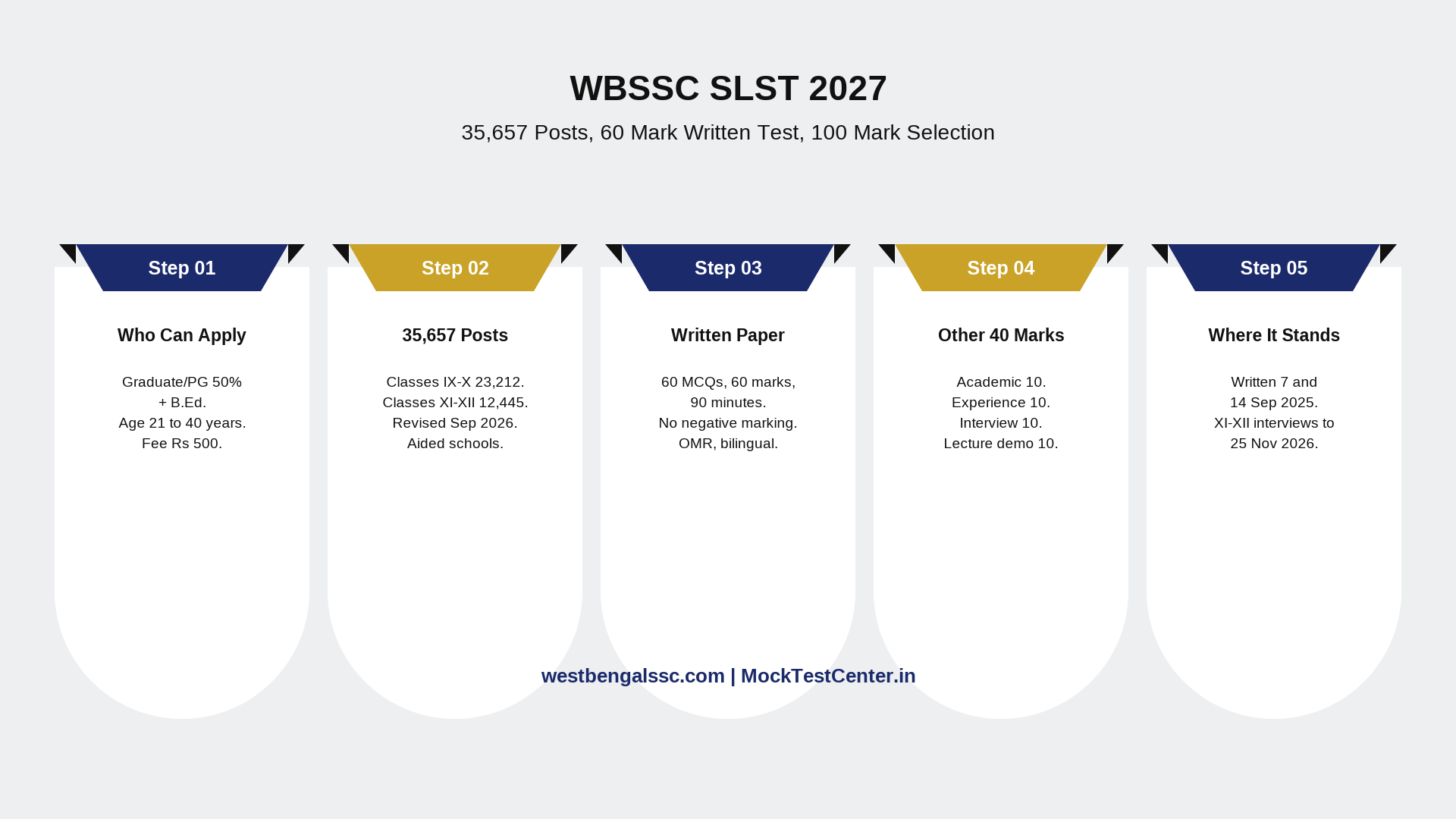
WBSSC SLST 2027 is the page for the West Bengal School Service Commission State Level Selection Test for Assistant Teachers, and the cycle it follows is the 2nd SLST of 2025, the largest teacher recruitment West Bengal has run in a decade. The commission published the notification on 30 May 2025 for 35,726 Assistant Teacher posts, revised later to 35,657, and held the written examination on 7 September 2025 for Classes IX and X and on 14 September 2025 for Classes XI and XII. The commission ran Classes XI and XII interviews in rounds through November 2026, while it had still to announce the Classes IX and X interview schedule as of 23 November 2026. The commission has published no 2027 notification as of 23 November 2026, so this guide anchors on the 2025 cycle and says so plainly wherever a 2027 figure would otherwise be guessed.
The first thing to understand about this recruitment is that it exists because the Supreme Court ordered it. On 3 April 2025, in Civil Appeal No. 4800 of 2024, the court set aside the 2016 selection panel for Assistant Teachers, and the state was told to run a fresh selection. The 2nd SLST of 2025 is that fresh selection. This recruitment differs from a routine annual drive. It carries the court's directions on transparency inside it, from carbon copies of OMR sheets to videotaped interviews, and every stage of it is subject to the outcome of review petitions in the Supreme Court. A candidate who prepares for this test is preparing for a recruitment that the whole state is watching.
The second thing to understand is the shape of the selection. The written paper carries 60 marks out of a total of 100. The other 40 marks come from academic qualification, teaching experience, an oral interview, and a lecture demonstration, 10 marks each. A candidate who treats the written paper as the whole test is fighting for 60 percent of the marks and ignoring the rest. The written paper is an OMR test of 60 multiple choice questions in 90 minutes with no negative marking, and it is the only stage that looks like a normal examination. The rest of the selection is a record of what the candidate has already done, plus a demonstration of how the candidate teaches.
WBSSC SLST 2027 at a glance
| Detail | WBSSC SLST 2027, as run in the 2nd SLST 2025 cycle |
|---|---|
| Conducting body | West Bengal Central School Service Commission, WBCSSC, also called WBSSC |
| Exam | State Level Selection Test, Assistant Teacher, Classes IX to X and XI to XII |
| Live cycle | 2nd SLST, Assistant Teacher, 2025, Memo No. 1092/7016/CSSC/ESTT/2025 dated 30 May 2025 |
| Posts in live cycle | 35,657 revised, Classes IX to X 23,212, Classes XI to XII 12,445, original notice 35,726 |
| Applications | 16 June 2025, 5 PM, to 14 July 2025, extended to 21 July 2025, re-opened 23 August to 2 September 2025, closed |
| Fee | General and OBC Rs 500, SC, ST and PH Rs 200 |
| Written exam | 7 September 2025, Classes IX to X, 14 September 2025, Classes XI to XII |
| Written paper | 60 MCQs, 60 marks, 90 minutes, OMR, no negative marking |
| Selection total | 100 marks, written 60, academic 10, experience 10, interview 10, lecture demo 10 |
| Age limit | 21 to 40 years as on 1 January 2025, relaxations for SC, ST, OBC and PH |
| Status | Classes XI to XII interviews in rounds to 25 November 2026, Classes IX to X interview schedule not announced as of 23 November 2026 |
| 2027 notification | Not published as of 23 November 2026 |
Why the 2nd SLST exists: the Supreme Court order of 3 April 2025
The 2nd SLST is the second State Level Selection Test for Assistant Teachers, and it came nearly ten years after the first. The first SLST produced the 2016 panel, and candidates challenged that panel in court for years. On 3 April 2025, the Supreme Court delivered its order in Civil Appeal No. 4800 of 2024, and the 2016 panel was set aside. The court directed the state to run a fresh selection, and the state framed the West Bengal School Service Commission, Selection for Appointment to the Posts of Assistant Teachers, Rules, 2025, to govern it. The notification of 30 May 2025 is the first act under those rules.
The court order shapes the test in ways a candidate can see. The advertisement states that the entire selection is subject to the outcome of review petitions in the Supreme Court. The preliminary interview lists carry the same condition. The transparency measures in the notification read like a direct answer to the court's concerns: candidates receive carbon copies of their OMR sheets, the commission publishes preliminary answer keys with a five day window for objections supported by authentic academic references, the commission videotapes interviews, and the commission prepares final merit lists region wise, taking vacancies and candidate preferences into account.
The age relaxation in the notification also carries the court's mark. Alongside the usual relaxations for SC, ST, OBC and PH candidates, the notification allows the relaxation permitted by the Supreme Court order of 3 April 2025. Candidates who lost years waiting for the 2016 litigation to end get that time back in the age limit. A candidate who is over 40 years old on 1 January 2025 should not assume disqualification without checking whether the court order relaxation applies, because the notification's age clause is written to cover exactly that case.
The scale of the recruitment follows from the same history. The 2016 panel covered thousands of posts, and the fresh selection had to cover the same ground. The original notice listed 35,726 posts, and the revised figure is 35,657. No teacher recruitment in West Bengal in recent years has come close to that number. The written examination alone drew candidates in lakhs, and the commission had to run it on two Sundays, one for each level, with separate papers for each subject.
The 35,657 posts, and the revision that cut 69
The original notification of 30 May 2025 listed 35,726 Assistant Teacher posts. Classes IX and X, the secondary level, carried 23,212 posts. Classes XI and XII, the higher secondary level, carried 12,514 posts. The two numbers add to 35,726. The commission published the subject wise vacancy list for Classes IX and X on 13 June 2025, and the higher secondary list followed.
The figure changed in September 2026. The West Bengal Board of Secondary Education sent revised final vacancies in Memo No. Admin/2321-B dated 3 September 2026, and the Classes XI and XII figure moved from 12,514 to 12,445. The Classes IX and X figure stayed at 23,212. The revised total is therefore 35,657, which is 69 posts fewer than the original notice. The commission published the revised preliminary interview list for Classes XI and XII on 28 September 2026 on the revised vacancies, and the revised list for Classes IX and X on 12 October 2026.
| Level | Posts, original notice 30 May 2025 | Posts, revised, September 2026 |
|---|---|---|
| Assistant Teacher, Classes IX to X | 23,212 | 23,212 |
| Assistant Teacher, Classes XI to XII | 12,514 | 12,445 |
| Total | 35,726 | 35,657 |
A candidate who quotes 35,726 is quoting the original notice, and a candidate who quotes 35,657 is quoting the current figure. Both numbers are correct for their dates, and this guide uses 35,657 as the live figure, with the original 35,726 recorded alongside it. The 69 post cut is small against a total of 35,726, but it matters for the interview list, because the commission draws the preliminary interview list at about 1.6 candidates per vacancy, and a change in the vacancy figure changes the size of the list. The revised Classes IX and X interview list of 12 October 2026 cancelled the earlier preliminary list of 12 December 2025, and the commission drew it on the revised vacancies.
The posts are in government aided and government sponsored secondary and higher secondary schools across West Bengal. The subjects are the school subjects: Bengali, English, Mathematics, Physical Science, Life Science, History, Geography, and the rest of the secondary and higher secondary curriculum, with separate lists for each subject and each level. A candidate applies for one subject at one level, and the competition is within that subject and level, not across the whole 35,657 posts. The subject wise vacancy list of 13 June 2025 is the document that shows how many posts a candidate's own subject carries, and a candidate who does not read it is preparing without knowing the size of the field.
The written paper: 60 questions in 90 minutes
The written examination is an OMR based test of 60 multiple choice questions, each carrying 1 mark, with four options per question. The total is 60 marks. The duration is 90 minutes, and there is no negative marking. The question papers are in English and Bengali, except for the language papers, which are in their own language. The Classes IX and X paper was held on 7 September 2025, and the Classes XI and XII paper on 14 September 2025. Candidates had to report by 11 AM, the gates closed at 11:45 AM, and the examination began at 12 noon.
| Detail | Written examination, 2nd SLST 2025 |
|---|---|
| Questions | 60 MCQs, 1 mark each, four options |
| Total marks | 60 |
| Duration | 90 minutes |
| Negative marking | None, a wrong answer costs nothing |
| Mode | OMR, pen and paper, carbon copy of the sheet given to the candidate |
| Language | English and Bengali, except language papers in their own language |
| Exam dates | 7 September 2025, Classes IX to X, 14 September 2025, Classes XI to XII |
| Weight in selection | 60 marks out of 100 |
Ninety minutes for 60 questions gives a candidate 90 seconds per question on average, which is generous beside the one minute per question that the primary TET allows. The extra time is not a gift. It is there because the questions test subject knowledge at graduation level for Classes IX and X, and at post graduation level for Classes XI and XII, and those questions need reading and thought. A candidate who rushes through in 45 minutes and leaves is not using the time the paper gives, and a candidate who spends three minutes on one question is spending the time of two other questions.
The duration carries one conflict in the sources. One tracker page gives the duration as 1 hour, while Adda247 and CareerPower give 90 minutes. This guide uses 90 minutes, because two independent pattern pages agree on it, and because the 90 minute figure matches the reporting time and the 12 noon start that the same pages report. The 1 hour figure appears on a page that also gives the academic qualification marks on a different scale from the notification, which weakens its reliability on the pattern. A candidate should confirm the duration from the admit card of the next cycle, because the admit card is the document that settles it.
No negative marking changes the strategy completely. A candidate should attempt all 60 questions, because a wrong answer costs nothing and a guess has a one in four chance of adding a mark. The carbon copy of the OMR sheet matters here too. A candidate who keeps the carbon copy can check the answers against the preliminary answer key when the commission publishes it, and can file an objection within the five day window with an authentic academic reference. The objection window is short, and a candidate who throws the carbon copy away cannot check the key.
The other 40 marks: academic, experience, interview, lecture demo
The written paper is 60 marks out of 100. The remaining 40 marks are split into four heads of 10 marks each, and each head rewards something different. The table below gives the split as the notification prescribes it, and the paragraphs that follow explain each head.
| Head | Marks | How the marks are earned |
|---|---|---|
| Written examination, OMR | 60 | 60 MCQs, 1 mark each, no negative marking, 90 minutes |
| Academic qualification | 10 | 60 percent and above 10 marks, 50 percent to below 60 percent 8 marks, below 50 percent 6 marks |
| Prior teaching experience | 10 | 2 marks per year of teaching in government or aided schools, maximum 10 marks |
| Oral interview | 10 | Communication, subject knowledge, teaching aptitude |
| Lecture demonstration | 10 | Teaching demonstration on a given topic |
| Total | 100 | Written 60 plus 40 from the other four heads |
Academic qualification carries 10 marks, graded on the candidate's marks in the qualifying degree. A candidate with 60 percent and above gets 10 marks, a candidate with 50 percent to below 60 percent gets 8 marks, and a candidate with below 50 percent gets 6 marks. For Classes IX and X, the commission takes the marks from the higher of the graduation and post graduation percentages. For Classes XI and XII, only the post graduation marks count. The difference is worth 2 marks at most, but 2 marks in a selection of 100 can decide a rank, and a candidate with a post graduation percentage below 50 percent should know that the academic head will give only 6 marks.
One tracker page gives a different academic scale, with 90 to 100 percent worth 10 marks and 80 to 89.99 percent worth 8 marks. That scale does not match the notification's scale, which starts at 60 percent for the full 10 marks. This guide follows the notification's scale, as reported by Adda247 and by the Sarkari Job summary of the notification. A candidate who prepares from the wrong scale will misjudge the academic head by several marks.
Teaching experience carries 10 marks at 2 marks per year, up to a maximum of 10 marks for five years. Only teaching in government or aided schools counts, and only substantive teaching posts at the secondary level count. A candidate with five years of such experience starts the selection with 10 marks already banked, while a fresh candidate starts with 0 in this head. The gap is real, and it is the reason experienced teachers have an edge in this selection that no amount of written paper preparation can close. A fresh candidate must make up those 10 marks in the written paper, the interview, and the lecture demonstration.
The oral interview carries 10 marks and tests communication, subject knowledge, and teaching aptitude. The lecture demonstration carries 10 marks and asks the candidate to teach a given topic, so that the panel can see the teaching rather than hear about it. The two together carry 20 marks, which is a third of the written paper's weight. A candidate who can answer questions on paper but cannot explain a topic to a class will lose marks here that no mock test can recover. The commission videotapes the interviews, which is a transparency measure from the notification, and a candidate should expect the panel to record the demonstration.
Who can apply: degrees, B.Ed., and the age limit
For Assistant Teacher in Classes IX and X, the candidate needs a graduation or post graduation degree with at least 50 percent marks in either, plus a B.Ed. from an NCTE recognised institution, or a four year B.A.Ed. or B.Sc.Ed. degree. For Assistant Teacher in Classes XI and XII, the candidate needs a post graduation degree with at least 50 percent marks, plus a B.Ed. or a B.A.Ed. or B.Sc.Ed. from an NCTE recognised institution. The 50 percent mark is the floor in the qualifying degree, and it is separate from the academic head's grading, which starts at 60 percent for the full 10 marks.
The B.Ed. requirement is strict. The National Council for Teacher Education must recognise the institution, and the candidate must hold the degree at the time the notification prescribes. A candidate in the final year of B.Ed. should read the notification's exact wording on the cut off date for the qualification, because the sources read for this guide do not quote it. The four year integrated B.A.Ed. and B.Sc.Ed. degrees stand in place of the separate graduation and B.Ed., which matters for candidates who took the integrated route.
The age limit is 21 to 40 years as on 1 January 2025. The relaxations are 5 years for SC and ST candidates, 3 years for OBC candidates, and 8 years for PH candidates, and the notification adds the relaxation allowed by the Supreme Court order of 3 April 2025. The minimum age of 21 years means a candidate who has just finished graduation at 20 cannot apply, and the maximum age of 40 years, with relaxations, means a candidate in the mid forties from a reserved category can still apply. The commission counts the age as on 1 January 2025, not on the date of application, so a candidate who turned 41 in February 2025 is still within the limit if the birthday falls after the cut off date.
Fees and the full 2025 timeline
The application fee was Rs 500 for general and OBC candidates, and Rs 200 for SC, ST and PH candidates. The fee was paid online, and the last date for fee payment matched the last date for the application. The fee is modest beside the scale of the recruitment, and it is the same for both levels, Classes IX and X and Classes XI and XII.
| Event | Date |
|---|---|
| Notification, Memo No. 1092/7016/CSSC/ESTT/2025 | 30 May 2025 |
| Subject wise vacancy list, Classes IX to X | 13 June 2025 |
| Applications open | 16 June 2025, 5 PM |
| Applications close, first date | 14 July 2025, 5 PM |
| Last date extended to | 21 July 2025 |
| Correction window | 30 July to 3 August 2025 |
| Applications re-opened | 23 August to 2 September 2025 |
| Written exam, Classes IX to X | 7 September 2025 |
| Written exam, Classes XI to XII | 14 September 2025 |
| Written result, tentative | Fourth week of October 2025 |
| Document verification | 18 November to 4 December 2025 |
| Interviews, Bengali and English subjects | From 26 November 2025 |
| Classes IX to X preliminary interview list, first | 12 December 2025, cancelled later |
| Classes XI to XII provisional panel | 21 January 2026 |
| Classes XI to XII revised preliminary interview list | 28 September 2026 |
| Classes IX to X revised preliminary interview list | 12 October 2026 |
| Classes XI to XII Round 4 interviews | 18 to 25 November 2026 |
The timeline shows a recruitment that did not run in a straight line. The application window closed on 14 July 2025, the commission extended it to 21 July 2025, and then re-opened it from 23 August to 2 September 2025. The written examinations were held in September 2025, and the tentative dates in the notification put the written result in the fourth week of October 2025, the panel on 24 November 2025, and counselling and recommendations from 29 November 2025. Those tentative dates did not hold. The interviews for Bengali and English subjects began on 26 November 2025, document verification ran from 18 November to 4 December 2025, and the process was still running a year later, with Round 4 interviews for Classes XI and XII scheduled from 18 to 25 November 2026.
The re-opening of applications in August 2025 is the detail that catches candidates out. A candidate who missed the July window got a second chance in August, and a candidate who applied in July and assumed the process was closed missed the correction window of 30 July to 3 August 2025. The commission's notices move the dates, and the only reliable calendar is the commission's own website, westbengalssc.com. A candidate who plans from a tracker page's dates risks missing a window that the commission opened after the tracker page appeared.
Where the 2025 cycle stands now
As of 23 November 2026, the 2nd SLST is in its interview stage, and the two levels are at different points. For Classes XI and XII, the provisional panel came out on 21 January 2026, the revised preliminary interview list came out on 28 September 2026, and Round 4 interviews for newly included candidates were running from 18 to 25 November 2026, with intimation letters on the commission's website. For Classes IX and X, the revised preliminary interview list came out on 12 October 2026, cancelling the earlier list of 12 December 2025, and the schedule for physical verification of documents and for the oral interview and lecture demonstration had not been announced. The commission drew the revised Classes IX and X list on the revised final vacancies from the board, and it runs to 1,662 list pages after the one page notice.
The commission draws the preliminary interview list at about 1.6 candidates per vacancy, category wise. For Classes IX and X, the list names 39,194 candidates against the vacancies shown, and the count from the list PDF gives 22,028 vacancies shown, against the advertisement's 23,212. The tracker page that counted the list notes that some category blocks are not in the list, so the true total may differ, and the commission has not stated a total in the notice. A candidate should not treat the tracker's count as the commission's figure. The commission's figure is the advertisement's 23,212 for Classes IX and X, and the revised 12,445 for Classes XI and XII.
The interview stage decides the 40 marks outside the written paper, and it is also where the process runs slowest. The commission publishes the lists in rounds, and each round adds candidates who were left out of the earlier lists. Round 4 for Classes XI and XII in November 2026 is for newly included candidates, which shows that the commission is still correcting the lists more than a year after the written examination. A candidate whose name is not in one list should check the next, because the commission revises the lists, and a candidate whose name appears should check the intimation letter on the website, because the commission notifies the interview dates there and not by post.
Pay, and why the notification gives no figure
The notification states the scale of pay as per extant state government norms, and gives no amount and no pay level. That is unusual beside other state recruitments, which print the pay scale in the advertisement, and it is the reason this guide gives no pay figure for the Assistant Teacher post. A tracker page that prints a pay figure for this recruitment is printing a figure from another source, not from the notification, and this guide does not repeat it.
The state government pays Assistant Teachers in government aided and sponsored schools in West Bengal under its pay rules for school teachers, and its pay commissions revise the pay from time to time. A candidate who wants the current figure should look at the state government's pay notification for school teachers, not at a tracker page's summary of this recruitment. The guide records the gap plainly: the notification gives no pay figure, and this guide states none here.
The pay question matters less than the job's security. An Assistant Teacher post in a government aided school is a permanent post with the state's service conditions, and the recruitment is for 35,657 posts, which is the largest teacher intake in the state's recent history. A candidate who qualifies is joining a service, not a contract, and the selection's 100 mark structure, with its weight on experience and on teaching demonstration, picks teachers who will stay in the classroom.
Syllabus: subject depth at graduation level
The syllabus for the written examination is the candidate's own subject, at graduation level for Classes IX and X, and at post graduation level for Classes XI and XII, plus teaching methodology. The commission publishes a subject wise syllabus for each subject, and the candidate should read the syllabus for the subject applied for, because the topics differ completely between subjects. A mathematics candidate and a history candidate sit the same pattern of 60 questions in 90 minutes, but they sit different papers.
The subject paper tests depth rather than breadth. For Classes IX and X, the commission frames the questions at graduation level in the subject, which means a candidate who graduated in the subject and has kept up with it will find the questions familiar, while a candidate who graduated years ago and has not revised will find them hard. For Classes XI and XII, the commission frames the questions at post graduation level, which means the candidate needs the depth of a master's degree in the subject. The teaching methodology part tests how the subject should be taught, and it is the part where a B.Ed. holder has an edge, because the B.Ed. course covers the pedagogy of the subject directly.
The commission publishes the syllabus documents on its website, and the candidate should download the syllabus for the subject and level applied for, rather than relying on a tracker page's summary. The tracker summaries often list the same generic topics for every subject, which is useless for preparation. The commission's syllabus names the units, and a candidate who works through those units one by one has a preparation plan that matches the paper. A candidate who works from a generic list has a plan that matches no paper at all.
The mistakes that cost candidates marks
The first mistake is treating the written paper as the whole selection. The written paper is 60 marks out of 100, and a candidate who scores 50 out of 60 in the written paper but 0 in experience and 5 in the interview and lecture demonstration ends with 55, while a candidate who scores 40 in the written paper but 10 in experience and 15 in the interview and demonstration ends with 65. The experienced candidate wins, and the written paper alone does not explain why. A candidate should count the marks already banked from academic qualification and experience before the written paper, and should prepare the lecture demonstration with the same seriousness as the written paper.
The second mistake is leaving questions unattempted. There is no negative marking, so a blank answer is a mark thrown away. A candidate who leaves 10 questions blank in a 60 question paper gives away up to 10 marks, and with four options per question, a guess on those 10 questions should add 2 or 3 marks on average. The carbon copy of the OMR sheet makes the point again: a candidate who attempts every question can check every answer against the key, and a candidate who leaves blanks cannot.
The third mistake is ignoring the five day objection window. The commission publishes the preliminary answer key and allows five days for objections, supported by authentic academic references. A candidate who does not check the key against the carbon copy within those five days loses the chance to challenge a wrong key, and a wrong key can cost more than one mark if it affects several questions. The window is short, and the commission does not extend it.
The fourth mistake is applying for the wrong level. A candidate with a post graduation degree and a B.Ed. can apply for Classes XI and XII, where the competition is in the post graduation subject, or for Classes IX and X, where the competition is at graduation level. The choice should follow the candidate's strength in the subject at the two levels, and the subject wise vacancy list, which shows how many posts each level carries in the subject. A candidate who applies for Classes XI and XII because the post sounds senior, without the post graduation depth to match, will score lower than the same candidate would at Classes IX and X.
The fifth mistake is trusting the tentative dates in the notification. The notification put the panel on 24 November 2025 and counselling from 29 November 2025, and neither date held. The process was still running Round 4 interviews in November 2026. A candidate who planned a joining date from the tentative dates, or who stopped checking the website after November 2025, will have missed the revised lists of September and October 2026. The commission's website is the only calendar that matters, and a candidate should check it until the commission publishes the panel.
A preparation plan for a 60 mark paper
The plan below assumes 12 weeks and a candidate who holds the B.Ed. and the subject degree already. It divides the time by the marks at stake, not by the number of chapters in a book. The written paper is 60 marks, the interview and lecture demonstration together are 20 marks, and the candidate's record fixes the academic and experience heads, so the plan spends its time on the written paper and on the demonstration.
Weeks 1 to 6 belong to the subject. Work through the commission's subject wise syllabus unit by unit, at graduation level for Classes IX and X and at post graduation level for Classes XI and XII. After each unit, write 10 questions on it from memory, and answer them the next day without looking at the notes. The questions a candidate writes are the questions that reveal the gaps, because a unit that cannot produce 10 questions is a unit the candidate does not yet understand. End each week with 60 subject questions under a 90 minute limit, and note the units where the errors cluster.
Weeks 7 to 8 belong to teaching methodology and to the B.Ed. material. Revise the pedagogy of the subject, the methods of teaching it, and the evaluation of learning, because the methodology part of the written paper and the lecture demonstration both draw on it. Practise explaining a topic from the syllabus in 10 minutes, out loud, to an empty room, because the lecture demonstration is a performance, and a performance no one has rehearsed will run over time or under time.
Weeks 9 to 10 belong to full papers. Take one full 60 question paper each week under a strict 90 minute limit, with an OMR sheet, and mark it against the answer key. The score matters less than the timing and the guessing discipline. The score will rise slowly either way. Note the questions left blank, and force the habit of attempting every question. A candidate who finishes in 60 minutes should slow down, because the extra 30 minutes are there for the questions that need a second read.
Weeks 11 to 12 belong to the interview and the demonstration. Prepare a 10 minute lecture on a topic from the syllabus, with a clear opening, a worked example, and a closing question for the class. Practise it until it fits in 10 minutes without rushing. Prepare answers for the interview questions that every panel asks, which are the candidate's own subject, the reason for choosing teaching, and the experience in the classroom. Do not start a new subject book in these two weeks. A new book in the last fortnight adds anxiety without adding marks.
What the tracker pages get wrong about SLST
The most common error is the vacancy figure. Pages that still print 35,726 as the live figure are quoting the original notice of 30 May 2025, and they miss the revision to 35,657 that followed the board's memo of 3 September 2026. The difference is 69 posts, all in Classes XI and XII, and it matters for the interview list, because the commission drew the list on the revised vacancies. A page that prints 35,726 without noting the revision is a page that stopped reading the commission's notices in May 2025.
The second common error is the duration of the written paper. One tracker page gives 1 hour, while Adda247 and CareerPower give 90 minutes. This guide uses 90 minutes, and records the conflict here. A candidate who practises 60 question papers in 60 minutes is training for a paper that does not exist, and will arrive at the hall with a pace that leaves 30 minutes unused. The admit card settles the duration, and the candidate should read it.
The third common error is the academic qualification scale. One tracker page gives 10 marks for 90 to 100 percent and 8 marks for 80 to 89.99 percent. The notification's scale gives 10 marks for 60 percent and above, 8 marks for 50 percent to below 60 percent, and 6 marks below 50 percent. The tracker scale would give a candidate with 65 percent only 6 marks, while the notification gives 10. A candidate who prepares from the wrong scale will misjudge the academic head by 4 marks, which is the difference between two ranks in a list drawn at 1.6 candidates per vacancy.
The fourth common error is the claim that the 2025 cycle is finished. Pages that describe the panel of 24 November 2025 as the final panel are quoting the tentative dates in the notification, not the record. The Classes XI and XII provisional panel came out on 21 January 2026, the revised lists came out in September and October 2026, and Round 4 interviews were running from 18 to 25 November 2026. The cycle is still open as of 23 November 2026, and the commission has announced no Classes IX and X interview schedule at all.
The fifth common error is the invention of a 2027 cycle. Some pages now print a WBSSC SLST 2027 pattern and syllabus as if a 2027 notification exists, and they carry the 2025 figures forward under a 2027 label. The commission has published no 2027 notification as of 23 November 2026. The figures in this guide come from the 2025 notification, and this guide labels them as 2025 figures. A 2027 notification, when it comes, will carry its own dates, fee, and vacancy count, and candidates should not quote the 2025 figures as 2027 figures.
What to watch for next
The next event is the Classes IX and X interview schedule, which the commission had still to announce as of 23 November 2026. The revised preliminary interview list for Classes IX and X came out on 12 October 2026, and the commission's notice says the commission will notify the schedule for physical verification of documents and for the oral interview and lecture demonstration soon. A candidate on that list should check westbengalssc.com for the schedule, and should keep the original testimonials, certificates, and relevant documents ready, because the verification precedes the interview.
The Classes XI and XII process is further along, with Round 4 interviews running to 25 November 2026. The next step there is the panel, and counselling and recommendations follow the panel. The review petitions in the Supreme Court remain pending, and the advertisement states that the entire selection is subject to their outcome. A candidate should follow the commission's notices and the court's orders together, because either can change the calendar.
A fresh SLST notification is not expected while the 2nd SLST is still running its interviews, and no 2027 notification has been published as of 23 November 2026. The candidate's job in the meantime is to keep the subject preparation current, because the written paper of the next cycle will test the same subject at the same level, and the lecture demonstration will test the same teaching skill. The 2nd SLST is the largest teacher recruitment in the state's recent history, and candidates will measure the next cycle, whenever it comes, against it.
Sources
West Bengal Central School Service Commission, 2nd SLST Assistant Teacher 2025, Memo No. 1092/7016/CSSC/ESTT/2025 dated 30 May 2025, 35,726 posts, Classes IX to X 23,212, Classes XI to XII 12,514, applications 16 June to 14 July 2025, extended to 21 July 2025, written exam 7 and 14 September 2025, subject to the outcome of review petitions in the Supreme Court, Civil Appeal No. 4800 of 2024. GovtJobsAlert, WBSSC Assistant Teacher Revised Interview List 2026 Out, Classes IX to X, 2nd SLST 2025, public notice dated 12 October 2026, cancelling the preliminary list of 12 December 2025, revised final vacancies from WBBSE Memo No. Admin/2321-B dated 3 September 2026, list of 1,662 pages, own count 22,028 vacancies shown and 39,194 candidates listed, advertisement figure 23,212. GovtJobGuru, WBSSC SLST 2025 Notification, 35,726 Assistant Teacher vacancies, Classes IX to X 23,212, Classes XI to XII 12,514, age 21 to 40 years, fee General and OBC Rs 500, applications 16 June to 21 July 2025, written exam first week of September 2025, result fourth week of October 2025. Chegg India, WBSSC SLST Exam Dates Announced, notification 30 May 2025, 35,726 vacancies, registration from 16 June 2025, written exam 7 and 14 September 2025, interview first to third week of November 2025 tentative, panel 24 November 2025, counselling 29 November 2025. Infigon Futures, WBSSC SLST Exam Pattern and Selection Process 2027, written 60 marks, 90 minutes, no negative marking, total 100 marks, revised vacancies 35,657, Classes IX to X 23,212, Classes XI to XII 12,445, age 21 to 40 years as on 1 January 2025, interviews postponed per Testbook update 13 November 2026. PlacementStore, WBSSC Assistant Teachers Recruitment 2025, 35,726 posts, notification 30 May 2025, age 21 to 40 years, SC and ST relaxation 5 years, OBC 3 years, PH 8 years, fee SC, ST and PH Rs 200, Classes IX to X 23,212, Classes XI to XII 12,514, written test first week of September 2025, panel 24 November 2025. Sarkari Job, WBSSC SLST Assistant Teacher Interview List 2026, notification 30 May 2025, applications 16 June to 14 July 2025, Classes XI to XII provisional panel 21 January 2026, revised preliminary interview lists 28 September 2026 and 12 October 2026, Classes XI to XII Round 4 interview 18 to 25 November 2026, Classes IX to X verification and interview not announced, age 21 to 40 years as on 1 January 2025, selection written OMR then preliminary interview list then document verification then oral interview and lecture demonstration then panel then counselling, written 60 marks, academic 10, experience 10, interview 10, lecture demonstration 10, preliminary interview list about 1.6 candidates per vacancy, pay as per extant state government norms. CareerPower, WBSSC SLST Recruitment 2025, 35,657 Assistant Teacher vacancies revised, 2nd SLST nearly ten years after the first, written 60 marks, academic 10, experience 10, interview 10, lecture demonstration 10, total 100, interviews for Bengali and English from 26 November 2025, document verification 18 November to 4 December 2025. Adda247, WBSSC SLST Syllabus 2026, 35,726 vacancies, written 60 MCQs, 60 marks, 90 minutes, no negative marking, academic 10 marks at 60 percent and above, 8 marks at 50 to 60 percent, 6 marks below 50 percent, experience 2 marks per year, maximum 10, interview 10, lecture demonstration 10, total 100. InFrontJob, WBSSC SLST 2025, 23,212 Assistant Teacher posts for Classes IX to X, Supreme Court order Civil Appeal No. 4800 of 2024 dated 3 April 2025, Rules 2025, written 60 MCQs, academic scale as in the notification, carbon copies of OMR sheets, preliminary answer keys with five day objection window, videotaped interviews, final merit lists region wise.







