
About UP Police Computer Operator 2027 Exam Series
📖 Table of Contents
- Has the UP Police Computer Operator 2027 notification come out?
- What a Computer Operator Grade A actually does all day
- Two cycles, one exam: the 930 story and the 1,352 story
- Who can apply: the 12th pass rule most summaries get wrong
- The UP Police Computer Operator 2027 written exam in numbers
- Syllabus, subject by subject
- General Knowledge, 40 questions
- Mental Ability and Reasoning, 40 questions
- Computer Science, 80 questions
- The typing test that ends more runs than the written exam
- No running test, no height test
- Pay, allowances and the road to Grade B
- Do not mix this up with the UPSSSC Computer Operator
- What the last cut off tells you
- A 90 day plan that fits around a job
- Five mistakes that cost good candidates a seat
- Check this first
- Sources
UP Police Computer Operator 2027: Grade A Exam Guide
The live recruitment for UP Police Computer Operator Grade A carries 1,352 posts under Advertisement Number 21 of 2025. Applications for that cycle closed on 15 January 2026.
The board put out an exam date notice on 23 March 2026 and placed the written exam in October and November 2026. No separate notification with a 2027 label has come out as of 19 November 2026. This UP Police Computer Operator 2027 guide therefore builds on the live 1,352 post cycle and the cycle before it, so you prepare on the real pattern instead of waiting for a fresh notice that may only repeat the same rules.
You will find the full story here. The two recent cycles with their dates and vacancy splits, the exact eligibility rule that most summaries get wrong, the written exam pattern question by question, the syllabus subject by subject, the typing test that ends more runs than the written paper, the pay, the promotion road, and a 90 day plan. Every number in this guide comes from a named source, and where sources disagree the guide says so in plain words.
Has the UP Police Computer Operator 2027 notification come out?
No. A check of the board website on 19 November 2026 found no new Computer Operator Grade A advertisement for 2027.
The Oliveboard tracker pages for this exam also list every 2027 date as still to be announced and point readers back to the previous cycle. That silence changes nothing about the exam calendar. The cycle already running is the one that matters.
The board, the Uttar Pradesh Police Recruitment and Promotion Board, released Advertisement Number PRPB-B (Computer Operator Grade-A) 21/2025 on 16 December 2025. It offered 1,352 posts.
Online forms ran from 16 December 2025 to 15 January 2026, with a correction window from 16 to 18 January 2026. The written exam window of October and November 2026 came from the board notice of 23 March 2026. If you applied in that window, your admit card and exact exam date will come from the board website at uppbpb.gov.in, and nowhere else counts as confirmation.
So treat the 2027 tag on this page the way the site means it. It marks the preparation cycle for the exam you will face next. What follows comes from the live advertisement. You get the rules first, then the pattern, then the syllabus, and any fresh 2027 notice will most likely repeat them with new dates and a new vacancy count.
What a Computer Operator Grade A actually does all day
Forget the image of a constable at a desk. A Computer Operator Grade A works inside the police computer cadre, and the job is data work. You feed crime records into the Crime and Criminal Tracking Network and Systems, you keep district databases current, you pull reports for senior officers, you type official letters and statements in Hindi and English, and you keep the computer cell of a police office running. When a station needs a record traced or a list compiled, the operator is the person who produces it.
The cadre is large. The Uttar Pradesh Police Computer Staff (Non-Gazetted) Service Rules of 2011 put the sanctioned strength of Computer Operator Grade A at 2,844 posts. That number comes from the rules themselves, published on the UP Police website.
It tells you two things. First, the department needs operators in bulk, which explains why one advertisement can carry 1,352 posts. Second, this is a standing cadre with its own promotion line, not a one off contract job.
Promotion runs on time served. The same 2011 rules say Computer Operator Grade B comes by promotion from Grade A operators who have completed six years of service as Grade A on the first day of the year of recruitment.
Grade A itself comes by direct recruitment, which is the door this exam opens. The UP Police Head Operator 2027 post sits in the radio cadre beside this one, and the two should not be mixed up. One handles computers and records, the other handles wireless sets and signals.
The work suits a particular kind of candidate. You need steady typing speed in two languages, comfort with office software and databases, and patience for long stretches of screen work. You do not need to run, jump or clear a height bar, and that single fact changes who should apply. More on that below.
Two cycles, one exam: the 930 story and the 1,352 story
Two advertisements explain everything about this exam, and mixing them up causes most of the wrong information floating around. The first is the 930 post cycle. The second is the 1,352 post cycle now running. Here is each one in order.
The 930 post cycle began with Advertisement Number PRPB-1A-2, issued in 2023 for Programmer Grade 2 and Computer Operator Grade A together. The combined advertisement carried 985 posts, 930 for Computer Operator Grade A and 55 for Programmer Grade 2.
Applications ran from 7 January 2024 to 31 January 2024. Then the wait began, and it ran long. The written exam took place on 1 November 2025, almost two years after the advertisement.
The written result came on 10 December 2025. The typing test followed on 21 December 2025.
Document verification ran on 29 and 30 January 2026. The final result came in February 2026, with all 930 Computer Operator posts filled. On 17 June 2026 the Chief Minister handed appointment letters to the 930 selected operators at Lok Bhavan in Lucknow, and press reports of that ceremony noted 142 women among the selected candidates.
That long gap between form and exam is the most useful lesson in this whole guide. In this recruitment, the form date is not the exam date.
Candidates who stopped studying after applying in January 2024 had nearly two years of drift before the paper. Candidates who kept a steady routine walked into the hall ready. Plan for the same kind of gap every time.
| Category | 930 post cycle (2023 advertisement) | 1,352 post cycle (2025 advertisement) |
|---|---|---|
| Unreserved | 381 | 545 |
| Economically Weaker Section | 91 | 134 |
| Other Backward Classes | 249 | 364 |
| Scheduled Caste | 193 | 283 |
| Scheduled Tribe | 16 | 26 |
| Total | 930 | 1,352 |
The 1,352 post cycle is bigger in every category. Unreserved seats rose from 381 to 545. OBC seats rose from 249 to 364.
SC seats rose from 193 to 283. The table above adds up exactly in both columns, which is worth checking, because some early reports of the 1,352 cycle printed 132 for EWS instead of 134, and 132 makes the total 1,350 rather than 1,352. The split used here, 545 plus 134 plus 364 plus 283 plus 26, is the one that adds to 1,352, and it matches the notification summaries carried by the exam trackers.
One more number from the last cycle helps you judge the competition. A tracker of the final result reported the unreserved final cut off at 139.62 marks out of 200. That figure comes from a single tracker, so treat it as reported rather than official, yet it points the same way as the rest of the story.
The qualifying line for the written paper sits at 40 percent, but the final selection line sits far above it. Clearing the paper gets you to the typing test. Beating the cut off gets you the job.
Who can apply: the 12th pass rule most summaries get wrong
Here is the correction that matters most in this guide. Many summaries describe this post as a graduation level job. The notification says something else.
You need Intermediate with Physics and Mathematics from a recognised board. The 12th pass is the base qualification. A graduation degree is not the requirement. The 12th pass with Physics and Mathematics is the requirement, and it must sit alongside a computer qualification.
The computer qualification gives you two routes. Route one is the O Level certificate in Computer from DOEACC, now NIELIT, or an examination recognised as equal to it by the government.
Route two is a diploma in Computer Engineering, Information Technology or Electronics Engineering from the Board of Technical Education in Uttar Pradesh or an institution the government recognises as equal. You need the Intermediate pass plus one of those two. A candidate with a BTech but no Physics and Mathematics at Intermediate level does not fit the rule as written, while a candidate with Intermediate in Physics and Mathematics plus an O Level certificate fits it exactly.
Age runs from 18 to 28 years. The 1,352 post cycle counted age as on 1 July 2025. The 930 post cycle counted age as on 1 July 2023.
The date moves with each advertisement, so read it off the notification of the cycle you apply in, not off a guide. Relaxation follows Uttar Pradesh government rules. Notification summaries for the 1,352 cycle report a five year relaxation for reserved category candidates who live in Uttar Pradesh, which takes the upper limit to 33 years for them, and a further five years for state government employees under the state rules.
Nationality follows the usual state pattern. The candidate must be an Indian citizen, or a Tibetan refugee who came to India before 1 January 1962, or a person of Indian origin who migrated from specified countries for permanent settlement in India. The notification also lists preferential qualifications, and summaries name service in the Territorial Army and an NCC B certificate among them. Preference is not eligibility; the board counts it only after you clear the tests.
Check your documents before you apply, not after. The board checks the Intermediate marksheet for Physics and Mathematics, the O Level certificate or diploma, the age proof and the caste or category certificate at document verification. A missing O Level certificate has ended more applications than a low written score, because candidates discover the gap only when the board asks for the paper.
The UP Police Computer Operator 2027 written exam in numbers
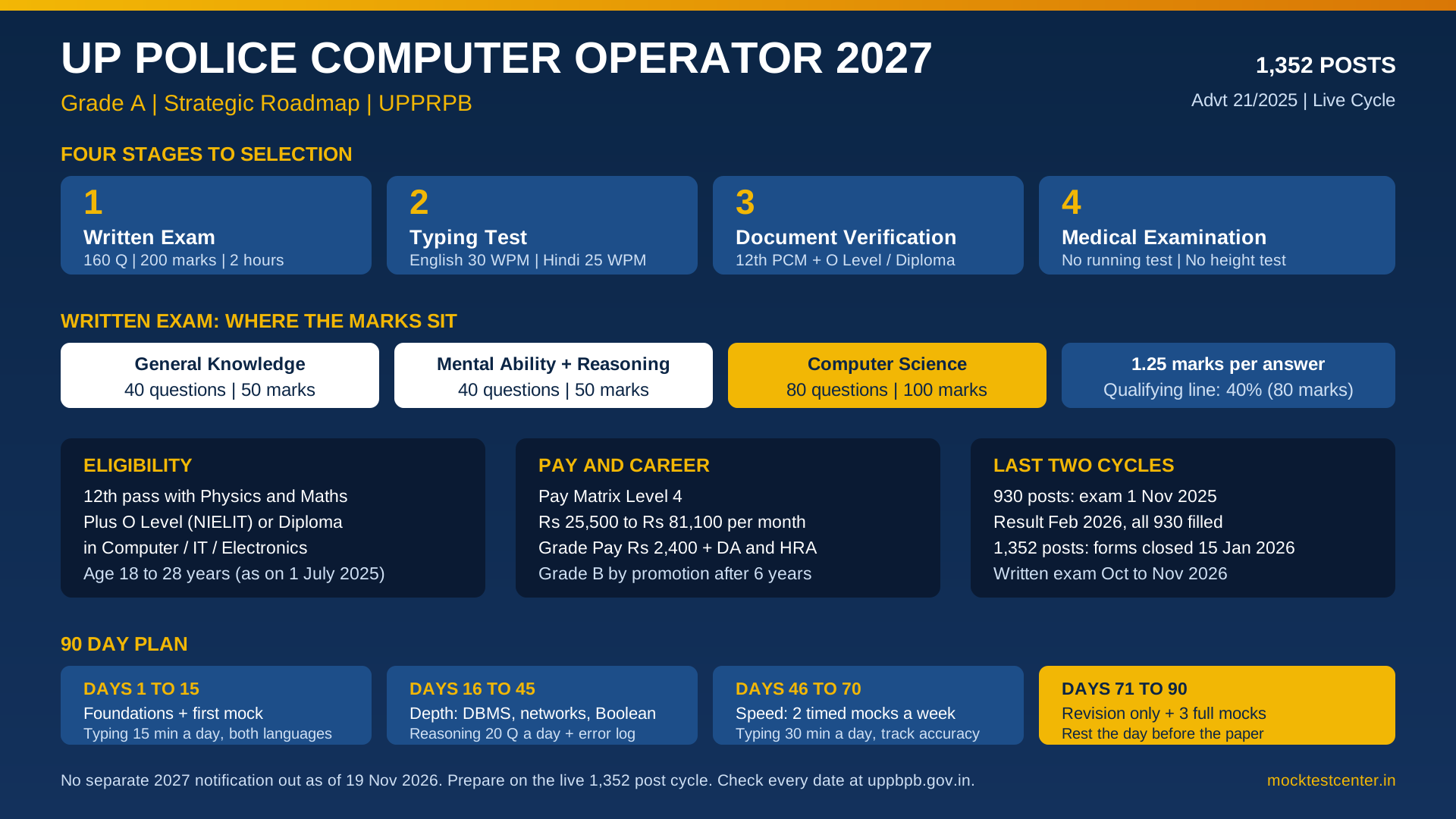
The written exam is a computer based objective paper. It carries 160 questions and 200 marks, and it runs for 2 hours.
Each correct answer carries 1.25 marks. The minimum qualifying score is 40 percent, which works out to 80 marks out of 200. The paper divides into three blocks by subject, and Computer Science carries half the paper on its own.
| Subject | Questions | Marks |
|---|---|---|
| General Knowledge | 40 | 50 |
| Mental Ability and Reasoning | 40 | 50 |
| Computer Science | 80 | 100 |
| Total | 160 | 200 |
Read that split the way a candidate should. Computer Science is half the marks. General Knowledge and reasoning together make the other half.
A candidate who treats Computer Science as one subject among equals will lose the paper in the subject that decides it. The Oliveboard syllabus page names four subjects, while the question split reported by Testbook and other trackers groups mental ability with reasoning at 40 questions. Either way the totals match: 160 questions, 200 marks, 2 hours.
Negative marking is the one point where the sources part company, so this guide will not pretend the matter is settled. One tracker states a deduction of one fourth of a mark per wrong answer. Another tracker states plainly that the paper carries no negative marking.
The Oliveboard pattern page, which follows the previous notification closely, says nothing about a deduction at all. Until the board notice for your cycle states the rule, the safe way to play it is simple. Attempt a question only when you can rule out at least two options, and leave the wild guesses alone. That approach loses nothing if there is no deduction, and it saves marks if there is one.
Time is the second hidden test. Two hours for 160 questions gives you 45 seconds per question, and that average includes reading time. The computer section rewards speed because most of its questions are fact recall.
The reasoning section eats time because each question needs working. A workable order is to clear the computer questions first while your recall is fresh, then take General Knowledge, then settle into reasoning with the time that remains. Mock tests exist to fix this order for you, and ten timed mocks will teach you more about your pace than any amount of reading about it.
Syllabus, subject by subject
The syllabus is wide, yet it has stayed close to the same shape across cycles. The list below follows the notification syllabus as reported by Oliveboard and the exam trackers. Treat it as the map, and spend your hours in proportion to the marks.
General Knowledge, 40 questions
General Knowledge covers Indian history and geography and polity and economy and science, with a deliberate tilt toward Uttar Pradesh and current affairs. The full list runs as follows.
- General science and the history of India
- The Indian Constitution and the Indian economy
- Indian culture and Indian agriculture
- Commerce and trade and population
- Environment and urbanisation
- Geography of India and world geography
- Natural resources and the revenue system of Uttar Pradesh
- Police and general administration in Uttar Pradesh
- Uttar Pradesh culture and education
- Human rights and internal security
- Security and terrorism
- India and its neighbouring countries
- Contemporary issues of international importance
- National and international organisations
- Demonetisation and its impact
- Cyber crime and GST
- Awards and honours
- Countries and their capitals
- World currencies and important days
- Research and discoveries
- Books and authors
- Social media and communication
The revenue, police and general administrative system of Uttar Pradesh is the part most candidates skip and then regret.
Two parts of that list deserve extra weight. Cyber crime appears in the syllabus, and it fits the job, because the operator works with police data systems. UP specific knowledge appears twice, once in culture and once in administration, and questions on districts and rivers and folk traditions reward a candidate who studied the state rather than only the country. Keep a separate notebook for Uttar Pradesh and add to it every week.
Mental Ability and Reasoning, 40 questions
The reasoning and mental ability section tests pattern sense and quick logic. The reasoning topics are:
- Analogy
- Similarities and differences
- Space visualisation
- Problem solving
- Analysis and judgement
- Decision making
- Visual memory
- Discrimination
- Observation
- Relationships
- Concepts
- Arithmetical reasoning
- Verbal and figure classification
- Arithmetical number series
- Abstract ideas and symbols and their relationships
The mental ability topics are:
- Logical diagrams
- Symbol relationship interpretation
- Perception test
- Word formation test
- Letter and number series
- Word and alphabet analogy
- Common sense test
- Direction sense test
- Logical interpretation of data
- Forcefulness of arguments
- Determining implied meanings
This is the section where practice beats theory. Reading about analogy does not build analogy speed. Solving twenty questions a day for six weeks does.
Keep an error log. When a series question beats you, write down the rule you missed. After a month the log will show your weak types, usually two or three of them, and those are the types you drill until they stop costing marks.
Computer Science, 80 questions
Computer Science is half the paper, so it gets half your study time. The syllabus covers fourteen topics, and they run as follows:
- History and evolution of computers across the generations
- Organisation of computer systems: components and architecture
- Hardware: input devices and output devices and storage
- Software: system software and application software and utilities
- Peripheral devices and their uses
- Algorithms and flowcharts and number systems
- Database management: data organisation and file management and relational models with FoxPro and Oracle and SQL
- PC software and office automation
- Workplace productivity tools: word processing and spreadsheets and presentations with Microsoft Office and OpenOffice
- Computer networks: LAN and MAN and WAN and topology and security
- Internet: working of the internet and search engines and email and e-commerce and e-banking
- Emerging technologies: artificial intelligence and mobile computing and green computing and web publishing
- Boolean algebra: operators and truth tables and Karnaugh maps
- Data structures: arrays and stacks and queues
That list looks long, and it is long, but it has a centre. Fundamentals with hardware and software make up most of the questions. Networks with databases and office tools add the rest. Boolean algebra and data structures are smaller in count yet they separate the top scorers, because many candidates skip them as too technical.
Do the opposite. Learn number system conversions until they take seconds.
Learn the basic gates and truth tables. Learn arrays and stacks and queues with one example each. Those topics pay more marks per hour than another round of history notes.
One practical note. The syllabus names FoxPro and Oracle, which are old names in a modern paper.
Do not chase the newest technology news for this section. The paper tests the syllabus as written, and the syllabus as written is a fundamentals paper. A candidate who knows the basics cold will outscore a candidate who skimmed the latest headlines.
The typing test that ends more runs than the written exam
Clearing the UP Police Computer Operator 2027 written paper does not finish the job. The typing test comes next, and it is qualifying in nature, which means it adds no marks to your merit but it can still remove you from the race. The requirement is 30 words per minute in English and 25 words per minute in Hindi. Coaching trackers add that the test demands 85 percent accuracy, though that figure comes from tracker summaries rather than the notification text itself.
The 930 post cycle shows the order of events. The written exam ran on 1 November 2025, the written result came on 10 December 2025, and the typing test followed on 21 December 2025.
Eleven days. That is the gap you get between knowing you passed and sitting at the keyboard. A candidate who starts typing practice after the written result has eleven days to build a skill that needs months.
Start typing from week one, fifteen minutes a day, in both languages. Hindi typing trips up more candidates than English, because most people type Hindi rarely and the keyboard layout feels unfamiliar.
Practice on the same kind of keyboard you will face, a standard desktop keyboard, and practice with passages rather than single words. Speed without accuracy fails the test, so watch your error rate as closely as your words per minute. A steady 32 words per minute in English with clean accuracy beats a shaky 40 with errors.
One more detail matters. The typing test is computer based, and it runs on the board system rather than your own machine.
Practise without autocorrect, without word prediction and without your phone keyboard. The test will not help you finish a word. Your fingers have to do that alone.
No running test, no height test
This is the fact that surprises most first time applicants. The Computer Operator selection has no physical efficiency test and no physical standard test.
There is no run, no height measurement and no chest measurement. The stages are the written exam and the typing test, then document verification and a medical examination. That is the whole list as the trackers report it.
Compare that with the uniformed posts, and the difference stands out. The UP Police Constable 2027 selection measures height and chest and then tests running, and the UP Police Sub Inspector 2027 and UP Police ASI 2027 selections carry their own physical stages.
The UP Police Jail Warder 2027 and UP Police Fireman 2027 posts also test the body, because their duties demand it. A computer operator works at a terminal, so the board tests the hands and the head instead. Candidates who would fail a constable height bar can still win this post, and candidates who can run well but type slowly cannot.
The medical examination still applies, and it still matters. It checks general fitness and vision and hearing.
It also screens for conditions that would keep you from desk work over long hours. It is a fitness check for the job as it is, not a test of athletic ability. Keep your eyes checked and your records ready, and treat the medical stage as a formality you prepare for rather than a hurdle you fear.
Pay, allowances and the road to Grade B
The post sits in Pay Matrix Level 4 under the Seventh Pay Commission. The pay scale runs from Rs 25,500 to Rs 81,100 per month.
The older description of the same scale gives a pay band of Rs 5,200 to Rs 20,200 with a grade pay of Rs 2,400. On top of basic pay come dearness allowance, house rent allowance and other benefits under Uttar Pradesh government rules. The starting basic pay is Rs 25,500, and the in hand amount grows with allowances and the place of posting.
The probation period is reported as two years. The figure comes from the Oliveboard salary page, which states it as the general position rather than a notification clause, so treat it as reported and confirm it from the appointment terms when they come. Two years of probation is the norm for state posts of this kind, and it passes with satisfactory service and conduct.
The career road is written into the service rules. Six years as Computer Operator Grade A opens the door to promotion as Computer Operator Grade B, through the departmental process.
Further grades follow the same ladder. The salary grows with each step, and the work shifts from data entry toward supervision of the computer cell. For a 12th pass candidate, that is a rare combination: entry without a degree, and a promotion line that does not ask for one later either.
Do not mix this up with the UPSSSC Computer Operator
Two different exams share the words Computer Operator, and candidates apply to the wrong one every year. This guide covers the UP Police Computer Operator Grade A, run by the Uttar Pradesh Police Recruitment and Promotion Board for the police department. The other exam is the UPSSSC Computer Operator, run by the Uttar Pradesh Subordinate Services Selection Commission for other departments.
The UPSSSC version is a different shape altogether. Its 2026 advertisement, Number 20-Pariksha/2026, offered only 12 posts, 11 for Computer Operator Grade A and 1 for Assistant Computer Operator, in the office of the Advocate General at the Allahabad High Court.
It asked for a graduation degree plus a diploma in Computer Science or an NIELIT O Level certificate, with years of experience in computer applications reported for the Grade A post. The age window was 21 to 40 years. Applications ran from 7 September to 28 September 2026, and only candidates who held a valid PET 2025 score card could apply, because shortlisting ran on the PET 2025 score.
Put the two side by side and the confusion clears. The police post takes 12th pass candidates with Physics and Mathematics, needs no PET score, needs no graduation, and recruits in the hundreds and thousands. The UPSSSC post takes graduates and needs a PET score and experience.
It recruits in single digits for a court office. Same job title, different door. Check the advertisement number before you fill any form, and check the board name at the top of the page.
What the last cut off tells you
The qualifying line and the selection line are two different numbers, and the gap between them decides your target score. The written paper asks for 40 percent to qualify, which is 80 marks out of 200. The final selection line for the 930 post cycle sat far above that. A tracker of the final result reported the unreserved final cut off at 139.62 marks out of 200, and the same report noted that 142 women stood among the 930 selected candidates.
Read those numbers as a target for UP Police Computer Operator 2027, not as a promise. Cut offs move with the paper and the competition, and the 1,352 post cycle will produce its own figures. But the shape will hold.
Computer Science carries 100 marks, and a candidate who scores 75 or more there can afford an ordinary score in General Knowledge. A candidate who scores 50 in Computer Science needs near perfection elsewhere, and near perfection rarely happens. Aim for 145 or more in your mocks before the real paper. If your mocks sit at 120, the gap is not a small one, and the fix is Computer Science revision plus typing practice, not more General Knowledge notes.
Women candidates should note one more thing. The 930 cycle selected 142 women, and the 1,352 cycle is open to male and female candidates alike, with the same age and qualification rules for both. The typing test and the medical examination apply the same way. Nothing in this recruitment bars women from the computer cadre, and the appointment ceremony in June 2026 made that visible.
A 90 day plan that fits around a job
Ninety days is enough if you treat it as a schedule rather than a wish. This UP Police Computer Operator 2027 plan assumes three hours a day, split across the three blocks in proportion to their marks, with typing practice every day from the start.
Days 1 to 15 belong to foundations. Cover computer fundamentals with hardware and software. Add number systems and office tools.
Finish the first pass of the General Knowledge syllabus. Type for fifteen minutes daily in English and fifteen in Hindi. Take one mock at the end of week two to find your starting score, and write it down.
Days 16 to 45 belong to depth. Work through databases and networks. Then take Boolean algebra and data structures, one topic at a time, with questions after each topic.
Start reasoning practice at twenty questions a day and keep the error log going. Add Uttar Pradesh specific notes to your General Knowledge file every week. Take a mock every Sunday and compare it with the last one.
Days 46 to 70 belong to speed. Move to two mocks a week under strict time limits, and review every wrong answer the same day. Push typing to thirty minutes a day, split between the two languages, and measure words per minute and accuracy once a week. Cut any topic that has not appeared in your mocks and put the hours into the topics that keep appearing.
Days 71 to 90 belong to revision and nothing else. Rework your error log from start to finish.
Revisit the Computer Science topics with the highest weight. Take three full mocks in the final ten days, each at the same hour as the real exam, and rest the day before the paper. A tired candidate types slower and reads slower, and the last day is for sleep rather than study.
If you have less than ninety days, shrink the plan in the same order. Cut General Knowledge breadth first, because it carries 50 marks and rewards long reading. Never cut Computer Science hours and never cut typing practice, because those two decide the result.
Five mistakes that cost good candidates a seat
The first mistake is applying with the wrong qualification. Candidates with a graduation degree assume the degree covers everything, then find at document verification that the board wants Intermediate with Physics and Mathematics plus an O Level certificate or diploma. Check the combination before you pay the fee.
The second mistake is ignoring Hindi typing. English feels easier, so it gets the practice, and Hindi gets a few days at the end. The test demands both, and the Hindi pass mark has ended runs that cleared the written paper by a wide margin.
The third mistake is studying General Knowledge as if it were half the paper. It carries 50 marks out of 200. Computer Science carries 100. Hours should follow marks, and any plan that gives the two subjects equal time is a plan that loses the exam quietly.
The fourth mistake is trusting a single tracker for the negative marking rule. The sources disagree, and a candidate who assumes there is no deduction will guess freely, while a candidate who assumes there is one will leave marks behind. Read the board notice for your cycle, and use the attempt rule from the pattern section above until you have it.
The fifth mistake is waiting for the next notification before starting. The 930 cycle took almost two years from form to exam, and the 1,352 cycle took ten months from form to the exam window. The candidate who starts when the notice comes has already lost the months that matter. Start on the current pattern, and adjust the dates when the board publishes them.
Check this first
Three actions, in order. First, open the board website at uppbpb.gov.in and look for the Computer Operator Grade A notices, the admit card link and the exam date notice.
Second, check your Intermediate marksheet for Physics and Mathematics and your O Level certificate or diploma, and put both in one folder with your age proof. Third, take a timed mock of 160 questions in two hours and a typing test in both languages, and write down both scores. Those two numbers tell you exactly where your ninety days should go.
Other uniformed options sit nearby if this post does not fit you. The Agniveer Vayu 2027 intake and the AFCAT 2027 exam lead toward the Air Force, the Bihar Police Constable 2027 recruitment leads toward the Bihar Police, and the SSC GD 2027 exam leads toward the central armed police forces. Each has its own age and qualification and physical rules. Each deserves its own guide before you apply.
Sources
Uttar Pradesh Police Recruitment and Promotion Board, official website at uppbpb.gov.in, checked 19 November 2026. The board site confirms the board name and hosts the Computer Operator Grade A notices, including the exam date notice of 23 March 2026 placing the written exam in October and November 2026.
Uttar Pradesh Police Computer Staff (Non-Gazetted) Service Rules, 2011, published on the UP Police website at uppolice.gov.in. The rules give the Grade A cadre strength of 2,844 posts, direct recruitment for Grade A, promotion to Grade B after six years as Grade A, and the age window of 18 to 28 years.
Advertisement Number PRPB-B (Computer Operator Grade-A) 21/2025, notified 16 December 2025, for 1,352 posts, as reported by The Times of India; Moneycontrol; Adda247; Infoeazy; Rojgar Warrior; Testbook. Application window 16 December 2025 to 15 January 2026.
Correction window 16 to 18 January 2026. Fee Rs 500 for most candidates and Rs 400 for SC and ST candidates. Category split 545 Unreserved, 134 EWS, 364 OBC, 283 SC, 26 ST, totalling 1,352.
Advertisement Number PRPB-1A-2 (Programmer Grade-2 and Computer Operator Grade-A) 2023, for 930 Computer Operator posts and 55 Programmer Grade 2 posts, as reported by Oliveboard; PlacementStore; IndiaSarkariExam; SarkariJobsForYou. Applications 7 to 31 January 2024, written exam 1 November 2025, written result 10 December 2025, typing test 21 December 2025, document verification 29 and 30 January 2026, final result February 2026. Category split 381 Unreserved, 91 EWS, 249 OBC, 193 SC, 16 ST, totalling 930.
Appointment letters to 930 Computer Operators Grade A handed over on 17 June 2026 at Lok Bhavan, Lucknow, as reported by Nation Press and Impressive Times and Moneycontrol, with 142 women among the selected candidates as reported by Moneycontrol. Unreserved final cut off of 139.62 marks out of 200 as reported by SarkariJobsForYou.
Exam pattern and syllabus, 160 questions, 200 marks, 2 hours, 1.25 marks per correct answer, 40 percent qualifying marks, subject split 40 General Knowledge, 40 Mental Ability and Reasoning, 80 Computer Science, as reported by Oliveboard; Testbook; Infoeazy; Adda247; and the Arihant exam guide. Typing speeds of 30 words per minute in English and 25 words per minute in Hindi, qualifying in nature, as reported by Testbook and Infoeazy and the Arihant exam guide, with 85 percent accuracy reported by Testbook and Arihant. Pay Matrix Level 4, Rs 25,500 to Rs 81,100, grade pay Rs 2,400, as reported by Oliveboard and Testbook. No physical efficiency test for this post, as reported by LikhPadh and the exam trackers.
UPSSSC Computer Operator Advertisement Number 20-Pariksha/2026, 12 posts for the Advocate General office at the Allahabad High Court, PET 2025 score card mandatory, age 21 to 40 years, applications 7 to 28 September 2026, as reported by Testbook and LetMeProve. No 2027 notification for UP Police Computer Operator Grade A as of 19 November 2026, as stated on the Oliveboard 2027 tracker pages and confirmed by a check of uppbpb.gov.in.







