
About MPSC Engineering Services 2027 Exam Series
📖 Table of Contents
- MPSC Engineering Services 2027 at a glance
- Two examinations, not one
- The 296 civil posts, post by post
- Who can apply, and the age and language rules
- The combined Preliminary examination
- The Civil Main examination, where the merit is made
- The other door: Water Resources Assistant Engineer, 151 posts
- What the 2023 cycle shows about time
- How to prepare, in the order that matters
- Mistakes that end attempts
- Pay, posting and the job itself
- Where to check, and what this guide does not claim
- Sources
MPSC Engineering Services 2027: Complete Exam Guide
The Maharashtra Public Service Commission published Advertisement Number 003/2026 for the Maharashtra Civil Engineering Services Main Examination 2025, and that notification carries 296 posts. Applications for it ran from 16 March to 30 March 2026, and the Main examination was held on 16 May 2026. That is the live cycle for civil engineering. No separate 2027 notification for MPSC Engineering Services has been published as of 22 November 2026, so this guide anchors on the 2025 cycle and says so wherever a 2027 figure would otherwise be guessed. The page title carries 2027 because the Main examination and the selection that follows it conclude in the 2027 grouping used by this site, and because candidates searching for the next cycle land here first.
Engineering Services in Maharashtra runs as a shared screening test followed by separate Main examinations for each discipline. Civil, Mechanical and Electrical candidates sit the same combined Preliminary examination with the other gazetted services, and then each discipline gets its own Main notification with its own post count. A candidate who treats the whole thing as a single exam will misunderstand the dates, the fees and the syllabus at every stage. This guide separates the two stages cleanly and gives the verified figure for each.
The combined Preliminary examination for the 2025 cycle was notified as Advertisement Number 012/2025 on 18 March 2025. It covered 385 posts in all: 127 in the State Services, 144 in the Maharashtra Forest Service, and 114 in the Maharashtra Civil Engineering Services. Applications ran from 28 March to 17 April 2025. The Preliminary examination was first scheduled for 28 September 2025 and then postponed to 9 November 2025 because flood like conditions cut off villages and talukas across several districts and the state meteorological department had issued heavy rainfall warnings. The Indian Express reported the postponement on 27 September 2025, and the Commission notice put the revised date at 9 November 2025 across 524 sub centres in 37 districts. That postponement is the single most useful fact in this guide for a candidate planning travel, because it shows the Commission will move a date when the weather forces it, and it has done so in the live cycle itself.
Then the numbers changed. The Main notification for civil engineering, Advertisement Number 003/2026, carried 296 posts, far more than the 114 civil posts listed in the combined Preliminary advertisement. The break up is 28 Assistant Executive Engineer Civil in Group A, 86 Assistant Engineer Grade 1 Civil in Group A, and 182 Assistant Engineer Grade 2 Civil in Group B. The tracker sites that reproduce the notification all agree on 296 and on the three way split, and the Marathi job portals quote the same figures from the same advertisement. What no tracker explains is how 114 became 296, whether fresh requisitions from departments were added between the Preliminary and the Main stage or whether the Preliminary advertisement listed only part of the requirement. This guide reports both numbers and flags the gap, because a candidate who quotes 114 as the vacancy count for this cycle is using a superseded figure.
MPSC Engineering Services 2027 at a glance
| Detail | MPSC Engineering Services 2027, as run in the 2025 cycle |
|---|---|
| Conducting body | Maharashtra Public Service Commission (MPSC) |
| Exam | Maharashtra Engineering Services, Civil, Mechanical and Electrical, Group A and Group B gazetted posts |
| Live cycle, Preliminary | 2025, Advertisement Number 012/2025 dated 18 March 2025, 385 posts in all, 114 of them civil engineering |
| Live cycle, Civil Main | 2025, Advertisement Number 003/2026, 296 posts, applications 16 March to 30 March 2026 |
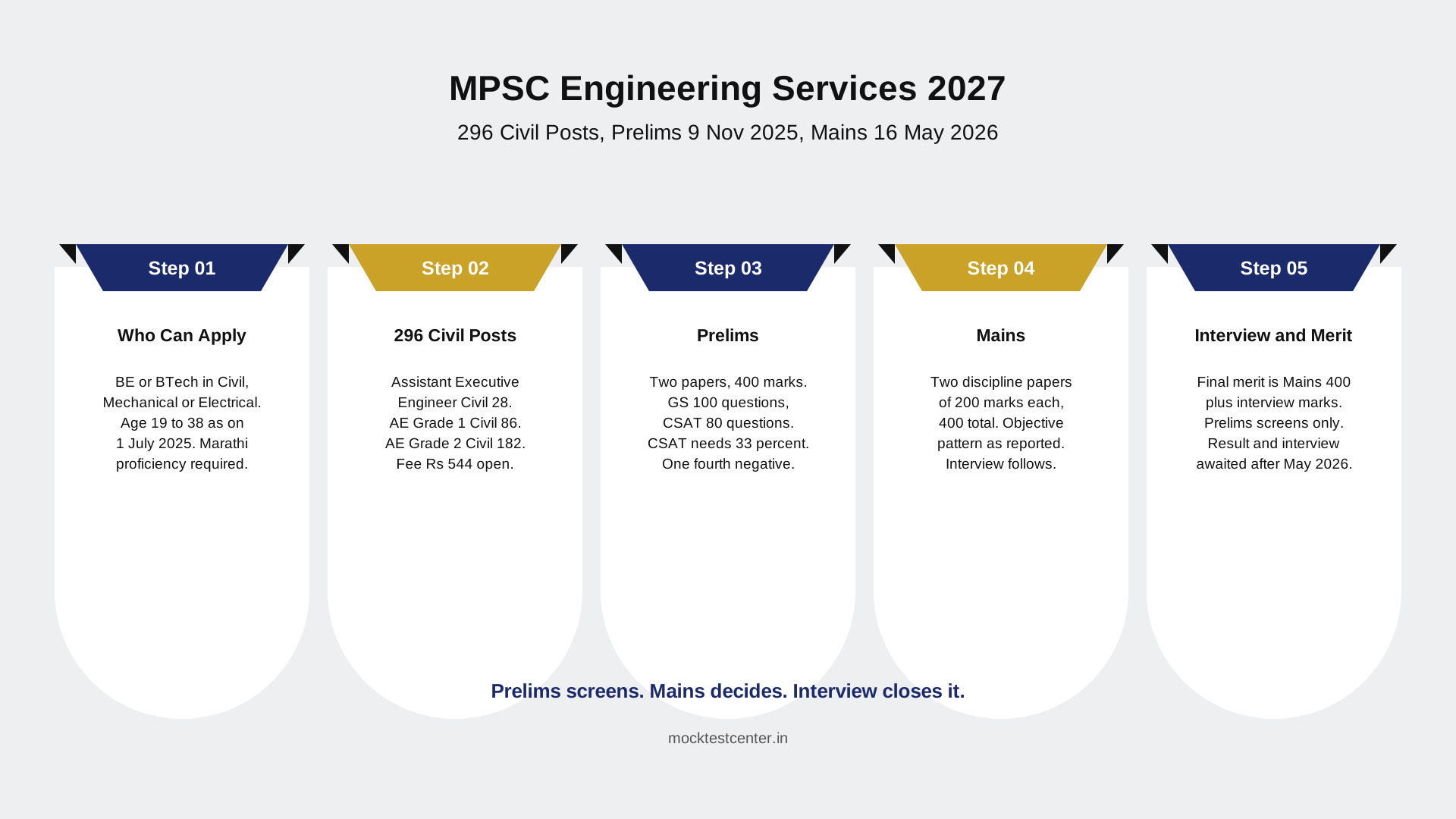
| Civil Main posts | 296, with Assistant Executive Engineer Civil 28, Assistant Engineer Grade 1 Civil 86, Assistant Engineer Grade 2 Civil 182 |
| Preliminary | 9 November 2025, after postponement from 28 September 2025, two papers, 400 marks in all |
| Civil Main | 16 May 2026, two discipline papers of 200 marks each, 400 marks in all |
| Interview | Personality test after the Main examination, marks not confirmed in the tracker reports for the Civil Main cycle |
| Final merit | Main examination marks plus interview marks, Preliminary marks count for screening only |
| Education | BE or BTech in the relevant discipline from a recognised university, Marathi proficiency required |
| Age limit | 19 to 38 years as on 1 July 2025 for the open category, 5 years relaxation for reserved categories, EWS, orphans and PwD |
| Fee in live cycle | Rs 544 for open category, Rs 344 for reserved, EWS, orphan and PwD categories |
| 2027 notification | Not published as of 22 November 2026 |
Two examinations, not one
The structure is the first thing to get right, because every tracker page that mixes the two stages together gets something wrong. Stage one is the Maharashtra Civil Services Gazetted Combined Preliminary Examination. It is shared by the State Services, the Forest Service and the Civil Engineering Services, and it tests general studies and aptitude, not engineering. Stage two is the discipline Main examination. Civil candidates sit the Maharashtra Civil Engineering Services Main Examination. Mechanical and Electrical candidates wait for their own Main notifications, which come separately and on their own dates. The Preliminary result decides who may apply for the Main examination, and a fresh application window opens for the Main stage itself.
That is why the 2025 cycle has two advertisement numbers and two application windows. Advertisement Number 012/2025, dated 18 March 2025, opened the Preliminary stage with applications from 28 March to 17 April 2025. Advertisement Number 003/2026 opened the Civil Main stage with applications from 16 March to 30 March 2026. A candidate who applied for the Preliminary examination in March 2025 and cleared it still had to apply again for the Main examination in March 2026 and pay the fee again. The fee for the Main stage was Rs 544 for the open category and Rs 344 for reserved, EWS, orphan and PwD candidates, as reported by Majhi Naukri, GovNokri and Sarkari Naukri Front from the same notification.
Mechanical and Electrical candidates face a longer wait inside the same structure. Their Main examinations are notified separately and periodically, and the tracker page that covers this examination most fully states plainly that vacancies for Mechanical and Electrical Engineering Services are notified separately. There is also a second door for Mechanical and Electrical graduates, described later in this guide: the Assistant Engineer posts in the Water Resources Department, which run on their own Preliminary and Main examinations with 151 posts in the live cycle. A Mechanical or Electrical graduate who waits only for the discipline Main notification and ignores the Water Resources door is watching one gate while another stands open.
The Preliminary result for the 2025 cycle was declared on 4 March 2026, according to the tracker page that follows this examination cycle by cycle. That date is tracker reported, not confirmed from a Commission notice in this research, and it is flagged as such. What is confirmed from multiple sources is the shape of the timeline: notification in March 2025, Preliminary in November 2025, Main application in March 2026, Main examination in May 2026. The full process from Preliminary notification to final selection commonly takes one and a half to two years, and interviews for the 2023 cycle were held only in March to May 2025. A candidate who plans on a six month cycle will be disappointed. A candidate who plans on two years will be ready.
The 296 civil posts, post by post
The 296 posts in Advertisement Number 003/2026 split into three posts, and the split decides pay, rank and the department a candidate joins. Assistant Executive Engineer Civil, Group A, carries 28 posts and a pay scale of Rs 56,100 to Rs 1,77,500. Assistant Engineer Grade 1 Civil, Group A, carries 86 posts and a pay scale of Rs 38,600 to Rs 1,22,800. Assistant Engineer Grade 2 Civil, Group B, carries 182 posts and the same pay scale of Rs 38,600 to Rs 1,22,800. The two Assistant Engineer grades share a pay scale but sit in different groups, and the Group A grade carries the faster promotion line. The Grade 2 posts are the largest block in the examination, with 182 of the 296 seats, so a candidate in the middle of the merit list is far more likely to land in Grade 2 than in either of the other two posts.
The posts sit across departments that build and run the physical backbone of the state. The typical departments named by the trackers are Public Works, Water Resources and Irrigation, Rural Development and Energy, with posts such as Assistant Executive Engineer, Assistant Engineer Grade 1 and Grade 2, Deputy Engineer and Water Conservation Officer. The exact department wise allocation for the 296 posts is published in the notification itself, and the tracker summaries reproduce the post wise count without a full department table. A candidate should read the department allocation in the notification before filling preferences, because a Water Resources posting and a Public Works posting mean different daily work even at the same grade.
The pay figures above are the 7th Pay Commission based Maharashtra pay matrix levels quoted from the notification by the tracker sites. Assistant Executive Engineer sits at the higher level and Assistant Engineer at the level below it, and allowances sit on top of the basic pay as per state government rules. The tracker sites also quote an approximate in hand figure for the Assistant Engineer, but this guide does not repeat it, because in hand pay depends on posting, allowances and deductions, and no tracker shows its working. The pay scale from the notification is the figure a candidate can trust.
One more number belongs in this section because candidates quote it constantly. The combined Preliminary advertisement listed 114 civil engineering posts. The Main notification lists 296. Both numbers are real, and both come from MPSC advertisements. The 296 figure governs the Main examination, because it is the later notification and the one under which candidates actually applied in March 2026. The 114 figure governs nothing after the Preliminary stage. The reconciliation between the two, how the count grew by 182 posts between the two notifications, was not explained in any tracker report found in this research, and this guide flags that as an open question for the upload pre check to confirm from the notification PDFs on mpsc.gov.in.
Who can apply, and the age and language rules
The education rule is discipline specific. A candidate needs a Bachelor degree in Engineering, BE or BTech, or an equivalent qualification in the relevant discipline from a recognised university. Civil posts need a civil engineering degree, including allied streams such as Civil and Water Management, Civil and Environmental, Structural and Construction Engineering. Mechanical posts need a mechanical engineering degree. Electrical posts need an electrical engineering degree. A civil degree does not qualify a candidate for a mechanical post, and the notification lists the accepted streams for each post. Final year students are generally allowed to apply provisionally, subject to producing the degree certificate later as the notification specifies, and the tracker that follows this examination states that position clearly.
The age rule in the live cycle is 19 to 38 years as on 1 July 2025 for the open category. The upper limit is relaxed by 5 years for reserved categories, EWS, orphan and PwD candidates, taking the upper limit to 43 years for those categories. The 19 year lower limit applies to the Assistant Executive Engineer and Assistant Engineer posts, and one tracker records the lower limit as 18 for some posts, which is why this guide states 19 and flags the 18 year reading as a minor tracker conflict. A candidate near the upper edge should check the age as on date in the notification itself, because MPSC uses 1 July of the recruitment year here while other MPSC examinations use 1 April, and the wrong reference date can make a candidate think they are eligible when they are not, or the other way round.
Marathi proficiency is a real requirement that the notification states plainly. Candidates are generally required to have proficiency in Marathi, meaning reading, writing and speaking, since the post involves work within the Maharashtra state government administration. The tracker page states this as a general requirement, and the notification carries the exact form of it. An engineering graduate from outside Maharashtra who holds the right degree but cannot work in Marathi will struggle at the interview stage and in the job itself, and should treat Marathi as part of the preparation rather than an afterthought.
There is no fixed cap on the number of attempts. A candidate may apply in any notified cycle as long as the age and qualification criteria for that cycle are met. That matters because the cycle takes one and a half to two years from notification to final selection, so a candidate who misses one cycle by age in the next cycle has lost more than a year of waiting. The fee is Rs 544 for the open category and Rs 344 for reserved, EWS, orphan and PwD candidates, payable online only through mpsconline.gov.in. The application itself is online only, and the admit card, answer key and result all come through the candidate login on the same portal.
The combined Preliminary examination
The MPSC Engineering Services exam pattern starts with two Preliminary papers, and only one of them decides the cut off. Paper 1 is General Studies, with 100 objective questions for 200 marks in 2 hours. Paper 2 is the aptitude test, often called CSAT, with 80 objective questions for 200 marks in 2 hours. The CSAT paper is qualifying in nature, and a candidate must score at least 33 percent in it, which is 66 marks out of 200. The cut off for the Main examination is decided on Paper 1 marks alone, among candidates who clear the CSAT qualifying mark. That structure is confirmed by Disha Publication, by the agriculture tracker pages that describe the same combined Preliminary, and by the engineering tracker page, and all three agree on the question counts, the marks and the 33 percent rule.
Negative marking applies in both papers. One fourth of the marks allotted to a question is deducted for each wrong answer, which is the standard MPSC pattern. A wrong answer in Paper 1 costs half a mark, since each question carries 2 marks. A wrong answer in the CSAT paper costs 0.625 marks, since each question carries 2.5 marks. The Preliminary marks do not count in the final merit at all. The Preliminary is a screening test only, and a candidate who tops the Preliminary starts the Main examination on equal footing with the last candidate who cleared the cut off. That single fact should shape preparation: the Preliminary deserves enough study to clear the cut off safely, and the engineering papers deserve the larger share of time.
The General Studies syllabus for Paper 1 covers history of India and the Indian national movement, current affairs, Indian and Maharashtrian polity, geography of India and Maharashtra, the Indian economy, environmental ecology and biodiversity, science and technology, and general mental ability. The CSAT syllabus covers comprehension, logical reasoning, quantitative aptitude, decision making and basic numeracy. Maharashtra specific content carries real weight in Paper 1, and a candidate who knows national polity but not the geography, rivers, dams and districts of Maharashtra will drop marks that other candidates collect easily.
The postponement in the live cycle deserves a paragraph of its own, because it is the kind of event that ruins a candidate who plans tightly. The Preliminary was first scheduled for 28 September 2025. On 27 September 2025 the Commission postponed it, citing flood like conditions across several districts and heavy rainfall warnings from the state meteorological department. The notice said many villages and talukas had lost connectivity with each other, and the government had requested the reschedule so that no candidate would be deprived of appearing. The revised date was 9 November 2025. The same postponement also pushed the Group B non gazetted combined Preliminary, which had been set for 9 November 2025, to a later date. A candidate who had booked travel for 28 September had about a day to change plans, and the lesson is plain: do not book non refundable travel for an MPSC examination in the monsoon season, and check mpsc.gov.in in the last week before the examination even when the date looks settled.
The Civil Main examination, where the merit is made
The MPSC Engineering Services exam pattern then narrows to two discipline papers. The Civil Main examination has two papers, both discipline specific, each carrying 200 marks, for a total of 400 marks. Paper 1 and Paper 2 test the core technical subjects of civil engineering, and candidates may answer in English or Marathi. That is the pattern reported by the tracker page that follows this examination most closely, and it matches the shape of the other MPSC technical Main examinations. The examination was held on 16 May 2026, according to Majhi Naukri and the same tracker page, with centres at Amravati, Chhatrapati Sambhajinagar, Nagpur, Nashik, Navi Mumbai and Pune. One tracker site reports the Main date as 9 May 2026 instead, and this guide uses 16 May and flags the 9 May date as a conflicting tracker report.
One honest uncertainty sits inside the Main pattern, and this guide will not hide it. The detailed tracker page says the Main papers are objective type, multiple choice questions. Some secondary sources describe the Main examination as descriptive instead. The notification is the only document that settles the question type, and the tracker reports found in this research do not quote it directly on this point. A candidate preparing for the next cycle should confirm the question type, the per paper duration and the interview weightage from the discipline notification on mpsc.gov.in before choosing between objective practice and descriptive answer writing, because the two kinds of preparation barely overlap. The mock tests on this page follow the objective pattern reported by the detailed tracker, with two papers of 200 marks each.
The interview follows the Main examination for candidates who clear the Main cut off, and it is a personality test. The interview marks for the Civil Main cycle were not confirmed in the tracker reports found in this research, and this guide does not invent a figure. The separate Water Resources Assistant Engineer track, described in the next section, reports an interview of 50 marks, and the agriculture tracker reports the same 50 mark interview for its Main examination. A reader should treat 50 marks as a plausible figure for the Civil Main interview and wait for the notification to confirm it. Final merit is the Main examination marks plus the interview marks. The Preliminary contributes nothing.
The civil engineering syllabus for the Main papers runs across the full undergraduate course. The subjects named in the tracker syllabus pages include structural analysis and design, geotechnical engineering and soil mechanics, fluid mechanics and hydraulics, water resources and irrigation engineering, transportation engineering, environmental engineering, construction management, surveying, and engineering mechanics. Paper 1 leans toward the design and analysis subjects, and Paper 2 leans toward water, transport, environment and construction, though the exact paper wise split is set by the notification syllabus and varies between cycles. A candidate should work from the official syllabus PDF for the cycle they are appearing in, because MPSC revises the syllabus between cycles and drops topics without announcement in the press.
The other door: Water Resources Assistant Engineer, 151 posts
Mechanical and Electrical graduates, and civil graduates who missed the Civil Main window, have a second live route that many guides never mention. The Maharashtra Public Service Commission notified Assistant Engineer Civil and Assistant Engineer Electrical and Mechanical posts in the Water Resources Department through the Maharashtra Engineering Service Preliminary Examination, with 151 posts in all. The break up is 102 Assistant Engineer Civil in Group B and 49 Assistant Engineer Electrical and Mechanical in Group B. Applications ran from 3 October to 23 October 2025, and the Preliminary examination was held on 17 December 2025.
The pattern for this track is stated more completely than the pattern for the Civil Main cycle, and it is worth recording in full. The Preliminary examination carries 200 marks, with 100 questions of 2 marks each in 90 minutes. The Main examination carries 400 marks. The interview carries 50 marks. The age limit is 18 to 38 years for general candidates as on 1 January 2025, with relaxation to 43 years for reserved categories. The advertisement number for this notification was not verified in the research for this guide, and it is flagged as an open item. The Preliminary date of 17 December 2025 and the post counts come from a single tracker site, and this guide presents them as tracker reported rather than confirmed from a Commission notice.
The lesson of this second door is structural. MPSC notifies engineering posts through more than one channel, and the channels do not share a calendar. The combined Preliminary route leads to the discipline Main examinations. The Water Resources route runs its own Preliminary and Main examinations. A candidate who follows only one channel can miss a notification that fits their degree exactly, and the notifications do not wait for each other. The practical habit is to check the MPSC website for every engineering advertisement, not only the one labelled with the discipline name, and to keep the documents ready so that a three week application window does not pass while certificates are being collected.
What the 2023 cycle shows about time
The 2023 cycle is the freshest completed map of how long this examination takes, and its numbers are worth reading in full. The tracker page records that interviews for the 2023 cycle were held only in March to May 2025, which is roughly one and a half to two years after the cycle began. The full process from Preliminary notification to final selection commonly spans that long, and the 2025 cycle follows the same shape: Preliminary notification in March 2025, Preliminary examination in November 2025, Main application in March 2026, Main examination in May 2026, with the Main result and interview still awaited as of the research for this guide.
That timeline changes how a candidate should plan. A candidate who clears the Preliminary in November 2025 and waits for the Main result before starting interview preparation will have months of dead time, and a candidate who starts Main preparation only after the Preliminary result will have about two months for a 400 mark technical examination. The sensible order is to treat the Preliminary as a hurdle and the technical papers as the real examination, and to keep the technical preparation running through the whole cycle. The gap between the Main examination and the interview is the only window for interview preparation, and it is shorter than the gap between the Preliminary and the Main.
The other lesson of the timeline is about age. A candidate who is 37 at the Preliminary notification and 38 at the Main examination is still inside the limit if the age is counted as on 1 July of the recruitment year, but a candidate who misreads the reference date can wrongly rule themselves out. The reference date for the Civil Main cycle is 1 July 2025. The reference date for the Water Resources track is 1 January 2025. Different notifications use different reference dates, and the notification in hand is the only authority.
How to prepare, in the order that matters
Preparation should follow the weight of the marks. The Main examination carries 400 marks and the interview follows it, while the Preliminary carries no merit weight at all. That means the technical papers deserve the largest share of study time from the start, and the Preliminary deserves enough time to clear the cut off safely. Candidates who spend a full year on general studies and then discover structural design in the last month usually fail the Main examination, because technical subjects cannot be learned in a fortnight.
For the technical papers, the undergraduate course is the syllabus, and the previous year papers are the map. A candidate should work subject by subject, solving numerical problems by hand, because the Main papers test calculation speed as much as theory. Structural analysis, soil mechanics and hydraulics carry the heaviest numerical load, and a candidate who can solve a problem in four minutes has an advantage over a candidate who needs eight. Short notes with formulae, standard values and unit conversions are worth more than a second reading of a textbook, because the examination rewards recall under time pressure.
For the Preliminary, Maharashtra is the highest value subject. The history, geography, polity and economy of the state appear across Paper 1, and most engineering graduates score their lowest marks here because their degree never covered it. A candidate should read one solid book on Maharashtra geography and economy and one on modern Indian history and polity, then revise them three times rather than reading three books once. Current affairs should cover the twelve months before the examination, with a focus on Maharashtra government schemes, appointments, dams, irrigation projects and the state budget.
The CSAT paper deserves a warning of its own. It is qualifying, and qualifying papers are the ones candidates ignore. The qualifying mark is 33 percent, which is 66 marks out of 200, and a candidate who scores 150 in Paper 1 and 60 in CSAT does not reach the Main examination at all. Two sessions a week on comprehension, reasoning and quantitative aptitude from the start prevents that outcome. The CSAT paper is long, and a candidate who has never practised it under time pressure will leave questions unattempted.
Mock tests for MPSC Engineering Services 2027 should copy the real conditions. Preliminary mocks should run Paper 1 and Paper 2 in the real time limits, with the one fourth negative marking applied, so that the candidate learns the cost of guessing. Main mocks should run two papers of 200 marks each, with numerical problems solved by hand and a strict time limit, so that calculation speed is built before the real examination. The last thirty days before the Preliminary should carry no new book and no new topic. They should carry revision of notes, previous year papers, and full length mocks with error analysis.
Mistakes that end attempts
The first mistake is preparing for the wrong Main examination. The Rajyaseva Main examination has six papers including language papers, an essay and four general studies papers, and it is the examination most Maharashtra guides describe in detail. The Engineering Services Main examination has two discipline papers. A candidate who follows a Rajyaseva plan for an engineering cycle will spend months on essay writing and optional subjects that the engineering Main examination never tests, and will arrive at the Main examination without the technical preparation the 400 marks demand.
The second mistake is ignoring the CSAT qualifying mark. The 33 percent rule is stated in every tracker, and it still catches candidates every cycle, because the cut off discussion always focuses on Paper 1 and the CSAT paper is treated as a formality. It is a gate, and a candidate who fails it is out regardless of the Paper 1 score.
The third mistake is quoting the wrong vacancy count. The 114 civil posts in the combined Preliminary advertisement and the 296 posts in the Main notification are both real, and the 296 figure governs the Main examination. A candidate who prepares from the 114 figure will underestimate the seats and may also misjudge the cut off, because the cut off for 296 posts is lower than the cut off for 114 posts at the same level of competition. Check the advertisement number on any guide: the live Main cycle is Advertisement Number 003/2026.
The fourth mistake is trusting a single tracker site for dates. The Main examination date for the 2025 cycle is reported as 16 May 2026 by two sources and as 9 May 2026 by a third. The Preliminary date moved once, from 28 September to 9 November 2025. Candidates who booked travel for the earlier date had to change plans. The official MPSC notices on mpsc.gov.in are the only sources that settle a date, and this guide lists the source for every date it states.
The fifth mistake is waiting for the notification instead of preparing. The Engineering Services examination does not run on a fixed annual calendar, and the full process takes one and a half to two years. A candidate who waits for the next notification before opening a technical book has already lost the months that decide the result. The technical syllabus changes little between cycles, and the previous year papers are available now.
Pay, posting and the job itself
The pay for the civil posts sits in the Maharashtra pay matrix at the levels given in the notification. Assistant Executive Engineer Civil carries Rs 56,100 to Rs 1,77,500. Assistant Engineer Grade 1 and Grade 2 Civil carry Rs 38,600 to Rs 1,22,800. Allowances sit on top of the basic pay as per state government rules, and the exact in hand figure depends on posting and allowances. The Group A posts carry the faster promotion line, and the Assistant Executive Engineer is the post most candidates picture when they say engineering services, though it carries only 28 of the 296 seats.
The job is field work as much as office work. An Assistant Engineer in Public Works or Water Resources supervises construction, checks measurements, prepares estimates, inspects sites and handles contractors, often in the same week. A posting in the irrigation department means canal and dam work. A posting in Rural Development means rural roads and water supply schemes. The work is transferable across districts, and the first posting is rarely the home district. Candidates who join for a posting near home should understand that the service does not work that way.
Promotion runs through the state engineering hierarchy, from Assistant Engineer to Executive Engineer and beyond, and the precise timelines depend on vacancies and seniority. This guide does not publish a promotion timeline because the Commission does not publish one in the advertisement. Candidates should treat any tracker site promotion chart as indicative rather than official.
Where to check, and what this guide does not claim
Every date, post count and fee in this guide comes from the sources listed below. The official website is mpsc.gov.in, and the online application portal is mpsconline.gov.in. The examination calendar, press notes, answer keys and results appear on the MPSC website first, and every other site copies them. A candidate who checks the MPSC website once a week from application to result will never miss a notice.
This guide does not publish a 2027 notification, because none exists as of 22 November 2026. It does not publish a 2027 vacancy count, a 2027 application window, or a 2027 fee. When the next notification appears, the figures in this guide will need updating, and the first place to check is the advertisement number on the MPSC website. The mock tests on this page follow the MPSC Engineering Services exam pattern of the live cycle: two Preliminary papers of 200 marks each with a 33 percent qualifying rule for CSAT, two Main papers of 200 marks each in the discipline, and one fourth negative marking in the Preliminary.
One more caution belongs here. Several tracker sites label the combined Preliminary cycle as the Rajyaseva examination, and several label the Civil Main notification as a 2026 recruitment, because the Main notification is dated March 2026. The Preliminary notification is Advertisement Number 012/2025 dated 18 March 2025, the Main notification is Advertisement Number 003/2026, and the cycle is the 2025 cycle in MPSC numbering. The page title carries 2027 because that is the year in which the selection concludes and the next cycle is expected, and because this site groups its examination pages by that year. The next step for a candidate reading this guide is simple: confirm the Main question type and the interview marks from the notification on mpsc.gov.in, then start the technical papers.
Sources
Maharashtra Public Service Commission, Advertisement Number 012/2025 dated 18 March 2025, Maharashtra Civil Services Gazetted Combined Preliminary Examination 2025, 385 posts, State Services 127, Forest Service 144, Civil Engineering Services 114, applications 28 March to 17 April 2025, on mpsc.gov.in. Indian Express, 27 September 2025, Maharashtra MPSC CSE Prelims 2025 postponed, Preliminary moved from 28 September to 9 November 2025, 524 sub centres across 37 districts. PW Live, MPSC Rajyaseva Exam Date 2025, Preliminary revised to 9 November 2025. Maharashtra Public Service Commission, Advertisement Number 003/2026, Maharashtra Civil Engineering Services Main Examination 2025, 296 posts, applications 16 March to 30 March 2026, Main examination 16 May 2026, on mpsc.gov.in. Majhi Naukri, MPSC Civil Engineering Services Bharti 2026, Advertisement Number 003/2026, 296 posts, Assistant Executive Engineer Civil Group A 28, Assistant Engineer Grade 1 Civil Group A 86, Assistant Engineer Grade 2 Civil Group B 182, fee Rs 544 and Rs 344, age 19 to 38 years as on 1 July 2025, centres Amravati, Chhatrapati Sambhajinagar, Nagpur, Nashik, Navi Mumbai and Pune, Main examination 16 May 2026. GovNokri, MPSC Civil Engineering Services Recruitment 2026, 296 posts, Advertisement Number 003/2026, fee Rs 544 and Rs 344. Sarkari Naukri Front, MPSC Civil Engg Recruitment 2025, 296 posts, Advertisement Number 003/2026, Assistant Executive Engineer Civil 28, Assistant Engineer Grade 1 Civil 86, Assistant Engineer Grade 2 Civil 182, pay Rs 56,100 to Rs 1,77,500 and Rs 38,600 to Rs 1,22,800. A2Z Exam Detail, MPSC Maharashtra Engineering Services Examination, combined Preliminary Advertisement Number 012/2025, Civil Main 296 posts, Main examination 16 May 2026, Preliminary result 4 March 2026, Main two papers of 200 marks each, negative marking one fourth, age 18 and 19 to 38 years, fee Rs 544 and Rs 344, interviews for the 2023 cycle held March to May 2025. Disha Publication, MPSC 2025, 385 vacancies, State Service 127, Forest Service 144, Civil Engineering Services 114, Preliminary 28 September 2025, Paper 1 100 questions 200 marks, Paper 2 80 questions 200 marks. GovtJobOnline, Maharashtra MPSC Assistant Engineer Civil Electrical Mechanical Recruitment 2026, Water Resources Department, 151 posts, Assistant Engineer Civil Group B 102, Assistant Engineer Electrical and Mechanical Group B 49, applications 3 October to 23 October 2025, Preliminary 17 December 2025, Preliminary 200 marks, Main 400 marks, Interview 50 marks. Pune Mirror, MPSC advertisement for 2025 State Service Exam, 385 posts, 127 State Service, 144 Forest Service, 114 Engineering Services, Preliminary 28 September 2025, applications 28 March to 17 April 2025.







