
About Ladakh Police Constable 2027 Exam Series
📖 Table of Contents
- Ladakh Police Constable 2027 and the live cycle in numbers
- The written exam pattern
- Who can apply for Ladakh Police Constable
- Physical standards and the physical tests
- Fee, salary and what the job pays
- The 2023 cycle, the first Ladakh Police Constable recruitment
- General Knowledge, the 60 mark heart of the paper
- The Border Battalion, and the district wise rule
- The Women Battalion
- Reasoning, Arithmetic and Science, the 40 mark block
- How the selection runs from form to final list
- A 90 day plan that fits this paper
- Life as a Ladakh Police Constable
- Mistakes that cost candidates this exam
- Sources
Ladakh Police Constable 2027: Complete Exam Guide
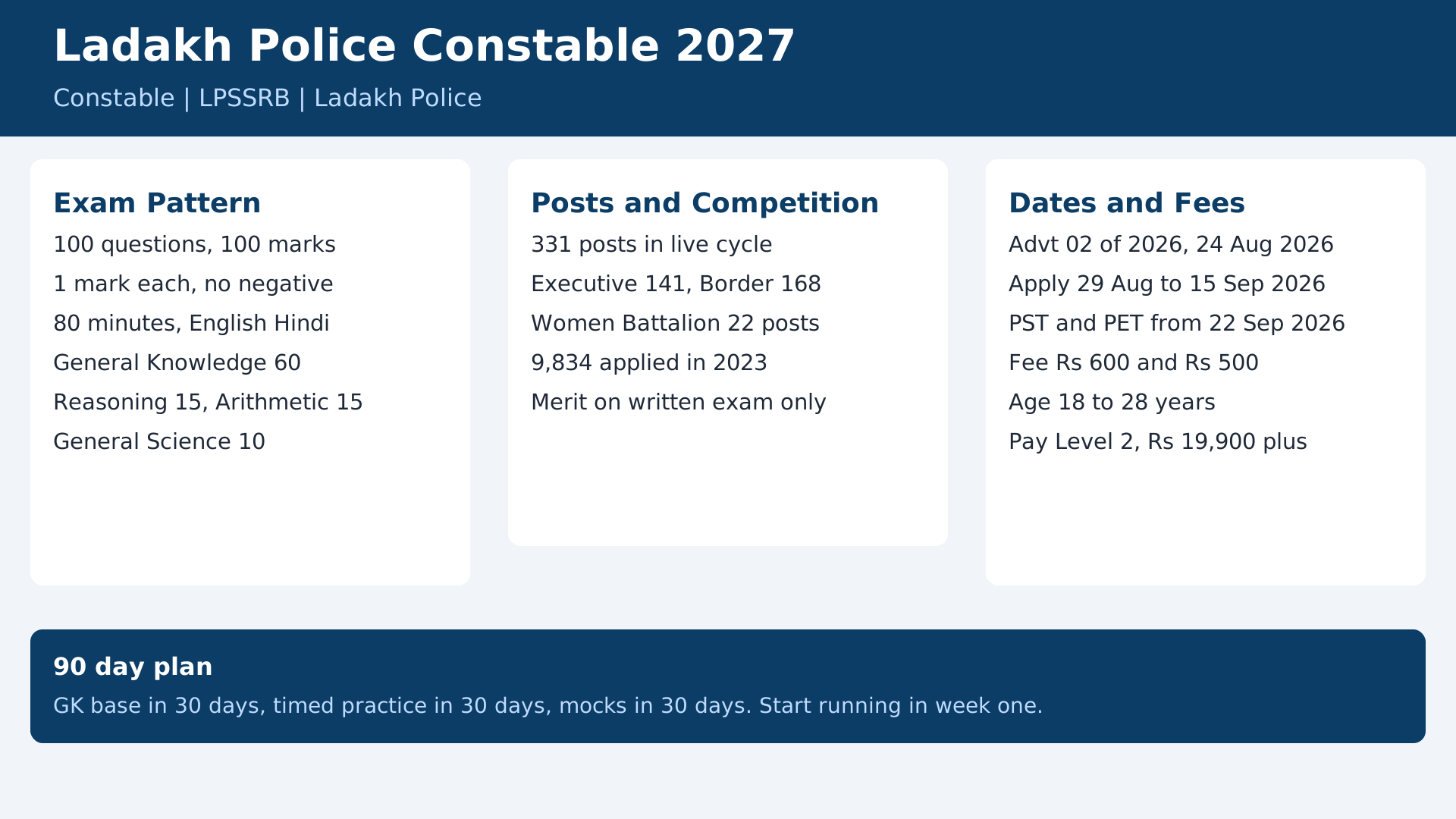
The Ladakh Police Subordinate Service Recruitment Board, LPSSRB, advertised 331 Constable posts in August 2026, and that cycle is still running, with the Physical Standard Test and Physical Endurance Test held from 22 September 2026 and the written exam date still to be notified. Ladakh Police Constable 2027 has no notification yet as of 20 November 2026, so every fact in this guide comes from the live cycle, Advertisement Number 02 of 2026, and the 2023 cycle, Advertisement Numbers 01 and 02 of 2023, and the LPSSRB notices that followed them. If you plan to sit for the 2027 cycle, those two cycles are the closest picture you have of the posts, the pattern, the age limits, the physical tests and the fees. The Ladakh Police conducts the recruitment through the Ladakh Police Subordinate Service Recruitment Board, under the Administration of the Union Territory of Ladakh.
A Ladakh Police Constable works in the highest police jurisdiction in India, across Leh and Kargil, at altitudes where the air is thin and the winter is long. The post needs 10th pass, it carries a written exam of 100 questions in 80 minutes with no negative marking, and it pays Level 2, Rs 19,900 to Rs 63,200 a month. The recruitment is different from the Jammu and Kashmir Police Constable recruitment in three ways: the conducting body is the Ladakh Police Subordinate Service Recruitment Board, not JKSSB; the written paper is bilingual, English and Hindi, with no negative marking; and the Border Battalion posts need a domicile from a border village in the district.
Ladakh Police Constable 2027 and the live cycle in numbers
| Item | Detail |
|---|---|
| Conducting body | Ladakh Police Subordinate Service Recruitment Board (LPSSRB) |
| Department | Police Department, Administration of UT of Ladakh |
| Notification | Advertisement Number 02 of 2026 dated 24 August 2026 |
| Posts | 331 Constable posts |
| Application window | 29 August 2026 to 15 September 2026 |
| Physical tests | PST and PET from 22 September 2026 |
| Written exam | Date to be notified separately |
| Age limit | 18 to 28 years as on 1 January 2026 |
| Qualification | 10th pass (matriculation) |
| Pay | Level 2, Rs 19,900 to Rs 63,200 per month |
| Application fee | Rs 600 UR and EWS, Rs 500 SC, ST and ALC |
| 2027 notification | Not issued as of 20 November 2026 |
The 331 posts split into three groups. Executive, Armed, IRP and SDRF carry 141 posts. Border Battalion carries 168 posts, split by district: Nubra 71, Changthang 40, Sham 13, Kargil 43, and Drass 1. Women Battalion carries 22 posts, split by district: Leh 4, Nubra 4, Sham 0, Changthang 3, Kargil 0, Zanskar 2, and Drass 9. The Border Battalion posts need a domicile from a border village in the district, and the Women Battalion posts are for women only. The district wise split is the point that decides where you can apply, because the Border Battalion is district wise only.
The timeline of the 2026 cycle is fast by JKSSB standards. The notification came on 24 August 2026, applications ran from 29 August to 15 September 2026, and the Physical Standard Test and Physical Endurance Test started on 22 September 2026, one week after the application window closed. The written exam date has not been notified as of 20 November 2026. The 2023 cycle was the first Ladakh Police Constable recruitment after the reorganisation, with 298 posts, 264 Executive, Armed, Home Guard, Civil Defence and SDRF and 34 Telecom, notified on 7 September 2023, with 9,834 applicants, and the written exam held on 9 and 10 December 2023.
The written exam pattern
The written exam is an objective paper of 100 questions for 100 marks, with each question carrying 1 mark and a duration of 80 minutes. The questions are set in English and Hindi, and the candidate can choose the language. There is no negative marking in the Ladakh Police Constable written exam, which makes it the only uniformed exam in this set with no negative marking. The section split is General Knowledge 60 marks, Reasoning 15 marks, Arithmetic 15 marks, and General Science 10 marks. The exam centres are Leh and Kargil.
| Section | Marks |
|---|---|
| General Knowledge | 60 |
| Reasoning | 15 |
| Arithmetic | 15 |
| General Science | 10 |
| Total | 100 |
Merit is decided by the written examination alone, with the incentives added to it. The Physical Standard Test and the Physical Endurance Test are qualifying only, and they add no marks. The incentives are NCC, 5 percent for C certificate, 3 percent for B certificate, and 2 percent for A certificate, added to the written marks for merit, and the desired qualification, a Light Motor Vehicle driving licence with a transport endorsement and a driving test, or a one year computer certificate from an AICTE recognised institution, up to 5 percent of the written marks. Only one desired qualification can be claimed. A candidate who holds an NCC C certificate and a driving licence starts the merit list with up to 10 percent added to the written marks, and that is often the difference between selection and rejection.
One tracker, Adda247, reports a written examination of 400 marks in a table, which is an error, and it is flagged here. The written exam is 100 questions for 100 marks, and the 400 mark figure does not appear in the notification or in any other tracker. The upload check should confirm the pattern against the notification for Advertisement Number 02 of 2026 before anyone builds a study plan on it. What is certain is the shape, 100 questions in 80 minutes, no negative marking, bilingual, and the section split, because those figures appear consistently across the tracker pages that report the notification.
Who can apply for Ladakh Police Constable
You must have passed 10th, matriculation, from a recognised board. Serving Special Police Officers with 3 or more years of service can apply with 8th pass. The age limit is 18 to 28 years as on 1 January 2026 for the live cycle. SC, ST and ALC candidates run to 33 years. Serving Special Police Officers with 3 or more years of service and Village Home Guards with 5 or more years of service run to 37 years. Ex servicemen are relaxed under the rules. You must hold a domicile certificate of the Union Territory of Ladakh. Only domiciles of Ladakh can apply, and the Border Battalion posts need a domicile from a border village in the district.
The Women Battalion posts are for women only. The Executive, Armed, IRP and SDRF posts are open to men and women, and the Border Battalion posts are open to men and women who hold a border village domicile in the district. The desired qualification is a Light Motor Vehicle driving licence with a transport endorsement and a driving test, or a one year computer certificate from an AICTE recognised institution, and it adds up to 5 percent of the written marks for merit. Only one desired qualification can be claimed, so choose the one you hold.
Physical standards and the physical tests
The physical standards for Ladakh Police Constable are height and chest, and they are the same standard used across the police forces in India, with a small relaxation for the high altitude region. Male candidates need a minimum height of 162 cm, with a chest of 81 cm normal and 85 cm expanded. Female candidates need a minimum height of 152 cm. There is no chest standard for female candidates.
| Standard | Male | Female |
|---|---|---|
| Height | 162 cm minimum | 152 cm minimum |
| Chest normal | 81 cm | Not applicable |
| Chest expansion | 85 cm | Not applicable |
The Physical Endurance Test is a run, a long jump, and pushups for men, and a run, a long jump, and a shot put for women. Male candidates must run 1600 metres in 7 minutes 30 seconds, complete a long jump of 12 feet in 3 attempts, and do 20 pushups. Female candidates must run 1200 metres in 7 minutes 30 seconds, complete a long jump of 9 feet in 3 attempts, and throw a 4 kg shot put 14.5 feet in 3 attempts. The Physical Standard Test and the Physical Endurance Test are qualifying only, and they add no marks. Train for the run from the start, because the run is the stage that decides the physical tests, and the high altitude of Leh and Kargil makes the run harder than the same run at sea level.
Fee, salary and what the job pays
The application fee for the live cycle is Rs 600 for UR and EWS candidates, and Rs 500 for SC, ST and ALC candidates. Pay online only, on the LPSSRB portal. The fee is non refundable, and an application without the fee is rejected without consideration. The fee for the 2023 cycle was not verified, and it is flagged here.
The pay is Constable, Level 2, in the pay matrix, and the standard Level 2 range is Rs 19,900 to Rs 63,200 per month, plus the allowances that apply to Ladakh Police personnel, including the high altitude allowance. The range itself was not read in the notification text, and it is flagged here as the standard Level 2 range, not a figure from the notification. During the probation period the Ladakh Probationer Rules apply to pay and allowances. The career path from Constable runs upward to Head Constable, Assistant Sub Inspector, Sub Inspector, and Inspector, through promotion and departmental examination, and Constables who hold a driving licence or a computer certificate often move faster.
The 2023 cycle, the first Ladakh Police Constable recruitment
The 2023 cycle was the first Ladakh Police Constable recruitment after the reorganisation of the state into two union territories, and it is worth knowing because it set the pattern for the 2026 cycle. The notification, Advertisement Numbers 01 and 02 of 2023, came on 7 September 2023, for 298 posts, 264 Executive, Armed, Home Guard, Civil Defence and SDRF and 34 Telecom. Applications ran from 22 September to 16 October 2023, and 9,834 candidates applied. The Physical Measurement Test and Physical Endurance Test ran from 4 to 10 November 2023, the result came on 29 November 2023, and the written exam was held on 9 December 2023 for Telecom and 10 December 2023 for Executive.
The 2023 cycle shows the same pattern as the 2026 cycle: the physical tests come first, the written exam follows, and the whole process runs in about three months, which is fast by JKSSB standards. The 2026 cycle follows the same order, with the physical tests from 22 September 2026 and the written exam date still to be notified. If you are preparing for the next cycle, train for the physical tests from the start, because the physical tests come first and they are the first stage that can end a selection, and the altitude makes them harder.
General Knowledge, the 60 mark heart of the paper
General Knowledge carries 60 of the 100 marks, and it is the section that decides the merit list more than any other. The topics include the history and geography of Ladakh, the districts and the administrative structure, the rivers and the mountains, the art and culture, the festivals and the languages, and the current affairs of the Union Territory. The questions also cover the Indian Constitution, the Parliament, the judiciary, and the national schemes, with a focus on the schemes for the border areas and the high altitude regions.
The best way to prepare for this section is to read one newspaper a day, and to keep a notebook of Ladakh facts: the districts and their headquarters, the rivers and their tributaries, the passes and the mountains, the monasteries and the festivals, and the schemes for the border villages. The section is 60 marks, and it is the section that separates a candidate who prepares from a candidate who guesses. The 60 marks are the most predictable marks in the paper, because the topics are fixed and the level is matriculation.
The Border Battalion, and the district wise rule
The Border Battalion is the largest group in the 2026 cycle, with 168 of the 331 posts, and it is the group with the strictest domicile rule. The posts are split by district: Nubra 71, Changthang 40, Sham 13, Kargil 43, and Drass 1. A candidate can apply only for the Border Battalion posts of the district where the candidate holds a border village domicile, and the domicile must be from a border village in that district. A candidate from Leh cannot apply for a Kargil Border Battalion post, and a candidate from Kargil cannot apply for a Nubra Border Battalion post, even if the candidate holds a Ladakh domicile.
The rule exists because the Border Battalion is a local force, raised from the border villages to serve in the border areas, and the department wants constables who know the ground, the language, and the people of the district they serve. The Border Battalion constables work in the border villages, patrol the border areas, and assist the army and the border forces in the region. The work is physical, remote, and seasonal, with winter duty in temperatures that fall below minus 20 degrees. A candidate who holds a border village domicile should apply for the Border Battalion, because the competition is district wise and the posts are many, and a candidate who does not hold a border village domicile should apply for the Executive, Armed, IRP and SDRF posts instead.
The Women Battalion
The Women Battalion carries 22 posts in the 2026 cycle, split by district: Leh 4, Nubra 4, Sham 0, Changthang 3, Kargil 0, Zanskar 2, and Drass 9. The posts are for women only, and the physical standards and the physical tests are the female standards: height 152 cm, run 1200 metres in 7 minutes 30 seconds, long jump 9 feet in 3 attempts, and shot put 4 kg 14.5 feet in 3 attempts. The Women Battalion constables work in the women police stations across the districts, and they handle cases involving women and children, including domestic violence, harassment, and child protection.
The Women Battalion is the smallest group in the cycle, and the competition is high, because the posts are few and the applicants are many. A woman candidate who holds a border village domicile can apply for the Border Battalion posts of her district as well as the Women Battalion posts, and a woman candidate who does not hold a border village domicile can apply for the Executive, Armed, IRP and SDRF posts and the Women Battalion posts. The written exam is the same for all groups, 100 questions in 80 minutes, no negative marking, bilingual, and the merit list is drawn group wise.
Reasoning, Arithmetic and Science, the 40 mark block
Reasoning, Arithmetic and General Science carry 15, 15 and 10 marks, and together they are 40 marks, a third of the paper. Reasoning tests analogy, series, coding and decoding, blood relations, direction sense, and non verbal reasoning at matriculation level. Arithmetic tests number system, percentage, ratio and proportion, profit and loss, time and work, simple interest, averages, and mensuration at Class 10 level. General Science tests Physics, Chemistry and Biology at Class 10 level, with a focus on everyday science.
The 40 marks are the section to practise by mock test, because the questions are straightforward and the level is matriculation, and a candidate who practises 50 questions a day under a timer will score well. The arithmetic section is the one to study from a book, because the questions are factual and the topics are fixed. The science section is the one to revise from Class 10 NCERT, because the questions are set at school level and the NCERT text is the source. The reasoning section is the one to build by practice, because the patterns repeat and the speed comes from familiarity.
How the selection runs from form to final list
The selection has four stages, and they run in a fixed order for this recruitment. First comes the online application on the LPSSRB portal, with the fee paid online and the documents uploaded in the prescribed format. Then comes the Physical Standard Test, with the height and chest check, and the Physical Endurance Test, with the run, the long jump, and the pushups or the shot put. Candidates who pass the physical tests move to the written examination, which is the only stage that carries marks. Those who clear the written exam move to document verification, where LPSSRB checks your matriculation certificate, your domicile certificate, your date of birth, and your category certificate against the cut off dates in the notification. Medical examination follows selection under the department rules. There is no interview in this recruitment.
The order is different from the JKSSB pattern, where the written exam comes first and the physical tests follow. In Ladakh, the physical tests come first, and the written exam follows, which is why the physical tests started one week after the application window closed in the 2026 cycle. Train for the run from the start, because the physical tests come first and they are the first stage that can end a selection. The high altitude of Leh and Kargil makes the run harder than the same run at sea level, so train at altitude if you can, and build the run slowly over eight weeks.
A 90 day plan that fits this paper
Days 1 to 30 are for the base. General Knowledge carries 60 marks, so give it two hours a day, from the newspaper and a Ladakh general knowledge book, covering the history and geography of Ladakh, the districts, the rivers, the mountains, and the current affairs. Give one hour a day to Reasoning and Arithmetic together, and one hour to General Science, because those three sections carry 40 marks between them. Start running in the first week. Three runs a week, building from 1 km to 3 km, in the shoes you will wear on the test day, on flat ground where you can find it, and build the distance slowly so the knees and the lungs adapt together.
Days 31 to 60 are for practice. The paper is 100 questions in 80 minutes, so speed is a skill of its own. Do 50 questions a day under a timer, and keep an error log of every question you get wrong. Revise the error log every Sunday. Take your first full mock test at the end of week six, under exam conditions, with no negative marking, so you can attempt every question. Score it and count every mark lost to a guess, then find your weak subject before the last month. Build the runs to 1600 metres in this block, and practise the long jump and the pushups or the shot put twice a week.
Days 61 to 90 are for mocks and revision. Take two mocks a week, and spend the day after each mock only on the questions you got wrong. Revise the Ladakh facts, the reasoning patterns, the arithmetic formulae, and the science chapters in the final two weeks. Do one full 1600 metre run for male candidates, or 1200 metre run for female candidates, in the eighth week, to prove to yourself that the time is possible. In the last three days, stop learning new topics. Sleep properly, keep the running light, and revise your error log. The candidates who fail this exam usually fail on the run or on time management, not on knowledge, and both are fixed in the 90 days before the exam, not in the exam hall.
Life as a Ladakh Police Constable
A Ladakh Police Constable works in the highest police jurisdiction in India, across Leh and Kargil, at altitudes where the air is thin and the winter is long. The posting is usually a police station or a police post in Leh or Kargil, with duty across the district, and the work includes patrolling, traffic management, border area duty, and assistance in disaster response. The Border Battalion posts are in the border villages of Nubra, Changthang, Sham, Kargil and Drass, and the Women Battalion posts are in the women police stations across the districts.
The work is physical and seasonal. Summer brings tourism, traffic, and patrol. Winter brings snow, closed passes, and duty in temperatures that fall below minus 20 degrees. The high altitude allowance is the recognition of that hardship, and the department provides accommodation and facilities for the constables posted in the border areas. A Constable who likes the outdoors, can live with basic facilities, and can work in the cold will suit the post, and a Constable who wants a desk will not. The department runs training for Constables at the Police Training School, and the training covers law, drill, weapons, and first aid, so the job is a mix of physical work and legal knowledge, and the training is the base that every Constable builds on.
Mistakes that cost candidates this exam
The first mistake is applying without a Ladakh domicile certificate in hand, or with a border village domicile that does not match the district of the Border Battalion post. The Border Battalion is district wise only, and a candidate who applies for the wrong district is rejected at verification. The second mistake is training at sea level and expecting the run to feel the same at altitude. The run is 1600 metres in 7 minutes 30 seconds for men and 1200 metres in 7 minutes 30 seconds for women, and the thin air of Leh and Kargil makes it harder, so train at altitude if you can. The third mistake is ignoring General Knowledge. It carries 60 of the 100 marks, so a candidate who revises only Reasoning is preparing for a different exam. The fourth mistake is not claiming the NCC incentive or the desired qualification, because 5 percent for an NCC C certificate and 5 percent for a driving licence or a computer certificate is up to 10 percent of the written marks, and that is often the difference between selection and rejection.
Ladakh Police Constable aspirants often prepare for other police and uniformed exams alongside this one. The UP Police Constable 2027, Bihar Police Constable 2027, SSC GD 2027, SSC Delhi Police Constable 2027, AFCAT 2027, Agniveer Vayu 2027, IBPS Clerk 2027, SBI Clerk 2027, UP Police Fireman 2027 and UPPSC PCS 2027 pages on this site carry the same style of mock test guide, and the pattern habit you build here transfers directly to them.
Sources
Ladakh Police Advertisement Number 02 of 2026 dated 24 August 2026, for the 331 Constable posts, the split of Executive, Armed, IRP and SDRF 141, Border Battalion 168, and Women Battalion 22, the application window of 29 August to 15 September 2026, the physical tests from 22 September 2026, the fee of Rs 600 and Rs 500, the age limits of 18 to 28, 33 and 37 years, and the physical standards of 162 cm and 81 cm plus 85 cm for men and 152 cm for women, from the notification copies on Testbook, Oliveboard, and the Ladakh Police website at police.ladakh.gov.in. Ladakh Police Advertisement Numbers 01 and 02 of 2023, for the 298 Constable posts, the 9,834 applicants, the physical tests of 4 to 10 November 2023, and the written exams of 9 and 10 December 2023, from the notification copies on Testbook and the Ladakh Police website. The written examination pattern of 100 questions, 100 marks, 80 minutes, no negative marking, bilingual English and Hindi, and the section split of General Knowledge 60, Reasoning 15, Arithmetic 15, and General Science 10, from the notification copies on Testbook and Oliveboard. The NCC incentive of 5, 3 and 2 percent, and the desired qualification incentive of up to 5 percent, from the notification summary. The official Ladakh Police site at police.ladakh.gov.in, which was reachable during preparation on 20 November 2026, and the official Ladakh Police logo, downloaded from police.ladakh.gov.in on 20 November 2026.







