About Kerala PSC Staff Nurse 2027 Exam Series
📖 Table of Contents
- Kerala PSC Staff Nurse 2027 at a glance
- Two recruitments under one name, and why the category number matters
- No 2027 notification yet, and where the live cycles stand
- The Medical Education cycle, 469/2024, date by date
- The Health Services cycle, 066/2023, and the district lists
- Who can apply: Plus Two, nursing qualification, and council registration
- Age, and the relaxation rules
- How the application works through One Time Registration
- The written paper in full
- The syllabus, module by module
- The shortlist, the interview, and the ranked list
- Pay, posting, and the career after selection
- The earlier cycles, and what they show
- A preparation plan that fits the paper
- Mistakes that cost candidates a place on the list
- What to watch next
- Mock tests for Kerala PSC Staff Nurse 2027: Full Tests, PYQ, Chapter Tests, Sectional Tests, NCERT based Tests, Current Affairs and PYQ PDF Downloads
- Sources
Kerala PSC Staff Nurse 2027: Complete Exam Guide
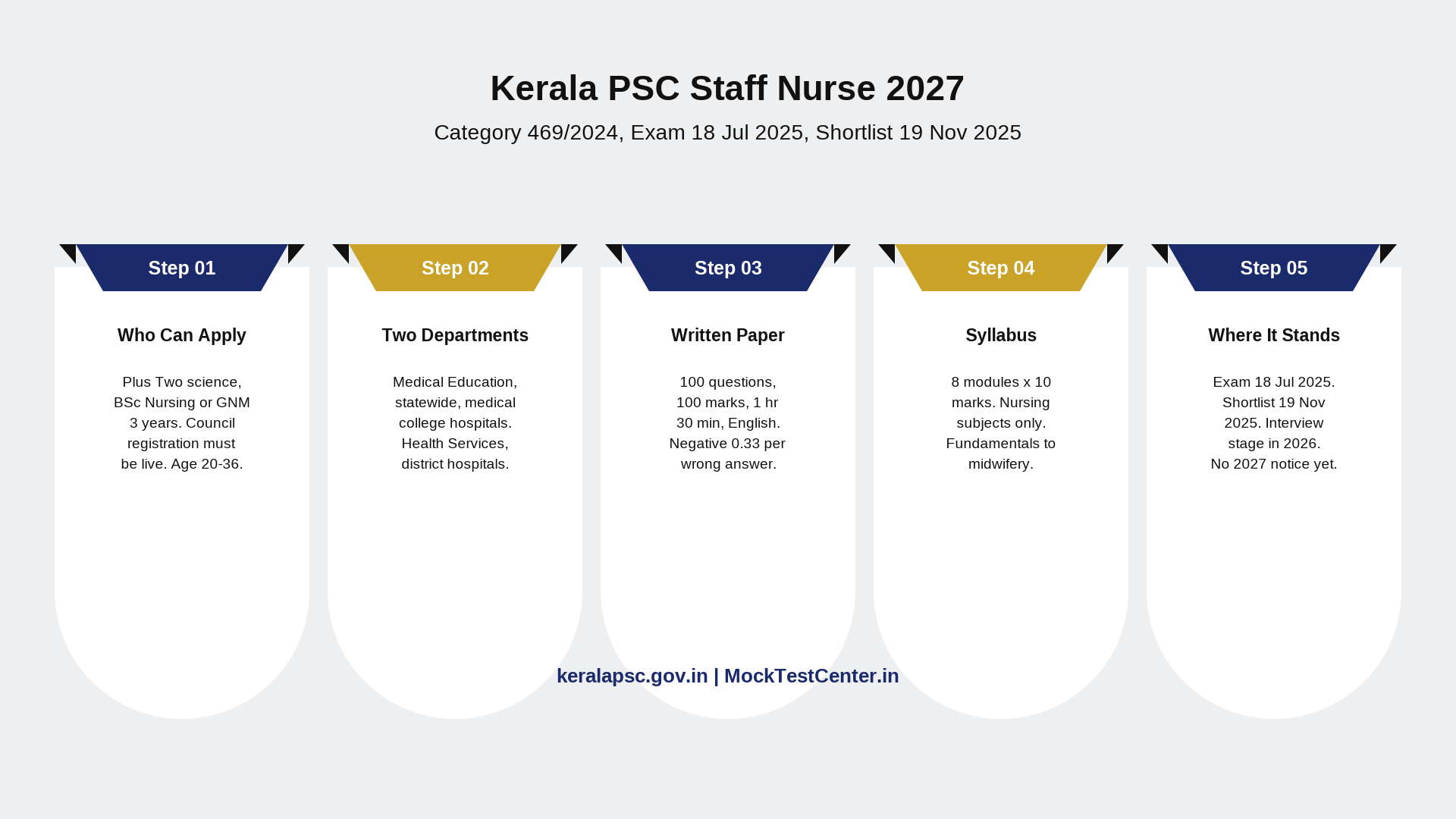
Kerala PSC Staff Nurse 2027 on this page follows the live cycles of the Kerala Public Service Commission recruitment for the post of Staff Nurse Grade II, and the newest live cycle is Category Number 469/2024 in the Medical Education Department. The Kerala Public Service Commission, known as Kerala PSC, published that notification in the extraordinary gazette dated 16 December 2024. Applications ran from 16 December 2024 to 15 January 2025, the written examination took place on 18 July 2025, and the shortlist for interview came out on 19 November 2025.
No separate 2027 notification has been published as of 23 November 2026, so this guide anchors on the 469/2024 cycle and on the Health Services cycle before it, Category Number 066/2023, and says so wherever a 2027 figure would otherwise be guessed. The page carries 2027 in its title because the site groups examination pages by that year. The recruitment itself carries category numbers, and the category number is the identifier a candidate should use when checking the Kerala PSC website.
Staff Nurse Grade II is one of the most competitive nursing recruitments in Kerala, and the reason is plain. The post puts a nurse in a government hospital, with a starting scale of Rs 39,300 to Rs 83,000, with the security of a state government appointment, and with a career that runs through the health services of the state. Every year of nursing graduates in Kerala watches for it, and the number of applicants runs far past the number of posts the departments report.
The recruitment is also one of the easiest to misunderstand, because the same post name covers two different departments, two different category numbers, and two different kinds of list. The Medical Education Department recruits statewide for its medical college hospitals. The Health Services Department recruits district wise for its government hospitals. A candidate who applies for one and prepares for the other is preparing for the wrong list, and a candidate who reads a tracker page without checking the category number may not notice the difference until the examination date.
Kerala PSC Staff Nurse 2027 at a glance
| Detail | Kerala PSC Staff Nurse 2027, as run in the 469/2024 cycle |
|---|---|
| Conducting body | Kerala Public Service Commission (Kerala PSC), Thiruvananthapuram, website keralapsc.gov.in |
| Exam | Staff Nurse Grade II, Medical Education Department, statewide, Category Number 469/2024 |
| Gazette date | 16 December 2024 |
| Applications | 16 December 2024 to 15 January 2025, closed, through One Time Registration |
| Vacancies | Anticipated vacancies, no number published in the notification |
| Education | Plus Two with science subjects, plus BSc Nursing or General Nursing and Midwifery of not less than 3 years, plus Kerala Nurses and Midwives Council registration |
| Age limit | 20 to 36 years, born 2 January 1988 to 1 January 2004, both dates included, for the 469/2024 cycle |
| Pay scale | Rs 39,300 to Rs 83,000, plus dearness allowance and house rent allowance |
| Written exam | 18 July 2025, Friday, OMR, 100 marks, 1 hour 30 minutes, English medium, negative marking 0.33 per wrong answer |
| Confirmation | 22 April to 11 May 2025, through the Thulasi profile |
| Admit card | 4 July 2025 |
| Shortlist | Short List Number 249/2025/ER IX, dated 19 November 2025, for interview after document verification |
| Interview | Interview stage reached in 2026, with a postponement notice also on record, see the conflicts section |
| 2027 notification | Not published as of 23 November 2026 |
Two recruitments under one name, and why the category number matters
The post is Staff Nurse Grade II in both departments, and the qualification is the same in both departments. The difference sits in where the nurse works and how the list is drawn. The Medical Education Department recruits statewide, and its nurses work in the medical college hospitals. The Health Services Department recruits district wise, and its nurses work in the government hospitals of a district, under the District Medical Officer. A candidate applies for the department and the district or the statewide list that the notification names, and the ranked list follows that choice.
The category number is the only safe way to tell the recruitments apart. Category Number 469/2024 is the Medical Education recruitment, statewide, with its gazette dated 16 December 2024. Category Number 066/2023 is the Health Services recruitment, district wise, with its gazette dated 30 May 2023 and its written examination held on 9 November 2023. Category Number 418/2019 is an older Health Services recruitment, with its gazette dated 30 December 2019 and its written examination held on 30 January 2021. Category Number 213/2021 is an older Medical Education recruitment. A page that says Staff Nurse without a category number may describe any of them, and the dates will not match.
The confusion is worse on tracker pages, because the same page often carries the dates of two cycles side by side. One Entri page carries the 469/2024 examination date of 18 July 2025 and, in the same table, an admit card date that belongs to a different reading of the cycle. Another page carries a duration of 1 hour 15 minutes beside a duration of 1 hour 30 minutes. This guide prints the dates and the duration for each category number separately, and it records the conflicts where the sources disagree, so that a candidate can see which figure belongs to which cycle.
The lesson is short. Read the category number first, and read the department second. Everything else in the notification follows from those two facts: the list, the posting, and the calendar. A candidate who applies under 469/2024 watches the Medical Education shortlist and the interview schedule for that category number, and a candidate who applied under 066/2023 watches the Health Services lists for the district applied for.
No 2027 notification yet, and where the live cycles stand
Search results for this examination carry several different years in the same week, and the confusion has a simple cause. Tracker pages label the recruitment by the year they write about it, so the same cycle appears as 2024, 2025, and 2026 on different pages. The notification for 469/2024 came out on 16 December 2024, so some pages call it the 2024 recruitment. The written examination took place in July 2025, so other pages call it the 2025 examination. The shortlist came out in November 2025 and the interview stage ran in 2026, so still other pages call it the 2026 recruitment.
The category number settles the confusion. Category Number 469/2024 is the live Medical Education cycle, and it stands at the interview stage. The shortlist, Number 249/2025/ER IX, was dated 19 November 2025, and it carries the register numbers of the candidates found provisionally eligible to be called for interview, subject to verification of the original documents. The interview schedule was to be published in due course, and the candidates on the shortlist were directed to be present for verification of original documents and interview as per that schedule.
No notification for a fresh Staff Nurse Grade II recruitment had been published as of 23 November 2026, for either department. The Health Services ranked lists from the 066/2023 cycle continue to supply appointments in 2026, and the Medical Education cycle moves through its interview stage. A nurse who wants the next chance should prepare during this interval, because the application window for 469/2024 ran for one month, and the window for the next notification will be just as short.
The gap between notifications is part of the story. The Health Services notification of 066/2023 came in May 2023, and the Medical Education notification of 469/2024 came in December 2024, about eighteen months later. The cycle before the 066/2023 one, Category Number 418/2019, came in December 2019. The pattern is a long wait, a short window, and then a cycle that runs for more than a year from gazette to ranked list. A nurse who prepares during the wait is ready when the window opens, and a nurse who starts at the gazette is already behind.
The Medical Education cycle, 469/2024, date by date
The cycle opened with the extraordinary gazette dated 16 December 2024. Applications ran online through the Kerala PSC One Time Registration system, from 16 December 2024 to 15 January 2025. The notification stated the number of vacancies as anticipated vacancies, which is the Kerala PSC form of words for a recruitment where departments report vacancies as they arise, and no fixed number is published at the notification stage. The method of appointment is direct recruitment, and the scale of pay is Rs 39,300 to Rs 83,000.
The confirmation window ran from 22 April to 11 May 2025, and candidates confirmed through their Thulasi profile. The admit card was released on 4 July 2025. The written examination was held on 18 July 2025, a Friday, as an OMR examination. The paper carried 100 marks, ran for 1 hour 30 minutes, and was set in English. One mark was awarded for each correct answer, and 0.33 marks were deducted for each wrong answer.
The shortlist came out as Short List Number 249/2025/ER IX, dated 19 November 2025. The shortlist notice states that the examination was held on 18 July 2025, and that the register numbers in the list are arranged in numerical sequence, and that the arrangement does not indicate the respective rank on the basis of the test. The candidates on the shortlist were directed to be present for verification of original documents and interview as per the schedule to be published in due course.
The interview stage followed the shortlist, and the sources disagree on its position in 2026. Entri states that interviews for the 469/2024 recruitment were held in August 2026, and that appointments from Health Services ranked lists continue in 2026. The Kerala PSC latest notices page carries an entry headed Interview Postponed for Staff Nurse Grade II in the Medical Education Department, Category Number 469/2024. This guide records both, and it does not choose between them, because the postponement notice carries no date in the material read, and the Entri statement carries no notice number. A candidate on the shortlist should check the Kerala PSC website and the Thulasi profile for the interview schedule, and should treat the postponement notice as a reason to check again before travelling.
The ranked list for 469/2024 had not been published as of the sources read for this guide, and this guide states no ranked list date and no ranked list total for the cycle. The shortlist is not the ranked list. The shortlist names the candidates called for interview, and the ranked list names the candidates selected in order of merit after the interview. A page that prints a ranked list total for 469/2024 is guessing, because the commission had published only the shortlist at the point the sources were read.
The Health Services cycle, 066/2023, and the district lists
The Health Services cycle carried Category Number 066/2023, and it recruited Staff Nurse Grade II for the Health Services Department, district wise. The gazette was dated 30 May 2023, and applications ran from 30 May to 29 June 2023. The scale of pay was Rs 39,300 to Rs 83,000, and the vacancies were stated as anticipatory vacancies. The age limit was 20 to 36 years, counted as on 1 January 2023, with birth dates from 2 January 1987 to 1 January 2003, both dates included, for the general limits.
The written examination was held on 9 November 2023, a Thursday. The paper carried 100 marks and ran for 1 hour 30 minutes, with the medium of questions in English, and the mode of examination stated as OMR or online, objective multiple choice. The syllabus for the post was the detailed nursing syllabus published by the commission, and the same syllabus structure carries forward into the 469/2024 cycle.
The district wise character of the Health Services recruitment changes the posting, and it changes the competition. A candidate applies for a district, and the ranked list for that district supplies the hospitals of that district. The number of vacancies in a district is small, and the list for a district with few vacancies moves slowly. A candidate who applies for a district with many hospitals and many vacancies may be advised sooner than a candidate who applies for a district with few. The notification does not publish the district wise vacancy split at the application stage, because the vacancies are anticipatory, and the candidate applies without knowing the exact number for the district.
The earlier Health Services cycle, Category Number 418/2019, shows the same shape over a longer calendar. Its gazette was dated 30 December 2019, its last date for applications was 5 February 2020, and its written examination was held on 30 January 2021, more than a year after the gazette. The 066/2023 cycle ran faster, with its examination about five months after the gazette. The commission has shortened the calendar, and the candidate who applies under the next notification should still plan for many months from application to ranked list.
Appointments from the Health Services ranked lists continue in 2026, according to the Entri report on the Staff Nurse recruitment, and that is the normal course for a Kerala PSC ranked list. The list stays in force for a fixed period, and the departments draw from it as vacancies are reported. A nurse on a district list watches the advice memos, and a nurse off the list watches for the next notification. The two groups need different things from this guide, and the sections below serve both.
Who can apply: Plus Two, nursing qualification, and council registration
The qualification for Staff Nurse Grade II has three parts, and all three must be complete. The first part is the school qualification. A candidate needs a pass in Plus Two or Pre-degree with science subjects, or a pass in VHSE with science subjects, or a pass in VHSE in Domestic Nursing, from a recognised institution. The notification states the school qualification in those words, and it accepts the VHSE routes alongside the Plus Two route.
The second part is the nursing qualification. A candidate needs a pass in BSc Nursing from a recognised university, or a pass in the General Nursing and Midwifery course of not less than 3 years duration from an institution recognised by the government. The two routes stand on the same footing for this post, and the notification does not prefer one over the other. A BSc Nursing graduate and a GNM holder apply for the same post, sit the same paper, and join the same ranked list.
The third part is the registration, and it is the part that ends the most candidacies at verification. A candidate needs a certificate of registration with the Kerala Nurses and Midwives Council as Nurse and Midwife, in the case of a woman candidate, and as Nurse, in the case of a male candidate. The registration must be live at the time the commission asks for it, and the candidate should carry the original certificate to the document verification. A nurse whose registration has lapsed, or whose registration is with another state council and has not been transferred, should settle the position before the interview, not after the call.
Male candidates should note the wording of the registration rule, because it differs by sex in the notification. A woman candidate registers as Nurse and Midwife, and a male candidate registers as Nurse. The distinction follows the council rules, and the commission applies it at verification. A male candidate who holds the GNM qualification and the council registration as Nurse meets the rule, and a woman candidate who holds the same qualification and the registration as Nurse and Midwife meets it.
Indian citizenship is required, and the candidate should be a citizen of India. The notification carries that condition expressly, and the commission verifies it with the documents at the interview stage. The candidate who holds a nursing qualification from outside Kerala should check the recognition of the institution, because the notification requires the institution to be recognised by the government, and a qualification from an unrecognised institution does not meet the rule even if the candidate holds council registration.
Age, and the relaxation rules
The age limit for the 469/2024 cycle is 20 to 36 years, and the notification fixes the birth window as 2 January 1988 to 1 January 2004, both dates included. A candidate born before 2 January 1988 is over age for the general limits in that cycle, and a candidate born after 1 January 2004 is under age. The 066/2023 cycle fixed its own window as 2 January 1987 to 1 January 2003, both dates included, counted as on 1 January 2023. The window moves with the cycle, and the candidate should read it in the notification for the cycle applied under, not carry the last cycle dates forward.
Relaxation applies under the Kerala government rules, and it applies to the reserved categories in the usual way. SC and ST candidates, OBC candidates, and other eligible categories get the relaxation the rules fix, and the exact years come from the notification for the cycle. This guide states the general limits with their birth windows, because those are the figures the sources carry, and it does not print the relaxation years as a single number, because the sources read carry the relaxation as a reference to the government rules rather than as a table.
The age rule catches more candidates than the qualification rule, because a nurse who finished the GNM course late, or who took a break after Plus Two, may find the upper limit closer than expected. A candidate who is 36 at the cut off date and 37 at the examination date is still within the limit, because the age is counted as on the date the notification fixes. The date matters more than the birthday, and the candidate should check the notification date before deciding whether to apply.
How the application works through One Time Registration
Applications run online only, through the Kerala PSC One Time Registration system on keralapsc.gov.in and the Thulasi portal. A candidate registers once, with a valid mobile number and email ID, and then applies for each post from the same profile. The photograph and signature go up in the format the notification fixes, and the application for the post is submitted from the profile before the last date. The 469/2024 last date was 15 January 2025, and the portal closes at the hour the notification fixes.
The notification material read for this guide carries no application fee figure for this post, and this guide states none. Kerala PSC applications run through the One Time Registration profile, and the candidate should read the fee position, if any, in the notification for the cycle applied under. A page that prints a fee for this post without citing the notification is guessing, and the fee is the kind of detail that changes between cycles.
Confirmation is a separate step that catches candidates every cycle. After the application, the commission opens a confirmation window for the examination, and only candidates who confirm through their Thulasi profile receive an admission ticket. The confirmation window for the 469/2024 cycle ran from 22 April to 11 May 2025. The admit card was released on 4 July 2025, and the examination was held on 18 July 2025. A candidate who applies and forgets to confirm does not sit the examination, and no late confirmation is accepted.
The submitted application should be kept until the final result, because the commission asks for it at the document verification stage. The profile also carries the messages about shortlists, eligibility lists, and interview calls, and the candidate who checks the profile regularly misses nothing. The commission publishes its notices on keralapsc.gov.in, and the candidate who relies on a coaching portal alone learns the dates late.
The written paper in full
The Kerala PSC Staff Nurse exam pattern is a single written paper, and it is an objective multiple choice test valued by OMR or held online. For the 469/2024 cycle the paper was held as an OMR examination on 18 July 2025, and it carried 100 marks in 1 hour 30 minutes, with the medium of questions in English. One mark is awarded for each correct answer, and 0.33 marks are deducted for each wrong answer. A question left unanswered carries no penalty.
The arithmetic of the paper is the same as the Secretariat Assistant paper, and it is worth stating plainly. One hundred questions in 90 minutes allow 54 seconds per question, and the paper rewards the candidate who moves on from a stuck question instead of burning two minutes on it. Three wrong guesses cancel one correct answer, so a candidate who guesses blindly loses marks fast, and a candidate who leaves a question blank loses nothing. The discipline is to attempt a question only when at least two options can be eliminated, and to leave the rest.
The duration carries a conflict that this guide records rather than hides. The Entri syllabus page for the 469/2024 cycle states the duration as 1 hour 30 minutes in one place and as 1 hour 15 minutes in its pattern section, and the older Medical Education recruitment under Category Number 213/2021 carried a duration of 1 hour 15 minutes for 100 marks. The examination date page for 469/2024, the Entri exam date page, and the Medium guide to the examination all state 1 hour 30 minutes for the 18 July 2025 paper, and the shortlist notice confirms the OMR examination on that date. This guide uses 1 hour 30 minutes for 469/2024, and it records the 1 hour 15 minutes figure as the duration of the older cycle that the syllabus page appears to have carried forward.
The paper tests nursing subjects, and it tests them at the level of the BSc Nursing and GNM courses. The syllabus carries no general knowledge section of the kind the degree level examinations carry, and no arithmetic section. A nurse who has kept the course notes from the training years has the ground already, and a nurse who has worked in a hospital for years has seen much of the syllabus in practice. The paper rewards the nurse who revises the course systematically, not the nurse who reads a general knowledge book.
| Stage | Paper | Questions and marks | Time | Medium |
|---|---|---|---|---|
| Written test, 469/2024 | One objective paper, OMR | 100 questions, 100 marks, 1 mark each, minus 0.33 per wrong answer | 1 hour 30 minutes | English |
| Written test, 066/2023 | One objective paper, OMR or online | 100 marks | 1 hour 30 minutes | English |
| Written test, 213/2021 | One objective paper, OMR | 100 marks | 1 hour 15 minutes | English |
| Shortlist | Provisional eligibility for interview | Register numbers in numerical sequence | 19 November 2025 for 469/2024 | As published |
| Interview | Personal interview after document verification | Marks not verified in sources read | As scheduled | As scheduled |
The syllabus, module by module
The detailed syllabus for Staff Nurse Grade II is published by the Kerala PSC, and it is divided into modules of 10 marks each. The Entri syllabus page for the 469/2024 cycle lists eight modules, and the official syllabus PDF for the Health Services categories lists the same eight modules with their full topic lists. The eight modules carry 80 marks between them, and the paper carries 100 marks, and that gap is a conflict this guide records below rather than filling with a guess.
Module I covers Behavioural Sciences, with Anatomy and Physiology, Microbiology, and Sociology. Anatomy and Physiology covers the structure and function of the body systems, and it is the ground the rest of nursing stands on. Microbiology covers the organisms that cause infection, and the ways infection spreads, and it leads directly into the infection control questions of the Fundamentals module. Sociology covers the social setting of health, and the family, the community, and the social factors that shape illness and care.
Module II covers Behavioural Sciences again, with Psychology and Sociology. Psychology covers the concept, the scope, and the significance of psychology for nurses, and it covers the behaviour of the patient, the family, and the nurse in the hospital. The module sits beside Module I, and the two together carry 20 marks, which is a fifth of the paper. A candidate who revises the behavioural sciences as one block, rather than as two separate modules, covers both.
Module III covers Fundamentals of Nursing, and it is the module a working nurse knows best. It covers the concept, the scope, the ethics, and the principles of nursing, the history of nursing in India, and the health care agencies. It covers admission, transfer, and discharge procedures, and the basic nursing skills of communication, interview, recording, and reporting. It covers the assessment of the patient, physical, physiological, and psychological, and the nursing process of assessment, diagnosis, planning, implementation, and evaluation. It covers infection control methods, the nature and type of infection, the chain of infection transmission, and medical and surgical asepsis, isolation precautions, barrier nursing, hand washing, isolation, and personal protective equipment, with its uses, types, and techniques of wearing and removing, and the transportation of the infected patient. It covers first aid, with its importance and principles, its procedures and techniques, the transportation of the injured, and cardiopulmonary resuscitation.
Module IV covers Community Health Nursing, and it covers primary health care, and the health of the community rather than the health of one patient. It covers the national health programmes, the community health nurse, and the care of the family in its home. A nurse who has worked in a primary health centre knows this module from the field, and a nurse who has worked only in a hospital ward should study it from the course notes, because the questions test the community setting that the ward does not show.
Module V covers Medical Surgical Nursing, and it is the largest clinical block in the paper. It covers fluid and electrolyte imbalance, and the management of respiratory disorders, and oncological care, with the psychosocial aspects of cancer, rehabilitation, palliative care, and the drugs used in cancer. It covers the medical, surgical, and nursing management of patients with burns, breast disorders, and integumentary disorders, and plastic and reconstructive surgery, with skin grafts and flaps, complications, preparation of the patient, postoperative care, and health education. It covers the role of the nurse in medical and surgical emergencies, with the scope and practice of emergency nursing, the principles of emergency care, triage, airway obstruction, haemorrhage, and shock.
Module VI covers Mental Health Nursing, and it covers the concept of mental health and mental illness, and the principles of mental health nursing. It covers the history and trend of psychiatric nursing, and the National Mental Health Programme. It covers mental health assessment, with history taking, the mental status examination, and the interview technique. It covers communication skills, the factors influencing communication, and the barriers to it. It covers personality, and the types of personality related to psychiatric disorders. It covers psychiatric emergencies and crisis intervention, with patients who are overactive, underactive, and violent, and with suicide, adverse drug reactions, withdrawal symptoms, and acute psychosis. It covers forensic psychiatry and the legal aspects.
Module VII covers Child Health Nursing, and it covers the concept of child health care, and the trends and emerging challenges for the paediatric nurse. It covers preventive paediatrics and child health figures, and growth and development, and the role of the nurse in caring for a sick child, with paediatric procedures. It covers the medical and nursing management of children with behavioural disorders, and the pre operative and post operative care of children undergoing surgery. It covers the child welfare programmes, and the care of the child in the community as well as in the hospital.
Module VIII covers Midwifery and Gynaecological Nursing, and it covers the scope and trends in midwifery, and the maternal health figures for India. It covers antenatal care, and the care of the mother in labour, and the post delivery care of the mother and baby. It covers family planning and contraception, and the role of the nurse in promoting maternal and child health. The module carries the weight of the registration rule itself, because the registration is as Nurse and Midwife, and the paper tests the midwifery ground that the title promises.
| Module | Subject | Marks |
|---|---|---|
| Module I | Behavioural Sciences, Anatomy and Physiology, Microbiology, Sociology | 10 |
| Module II | Behavioural Sciences, Psychology, Sociology | 10 |
| Module III | Fundamentals of Nursing | 10 |
| Module IV | Community Health Nursing | 10 |
| Module V | Medical Surgical Nursing | 10 |
| Module VI | Mental Health Nursing | 10 |
| Module VII | Child Health Nursing | 10 |
| Module VIII | Midwifery and Gynaecological Nursing | 10 |
| Modules I to VIII | Eight modules as listed in the sources read | 80 |
| Paper total | As stated for the 469/2024 and 066/2023 examinations | 100 |
The gap between the eight modules and the paper total deserves a plain statement. The eight modules carry 10 marks each, which is 80 marks, and the paper carries 100 marks. Other sources describe further modules covering research methods and professional trends, which would bring the total to 100 marks, and the Sahakari Race Plus syllabus page states that its modules six to ten cover Mental Health Nursing, Child Health Nursing, Midwifery, Research Methods, and Professional Trends. The official syllabus PDF read for this guide lists eight modules, and the Entri syllabus page for 469/2024 lists eight modules. This guide prints the eight modules with their marks, and it records the remaining 20 marks as an unresolved gap, because no source read for this guide gives the mark split for the further modules with a notice number. A candidate should download the detailed syllabus from keralapsc.gov.in for the category applied under, and should prepare the research and professional trends ground alongside the eight modules, because the paper may draw its remaining questions from there.
The shortlist, the interview, and the ranked list
The selection runs through the written test, the shortlist, the document verification, and the interview, and the ranked list follows the interview. The shortlist for 469/2024, Number 249/2025/ER IX dated 19 November 2025, carries the register numbers of the candidates found provisionally eligible to be called for interview, subject to the verification of the original documents. The register numbers are arranged in numerical sequence, and the arrangement does not indicate the respective rank on the basis of the test. The candidates on the shortlist were directed to be present for verification of original documents and interview as per the schedule to be published in due course.
The interview marks for this post do not appear in the sources read for this guide, and this guide states no interview weight. The notification for the Secretariat Assistant post states its interview weight as 20 marks, and the Staff Nurse sources read for this guide carry no equivalent figure. A page that prints an interview weight for Staff Nurse Grade II without citing the notification is guessing, and the candidate should read the weight in the notification for the cycle applied under.
Document verification is the step that ends the most candidacies after the shortlist, and it ends them for avoidable reasons. The candidate must carry the original Plus Two certificate, the original BSc Nursing or GNM certificate, and the original Kerala Nurses and Midwives Council registration certificate, with the registration as Nurse and Midwife for a woman candidate and as Nurse for a male candidate. A certificate that does not match the application, or a registration that has lapsed, costs the candidate the appointment even after a place on the shortlist. The candidate should assemble the file before the interview call, not after it.
The ranked list is prepared after the interview, and it names the candidates selected in order of merit. The ranked list for 469/2024 had not been published as of the sources read for this guide. The Health Services ranked lists from the 066/2023 cycle continue to supply appointments in 2026, and the Medical Education cycle moves through its interview stage. A candidate on the shortlist watches the interview schedule on the Kerala PSC website and the Thulasi profile, and a candidate on a ranked list watches the advice memos.
Pay, posting, and the career after selection
The pay scale for the post is Rs 39,300 to Rs 83,000. The scale carries dearness allowance and house rent allowance, and the in hand figure depends on the posting, the allowances in force, and the deductions. The Medical Education posting is in a medical college hospital, and the Health Services posting is in a government hospital of the district applied for. A nurse who joins should expect shift duty from the first week, including night duty, and should expect the first year to be a course in the routines of the ward, the intensive care unit, or the casualty.
The career runs through the nursing service, and a Staff Nurse Grade II moves to higher grades with service, seniority, and departmental examinations. The grade is a starting point, and the nurses who rise fastest are the ones who keep their clinical skills sharp and who learn the administration of the ward early. The written paper already tests the ground the career needs, because the syllabus covers the fundamentals, the medical surgical ground, the community health ground, and the midwifery ground, and those are the subjects a Staff Nurse uses every day on the ward.
One fact about the posting deserves a plain statement. The Health Services recruitment is district wise, and a nurse who applies for a district should be ready to serve in the hospitals of that district, including the taluk hospitals and the community health centres, not only in the district hospital. The Medical Education recruitment is statewide, and a nurse who joins it should be ready for a posting in any medical college hospital in the state. The posting follows the vacancy, not the preference of the candidate alone, and the transfer rules of the department govern the later moves.
The work itself is the reason most nurses apply, and it is worth a line without decoration. A Staff Nurse in a government hospital cares for patients who cannot pay for private care, and the ward is often full, and the shift is often long. The post carries the security of a government appointment, and it carries the weight of that work. A candidate who wants the post for the security alone should think about the shifts, and a candidate who wants the work should know that the security follows it.
The earlier cycles, and what they show
The earlier cycles show a recruitment that runs on the same shape every time, with a calendar that has shortened. The Health Services cycle of Category Number 418/2019 carried its gazette on 30 December 2019, its last date on 5 February 2020, and its written examination on 30 January 2021, more than a year after the gazette. The Health Services cycle of Category Number 066/2023 carried its gazette on 30 May 2023, its last date on 29 June 2023, and its written examination on 9 November 2023, about five months after the gazette. The Medical Education cycle of Category Number 469/2024 carried its gazette on 16 December 2024, its last date on 15 January 2025, and its written examination on 18 July 2025, about seven months after the gazette.
The syllabus has stayed stable across those cycles, and that stability helps the candidate. The eight modules listed for the Health Services categories in the official syllabus PDF are the same eight modules the Entri page lists for the 469/2024 cycle, and the older syllabus for Category Number 213/2021 carries the same module structure with the same 10 mark blocks. A nurse who prepares the eight modules is preparing for the next cycle as well as for the last one, and the preparation does not go out of date when the category number changes.
The examination itself has stayed stable too, with one change that matters. The older Medical Education cycle under Category Number 213/2021 carried a duration of 1 hour 15 minutes for 100 marks, and the 469/2024 cycle carried a duration of 1 hour 30 minutes for 100 marks. The extra fifteen minutes change the timing of the paper, and the candidate who practises with the older duration will finish the mock test early and learn the wrong pace. Practise with 90 minutes for the 469/2024 pattern, and check the duration in the notification for the next cycle before the first mock test.
The lesson of the earlier cycles is that the examination rewards the nurse who revises the course systematically, not the nurse who reads a general knowledge book. The paper carries no general knowledge section, and no arithmetic section, and the marks sit in the nursing subjects. A nurse who has kept the course notes from the training years has the ground already, and a nurse who has worked in a hospital for years has seen much of the syllabus in practice. The preparation is revision, not fresh study, and the candidate who revises module by module, with a mock test every week, is ready when the window opens.
A preparation plan that fits the paper
The plan starts with the weight of the marks, because the marks are the only honest guide to where the time should go. The eight modules carry 10 marks each, and no module can be skipped, because each one carries a tenth of the paper. A candidate who is strong in Medical Surgical Nursing and weak in Midwifery loses the same marks in the weak module that the strong module earns. The plan gives each module its week, and it revises each module twice before the examination.
For the behavioural sciences, the daily work is the course notes, read with a notebook. Anatomy and Physiology needs the systems revised in order, with the structure and the function of each system kept together. Microbiology needs the organisms, the modes of transmission, and the infection control measures kept together, because the questions test the chain from organism to infection to prevention. Psychology and Sociology need the concepts kept in plain words, because the questions test the meaning of the concept, not the name of the theorist alone.
For Fundamentals of Nursing, the plan is practice on paper. The nursing process, the admission and discharge procedures, and the infection control measures are the ground a working nurse knows, and the revision should turn that knowledge into answers under time. A set of questions a day on the fundamentals, taken in 90 minutes with the negative marking applied, teaches the timing that the paper demands, and the review after each set should list the questions lost to guessing, the questions lost to a gap in the notes, and the questions lost to time.
For the clinical modules, the plan follows the ward. Medical Surgical Nursing needs the fluid and electrolyte ground, the respiratory disorders, the oncology ground, and the emergency ground revised from the course notes, with the nursing management kept beside the medical management for each condition. Mental Health Nursing needs the assessment ground, the communication ground, and the emergency ground revised together. Child Health Nursing needs growth and development, and the care of the sick child, revised with the paediatric procedures. Midwifery needs the antenatal ground, the labour ground, and the post delivery ground revised in order, with the maternal health figures kept beside them.
For Community Health Nursing, the plan is the national health programmes, revised from the course notes and from the current programme names. A nurse who has worked in a primary health centre knows this module from the field, and a nurse who has worked only in a hospital ward should study it from the notes, because the questions test the community setting that the ward does not show. The module carries 10 marks, and the field knowledge alone does not cover it, because the questions test the programme names and the structure of the services.
Mock tests close the plan. A mock test every week, taken in 90 minutes with the negative marking applied, teaches the timing that the paper demands. The score on a mock test matters less than the review after it, and the review should list the questions lost to guessing, the questions lost to a gap in the syllabus, and the questions lost to time. The candidate who fixes the guessing first gains marks fastest, because three wrong guesses cancel one correct answer.
Mistakes that cost candidates a place on the list
The first mistake is applying under the wrong category number. The Medical Education recruitment is statewide, and the Health Services recruitment is district wise, and the two carry different lists, different postings, and different calendars. A candidate who applies for a district list and expects a medical college posting has misunderstood the notification, and a candidate who reads a tracker page without checking the category number may not notice the difference until the examination date. Read the category number first, and read the department second.
The second mistake is trusting a tracker page on the duration. The 469/2024 paper ran for 1 hour 30 minutes, and the older 213/2021 paper ran for 1 hour 15 minutes, and the syllabus pages carry both figures side by side. A candidate who practises with the older duration learns the wrong pace, and a candidate who practises with 90 minutes is ready for the paper as it was held. Check the duration in the notification for the cycle applied under, and practise with that duration from the first mock test.
The third mistake is guessing blindly in the objective paper, where the Kerala PSC Staff Nurse exam pattern punishes it. The penalty is 0.33 marks per wrong answer, and the same penalty applies across the paper. A candidate who guesses on twenty questions and gets five right loses five marks net, and a candidate who leaves those twenty blank loses nothing. Attempt a question only when two options can be eliminated, and leave the rest.
The fourth mistake is skipping the confirmation step. The commission opens a confirmation window for the examination, and only candidates who confirm through their Thulasi profile receive an admission ticket. The confirmation window for the 469/2024 cycle ran from 22 April to 11 May 2025, and the admit card was released on 4 July 2025. The candidate who applies in January and forgets to confirm in April does not sit the paper in July, and no late confirmation is accepted. Set a reminder for the confirmation window as soon as the application is submitted, and check the profile every week from the application to the examination.
The fifth mistake is trusting a vacancy total from a tracker page. Kerala PSC states the vacancies for this post as anticipated vacancies, and no fixed number is published at the notification stage. A page that prints a firm number for the 469/2024 cycle is guessing, and a candidate who plans around a guessed number plans around nothing. The hard numbers for the cycle are the examination date of 18 July 2025 and the shortlist date of 19 November 2025, and those are the only vacancy related figures a candidate can plan around.
The sixth mistake is neglecting the registration. The Kerala Nurses and Midwives Council registration must be live at the time the commission asks for it, and the candidate should carry the original certificate to the document verification. A nurse whose registration has lapsed, or whose registration is with another state council and has not been transferred, should settle the position before the interview, not after the call. A missing or lapsed registration costs the appointment even after a place on the shortlist.
The seventh mistake is skipping a module. The eight modules carry 10 marks each, and each one carries a tenth of the paper. A candidate who is strong in the clinical modules and weak in the behavioural sciences loses the same marks in the weak modules that the strong modules earn. Give each module its week, revise each module twice, and take a mock test every week, and the paper will repay the even preparation.
What to watch next
The 469/2024 cycle stands at the interview stage, and the candidates on the shortlist should watch the Kerala PSC website and the Thulasi profile for the interview schedule. The shortlist, Number 249/2025/ER IX, was dated 19 November 2025, and the interview schedule was to be published in due course. The postponement notice on the commission latest notices page is a reason to check again before travelling, and the Entri report that interviews were held in August 2026 is a reason to check the profile for the position of the individual candidate. The two sources disagree, and the commission website is the place that settles the disagreement.
The ranked list for 469/2024 will follow the interview, and it will name the candidates selected in order of merit for the medical college hospitals. A candidate on the shortlist should keep the documents ready for the verification, and should keep the registration live. A candidate off the shortlist should watch for the next notification, which will carry its own category number, its own dates, and its own fee position, and should prepare the eight modules in the meantime.
The next notification will come when the ranked lists near exhaustion and the departments report fresh vacancies, and no date for it has been announced as of 23 November 2026. The Health Services ranked lists from the 066/2023 cycle continue to supply appointments in 2026, and the Medical Education cycle moves through its interview stage. The nurse who revises the eight modules now will sit the next paper with the syllabus already covered, and the nurse who waits for the gazette will start from zero with a short window.
Check keralapsc.gov.in for the notification, the examination programme, the shortlists, and the ranked lists. Check the Thulasi profile for the confirmation window and the admission ticket. Keep the preparation even across the modules, keep the guessing under control, and keep the registration live. The post rewards the nurse who does the steady revision through the long gap between notifications, and the shortlist of 19 November 2025 shows that the road, though long, is open.
Mock tests for Kerala PSC Staff Nurse 2027: Full Tests, PYQ, Chapter Tests, Sectional Tests, NCERT based Tests, Current Affairs and PYQ PDF Downloads
The mock tests on this page follow the single written paper this guide records for the 469/2024 cycle. A full test carries 100 questions and 100 marks in 1 hour 30 minutes, with the questions in English, and the commission deducts 0.33 marks for each wrong answer. The older paper under 213/2021 ran for 1 hour 15 minutes, so a candidate who practises with the older duration learns the wrong pace. Take each full test in 90 minutes in one sitting, apply the negative marking exactly as the commission applies it, and review the guessing first, because three wrong guesses cancel one correct answer.
The previous year papers tab draws on the papers this guide records by date. The commission held the written examination under 418/2019 on 30 January 2021. The commission held the written examination under 066/2023 on 9 November 2023. The commission held the written examination under 469/2024 on 18 July 2025. Those three papers show the real shape of the examination and the real mix of nursing subjects. This guide names no separate published set of previous year papers for this post. The tab will carry papers as Kerala PSC publishes them, and the candidate should check keralapsc.gov.in for the official papers.
Chapter tests follow the eight modules of the detailed syllabus, with each module carrying 10 marks. Module I covers Behavioural Sciences with Anatomy and Physiology, Microbiology, and Sociology, and Module II covers Behavioural Sciences with Psychology and Sociology. Module III covers Fundamentals of Nursing, Module IV covers Community Health Nursing, and Module V covers Medical Surgical Nursing, including fluid and electrolyte imbalance, respiratory disorders, oncological care with the drugs used in cancer, burns, and emergencies. Module VI covers Mental Health Nursing, Module VII covers Child Health Nursing, and Module VIII covers Midwifery and Gynaecological Nursing. The eight modules carry 80 marks against a paper total of 100, and this guide records the remaining 20 marks as an unresolved gap, with other sources pointing to research methods and professional trends.
Sectional tests take one module and test it alone, with each module worth 10 marks. A sectional test on Fundamentals of Nursing can cover the nursing process, admission and discharge, infection control, and first aid. A sectional test on Medical Surgical Nursing can cover fluid and electrolyte imbalance, respiratory disorders, and emergencies. A sectional test on Midwifery can cover antenatal care, care in labour, and post delivery care. Use a sectional test to fix a weak module, and use a full test to check whether the fix holds under the clock.
NCERT based tests cover only a small school science base for this paper, and never the nursing subjects. NCERT books from Class 6 to Class 12 support the school level anatomy and physiology ground behind Module I, and the general science behind microbiology. The paper tests the BSc Nursing and GNM course ground, so the nursing modules need the course notes. The paper carries no general knowledge section, no arithmetic section, and no current affairs section, so this page carries no NCERT general knowledge test and no current affairs test for Staff Nurse.
PYQ PDF downloads live on keralapsc.gov.in, where Kerala PSC publishes its notifications, its detailed syllabus, its shortlists, and its ranked lists. This guide names no official PYQ PDF for a named paper of this post, so this page prints no download link for a previous year paper. The tab will carry papers as the commission publishes them.
Sources
Entri, Kerala PSC Staff Nurse Grade 2 Coaching page, Staff Nurse Grade II for Health Services district wise and for Medical Education medical college hospitals, Medical Education recruitment Category Number 469/2024 reached the interview stage in August 2026, notification released 16 December 2024, interviews held in August 2026, age 20 to 36 years, born 2 January 1988 to 1 January 2004, both dates included, qualification Plus Two with science subjects or VHSE with science subjects or VHSE in Domestic Nursing, BSc Nursing or General Nursing and Midwifery of 3 years duration, certificate of registration with the Kerala Nurses and Midwives Council as Nurse and Midwife for women candidates or as Nurse for male candidates, pay scale Rs 39,300 to Rs 83,000, appointments from Health Services ranked lists continue in 2026. Kerala Public Service Commission, shortlist notice for Staff Nurse Grade II statewide Category Number 469/2024 in Medical Education, Short List Number 249/2025/ER IX dated 19 November 2025, OMR held on 18 July 2025, pay Rs 39,300 to Rs 83,000, register numbers arranged in numerical sequence, candidates directed to be present for verification of original documents and interview as per schedule to be published in due course. Entri, Kerala PSC Staff Nurse Grade 2 Exam Date page, examination scheduled 18 July 2025 Friday, admit card released 4 July 2025, confirmation window 22 April to 11 May 2025, applications 16 December 2024 to 15 January 2025, Category Number 469/2024. Easy Job Alerts, Medical Education Recruitment 2025 page, applications 16 December 2024 to 15 January 2025, Category Number 469/2024, selection through shortlisting, written examination, document verification, and personal interview. Kerala Public Service Commission, extraordinary gazette date 16 December 2024 page, Staff Nurse Grade II Medical Education Category Number 469/2024. Kerala Public Service Commission, latest notices page, Interview Postponed for Staff Nurse Grade II Medical Education Department Category Number 469/2024.
Kerala Gurukulam, Category Number 066/2023 Staff Nurse Grade II Health Services page, scale of pay Rs 39,300 to Rs 83,000, vacancy anticipatory vacancies, age limit 20 to 36, qualification Plus Two or Pre-degree with science subjects or VHSE with science subjects or VHSE in Domestic Nursing, BSc Nursing or General Nursing and Midwifery of not less than 3 years duration, certificate of registration with Kerala Nurses and Midwives Council as Nurse and Midwife for woman candidates and as Nurse for male candidates, examination date 9 November 2023 Thursday, maximum marks 100, duration 1 hour 30 minutes, medium of questions English, mode OMR or online objective multiple choice. The Nurse Page, Kerala PSC DHS Staff Nurse Recruitment 2023 guide, Category Number 66/2023, age 20 to 36 years as on 1 January 2003, born 2 January 1987 to 1 January 2003, both dates included, applications 30 May to 29 June 2023, written test 75 minutes and 100 marks as stated on that page, syllabus Anatomy and Physiology, Microbiology, Psychology, Sociology, Fundamentals of Nursing, Medical Surgical Nursing, Community Health Nursing, Psychiatric Nursing, Midwifery and Gynaecological Nursing, Paediatric Nursing. The Nurse Page, Kerala PSC Staff Nurse Vacancy 2020 page, Category Number 418/2019, extraordinary gazette 30 December 2019, last date of application 5 February 2020, date of written examination 30 January 2021, duration 90 minutes, age 20 to 36 years. Entri, Kerala PSC Staff Nurse Grade 2 Syllabus and Exam Pattern page, Category Number 469/2024, examination 100 marks, duration 1 hour 30 minutes in one place and 1 hour 15 minutes in the pattern section, negative marking 0.33 per wrong answer, eight modules of 10 marks each: Behavioural Sciences, Psychology and Sociology, Fundamentals of Nursing, Community Health Nursing, Medical Surgical Nursing, Mental Health Nursing, Child Health Nursing, Obstetrics Nursing, admit card 4 July 2025, examination 18 July 2025. Kerala Public Service Commission, detailed syllabus for Staff Nurse Grade II Health Services, Category Numbers 273/2023, 302/2023, 437/2023, 462/2023, Modules I to VIII of 10 marks each, Behavioural Sciences, Psychology, Fundamentals of Nursing, Community Health Nursing, Medical Surgical Nursing, Mental Health Nursing, Child Health Nursing, Midwifery and Gynaecological Nursing. Thozhilvartha, Kerala PSC Staff Nurse Grade II Exam Syllabus 2021 page, Category Number 213/2021, Medical Education, maximum marks 100, duration 1 hour 15 minutes, medium English, mode OMR objective multiple choice. Sahakari Race Plus, Kerala PSC Staff Nurse Syllabus 2024 page, Category Numbers 274/2022 and 456/2022, total marks 100, modules six to ten covering Mental Health Nursing, Child Health Nursing, Midwifery, Research Methods, and Professional Trends. Medium, Kerala PSC Staff Nurse Exam guide, Medical Education recruitment Category Number 469/2024, anticipated vacancies, pay Rs 39,300 to Rs 83,000, written examination 100 mark OMR or online examination with a duration of 1 hour 30 minutes, shortlist published November 2025.