
About JKSSB AHTO 2027 Exam Series
📖 Table of Contents
- JKSSB AHTO 2027 and the 2025 advertisement in numbers
- What an Assistant Handicrafts Training Officer actually does
- Who can apply for JKSSB AHTO 2027
- The written exam, section by section
- The syllabus, subject by subject
- How the last cycle ran, and why the wait was so long
- How hard is it to get in
- Mistakes that cost marks
- A 90 day plan that fits around a job
- Books and papers that actually help
- How to apply, and the documents to keep ready
- Previous papers and mock tests: how to use them
- Sources
JKSSB AHTO 2027: Assistant Handicrafts and Handloom Training Officer Guide
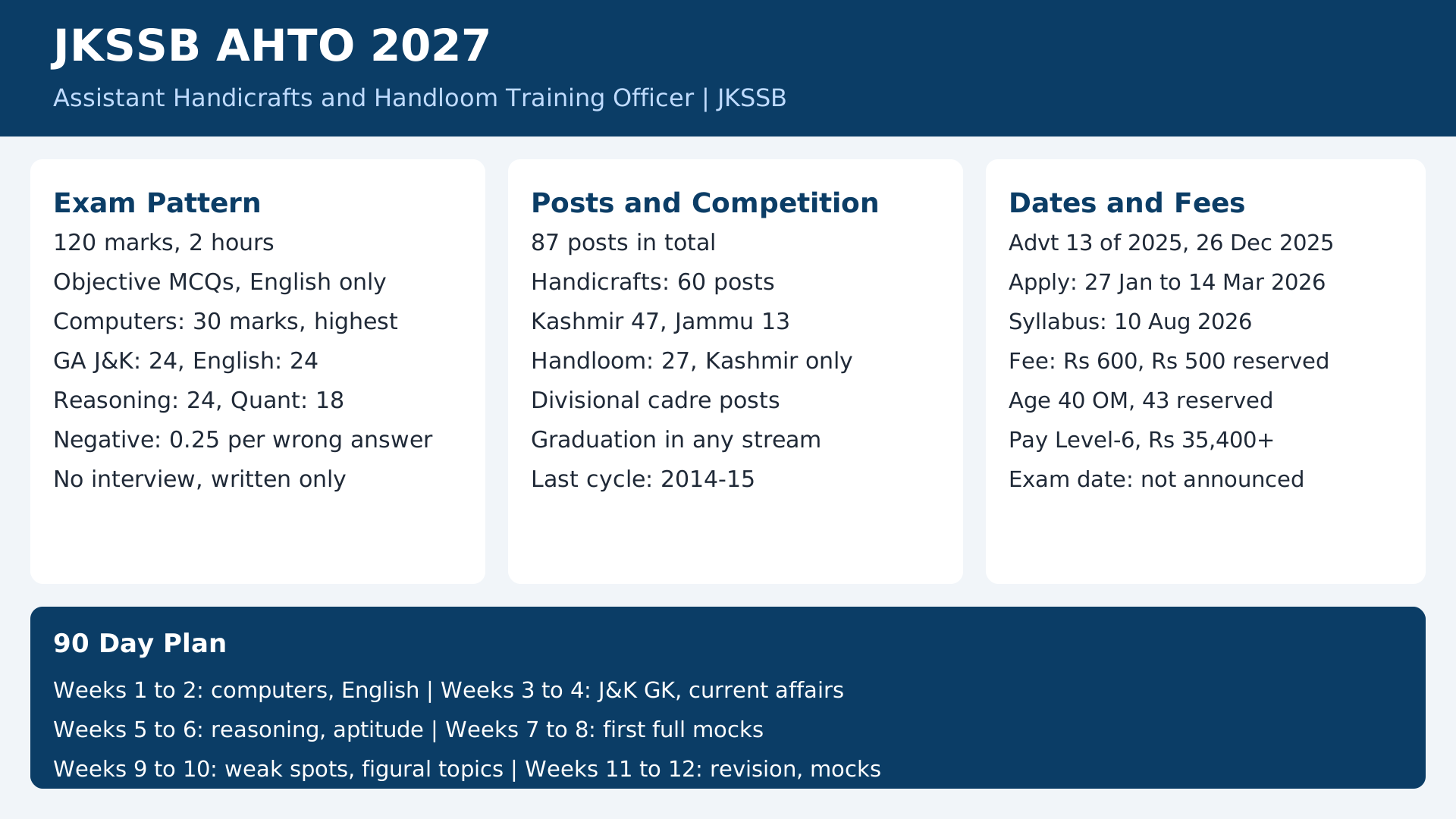
JKSSB advertised 87 Assistant Handicrafts Training Officer and Assistant Handloom Training Officer posts after a wait of about ten years, and the written test is a single 120 mark paper with no technical paper at all. The Jammu and Kashmir Services Selection Board issued Advertisement No. 13 of 2025 on 26 December 2025, opened applications on 27 January 2026, and notified the syllabus on 10 August 2026. JKSSB AHTO 2027 has no separate fresh advertisement, so every fact in this guide comes from that 2025 advertisement and its syllabus notice. If you applied in the January to March 2026 window, this is the paper you are preparing for.
The first thing to get straight is the name. AHTO does not stand for a horticulture post. It covers two posts in the Industries and Commerce Department, Assistant Handicrafts Training Officer and Assistant Handloom Training Officer, and both share one syllabus and one written test. A plain graduation in any subject makes you eligible, the paper is set in English only, and selection rests on the written test alone, followed by document verification. There is no interview and no craft test. That makes this one of the simplest JKSSB papers to prepare for, and also one where small differences in accuracy decide the merit list.
JKSSB AHTO 2027 and the 2025 advertisement in numbers
| Item | Detail |
|---|---|
| Conducting body | Jammu and Kashmir Services Selection Board (JKSSB) |
| Advertisement | No. 13 of 2025, dated 26 December 2025 |
| Department | Industries and Commerce (Handicrafts and Handloom) |
| Posts | 87 in total: 60 Handicrafts and 27 Handloom |
| Handicrafts split | 47 in Kashmir Division, 13 in Jammu Division |
| Handloom split | 27 in Kashmir Division only |
| Application window | 27 January 2026 to 14 March 2026, online only |
| Syllabus notified | 10 August 2026, Annexure A |
| Exam date | Not announced as of 20 November 2026 |
| Pay scale | Level-6, Rs 35,400 to Rs 1,12,400 |
| 2027 notification | No fresh 2027 advertisement issued |
The split matters when you pick your preference. Jammu Division has only 13 Handicrafts posts and no Handloom post at all, while Kashmir Division carries 74 of the 87 posts. A candidate from Jammu can still apply for the Kashmir Division posts, since the advertisement is open to domiciles from across the Union Territory, but the posting will be in the division you are selected for. Read the cadre column in the advertisement before you fill the form, because the division decides where you will work for years.
The ten year gap is the other number that shapes this exam. These posts were last part of a recruitment in 2014-15, so there is no recent previous paper to lean on and no recent cut-off to aim at. The syllabus notice of 10 August 2026 is the only official guide to the paper, and it is a general graduate paper, not a craft paper. Treat the five subjects in that notice as the whole exam, because that is what the notice says.
What an Assistant Handicrafts Training Officer actually does
A training officer in the Handicrafts and Handloom wings works where the craft is taught and where it is sold. The department runs training centres and craft development work across the two divisions, and the officer's day is split between the centre, the artisans and the paperwork that keeps both running. You will watch trainees learn a craft, keep attendance and progress records, arrange raw material and tools, and report on how each batch is doing. The work is closer to a field supervisor with a teaching brief than to a desk job in the secretariat.
Handicrafts in Jammu and Kashmir covers papier mache, walnut wood carving, carpet weaving, crewel embroidery, shawl weaving and copperware, among other crafts. Handloom covers the weaving centres that produce woollen and pashmina cloth. An officer does not need to be a master craftsman, and the advertisement asks only for a graduation, but a working familiarity with these crafts helps from the first week. You will talk to artisans who have spent decades at a loom or a workbench, and they will judge you on whether you understand what their work involves.
The post sits in the Industries and Commerce Department, and the cadre is divisional, not district. That means transfers happen within the division, between the centres and offices of that division. The pay is Level-6, which runs from Rs 35,400 to Rs 1,12,400, with the allowances that apply to Union Territory employees. For a graduate post with no interview and no technical paper, that pay band is one reason the competition will be sharp even though the post count is small.
One more point deserves a plain statement. This is not a horticulture post and it has nothing to do with the Horticulture Department. The Horticulture Technician posts advertised under Advertisement No. 08 of 2026 are a separate recruitment with a separate qualification, a 10+2 pass with a one year Basic Horticulture training certificate. Candidates who mix the two up waste weeks preparing the wrong syllabus, and the mix-up is easy because both advertisements appeared within months of each other. If your application number belongs to Advertisement No. 13 of 2025, your paper is the general 120 mark paper described below.
Who can apply for JKSSB AHTO 2027
The advertisement lists the qualification simply as Graduate, for all three items, without naming a subject. Any graduation from a recognised university works, in arts, science, commerce or any other stream. The degree must be held on or before the last date of application, and the original certificates are checked at document verification. There is no percentage bar in the advertisement, so a pass degree is enough, and there is no age relaxation tied to marks.
Domicile is compulsory. You must hold a domicile certificate of the Union Territory of Jammu and Kashmir, issued on or before the last date of application. Candidates from outside the Union Territory cannot apply, even with a graduation from a recognised university. Keep the certificate ready in the prescribed format, because the board gives no later chance to produce it.
| Category | Maximum age | Not born before |
|---|---|---|
| Open Merit | 40 years | 1 January 1985 |
| SC, ST-1, ST-2, RBA, ALC/IB, EWS, OBC | 43 years | 1 January 1982 |
| Physically challenged | 42 years | 1 January 1983 |
| Ex-Servicemen | 48 years | 1 January 1977 |
Age is counted as on 1 January 2025, and no candidate may be born after 1 January 2007. The Open Merit ceiling of 40 years is the standard JKSSB figure, and it is generous by the standards of most state recruitments, where the general ceiling often stops at 35. That wide window is part of why the applicant pool for a small post count can still run into the thousands.
The fee is Rs 600 for general candidates and Rs 500 for SC, ST-1, ST-2, EWS and PwBD candidates, paid online only through net banking or a credit or debit card. The fee is not refunded, and an application without the fee is not considered. The application window opened on 27 January 2026 and the original last date was 25 February 2026. It was later extended to 14 March 2026, and the window has now closed, so this guide is for candidates who already applied.
The written exam, section by section
The written test is a single objective paper of 120 marks in 2 hours, with multiple choice questions set in English only. Selection is made on the merit of this paper alone, and document verification follows for shortlisted candidates. No interview is mentioned anywhere in the advertisement, and no skill test or craft test is part of the selection.
| Subject | Marks | Share |
|---|---|---|
| General Awareness with special reference to UT of Jammu and Kashmir | 24 | 20 percent |
| General English and Comprehension | 24 | 20 percent |
| General Intelligence and Reasoning | 24 | 20 percent |
| Quantitative Aptitude | 18 | 15 percent |
| Basic Knowledge of Computers | 30 | 25 percent |
| Total | 120 | 100 percent |
Negative marking is one-fourth of the marks assigned to a question. Each question carries 1 mark, so a wrong answer costs 0.25 marks, and a blank answer costs nothing. That rule rewards disciplined guessing. If you can eliminate two options, attempt the question. If you cannot eliminate even one, leave it blank, because four wrong answers wipe out one right one.
Computers carries the highest weight at 30 marks, more than any other subject, and that is the single most useful fact in the whole pattern. Many graduates treat computers as a side subject and give it the last week, which is exactly the wrong order here. A quarter of the paper sits in seven computer topics, and most of them are memory based rather than problem solving, so the marks come faster than in reasoning or aptitude.
The other point that surprises candidates is the absence of any craft paper. There is no separate handicraft or handloom technical section, no paper on weaving or papier mache, and no drawing test. The syllabus notice lists five general subjects only, and the same syllabus applies to both the Handicrafts and the Handloom posts. Your preparation is a general graduate paper, and the craft knowledge helps on the job, not in the exam hall.
The syllabus, subject by subject
General Awareness with special reference to the Union Territory of Jammu and Kashmir carries 24 marks and fifteen topics. The list runs from current events of national and international importance through the political and physical divisions of India, climate and crops, transport and communication, demography and census, rivers and lakes, the Indian economy, culture and heritage, history with special reference to the Freedom Movement, the Constitution with the Preamble, Fundamental Rights, Fundamental Duties and Directive Principles, science and technology, environment and ecology, and taxation including direct and indirect tax, CBDT and GST. Then comes the Jammu and Kashmir block, which is the part to weight heaviest: history, economy, geography with weather, climate, crops, rivers, lakes, flora and fauna, heritage and culture, important tourist destinations, and the Jammu and Kashmir Reorganisation Act, 2019. The last topic is Centrally Sponsored Schemes such as MGNREGA, PMAY and SBM, with the Panchayati Raj Act and Rules.
General English and Comprehension carries 24 marks across sixteen topics, and it is the most predictable section in the paper. Tenses, narration, modals, articles, clauses, prepositions, active and passive voice, error spotting, sentence correction and spelling correction make up the grammar core. Reading comprehension, fill in the blanks with phrases, pronouns and homonyms, synonyms and antonyms, pairs of words used in meaningful sentences, rearranging jumbled sentences, and idioms and phrases make up the rest. This is a section where a daily habit of twenty questions beats a weekend of theory, because the rules are few and the practice is what sticks.
General Intelligence and Reasoning carries 24 marks in two parts. The first part covers number series, letter series, semantic series, speed, distance and time, statements and conclusions, logical reasoning, mental reasoning, word building, numerical operations, semantic analogy, symbolic and number analogy, figural analogy, semantic classification, symbolic and number classification, figural classification and problem solving. The second part covers symbolic operations, trends, space orientation, space visualisation, Venn diagrams, drawing inferences, punched hole and pattern folding and unfolding, figural pattern folding and completion, indexing, address matching, date and city matching, classification of centre codes and roll numbers, and small and capital letters. The figural topics look strange on a first read and reward anyone who practises them daily for a month.
Quantitative Aptitude carries 18 marks, the smallest share, in two parts. The first part is arithmetic: whole numbers, decimals, fractions and relationships between numbers, profit and loss, discount, partnership business, mixture and alligation, time and distance, time and work, percentage, ratio and proportion, square roots, averages, interest and basic algebra. The second part is geometry and data: graphs of linear equations, triangles and their centres, congruence and similarity, circles and their chords and tangents, quadrilaterals, regular polygons, prisms, cones, cylinders, spheres, heights and distances, histograms, frequency polygons, bar diagrams and pie charts, hemispheres, rectangular parallelepipeds, pyramids, trigonometric ratios, degree and radian measures, standard identities and complementary angles. Eighteen marks is small, but the section is also the slowest, so do it after the fast sections in the exam hall.
Basic Knowledge of Computers carries 30 marks across seven topics, and it deserves the largest share of your calendar. The topics are basic applications of computers and their components, fundamentals of computer science, hardware and software with the concept of open source technologies, input and output devices, MS Word, MS Excel, MS Access, MS PowerPoint, PDF, internet and email, computer viruses and the latest anti-virus, and the role of information technology in governance. MS Office features, the difference between hardware and software, input and output devices and virus basics are easy marks once revised, and they repeat in some form in almost every JKSSB graduate paper.
How the last cycle ran, and why the wait was so long
These posts were last part of a recruitment in 2014-15, which means the 2025 advertisement ended a wait of about a decade. The Department of Industries and Commerce forwarded 87 posts to the board, and the advertisement followed on 26 December 2025. Applications opened on 27 January 2026, the original last date of 25 February 2026 was extended to 14 March 2026, and the syllabus notice came on 10 August 2026. The exam date has not been announced as of 20 November 2026, and the board will notify it on jkssb.nic.in.
A ten year gap changes how you should read the competition. There is no previous paper from a recent cycle, no recent cut-off, and no pool of candidates who sat for this post last year and know the paper. Everyone is preparing from the same syllabus notice, which levels the field for first time candidates and punishes anyone who waits for a previous paper to appear. The syllabus notice is the previous paper, in the only sense that matters.
The gap also explains why the post count is small. Eighty seven posts across three items is a modest recruitment, and the category split shows how thin the seats are in some categories. Item 300, Handicrafts in Kashmir Division, has 47 posts with 19 in Open Merit. Item 301, Handicrafts in Jammu Division, has 13 posts with 6 in Open Merit. Item 302, Handloom in Kashmir Division, has 27 posts with 11 in Open Merit. In the smallest categories the seats are one or two per item, so the merit list will be decided by a fraction of a mark in places.
How hard is it to get in
No applicant count has been published for this cycle, and no cut-off exists yet, so any number you see quoted for the competition is a guess. What can be said with confidence is that the arithmetic is unforgiving. Eighty seven posts with a graduation only eligibility and a Level-6 pay scale will draw thousands of applications, and the written test is the only filter. There is no interview to recover a weak paper and no second stage to climb back through.
The 120 mark paper makes the arithmetic sharper still. With 0.25 negative marking, the difference between a careful candidate and a careless one is not a few marks but a rank band. Four blind guesses that go wrong cost a full mark, and a full mark can move a candidate dozens of places in a list this small. The candidates who clear this paper will be the ones who attempted about 100 questions with high accuracy, not the ones who attempted all 120.
Computers is where the list will be decided for many candidates. It carries 30 marks, and it is the section where a graduate who prepares it properly can score close to full marks, while a candidate who ignores it drops a quarter of the paper. General Awareness with the Jammu and Kashmir block is the second decider, because the Jammu and Kashmir topics are the ones most candidates underprepare. English and reasoning are steady sections where the gap between candidates is smaller.
Mistakes that cost marks
The first mistake is preparing for a horticulture exam. The name AHTO misleads people who do not read the advertisement, and a week spent on horticulture notes is a week lost from the five subjects that actually appear. Read the advertisement number on your application, and if it says 13 of 2025, your paper is the general graduate paper.
The second mistake is skipping computers because it feels non-academic. Thirty marks is a quarter of the paper, and the topics are the most learnable in the whole syllabus. A candidate who gives computers two hours a day for three weeks will outscore a candidate who gives it the last three days, and the gap will be larger than the gap in any other section.
The third mistake is guessing blindly. One-fourth negative marking looks small until you count it across a paper. Twenty blind guesses with a one in four hit rate give you five marks and cost you three and three-quarter marks, for a net gain of one and a quarter marks, and that is the generous case. Most blind guessing runs worse than chance, because the wrong options are designed to look right. Attempt what you can narrow down, and leave the rest blank.
The fourth mistake is reading only national current affairs and ignoring the Jammu and Kashmir block in General Awareness. History, economy, geography, heritage, tourist destinations and the Reorganisation Act of 2019 are named topics in the syllabus, and they will appear. A candidate who knows the national news and nothing about the Union Territory gives away marks that are written into the syllabus in plain words.
The fifth mistake is waiting for the exam date before starting. The syllabus is out, the pattern is fixed, and the paper is 120 marks in 2 hours. A candidate who starts now gets three months of steady preparation, while a candidate who waits for the date gets a notice period of a few weeks and a panic. The date will come, and it will come suddenly, as JKSSB dates usually do.
JKSSB AHTO aspirants often prepare for other state and national exams alongside this one. The SBI PO 2027, IBPS PO 2027, IBPS Clerk 2027, SBI Clerk 2027, SSC GD 2027, UP Police Constable 2027, UGC NET Paper 1 2027, RBI Assistant 2027, IBPS RRB PO 2027, UPPSC PCS 2027 pages on this site carry the same style of mock test guide, and the pattern habit you build here transfers directly to them.
A 90 day plan that fits around a job
Weeks 1 to 2 belong to computers and English grammar. Cover all seven computer topics, with MS Office, hardware and software, and input and output devices first, and run through tenses, voice, narration and prepositions in English. End each day with twenty computer questions and twenty English questions, and keep a notebook of the ones you miss.
Weeks 3 to 4 belong to General Awareness, with the Jammu and Kashmir block given its own hour every day. History, geography, economy, heritage and the Reorganisation Act need reading, not skimming, and the Centrally Sponsored Schemes need their names, their purpose and their target group. Add a daily current affairs note of ten lines, and revise it every Sunday.
Weeks 5 to 6 belong to reasoning and aptitude. Series, analogies, classification and Venn diagrams in reasoning, and percentage, profit and loss, time and work and ratio in aptitude, with geometry started in the second week. Practise with a timer from the first day of this block, because speed is a skill and it only comes from timed work.
Weeks 7 to 8 are for the first full mocks. Two full 120 mark papers in 2 hours each week, with the whole paper reviewed the same day. The review matters more than the score. Write down every question you got wrong and why, and sort the reasons into three piles: did not know, knew but rushed, and guessed badly. The third pile is the one to shrink first.
Weeks 9 to 10 are for the weak spots the mocks exposed, plus the figural reasoning topics that most candidates leave late. Punched hole, pattern folding, space visualisation and classification need daily drills, and they improve fast once you see the pattern in how the questions are built.
Weeks 11 to 12 are for revision and mocks only. No new theory, no new book, no new topic. Re-read your error notebook, re-do the computer topics, re-read the Jammu and Kashmir notes, and sit for three more full mocks in exam conditions. In the last week, cut the study hours and protect your sleep, because a fresh mind is worth more than one more chapter.
Books and papers that actually help
For General Awareness, a standard general knowledge manual plus a Jammu and Kashmir general knowledge book covers the syllabus, and a daily newspaper covers current affairs. Do not buy three manuals. One manual, read twice, beats three manuals read once, and the second reading is where the facts stick.
For English, a school level grammar book and a previous papers book for graduate level exams cover the sixteen topics. The grammar is standard, and the practice matters more than the book. Twenty questions a day for ninety days is 1,800 questions, and that is enough to make the grammar automatic.
For reasoning and aptitude, a standard reasoning book and a standard aptitude book are enough, and the JKSSB graduate level previous papers are the best guide to the level. For computers, a basic computer awareness book plus the MS Office help files on your own computer will cover the seven topics, and actually opening Word, Excel and PowerPoint while you study makes the features stick in a way reading alone does not.
The single best practice material is the set of previous JKSSB graduate level papers, because the board repeats its style even when it changes its subjects. Solve them in 2 hours with the 0.25 negative marking applied, and score yourself strictly. A mock without negative marking teaches you nothing about this exam.
How to apply, and the documents to keep ready
The application for Advertisement No. 13 of 2025 ran online on the JKSSB portal, and the window has now closed, so this section is for candidates who applied and for candidates who will apply when the next cycle opens. The steps are the same in every JKSSB recruitment, and they are worth knowing in advance, because the portal gives no extra time for a document that is missing.
First, read the advertisement in full, including the annexures, before touching the form. The item numbers, the cadre, the category split, the age table and the fee are all in the notification, and the form asks for the item number and the category exactly as the notification lists them. Second, complete the one time registration on the portal if you have not done so already, and keep the login details safe, because the same login carries the admit card and the result later.
Third, fill the form with the details as they appear on the matriculation certificate, because the board matches the name, the date of birth and the parents names against that certificate. Fourth, upload the photograph and signature in the size and format the notification prescribes, and check the preview before submitting, because a blurred photograph or a cropped signature can hold up the admit card. Fifth, upload the domicile certificate and the category certificate in the prescribed format, with the dates on or before the last date of application. Sixth, pay the fee online and download the confirmation page, because the payment receipt is the proof that the application went through.
Keep a folder ready with the matriculation certificate, the domicile certificate, the category certificate if you claim reservation, the graduation degree and marks sheets, a valid photo identity proof, and two recent passport size colour photographs. The original certificates are checked at document verification, and a bonafide certificate is needed for degrees from non-central universities outside Jammu and Kashmir. Get the folder ready before the exam, not after the result, because the document verification notice gives little time.
Previous papers and mock tests: how to use them
There is no recent previous paper for this post, because the last cycle ran in 2014-15, so the best practice material is the set of previous JKSSB graduate level papers. The board repeats its style even when it changes its subjects, and the five subjects in the AHTO syllabus appear in the same form in the graduate level papers. Solve them in 2 hours with the 0.25 negative marking applied, and score yourself strictly, because a mock without negative marking teaches you nothing about this exam.
Use the mocks in three stages. In the first stage, solve section-wise papers to build speed in each subject, with computers and English first, because they are the fastest sections. In the second stage, solve full 120 mark papers in 2 hours, with the whole paper reviewed the same day. In the third stage, in the last month, solve two full papers a week in exam conditions, at the same time of day as the real exam, with no breaks and no phone.
The review matters more than the score. Write down every question you got wrong and why, and sort the reasons into three piles: did not know, knew but rushed, and guessed badly. The third pile is the one to shrink first, because it is the only one you can fix by behaviour alone. Re-do the questions in the first pile after a week, and check whether they stick. A mock that is solved and forgotten is a wasted mock, and a mock that is reviewed properly is worth more than a chapter of theory.
Sources
JKSSB syllabus notice dated 10 August 2026, Annexure A, for Advertisement Notification No. 13 of 2025, as reported by JKEdusphere, for the 87 posts, the item-wise split, the 120 mark pattern, the five subject weights, the 0.25 negative marking, the Level-6 pay scale, the age limits, the fee and the application window.
JKSSB Edge AHTO recruitment page, for the advertisement date of 26 December 2025, the 60 Handicrafts and 27 Handloom split, the graduation requirement and the 2014-15 last cycle.
JobsReer JKSSB syllabus 2026 page, for the syllabus notices of 10 August 2026 covering Notification No. 03 of 2026 and Notification No. 13 of 2025.







